7 Habits Of Highly
Effective People
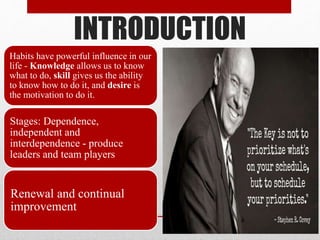
INTRODUCTION
Habits have powerful influence in our
life - Knowledge allows us to know
what to do, skill gives us the ability
to know how to do it, and desire is
the motivation to do it.
Stages: Dependence,
independent and
interdependence - produce
leaders and team players
Renewal and continual
improvement
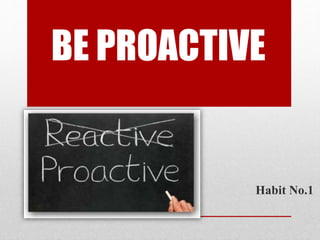
BE PROACTIVE
Habit No.1
SCENARIOS
• Your boss is talking to
another employee when
you come in to punch
your time card. You
have reason to believe
they are talking about
you. This makes you
feel uncomfortable and
mad.
• At work, you developed
a new way to organize
the filling system that
makes it easier for the
office staff to find
documents. Your
supervisor takes all the
credit.
1. How will you
proactively respond
to this situation?
• 2. How will you
proactively
respond to this
situation?
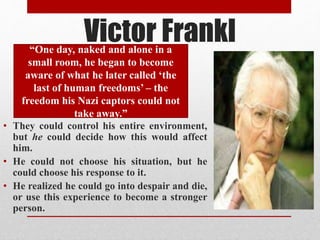
• They could control his entire environment,
but he could decide how this would affect
him.
• He could not choose his situation, but he
could choose his response to it.
• He realized he could go into despair and die,
or use this experience to become a stronger
person.
Victor Frankl“One day, naked and alone in a
small room, he began to become
aware of what he later called ‘the
last of human freedoms’ – the
freedom his Nazi captors could not
take away.”
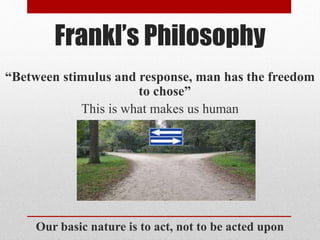
Frankl’s Philosophy
“Between stimulus and response, man has the freedom
to chose”
This is what makes us human
Our basic nature is to act, not to be acted upon
Language
Problem with language – self fulfilling
That’s just the way I am…
I don’t have time…
If I don’t have , I can’t function…
If we gave you a million dollars, could you change?
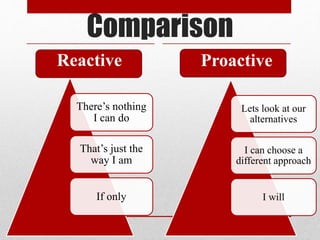
Comparison
There’s nothing
I can do
That’s just the
way I am
If only
Lets look at our
alternatives
I can choose a
different approach
I will
Reactive Proactive
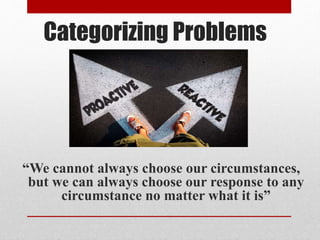
Categorizing Problems
“We cannot always choose our circumstances,
but we can always choose our response to any
circumstance no matter what it is”
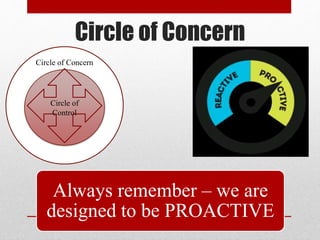
Circle of Concern
Circle of Concern
Circle of
Control
Always remember – we are
designed to be PROACTIVE
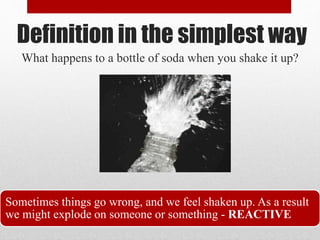
Definition in the simplest way
What happens to a bottle of soda when you shake it up?
Sometimes things go wrong, and we feel shaken up. As a result
we might explode on someone or something - REACTIVE
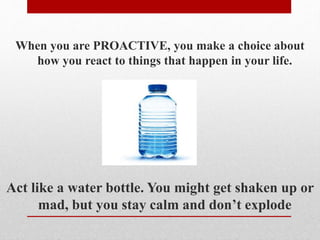
When you are PROACTIVE, you make a choice about
how you react to things that happen in your life.
Act like a water bottle. You might get shaken up or
mad, but you stay calm and don’t explode
BEGIN WITH THE
END IN MIND
Habit No.2
Identify the core value that
guide you.
Visualize what you want to
achieve in life.
Determine the road you will
take to reach your vision.
Personal Leadership
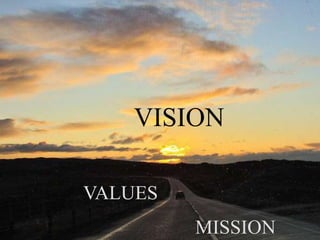
MISSION
VALUES
VISION
Core Values and Leadership
Values are based on deep
beliefs, often learned
early and reinforced at
turning point of your life.
• - Anchor your leadership
• - Influence how you lead
• - built trust from colleagues and staff
As a leader, your
personal values
You need to know
your values.
PUT FIRST
THINGS FIRST
Habit No.3
What is that one thing that you
could do (you aren't doing now)
that if you did on a regular basis,
would make a tremendous positive
difference in your personal life?
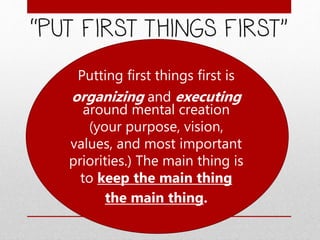
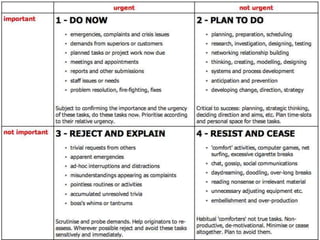
Putting first things first is
organizing and executing
around mental creation
(your purpose, vision,
values, and most important
priorities.) The main thing is
to keep the main thing
the main thing.
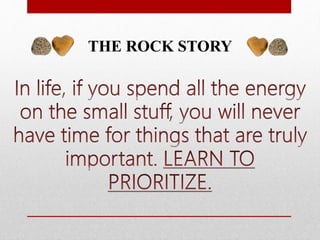
THE ROCK STORY
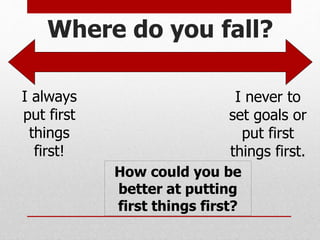
Where do you fall?
I always
put first
things
first!
I never to
set goals or
put first
things first.
How could you be
better at putting
first things first?
THINK WIN WIN
Habit No.4
In order to maintain our relationships
with others properly we need to think
win win.
This isn't just a technique you can apply in
everyday situations and relationships, it’s a
philosophy- A whole way of thinking and
being.
Think Win win isnt about being nice,
nor it is a quick-fix technique
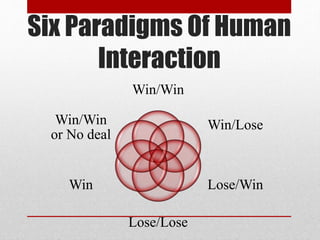
Six Paradigms Of Human
Interaction
Win/Win
Win/Lose
Lose/Win
Lose/Lose
Win
Win/Win
or No deal
SEEK FIRST TO
UNDERSTAND THAN TO
BE UNDERSTOOD
Habit No.5
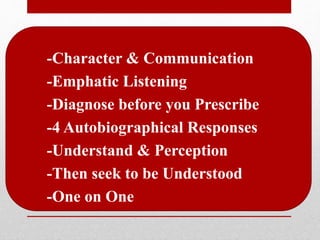
• -Character & Communication
• -Emphatic Listening
• -Diagnose before you Prescribe
• -4 Autobiographical Responses
• -Understand & Perception
• -Then seek to be Understood
• -One on One
IN PRACTISE
SYNERGIZE
Habit No. 6
SYNERGY is the essence of principle
centered leadership.
It catalyzes, unifies, and unleashes the
greatest power within people.
It means that the whole is greater than
the sum of its parts.
SYNERGYSTIC COMMUNICATION
SYNERGY IN THE CLASSROOM
SYNERGY IN BUSINESS
SHARPEN THE
SAW
Habit No.7
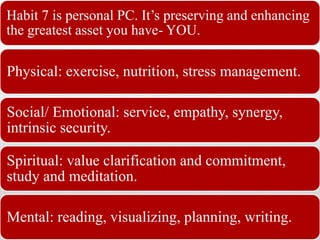
Habit 7 is personal PC. It’s preserving and enhancing
the greatest asset you have- YOU.
Physical: exercise, nutrition, stress management.
Social/ Emotional: service, empathy, synergy,
intrinsic security.
Spiritual: value clarification and commitment,
study and meditation.
Mental: reading, visualizing, planning, writing.
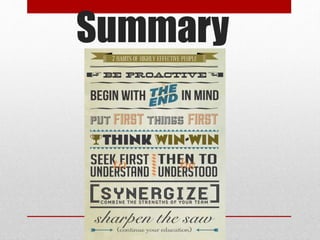
Summary
CONCLUSION
Make and keep a promise
Involve others in the problem and work out the solution
together
We should take the opportunity to explore
ourselves and our impact on others and to do so by
taking advantage of his Stephen Convey’s insights.
This book is the key to success for people in all walks of
life. It is very thought-provoking.
THANK YOU

7 habits

  • 1.
    7 Habits OfHighly Effective People
  • 2.
    INTRODUCTION Habits have powerfulinfluence in our life - Knowledge allows us to know what to do, skill gives us the ability to know how to do it, and desire is the motivation to do it. Stages: Dependence, independent and interdependence - produce leaders and team players Renewal and continual improvement
  • 3.
  • 4.
    SCENARIOS • Your bossis talking to another employee when you come in to punch your time card. You have reason to believe they are talking about you. This makes you feel uncomfortable and mad. • At work, you developed a new way to organize the filling system that makes it easier for the office staff to find documents. Your supervisor takes all the credit. 1. How will you proactively respond to this situation? • 2. How will you proactively respond to this situation?
  • 6.
    • They couldcontrol his entire environment, but he could decide how this would affect him. • He could not choose his situation, but he could choose his response to it. • He realized he could go into despair and die, or use this experience to become a stronger person. Victor Frankl“One day, naked and alone in a small room, he began to become aware of what he later called ‘the last of human freedoms’ – the freedom his Nazi captors could not take away.”
  • 7.
    Frankl’s Philosophy “Between stimulusand response, man has the freedom to chose” This is what makes us human Our basic nature is to act, not to be acted upon
  • 8.
    Language Problem with language– self fulfilling That’s just the way I am… I don’t have time… If I don’t have , I can’t function… If we gave you a million dollars, could you change?
  • 9.
    Comparison There’s nothing I cando That’s just the way I am If only Lets look at our alternatives I can choose a different approach I will Reactive Proactive
  • 10.
    Categorizing Problems “We cannotalways choose our circumstances, but we can always choose our response to any circumstance no matter what it is”
  • 11.
    Circle of Concern Circleof Concern Circle of Control Always remember – we are designed to be PROACTIVE
  • 12.
    Definition in thesimplest way What happens to a bottle of soda when you shake it up? Sometimes things go wrong, and we feel shaken up. As a result we might explode on someone or something - REACTIVE
  • 13.
    When you arePROACTIVE, you make a choice about how you react to things that happen in your life. Act like a water bottle. You might get shaken up or mad, but you stay calm and don’t explode
  • 14.
    BEGIN WITH THE ENDIN MIND Habit No.2
  • 15.
    Identify the corevalue that guide you. Visualize what you want to achieve in life. Determine the road you will take to reach your vision. Personal Leadership
  • 16.
  • 17.
    Core Values andLeadership Values are based on deep beliefs, often learned early and reinforced at turning point of your life. • - Anchor your leadership • - Influence how you lead • - built trust from colleagues and staff As a leader, your personal values You need to know your values.
  • 18.
  • 19.
    What is thatone thing that you could do (you aren't doing now) that if you did on a regular basis, would make a tremendous positive difference in your personal life?
  • 20.
    Putting first thingsfirst is organizing and executing around mental creation (your purpose, vision, values, and most important priorities.) The main thing is to keep the main thing the main thing.
  • 22.
  • 23.
    Where do youfall? I always put first things first! I never to set goals or put first things first. How could you be better at putting first things first?
  • 25.
  • 26.
    In order tomaintain our relationships with others properly we need to think win win. This isn't just a technique you can apply in everyday situations and relationships, it’s a philosophy- A whole way of thinking and being. Think Win win isnt about being nice, nor it is a quick-fix technique
  • 27.
    Six Paradigms OfHuman Interaction Win/Win Win/Lose Lose/Win Lose/Lose Win Win/Win or No deal
  • 28.
    SEEK FIRST TO UNDERSTANDTHAN TO BE UNDERSTOOD Habit No.5
  • 29.
    • -Character &Communication • -Emphatic Listening • -Diagnose before you Prescribe • -4 Autobiographical Responses • -Understand & Perception • -Then seek to be Understood • -One on One
  • 30.
  • 31.
  • 32.
    SYNERGY is theessence of principle centered leadership. It catalyzes, unifies, and unleashes the greatest power within people. It means that the whole is greater than the sum of its parts. SYNERGYSTIC COMMUNICATION SYNERGY IN THE CLASSROOM SYNERGY IN BUSINESS
  • 33.
  • 34.
    Habit 7 ispersonal PC. It’s preserving and enhancing the greatest asset you have- YOU. Physical: exercise, nutrition, stress management. Social/ Emotional: service, empathy, synergy, intrinsic security. Spiritual: value clarification and commitment, study and meditation. Mental: reading, visualizing, planning, writing.
  • 35.
  • 36.
    CONCLUSION Make and keepa promise Involve others in the problem and work out the solution together We should take the opportunity to explore ourselves and our impact on others and to do so by taking advantage of his Stephen Convey’s insights. This book is the key to success for people in all walks of life. It is very thought-provoking.
  • 37.

Editor's Notes

  • #17 Note to facilitator: this slide contains animation. Right click for each term to appear. EXPLAIN that there are three main concepts in this session: values, vision, and mission. Vision is what you want for the future, an image of hope, of something you truly wish to create. Mission is what you do everyday to move towards that future, or the road you take to reach your vision. Values are what drive or motivate you to reach your vision and keep you on the road to your vision. We are going to spend some time identifying our values, vision, and mission in this session. Image Source: Julia Manzerova http://www.flickr.com/photos/julia_manzerova/4355863702/