To Aquire the 7 Habits
Be willing to :
Learn It
Teach It
Do It
Apply it to Your Life
Paradigm
The way and individual perceives,
understands, and interprets the surrounding
world. A mental map.
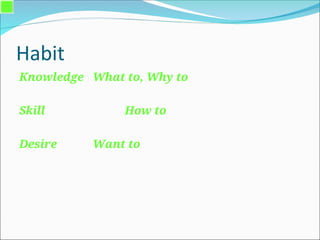
Habit
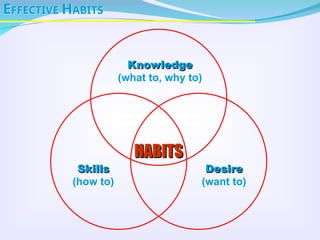
Knowledge What to, Why to
Skill How to
Desire Want to
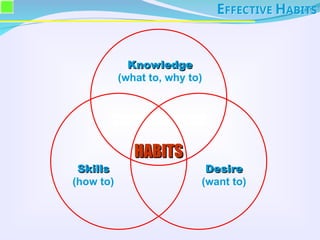
Knowledge
Knowledge
(what to, why to)
Desire
Desire
(want to)
Skills
Skills
(how to)
HABITS
HABITS
EFFECTIVE HABITS
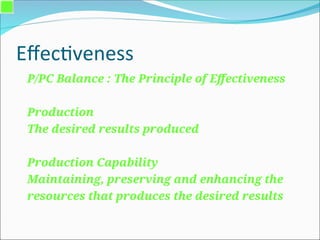
Effectiveness
P/PC Balance : The Principle of Effectiveness
Production
The desired results produced
Production Capability
Maintaining, preserving and enhancing the
resources that produces the desired results
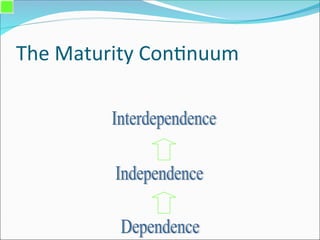
The Maturity Continuum
Character & Personality
Although image, techniques and skills can
influence your outward success, the weight of
real effectiveness lies in good character.
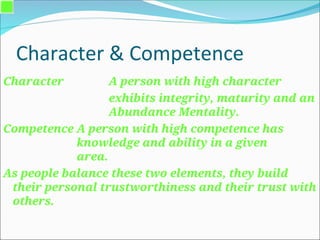
Character & Competence
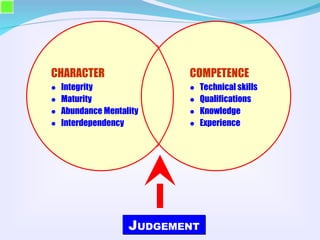
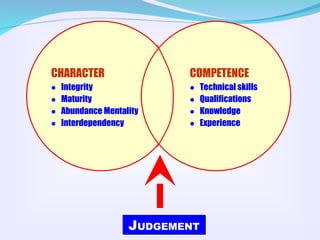
Character A person with high character
exhibits integrity, maturity and an
Abundance Mentality.
Competence A person with high competence has
knowledge and ability in a given
area.
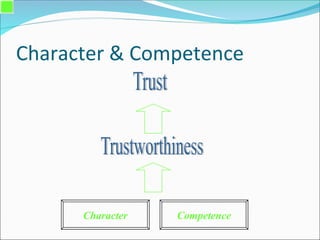
As people balance these two elements, they build
their personal trustworthiness and their trust with
others.
Character & Competence
Character Competence
JUDGEMENT
CHARACTER
 Integrity
 Maturity
 Abundance Mentality
 Interdependency
COMPETENCE
 Technical skills
 Qualifications
 Knowledge
 Experience
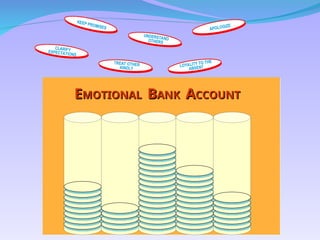
E
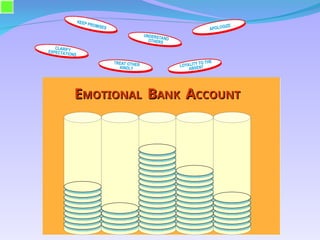
EMOTIONAL
MOTIONAL B
BANK
ANK A
ACCOUNT
CCOUNT
KEEP PROMISES APOLOGIZE
CLARIFY
EXPECTATIONS
TREAT OTHER
KINDLY
UNDERSTAND
OTHERS
LOYALITY TO THE
ABSENT
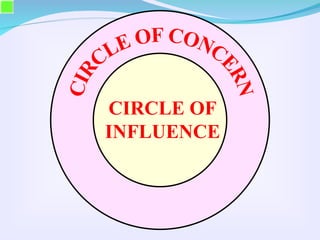
CIRCLE OF
INFLUENCE
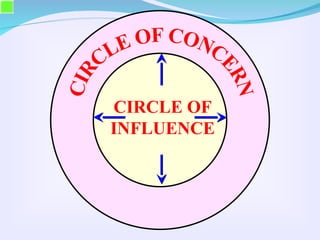
CIRCLE OF
INFLUENCE
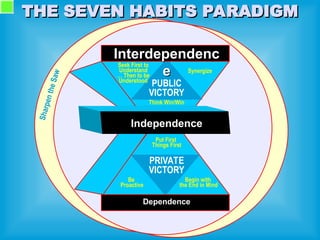
Independence
Independence
Dependence
Dependence
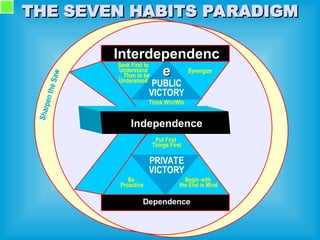
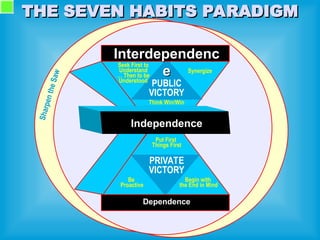
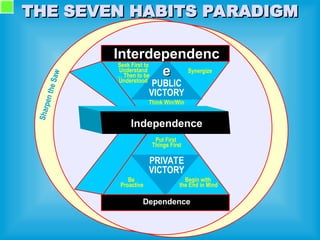
Interdependenc
Interdependenc
e
e
PUBLIC
VICTORY
PRIVATE
VICTORY
Seek First to
Understand
… Then to be
Understood
Synergize
Think Win/Win
Put First
Things First
Be
Proactive
Begin with
the End in Mind
S
h
a
r
p
e
n
t
h
e
S
a
w
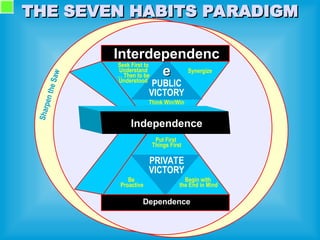
THE SEVEN HABITS PARADIGM
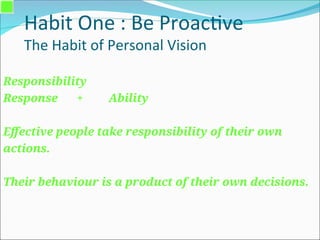
Habit One : Be Proactive
The Habit of Personal Vision
Responsibility
Response + Ability
Effective people take responsibility of their own
actions.
Their behaviour is a product of their own decisions.
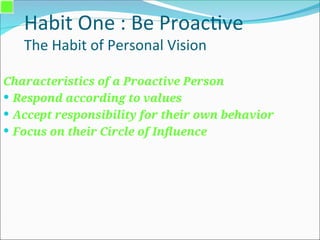
Habit One : Be Proactive
The Habit of Personal Vision
Characteristics of a Proactive Person
 Respond according to values
 Accept responsibility for their own behavior
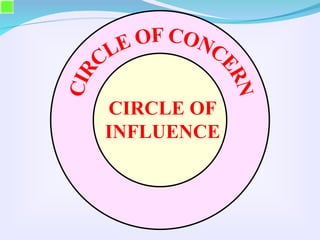
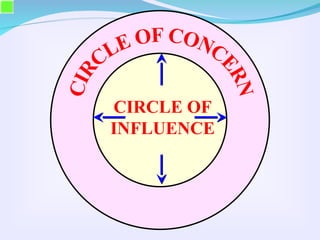
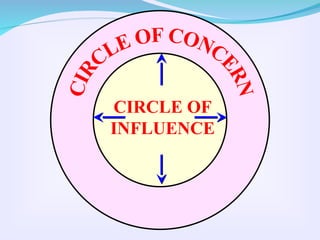
 Focus on their Circle of Influence
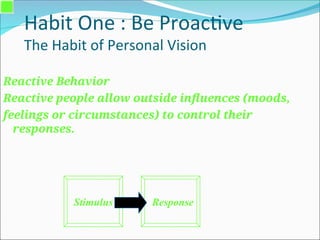
Habit One : Be Proactive
The Habit of Personal Vision
Reactive Behavior
Reactive people allow outside influences (moods,
feelings or circumstances) to control their
responses.
Stimulus Response
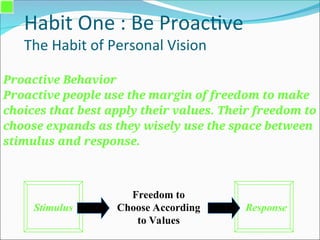
Habit One : Be Proactive
The Habit of Personal Vision
Proactive Behavior
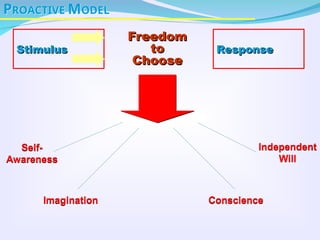
Proactive people use the margin of freedom to make
choices that best apply their values. Their freedom to
choose expands as they wisely use the space between
stimulus and response.
Stimulus Response
Freedom to
Choose According
to Values
PROACTIVE MODEL
Stimulus
Stimulus Response
Response
Freedom
Freedom
to
to
Choose
Choose
Self-
Awareness
Imagination Conscience
Independent
Will
Habit One : Be Proactive
The Habit of Personal Vision
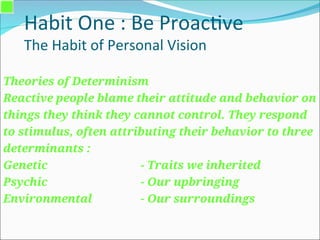
Theories of Determinism
Reactive people blame their attitude and behavior on
things they think they cannot control. They respond
to stimulus, often attributing their behavior to three
determinants :
Genetic - Traits we inherited
Psychic - Our upbringing
Environmental - Our surroundings
CIRCLE OF
INFLUENCE
CIRCLE OF
INFLUENCE
Habit One : Be Proactive
The Habit of Personal Vision
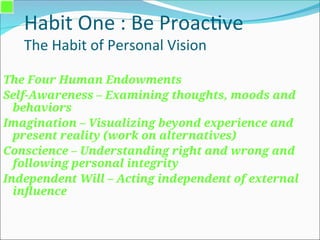
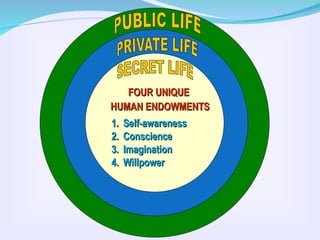
The Four Human Endowments
Self-Awareness – Examining thoughts, moods and
behaviors
Imagination – Visualizing beyond experience and
present reality (work on alternatives)
Conscience – Understanding right and wrong and
following personal integrity
Independent Will – Acting independent of external
influence
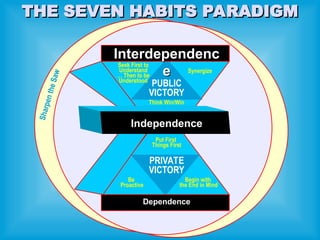
Independence
Independence
Dependence
Dependence
Interdependenc
Interdependenc
e
e
PUBLIC
VICTORY
PRIVATE
VICTORY
Seek First to
Understand
… Then to be
Understood
Synergize
Think Win/Win
Put First
Things First
Be
Proactive
Begin with
the End in Mind
S
h
a
r
p
e
n
t
h
e
S
a
w
THE SEVEN HABITS PARADIGM
Habit Two
Begin with the End in Mind
The Habit of Personal Leadership
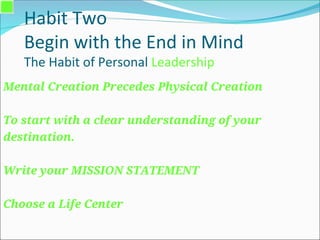
Mental Creation Precedes Physical Creation
To start with a clear understanding of your
destination.
Write your MISSION STATEMENT
Choose a Life Center
Habit Two
Begin with the End in Mind
The Habit of Personal Leadership
Habit Two
Begin with the End in Mind
The Habit of Personal Leadership
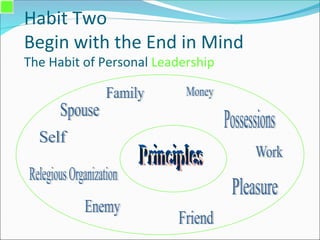
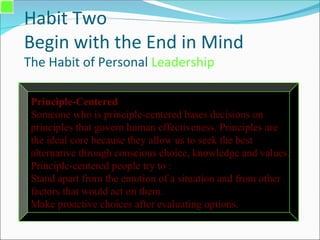
Principle-Centered
Someone who is principle-centered bases decisions on
principles that govern human effectiveness. Principles are
the ideal core because they allow us to seek the best
alternative through conscious choice, knowledge and values.
Principle-centered people try to :
Stand apart from the emotion of a situation and from other
factors that would act on them.
Make proactive choices after evaluating options.
Habit Two
Begin with the End in Mind
The Habit of Personal Leadership
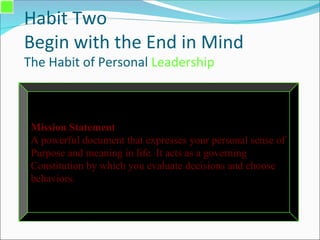
Mission Statement
A powerful document that expresses your personal sense of
Purpose and meaning in life. It acts as a governing
Constitution by which you evaluate decisions and choose
behaviors.
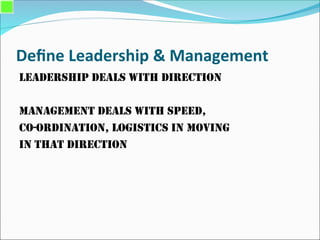
Define Leadership & Management
Leadership deals with Direction
Management deals with Speed,
Co-ordination, Logistics in moving
in that direction
Independence
Independence
Dependence
Dependence
Interdependenc
Interdependenc
e
e
PUBLIC
VICTORY
PRIVATE
VICTORY
Seek First to
Understand
… Then to be
Understood
Synergize
Think Win/Win
Put First
Things First
Be
Proactive
Begin with
the End in Mind
S
h
a
r
p
e
n
t
h
e
S
a
w
THE SEVEN HABITS PARADIGM
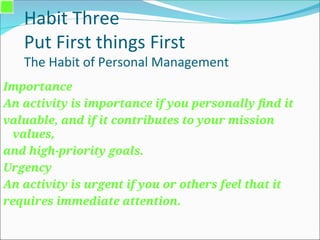
Habit Three
Put First things First
The Habit of Personal Management
Importance
An activity is importance if you personally find it
valuable, and if it contributes to your mission
values,
and high-priority goals.
Urgency
An activity is urgent if you or others feel that it
requires immediate attention.
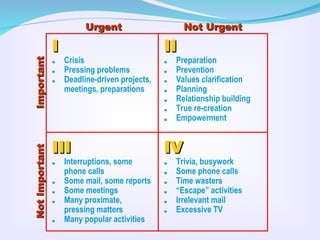
. Crisis
. Pressing problems
. Deadline-driven projects,
meetings, preparations
. Preparation
. Prevention
. Values clarification
. Planning
. Relationship building
. True re-creation
. Empowerment
. Interruptions, some
phone calls
. Some mail, some reports
. Some meetings
. Many proximate,
pressing matters
. Many popular activities
. Trivia, busywork
. Some phone calls
. Time wasters
. “Escape” activities
. Irrelevant mail
. Excessive TV
I
I II
II
III
III IV
IV
Urgent
Urgent Not Urgent
Not Urgent
Important
Important
Not
Important
Not
Important
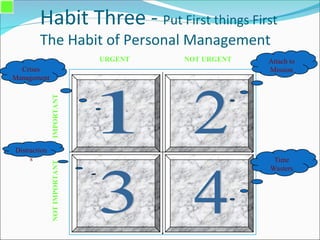
Habit Three - Put First things First
The Habit of Personal Management
URGENT
IMPORTANT
NOT URGENT
NOT
IMPORTANT
Crises
Management
Attach to
Mission
Distraction
s Time
Wasters
Habit Three - Put First things First
The Habit of Personal Management
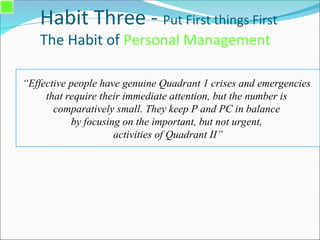
“Effective people have genuine Quadrant 1 crises and emergencies
that require their immediate attention, but the number is
comparatively small. They keep P and PC in balance
by focusing on the important, but not urgent,
activities of Quadrant II”
Habit Three - Put First things First
The Habit of Personal Management
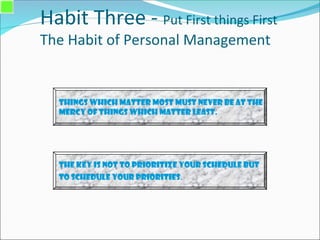
Things which matter most must never be at the
mercy of things which matter least.
The Key is not to prioritize your schedule but
to schedule your priorities.
Habit Three - Put First things First
The Habit of Personal Management
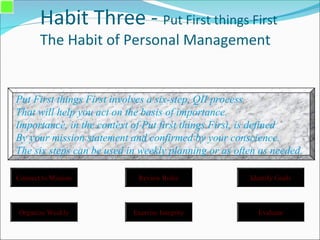
Put First things First involves a six-step, QII process
That will help you act on the basis of importance.
Importance, in the context of Put first things First, is defined
By your mission statement and confirmed by your conscience.
The six steps can be used in weekly planning or as often as needed.
Connect to Mission Review Roles Identify Goals
Organize Weekly Exercise Integrity Evaluate
Habits One, Two & Three
The first three habits help develop a deep base of character and
personal security . Once these 3 habits become part of who you are
you are then ready to begin building rich enduring highly
productive relationships with other people and that’s where habits
four, five and six come in.
Habits Four, Five & Six
These are the habits that lead to interdependent relationships.
Habit Four : Think Win-win
The attitude of seeking solutions, so that every one can win.
Do this by communicating. This is done by Habit Five
Habit Five : Seek first to understand, then to be understood
Habit Six : This is the habit of creative co-operation - Synergy
This happens when two sides in a dispute work together to come with
a solution which is better than what either side initially proposed.
Independence
Independence
Dependence
Dependence
Interdependenc
Interdependenc
e
e
PUBLIC
VICTORY
PRIVATE
VICTORY
Seek First to
Understand
… Then to be
Understood
Synergize
Think Win/Win
Put First
Things First
Be
Proactive
Begin with
the End in Mind
S
h
a
r
p
e
n
t
h
e
S
a
w
THE SEVEN HABITS PARADIGM
Habit Four – Think Win-Win
The Habit of Interpersonal Leadership
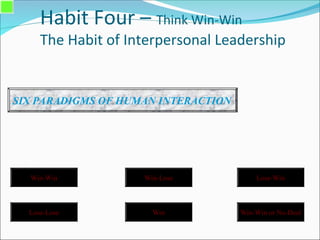
SIX PARADIGMS OF HUMAN INTERACTION
Win-Win Win-Lose Lose-Win
Lose-Lose Win Win-Win or No-Deal
Habit Four - Think Win-Win
The Habit of Interpersonal Leadership
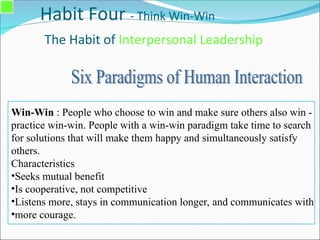
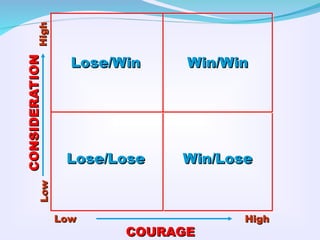
Win-Win : People who choose to win and make sure others also win -
practice win-win. People with a win-win paradigm take time to search
for solutions that will make them happy and simultaneously satisfy
others.
Characteristics
•Seeks mutual benefit
•Is cooperative, not competitive
•Listens more, stays in communication longer, and communicates with
•more courage.
Habit Four - Think Win-Win
The Habit of Interpersonal Leadership
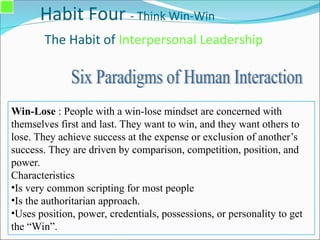
Win-Lose : People with a win-lose mindset are concerned with
themselves first and last. They want to win, and they want others to
lose. They achieve success at the expense or exclusion of another’s
success. They are driven by comparison, competition, position, and
power.
Characteristics
•Is very common scripting for most people
•Is the authoritarian approach.
•Uses position, power, credentials, possessions, or personality to get
the “Win”.
Habit Four - Think Win-Win
The Habit of Interpersonal Leadership
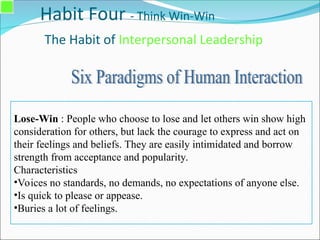
Lose-Win : People who choose to lose and let others win show high
consideration for others, but lack the courage to express and act on
their feelings and beliefs. They are easily intimidated and borrow
strength from acceptance and popularity.
Characteristics
•Voices no standards, no demands, no expectations of anyone else.
•Is quick to please or appease.
•Buries a lot of feelings.
Habit Four - Think Win-Win
The Habit of Interpersonal Leadership
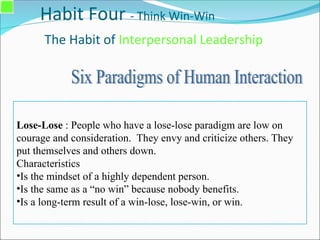
Lose-Lose : People who have a lose-lose paradigm are low on
courage and consideration. They envy and criticize others. They
put themselves and others down.
Characteristics
•Is the mindset of a highly dependent person.
•Is the same as a “no win” because nobody benefits.
•Is a long-term result of a win-lose, lose-win, or win.
Habit Four - Think Win-Win
The Habit of Interpersonal Leadership
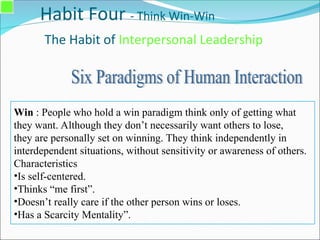
Win : People who hold a win paradigm think only of getting what
they want. Although they don’t necessarily want others to lose,
they are personally set on winning. They think independently in
interdependent situations, without sensitivity or awareness of others.
Characteristics
•Is self-centered.
•Thinks “me first”.
•Doesn’t really care if the other person wins or loses.
•Has a Scarcity Mentality”.
Habit Four - Think Win-Win
The Habit of Interpersonal Leadership
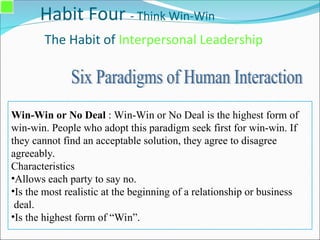
Win-Win or No Deal : Win-Win or No Deal is the highest form of
win-win. People who adopt this paradigm seek first for win-win. If
they cannot find an acceptable solution, they agree to disagree
agreeably.
Characteristics
•Allows each party to say no.
•Is the most realistic at the beginning of a relationship or business
deal.
•Is the highest form of “Win”.
Habit Four – Think Win-Win
The Habit of Interpersonal Leadership
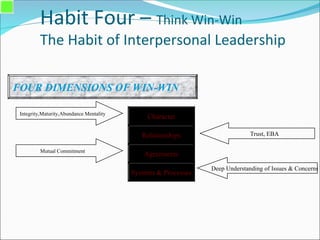
FOUR DIMENSIONS OF WIN-WIN
Character
Relationships
Agreements
Systems & Processes
Integrity,Maturity,Abundance Mentality
Trust, EBA
Mutual Commitment
Deep Understanding of Issues & Concerns
Habit Four – Think Win-Win
The Habit of Interpersonal Leadership
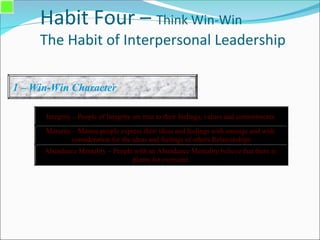
1 – Win-Win Character
Integrity – People of Integrity are true to their feelings, values and commitments.
Maturity – Mature people express their ideas and feelings with courage and with
consideration for the ideas and feelings of others.Relationships
Abundance Mentality – People with an Abundance Mentality believe that there is
plenty for everyone.
Habit Four – Think Win-Win
The Habit of Interpersonal Leadership
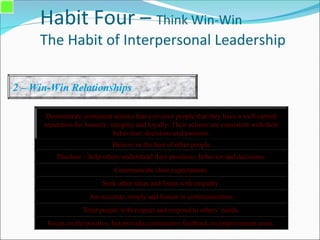
2 – Win-Win Relationships
Demonstrate consistent actions that convince people that they have a well-earned
reputation for honesty, integrity and loyalty. Their actions are consistent with their
behaviour, decisions and position.
Believe in the best of other people
Disclose – help others understand their positions, behavior and decisions.
Communicate clear expectations.
Seek other ideas and listen with empathy.
Are accurate, timely and honest in communication.
Treat people with respect and respond to others’ needs.
Focus on the positive, but provide constructive feedback on improvement areas.
Habit Four – Think Win-Win
The Habit of Interpersonal Leadership
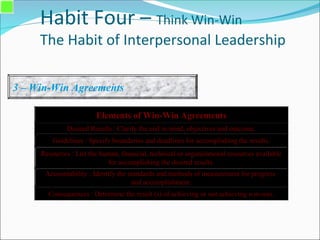
3 – Win-Win Agreements
Elements of Win-Win Agreements
Desired Results : Clarify the end in mind, objectives and outcome.
Guidelines : Specify boundaries and deadlines for accomplishing the results.
Resources : List the human, financial, technical or organizational resources available
for accomplishing the desired results.
Accountability : Identify the standards and methods of measurement for progress
and accomplishment.
Consequences : Determine the result (s) of achieving or not achieving win-win.
Habit Four – Think Win-Win
The Habit of Interpersonal Leadership
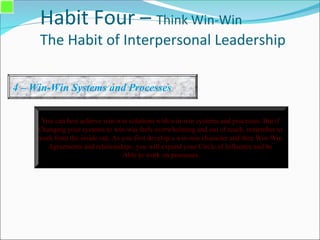
4 – Win-Win Systems and Processes
You can best achieve win-win solutions with win-win systems and processes. But if
Changing your systems to win-win feels overwhelming and out of reach, remember to
work from the inside out. As you first develop a win-win character and then Win-Win
Agreements and relationships, you will expand your Circle of Influence and be
Able to work on processes.
Independence
Independence
Dependence
Dependence
Interdependenc
Interdependenc
e
e
PUBLIC
VICTORY
PRIVATE
VICTORY
Seek First to
Understand
… Then to be
Understood
Synergize
Think Win/Win
Put First
Things First
Be
Proactive
Begin with
the End in Mind
S
h
a
r
p
e
n
t
h
e
S
a
w
THE SEVEN HABITS PARADIGM
Habit Five
-Seek First to Understand, Then to Be Understood
The Habit of Empathic Communication
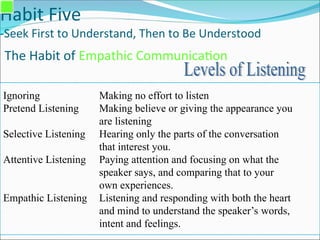
Ignoring Making no effort to listen
Pretend Listening Making believe or giving the appearance you
are listening
Selective Listening Hearing only the parts of the conversation
that interest you.
Attentive Listening Paying attention and focusing on what the
speaker says, and comparing that to your
own experiences.
Empathic Listening Listening and responding with both the heart
and mind to understand the speaker’s words,
intent and feelings.
Independence
Independence
Dependence
Dependence
Interdependenc
Interdependenc
e
e
PUBLIC
VICTORY
PRIVATE
VICTORY
Seek First to
Understand
… Then to be
Understood
Synergize
Think Win/Win
Put First
Things First
Be
Proactive
Begin with
the End in Mind
S
h
a
r
p
e
n
t
h
e
S
a
w
THE SEVEN HABITS PARADIGM
Habit Six - Synergize
The Habit of Creative Cooperation
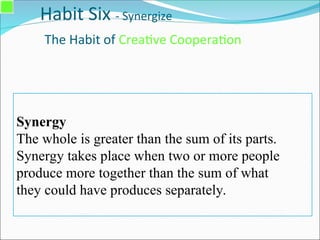
Synergy
The whole is greater than the sum of its parts.
Synergy takes place when two or more people
produce more together than the sum of what
they could have produces separately.
Habit Six - Synergize
The Habit of Creative Cooperation
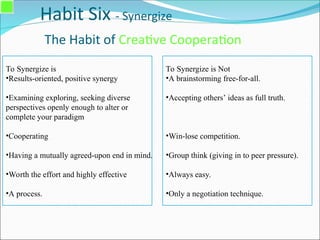
To Synergize is
•Results-oriented, positive synergy
•Examining exploring, seeking diverse
perspectives openly enough to alter or
complete your paradigm
•Cooperating
•Having a mutually agreed-upon end in mind.
•Worth the effort and highly effective
•A process.
To Synergize is Not
•A brainstorming free-for-all.
•Accepting others’ ideas as full truth.
•Win-lose competition.
•Group think (giving in to peer pressure).
•Always easy.
•Only a negotiation technique.
Habit Six - Synergize
The Habit of Creative Cooperation
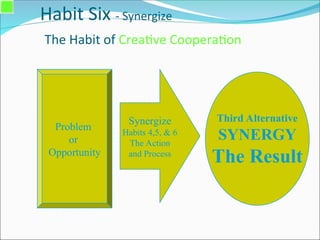
Problem
or
Opportunity
Synergize
Habits 4,5, & 6
The Action
and Process
Third Alternative
SYNERGY
The Result
Habit Six - Synergize
The Habit of Creative Cooperation
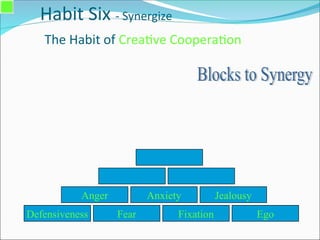
Defensiveness Fear Fixation Ego
Anger Anxiety Jealousy
Habit Six - Synergize
The Habit of Creative Cooperation
The essence of synergy is valuing the differences. Valuing the differences
does not imply that individuals approve of or agree with differences;
however it does mean that people respect differences and view them
as opportunities for learning. The differing opinions of others and their
viewpoints, perspectives, talents and gifts are valuable when seeking
solutions. These differences enable you to discover and produce things
together that you would much less likely discover and produce
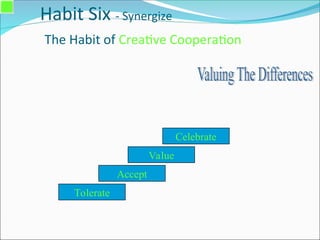
individually. At what level do you value the differences ?
Habit Six - Synergize
The Habit of Creative Cooperation
Tolerate
Accept
Value
Celebrate
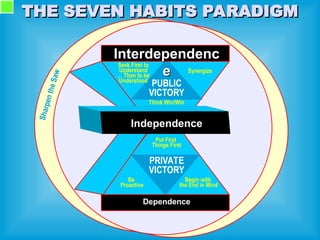
Independence
Independence
Dependence
Dependence
Interdependenc
Interdependenc
e
e
PUBLIC
VICTORY
PRIVATE
VICTORY
Seek First to
Understand
… Then to be
Understood
Synergize
Think Win/Win
Put First
Things First
Be
Proactive
Begin with
the End in Mind
S
h
a
r
p
e
n
t
h
e
S
a
w
THE SEVEN HABITS PARADIGM
Habit Seven - Sharpen the Saw
The Habit of Renewal
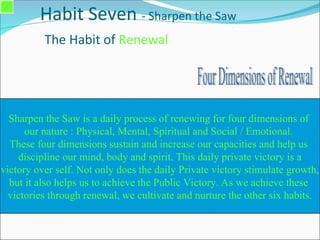
Sharpen the Saw is a daily process of renewing for four dimensions of
our nature : Physical, Mental, Spiritual and Social / Emotional.
These four dimensions sustain and increase our capacities and help us
discipline our mind, body and spirit. This daily private victory is a
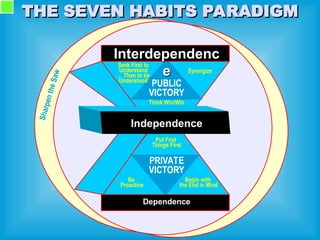
victory over self. Not only does the daily Private victory stimulate growth,
but it also helps us to achieve the Public Victory. As we achieve these
victories through renewal, we cultivate and nurture the other six habits.
Habit Seven - Sharpen the Saw
The Habit of Renewal
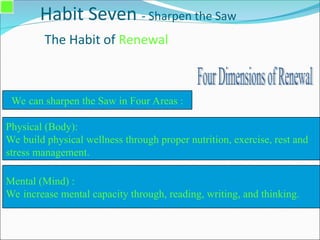
Physical (Body):
We build physical wellness through proper nutrition, exercise, rest and
stress management.
We can sharpen the Saw in Four Areas :
Mental (Mind) :
We increase mental capacity through, reading, writing, and thinking.
Habit Seven - Sharpen the Saw
The Habit of Renewal
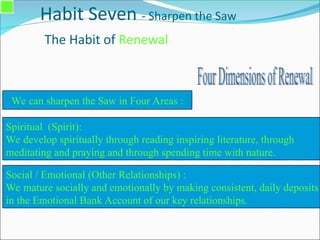
Spiritual (Spirit):
We develop spiritually through reading inspiring literature, through
meditating and praying and through spending time with nature.
We can sharpen the Saw in Four Areas :
Social / Emotional (Other Relationships) :
We mature socially and emotionally by making consistent, daily deposits
in the Emotional Bank Account of our key relationships.
Independence
Independence
Dependence
Dependence
Interdependenc
Interdependenc
e
e
PUBLIC
VICTORY
PRIVATE
VICTORY
Seek First to
Understand
… Then to be
Understood
Synergize
Think Win/Win
Put First
Things First
Be
Proactive
Begin with
the End in Mind
S
h
a
r
p
e
n
t
h
e
S
a
w
THE SEVEN HABITS PARADIGM
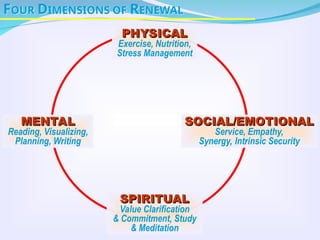
PHYSICAL
PHYSICAL
Exercise, Nutrition,
Stress Management
FOUR DIMENSIONS OF RENEWAL
MENTAL
MENTAL
Reading, Visualizing,
Planning, Writing
SOCIAL/EMOTIONAL
SOCIAL/EMOTIONAL
Service, Empathy,
Synergy, Intrinsic Security
SPIRITUAL
SPIRITUAL
Value Clarification
& Commitment, Study
& Meditation
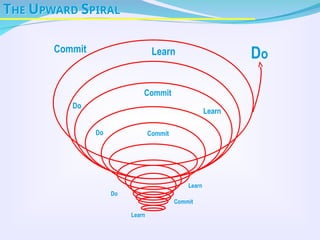
THE UPWARD SPIRAL
Learn
Do
Commit
Learn
Commit
Do
Do
Learn
Commit
Learn
Commit
Do
Lose/Win
Lose/Win
High
High
Low
Low
Win/Win
Win/Win
Lose/Lose
Lose/Lose Win/Lose
Win/Lose
CONSIDERATION
CONSIDERATION
Low
Low High
High
COURAGE
COURAGE
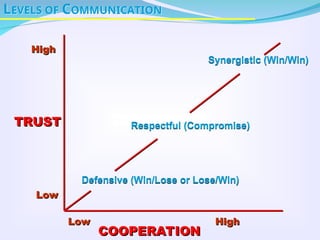
LEVELS OF COMMUNICATION
TRUST
TRUST
Synergistic (Win/Win)
COOPERATION
COOPERATION
Respectful (Compromise)
Defensive (Win/Lose or Lose/Win)
Low
Low
High
High
Low
Low High
High
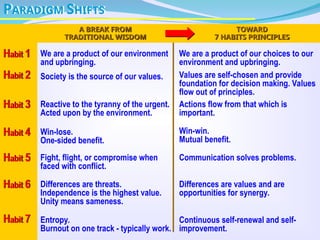
PARADIGM SHIFTS
A BREAK FROM
TRADITIONAL WISDOM
TOWARD
7 HABITS PRINCIPLES
Habit 1 We are a product of our environment
and upbringing.
Habit 2 Society is the source of our values.
Habit 3 Reactive to the tyranny of the urgent.
Acted upon by the environment.
Habit 4 Win-lose.
One-sided benefit.
Habit 5 Fight, flight, or compromise when
faced with conflict.
Habit 6 Differences are threats.
Independence is the highest value.
Unity means sameness.
Habit 7 Entropy.
Burnout on one track - typically work.
We are a product of our choices to our
environment and upbringing.
Values are self-chosen and provide
foundation for decision making. Values
flow out of principles.
Actions flow from that which is
important.
Win-win.
Mutual benefit.
Communication solves problems.
Differences are values and are
opportunities for synergy.
Continuous self-renewal and self-
improvement.
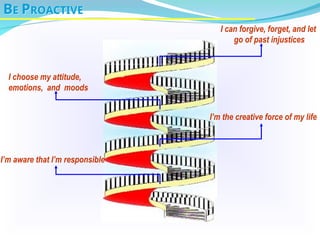
BE PROACTIVE
I can forgive, forget, and let
go of past injustices
I’m aware that I’m responsible
I’m the creative force of my life
I choose my attitude,
emotions, and moods
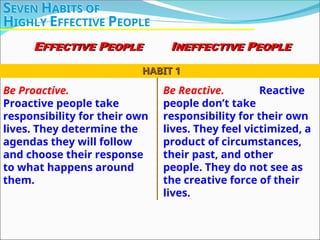
SEVEN HABITS OF
HIGHLY EFFECTIVE PEOPLE
EFFECTIVE PEOPLE INEFFECTIVE PEOPLE
HABIT 1
HABIT 1
Be Proactive.
Proactive people take
responsibility for their own
lives. They determine the
agendas they will follow
and choose their response
to what happens around
them.
Be Reactive. Reactive
people don’t take
responsibility for their own
lives. They feel victimized, a
product of circumstances,
their past, and other
people. They do not see as
the creative force of their
lives.
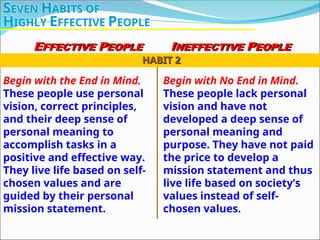
Begin with the End in Mind.
These people use personal
vision, correct principles,
and their deep sense of
personal meaning to
accomplish tasks in a
positive and effective way.
They live life based on self-
chosen values and are
guided by their personal
mission statement.
Begin with No End in Mind.
These people lack personal
vision and have not
developed a deep sense of
personal meaning and
purpose. They have not paid
the price to develop a
mission statement and thus
live life based on society’s
values instead of self-
chosen values.
HABIT 2
HABIT 2
SEVEN HABITS OF
HIGHLY EFFECTIVE PEOPLE
EFFECTIVE PEOPLE INEFFECTIVE PEOPLE
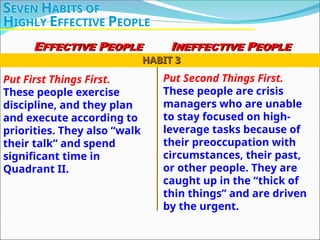
Put First Things First.
These people exercise
discipline, and they plan
and execute according to
priorities. They also “walk
their talk” and spend
significant time in
Quadrant II.
Put Second Things First.
These people are crisis
managers who are unable
to stay focused on high-
leverage tasks because of
their preoccupation with
circumstances, their past,
or other people. They are
caught up in the “thick of
thin things” and are driven
by the urgent.
HABIT 3
HABIT 3
SEVEN HABITS OF
HIGHLY EFFECTIVE PEOPLE
EFFECTIVE PEOPLE INEFFECTIVE PEOPLE
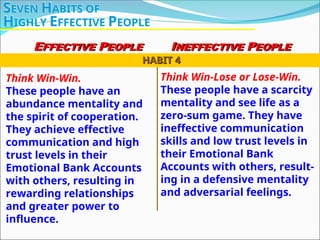
Think Win-Win.
These people have an
abundance mentality and
the spirit of cooperation.
They achieve effective
communication and high
trust levels in their
Emotional Bank Accounts
with others, resulting in
rewarding relationships
and greater power to
influence.
Think Win-Lose or Lose-Win.
These people have a scarcity
mentality and see life as a
zero-sum game. They have
ineffective communication
skills and low trust levels in
their Emotional Bank
Accounts with others, result-
ing in a defensive mentality
and adversarial feelings.
HABIT 4
HABIT 4
SEVEN HABITS OF
HIGHLY EFFECTIVE PEOPLE
EFFECTIVE PEOPLE INEFFECTIVE PEOPLE
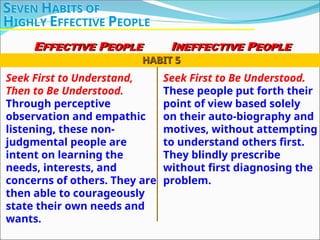
Seek First to Understand,
Then to Be Understood.
Through perceptive
observation and empathic
listening, these non-
judgmental people are
intent on learning the
needs, interests, and
concerns of others. They are
then able to courageously
state their own needs and
wants.
Seek First to Be Understood.
These people put forth their
point of view based solely
on their auto-biography and
motives, without attempting
to understand others first.
They blindly prescribe
without first diagnosing the
problem.
HABIT 5
HABIT 5
SEVEN HABITS OF
HIGHLY EFFECTIVE PEOPLE
EFFECTIVE PEOPLE INEFFECTIVE PEOPLE
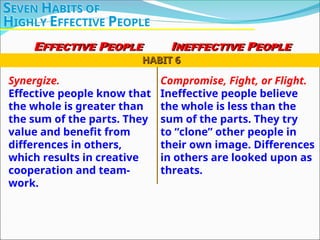
Synergize.
Effective people know that
the whole is greater than
the sum of the parts. They
value and benefit from
differences in others,
which results in creative
cooperation and team-
work.
Compromise, Fight, or Flight.
Ineffective people believe
the whole is less than the
sum of the parts. They try
to “clone” other people in
their own image. Differences
in others are looked upon as
threats.
HABIT 6
HABIT 6
SEVEN HABITS OF
HIGHLY EFFECTIVE PEOPLE
EFFECTIVE PEOPLE INEFFECTIVE PEOPLE
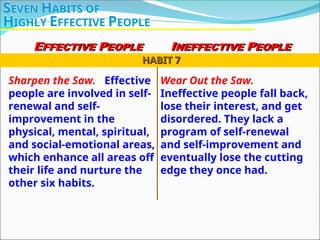
Sharpen the Saw. Effective
people are involved in self-
renewal and self-
improvement in the
physical, mental, spiritual,
and social-emotional areas,
which enhance all areas off
their life and nurture the
other six habits.
Wear Out the Saw.
Ineffective people fall back,
lose their interest, and get
disordered. They lack a
program of self-renewal
and self-improvement and
eventually lose the cutting
edge they once had.
HABIT 7
HABIT 7
SEVEN HABITS OF
HIGHLY EFFECTIVE PEOPLE
EFFECTIVE PEOPLE INEFFECTIVE PEOPLE
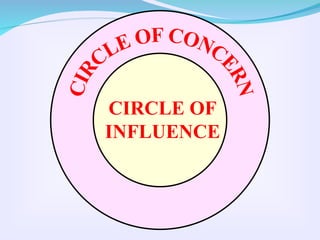
CIRCLE OF
INFLUENCE
CIRCLE OF
INFLUENCE
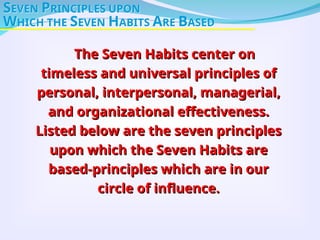
SEVEN PRINCIPLES UPON
WHICH THE SEVEN HABITS ARE BASED
The Seven Habits center on
timeless and universal principles of
personal, interpersonal, managerial,
and organizational effectiveness.
Listed below are the seven principles
upon which the Seven Habits are
based-principles which are in our
circle of influence.
1. The principle of continuous learning, of self-
reeducation - the discipline that drives us
toward the values we believe in. Such constant
learning is required in today’s world, in light of
the fact that many of us can expect to work in
up to five radically different fields before we
retire.
2. The principle of service, of giving oneself to
others, of helping to facilitate other people’s
work.
SEVEN PRINCIPLES UPON
WHICH THE SEVEN HABITS ARE BASED
3. The principle of staying positive and optimistic,
radiating positive energy - including avoiding
the four emotional cancers (criticising complain-
ing, comparing, and competing).
4. The principle of affirmation of others - treating
people as proactive individuals who have great
potential.
5. The principle of balance - the ability to identify
our various roles and to spend appropriate
amounts of time in, and focus on, all the impor-
tant roles and dimensions of our life. Success in
one area of our life cannot compensate for
neglect or failure in other areas of our life.
SEVEN PRINCIPLES UPON
WHICH THE SEVEN HABITS ARE BASED
6. The balance of spontaneity and serendipity - the
ability to experience life with a sense of
adventure, excitement, and fresh rediscovery,
instead of trying to find a serious side to things
that have no serious side.
7. The principle of consistent self-renewal and self-
improvement in the four dimensions of one’s
life: physical, mental, spiritual, and social-
emotional.
SEVEN PRINCIPLES UPON
WHICH THE SEVEN HABITS ARE BASED
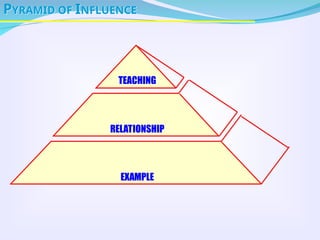
PYRAMID OF INFLUENCE
TEACHING
RELATIONSHIP
EXAMPLE
Knowledge
Knowledge
(what to, why to)
Desire
Desire
(want to)
Skills
Skills
(how to)
HABITS
HABITS
EFFECTIVE HABITS
JUDGEMENT
CHARACTER
 Integrity
 Maturity
 Abundance Mentality
 Interdependency
COMPETENCE
 Technical skills
 Qualifications
 Knowledge
 Experience
FOUR UNIQUE
FOUR UNIQUE
HUMAN ENDOWMENTS
HUMAN ENDOWMENTS
1.
1. Self-awareness
Self-awareness
2.
2. Conscience
Conscience
3.
3. Imagination
Imagination
4.
4. Willpower
Willpower
FOUR UNIQUE HUMAN
ENDOWMENTS
1.
1. S
Self-Awareness
elf-Awareness
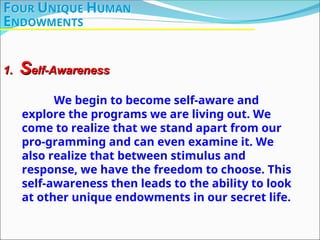
We begin to become self-aware and
explore the programs we are living out. We
come to realize that we stand apart from our
pro-gramming and can even examine it. We
also realize that between stimulus and
response, we have the freedom to choose. This
self-awareness then leads to the ability to look
at other unique endowments in our secret life.
Our conscience is our internal sense of
right and wrong, our “moral nature.” It is the
“greater harmonizer” and “balance wheel” of
all the principles that govern our behaviour.
Our conscience gives us a sense of the degree
to which our thoughts and actions are in
harmony with our principles.
2.
2. C
Conscience
onscience
FOUR UNIQUE HUMAN
ENDOWMENTS
We can visit the power of the mind to
create or to imagine that which does not exist
now. In that imagination lie our faith and our
hope for the future. We look at what is possible,
what we can envision.
3.
3. P
Power of Imagination
ower of Imagination
FOUR UNIQUE HUMAN
ENDOWMENTS
Willpower refers to our determination,
our resoluteness - our ability to act based
solely on our self-awareness. We ask
ourselves, “Am I really willing to to the
distance on my mission statement?” “Am I
willing to walk my talk?” “Am I really willing
to put first things first in spite of external
distractions and pressures?” “Am I going to
live a life of total integrity?”
4.
4. W
Willpower or Independent Will
illpower or Independent Will
FOUR UNIQUE HUMAN
ENDOWMENTS
Developing a mission statement is
foundational to Habit 2, Begin with the
End in Mind. It sets general guidelines for
our life based on our values and our roles
and goals. There are four basic
characteristics of good mission
statements, whether they be personal,
family, or organizational mission
statements.
statements.
BASIC CHARACTERISTICS OF
GOOD MISSION STATEMENTS
1. A mission statement should be timeless and
changeless. Because goals are not timeless,
they should not be included. Mission state-
ments should be based upon unchanging core
principles that operate regardless of present
realities or situations. This changeless core
will enable us to live with changes inside
other people and inside the environment. As
our consciousness grows and we mature, we
will gradually strengthen, deepen, and
improve our mission statement. Nevertheless,
we should always initially write our mission
statement as if it will never change - as if it
were timeless.
BASIC CHARACTERISTICS OF
GOOD MISSION STATEMENTS
2. A mission statement should deal with both
ends and means. Ends have to do with what
we are about. Means have to do with how we
go about achieving those ends. Principles are
what we implements to achieve those ends.
Ends and means are inseparable. In truth,
ends preexist in the means. “You’ll never
achieve a worthy end through unworthy
means.”
BASIC CHARACTERISTICS OF
GOOD MISSION STATEMENTS
3. A mission statement should deal with all
four of our basic needs:
a. To live (our physical and economic
needs)
b. To love and to be loved (our cultural and
social ends)
c. To learn (our needs to grow, develop, be
recognized, and be useful)
d. To leave a legacy (our spiritual need for
meaning, for feeling that life matters,
that we add value and make a
difference.
BASIC CHARACTERISTICS OF
GOOD MISSION STATEMENTS
4. A mission statement should deal with all the significant
roles of our life, such as a parent, teacher, manager,
neighbour, and so forth.
“Internalizing” our mission statement will also help
us get a clear understanding of what is truly
important. Goethe once said, “Things which matter
most must never be at the mercy of things which
matter least.” This means that we learn how to say
no at appropriate times. Every time we say yes to
something that is of little or no importance, we are
saying no to something that is more important.
Almost every day, most of us are caught in circum-
stances where we should say no but don’t. We often
lack the ability to utter a firm but gracious no.
BASIC CHARACTERISTICS OF
GOOD MISSION STATEMENTS
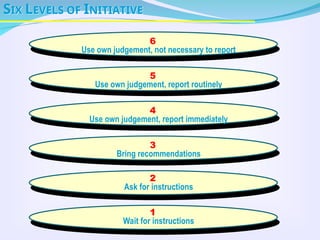
SIX LEVELS OF INITIATIVE
1
Wait for instructions
2
Ask for instructions
3
Bring recommendations
4
Use own judgement, report immediately
5
Use own judgement, report routinely
6
Use own judgement, not necessary to report
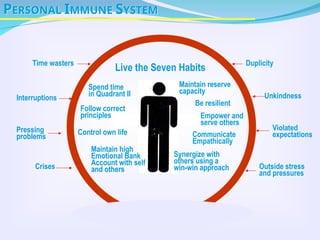
Duplicity
Unkindness
Violated
expectations
Outside stress
and pressures
Time wasters
Interruptions
Pressing
problems
Crises
PERSONAL IMMUNE SYSTEM
Live the Seven Habits
Spend time
in Quadrant II
Follow correct
principles
Control own life
Maintain high
Emotional Bank
Account with self
and others
Maintain reserve
capacity
Be resilient
Empower and
serve others
Communicate
Empathically
Synergize with
others using a
win-win approach
E
EMOTIONAL
MOTIONAL B
BANK
ANK A
ACCOUNT
CCOUNT
KEEP PROMISES APOLOGIZE
CLARIFY
EXPECTATIONS
TREAT OTHER
KINDLY
UNDERSTAND
OTHERS
LOYALITY TO THE
ABSENT
7habitsofhighlyeffectivepeople-123738895932-phpapp02.ppt

7habitsofhighlyeffectivepeople-123738895932-phpapp02.ppt

  • 2.
    To Aquire the7 Habits Be willing to : Learn It Teach It Do It Apply it to Your Life
  • 4.
    Paradigm The way andindividual perceives, understands, and interprets the surrounding world. A mental map.
  • 5.
    Habit Knowledge What to,Why to Skill How to Desire Want to
  • 6.
    Knowledge Knowledge (what to, whyto) Desire Desire (want to) Skills Skills (how to) HABITS HABITS EFFECTIVE HABITS
  • 7.
    Effectiveness P/PC Balance :The Principle of Effectiveness Production The desired results produced Production Capability Maintaining, preserving and enhancing the resources that produces the desired results
  • 8.
  • 9.
    Character & Personality Althoughimage, techniques and skills can influence your outward success, the weight of real effectiveness lies in good character.
  • 10.
    Character & Competence CharacterA person with high character exhibits integrity, maturity and an Abundance Mentality. Competence A person with high competence has knowledge and ability in a given area. As people balance these two elements, they build their personal trustworthiness and their trust with others.
  • 11.
  • 12.
    JUDGEMENT CHARACTER  Integrity  Maturity Abundance Mentality  Interdependency COMPETENCE  Technical skills  Qualifications  Knowledge  Experience
  • 13.
    E EMOTIONAL MOTIONAL B BANK ANK A ACCOUNT CCOUNT KEEPPROMISES APOLOGIZE CLARIFY EXPECTATIONS TREAT OTHER KINDLY UNDERSTAND OTHERS LOYALITY TO THE ABSENT
  • 14.
  • 15.
  • 17.
    Independence Independence Dependence Dependence Interdependenc Interdependenc e e PUBLIC VICTORY PRIVATE VICTORY Seek First to Understand …Then to be Understood Synergize Think Win/Win Put First Things First Be Proactive Begin with the End in Mind S h a r p e n t h e S a w THE SEVEN HABITS PARADIGM THE SEVEN HABITS PARADIGM
  • 18.
    Habit One :Be Proactive The Habit of Personal Vision Responsibility Response + Ability Effective people take responsibility of their own actions. Their behaviour is a product of their own decisions.
  • 19.
    Habit One :Be Proactive The Habit of Personal Vision Characteristics of a Proactive Person  Respond according to values  Accept responsibility for their own behavior  Focus on their Circle of Influence
  • 20.
    Habit One :Be Proactive The Habit of Personal Vision Reactive Behavior Reactive people allow outside influences (moods, feelings or circumstances) to control their responses. Stimulus Response
  • 21.
    Habit One :Be Proactive The Habit of Personal Vision Proactive Behavior Proactive people use the margin of freedom to make choices that best apply their values. Their freedom to choose expands as they wisely use the space between stimulus and response. Stimulus Response Freedom to Choose According to Values
  • 22.
  • 23.
    Habit One :Be Proactive The Habit of Personal Vision Theories of Determinism Reactive people blame their attitude and behavior on things they think they cannot control. They respond to stimulus, often attributing their behavior to three determinants : Genetic - Traits we inherited Psychic - Our upbringing Environmental - Our surroundings
  • 24.
  • 25.
  • 26.
    Habit One :Be Proactive The Habit of Personal Vision The Four Human Endowments Self-Awareness – Examining thoughts, moods and behaviors Imagination – Visualizing beyond experience and present reality (work on alternatives) Conscience – Understanding right and wrong and following personal integrity Independent Will – Acting independent of external influence
  • 28.
    Independence Independence Dependence Dependence Interdependenc Interdependenc e e PUBLIC VICTORY PRIVATE VICTORY Seek First to Understand …Then to be Understood Synergize Think Win/Win Put First Things First Be Proactive Begin with the End in Mind S h a r p e n t h e S a w THE SEVEN HABITS PARADIGM THE SEVEN HABITS PARADIGM
  • 29.
    Habit Two Begin withthe End in Mind The Habit of Personal Leadership Mental Creation Precedes Physical Creation To start with a clear understanding of your destination. Write your MISSION STATEMENT Choose a Life Center
  • 30.
    Habit Two Begin withthe End in Mind The Habit of Personal Leadership
  • 31.
    Habit Two Begin withthe End in Mind The Habit of Personal Leadership Principle-Centered Someone who is principle-centered bases decisions on principles that govern human effectiveness. Principles are the ideal core because they allow us to seek the best alternative through conscious choice, knowledge and values. Principle-centered people try to : Stand apart from the emotion of a situation and from other factors that would act on them. Make proactive choices after evaluating options.
  • 32.
    Habit Two Begin withthe End in Mind The Habit of Personal Leadership Mission Statement A powerful document that expresses your personal sense of Purpose and meaning in life. It acts as a governing Constitution by which you evaluate decisions and choose behaviors.
  • 33.
    Define Leadership &Management Leadership deals with Direction Management deals with Speed, Co-ordination, Logistics in moving in that direction
  • 35.
    Independence Independence Dependence Dependence Interdependenc Interdependenc e e PUBLIC VICTORY PRIVATE VICTORY Seek First to Understand …Then to be Understood Synergize Think Win/Win Put First Things First Be Proactive Begin with the End in Mind S h a r p e n t h e S a w THE SEVEN HABITS PARADIGM THE SEVEN HABITS PARADIGM
  • 36.
    Habit Three Put Firstthings First The Habit of Personal Management Importance An activity is importance if you personally find it valuable, and if it contributes to your mission values, and high-priority goals. Urgency An activity is urgent if you or others feel that it requires immediate attention.
  • 37.
    . Crisis . Pressingproblems . Deadline-driven projects, meetings, preparations . Preparation . Prevention . Values clarification . Planning . Relationship building . True re-creation . Empowerment . Interruptions, some phone calls . Some mail, some reports . Some meetings . Many proximate, pressing matters . Many popular activities . Trivia, busywork . Some phone calls . Time wasters . “Escape” activities . Irrelevant mail . Excessive TV I I II II III III IV IV Urgent Urgent Not Urgent Not Urgent Important Important Not Important Not Important
  • 38.
    Habit Three -Put First things First The Habit of Personal Management URGENT IMPORTANT NOT URGENT NOT IMPORTANT Crises Management Attach to Mission Distraction s Time Wasters
  • 39.
    Habit Three -Put First things First The Habit of Personal Management “Effective people have genuine Quadrant 1 crises and emergencies that require their immediate attention, but the number is comparatively small. They keep P and PC in balance by focusing on the important, but not urgent, activities of Quadrant II”
  • 40.
    Habit Three -Put First things First The Habit of Personal Management Things which matter most must never be at the mercy of things which matter least. The Key is not to prioritize your schedule but to schedule your priorities.
  • 41.
    Habit Three -Put First things First The Habit of Personal Management Put First things First involves a six-step, QII process That will help you act on the basis of importance. Importance, in the context of Put first things First, is defined By your mission statement and confirmed by your conscience. The six steps can be used in weekly planning or as often as needed. Connect to Mission Review Roles Identify Goals Organize Weekly Exercise Integrity Evaluate
  • 42.
    Habits One, Two& Three The first three habits help develop a deep base of character and personal security . Once these 3 habits become part of who you are you are then ready to begin building rich enduring highly productive relationships with other people and that’s where habits four, five and six come in.
  • 44.
    Habits Four, Five& Six These are the habits that lead to interdependent relationships. Habit Four : Think Win-win The attitude of seeking solutions, so that every one can win. Do this by communicating. This is done by Habit Five Habit Five : Seek first to understand, then to be understood Habit Six : This is the habit of creative co-operation - Synergy This happens when two sides in a dispute work together to come with a solution which is better than what either side initially proposed.
  • 46.
    Independence Independence Dependence Dependence Interdependenc Interdependenc e e PUBLIC VICTORY PRIVATE VICTORY Seek First to Understand …Then to be Understood Synergize Think Win/Win Put First Things First Be Proactive Begin with the End in Mind S h a r p e n t h e S a w THE SEVEN HABITS PARADIGM THE SEVEN HABITS PARADIGM
  • 47.
    Habit Four –Think Win-Win The Habit of Interpersonal Leadership SIX PARADIGMS OF HUMAN INTERACTION Win-Win Win-Lose Lose-Win Lose-Lose Win Win-Win or No-Deal
  • 48.
    Habit Four -Think Win-Win The Habit of Interpersonal Leadership Win-Win : People who choose to win and make sure others also win - practice win-win. People with a win-win paradigm take time to search for solutions that will make them happy and simultaneously satisfy others. Characteristics •Seeks mutual benefit •Is cooperative, not competitive •Listens more, stays in communication longer, and communicates with •more courage.
  • 49.
    Habit Four -Think Win-Win The Habit of Interpersonal Leadership Win-Lose : People with a win-lose mindset are concerned with themselves first and last. They want to win, and they want others to lose. They achieve success at the expense or exclusion of another’s success. They are driven by comparison, competition, position, and power. Characteristics •Is very common scripting for most people •Is the authoritarian approach. •Uses position, power, credentials, possessions, or personality to get the “Win”.
  • 50.
    Habit Four -Think Win-Win The Habit of Interpersonal Leadership Lose-Win : People who choose to lose and let others win show high consideration for others, but lack the courage to express and act on their feelings and beliefs. They are easily intimidated and borrow strength from acceptance and popularity. Characteristics •Voices no standards, no demands, no expectations of anyone else. •Is quick to please or appease. •Buries a lot of feelings.
  • 51.
    Habit Four -Think Win-Win The Habit of Interpersonal Leadership Lose-Lose : People who have a lose-lose paradigm are low on courage and consideration. They envy and criticize others. They put themselves and others down. Characteristics •Is the mindset of a highly dependent person. •Is the same as a “no win” because nobody benefits. •Is a long-term result of a win-lose, lose-win, or win.
  • 52.
    Habit Four -Think Win-Win The Habit of Interpersonal Leadership Win : People who hold a win paradigm think only of getting what they want. Although they don’t necessarily want others to lose, they are personally set on winning. They think independently in interdependent situations, without sensitivity or awareness of others. Characteristics •Is self-centered. •Thinks “me first”. •Doesn’t really care if the other person wins or loses. •Has a Scarcity Mentality”.
  • 53.
    Habit Four -Think Win-Win The Habit of Interpersonal Leadership Win-Win or No Deal : Win-Win or No Deal is the highest form of win-win. People who adopt this paradigm seek first for win-win. If they cannot find an acceptable solution, they agree to disagree agreeably. Characteristics •Allows each party to say no. •Is the most realistic at the beginning of a relationship or business deal. •Is the highest form of “Win”.
  • 54.
    Habit Four –Think Win-Win The Habit of Interpersonal Leadership FOUR DIMENSIONS OF WIN-WIN Character Relationships Agreements Systems & Processes Integrity,Maturity,Abundance Mentality Trust, EBA Mutual Commitment Deep Understanding of Issues & Concerns
  • 55.
    Habit Four –Think Win-Win The Habit of Interpersonal Leadership 1 – Win-Win Character Integrity – People of Integrity are true to their feelings, values and commitments. Maturity – Mature people express their ideas and feelings with courage and with consideration for the ideas and feelings of others.Relationships Abundance Mentality – People with an Abundance Mentality believe that there is plenty for everyone.
  • 56.
    Habit Four –Think Win-Win The Habit of Interpersonal Leadership 2 – Win-Win Relationships Demonstrate consistent actions that convince people that they have a well-earned reputation for honesty, integrity and loyalty. Their actions are consistent with their behaviour, decisions and position. Believe in the best of other people Disclose – help others understand their positions, behavior and decisions. Communicate clear expectations. Seek other ideas and listen with empathy. Are accurate, timely and honest in communication. Treat people with respect and respond to others’ needs. Focus on the positive, but provide constructive feedback on improvement areas.
  • 57.
    Habit Four –Think Win-Win The Habit of Interpersonal Leadership 3 – Win-Win Agreements Elements of Win-Win Agreements Desired Results : Clarify the end in mind, objectives and outcome. Guidelines : Specify boundaries and deadlines for accomplishing the results. Resources : List the human, financial, technical or organizational resources available for accomplishing the desired results. Accountability : Identify the standards and methods of measurement for progress and accomplishment. Consequences : Determine the result (s) of achieving or not achieving win-win.
  • 58.
    Habit Four –Think Win-Win The Habit of Interpersonal Leadership 4 – Win-Win Systems and Processes You can best achieve win-win solutions with win-win systems and processes. But if Changing your systems to win-win feels overwhelming and out of reach, remember to work from the inside out. As you first develop a win-win character and then Win-Win Agreements and relationships, you will expand your Circle of Influence and be Able to work on processes.
  • 60.
    Independence Independence Dependence Dependence Interdependenc Interdependenc e e PUBLIC VICTORY PRIVATE VICTORY Seek First to Understand …Then to be Understood Synergize Think Win/Win Put First Things First Be Proactive Begin with the End in Mind S h a r p e n t h e S a w THE SEVEN HABITS PARADIGM THE SEVEN HABITS PARADIGM
  • 61.
    Habit Five -Seek Firstto Understand, Then to Be Understood The Habit of Empathic Communication Ignoring Making no effort to listen Pretend Listening Making believe or giving the appearance you are listening Selective Listening Hearing only the parts of the conversation that interest you. Attentive Listening Paying attention and focusing on what the speaker says, and comparing that to your own experiences. Empathic Listening Listening and responding with both the heart and mind to understand the speaker’s words, intent and feelings.
  • 63.
    Independence Independence Dependence Dependence Interdependenc Interdependenc e e PUBLIC VICTORY PRIVATE VICTORY Seek First to Understand …Then to be Understood Synergize Think Win/Win Put First Things First Be Proactive Begin with the End in Mind S h a r p e n t h e S a w THE SEVEN HABITS PARADIGM THE SEVEN HABITS PARADIGM
  • 64.
    Habit Six -Synergize The Habit of Creative Cooperation Synergy The whole is greater than the sum of its parts. Synergy takes place when two or more people produce more together than the sum of what they could have produces separately.
  • 65.
    Habit Six -Synergize The Habit of Creative Cooperation To Synergize is •Results-oriented, positive synergy •Examining exploring, seeking diverse perspectives openly enough to alter or complete your paradigm •Cooperating •Having a mutually agreed-upon end in mind. •Worth the effort and highly effective •A process. To Synergize is Not •A brainstorming free-for-all. •Accepting others’ ideas as full truth. •Win-lose competition. •Group think (giving in to peer pressure). •Always easy. •Only a negotiation technique.
  • 66.
    Habit Six -Synergize The Habit of Creative Cooperation Problem or Opportunity Synergize Habits 4,5, & 6 The Action and Process Third Alternative SYNERGY The Result
  • 67.
    Habit Six -Synergize The Habit of Creative Cooperation Defensiveness Fear Fixation Ego Anger Anxiety Jealousy
  • 68.
    Habit Six -Synergize The Habit of Creative Cooperation The essence of synergy is valuing the differences. Valuing the differences does not imply that individuals approve of or agree with differences; however it does mean that people respect differences and view them as opportunities for learning. The differing opinions of others and their viewpoints, perspectives, talents and gifts are valuable when seeking solutions. These differences enable you to discover and produce things together that you would much less likely discover and produce individually. At what level do you value the differences ?
  • 69.
    Habit Six -Synergize The Habit of Creative Cooperation Tolerate Accept Value Celebrate
  • 71.
    Independence Independence Dependence Dependence Interdependenc Interdependenc e e PUBLIC VICTORY PRIVATE VICTORY Seek First to Understand …Then to be Understood Synergize Think Win/Win Put First Things First Be Proactive Begin with the End in Mind S h a r p e n t h e S a w THE SEVEN HABITS PARADIGM THE SEVEN HABITS PARADIGM
  • 72.
    Habit Seven -Sharpen the Saw The Habit of Renewal Sharpen the Saw is a daily process of renewing for four dimensions of our nature : Physical, Mental, Spiritual and Social / Emotional. These four dimensions sustain and increase our capacities and help us discipline our mind, body and spirit. This daily private victory is a victory over self. Not only does the daily Private victory stimulate growth, but it also helps us to achieve the Public Victory. As we achieve these victories through renewal, we cultivate and nurture the other six habits.
  • 73.
    Habit Seven -Sharpen the Saw The Habit of Renewal Physical (Body): We build physical wellness through proper nutrition, exercise, rest and stress management. We can sharpen the Saw in Four Areas : Mental (Mind) : We increase mental capacity through, reading, writing, and thinking.
  • 74.
    Habit Seven -Sharpen the Saw The Habit of Renewal Spiritual (Spirit): We develop spiritually through reading inspiring literature, through meditating and praying and through spending time with nature. We can sharpen the Saw in Four Areas : Social / Emotional (Other Relationships) : We mature socially and emotionally by making consistent, daily deposits in the Emotional Bank Account of our key relationships.
  • 75.
    Independence Independence Dependence Dependence Interdependenc Interdependenc e e PUBLIC VICTORY PRIVATE VICTORY Seek First to Understand …Then to be Understood Synergize Think Win/Win Put First Things First Be Proactive Begin with the End in Mind S h a r p e n t h e S a w THE SEVEN HABITS PARADIGM THE SEVEN HABITS PARADIGM
  • 76.
    PHYSICAL PHYSICAL Exercise, Nutrition, Stress Management FOURDIMENSIONS OF RENEWAL MENTAL MENTAL Reading, Visualizing, Planning, Writing SOCIAL/EMOTIONAL SOCIAL/EMOTIONAL Service, Empathy, Synergy, Intrinsic Security SPIRITUAL SPIRITUAL Value Clarification & Commitment, Study & Meditation
  • 77.
  • 78.
  • 79.
    LEVELS OF COMMUNICATION TRUST TRUST Synergistic(Win/Win) COOPERATION COOPERATION Respectful (Compromise) Defensive (Win/Lose or Lose/Win) Low Low High High Low Low High High
  • 80.
    PARADIGM SHIFTS A BREAKFROM TRADITIONAL WISDOM TOWARD 7 HABITS PRINCIPLES Habit 1 We are a product of our environment and upbringing. Habit 2 Society is the source of our values. Habit 3 Reactive to the tyranny of the urgent. Acted upon by the environment. Habit 4 Win-lose. One-sided benefit. Habit 5 Fight, flight, or compromise when faced with conflict. Habit 6 Differences are threats. Independence is the highest value. Unity means sameness. Habit 7 Entropy. Burnout on one track - typically work. We are a product of our choices to our environment and upbringing. Values are self-chosen and provide foundation for decision making. Values flow out of principles. Actions flow from that which is important. Win-win. Mutual benefit. Communication solves problems. Differences are values and are opportunities for synergy. Continuous self-renewal and self- improvement.
  • 81.
    BE PROACTIVE I canforgive, forget, and let go of past injustices I’m aware that I’m responsible I’m the creative force of my life I choose my attitude, emotions, and moods
  • 85.
    SEVEN HABITS OF HIGHLYEFFECTIVE PEOPLE EFFECTIVE PEOPLE INEFFECTIVE PEOPLE HABIT 1 HABIT 1 Be Proactive. Proactive people take responsibility for their own lives. They determine the agendas they will follow and choose their response to what happens around them. Be Reactive. Reactive people don’t take responsibility for their own lives. They feel victimized, a product of circumstances, their past, and other people. They do not see as the creative force of their lives.
  • 86.
    Begin with theEnd in Mind. These people use personal vision, correct principles, and their deep sense of personal meaning to accomplish tasks in a positive and effective way. They live life based on self- chosen values and are guided by their personal mission statement. Begin with No End in Mind. These people lack personal vision and have not developed a deep sense of personal meaning and purpose. They have not paid the price to develop a mission statement and thus live life based on society’s values instead of self- chosen values. HABIT 2 HABIT 2 SEVEN HABITS OF HIGHLY EFFECTIVE PEOPLE EFFECTIVE PEOPLE INEFFECTIVE PEOPLE
  • 87.
    Put First ThingsFirst. These people exercise discipline, and they plan and execute according to priorities. They also “walk their talk” and spend significant time in Quadrant II. Put Second Things First. These people are crisis managers who are unable to stay focused on high- leverage tasks because of their preoccupation with circumstances, their past, or other people. They are caught up in the “thick of thin things” and are driven by the urgent. HABIT 3 HABIT 3 SEVEN HABITS OF HIGHLY EFFECTIVE PEOPLE EFFECTIVE PEOPLE INEFFECTIVE PEOPLE
  • 88.
    Think Win-Win. These peoplehave an abundance mentality and the spirit of cooperation. They achieve effective communication and high trust levels in their Emotional Bank Accounts with others, resulting in rewarding relationships and greater power to influence. Think Win-Lose or Lose-Win. These people have a scarcity mentality and see life as a zero-sum game. They have ineffective communication skills and low trust levels in their Emotional Bank Accounts with others, result- ing in a defensive mentality and adversarial feelings. HABIT 4 HABIT 4 SEVEN HABITS OF HIGHLY EFFECTIVE PEOPLE EFFECTIVE PEOPLE INEFFECTIVE PEOPLE
  • 89.
    Seek First toUnderstand, Then to Be Understood. Through perceptive observation and empathic listening, these non- judgmental people are intent on learning the needs, interests, and concerns of others. They are then able to courageously state their own needs and wants. Seek First to Be Understood. These people put forth their point of view based solely on their auto-biography and motives, without attempting to understand others first. They blindly prescribe without first diagnosing the problem. HABIT 5 HABIT 5 SEVEN HABITS OF HIGHLY EFFECTIVE PEOPLE EFFECTIVE PEOPLE INEFFECTIVE PEOPLE
  • 90.
    Synergize. Effective people knowthat the whole is greater than the sum of the parts. They value and benefit from differences in others, which results in creative cooperation and team- work. Compromise, Fight, or Flight. Ineffective people believe the whole is less than the sum of the parts. They try to “clone” other people in their own image. Differences in others are looked upon as threats. HABIT 6 HABIT 6 SEVEN HABITS OF HIGHLY EFFECTIVE PEOPLE EFFECTIVE PEOPLE INEFFECTIVE PEOPLE
  • 91.
    Sharpen the Saw.Effective people are involved in self- renewal and self- improvement in the physical, mental, spiritual, and social-emotional areas, which enhance all areas off their life and nurture the other six habits. Wear Out the Saw. Ineffective people fall back, lose their interest, and get disordered. They lack a program of self-renewal and self-improvement and eventually lose the cutting edge they once had. HABIT 7 HABIT 7 SEVEN HABITS OF HIGHLY EFFECTIVE PEOPLE EFFECTIVE PEOPLE INEFFECTIVE PEOPLE
  • 92.
  • 93.
  • 94.
    SEVEN PRINCIPLES UPON WHICHTHE SEVEN HABITS ARE BASED The Seven Habits center on The Seven Habits center on timeless and universal principles of timeless and universal principles of personal, interpersonal, managerial, personal, interpersonal, managerial, and organizational effectiveness. and organizational effectiveness. Listed below are the seven principles Listed below are the seven principles upon which the Seven Habits are upon which the Seven Habits are based-principles which are in our based-principles which are in our circle of influence. circle of influence.
  • 95.
    1. The principleof continuous learning, of self- reeducation - the discipline that drives us toward the values we believe in. Such constant learning is required in today’s world, in light of the fact that many of us can expect to work in up to five radically different fields before we retire. 2. The principle of service, of giving oneself to others, of helping to facilitate other people’s work. SEVEN PRINCIPLES UPON WHICH THE SEVEN HABITS ARE BASED
  • 96.
    3. The principleof staying positive and optimistic, radiating positive energy - including avoiding the four emotional cancers (criticising complain- ing, comparing, and competing). 4. The principle of affirmation of others - treating people as proactive individuals who have great potential. 5. The principle of balance - the ability to identify our various roles and to spend appropriate amounts of time in, and focus on, all the impor- tant roles and dimensions of our life. Success in one area of our life cannot compensate for neglect or failure in other areas of our life. SEVEN PRINCIPLES UPON WHICH THE SEVEN HABITS ARE BASED
  • 97.
    6. The balanceof spontaneity and serendipity - the ability to experience life with a sense of adventure, excitement, and fresh rediscovery, instead of trying to find a serious side to things that have no serious side. 7. The principle of consistent self-renewal and self- improvement in the four dimensions of one’s life: physical, mental, spiritual, and social- emotional. SEVEN PRINCIPLES UPON WHICH THE SEVEN HABITS ARE BASED
  • 98.
  • 99.
    Knowledge Knowledge (what to, whyto) Desire Desire (want to) Skills Skills (how to) HABITS HABITS EFFECTIVE HABITS
  • 100.
    JUDGEMENT CHARACTER  Integrity  Maturity Abundance Mentality  Interdependency COMPETENCE  Technical skills  Qualifications  Knowledge  Experience
  • 101.
    FOUR UNIQUE FOUR UNIQUE HUMANENDOWMENTS HUMAN ENDOWMENTS 1. 1. Self-awareness Self-awareness 2. 2. Conscience Conscience 3. 3. Imagination Imagination 4. 4. Willpower Willpower
  • 102.
    FOUR UNIQUE HUMAN ENDOWMENTS 1. 1.S Self-Awareness elf-Awareness We begin to become self-aware and explore the programs we are living out. We come to realize that we stand apart from our pro-gramming and can even examine it. We also realize that between stimulus and response, we have the freedom to choose. This self-awareness then leads to the ability to look at other unique endowments in our secret life.
  • 103.
    Our conscience isour internal sense of right and wrong, our “moral nature.” It is the “greater harmonizer” and “balance wheel” of all the principles that govern our behaviour. Our conscience gives us a sense of the degree to which our thoughts and actions are in harmony with our principles. 2. 2. C Conscience onscience FOUR UNIQUE HUMAN ENDOWMENTS
  • 104.
    We can visitthe power of the mind to create or to imagine that which does not exist now. In that imagination lie our faith and our hope for the future. We look at what is possible, what we can envision. 3. 3. P Power of Imagination ower of Imagination FOUR UNIQUE HUMAN ENDOWMENTS
  • 105.
    Willpower refers toour determination, our resoluteness - our ability to act based solely on our self-awareness. We ask ourselves, “Am I really willing to to the distance on my mission statement?” “Am I willing to walk my talk?” “Am I really willing to put first things first in spite of external distractions and pressures?” “Am I going to live a life of total integrity?” 4. 4. W Willpower or Independent Will illpower or Independent Will FOUR UNIQUE HUMAN ENDOWMENTS
  • 106.
    Developing a missionstatement is Developing a mission statement is foundational to Habit 2, Begin with the foundational to Habit 2, Begin with the End in Mind. It sets general guidelines for End in Mind. It sets general guidelines for our life based on our values and our roles our life based on our values and our roles and goals. There are four basic and goals. There are four basic characteristics of good mission characteristics of good mission statements, whether they be personal, statements, whether they be personal, family, or organizational mission family, or organizational mission statements. statements. BASIC CHARACTERISTICS OF GOOD MISSION STATEMENTS
  • 107.
    1. A missionstatement should be timeless and changeless. Because goals are not timeless, they should not be included. Mission state- ments should be based upon unchanging core principles that operate regardless of present realities or situations. This changeless core will enable us to live with changes inside other people and inside the environment. As our consciousness grows and we mature, we will gradually strengthen, deepen, and improve our mission statement. Nevertheless, we should always initially write our mission statement as if it will never change - as if it were timeless. BASIC CHARACTERISTICS OF GOOD MISSION STATEMENTS
  • 108.
    2. A missionstatement should deal with both ends and means. Ends have to do with what we are about. Means have to do with how we go about achieving those ends. Principles are what we implements to achieve those ends. Ends and means are inseparable. In truth, ends preexist in the means. “You’ll never achieve a worthy end through unworthy means.” BASIC CHARACTERISTICS OF GOOD MISSION STATEMENTS
  • 109.
    3. A missionstatement should deal with all four of our basic needs: a. To live (our physical and economic needs) b. To love and to be loved (our cultural and social ends) c. To learn (our needs to grow, develop, be recognized, and be useful) d. To leave a legacy (our spiritual need for meaning, for feeling that life matters, that we add value and make a difference. BASIC CHARACTERISTICS OF GOOD MISSION STATEMENTS
  • 110.
    4. A missionstatement should deal with all the significant roles of our life, such as a parent, teacher, manager, neighbour, and so forth. “Internalizing” our mission statement will also help us get a clear understanding of what is truly important. Goethe once said, “Things which matter most must never be at the mercy of things which matter least.” This means that we learn how to say no at appropriate times. Every time we say yes to something that is of little or no importance, we are saying no to something that is more important. Almost every day, most of us are caught in circum- stances where we should say no but don’t. We often lack the ability to utter a firm but gracious no. BASIC CHARACTERISTICS OF GOOD MISSION STATEMENTS
  • 111.
    SIX LEVELS OFINITIATIVE 1 Wait for instructions 2 Ask for instructions 3 Bring recommendations 4 Use own judgement, report immediately 5 Use own judgement, report routinely 6 Use own judgement, not necessary to report
  • 112.
    Duplicity Unkindness Violated expectations Outside stress and pressures Timewasters Interruptions Pressing problems Crises PERSONAL IMMUNE SYSTEM Live the Seven Habits Spend time in Quadrant II Follow correct principles Control own life Maintain high Emotional Bank Account with self and others Maintain reserve capacity Be resilient Empower and serve others Communicate Empathically Synergize with others using a win-win approach
  • 113.
    E EMOTIONAL MOTIONAL B BANK ANK A ACCOUNT CCOUNT KEEPPROMISES APOLOGIZE CLARIFY EXPECTATIONS TREAT OTHER KINDLY UNDERSTAND OTHERS LOYALITY TO THE ABSENT