Abnormal Psychology, Thirteenth
Edition, DSM-5 Update
by
Ann M. Kring,
Sheri L. Johnson,
Gerald C. Davison,
& John M. Neale
© 2015 John Wiley & Sons, Inc. All rights reserved.
Chapter 5: Mood Disorders
I. Clinical Descriptions and Epidemiology of
Mood Disorders
II. Etiology of Mood Disorders
III. Treatment of Mood Disorders
IV. Suicide
© 2015 John Wiley & Sons, Inc. All rights reserved.
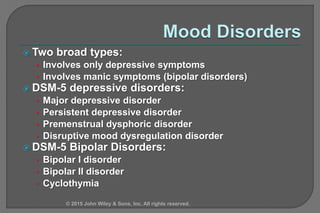
 Two broad types:
• Involves only depressive symptoms
• Involves manic symptoms (bipolar disorders)
 DSM-5 depressive disorders:
• Major depressive disorder
• Persistent depressive disorder
• Premenstrual dysphoric disorder
• Disruptive mood dysregulation disorder
 DSM-5 Bipolar Disorders:
• Bipolar I disorder
• Bipolar II disorder
• Cyclothymia
© 2015 John Wiley & Sons, Inc. All rights reserved.
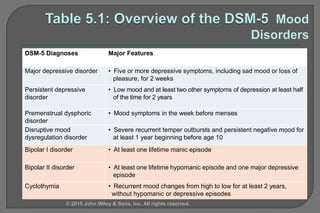
DSM-5 Diagnoses Major Features
Major depressive disorder • Five or more depressive symptoms, including sad mood or loss of
pleasure, for 2 weeks
Persistent depressive
disorder
• Low mood and at least two other symptoms of depression at least half
of the time for 2 years
Premenstrual dysphoric
disorder
• Mood symptoms in the week before menses
Disruptive mood
dysregulation disorder
• Severe recurrent temper outbursts and persistent negative mood for
at least 1 year beginning before age 10
Bipolar I disorder • At least one lifetime manic episode
Bipolar II disorder • At least one lifetime hypomanic episode and one major depressive
episode
Cyclothymia • Recurrent mood changes from high to low for at least 2 years,
without hypomanic or depressive episodes
© 2015 John Wiley & Sons, Inc. All rights reserved.
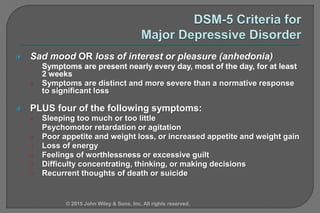
 Sad mood OR loss of interest or pleasure (anhedonia)
• Symptoms are present nearly every day, most of the day, for at least
2 weeks
• Symptoms are distinct and more severe than a normative response
to significant loss
 PLUS four of the following symptoms:
• Sleeping too much or too little
• Psychomotor retardation or agitation
• Poor appetite and weight loss, or increased appetite and weight gain
• Loss of energy
• Feelings of worthlessness or excessive guilt
• Difficulty concentrating, thinking, or making decisions
• Recurrent thoughts of death or suicide
© 2015 John Wiley & Sons, Inc. All rights reserved.
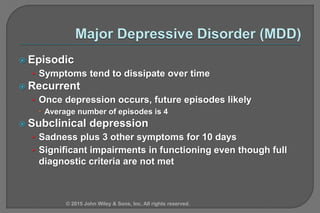
 Episodic
• Symptoms tend to dissipate over time
 Recurrent
• Once depression occurs, future episodes likely
 Average number of episodes is 4
 Subclinical depression
• Sadness plus 3 other symptoms for 10 days
• Significant impairments in functioning even though full
diagnostic criteria are not met
© 2015 John Wiley & Sons, Inc. All rights reserved.
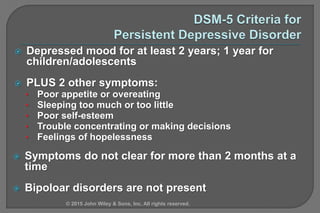
 Depressed mood for at least 2 years; 1 year for
children/adolescents
 PLUS 2 other symptoms:
• Poor appetite or overeating
• Sleeping too much or too little
• Poor self-esteem
• Trouble concentrating or making decisions
• Feelings of hopelessness
 Symptoms do not clear for more than 2 months at a
time
 Bipoloar disorders are not present
© 2015 John Wiley & Sons, Inc. All rights reserved.
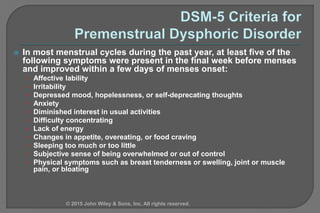
 In most menstrual cycles during the past year, at least five of the
following symptoms were present in the final week before menses
and improved within a few days of menses onset:
• Affective lability
• Irritability
• Depressed mood, hopelessness, or self-deprecating thoughts
• Anxiety
• Diminished interest in usual activities
• Difficulty concentrating
• Lack of energy
• Changes in appetite, overeating, or food craving
• Sleeping too much or too little
• Subjective sense of being overwhelmed or out of control
• Physical symptoms such as breast tenderness or swelling, joint or muscle
pain, or bloating
© 2015 John Wiley & Sons, Inc. All rights reserved.
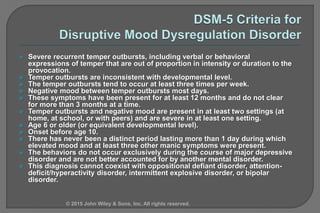
 Severe recurrent temper outbursts, including verbal or behavioral
expressions of temper that are out of proportion in intensity or duration to the
provocation.
 Temper outbursts are inconsistent with developmental level.
 The temper outbursts tend to occur at least three times per week.
 Negative mood between temper outbursts most days.
 These symptoms have been present for at least 12 months and do not clear
for more than 3 months at a time.
 Temper outbursts and negative mood are present in at least two settings (at
home, at school, or with peers) and are severe in at least one setting.
 Age 6 or older (or equivalent developmental level).
 Onset before age 10.
 There has never been a distinct period lasting more than 1 day during which
elevated mood and at least three other manic symptoms were present.
 The behaviors do not occur exclusively during the course of major depressive
disorder and are not better accounted for by another mental disorder.
 This diagnosis cannot coexist with oppositional defiant disorder, attention-
deficit/hyperactivity disorder, intermittent explosive disorder, or bipolar
disorder.
© 2015 John Wiley & Sons, Inc. All rights reserved.
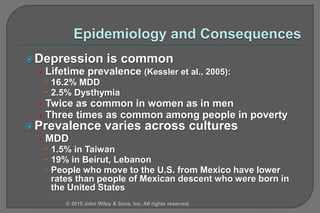
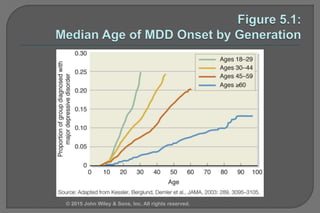
Depression is common
• Lifetime prevalence (Kessler et al., 2005):
 16.2% MDD
 2.5% Dysthymia
• Twice as common in women as in men
• Three times as common among people in poverty
Prevalence varies across cultures
• MDD
 1.5% in Taiwan
 19% in Beirut, Lebanon
 People who move to the U.S. from Mexico have lower
rates than people of Mexican descent who were born in
the United States
© 2015 John Wiley & Sons, Inc. All rights reserved.
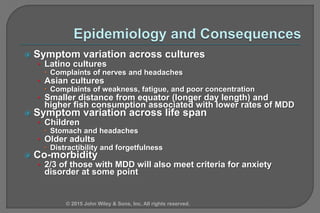
 Symptom variation across cultures
• Latino cultures
 Complaints of nerves and headaches
• Asian cultures
 Complaints of weakness, fatigue, and poor concentration
• Smaller distance from equator (longer day length) and
higher fish consumption associated with lower rates of MDD
 Symptom variation across life span
• Children
 Stomach and headaches
• Older adults
 Distractibility and forgetfulness
 Co-morbidity
• 2/3 of those with MDD will also meet criteria for anxiety
disorder at some point
© 2015 John Wiley & Sons, Inc. All rights reserved.
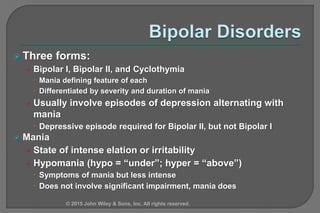
 Three forms:
• Bipolar I, Bipolar II, and Cyclothymia
 Mania defining feature of each
 Differentiated by severity and duration of mania
• Usually involve episodes of depression alternating with
mania
 Depressive episode required for Bipolar II, but not Bipolar I
 Mania
• State of intense elation or irritability
• Hypomania (hypo = “under”; hyper = “above”)
 Symptoms of mania but less intense
 Does not involve significant impairment, mania does
© 2015 John Wiley & Sons, Inc. All rights reserved.
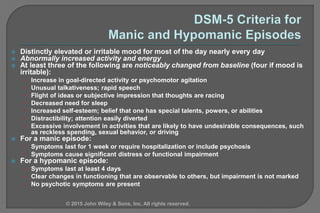
 Distinctly elevated or irritable mood for most of the day nearly every day
 Abnormally increased activity and energy
 At least three of the following are noticeably changed from baseline (four if mood is
irritable):
• Increase in goal-directed activity or psychomotor agitation
• Unusual talkativeness; rapid speech
• Flight of ideas or subjective impression that thoughts are racing
• Decreased need for sleep
• Increased self-esteem; belief that one has special talents, powers, or abilities
• Distractibility; attention easily diverted
• Excessive involvement in activities that are likely to have undesirable consequences, such
as reckless spending, sexual behavior, or driving
 For a manic episode:
• Symptoms last for 1 week or require hospitalization or include psychosis
• Symptoms cause significant distress or functional impairment
 For a hypomanic episode:
• Symptoms last at least 4 days
• Clear changes in functioning that are observable to others, but impairment is not marked
• No psychotic symptoms are present
© 2015 John Wiley & Sons, Inc. All rights reserved.
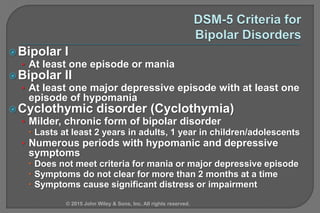
Bipolar I
• At least one episode or mania
Bipolar II
• At least one major depressive episode with at least one
episode of hypomania
Cyclothymic disorder (Cyclothymia)
• Milder, chronic form of bipolar disorder
 Lasts at least 2 years in adults, 1 year in children/adolescents
• Numerous periods with hypomanic and depressive
symptoms
 Does not meet criteria for mania or major depressive episode
 Symptoms do not clear for more than 2 months at a time
 Symptoms cause significant distress or impairment
© 2015 John Wiley & Sons, Inc. All rights reserved.
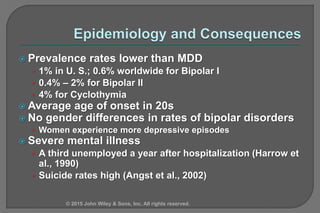
 Prevalence rates lower than MDD
• 1% in U. S.; 0.6% worldwide for Bipolar I
• 0.4% – 2% for Bipolar II
• 4% for Cyclothymia
 Average age of onset in 20s
 No gender differences in rates of bipolar disorders
• Women experience more depressive episodes
 Severe mental illness
• A third unemployed a year after hospitalization (Harrow et
al., 1990)
• Suicide rates high (Angst et al., 2002)
© 2015 John Wiley & Sons, Inc. All rights reserved.
What factors contribute to onset of mood
disorders?
• Neurobiological factors
• Psychosocial factors
© 2015 John Wiley & Sons, Inc. All rights reserved.
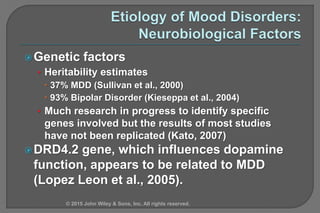
Genetic factors
• Heritability estimates
 37% MDD (Sullivan et al., 2000)
 93% Bipolar Disorder (Kieseppa et al., 2004)
• Much research in progress to identify specific
genes involved but the results of most studies
have not been replicated (Kato, 2007)
DRD4.2 gene, which influences dopamine
function, appears to be related to MDD
(Lopez Leon et al., 2005).
© 2015 John Wiley & Sons, Inc. All rights reserved.
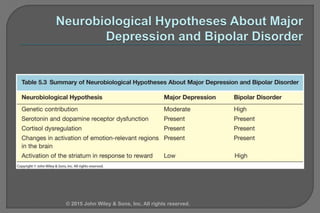
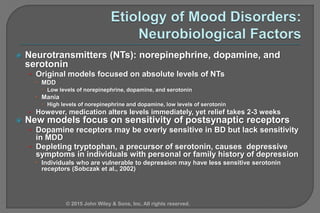
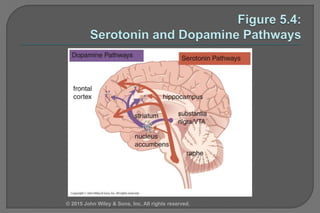
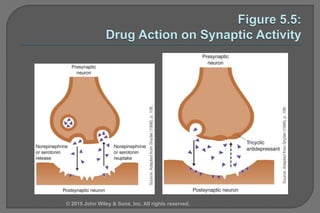
 Neurotransmitters (NTs): norepinephrine, dopamine, and
serotonin
• Original models focused on absolute levels of NTs
 MDD
 Low levels of norepinephrine, dopamine, and serotonin
 Mania
 High levels of norepinephrine and dopamine, low levels of serotonin
• However, medication alters levels immediately, yet relief takes 2-3 weeks
 New models focus on sensitivity of postsynaptic receptors
• Dopamine receptors may be overly sensitive in BD but lack sensitivity
in MDD
• Depleting tryptophan, a precursor of serotonin, causes depressive
symptoms in individuals with personal or family history of depression
 Individuals who are vulnerable to depression may have less sensitive serotonin
receptors (Sobczak et al., 2002)
© 2015 John Wiley & Sons, Inc. All rights reserved.
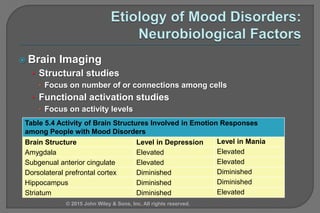
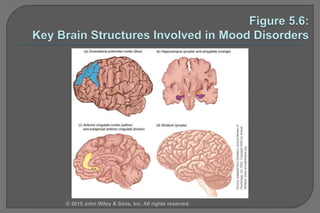
 Brain Imaging
• Structural studies
 Focus on number of or connections among cells
• Functional activation studies
 Focus on activity levels
Table 5.4 Activity of Brain Structures Involved in Emotion Responses
among People with Mood Disorders
Brain Structure Level in Depression Level in Mania
Amygdala Elevated Elevated
Subgenual anterior cingulate Elevated Elevated
Dorsolateral prefrontal cortex Diminished Diminished
Hippocampus Diminished Diminished
Striatum Diminished Elevated
© 2015 John Wiley & Sons, Inc. All rights reserved.
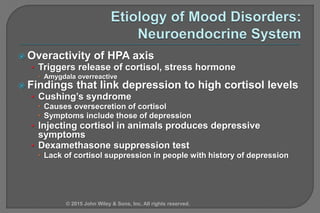
 Overactivity of HPA axis
• Triggers release of cortisol, stress hormone
 Amygdala overreactive
 Findings that link depression to high cortisol levels
• Cushing’s syndrome
 Causes oversecretion of cortisol
 Symptoms include those of depression
• Injecting cortisol in animals produces depressive
symptoms
• Dexamethasone suppression test
 Lack of cortisol suppression in people with history of depression
© 2015 John Wiley & Sons, Inc. All rights reserved.
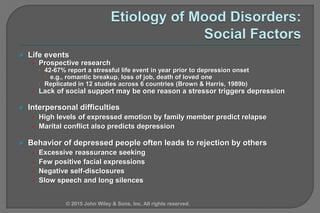
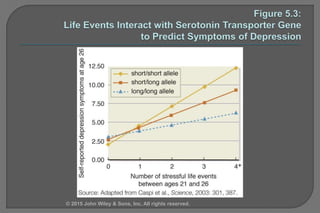
 Life events
• Prospective research
 42-67% report a stressful life event in year prior to depression onset
 e.g., romantic breakup, loss of job, death of loved one
 Replicated in 12 studies across 6 countries (Brown & Harris, 1989b)
• Lack of social support may be one reason a stressor triggers depression
 Interpersonal difficulties
• High levels of expressed emotion by family member predict relapse
• Marital conflict also predicts depression
 Behavior of depressed people often leads to rejection by others
• Excessive reassurance seeking
• Few positive facial expressions
• Negative self-disclosures
• Slow speech and long silences
© 2015 John Wiley & Sons, Inc. All rights reserved.
Why do some people become depressed
after a stressful life event and others do not?
• Social support
• Neuroticism
• Cognitive theories
© 2015 John Wiley & Sons, Inc. All rights reserved.
Neuroticism
• Tendency to react with higher levels of negative
affect
• Predicts onset of depression (Jorm et al., 2000)
© 2015 John Wiley & Sons, Inc. All rights reserved.
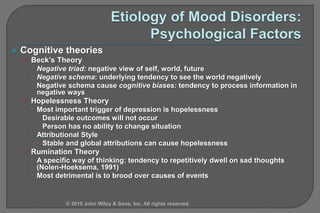
 Cognitive theories
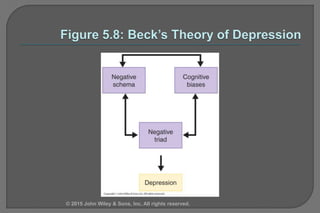
• Beck’s Theory
 Negative triad: negative view of self, world, future
 Negative schema: underlying tendency to see the world negatively
 Negative schema cause cognitive biases: tendency to process information in
negative ways
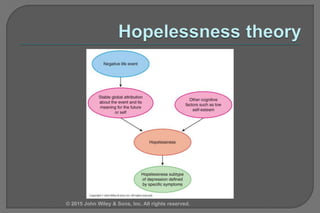
• Hopelessness Theory
 Most important trigger of depression is hopelessness
 Desirable outcomes will not occur
 Person has no ability to change situation
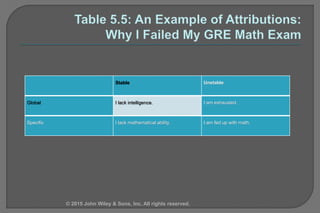
 Attributional Style
 Stable and global attributions can cause hopelessness
• Rumination Theory
 A specific way of thinking: tendency to repetitively dwell on sad thoughts
(Nolen-Hoeksema, 1991)
 Most detrimental is to brood over causes of events
© 2015 John Wiley & Sons, Inc. All rights reserved.
Stable Unstable
Global I lack intelligence. I am exhausted.
Specific I lack mathematical ability. I am fed up with math.
© 2015 John Wiley & Sons, Inc. All rights reserved.
Triggers of depressive episodes in bipolar
disorder appear similar to the triggers of
major depressive episodes
• Negative life events, neuroticism, negative
cognitions, expressed emotion, and lack of social
support
Predictors of mania
• Reward sensitivity
• Sleep disruption
© 2015 John Wiley & Sons, Inc. All rights reserved.
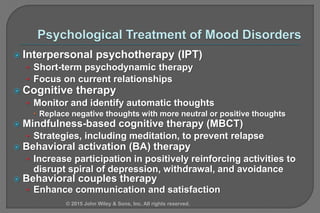
 Interpersonal psychotherapy (IPT)
• Short-term psychodynamic therapy
• Focus on current relationships
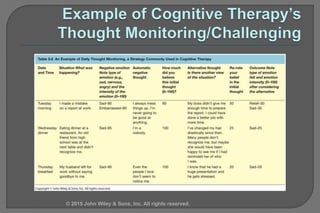
 Cognitive therapy
• Monitor and identify automatic thoughts
 Replace negative thoughts with more neutral or positive thoughts
 Mindfulness-based cognitive therapy (MBCT)
• Strategies, including meditation, to prevent relapse
 Behavioral activation (BA) therapy
• Increase participation in positively reinforcing activities to
disrupt spiral of depression, withdrawal, and avoidance
 Behavioral couples therapy
• Enhance communication and satisfaction
© 2015 John Wiley & Sons, Inc. All rights reserved.
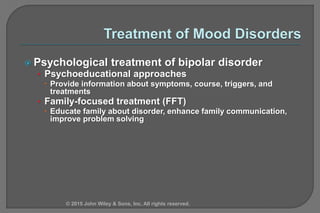
 Psychological treatment of bipolar disorder
• Psychoeducational approaches
 Provide information about symptoms, course, triggers, and
treatments
• Family-focused treatment (FFT)
 Educate family about disorder, enhance family communication,
improve problem solving
© 2015 John Wiley & Sons, Inc. All rights reserved.
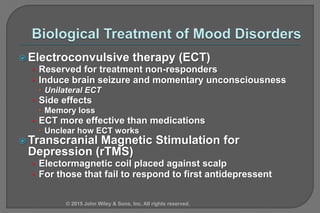
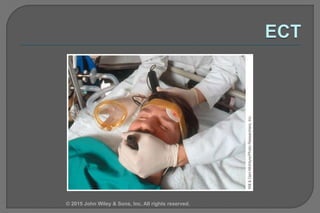
 Electroconvulsive therapy (ECT)
• Reserved for treatment non-responders
• Induce brain seizure and momentary unconsciousness
 Unilateral ECT
• Side effects
 Memory loss
• ECT more effective than medications
 Unclear how ECT works
 Transcranial Magnetic Stimulation for
Depression (rTMS)
• Electormagnetic coil placed against scalp
• For those that fail to respond to first antidepressent
© 2015 John Wiley & Sons, Inc. All rights reserved.
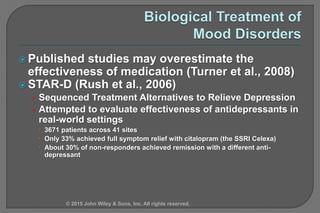
 Published studies may overestimate the
effectiveness of medication (Turner et al., 2008)
 STAR-D (Rush et al., 2006)
• Sequenced Treatment Alternatives to Relieve Depression
• Attempted to evaluate effectiveness of antidepressants in
real-world settings
 3671 patients across 41 sites
 Only 33% achieved full symptom relief with citalopram (the SSRI Celexa)
 About 30% of non-responders achieved remission with a different anti-
depressant
© 2015 John Wiley & Sons, Inc. All rights reserved.
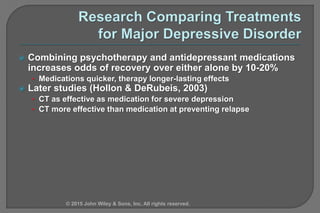
 Combining psychotherapy and antidepressant medications
increases odds of recovery over either alone by 10-20%
• Medications quicker, therapy longer-lasting effects
 Later studies (Hollon & DeRubeis, 2003)
• CT as effective as medication for severe depression
• CT more effective than medication at preventing relapse
© 2015 John Wiley & Sons, Inc. All rights reserved.
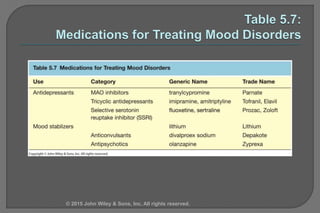
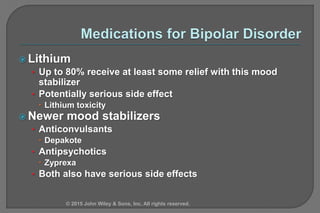
 Lithium
• Up to 80% receive at least some relief with this mood
stabilizer
• Potentially serious side effect
 Lithium toxicity
 Newer mood stabilizers
• Anticonvulsants
 Depakote
• Antipsychotics
 Zyprexa
• Both also have serious side effects
© 2015 John Wiley & Sons, Inc. All rights reserved.
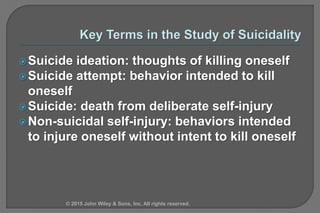
Suicide ideation: thoughts of killing oneself
Suicide attempt: behavior intended to kill
oneself
Suicide: death from deliberate self-injury
Non-suicidal self-injury: behaviors intended
to injure oneself without intent to kill oneself
© 2015 John Wiley & Sons, Inc. All rights reserved.
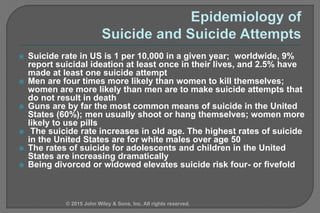
 Suicide rate in US is 1 per 10,000 in a given year; worldwide, 9%
report suicidal ideation at least once in their lives, and 2.5% have
made at least one suicide attempt
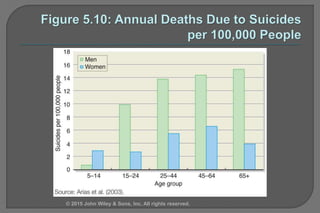
 Men are four times more likely than women to kill themselves;
women are more likely than men are to make suicide attempts that
do not result in death
 Guns are by far the most common means of suicide in the United
States (60%); men usually shoot or hang themselves; women more
likely to use pills
 The suicide rate increases in old age. The highest rates of suicide
in the United States are for white males over age 50
 The rates of suicide for adolescents and children in the United
States are increasing dramatically
 Being divorced or widowed elevates suicide risk four- or fivefold
© 2015 John Wiley & Sons, Inc. All rights reserved.
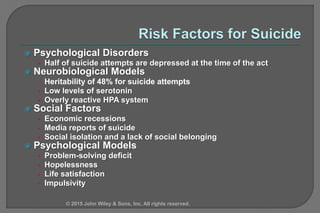
 Psychological Disorders
• Half of suicide attempts are depressed at the time of the act
 Neurobiological Models
• Heritability of 48% for suicide attempts
• Low levels of serotonin
• Overly reactive HPA system
 Social Factors
• Economic recessions
• Media reports of suicide
• Social isolation and a lack of social belonging
 Psychological Models
• Problem-solving deficit
• Hopelessness
• Life satisfaction
• Impulsivity
© 2015 John Wiley & Sons, Inc. All rights reserved.
Talk about suicide openly and matter-of-
factly
Most people are ambivalent about their
suicidal intentions
Treat the associated mental disorder
Treat suicidality directly
Suicide prevention centers
© 2015 John Wiley & Sons, Inc. All rights reserved.
Copyright 2015 by John Wiley & Sons, Inc. All
rights reserved. No part of the material protected
by this copyright may be reproduced or utilized in
any form or by any means, electronic or
mechanical, including photocopying, recording or
by any information storage and retrieval system,
without written permission of the copyright owner.
© 2015 John Wiley & Sons, Inc. All rights reserved.

Chapter+5+slides+-+350.@############pptx

  • 1.
    Abnormal Psychology, Thirteenth Edition,DSM-5 Update by Ann M. Kring, Sheri L. Johnson, Gerald C. Davison, & John M. Neale © 2015 John Wiley & Sons, Inc. All rights reserved.
  • 2.
    Chapter 5: MoodDisorders I. Clinical Descriptions and Epidemiology of Mood Disorders II. Etiology of Mood Disorders III. Treatment of Mood Disorders IV. Suicide © 2015 John Wiley & Sons, Inc. All rights reserved.
  • 3.
    © 2015 JohnWiley & Sons, Inc. All rights reserved.
  • 4.
     Two broadtypes: • Involves only depressive symptoms • Involves manic symptoms (bipolar disorders)  DSM-5 depressive disorders: • Major depressive disorder • Persistent depressive disorder • Premenstrual dysphoric disorder • Disruptive mood dysregulation disorder  DSM-5 Bipolar Disorders: • Bipolar I disorder • Bipolar II disorder • Cyclothymia © 2015 John Wiley & Sons, Inc. All rights reserved.
  • 5.
    DSM-5 Diagnoses MajorFeatures Major depressive disorder • Five or more depressive symptoms, including sad mood or loss of pleasure, for 2 weeks Persistent depressive disorder • Low mood and at least two other symptoms of depression at least half of the time for 2 years Premenstrual dysphoric disorder • Mood symptoms in the week before menses Disruptive mood dysregulation disorder • Severe recurrent temper outbursts and persistent negative mood for at least 1 year beginning before age 10 Bipolar I disorder • At least one lifetime manic episode Bipolar II disorder • At least one lifetime hypomanic episode and one major depressive episode Cyclothymia • Recurrent mood changes from high to low for at least 2 years, without hypomanic or depressive episodes © 2015 John Wiley & Sons, Inc. All rights reserved.
  • 6.
     Sad moodOR loss of interest or pleasure (anhedonia) • Symptoms are present nearly every day, most of the day, for at least 2 weeks • Symptoms are distinct and more severe than a normative response to significant loss  PLUS four of the following symptoms: • Sleeping too much or too little • Psychomotor retardation or agitation • Poor appetite and weight loss, or increased appetite and weight gain • Loss of energy • Feelings of worthlessness or excessive guilt • Difficulty concentrating, thinking, or making decisions • Recurrent thoughts of death or suicide © 2015 John Wiley & Sons, Inc. All rights reserved.
  • 7.
     Episodic • Symptomstend to dissipate over time  Recurrent • Once depression occurs, future episodes likely  Average number of episodes is 4  Subclinical depression • Sadness plus 3 other symptoms for 10 days • Significant impairments in functioning even though full diagnostic criteria are not met © 2015 John Wiley & Sons, Inc. All rights reserved.
  • 8.
     Depressed moodfor at least 2 years; 1 year for children/adolescents  PLUS 2 other symptoms: • Poor appetite or overeating • Sleeping too much or too little • Poor self-esteem • Trouble concentrating or making decisions • Feelings of hopelessness  Symptoms do not clear for more than 2 months at a time  Bipoloar disorders are not present © 2015 John Wiley & Sons, Inc. All rights reserved.
  • 9.
     In mostmenstrual cycles during the past year, at least five of the following symptoms were present in the final week before menses and improved within a few days of menses onset: • Affective lability • Irritability • Depressed mood, hopelessness, or self-deprecating thoughts • Anxiety • Diminished interest in usual activities • Difficulty concentrating • Lack of energy • Changes in appetite, overeating, or food craving • Sleeping too much or too little • Subjective sense of being overwhelmed or out of control • Physical symptoms such as breast tenderness or swelling, joint or muscle pain, or bloating © 2015 John Wiley & Sons, Inc. All rights reserved.
  • 10.
     Severe recurrenttemper outbursts, including verbal or behavioral expressions of temper that are out of proportion in intensity or duration to the provocation.  Temper outbursts are inconsistent with developmental level.  The temper outbursts tend to occur at least three times per week.  Negative mood between temper outbursts most days.  These symptoms have been present for at least 12 months and do not clear for more than 3 months at a time.  Temper outbursts and negative mood are present in at least two settings (at home, at school, or with peers) and are severe in at least one setting.  Age 6 or older (or equivalent developmental level).  Onset before age 10.  There has never been a distinct period lasting more than 1 day during which elevated mood and at least three other manic symptoms were present.  The behaviors do not occur exclusively during the course of major depressive disorder and are not better accounted for by another mental disorder.  This diagnosis cannot coexist with oppositional defiant disorder, attention- deficit/hyperactivity disorder, intermittent explosive disorder, or bipolar disorder. © 2015 John Wiley & Sons, Inc. All rights reserved.
  • 11.
    Depression is common •Lifetime prevalence (Kessler et al., 2005):  16.2% MDD  2.5% Dysthymia • Twice as common in women as in men • Three times as common among people in poverty Prevalence varies across cultures • MDD  1.5% in Taiwan  19% in Beirut, Lebanon  People who move to the U.S. from Mexico have lower rates than people of Mexican descent who were born in the United States © 2015 John Wiley & Sons, Inc. All rights reserved.
  • 12.
     Symptom variationacross cultures • Latino cultures  Complaints of nerves and headaches • Asian cultures  Complaints of weakness, fatigue, and poor concentration • Smaller distance from equator (longer day length) and higher fish consumption associated with lower rates of MDD  Symptom variation across life span • Children  Stomach and headaches • Older adults  Distractibility and forgetfulness  Co-morbidity • 2/3 of those with MDD will also meet criteria for anxiety disorder at some point © 2015 John Wiley & Sons, Inc. All rights reserved.
  • 13.
    © 2015 JohnWiley & Sons, Inc. All rights reserved.
  • 14.
     Three forms: •Bipolar I, Bipolar II, and Cyclothymia  Mania defining feature of each  Differentiated by severity and duration of mania • Usually involve episodes of depression alternating with mania  Depressive episode required for Bipolar II, but not Bipolar I  Mania • State of intense elation or irritability • Hypomania (hypo = “under”; hyper = “above”)  Symptoms of mania but less intense  Does not involve significant impairment, mania does © 2015 John Wiley & Sons, Inc. All rights reserved.
  • 15.
     Distinctly elevatedor irritable mood for most of the day nearly every day  Abnormally increased activity and energy  At least three of the following are noticeably changed from baseline (four if mood is irritable): • Increase in goal-directed activity or psychomotor agitation • Unusual talkativeness; rapid speech • Flight of ideas or subjective impression that thoughts are racing • Decreased need for sleep • Increased self-esteem; belief that one has special talents, powers, or abilities • Distractibility; attention easily diverted • Excessive involvement in activities that are likely to have undesirable consequences, such as reckless spending, sexual behavior, or driving  For a manic episode: • Symptoms last for 1 week or require hospitalization or include psychosis • Symptoms cause significant distress or functional impairment  For a hypomanic episode: • Symptoms last at least 4 days • Clear changes in functioning that are observable to others, but impairment is not marked • No psychotic symptoms are present © 2015 John Wiley & Sons, Inc. All rights reserved.
  • 16.
    Bipolar I • Atleast one episode or mania Bipolar II • At least one major depressive episode with at least one episode of hypomania Cyclothymic disorder (Cyclothymia) • Milder, chronic form of bipolar disorder  Lasts at least 2 years in adults, 1 year in children/adolescents • Numerous periods with hypomanic and depressive symptoms  Does not meet criteria for mania or major depressive episode  Symptoms do not clear for more than 2 months at a time  Symptoms cause significant distress or impairment © 2015 John Wiley & Sons, Inc. All rights reserved.
  • 17.
     Prevalence rateslower than MDD • 1% in U. S.; 0.6% worldwide for Bipolar I • 0.4% – 2% for Bipolar II • 4% for Cyclothymia  Average age of onset in 20s  No gender differences in rates of bipolar disorders • Women experience more depressive episodes  Severe mental illness • A third unemployed a year after hospitalization (Harrow et al., 1990) • Suicide rates high (Angst et al., 2002) © 2015 John Wiley & Sons, Inc. All rights reserved.
  • 18.
    © 2015 JohnWiley & Sons, Inc. All rights reserved.
  • 19.
    © 2015 JohnWiley & Sons, Inc. All rights reserved.
  • 20.
    © 2015 JohnWiley & Sons, Inc. All rights reserved.
  • 21.
    What factors contributeto onset of mood disorders? • Neurobiological factors • Psychosocial factors © 2015 John Wiley & Sons, Inc. All rights reserved.
  • 22.
    Genetic factors • Heritabilityestimates  37% MDD (Sullivan et al., 2000)  93% Bipolar Disorder (Kieseppa et al., 2004) • Much research in progress to identify specific genes involved but the results of most studies have not been replicated (Kato, 2007) DRD4.2 gene, which influences dopamine function, appears to be related to MDD (Lopez Leon et al., 2005). © 2015 John Wiley & Sons, Inc. All rights reserved.
  • 23.
    © 2015 JohnWiley & Sons, Inc. All rights reserved.
  • 24.
     Neurotransmitters (NTs):norepinephrine, dopamine, and serotonin • Original models focused on absolute levels of NTs  MDD  Low levels of norepinephrine, dopamine, and serotonin  Mania  High levels of norepinephrine and dopamine, low levels of serotonin • However, medication alters levels immediately, yet relief takes 2-3 weeks  New models focus on sensitivity of postsynaptic receptors • Dopamine receptors may be overly sensitive in BD but lack sensitivity in MDD • Depleting tryptophan, a precursor of serotonin, causes depressive symptoms in individuals with personal or family history of depression  Individuals who are vulnerable to depression may have less sensitive serotonin receptors (Sobczak et al., 2002) © 2015 John Wiley & Sons, Inc. All rights reserved.
  • 25.
    © 2015 JohnWiley & Sons, Inc. All rights reserved.
  • 26.
    © 2015 JohnWiley & Sons, Inc. All rights reserved.
  • 27.
     Brain Imaging •Structural studies  Focus on number of or connections among cells • Functional activation studies  Focus on activity levels Table 5.4 Activity of Brain Structures Involved in Emotion Responses among People with Mood Disorders Brain Structure Level in Depression Level in Mania Amygdala Elevated Elevated Subgenual anterior cingulate Elevated Elevated Dorsolateral prefrontal cortex Diminished Diminished Hippocampus Diminished Diminished Striatum Diminished Elevated © 2015 John Wiley & Sons, Inc. All rights reserved.
  • 28.
    © 2015 JohnWiley & Sons, Inc. All rights reserved.
  • 29.
     Overactivity ofHPA axis • Triggers release of cortisol, stress hormone  Amygdala overreactive  Findings that link depression to high cortisol levels • Cushing’s syndrome  Causes oversecretion of cortisol  Symptoms include those of depression • Injecting cortisol in animals produces depressive symptoms • Dexamethasone suppression test  Lack of cortisol suppression in people with history of depression © 2015 John Wiley & Sons, Inc. All rights reserved.
  • 30.
     Life events •Prospective research  42-67% report a stressful life event in year prior to depression onset  e.g., romantic breakup, loss of job, death of loved one  Replicated in 12 studies across 6 countries (Brown & Harris, 1989b) • Lack of social support may be one reason a stressor triggers depression  Interpersonal difficulties • High levels of expressed emotion by family member predict relapse • Marital conflict also predicts depression  Behavior of depressed people often leads to rejection by others • Excessive reassurance seeking • Few positive facial expressions • Negative self-disclosures • Slow speech and long silences © 2015 John Wiley & Sons, Inc. All rights reserved.
  • 31.
    Why do somepeople become depressed after a stressful life event and others do not? • Social support • Neuroticism • Cognitive theories © 2015 John Wiley & Sons, Inc. All rights reserved.
  • 32.
    Neuroticism • Tendency toreact with higher levels of negative affect • Predicts onset of depression (Jorm et al., 2000) © 2015 John Wiley & Sons, Inc. All rights reserved.
  • 33.
     Cognitive theories •Beck’s Theory  Negative triad: negative view of self, world, future  Negative schema: underlying tendency to see the world negatively  Negative schema cause cognitive biases: tendency to process information in negative ways • Hopelessness Theory  Most important trigger of depression is hopelessness  Desirable outcomes will not occur  Person has no ability to change situation  Attributional Style  Stable and global attributions can cause hopelessness • Rumination Theory  A specific way of thinking: tendency to repetitively dwell on sad thoughts (Nolen-Hoeksema, 1991)  Most detrimental is to brood over causes of events © 2015 John Wiley & Sons, Inc. All rights reserved.
  • 34.
    © 2015 JohnWiley & Sons, Inc. All rights reserved.
  • 35.
    © 2015 JohnWiley & Sons, Inc. All rights reserved.
  • 36.
    Stable Unstable Global Ilack intelligence. I am exhausted. Specific I lack mathematical ability. I am fed up with math. © 2015 John Wiley & Sons, Inc. All rights reserved.
  • 37.
    © 2015 JohnWiley & Sons, Inc. All rights reserved.
  • 38.
    Triggers of depressiveepisodes in bipolar disorder appear similar to the triggers of major depressive episodes • Negative life events, neuroticism, negative cognitions, expressed emotion, and lack of social support Predictors of mania • Reward sensitivity • Sleep disruption © 2015 John Wiley & Sons, Inc. All rights reserved.
  • 39.
    © 2015 JohnWiley & Sons, Inc. All rights reserved.
  • 40.
     Interpersonal psychotherapy(IPT) • Short-term psychodynamic therapy • Focus on current relationships  Cognitive therapy • Monitor and identify automatic thoughts  Replace negative thoughts with more neutral or positive thoughts  Mindfulness-based cognitive therapy (MBCT) • Strategies, including meditation, to prevent relapse  Behavioral activation (BA) therapy • Increase participation in positively reinforcing activities to disrupt spiral of depression, withdrawal, and avoidance  Behavioral couples therapy • Enhance communication and satisfaction © 2015 John Wiley & Sons, Inc. All rights reserved.
  • 41.
    © 2015 JohnWiley & Sons, Inc. All rights reserved.
  • 42.
     Psychological treatmentof bipolar disorder • Psychoeducational approaches  Provide information about symptoms, course, triggers, and treatments • Family-focused treatment (FFT)  Educate family about disorder, enhance family communication, improve problem solving © 2015 John Wiley & Sons, Inc. All rights reserved.
  • 43.
     Electroconvulsive therapy(ECT) • Reserved for treatment non-responders • Induce brain seizure and momentary unconsciousness  Unilateral ECT • Side effects  Memory loss • ECT more effective than medications  Unclear how ECT works  Transcranial Magnetic Stimulation for Depression (rTMS) • Electormagnetic coil placed against scalp • For those that fail to respond to first antidepressent © 2015 John Wiley & Sons, Inc. All rights reserved.
  • 44.
    © 2015 JohnWiley & Sons, Inc. All rights reserved.
  • 45.
    © 2015 JohnWiley & Sons, Inc. All rights reserved.
  • 46.
     Published studiesmay overestimate the effectiveness of medication (Turner et al., 2008)  STAR-D (Rush et al., 2006) • Sequenced Treatment Alternatives to Relieve Depression • Attempted to evaluate effectiveness of antidepressants in real-world settings  3671 patients across 41 sites  Only 33% achieved full symptom relief with citalopram (the SSRI Celexa)  About 30% of non-responders achieved remission with a different anti- depressant © 2015 John Wiley & Sons, Inc. All rights reserved.
  • 47.
     Combining psychotherapyand antidepressant medications increases odds of recovery over either alone by 10-20% • Medications quicker, therapy longer-lasting effects  Later studies (Hollon & DeRubeis, 2003) • CT as effective as medication for severe depression • CT more effective than medication at preventing relapse © 2015 John Wiley & Sons, Inc. All rights reserved.
  • 48.
     Lithium • Upto 80% receive at least some relief with this mood stabilizer • Potentially serious side effect  Lithium toxicity  Newer mood stabilizers • Anticonvulsants  Depakote • Antipsychotics  Zyprexa • Both also have serious side effects © 2015 John Wiley & Sons, Inc. All rights reserved.
  • 49.
    © 2015 JohnWiley & Sons, Inc. All rights reserved.
  • 50.
    Suicide ideation: thoughtsof killing oneself Suicide attempt: behavior intended to kill oneself Suicide: death from deliberate self-injury Non-suicidal self-injury: behaviors intended to injure oneself without intent to kill oneself © 2015 John Wiley & Sons, Inc. All rights reserved.
  • 51.
     Suicide ratein US is 1 per 10,000 in a given year; worldwide, 9% report suicidal ideation at least once in their lives, and 2.5% have made at least one suicide attempt  Men are four times more likely than women to kill themselves; women are more likely than men are to make suicide attempts that do not result in death  Guns are by far the most common means of suicide in the United States (60%); men usually shoot or hang themselves; women more likely to use pills  The suicide rate increases in old age. The highest rates of suicide in the United States are for white males over age 50  The rates of suicide for adolescents and children in the United States are increasing dramatically  Being divorced or widowed elevates suicide risk four- or fivefold © 2015 John Wiley & Sons, Inc. All rights reserved.
  • 52.
    © 2015 JohnWiley & Sons, Inc. All rights reserved.
  • 53.
     Psychological Disorders •Half of suicide attempts are depressed at the time of the act  Neurobiological Models • Heritability of 48% for suicide attempts • Low levels of serotonin • Overly reactive HPA system  Social Factors • Economic recessions • Media reports of suicide • Social isolation and a lack of social belonging  Psychological Models • Problem-solving deficit • Hopelessness • Life satisfaction • Impulsivity © 2015 John Wiley & Sons, Inc. All rights reserved.
  • 54.
    © 2015 JohnWiley & Sons, Inc. All rights reserved.
  • 55.
    Talk about suicideopenly and matter-of- factly Most people are ambivalent about their suicidal intentions Treat the associated mental disorder Treat suicidality directly Suicide prevention centers © 2015 John Wiley & Sons, Inc. All rights reserved.
  • 56.
    © 2015 JohnWiley & Sons, Inc. All rights reserved.
  • 57.
    Copyright 2015 byJohn Wiley & Sons, Inc. All rights reserved. No part of the material protected by this copyright may be reproduced or utilized in any form or by any means, electronic or mechanical, including photocopying, recording or by any information storage and retrieval system, without written permission of the copyright owner. © 2015 John Wiley & Sons, Inc. All rights reserved.