DISRUPTIVE INNOVATION  & ENABLING TECHNOLOGY Cloud Computing Author: Tushprit Singh 0501323108 IT1 (7 th  Semester)
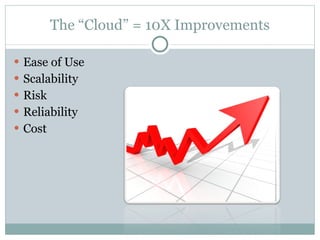
The “Cloud” = 10X Improvements Ease of Use Scalability Risk Reliability Cost
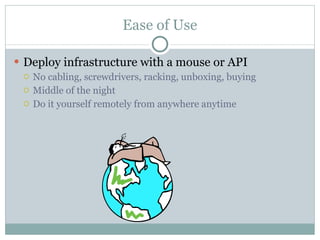
Ease of Use Deploy infrastructure with a mouse or API No cabling, screwdrivers, racking, unboxing, buying Middle of the night Do it yourself remotely from anywhere anytime
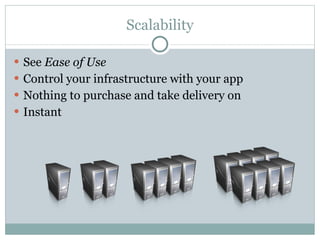
Scalability See  Ease of Use Control your infrastructure with your app Nothing to purchase and take delivery on Instant
Risk Nothing to buy Cancel immediately Change instantly, even operating systems Throw it out Rebuild it instantly after testing RISK
Reliability Based on enterprise grade hardware Design for failures: Automatically spin up replacements Use multiple clouds
Cost “ Turn off the lights” = turn off servers you aren’t using Ex:  Turn off development and test environments Pay for only what you use No need to buy in advance Zero Capital Outlay  No contracts
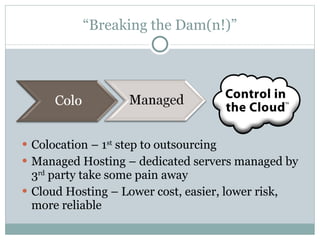
“ Breaking the Dam(n!)” Colocation – 1 st  step to outsourcing Managed Hosting – dedicated servers managed by 3 rd  party take some pain away Cloud Hosting – Lower cost, easier, lower risk, more reliable
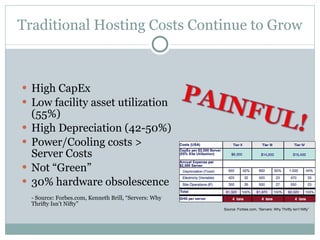
Traditional Hosting Costs Continue to Grow High CapEx Low facility asset utilization (55%) High Depreciation (42-50%) Power/Cooling costs > Server Costs Not “Green” 30% hardware obsolescence - Source: Forbes.com, Kenneth Brill, “Servers: Why Thrifty Isn’t Nifty” Source: Forbes.com, “Servers: Why Thrifty Isn’t Nifty”
UNDERSTANDING HOW EXPERTS VIEW “CLOUD COMPUTING” Multiple Definitions
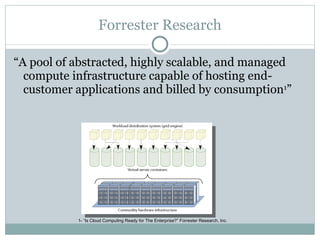
Forrester Research “ A pool of abstracted, highly scalable, and managed compute infrastructure capable of hosting end-customer applications and billed by consumption 1 ” 1- “Is Cloud Computing Ready for The Enterprise?” Forrester Research, Inc.
Other Definitions “ Cloud computing is an emerging approach to shared infrastructure in which large pools of systems are linked together to provide IT services.”  – IBM press release on “Blue Cloud” “… a hosted infrastructure model that delivers abstracted IT resources over the Internet”  – Thomas Weisel Partners LLC from “Into the Clouds: Leveraging  Data Centers and the Road to Cloud Computing” “ Cloud computing describes a systems architecture. Period. This particular architecture assumes nothing about the physical location, internal composition or ownership of its component parts.”  – James Urquhart blog post
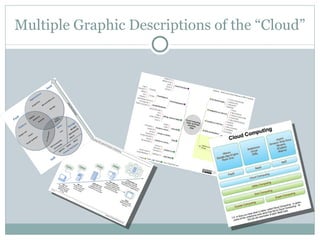
Multiple Graphic Descriptions of the “Cloud”
PERSPECTIVE VIEW OF “CLOUD COMPUTING” Redefining the definition
Defining the Segments SaaS Software as a Service Storage as a Service PaaS – Platform as a Service IaaS – Infrastructure as a Service
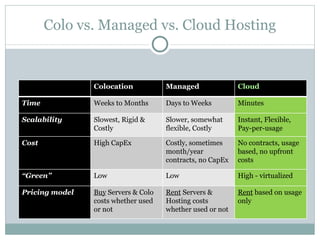
Colo vs. Managed vs. Cloud Hosting Colocation Managed Cloud Time Weeks to Months Days to Weeks Minutes Scalability Slowest, Rigid & Costly Slower, somewhat flexible, Costly Instant, Flexible, Pay-per-usage Cost High CapEx Costly, sometimes month/year contracts, no CapEx No contracts, usage based, no upfront costs “ Green” Low Low High - virtualized Pricing model Buy  Servers & Colo costs whether used or not Rent  Servers & Hosting costs whether used or not Rent  based on usage only
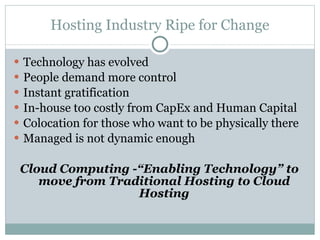
Hosting Industry Ripe for Change Technology has evolved People demand more control Instant gratification In-house too costly from CapEx and Human Capital Colocation for those who want to be physically there Managed is not dynamic enough Cloud Computing -“Enabling Technology” to move from Traditional Hosting to Cloud Hosting
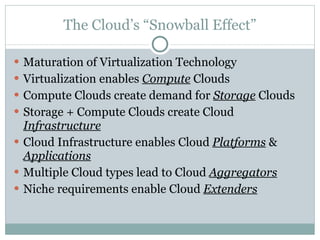
The Cloud’s “Snowball Effect” Maturation of Virtualization Technology Virtualization enables  Compute  Clouds Compute Clouds create demand for  Storage  Clouds Storage + Compute Clouds create Cloud  Infrastructure Cloud Infrastructure enables Cloud  Platforms  &  Applications Multiple Cloud types lead to Cloud  Aggregators Niche requirements enable Cloud  Extenders
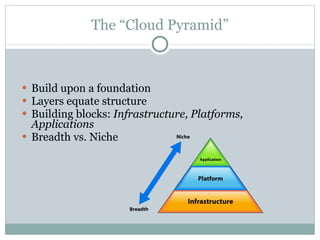
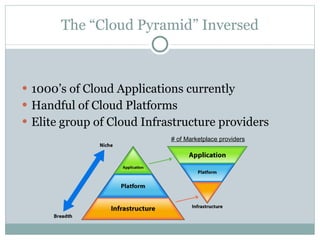
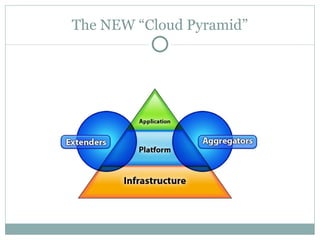
The “Cloud Pyramid” Build upon a foundation Layers equate structure Building blocks:  Infrastructure, Platforms, Applications Breadth vs. Niche
The “Cloud Pyramid” Inversed 1000’s of Cloud Applications currently Handful of Cloud Platforms Elite group of Cloud Infrastructure providers # of Marketplace providers
Cloud Computing is… …  virtualized compute power and storage delivered via platform-agnostic infrastructures of abstracted hardware and software accessed over the Internet. These shared, on-demand IT resources, are created and disposed of efficiently, are dynamically scalable through a variety of programmatic interfaces and are billed variably based on measurable usage.
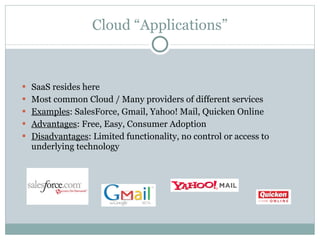
Cloud “Applications” SaaS resides here Most common Cloud / Many providers of different services Examples : SalesForce, Gmail, Yahoo! Mail, Quicken Online Advantages : Free, Easy, Consumer Adoption Disadvantages : Limited functionality, no control or access to underlying technology
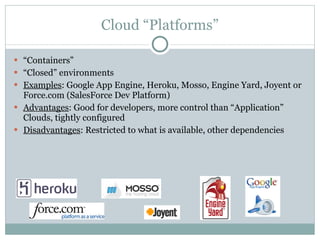
Cloud “Platforms” “ Containers” “ Closed” environments Examples : Google App Engine, Heroku, Mosso, Engine Yard, Joyent or Force.com (SalesForce Dev Platform) Advantages : Good for developers, more control than “Application” Clouds, tightly configured Disadvantages : Restricted to what is available, other dependencies
Cloud “Infrastructure” Provide “Compute” and “Storage” clouds Virtualization layers (hardware/software) Examples : Amazon EC2, GoGrid, Amazon S3, Nirvanix, Linode Advantages : Full control of environments and infrastructure Disadvantages : premium price point, limited competition
Cloud “Extenders” (Wild Card) Provides extension to Cloud Infrastructure and Platforms with basic functionality Examples : Amazon SimpleDB, Amazon SQS, Google BigTable Advantages : Extends functionality of Compute & Storage Clouds to integrate with legacy system or other clouds Disadvantages : Sometimes requires use of specific Platforms or Infrastructure
Cloud “Aggregators” (Wild Card) Sits on top of various Cloud Infrastructures for management Examples : RightScale, Appistry Advantages : Provides more options for Cloud environments Disadvantages : Dependent on Cloud Providers
The NEW “Cloud Pyramid”
Thank You

Cloud computing

  • 1.
    DISRUPTIVE INNOVATION & ENABLING TECHNOLOGY Cloud Computing Author: Tushprit Singh 0501323108 IT1 (7 th Semester)
  • 2.
    The “Cloud” =10X Improvements Ease of Use Scalability Risk Reliability Cost
  • 3.
    Ease of UseDeploy infrastructure with a mouse or API No cabling, screwdrivers, racking, unboxing, buying Middle of the night Do it yourself remotely from anywhere anytime
  • 4.
    Scalability See Ease of Use Control your infrastructure with your app Nothing to purchase and take delivery on Instant
  • 5.
    Risk Nothing tobuy Cancel immediately Change instantly, even operating systems Throw it out Rebuild it instantly after testing RISK
  • 6.
    Reliability Based onenterprise grade hardware Design for failures: Automatically spin up replacements Use multiple clouds
  • 7.
    Cost “ Turnoff the lights” = turn off servers you aren’t using Ex: Turn off development and test environments Pay for only what you use No need to buy in advance Zero Capital Outlay No contracts
  • 8.
    “ Breaking theDam(n!)” Colocation – 1 st step to outsourcing Managed Hosting – dedicated servers managed by 3 rd party take some pain away Cloud Hosting – Lower cost, easier, lower risk, more reliable
  • 9.
    Traditional Hosting CostsContinue to Grow High CapEx Low facility asset utilization (55%) High Depreciation (42-50%) Power/Cooling costs > Server Costs Not “Green” 30% hardware obsolescence - Source: Forbes.com, Kenneth Brill, “Servers: Why Thrifty Isn’t Nifty” Source: Forbes.com, “Servers: Why Thrifty Isn’t Nifty”
  • 10.
    UNDERSTANDING HOW EXPERTSVIEW “CLOUD COMPUTING” Multiple Definitions
  • 11.
    Forrester Research “A pool of abstracted, highly scalable, and managed compute infrastructure capable of hosting end-customer applications and billed by consumption 1 ” 1- “Is Cloud Computing Ready for The Enterprise?” Forrester Research, Inc.
  • 12.
    Other Definitions “Cloud computing is an emerging approach to shared infrastructure in which large pools of systems are linked together to provide IT services.” – IBM press release on “Blue Cloud” “… a hosted infrastructure model that delivers abstracted IT resources over the Internet” – Thomas Weisel Partners LLC from “Into the Clouds: Leveraging Data Centers and the Road to Cloud Computing” “ Cloud computing describes a systems architecture. Period. This particular architecture assumes nothing about the physical location, internal composition or ownership of its component parts.” – James Urquhart blog post
  • 13.
  • 14.
    PERSPECTIVE VIEW OF“CLOUD COMPUTING” Redefining the definition
  • 15.
    Defining the SegmentsSaaS Software as a Service Storage as a Service PaaS – Platform as a Service IaaS – Infrastructure as a Service
  • 16.
    Colo vs. Managedvs. Cloud Hosting Colocation Managed Cloud Time Weeks to Months Days to Weeks Minutes Scalability Slowest, Rigid & Costly Slower, somewhat flexible, Costly Instant, Flexible, Pay-per-usage Cost High CapEx Costly, sometimes month/year contracts, no CapEx No contracts, usage based, no upfront costs “ Green” Low Low High - virtualized Pricing model Buy Servers & Colo costs whether used or not Rent Servers & Hosting costs whether used or not Rent based on usage only
  • 17.
    Hosting Industry Ripefor Change Technology has evolved People demand more control Instant gratification In-house too costly from CapEx and Human Capital Colocation for those who want to be physically there Managed is not dynamic enough Cloud Computing -“Enabling Technology” to move from Traditional Hosting to Cloud Hosting
  • 18.
    The Cloud’s “SnowballEffect” Maturation of Virtualization Technology Virtualization enables Compute Clouds Compute Clouds create demand for Storage Clouds Storage + Compute Clouds create Cloud Infrastructure Cloud Infrastructure enables Cloud Platforms & Applications Multiple Cloud types lead to Cloud Aggregators Niche requirements enable Cloud Extenders
  • 19.
    The “Cloud Pyramid”Build upon a foundation Layers equate structure Building blocks: Infrastructure, Platforms, Applications Breadth vs. Niche
  • 20.
    The “Cloud Pyramid”Inversed 1000’s of Cloud Applications currently Handful of Cloud Platforms Elite group of Cloud Infrastructure providers # of Marketplace providers
  • 21.
    Cloud Computing is…… virtualized compute power and storage delivered via platform-agnostic infrastructures of abstracted hardware and software accessed over the Internet. These shared, on-demand IT resources, are created and disposed of efficiently, are dynamically scalable through a variety of programmatic interfaces and are billed variably based on measurable usage.
  • 22.
    Cloud “Applications” SaaSresides here Most common Cloud / Many providers of different services Examples : SalesForce, Gmail, Yahoo! Mail, Quicken Online Advantages : Free, Easy, Consumer Adoption Disadvantages : Limited functionality, no control or access to underlying technology
  • 23.
    Cloud “Platforms” “Containers” “ Closed” environments Examples : Google App Engine, Heroku, Mosso, Engine Yard, Joyent or Force.com (SalesForce Dev Platform) Advantages : Good for developers, more control than “Application” Clouds, tightly configured Disadvantages : Restricted to what is available, other dependencies
  • 24.
    Cloud “Infrastructure” Provide“Compute” and “Storage” clouds Virtualization layers (hardware/software) Examples : Amazon EC2, GoGrid, Amazon S3, Nirvanix, Linode Advantages : Full control of environments and infrastructure Disadvantages : premium price point, limited competition
  • 25.
    Cloud “Extenders” (WildCard) Provides extension to Cloud Infrastructure and Platforms with basic functionality Examples : Amazon SimpleDB, Amazon SQS, Google BigTable Advantages : Extends functionality of Compute & Storage Clouds to integrate with legacy system or other clouds Disadvantages : Sometimes requires use of specific Platforms or Infrastructure
  • 26.
    Cloud “Aggregators” (WildCard) Sits on top of various Cloud Infrastructures for management Examples : RightScale, Appistry Advantages : Provides more options for Cloud environments Disadvantages : Dependent on Cloud Providers
  • 27.
    The NEW “CloudPyramid”
  • 28.

Editor's Notes

  • #14 Source: http://et.cairene.net/2008/07/28/the-cloud-services-stack-infrastructure/ Source: http://www.productionscale.com/home/2008/7/13/cloud-computing-ectropy-and-other-thoughts-for-july-2008.html