31/10/2012


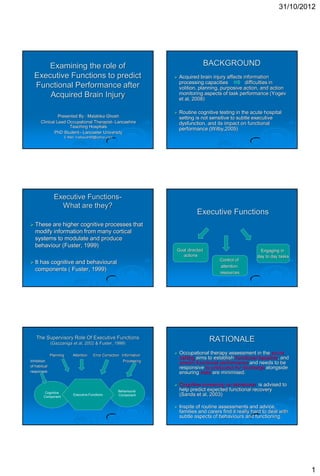
      Examining the role of                                                              BACKGROUND
  Executive Functions to predict                                            Acquired brain injury affects information
                                                                             processing capacities          difficulties in
  Functional Performance after                                               volition, planning, purposive action, and action
      Acquired Brain Injury                                                  monitoring aspects of task performance (Yogev
                                                                             et al, 2008)

                                                                            Routine cognitive testing in the acute hospital
                 Presented By : Malabika Ghosh                               setting is not sensitive to subtle executive
       Clinical Lead Occupational Therapist- Lancashire                      dysfunction, and its impact on functional
                      Teaching Hospitals
                                                                             performance (Wilby,2005)
               PhD Student– Lancaster University
                         E-Mail: malkaush99@yahoo.com


                Executive Functions-
                  What are they?
                                                                                     Executive Functions
 These  are higher cognitive processes that
   modify information from many cortical
   systems to modulate and produce
   behaviour (Fuster, 1999)
                                                                         Goal directed                              Engaging in
                                                                           actions                                day to day tasks
                                                                                                Control of
 It has cognitive and behavioural
                                                                                                attention
   components ( Fuster, 1999)
                                                                                                resources


   The Supervisory Role Of Executive Functions                                             RATIONALE
              (Gazzaniga et al, 2002 & Fuster, 1999)

              Planning        Attention   Error Correction Information
                                                                            Occupational therapy assessment in the acute
                                                                             setting aims to establish functional baseline, and
Inhibition                                                 Processing
                                                                             predict functional performance and needs to be
of habitual                                                                  responsive to pressures for discharge alongside
responses                                                                    ensuring risks are minimised.

                                                                            Cognitive screening on admission is advised to
                                                        Behavioural          help predict expected functional recovery
         Cognitive
        Component
                              Executive Functions       Component            (Sands et al, 2003)

                                                                            Inspite of routine assessments and advice,
                                                                             families and carers find it really hard to deal with
                                                                             subtle aspects of behaviours and functioning.


                                                                                                                                     1
31/10/2012


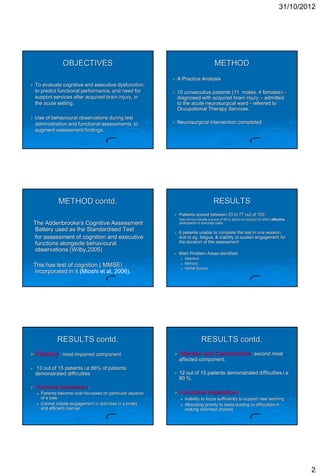
                   OBJECTIVES                                                               METHOD
                                                                  A Practice Analysis
   To evaluate cognitive and executive dysfunction,
    to predict functional performance, and need for               15 consecutive patients (11 males, 4 females) –
    support services after acquired brain injury, in               diagnosed with acquired brain injury – admitted
    the acute setting.                                             to the acute neurosurgical ward - referred to
                                                                   Occupational Therapy Services.
   Use of behavioural observations during test
    administration and functional assessments, to                 Neurosurgical intervention completed
    augment assessment findings.


                METHOD contd.                                                              RESULTS
                                                                  Patients scored between 23 to 77 out of 100.
                                                                   Test norms indicate a score of 89 or above is required to reflect effective
 The Addenbrooke’s Cognitive Assessment                            participation in everyday tasks

 Battery used as the Standardised Test                            6 patients unable to complete the test in one session,
 for assessment of cognition and executive                         due to eg. fatigue, & inability to sustain engagement for
 functions alongside behavioural                                   the duration of the assessment
 observations (Wilby,2005)
                                                                  Main Problem Areas identified:
                                                                       Attention
                                                                        Memory
 This has test of cognition ( MMSE)                                 

                                                                       Verbal fluency
 incorporated in it (Mioshi et al, 2006).


                RESULTS contd.                                                    RESULTS contd.
 Fluency : most impaired component                             Attention          and Concentration: second most
                                                                   affected component.
   13 out of 15 patients i.e 86% of patients
    demonstrated difficulties                                     12 out of 15 patients demonstrated difficulties i.e
                                                                   80 %.
   Functional Implications :
       Patients become over-focussed on particular aspects     Functional            Implications:
        of a task                                                      Inability to focus sufficiently to support new learning
       Cannot initiate engagement in activities in a timely           Allocating priority to tasks leading to difficulties in
        and efficient manner                                            making informed choices


                                                                                                                                                 2
31/10/2012


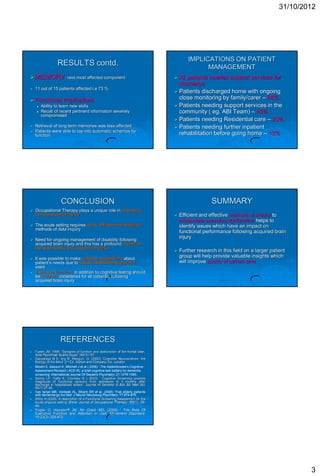
                                                                                           IMPLICATIONS ON PATIENT
                   RESULTS contd.                                                                MANAGEMENT
 MEMORY: next most affected component                                              Allpatients needed support services for
                                                                                     discharge
   11 out of 15 patients affected i.e 73 %
                                                                                    Patients discharged home with ongoing
 Functional           Implications:                                                 close monitoring by family/carer – 66%
        Ability to learn new skills                                                Patients needing support services in the
        Recall of recent pertinent information severely                             community ( eg. ABI Team) – 46%
         compromised
                                                                                    Patients needing Residential care – 20%
   Retrieval of long term memories was less affected                               Patients needing further inpatient
   Patients were able to tap into automatic schemas for
    function                                                                         rehabilitation before going home – 13%


                     CONCLUSION                                                                       SUMMARY
   Occupational Therapy plays a unique role in assessing
    functional performance                                                            Efficient and effective methods of inquiry to
                                                                                       extrapolate executive dysfunction helps to
   The acute setting requires quick, efficient and effective                          identify issues which have an impact on
    methods of data inquiry
                                                                                       functional performance following acquired brain
   Need for ongoing management of disability following
                                                                                       injury
    acquired brain injury and this has a profound impact on
    the wider family and support networks
                                                                                      Further research in this field on a larger patient
   It was possible to make valuable suggestions about
                                                                                       group will help provide valuable insights which
    patient’s needs due to holistic assessment approach                                will improve quality of patient care.
    used.
   Executive functions in addition to cognitive testing should
    be routinely considered for all patients, following
    acquired brain injury


                     REFERENCES
   Fuster JM. 1999. ‘Synopsis of function and dysfunction of the frontal lobe’.
    Acta Psychhiatr Scand Suppl; 395:51-57.
   Gazzaniga M.S. Ivry R. Mangun, G. (2002) ‘Cognitive Neuroscience- the
    Biology of the Mind’ 2nd Ed. Norton and Company Inc. London.
•   Mioshi E, dawson K, Mitchell J et al ( 2006) ‘ The Addenbrooke’s Cognitive
    Assessment Revised ( ACE-R): a brief cognitive test battery for dementia
    screening’ International Journal Of Geriatric Psychiatry; 21:1078-1085.
   Sands LP, Yaffe K, Covinsky K ( 2003) ‘ Cognitive Screening predicts
    magnitude of functional recovery from admission to 3 months after
    discharge in hospitalised elders’. Journal of Gerontol A Biol Sci Med Sci;
    58(1):37-45.
   Van Iersal MB, Verbeek AL, Bloem BR et al, (2006) ‘Frail elderly patients
    with dementia go too fast’ J Neurol Neurosurg Psychiatry; 77:874-876.
   Wilby H.(2005) ‘A description of a Functional Screening Assessment for the
    Acute physical setting’ British Journal of Occupational Therapy. 68(1), 39-
    44.
   Yogev G, Hausdorff JM, Nir Giladi MD, (2008) ‘ The Role Of
    Executive Function and Attention In Gait’ Movement Disorders;
    15;23(3):329-472.


                                                                                                                                              3

malabika executive functions

  • 1.
    31/10/2012 Examining the role of BACKGROUND Executive Functions to predict  Acquired brain injury affects information processing capacities difficulties in Functional Performance after volition, planning, purposive action, and action Acquired Brain Injury monitoring aspects of task performance (Yogev et al, 2008)  Routine cognitive testing in the acute hospital Presented By : Malabika Ghosh setting is not sensitive to subtle executive Clinical Lead Occupational Therapist- Lancashire dysfunction, and its impact on functional Teaching Hospitals performance (Wilby,2005) PhD Student– Lancaster University E-Mail: malkaush99@yahoo.com Executive Functions- What are they? Executive Functions  These are higher cognitive processes that modify information from many cortical systems to modulate and produce behaviour (Fuster, 1999) Goal directed Engaging in actions day to day tasks Control of  It has cognitive and behavioural attention components ( Fuster, 1999) resources The Supervisory Role Of Executive Functions RATIONALE (Gazzaniga et al, 2002 & Fuster, 1999) Planning Attention Error Correction Information  Occupational therapy assessment in the acute setting aims to establish functional baseline, and Inhibition Processing predict functional performance and needs to be of habitual responsive to pressures for discharge alongside responses ensuring risks are minimised.  Cognitive screening on admission is advised to Behavioural help predict expected functional recovery Cognitive Component Executive Functions Component (Sands et al, 2003)  Inspite of routine assessments and advice, families and carers find it really hard to deal with subtle aspects of behaviours and functioning. 1
  • 2.
    31/10/2012 OBJECTIVES METHOD  A Practice Analysis  To evaluate cognitive and executive dysfunction, to predict functional performance, and need for  15 consecutive patients (11 males, 4 females) – support services after acquired brain injury, in diagnosed with acquired brain injury – admitted the acute setting. to the acute neurosurgical ward - referred to Occupational Therapy Services.  Use of behavioural observations during test administration and functional assessments, to  Neurosurgical intervention completed augment assessment findings. METHOD contd. RESULTS  Patients scored between 23 to 77 out of 100. Test norms indicate a score of 89 or above is required to reflect effective The Addenbrooke’s Cognitive Assessment participation in everyday tasks Battery used as the Standardised Test  6 patients unable to complete the test in one session, for assessment of cognition and executive due to eg. fatigue, & inability to sustain engagement for functions alongside behavioural the duration of the assessment observations (Wilby,2005)  Main Problem Areas identified:  Attention Memory This has test of cognition ( MMSE)   Verbal fluency incorporated in it (Mioshi et al, 2006). RESULTS contd. RESULTS contd.  Fluency : most impaired component  Attention and Concentration: second most affected component.  13 out of 15 patients i.e 86% of patients demonstrated difficulties  12 out of 15 patients demonstrated difficulties i.e 80 %.  Functional Implications :  Patients become over-focussed on particular aspects  Functional Implications: of a task  Inability to focus sufficiently to support new learning  Cannot initiate engagement in activities in a timely  Allocating priority to tasks leading to difficulties in and efficient manner making informed choices 2
  • 3.
    31/10/2012 IMPLICATIONS ON PATIENT RESULTS contd. MANAGEMENT  MEMORY: next most affected component  Allpatients needed support services for discharge  11 out of 15 patients affected i.e 73 %  Patients discharged home with ongoing  Functional Implications: close monitoring by family/carer – 66%  Ability to learn new skills  Patients needing support services in the  Recall of recent pertinent information severely community ( eg. ABI Team) – 46% compromised  Patients needing Residential care – 20%  Retrieval of long term memories was less affected  Patients needing further inpatient  Patients were able to tap into automatic schemas for function rehabilitation before going home – 13% CONCLUSION SUMMARY  Occupational Therapy plays a unique role in assessing functional performance  Efficient and effective methods of inquiry to extrapolate executive dysfunction helps to  The acute setting requires quick, efficient and effective identify issues which have an impact on methods of data inquiry functional performance following acquired brain  Need for ongoing management of disability following injury acquired brain injury and this has a profound impact on the wider family and support networks  Further research in this field on a larger patient  It was possible to make valuable suggestions about group will help provide valuable insights which patient’s needs due to holistic assessment approach will improve quality of patient care. used.  Executive functions in addition to cognitive testing should be routinely considered for all patients, following acquired brain injury REFERENCES  Fuster JM. 1999. ‘Synopsis of function and dysfunction of the frontal lobe’. Acta Psychhiatr Scand Suppl; 395:51-57.  Gazzaniga M.S. Ivry R. Mangun, G. (2002) ‘Cognitive Neuroscience- the Biology of the Mind’ 2nd Ed. Norton and Company Inc. London. • Mioshi E, dawson K, Mitchell J et al ( 2006) ‘ The Addenbrooke’s Cognitive Assessment Revised ( ACE-R): a brief cognitive test battery for dementia screening’ International Journal Of Geriatric Psychiatry; 21:1078-1085.  Sands LP, Yaffe K, Covinsky K ( 2003) ‘ Cognitive Screening predicts magnitude of functional recovery from admission to 3 months after discharge in hospitalised elders’. Journal of Gerontol A Biol Sci Med Sci; 58(1):37-45.  Van Iersal MB, Verbeek AL, Bloem BR et al, (2006) ‘Frail elderly patients with dementia go too fast’ J Neurol Neurosurg Psychiatry; 77:874-876.  Wilby H.(2005) ‘A description of a Functional Screening Assessment for the Acute physical setting’ British Journal of Occupational Therapy. 68(1), 39- 44.  Yogev G, Hausdorff JM, Nir Giladi MD, (2008) ‘ The Role Of Executive Function and Attention In Gait’ Movement Disorders; 15;23(3):329-472. 3