








Examining the roles of Acceptance
  and Suppression in Relaxation

       Dr. Christopher Wilson
             Psychology
              24/11/10
Overview
• Background

• Experiment

• Discussion
WHAT IS RELAXATION?
A state of equilibrium that
is free from psychological
or physiological tension.
WHAT’S INVOLVED IN RELAXATION?
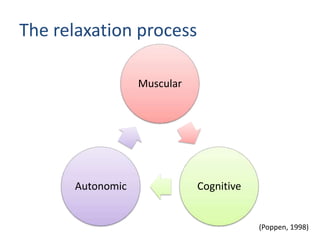
The relaxation process

                  Muscular


      Autonomic              Cognitive


                                         (Poppen, 1998)
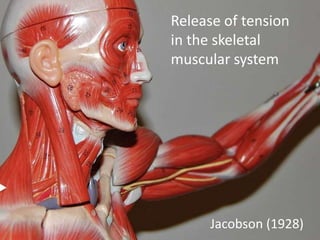
Release of tension
in the skeletal
muscular system


     Jacobson (1928)
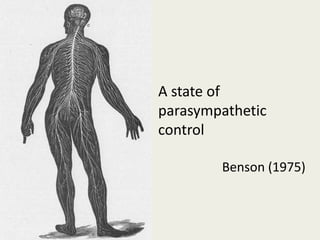
A state of
parasympathetic
control

        Benson (1975)
Self-
focused


          A form of selective
          attention

                 (Boals, 1978)
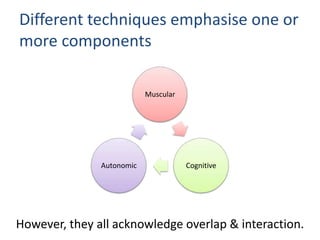
Different techniques emphasise one or
more components

                           Muscular


               Autonomic              Cognitive


However, they all acknowledge overlap & interaction.
THE RELAXATION PARADOX
“An effort to relax
is a failure to
relax”

 (Lehrer et al., 2007)
Increased self-
focus is also
associated with
anxiety (GAD)

(Wolff & Jones, 1993)
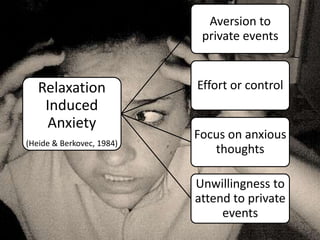
Aversion to
                            private events


   Relaxation              Effort or control
    Induced
    Anxiety
                           Focus on anxious
(Heide & Berkovec, 1984)
                              thoughts

                           Unwillingness to
                           attend to private
                                events
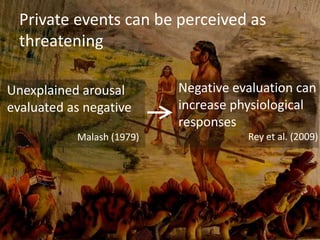
Private events can be perceived as
  threatening

Unexplained arousal        Negative evaluation can
evaluated as negative      increase physiological
                           responses
           Malash (1979)              Rey et al. (2009)
More than just
what I attend to,
it’s how I attend
to it
PASSIVITY
A detached attitude towards
the outcome of a
concentrated activity
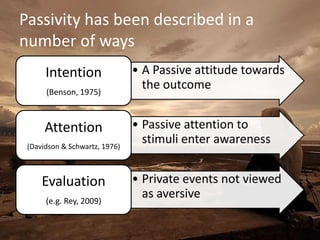
Passivity has been described in a
number of ways
      Intention                • A Passive attitude towards
      (Benson, 1975)
                                 the outcome


      Attention                • Passive attention to
 (Davidson & Schwartz, 1976)
                                 stimuli enter awareness


     Evaluation                • Private events not viewed
      (e.g. Rey, 2009)
                                 as aversive
Passivity is not the
default approach
• Suppression of
  anxious thoughts and
  sensations

• Paradoxical effects
  occur under
  increased cognitive
  load

        (Wegner et al, 1997)
Passivity is counter-intuitive


              “When success in the majority
               of areas of living results from
               goal-directed striving”
                                     (Smith, 1996)
Attempts to explain passivity are often
ambiguous
Let go

Clear your mind

Relax

Don’t panic
PSYCHOLOGICAL ACCEPTANCE
Experiential Avoidance is a commonly-
used strategy
 Thoughts and feelings are transient internal
 phenomena

                   However

    They are often perceived as accurate
          representations of reality
                                    Greco et al. (2008)
Psychological Acceptance promotes
contact with private events

 Do not seek to alter the content or frequency of
 private events directly.

                     Instead

 Seek to alter the context and function so as to
 diminish their behavioural impact.
                                       Greco et al. (2008)
Acceptance and Commitment Therapy
               (ACT)

Seeks to increase psychological flexibility so that
  valued actions may be achieved regardless of
  thoughts or feelings at any particular moment.

                                      Hayes et al. (1999)
PRECEDENTS FOR THE CURRENT
STUDY
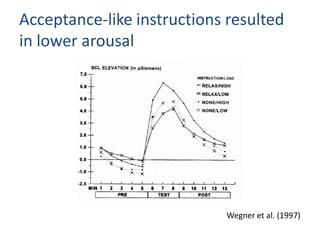
Acceptance-like instructions resulted
in lower arousal


                            Wegner et al. (1997)
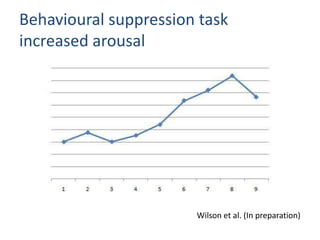
Behavioural suppression task
increased arousal


                       Wilson et al. (In preparation)
CURRENT STUDY: EXAMINING THE
UTILITY OF BRIEF INTERVENTIONS
Overall aim of the current research


 To examine the efficacy of interventions in
 reducing physiological arousal and subjective
 anxiety levels
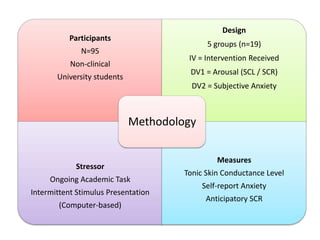
Design
           Participants
                                            5 groups (n=19)
              N=95
                                       IV = Intervention Received
           Non-clinical
                                       DV1 = Arousal (SCL / SCR)
       University students
                                        DV2 = Subjective Anxiety


                             Methodology

                                               Measures
            Stressor
                                      Tonic Skin Conductance Level
     Ongoing Academic Task
                                           Self-report Anxiety
Intermittent Stimulus Presentation
                                            Anticipatory SCR
        (Computer-based)
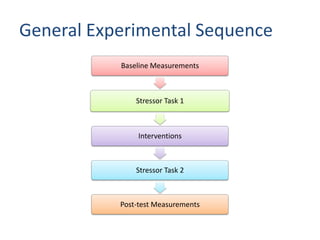
General Experimental Sequence
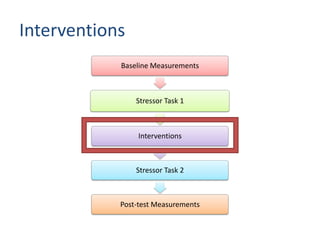
           Baseline Measurements


               Stressor Task 1


                Interventions


               Stressor Task 2


           Post-test Measurements
STRESSOR TASK
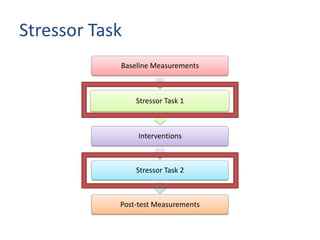
Stressor Task
            Baseline Measurements


                Stressor Task 1


                 Interventions


                Stressor Task 2


            Post-test Measurements
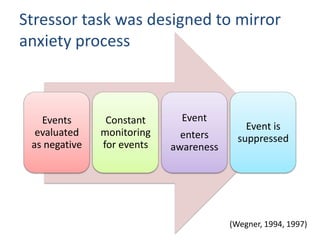
Stressor task was designed to mirror
anxiety process


   Events       Constant      Event
                                            Event is
  evaluated    monitoring     enters      suppressed
 as negative   for events   awareness


                                        (Wegner, 1994, 1997)
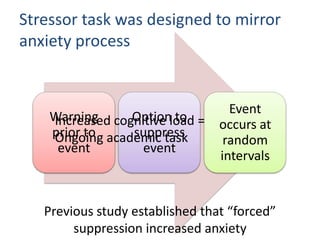
Stressor task was designed to mirror
anxiety process


                                   Event
    Warning cognitive load =
    Increased Option to          occurs at
    prior to academic task
    Ongoing      suppress
                                  random
     event        event
                                 intervals


   Previous study established that “forced”
        suppression increased anxiety
INTERVENTIONS
Interventions
            Baseline Measurements


                Stressor Task 1


                 Interventions


                Stressor Task 2


            Post-test Measurements
Interventions
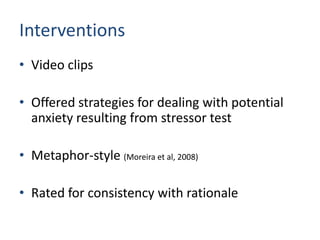
• Video clips

• Offered strategies for dealing with potential
  anxiety resulting from stressor test

• Metaphor-style (Moreira et al, 2008)

• Rated for consistency with rationale
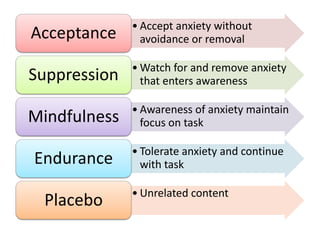
• Accept anxiety without
Acceptance      avoidance or removal

              • Watch for and remove anxiety
Suppression     that enters awareness

              • Awareness of anxiety maintain
Mindfulness     focus on task

              • Tolerate anxiety and continue
Endurance       with task

              • Unrelated content
 Placebo
MEASURES OF ANXIETY LEVEL
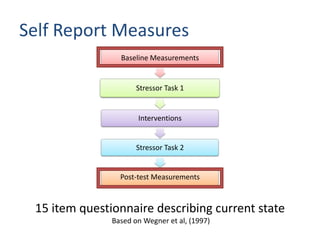
Self Report Measures
                 Baseline Measurements


                      Stressor Task 1


                      Interventions


                      Stressor Task 2


                 Post-test Measurements


 15 item questionnaire describing current state
               Based on Wegner et al, (1997)
Physiological arousal: Skin
Conductance

• Results from activation of ANS

• Sensitive to changes in emotional states

• SCL = Over time period

• SCR= Specific stimuli/events
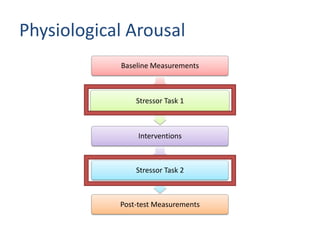
Physiological Arousal
            Baseline Measurements


                Stressor Task 1


                 Interventions


                Stressor Task 2


            Post-test Measurements
RESULTS
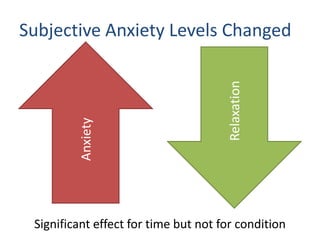
Subjective Anxiety Levels Changed


                                      Relaxation
         Anxiety


 Significant effect for time but not for condition
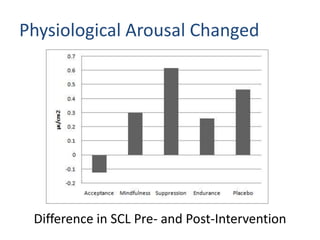
Physiological Arousal Changed


 Difference in SCL Pre- and Post-Intervention
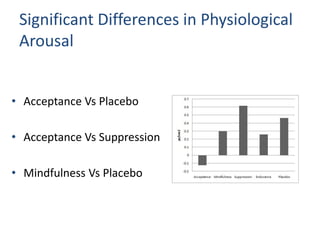
Significant Differences in Physiological
 Arousal


• Acceptance Vs Placebo

• Acceptance Vs Suppression

• Mindfulness Vs Placebo
DISCUSSION
Findings
• Suggests a role for Acceptance in relaxation
  protocols

• Reinforces previous findings on Suppression

• Suggests Acceptance is different to
  Mindfulness and Endurance
Points of discussion
• Differences in physiological and subjective
  measures

• Short length of interventions

• Physiological changes consistent but not large

• Generalisability of task
Further questions
• Deeper examination of processes within
  interventions

• Further examination of different
  warning/event arousal patterns

• Examining derived relational aspect of anxiety
THANK YOU – QUESTIONS?

Christopher Wilson SOFI Nov 2010

  • 1.
    Examining the rolesof Acceptance and Suppression in Relaxation Dr. Christopher Wilson Psychology 24/11/10
  • 2.
  • 3.
  • 4.
    A state ofequilibrium that is free from psychological or physiological tension.
  • 5.
  • 6.
    The relaxation process Muscular Autonomic Cognitive (Poppen, 1998)
  • 7.
    Release of tension inthe skeletal muscular system Jacobson (1928)
  • 8.
  • 9.
    Self- focused A form of selective attention (Boals, 1978)
  • 10.
    Different techniques emphasiseone or more components Muscular Autonomic Cognitive However, they all acknowledge overlap & interaction.
  • 11.
  • 12.
    “An effort torelax is a failure to relax” (Lehrer et al., 2007)
  • 13.
    Increased self- focus isalso associated with anxiety (GAD) (Wolff & Jones, 1993)
  • 14.
    Aversion to private events Relaxation Effort or control Induced Anxiety Focus on anxious (Heide & Berkovec, 1984) thoughts Unwillingness to attend to private events
  • 15.
    Private events canbe perceived as threatening Unexplained arousal Negative evaluation can evaluated as negative increase physiological responses Malash (1979) Rey et al. (2009)
  • 16.
    More than just whatI attend to, it’s how I attend to it
  • 17.
  • 18.
    A detached attitudetowards the outcome of a concentrated activity
  • 19.
    Passivity has beendescribed in a number of ways Intention • A Passive attitude towards (Benson, 1975) the outcome Attention • Passive attention to (Davidson & Schwartz, 1976) stimuli enter awareness Evaluation • Private events not viewed (e.g. Rey, 2009) as aversive
  • 20.
    Passivity is notthe default approach • Suppression of anxious thoughts and sensations • Paradoxical effects occur under increased cognitive load (Wegner et al, 1997)
  • 21.
    Passivity is counter-intuitive “When success in the majority of areas of living results from goal-directed striving” (Smith, 1996)
  • 22.
    Attempts to explainpassivity are often ambiguous Let go Clear your mind Relax Don’t panic
  • 23.
  • 24.
    Experiential Avoidance isa commonly- used strategy Thoughts and feelings are transient internal phenomena However They are often perceived as accurate representations of reality Greco et al. (2008)
  • 25.
    Psychological Acceptance promotes contactwith private events Do not seek to alter the content or frequency of private events directly. Instead Seek to alter the context and function so as to diminish their behavioural impact. Greco et al. (2008)
  • 26.
    Acceptance and CommitmentTherapy (ACT) Seeks to increase psychological flexibility so that valued actions may be achieved regardless of thoughts or feelings at any particular moment. Hayes et al. (1999)
  • 27.
    PRECEDENTS FOR THECURRENT STUDY
  • 28.
    Acceptance-like instructions resulted inlower arousal Wegner et al. (1997)
  • 29.
    Behavioural suppression task increasedarousal Wilson et al. (In preparation)
  • 30.
    CURRENT STUDY: EXAMININGTHE UTILITY OF BRIEF INTERVENTIONS
  • 31.
    Overall aim ofthe current research To examine the efficacy of interventions in reducing physiological arousal and subjective anxiety levels
  • 32.
    Design Participants 5 groups (n=19) N=95 IV = Intervention Received Non-clinical DV1 = Arousal (SCL / SCR) University students DV2 = Subjective Anxiety Methodology Measures Stressor Tonic Skin Conductance Level Ongoing Academic Task Self-report Anxiety Intermittent Stimulus Presentation Anticipatory SCR (Computer-based)
  • 33.
    General Experimental Sequence Baseline Measurements Stressor Task 1 Interventions Stressor Task 2 Post-test Measurements
  • 34.
  • 35.
    Stressor Task Baseline Measurements Stressor Task 1 Interventions Stressor Task 2 Post-test Measurements
  • 36.
    Stressor task wasdesigned to mirror anxiety process Events Constant Event Event is evaluated monitoring enters suppressed as negative for events awareness (Wegner, 1994, 1997)
  • 37.
    Stressor task wasdesigned to mirror anxiety process Event Warning cognitive load = Increased Option to occurs at prior to academic task Ongoing suppress random event event intervals Previous study established that “forced” suppression increased anxiety
  • 38.
  • 39.
    Interventions Baseline Measurements Stressor Task 1 Interventions Stressor Task 2 Post-test Measurements
  • 40.
    Interventions • Video clips •Offered strategies for dealing with potential anxiety resulting from stressor test • Metaphor-style (Moreira et al, 2008) • Rated for consistency with rationale
  • 41.
    • Accept anxietywithout Acceptance avoidance or removal • Watch for and remove anxiety Suppression that enters awareness • Awareness of anxiety maintain Mindfulness focus on task • Tolerate anxiety and continue Endurance with task • Unrelated content Placebo
  • 42.
  • 43.
    Self Report Measures Baseline Measurements Stressor Task 1 Interventions Stressor Task 2 Post-test Measurements 15 item questionnaire describing current state Based on Wegner et al, (1997)
  • 44.
    Physiological arousal: Skin Conductance •Results from activation of ANS • Sensitive to changes in emotional states • SCL = Over time period • SCR= Specific stimuli/events
  • 45.
    Physiological Arousal Baseline Measurements Stressor Task 1 Interventions Stressor Task 2 Post-test Measurements
  • 46.
  • 47.
    Subjective Anxiety LevelsChanged Relaxation Anxiety Significant effect for time but not for condition
  • 48.
    Physiological Arousal Changed Difference in SCL Pre- and Post-Intervention
  • 49.
    Significant Differences inPhysiological Arousal • Acceptance Vs Placebo • Acceptance Vs Suppression • Mindfulness Vs Placebo
  • 50.
  • 51.
    Findings • Suggests arole for Acceptance in relaxation protocols • Reinforces previous findings on Suppression • Suggests Acceptance is different to Mindfulness and Endurance
  • 52.
    Points of discussion •Differences in physiological and subjective measures • Short length of interventions • Physiological changes consistent but not large • Generalisability of task
  • 53.
    Further questions • Deeperexamination of processes within interventions • Further examination of different warning/event arousal patterns • Examining derived relational aspect of anxiety
  • 54.
    THANK YOU –QUESTIONS?

Editor's Notes

  • #17 Cognitive appraisals made at each stage of the process further influence physiological arousal.
  • #26 Recognise the self as the context in which private events occur, not the events themselves
  • #38 Increased cognitive load (academic task) Intermittent aversive event presentationPrior warning to facilitate monitoringOption to suppress event