6 FOOD GROUPS &
FUNCTIONS IN THE BODY
T. Nkhoma
Child Nurse Specialist
OBJECTIVES
By the end of this lesson, leaners should
be able to ;
I. State the 6 food groups for a healthy
body
II. Describe the types of nutrients found in
a particular food group
III.State the functions of food nutrients for
a health body
THE SIX FOOD GROUPS IN MALAWI
3
SIX FOOD GROUPS
1. VEGETABLES- green leaves, carrots, cabbages, egg plants,
tomatoes, pumpkins, okra, green beans
2. FRUITS- mangoes, pawpaws, guava
3. LEGUMES- cowpeas, soya beans, g-nuts
4. ANIMAL FOODS- meat, fish, eggs, fresh milk,
5. ENERGY FOODS-nsima, cassava, potatoes, rice, sweets
potatoes, millet, bread
6. FATS- Cooking oil, avocado, meat fats
 WATER as a supplement
REF. WHO 2014.
4
VARIETIES OF THE SIX FOOD GROUPS FOUND IN
MALAWIAN
Energy
Foods
Legumes
&
Nuts
Vegetable Food
From
Animal
Fat fruits
Nsima
from:
Millet
(Mawere),
Sorghum
(Mapila),
Maize
(Chimang
a),
Cassava
(Chinang
Lablab
(Nkhungu
dz
u)
Pigeon
Peas
(Nandolo)
Ground
Beans
(Nzama)
Cowpeas
Blackjack
(Chisoso)
Amaranth
(Bonongw
e)
Pumpkin
leaves
(Nkhwani)
Mushroom
(Bowa)
Pumpkin
Egg
(Mazira)
Termites
(Ngumbi)
Fish
(Nsomba)
Meat
(Nyama)
Chicken
(NKhuku)
Avocado
(Mapeyala
)
Cooking
Oil
(Mafuta)
Pumpkin
Seed
(Nthanga)
Baobab
(Mlambe)
Banana
(Nthochi)
Pawpaw
(Papaya)
Guava
(Gwafa)
(Local
Fruit)
Masawu 5
THE SIX FOOD GROUPS
1. Vegetables
 Include green leaf and yellow vegetables such as bonongwe,
chisoso, khwanya, mnkhwani, kholowa, rape, mpiru, kamganje,
carrot, egg plants, pumpkin, tomato and others such as mushroom.
They provide mostly vitamins , minerals, and water.
 Vegetables also contain fibre that is necessary for proper digestion.
2. Fruits
 They include citrus fruits (oranges, lemons, tangerines), bananas,
pine apple, pawpaw, mangoes, masau, bwemba, malambe, masuku,
peaches, apples, guava, water melon and many others. Fruits
provide mostly carbohydrates, vitamins & water.
6
THE SIX FOOD GROUPS CONT’D
3. Legumes and Nuts
 This group includes ground nuts, soyabeans, beans, peas,
cowpeas, ground beans (nzama), pigeon peas. They provide
mainly protein and carbohydrate. Soybeans and nuts also
contain a lot of fat in addition to protein and carbohydrate.
4. Animal Foods
 All of the foods in this group are of animal origin such as
meat, eggs, milk products, fish, and insects. They provide
protein, fats, vitamins minerals.
7
THE SIX FOOD GROUPS CONT’D
5. Fats
 This group includes oil seeds (soybeans, groundnuts), avocado pear,
cooking oil, milk and milk products such as butter, margarine, yourghut,
meat, fish, and poultry. They mainly provide fat.
6. Energey foods
 Foods in this include cereal grains such as sorghum, millet, maize, starchy
roots (cassava, potato) an d starchy fruits (banana). They mostly provide
carbohydrates. They also provide many other nutrients such as proteins
and minerals depending on how they are processed.
NOTE! All these foods are very important and should be eaten in combination
in order for them to complement each other in increasing dietary intake and
utilisation of the various nutrients by the body.
8
THE BUILDING BLOCKS OF HEALTH: ESSENTIAL FOOD NUTRIENTS
• Macronutrients: Needed in large amounts
• Carbohydrates
• Protein
• Fats
• Water
• Micronutrients: Needed in small amounts
• Vitamins
• Minerals
MACRONUTRIENTS-
1. CARBOHYDRATES
•Provide the body's primary source of
energy
•Two main types: simple and complex
•Choose complex carbohydrates over
simple carbohydrates whenever
possible
•Examples of complex carbohydrates:
whole grains, fruits, vegetables
•Examples of simple carbohydrates:
sugary drinks, pastries, white bread
MACRONUTRIENTS-
2. PROTEINS
• Essential for building and repairing
tissues
• Made up of amino acids
• Complete proteins contain all essential
amino acids (animal sources)
• Incomplete proteins lack one or more
essential amino acids (plant sources)
• Can be combined to create complete
proteins (rice and beans)
MACRONUTRIENTS-
3. FATS
• Provides energy, insulation, and
protection for organs
• Two main types: saturated and
unsaturated
• Choose unsaturated fats over saturated
fats whenever possible
• Examples of unsaturated fats:
avocados, olive oil, nuts, seeds
• Examples of saturated fats: red meat,
processed meats, full-fat dairy products
MACRONUTRIENTS-
4. WATER
The Essential Liquid in the
body
 It makes up about 60% of the
human body and is required in
KG amounts in the daily diet
 It does not provide energy
 Water serves many functions
in the body:- lubricant,
transport fluid, regulates body
temperature
MICRONUTRIENTS
1. VITAMINS

 A
 B
 C
 D
 E
 K
MICRONUTRIENTS
1. VITAMINS
Types of Vitamins
•Fat-soluble vitamins: Stored in the body's fatty tissues
• Vitamin A: Important for vision, immunity, and cell growth
• Vitamin D: Promotes bone health and calcium absorption
• Vitamin E: Acts as an antioxidant and protects cells from damage
• Vitamin K: Essential for blood clotting and bone health
•Water-soluble vitamins: Not stored in the body and need to be
replenished regularly
• Vitamin C: Supports immune function, collagen production, and
wound healing
• B vitamins: Play a crucial role in energy metabolism, brain
function, and cell health (Vitamin B1, B2, B3, B5, B6, B7, B9, B12)
MICRONUTRIENTS
2. MINERALS
• Inorganic elements needed in small amounts
• Essential for various bodily functions
• Examples:
• Calcium: Builds strong bones and teeth
• Iron: Carries oxygen in the blood
• Sodium: Maintains fluid balance
• Potassium: Supports muscle function and
nerve transmission
• Magnesium: Involved in energy
metabolism and muscle function
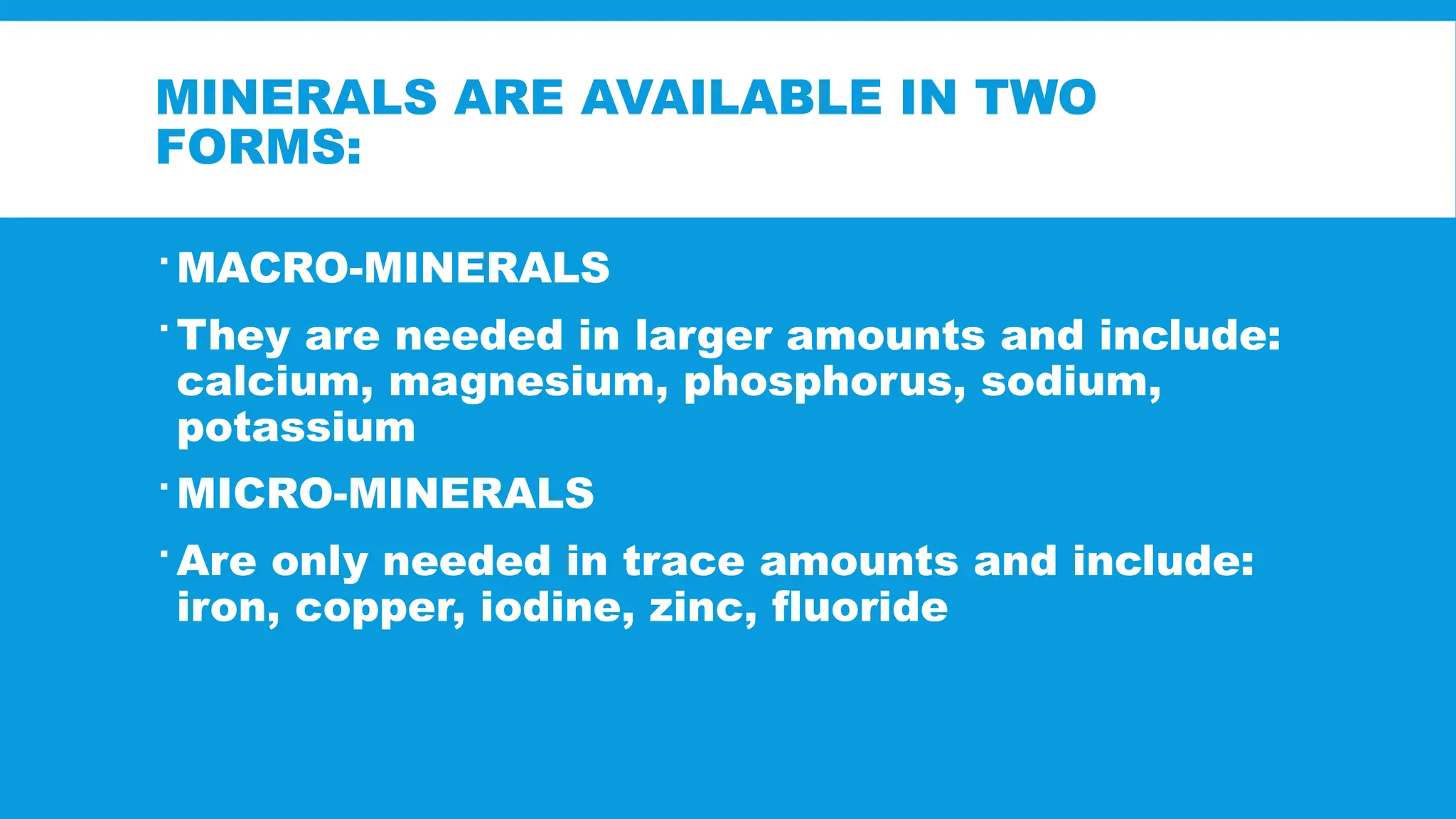
MINERALS ARE AVAILABLE IN TWO
FORMS:
 MACRO-MINERALS
 They are needed in larger amounts and include:
calcium, magnesium, phosphorus, sodium,
potassium
 MICRO-MINERALS
 Are only needed in trace amounts and include:
iron, copper, iodine, zinc, fluoride
Minerals are available in two forms:
• MACRO-MINERALS
• They are needed in larger amounts and include:
calcium, magnesium, phosphorus, sodium, potassium
• MICRO-MINERALS
• Are only needed in trace amounts and include: iron,
copper, iodine, zinc, fluoride
REFERENCES
1..
1.Academy of Nutrition and Dietetics. (2023). Dietary
Guidelines for Americans. https://www.myplate.gov/
2.Micronutrient Information Center. (2023, February).
Linus Pauling Institute. Oregon State University.
https://lpi.oregonstate.edu/mic
3.Whitney, E., Rolfes, S. R., & Crowe, T. (2020).
Understanding Normal and Clinical Nutrition (11th ed.).

6 FOOD GROUPS & FUNCTIONS IN THE BODY.pptx

  • 1.
    6 FOOD GROUPS& FUNCTIONS IN THE BODY T. Nkhoma Child Nurse Specialist
  • 2.
    OBJECTIVES By the endof this lesson, leaners should be able to ; I. State the 6 food groups for a healthy body II. Describe the types of nutrients found in a particular food group III.State the functions of food nutrients for a health body
  • 3.
    THE SIX FOODGROUPS IN MALAWI 3
  • 4.
    SIX FOOD GROUPS 1.VEGETABLES- green leaves, carrots, cabbages, egg plants, tomatoes, pumpkins, okra, green beans 2. FRUITS- mangoes, pawpaws, guava 3. LEGUMES- cowpeas, soya beans, g-nuts 4. ANIMAL FOODS- meat, fish, eggs, fresh milk, 5. ENERGY FOODS-nsima, cassava, potatoes, rice, sweets potatoes, millet, bread 6. FATS- Cooking oil, avocado, meat fats  WATER as a supplement REF. WHO 2014. 4
  • 5.
    VARIETIES OF THESIX FOOD GROUPS FOUND IN MALAWIAN Energy Foods Legumes & Nuts Vegetable Food From Animal Fat fruits Nsima from: Millet (Mawere), Sorghum (Mapila), Maize (Chimang a), Cassava (Chinang Lablab (Nkhungu dz u) Pigeon Peas (Nandolo) Ground Beans (Nzama) Cowpeas Blackjack (Chisoso) Amaranth (Bonongw e) Pumpkin leaves (Nkhwani) Mushroom (Bowa) Pumpkin Egg (Mazira) Termites (Ngumbi) Fish (Nsomba) Meat (Nyama) Chicken (NKhuku) Avocado (Mapeyala ) Cooking Oil (Mafuta) Pumpkin Seed (Nthanga) Baobab (Mlambe) Banana (Nthochi) Pawpaw (Papaya) Guava (Gwafa) (Local Fruit) Masawu 5
  • 6.
    THE SIX FOODGROUPS 1. Vegetables  Include green leaf and yellow vegetables such as bonongwe, chisoso, khwanya, mnkhwani, kholowa, rape, mpiru, kamganje, carrot, egg plants, pumpkin, tomato and others such as mushroom. They provide mostly vitamins , minerals, and water.  Vegetables also contain fibre that is necessary for proper digestion. 2. Fruits  They include citrus fruits (oranges, lemons, tangerines), bananas, pine apple, pawpaw, mangoes, masau, bwemba, malambe, masuku, peaches, apples, guava, water melon and many others. Fruits provide mostly carbohydrates, vitamins & water. 6
  • 7.
    THE SIX FOODGROUPS CONT’D 3. Legumes and Nuts  This group includes ground nuts, soyabeans, beans, peas, cowpeas, ground beans (nzama), pigeon peas. They provide mainly protein and carbohydrate. Soybeans and nuts also contain a lot of fat in addition to protein and carbohydrate. 4. Animal Foods  All of the foods in this group are of animal origin such as meat, eggs, milk products, fish, and insects. They provide protein, fats, vitamins minerals. 7
  • 8.
    THE SIX FOODGROUPS CONT’D 5. Fats  This group includes oil seeds (soybeans, groundnuts), avocado pear, cooking oil, milk and milk products such as butter, margarine, yourghut, meat, fish, and poultry. They mainly provide fat. 6. Energey foods  Foods in this include cereal grains such as sorghum, millet, maize, starchy roots (cassava, potato) an d starchy fruits (banana). They mostly provide carbohydrates. They also provide many other nutrients such as proteins and minerals depending on how they are processed. NOTE! All these foods are very important and should be eaten in combination in order for them to complement each other in increasing dietary intake and utilisation of the various nutrients by the body. 8
  • 9.
    THE BUILDING BLOCKSOF HEALTH: ESSENTIAL FOOD NUTRIENTS • Macronutrients: Needed in large amounts • Carbohydrates • Protein • Fats • Water • Micronutrients: Needed in small amounts • Vitamins • Minerals
  • 10.
    MACRONUTRIENTS- 1. CARBOHYDRATES •Provide thebody's primary source of energy •Two main types: simple and complex •Choose complex carbohydrates over simple carbohydrates whenever possible •Examples of complex carbohydrates: whole grains, fruits, vegetables •Examples of simple carbohydrates: sugary drinks, pastries, white bread
  • 11.
    MACRONUTRIENTS- 2. PROTEINS • Essentialfor building and repairing tissues • Made up of amino acids • Complete proteins contain all essential amino acids (animal sources) • Incomplete proteins lack one or more essential amino acids (plant sources) • Can be combined to create complete proteins (rice and beans)
  • 12.
    MACRONUTRIENTS- 3. FATS • Providesenergy, insulation, and protection for organs • Two main types: saturated and unsaturated • Choose unsaturated fats over saturated fats whenever possible • Examples of unsaturated fats: avocados, olive oil, nuts, seeds • Examples of saturated fats: red meat, processed meats, full-fat dairy products
  • 13.
    MACRONUTRIENTS- 4. WATER The EssentialLiquid in the body  It makes up about 60% of the human body and is required in KG amounts in the daily diet  It does not provide energy  Water serves many functions in the body:- lubricant, transport fluid, regulates body temperature
  • 14.
  • 15.
    MICRONUTRIENTS 1. VITAMINS Types ofVitamins •Fat-soluble vitamins: Stored in the body's fatty tissues • Vitamin A: Important for vision, immunity, and cell growth • Vitamin D: Promotes bone health and calcium absorption • Vitamin E: Acts as an antioxidant and protects cells from damage • Vitamin K: Essential for blood clotting and bone health •Water-soluble vitamins: Not stored in the body and need to be replenished regularly • Vitamin C: Supports immune function, collagen production, and wound healing • B vitamins: Play a crucial role in energy metabolism, brain function, and cell health (Vitamin B1, B2, B3, B5, B6, B7, B9, B12)
  • 16.
    MICRONUTRIENTS 2. MINERALS • Inorganicelements needed in small amounts • Essential for various bodily functions • Examples: • Calcium: Builds strong bones and teeth • Iron: Carries oxygen in the blood • Sodium: Maintains fluid balance • Potassium: Supports muscle function and nerve transmission • Magnesium: Involved in energy metabolism and muscle function
  • 17.
    MINERALS ARE AVAILABLEIN TWO FORMS:  MACRO-MINERALS  They are needed in larger amounts and include: calcium, magnesium, phosphorus, sodium, potassium  MICRO-MINERALS  Are only needed in trace amounts and include: iron, copper, iodine, zinc, fluoride
  • 18.
    Minerals are availablein two forms: • MACRO-MINERALS • They are needed in larger amounts and include: calcium, magnesium, phosphorus, sodium, potassium • MICRO-MINERALS • Are only needed in trace amounts and include: iron, copper, iodine, zinc, fluoride
  • 19.
    REFERENCES 1.. 1.Academy of Nutritionand Dietetics. (2023). Dietary Guidelines for Americans. https://www.myplate.gov/ 2.Micronutrient Information Center. (2023, February). Linus Pauling Institute. Oregon State University. https://lpi.oregonstate.edu/mic 3.Whitney, E., Rolfes, S. R., & Crowe, T. (2020). Understanding Normal and Clinical Nutrition (11th ed.).