www.dafne-project.eu
@dafne_project
DECISION ANALYTIC FRAMEWORK TO EXPLORE THE
WATER-ENERGY-FOOD NEXUS IN COMPLEX TRANSBOUNDARY
WATER RESOURCES OF FAST DEVELOPING COUNTRIES.
Funded under the H2020 Framework
Programme of the EU, GA No. 690268
ECCA 2019
Ebun Akinsete, ICRE8
May 29th, 2019
What is DAFNE?
The DAFNE project explores sustainable and
integrated options for the management of
water, energy and food.
Focus on transboundary context in fast growing
countries.
Objectives of DAFNE?
To establish a decision-analytic framework (DAF)
for Participatory and Integrated Planning (PIP) that will:
• Develop a better understanding of the WEF (Water-
Energy-Food) nexus
• Generate and explore alternative planning and
management solutions focused on the WEF nexus
• Contribute to solutions that foster profitable but
equitable use of resources without infringing on
environmental limits (thus minimizing and mitigating
societal conflicts)
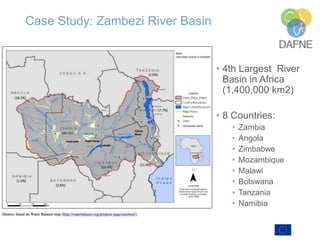
Case Study: Zambezi River Basin
• 4th Largest River
Basin in Africa
(1,400,000 km2)
• 8 Countries:
• Zambia
• Angola
• Zimbabwe
• Mozambique
• Malawi
• Botswana
• Tanzania
• Namibia
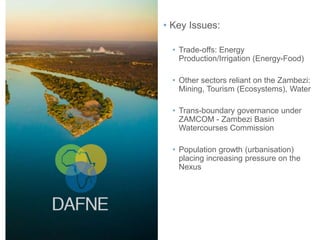
• Key Issues:
• Trade-offs: Energy
Production/Irrigation (Energy-Food)
• Other sectors reliant on the Zambezi:
Mining, Tourism (Ecosystems), Water
• Trans-boundary governance under
ZAMCOM - Zambezi Basin
Watercourses Commission
• Population growth (urbanisation)
placing increasing pressure on the
Nexus
Active engagement of diverse range of
stakeholders in the process from the outset of the
project
Tools to facilitate social
understanding of the impact
and support comparative
analysis of the
alternative through negotiations
(Negotiation Simulation Lab: NSL)
Building the Decision-Analytic Framework (DAF)
Stakeholder Involvement
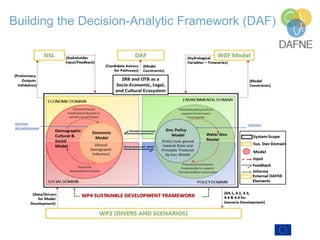
Building the Decision-Analytic Framework (DAF)
Extensive data collection (quantitative and
qualitative) on WEF related issues in the area
Developing Scenarios (baseline and future) to
characterize the hydrologic, ecological, infrastructural
(energy and water), social, economic systems as well as
the governance and policy contexts
Developing and integrating models which capture
each of the above elements
Identifying and assessing robust water management
alternatives, or temporal sequences thereof (pathways)
in collaboration with stakeholders
Integrated Models
Building the Decision-Analytic Framework (DAF)
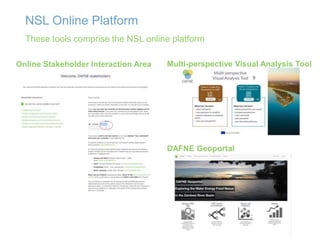
NSL Online Platform
These tools comprise the NSL online platform
Online Stakeholder Interaction Area Multi-perspective Visual Analysis Tool
DAFNE Geoportal
www.dafne-project.eu
@dafne_project

DAFNE Project Presentation

  • 1.
    www.dafne-project.eu @dafne_project DECISION ANALYTIC FRAMEWORKTO EXPLORE THE WATER-ENERGY-FOOD NEXUS IN COMPLEX TRANSBOUNDARY WATER RESOURCES OF FAST DEVELOPING COUNTRIES. Funded under the H2020 Framework Programme of the EU, GA No. 690268 ECCA 2019 Ebun Akinsete, ICRE8 May 29th, 2019
  • 2.
    What is DAFNE? TheDAFNE project explores sustainable and integrated options for the management of water, energy and food. Focus on transboundary context in fast growing countries.
  • 3.
    Objectives of DAFNE? Toestablish a decision-analytic framework (DAF) for Participatory and Integrated Planning (PIP) that will: • Develop a better understanding of the WEF (Water- Energy-Food) nexus • Generate and explore alternative planning and management solutions focused on the WEF nexus • Contribute to solutions that foster profitable but equitable use of resources without infringing on environmental limits (thus minimizing and mitigating societal conflicts)
  • 4.
    Case Study: ZambeziRiver Basin • 4th Largest River Basin in Africa (1,400,000 km2) • 8 Countries: • Zambia • Angola • Zimbabwe • Mozambique • Malawi • Botswana • Tanzania • Namibia
  • 5.
    • Key Issues: •Trade-offs: Energy Production/Irrigation (Energy-Food) • Other sectors reliant on the Zambezi: Mining, Tourism (Ecosystems), Water • Trans-boundary governance under ZAMCOM - Zambezi Basin Watercourses Commission • Population growth (urbanisation) placing increasing pressure on the Nexus
  • 6.
    Active engagement ofdiverse range of stakeholders in the process from the outset of the project Tools to facilitate social understanding of the impact and support comparative analysis of the alternative through negotiations (Negotiation Simulation Lab: NSL) Building the Decision-Analytic Framework (DAF) Stakeholder Involvement
  • 7.
    Building the Decision-AnalyticFramework (DAF) Extensive data collection (quantitative and qualitative) on WEF related issues in the area Developing Scenarios (baseline and future) to characterize the hydrologic, ecological, infrastructural (energy and water), social, economic systems as well as the governance and policy contexts Developing and integrating models which capture each of the above elements Identifying and assessing robust water management alternatives, or temporal sequences thereof (pathways) in collaboration with stakeholders Integrated Models
  • 8.
  • 9.
    NSL Online Platform Thesetools comprise the NSL online platform Online Stakeholder Interaction Area Multi-perspective Visual Analysis Tool DAFNE Geoportal
  • 10.

Editor's Notes

  • #5 … Behind Congo, Nile and Niger
  • #6  As the demands for water, energy and food increase due to population growth and rising living standards, so will the interconnectedness between the corresponding sectors; this is the so-called water-energy-food nexus. •In the near future, the irrigated area is expected to double and exceed 500.000 ha. •In terms of power, ongoing and planned projects will add 2700 MW to the electrical grid. •Projects in both sectors – agriculture and energy – are all located in the Middle and Lower Zambezi.
  • #7 BUILDING THE DAF: PILLAR 1 STAKEHOLDER ENGAGEMENT List KEY STAKEHOLDERS The tools used in the NSL include  1)  Online stakeholder interaction area     2)  Multi-perspective visual analysis tool     3)  Geoportal
  • #8 BUILDING THE DAF: PILLAR 2 INTEGRATED MODELS HYYDRO, WEF, ECON, SOCIAL, ENV. POLICY, GOVERNANCE
  • #9 BUILDING THE DAF: PILLAR 1 INTEGRATED MODELS HYYDRO, WEF, ECON, SOCIAL, ENV. POLICY, GOVERNANCE
  • #10  The Open data geo-information portal will provide data-driven results Observations of hydroclimatic and socio-demographic variables, their future projections in the considered scenarios, and the results of the Decision Analytic Framework