Electrical Engineering
6
6
F A C I L I T I E S S T A N D A R D S F O R T H E P U B L I C B U I L D I N G S S E R V I C E
Table of Contents Revised March 2003 – PBS-P1006.0
180
6.0 TABLE OF CONTENTS
6.1 General Approach
6.2 Codes and Standards
183 Electrical Design Standards
6.3 Commissioning
6.4 Placing Electrical Systems and
Communications Systems in Buildings
6.5 General Design Criteria
6.6 Electrical Load Analysis
188 Standards for Sizing Equipment and Systems
6.7 Utility Coordination and Site Considerations
6.8 Site Distribution
6.9 Primary Distribution
193 Transformers
6.10 Secondary Distribution
194 Secondary Distribution Systems
6.11 Wiring Devices
197 Placement of Receptacles
6.12 Emergency Power Systems
199 Batteries
199 Generator Systems
6.13 Uninterruptible Power Systems
6.14 Computer Center Power Distribution
6.15 Lighting
204 Interior Lighting
204 General Lighting Fixture Criteria
208 Lighting Criteria for Building Spaces
208 Lobbies, Atria, Tunnels and Public Corridors
208 Mechanical and Electrical Spaces
208 Dining Areas and Serveries
209 Lighting Controls
210 Exterior Lighting
6.16 Raceway System for Communications
212 Communications Raceways
6.17 Layout of Main Electrical Rooms
6.18 Alterations in Existing Buildings
and Historic Structures
215 Placing Electrical and Communications
Systems in Renovated Buildings
216 Building Service
216 Secondary Power Distribution
216 Computer Center Power
216 Lighting
218 Communications Distribution
Harry S. Truman Presidential Library
and Museum Addition and Renovation
Architect: Gould Evans
GSA Project Manager: Ann Marie Sweet-Abshire
Photo: Mike Sinclair
6
E L E C T R I C A L E N G I N E E R I N G
Revised March 2003 – PBS-P100 General Approach 6.1
181
It is GSA’s goal to build facilities equipped with the latest
advances in office technology and communication. This
intent should be extended to include the future evolution
of automated office and telecommunications equipment
as well. Making this concept a reality requires a
comprehensive design for engineering systems that goes
beyond the requirements of the immediate building
program. It also requires a higher level of integration
between architecture and engineering systems than one
would usually expect in an office building.
The trend toward intelligent buildings is gaining momen-
tum in the Federal sector. The Government recognizes
that communications needs and technology are growing
at an increasingly rapid pace. Work stations are becoming
more powerful, requiring faster and easier access to more
information. GSA must install the wiring and interfaces to
support these requirements. It should be noted that the
design of all communications systems is the responsibility
of GSA’s Federal Technology Service (FTS).
A computer-based building automation system (BAS) that
monitors and automatically controls lighting, heating,
ventilating and air conditioning is critical to the efficient
operation of the modern Federal office building. GSA
encourages integration of building automation systems
generally. Exceptions are the fire alarm and security
systems, which shall function as stand-alone systems with
a monitoring only interface to the BAS.
6.1 General Approach
Electrical and communications systems in GSA buildings
provide the infrastructure for an efficient work
environment for the occupants. These systems must
support the many types of equipment used in a modern
office setting in a reliable fashion.
There are three characteristics that distinguish GSA
buildings: long life span, changing occupancy needs, and
the use of a life cycle cost approach to account for total
project cost.
GSA owns and operates its buildings much longer than
the private sector. Consequently, a higher level of
durability is required for all systems, as is the ability to
replace equipment during the life of the building.
During the life span of a typical Federal building, many
minor and major alterations are necessary as the missions
of Government agencies change. The flexibility to adjust
to alterations easily must be designed into the building
systems from the outset. Electrical and communications
systems should provide ample capacity for increased load
concentrations in the future and allow modifications to be
made in one area without causing major disruptions in
other areas of the facility.
F A C I L I T I E S S T A N D A R D S F O R T H E P U B L I C B U I L D I N G S S E R V I C E
General Approach Revised March 2003 – PBS-P1006.1
182
Architects and engineers should always make environ-
mentally responsible choices regarding new building
materials and the disposal of discarded products.
Recycled material use needs to be maximized to the
fullest extent practical within the project requirements.
Architects and engineers should consider integrating
renewable energy technologies such as photovoltaics and
other solar applications, geothermal heat and wind into
building systems.
Security is an important consideration in electrical
engineering systems design. Refer to Chapter 8: Security
Design for detailed criteria related to this matter.
Consult Chapter 4.1: Installation Standards of the Fine
Arts Program Desk Guide for additional information.
Submission Requirements. Every project will have
unique characteristics and requirements for submission
and review. These shall be developed by the GSA Project
Manager. The general submission requirements for
each phase of project development are described in
Appendix A.
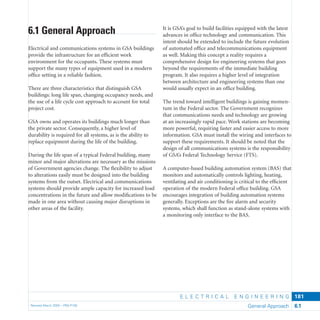
Atrium, Sandra Day O’Connor U.S. Courthouse, Phoenix, AZ
E L E C T R I C A L E N G I N E E R I N G
Revised March 2003 – PBS-P100 Codes and Standards 6.2
183
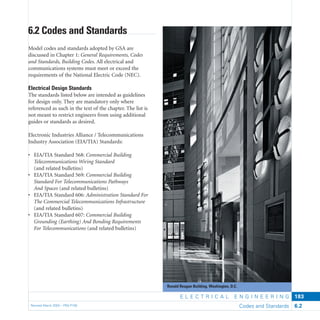
Ronald Reagan Building, Washington, D.C.
6.2 Codes and Standards
Model codes and standards adopted by GSA are
discussed in Chapter 1: General Requirements, Codes
and Standards, Building Codes. All electrical and
communications systems must meet or exceed the
requirements of the National Electric Code (NEC).
Electrical Design Standards
The standards listed below are intended as guidelines
for design only. They are mandatory only where
referenced as such in the text of the chapter. The list is
not meant to restrict engineers from using additional
guides or standards as desired.
Electronic Industries Alliance / Telecommunications
Industry Association (EIA/TIA) Standards:
• EIA/TIA Standard 568: Commercial Building
Telecommunications Wiring Standard
(and related bulletins)
• EIA/TIA Standard 569: Commercial Building
Standard For Telecommunications Pathways
And Spaces (and related bulletins)
• EIA/TIA Standard 606: Administration Standard For
The Commercial Telecommunications Infrastructure
(and related bulletins)
• EIA/TIA Standard 607: Commercial Building
Grounding (Earthing) And Bonding Requirements
For Telecommunications (and related bulletins)
Oakland Federal Building, Oakland, CA.
F A C I L I T I E S S T A N D A R D S F O R T H E P U B L I C B U I L D I N G S S E R V I C E
Commissioning Revised March 2003 – PBS-P1006.3
184
6.3 Commissioning
The design team’s electrical engineer shall identify
and coordinate commissioning practices with the
Construction Manager, Project Manager, and (if con-
tracted separately) the Commissioning Authority, for the
project’s programmed performance goals. As appropriate,
coordinate with other disciplines to fully enable required
testing and certifications. Incorporate into construction
specifications those testing and certification requirements
that involve construction contractors. Examples of
possible programmed performance goals, include:
• Emergency Power Equipment Modes of Operation.
• Clean Power/Grounding Characteristics.
• Functionality of Building-wide Communication Systems.
• Lighting Levels.
• Lighting Control Functions.
• Effectiveness of Building Automation System Interface.
• Functionality of Applied Innovative Technologies.
E L E C T R I C A L E N G I N E E R I N G
Revised March 2003 – PBS-P100 Placing Electrical Systems and Communications Systems in Buildings 6.4
185
Horizontal Distribution of Power and Communications.
In new construction the building shall have raised access
flooring. In buildings with access flooring, power circuits
should be provided via conduit, modular wire distribu-
tion boxes and modular wire cable sets to flush floor
receptacles. Communication cables can be laid exposed
directly on the slab and grouped together in rows 3600
mm (12 feet) on center.
Power, data and telephone cables shall be grouped
together in pathways that are separated into channels
for each system. Independent channels are required
in horizontal pathways for normal power, emergency
power, mechanical, fire alarm, security, television and
communications. The communications channel includes
voice and data. Major zones within the facility should
have horizontal distribution capacity for all seven
categories described above. Horizontal pathways serving
individual work stations must have at least three channels
for power, voice and data. EIA/TIA Standard 569:
Commercial Building Standard For Telecommunications
Pathways And Spaces (and related bulletins) provides
detailed requirements for communications pathways,
including requirements for underfloor ducts, access floor,
conduit, cable trays and wireways, ceiling pathways and
perimeter pathways. Provide at least 650 mm2
(1 square
inch) of horizontal capacity for power and communi-
cations to office areas for every 10 m2
(100 square feet)
of occupied area.
6.4 Placing Electrical Systems
and Communications Systems
in Buildings
In order to achieve system flexibility and thorough integra-
tion between building architecture and engineering systems,
a concept for the power and telecommunications infra-
structure that supports the distribution of electrical and
communications systems must be established during the
architectural schematic design. The locations of vertical
backbone pathways, horizontal pathways, closets, equip-
ment rooms and utility entrance facilities for electrical
and communications distribution equipment must be
established before the architectural concept is finalized.
Electrical Closets . The spacing of electrical and
communications closets in buildings is described in
Chapter 3: Architectural and Interior Design, Building
Planning, Placement of Core Elements and Distances.
Communications Closets. Communications closets
shall meet the requirements of EIA/TIA Standard 569:
Commercial Building Standard For Telecommunications
Pathways And Spaces (and related bulletins). The location
and size of communications closets are discussed in
Chapter 3: Architectural and Interior Design.
Planning Grid, Floor Grid and Ceiling Grid. A common
planning grid is to be used in all GSA buildings. Electrical
and communications elements in floors and ceilings
including lights, power, telephone and data are given
precise locations within the planning grid. The
relationship of this grid to wall placement, ceiling grids
and location of mechanical and electrical elements is
described in detail in Chapter 3: Architectural and Interior
Design, Building Planning, Planning Grid.
U.S. Courthouse, Kansas City, KS
F A C I L I T I E S S T A N D A R D S F O R T H E P U B L I C B U I L D I N G S S E R V I C E
Placing Electrical Systems and Communications Systems in Buildings Revised March 2003 – PBS-P1006.4
186
The placement of outlets in walls or in the partitions of
systems furniture should be avoided because of the
difficulty it creates for future reconfiguration of the office
space. This is true for both closed office and open plan
concepts. Light switches likewise should be located on
columns and the walls of fixed core elements, to the
maximum extent possible.
Flat conductors, poke-through and/or power poles shall
not be used in new construction.
These criteria apply to all occupiable area or net usable
space in a GSA building but not to public spaces or
support spaces, which can be considered fixed elements
and are not subject to frequent changes.
Vertical Distribution. Risers for normal power,
emergency power and communications should be
combined with other core elements to form compact
groups and maximize usable floor space. The number and
size of risers will depend on the systems chosen, but
future flexibility should be an important criterion in the
vertical layout as well. Electrical and communication
closets shall be vertically stacked. Electrical closets shall
have two capped 4-inch spare sleeves through the
structural floor for future flexibility. Communications
closets shall also have two capped spare sleeves in each
closet. Vertical risers for normal power, emergency power,
and communications should be aligned throughout the
building to minimize conduit bends and additional
cabling. Be aware of the requirements to locate fire alarm
vertical risers remotely.
E L E C T R I C A L E N G I N E E R I N G
Revised March 2003 – PBS-P100 General Design Criteria 6.5
187
Lightning Protection. Lightning protection shall be
provided in accordance with NFPA 780. The system
should be carefully designed to ensure that static dis-
charges are provided with an adequate path to ground.
Surge arresters on the main electrical service should
also be considered.
Cathodic Protection. The need for corrosion protection
for conduits and for all other underground piping and
buried metals on the project must be evaluated through
soil resistivity and pH testing. Testing for soils resistivity
is part of the Geotechnical Report. Cathodic protection
shall be provided for all metal underground storage tanks.
See Appendix A: Submission Requirements. Cathodic
protection should be designed by a qualified specialist.
Artwork. Museum standards for lighting works of art
range from 5 to 10 foot-candles for extremely light
sensitive materials such as paper and textiles, to 20 to 40
foot-candles for moderately sensitive materials such as
oil paintings and wood.
Please consult Chapter 4.1, Installation Standards, of the
Fine Arts Program Desk Guide for additional information.
6.5 General Design Criteria
Energy Conservation. The largest factor in the energy
consumption of a building is lighting. The overall
efficiency of the lighting system depends both on the
individual components and on the interaction of
components in a system. A good controls strategy that
eliminates lighting in unoccupied spaces and reduces it
where daylighting is available can contribute significantly
to energy conservation. The best way to institute such
controls is through a Building Automation System (BAS).
See section on Lighting, Lighting Controls in this chapter
for further discussion. Designers should check with local
power companies and include technologies that qualify
for rebates. The Office of Chief Architect assigns an
energy goal for each GSA new construction and building
modernization.
Visual Impact. Options regarding the location and
selection of electrical work that will have a visual impact
on the interior and exterior of the building should be
closely coordinated with the architectural design. This
includes colors and finishes of lights, outlets and switches.
Equipment Grounding Conductor. All low voltage
power distribution systems should be supplemented with
a separate, insulated equipment grounding conductor.
Grounding for communication systems must follow the
requirements in the EIA/TIA Standard 607: Commercial
Building Grounding (Earthing) And Bonding Requirements
For Telecommunications (and related bulletins).
F A C I L I T I E S S T A N D A R D S F O R T H E P U B L I C B U I L D I N G S S E R V I C E
Electrical Load Analysis Revised March 2003 – PBS-P1006.6
188
Standards for Sizing Equipment and Systems
To ensure maximum flexibility for future systems changes,
the electrical system must be sized as follows: panelboards
for branch circuits must be sized with 50 percent spare
ampacity, panelboards serving lighting only with 25
percent space switchboard ampacity, distribution panels
with 35 percent spare ampacity and main switchgear with
25 percent spare ampacity. Spare overcurrent devices shall
be provided as well as bus extension for installation of
future protective devices.
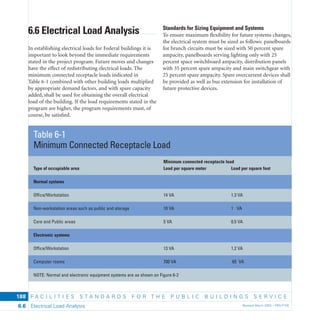
Table 6-1
Minimum Connected Receptacle Load
Minimum connected receptacle load
Type of occupiable area Load per square meter Load per square foot
Normal systems
Office/Workstation 14 VA 1.3 VA
Non-workstation areas such as public and storage 10 VA 1 VA
Core and Public areas 5 VA 0.5 VA
Electronic systems
Office/Workstation 13 VA 1.2 VA
Computer rooms 700 VA 65 VA
NOTE: Normal and electronic equipment systems are as shown on Figure 6-2
6.6 Electrical Load Analysis
In establishing electrical loads for Federal buildings it is
important to look beyond the immediate requirements
stated in the project program. Future moves and changes
have the effect of redistributing electrical loads. The
minimum connected receptacle loads indicated in
Table 6-1 combined with other building loads multiplied
by appropriate demand factors, and with spare capacity
added, shall be used for obtaining the overall electrical
load of the building. If the load requirements stated in the
program are higher, the program requirements must, of
course, be satisfied.
E L E C T R I C A L E N G I N E E R I N G
Revised March 2003 – PBS-P100 Utility Coordination and Site Considerations 6.7
189
In the case of large buildings or buildings with large
footprints, it may be necessary to have more than one
service. In large office buildings and in campus situations,
it may also be necessary to distribute medium voltage
power. If available, medium voltage, up to 15KV, should
be used for primary power distribution to substations.
Communications Service Coordination. The Architect/
Engineer shall coordinate with the client agency to
determine the enclosure and pathway requirements for
telecom systems. The Scope of Services varies with each
project; it includes as a minimum design of the infra-
structure (pathway and enclosure) and may include full
design and specification of the telecom system.
6.7 Utility Coordination
and Site Considerations
Power Company Coordination. See Chapter 2: Site
Planning and Landscape Design, Site Utilities, Utilities
Services.
These data must be established prior to initial system
design. Electrical load estimates must be prepared in
conjunction with utility company discussions to establish
the capacity of the new electrical services.
The service entrance location for commercial electrical
power should be determined concurrently with the devel-
opment of conceptual design. Space planning documents
and standards for equipment furnished by utility
companies should be incorporated into the concept
design. Locations for transformers, vaults, meters and
other utility items must be coordinated with the
architectural design to avoid detracting from the
building’s appearance.
Site Considerations. The routing of site utilities and
location of manholes should be determined early in the
design process.
It is desirable to have the utility company furnish power at
the main utilization voltage, i.e., 480/277V or 208/120V
(for small buildings). GSA prefers that the utility company
own and maintain the transformers.
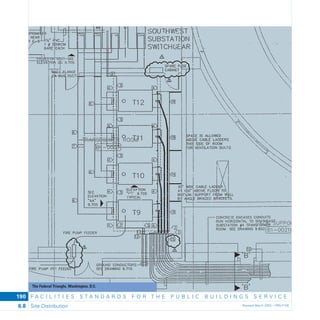
The Federal Triangle, Washington, D.C.
F A C I L I T I E S S T A N D A R D S F O R T H E P U B L I C B U I L D I N G S S E R V I C E
Site Distribution Revised March 2003 – PBS-P1006.8
190
E L E C T R I C A L E N G I N E E R I N G
Revised March 2003 – PBS-P100 Site Distribution 6.8
191
Where it is necessary to run communication cables
alongside power cables, two separate systems must be
provided with separate manhole compartments. The
same holds true for normal and emergency power cables.
Ductbanks should be spaced at least 300 mm (1 foot)
apart. Site entrance facilities including ductbanks and
manholes must comply with requirements stated in
Federal Information Processing Standard 175: Federal
Building Standard for Telecommunication Pathways and
Spaces (see also EIA/TIA [Electronic Industrial
Association/Telecommunication Industry Association]
Standard 568-A and related bulletins)
Electrical and communication ducts should be kept clear
of all other underground utilities, especially high
temperature water or steam.
Duct Sizes. Ducts should be sized as required for the
number and size of cables. Inner ducts must be provided
inside communication ducts wherever fiber optic cables
will be used. A sufficient number of spare ducts should be
included for planned future expansion; in addition, a
minimum of 25 percent spare ducts must be provided for
unknown future expansion.
Manholes. Manholes should be spaced no farther than
150 m (500 feet) apart for straight runs. The distance
between the service entrance and the first manhole should
not exceed 30 m (100 feet). Double manholes should be
used where electric power and communication lines
follow the same route. Separate manholes should be
provided for low and medium voltage systems. Manholes
6.8 Site Distribution
Exterior distribution systems must be either direct buried
conduit or concrete encased conduit systems. Cable
selection should be based on all aspects of cable operation
and the installation environment, including corrosion,
ambient heat, rodent attack, pulling tensions, and
potential mechanical abuse and seismic activity.
Direct Buried Conduit. Direct buried PVC, coated
intermediate metallic conduit (IMC) or rigid galvanized
steel (RGS) is appropriate for the distribution of branch
circuits. Direct buried cable should not be used.
Concrete-Encased Ductbank. Concrete-encased
ductbanks should be used where many circuits follow the
same route, for runs under permanent hard pavements
and where service reliability is paramount, such as service
entrances.
Duct line routes should be selected to balance maximum
flexibility with minimum cost and to avoid foundations
of other buildings and other structures. Ducts should be
provided with a cover of at least 600 mm (24 inches).
Ductbanks under railroads should be reinforced. Ducts
should slope 4 percent toward manholes. Changes in
direction should be by sweeps with a radius of 7.5 m
(25 feet) or more. Stub-ups into electrical equipment may
be installed with manufactured elbows. Duct line routes
should be selected to balance maximum flexibility with
minimum cost and to avoid foundations of other buildings
and other structures.
F A C I L I T I E S S T A N D A R D S F O R T H E P U B L I C B U I L D I N G S S E R V I C E
Primary Distribution Revised March 2003 – PBS-P1006.9
192
should have clear interior dimensions of no less than 1800
mm (6 feet) in depth, 1800 mm (6 feet) in length, and
1800 mm (6 feet) in width with an access opening at the
top of not less than 750 mm (30 inches) in diameter.
Manholes must have a minimum wall space of 1800 mm
(6 feet) on all sides where splices are to be racked.
Stubs. Minimum of two spare stubs should be provided
(to maintain a square or rectangular ductbank) so that the
manhole wall will not need to be disturbed when a future
extension is made. Stubs for communications manholes
must be coordinated with GSA Federal Technology
Service.
Smaller manholes may be used for low voltage feeders
(600V and below), branch circuits or communications
circuits. They should be not less than 1200 mm (4 feet) in
depth, 1200 mm (4 feet) in length, and 1200 mm (4 feet)
in width with a standard manhole cover and sump of the
same type provided for manholes. Generally, at least four
racks should be installed. Where more than two splices
occur (600V feeders only), a 6 feet by 6 feet by 6 feet
manhole may be more appropriate.
6.9 Primary Distribution
The selection of a primary distribution system, i.e., radial,
loop, primary selective, secondary selective, network, etc.,
should be evaluated on a case by case basis, with consider-
ation given first to safety, then to cost and reliability.
Generally, radial or loop systems are preferred.
The primary distribution system design should be based
on the estimated demand load plus 25 percent spare
capacity.
See Chapter 7: Fire Protection Engineering for additional
requirements.
Medium Voltage Switchgear. When required, medium
voltage service switchgear may be provided with either air,
vacuum or SF6 circuit breakers or fused air interrupter
switches. Provide voltmeter, ammeter and watt-hour
meter with demand register. Meters should be pulse-type
for connection to the BAS. Providing a power monitoring
and management system is an acceptable option.
Conductors. Conductors should be insulated with cross
linked polyethylene (XLP) or ethylene propylene rubber
(EPR). 133 percent insulation should be provided.
Conductor size should not exceed 240 mm2
(500 Kcmil).
Spot Network Transformers. In cases where reliability is
an absolutely critical concern - the IRS office that
processes refund checks, for example - network
transformers should be considered. In large cities, where
load densities are very high, utility companies may choose
to supply power through network transformers. If so,
these systems should be utility owned and maintained.
E L E C T R I C A L E N G I N E E R I N G
Revised March 2003 – PBS-P100 Secondary Distribution 6.10
193
Double-ended Substations. If reliability is critical and
spot networks cannot be provided by the utility, double-
ended substations should be used. Transformers may be
equipped with fans to increase the rated capacity. The
sum of the estimated demand load of both ends of the
substation must not exceed the rating of either trans-
former, and it must not exceed the fan cooling rating. All
double-ended substations should be equipped with two
secondary main breakers and one tie breaker set up for
open transition automatic transfer.
Transformers
Substation transformers must be dry-type with epoxy
resin cast coils or silica oil filled type. Liquid filled
transformers may be used outdoors. Substations should
be located at least 30 m (100 feet) from communications
frame equipment to avoid radio frequency interference.
Provide lightning arrestors on the primary side of all
transformers. Consider surge suppression on the
secondary and/or downstream busses.
Transformers located in underground vaults must not be
positioned directly adjacent to or beneath an exit way.
Where silica oil filled transformers are used, the design
must comply with all spillage containment and electrical
code requirements.
6.10 Secondary Distribution
Main Switchboards. 208V and/or 480V service
switchboards as well as substation secondary switchboards
should be provided with a single main service disconnect
device. This main device should be molded case, insulated
case, power air circuit breaker or fusible switch (where
appropriate) individually mounted, draw-out type (as
applicable). Insulated case and power air circuit breakers
should be electrically operated.
The meter section should contain a voltmeter, ammeter
and watt-hour meter with demand register. Meters should
be pulse type for connection to the BAS. Providing a
power monitoring and management system is an
acceptable option.
Feeder devices of switchboards 2,000 AMPS and larger
should be molded case, insulated case, power air circuit
breakers or fusible switches where appropriate,
individually mounted, draw-out type as applicable and
electrically operated. Feeder devices of switchboards
below 2,000 AMPS may be group-mounted, molded case
circuit breakers or fusible switches.
Switchboards should be front and rear accessible. In
smaller switchboards, front access only is acceptable if
space is limited.
Grounding. All grounding systems must be carefully
coordinated, especially in regard to: NEC grounding
electrode systems; lightning protection; communications
grounding; and computer room signal reference guide.
Power distribution system grounding must be in accor-
dance with the National Electrical Code. Also reference
general design criteria (this chapter) for equipment
grounding conductor. Grounding for communications
F A C I L I T I E S S T A N D A R D S F O R T H E P U B L I C B U I L D I N G S S E R V I C E
Secondary Distribution Revised March 2003 – PBS-P1006.10
194
systems must follow the requirements in EIA/TIA
Standard 607: Commercial Building Grounding (Earthing)
And Bonding Requirements For Telecommunications (and
related bulletins).
Ground Sources. The ground source for the electrical
power system must have a maximum resistance to ground
of 5 ohms, except in small buildings i.e. less than 5000 m2
(50,000 square feet) that have only minimal communi-
cations systems. Grounding systems for these buildings
may have a resistance up to 10 ohms. The grounding
design must be based on a soils resistivity test and ground
resistivity calculations. Below-grade connections should
be exothermically welded.
A wall-mounted, 6 mm by 50 mm (0.25-inch by 2-inch)
copper ground bus should be provided in each electrical
room. The ground bus should be located in the rear access
aisle of the room and should extend at least 1 m (3 feet).
It should be interconnected with the ground electrode and
ground bus in the switchgear or switchboard.
Isolated Grounding Panels. Provide separate panels for
computer loads to separate from general electrical loads in
lieu of an IG system which is more complex and prone to
mis-wiring.
Submetering. Electric power meters must be provided on
the services to all spaces planned to be outleased, to all
computer rooms and to the parking garage, if any.
Power Factor Correction. If the utility rate structure has a
power factor penalty, non-PCB centralized automatic
power factor capacitors should be connected at the main
electrical service on the load side of the utility metering.
Power factor capacitors should be designed to
automatically correct a lagging power factor to a value
that will avoid penalty charges. Switching circuits should
be specifically designed to prevent electrical noise from
entering the electrical power distribution system.
Motor Control Centers. Grouped motor controls should
be used where more than six starters are required in an
equipment room. Motor control center construction
should be NEMA Class I, Type B with magnetic (or solid
state if appropriate) starters and either circuit breakers or
fuses. Minimum starter size should be size 1 in motor
control centers. Each starter should have three overload
relays. Control circuit voltage should be 120V connected
ahead of each starter via control transformer as required.
Reduced voltage starters may be used for larger motors to
reduce starting KVA.
In the design of motor control centers on emergency
power, time delay relays should be considered to reduce
starting KVA on the generator.
Elevator Power. Elevators should be powered from a
shunt trip circuit breaker located in the elevator machine
rooms. Electrical design standards in elevator standard
ANSI/ASME A17.1 must be followed.
Secondary Distribution Systems
Secondary electrical power distribution systems in Federal
buildings are classified as normal, emergency and
uninterruptible. Normal power serves the general power
and lighting loads in the building. Emergency power is
distributed to life safety and critical loads. Uninterruptible
power is required for critical loads, which cannot be
interrupted.
In typical GSA office buildings it is recommended that
208/120V normal power be subdivided to isolate the office
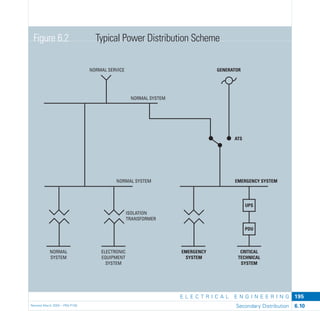
electronic equipment load. Figure 6-2 shows a typical
power distribution scheme.
E L E C T R I C A L E N G I N E E R I N G
Revised March 2003 – PBS-P100 Secondary Distribution 6.10
195
NORMAL SERVICE GENERATOR
ATS
EMERGENCY SYSTEMNORMAL SYSTEM
ISOLATION
TRANSFORMER
UPS
PDU
CRITICAL
TECHNICAL
SYSTEM
EMERGENCY
SYSTEM
ELECTRONIC
EQUIPMENT
SYSTEM
NORMAL
SYSTEM
NORMAL SYSTEM
Figure 6.2 Typical Power Distribution Scheme
F A C I L I T I E S S T A N D A R D S F O R T H E P U B L I C B U I L D I N G S S E R V I C E
Secondary Distribution Revised March 2003 – PBS-P1006.10
196
Bus Duct. Where plug-in bus duct is used, it should have
an integral ground bus, sized at 50 percent of the phase
bus to serve as the equipment grounding conductor.
Conductors. Aluminum or copper conductors are
acceptable for motor windings, transformer windings,
switchgear bussing, switchboard bussing and bus duct,
where the conductor is purchased as part of the
equipment. Aluminum conductors shall not be used for
primary feeders, branch feeding or branch circuits.
Power Distribution Panels. In general, circuit breaker
type panels will be the standard of construction for
federal buildings. With the exception of lighting and
receptacle panel boards, fusible switches may be
considered if specific design considerations warrant their
application, such as in electrical coordination of electrical
over-current devices.
Lighting and Receptacle Panelboards. Lighting and
receptacle panelboards shall be circuit breaker type.
Provide minimum 30 poles for 100 amps panelboards and
minimum 42 poles for 225 amp panelboards.
Lighting panelboards shall have minimum of three
20-amp 1-pole spare circuit breakers.
Receptacle panelboards should have minimum of six
20-amp 1-pole spare circuit breakers. For initial planning
purposes, the number of receptacle circuits may be
estimated by assuming 19 m2
(200 square feet) per circuit.
All panelboards must be located in closets. In
circumstances where horizontal runs would become
excessive and another riser is not warranted, shallow
closets, at least 600 mm (24inches) deep, may be used for
additional panelboards.
Panelboards Serving Electronic Equipment. Electronic
equipment panelboards serving personal computers,
computer terminals or dedicated work stations should
have an isolated ground bus. The service to the electronic
panelboard should be supplied from an isolation
transformer. Consideration shall be given to providing
equipment with 200 percent neutrals. For initial planning
purposes, the number of receptacle circuits may be
estimated by assuming 19 m2
(200 square feet) per
circuit.
Feeders and branch circuits serving electronic load panels
should be provided with isolated ground conductors.
E L E C T R I C A L E N G I N E E R I N G
Revised March 2003 – PBS-P100 Wiring Devices 6.11
197
Number of Receptacles. For initial planning purposes,
assume that office space uses systems furniture with a
density of two work stations for every 9 m2
(100 square
feet). Electrical systems should be designed to allow two
duplex outlets for electronic equipment power and two
duplex outlets for normal power per work station.
Conference Rooms. Conference rooms shall be served in
the same fashion as general office space.
Maintenance Shops. Maintenance shops require plugmold
strips above work benches with outlets 450 mm (18
inches) on center.
Electrical and Communications Closets. Electrical closets
require one emergency power receptacle that is identified
as Emergency Power at the receptacle. The communi-
cations closet will contain power and grounding for the
passive and active devices used for the telecommuni-
cations system, including at least two dedicated 20A, 120
Volt duplex electrical outlets on emergency power, and
additional convenience outlets at 1.8m (6 foot) intervals
around the walls and direct connection to the main
building grounding system. If uninterruptible power is
required in communications closets, it will be furnished as
part of the communications system.
Main Mechanical and Electrical Rooms. Main
mechanical and electrical equipment rooms shall each
have one emergency power receptacle that is identified
as Emergency Power at the receptacle.
Exterior Mechanical Equipment. Provide one receptacle
adjacent to mechanical equipment exterior to the
building.
Toilet Rooms. Each toilet room shall have at least one GFI
receptacle at the vanity or sink.
6.11 Wiring Devices
In GSA buildings, general wiring devices must be
specification grade. Emergency receptacles must be red.
Isolated grounding receptacles must be orange. Special
purpose receptacles must be brown. The color of standard
receptacles and switches should be coordinated with the
architectural color scheme; for example, white, not ivory,
devices should be used if walls are white or light gray.
Building standard receptacle must be duplex, specification
grade NEMA 5-20R. Special purpose receptacles should
be provided as required. Device plates should be plastic,
colored to match the receptacles.
Placement of Receptacles
Corridors. Receptacles in corridors shall be located 15 m
(50 feet) on center and 7.5 m (25 feet) from corridor
ends.
Office Space. Receptacles for housekeeping shall be placed
in exterior walls and walls around permanent cores or
corridors. Except for these, placement of receptacles in
walls should be avoided to the maximum extent possible.
See Chapter 3: Architectural and Interior Design, Building
Planning, Planning Module, Floor-to-Floor Heights and
Vertical Building Zoning, and Space Planning, Office Space,
Utility Placement.
Raised Access Floor. All wiring beneath a raised access
floor shall be routed in metal rigid or flexible conduit
to underfloor distribution boxes. One distribution box
per bay is recommended (see section Placing Electrical
Systems in Buildings, Horizontal Distribution of Power and
Communications). Flush-mounted access floor service
boxes should be attached to the underfloor distribution
boxes by means of a plug-in modular wiring system to
facilitate easy relocation.
F A C I L I T I E S S T A N D A R D S F O R T H E P U B L I C B U I L D I N G S S E R V I C E
Emergency Power Systems Revised March 2003 – PBS-P1006.12
198
E L E C T R I C A L E N G I N E E R I N G
Revised March 2003 – PBS-P100 Emergency Power Systems 6.12
199
When installed at high altitudes or in higher-than-rated
ambient temperatures, the unit must be derated in
accordance with manufacturers’ recommendations.
Operation of starting batteries and battery chargers must
also be considered in sizing calculations. In humid
locations heaters can reduce moisture collection in the
generator windings. Silencers are required for all
generators. Acoustical treatment of the generator room
shall be provided if necessary.
Generators should be located at least 30 m (100 feet) from
communications frame equipment to avoid radio
frequency interference. See Chapter 3: Architectural and
Interior Design, Space Planning, Building Support Spaces,
Mechanical and Electrical Rooms, Emergency Generator
Rooms for additional generator room requirements.
Radiators should be unit-mounted if possible. If
ventilation is restricted in indoor applications, remote
installation is acceptable. Heat recovery and load shedding
should not be considered.
Capacity. The engine generator should be sized to
approximately 110 percent of design load; ideally it should
run at 50 percent to 80 percent of its rated capacity after
the effect of the inrush current declines. When sizing the
generator, consider the inrush current of the motors that
are automatically started simultaneously. The initial
voltage drop on generator output due to starting currents
of loads must not exceed 15 percent.
6.12 Emergency Power Systems
All facilities must have an emergency power system for
life safety as required by code. It must be designed in
accordance with NFPA 110, Emergency and Standby Power
Systems. See Chapter 7: Fire Protection Engineering for
additional requirements.
Batteries
Self contained battery units may be used for individual
light fixtures in buildings where an emergency generator
is not required for other systems.
Fire alarm and security systems must be provided with
their own battery back-up.
Generator Systems
The system should consist of a central engine generator
and a separate distribution system with automatic transfer
switch(es), distribution panels, and 480/277V lighting
panel (if applicable) with dry-type transformers feeding
208/120V panels as required.
Service Conditions. If the unit is to be installed outdoors,
it should be provided with a suitable enclosure and have
provisions to ensure reliable starting in cold weather.
Starting aids such as jacket-water heaters can be specified
to improve reliable starting capability in cold weather.
F A C I L I T I E S S T A N D A R D S F O R T H E P U B L I C B U I L D I N G S S E R V I C E
Emergency Power Systems Revised March 2003 – PBS-P1006.12
200
Emergency Power Loads. Emergency power should be
provided for the following functions:
• Egress and exit lighting.
• Fire alarm system.
• Generator auxiliaries.
• Smoke control systems (if required by code)1
.
• Fire pump.
• Lighting2
.
• Telephone switch.
• Security systems.
• Mechanical control systems.
• Building Automation System (BAS).
• Elevators (one per bank)1
.
• Sump pumps.
• Sewage ejector pumps.
• Exhaust fans removing toxic, explosive or flammable
fumes.
• Uninterruptible power systems serving computer rooms1
.
• Air conditioning systems for computer and UPS rooms1
.
• Exhaust fan in UPS battery rooms.
• Power and lighting for Fire Control Center and Security
Control Center.
• Lighting for main electrical room, electrical closets, and
communications closets.
• Air conditioning systems for communications closets.
• Emergency power receptacles.
• Horizontal sliding doors.
• Other associated equipment designated by code.
Notes:
1 Evaluate on a case by case basis.
2 As noted in the Section: Lighting Criteria for Building Spaces
of this chapter.
Distribution System. The distribution system should be
designed so that emergency and auxiliary power sources
cannot backfeed energy into the de-energized normal
voltage systems under normal, emergency or failure
conditions.
Generator Derangement Alarms. Generator derangement
alarms must be provided in the generator room. All
malfunctions should be transmitted to the BAS. In
buildings without BAS, a generator alarm annunciator
should be located within the Fire Command Center.
Automatic Transfer Switches. Automatic transfer
switches serving motor loads should be dual motor-
operated (adjustable time delay neutral position) or have
in-phase monitor (transfer when normal and emergency
voltages are in phase) to reduce possible motor damage
caused by out-of-phase transfer. They may also have pre-
transfer contacts to signal time delay relays in the
emergency motor control centers.
In order to reduce possible nuisance tripping of ground
fault relays, automatic transfer switches serving 3-phase,
4-wire loads should have 4-pole contacts with an
overlapping neutral.
Automatic transfer switches should include a bypass
isolation switch that allows manual bypass of the normal
or emergency source to insure continued power to
emergency circuits in the event of a switch failure or
required maintenance.
Load Bank. Generally, generators should be run with the
actual load connected. In selected applications where
critical loads cannot tolerate a momentary outage, load
banks may be considered.
Paralleling. For computer centers and other critical
facilities, generator paralleling should be considered.
Fuel Distribution System. See Chapter 5: Mechanical
Engineering, Heating Systems, Boilers and Heat Exchangers,
for information on fuel oil piping and underground fuel
oil tanks.
E L E C T R I C A L E N G I N E E R I N G
Revised March 2003 – PBS-P100 Uninterruptible Power Systems 6.13
201
Emergency Electrical Power Source Requirements. When
the UPS is running on emergency power, the current to
recharge the UPS batteries should be limited. This limited
battery charging load should be added when sizing the
emergency generator.
If the UPS system is backed up by a generator to provide
for continuous operation, then the generator must also
provide power to all necessary auxiliary equipment, i.e.,
the lighting, ventilation, and air conditioning supplying
the UPS and serving the critical technical area.
System Status and Control Panel. The UPS should
include all instruments and controls for proper system
operation. The system status panel should have an
appropriate audio/visual alarm to alert operators of
potential problems. It should include the following
monitoring and alarm functions: system on, system
bypassed, system fault, out of phase utility fault, closed
generator circuit breaker. It should have an audible alarm
and alarm silencer button. Since UPS equipment rooms
are usually unattended, an additional remote system status
panel must be provided in the space served by the UPS.
The alarms should also be transmitted to the BAS.
UPS and Battery Room Requirements. Provide emer-
gency lighting in both spaces. Provide a telephone in or
adjacent to the UPS room. Battery room design must
accommodate: proper ventilation; hydrogen detection,
spill containment; working clearances. See Chapter 3:
Architectural and Interior Design, Space Planning, Spaces
for Uninterruptible Power Systems (UPS) and Batteries
for additional requirements for UPS and battery room.
See NEC and Chapter 7: Fire Protection Engineering for
additional requirements.
6.13 Uninterruptible
Power Systems
In some facilities computer room back-up systems may
be designed by the tenant agency. If this is the case, shell
space and utility rough-ins should be provided. In facil-
ities where uninterruptible power supply (UPS) systems
are to be provided as part of the building construction,
they should be designed as described in this section. All
UPS systems are considered to be above standard for
GSA space. Tenant agencies with UPS requirements are
advised that a maintenance contract is recommended.
Requirements for UPS systems must be evaluated on a
case by case basis. If UPS is required, it may or may not
require generator back-up. When generator back-up is
unnecessary, sufficient battery capacity should be
provided to allow for an orderly shut-down.
Electrical Service Size. A UPS system should be sized
with 25 percent spare capacity.
Critical Technical Loads. The nature, size, and locations
of critical loads to be supplied by the UPS will be pro-
vided in the program. The UPS system should serve
critical loads only. Non-critical loads should be served
by separate distribution systems supplied from either the
normal or electronic distribution system. Section Site
Distribution, Secondary Distribution, Secondary Distribu-
tion Systems Figure 6-2 of this chapter shows the integra-
tion of UPS into the building power distribution system.
F A C I L I T I E S S T A N D A R D S F O R T H E P U B L I C B U I L D I N G S S E R V I C E
Computer Center Power Distribution Revised March 2003 – PBS-P1006.14
202
6.14 Computer Center
Power Distribution
In some GSA buildings the power distribution system for
computer centers will be designed by the tenant agency.
In that case utility rough-in should be provided under the
construction contract. If distribution is to be provided
under the building contract, it should be designed accord-
ing to the criteria in this section.
Power Distribution Units (PDU’s). PDU’s with internal
or remote isolation transformers and output panelboards
should be provided in all computer centers.
Non-linear Loads. Non-linear loads generate harmonic
currents that are reflected into the neutral service con-
ductors. Engineers should exercise caution when design-
ing circuits and selecting equipment to serve non-linear
loads, such as automated data processing equipment in
computer centers. It is recommended to size neutrals at
twice the size of the phase conductor. PDU’s with internal
or remote isolation transformers should also be derated
for non-linear loads. The transformer rating must take the
increased neutral size into account.
Computer Center Grounding. To prevent electrical noise
from affecting computer system operation, a low-
frequency power system grounding and a high-frequency
signal reference grounding system should be provided.
The design of the computer room grounding system
should be discussed with the computer center staff.
Low Frequency Power System Grounding. The primary
concern is to provide a safe, low-frequency, single point
grounding system which complies with Article 250 of the
National Electrical Code. The single point ground must
be established to ground the isolation transformer or its
associated main service distribution panel.
A grounding conductor should be run from the PDU
isolation transformer to the nearest effective earth
grounding electrode as defined in the NEC. All circuits
serving Automated Data Processing (ADP) equipment
from a PDU should have grounding conductors equal in
size to the phase conductors.
High Frequency Power System Grounding. In addition
to the low frequency power system grounding, a high
frequency signal reference grounding system for radio
frequency noise is required (with the two systems bonded
together at one point). A grid made up of 600 mm (2
foot) squares will provide an effective signal reference
grounding system. The raised floor grid may be used if it
has mechanically bolted stringers. Alternatively a grid can
be constructed by laying a 600 mm mesh (2-foot squares)
of braided copper strap or 1.3 mm (16 gauge, 0.051 inch)
by 50 mm (2-inch) copper strip directly on the structural
floor below the raised access floor. Data processing
equipment should be connected to the reference grid by
the most direct route with a braided copper strap.
Common Mode Noise Reduction. The reduction of
common mode noise is particularly important for the
proper operation of computer-based, distributed
microprocessor-based systems, i.e., building automation
systems, electronic security systems, card access control
systems, and local area networks.
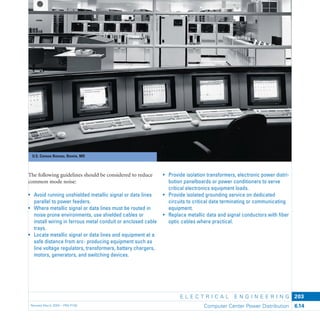
U.S. Census Bureau, Bowie, MD
E L E C T R I C A L E N G I N E E R I N G
Revised March 2003 – PBS-P100 Computer Center Power Distribution 6.14
203
• Provide isolation transformers, electronic power distri-
bution panelboards or power conditioners to serve
critical electronics equipment loads.
• Provide isolated grounding service on dedicated
circuits to critical data terminating or communicating
equipment.
• Replace metallic data and signal conductors with fiber
optic cables where practical.
The following guidelines should be considered to reduce
common mode noise:
• Avoid running unshielded metallic signal or data lines
parallel to power feeders.
• Where metallic signal or data lines must be routed in
noise prone environments, use shielded cables or
install wiring in ferrous metal conduit or enclosed cable
trays.
• Locate metallic signal or data lines and equipment at a
safe distance from arc- producing equipment such as
line voltage regulators, transformers, battery chargers,
motors, generators, and switching devices.
F A C I L I T I E S S T A N D A R D S F O R T H E P U B L I C B U I L D I N G S S E R V I C E
Lighting Revised March 2003 – PBS-P1006.15
204
Light Sources. Generally, interior lighting should be
fluorescent. Downlights should be compact fluorescent;
high bay lighting should be high intensity discharge
(HID) type. HID can also be an appropriate source for
indirect lighting of high spaces. However, it should not be
used in spaces where instantaneous control is important,
such as conference rooms, auditoria or courtrooms.
Dimming can be accomplished with incandescent,
fluorescent or HID fixtures, although HID and fluorescent
dimmers should not be used where harmonics constitute
a problem. Incandescent lighting should be used
sparingly. It is appropriate where special architectural
effects are desired.
General Lighting Fixture Criteria
Lighting Fixture Features. Lighting fixtures and
associated fittings should always be of standard
commercial design. Custom-designed fixtures should be
avoided. They may only be used with express approval
from GSA in cases where available standard units cannot
fulfill the required function.
Offices and other areas using personal computers or other
VDT systems should use indirect or deep-cell parabolic
ceiling fixtures. If acrylic lenses or diffusers are used, they
should be non-combustible.
Baseline Building Fixture. The fixture to be used for
baseline cost comparisons for office space is a 600 mm
(2-foot) by 1200 mm (4-foot) 3 lamp fixture utilizing T-8
or CFL lamps and electronic ballasts, deep cell parabolic
diffuser, and white enamel reflector.
The number of fixture types and lamp types in the
building must be minimized.
6.15 Lighting
Lighting should be designed to enhance both the overall
building architecture as well as the effect of individual
spaces within the building.
Interior Lighting
Consideration should be given to the options offered by
direct lighting, indirect lighting, downlighting, uplighting
and lighting from wall- or floor-mounted fixtures.
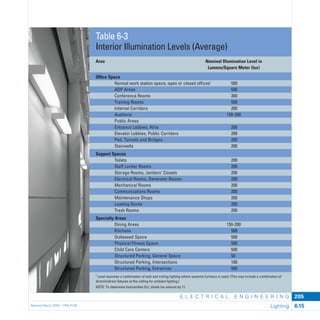
Illumination Levels. For lighting levels for interior spaces
see the values indicated in Table 6-3. For those areas not
listed in the table, the IES Lighting Handbook may be used
as a guide.
In office areas with system furniture, assume that
undercabinet task lighting is used and provide general
illumination of about 300 Lux (30 footcandles) on the
work surface. Ceiling lighting branch circuit capacity,
however, should be sufficient to provide levels in Table 6-3
for occupancy changes.
Energy Efficient Design. Lighting design must comply
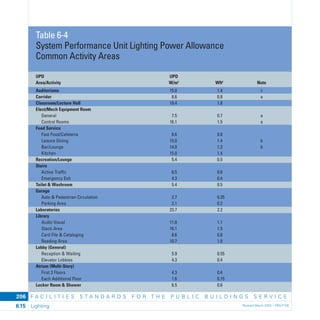
with ASHRAE/IES 90.1 as modified by Table 6-4. Power
allowances for normal system receptacles include task
lighting as shown in Table 6-1. Lighting calculations
should show the effect of both general and task lighting
assuming that task lighting where it is used has compact
fluorescent tubes.
Accessibility for Servicing. Careful consideration must be
taken in the design of lighting systems regarding servicing
of the fixtures and replacement of tubes or bulbs. This
issue needs to be discussed with building operation staff
to determine the dimensional limits of servicing
equipment.
E L E C T R I C A L E N G I N E E R I N G
Revised March 2003 – PBS-P100 Lighting 6.15
205
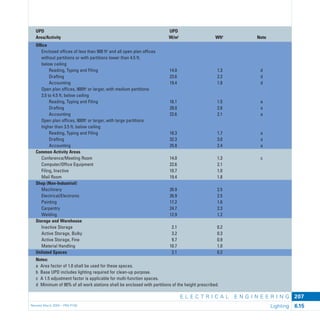
Table 6-3
Interior Illumination Levels (Average)
Area Nominal Illumination Level in
Lumens/Square Meter (lux)
Office Space
Normal work station space, open or closed offices1
500
ADP Areas 500
Conference Rooms 300
Training Rooms 500
Internal Corridors 200
Auditoria 150-200
Public Areas
Entrance Lobbies, Atria 200
Elevator Lobbies, Public Corridors 200
Ped. Tunnels and Bridges 200
Stairwells 200
Support Spaces
Toilets 200
Staff Locker Rooms 200
Storage Rooms, Janitors’ Closets 200
Electrical Rooms, Generator Rooms 200
Mechanical Rooms 200
Communications Rooms 200
Maintenance Shops 200
Loading Docks 200
Trash Rooms 200
Specialty Areas
Dining Areas 150-200
Kitchens 500
Outleased Space 500
Physical Fitness Space 500
Child Care Centers 500
Structured Parking, General Space 50
Structured Parking, Intersections 100
Structured Parking, Entrances 500
1
Level assumes a combination of task and ceiling lighting where systems furniture is used. (This may include a combination of
direct/indirect fixtures at the ceiling for ambient lighting.)
NOTE: To determine footcandles (fc), divide lux amount by 11.
F A C I L I T I E S S T A N D A R D S F O R T H E P U B L I C B U I L D I N G S S E R V I C E
Lighting Revised March 2003 – PBS-P1006.15
206
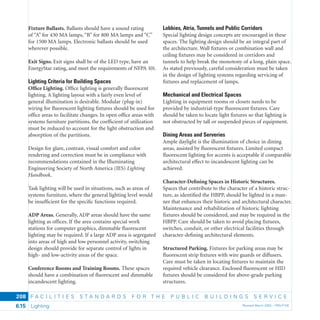
Table 6-4
System Performance Unit Lighting Power Allowance
Common Activity Areas
UPD UPD
Area/Activity W/m2
Wft2
Note
Auditoriums 15.0 1.4 c
Corridor 8.6 0.8 a
Classroom/Lecture Hall 19.4 1.8
Elect/Mech Equipment Room
General 7.5 0.7 a
Control Rooms 16.1 1.5 a
Food Service
Fast Food/Cafeteria 8.6 0.8
Leisure Dining 15.0 1.4 b
Bar/Lounge 14.0 1.3 b
Kitchen 15.0 1.4
Recreation/Lounge 5.4 0.5
Stairs
Active Traffic 6.5 0.6
Emergency Exit 4.3 0.4
Toilet & Washroom 5.4 0.5
Garage
Auto & Pedestrian Circulation 2.7 0.25
Parking Area 2.1 0.2
Laboratories 23.7 2.2
Library
Audio Visual 11.8 1.1
Stack Area 16.1 1.5
Card File & Cataloging 8.6 0.8
Reading Area 10.7 1.0
Lobby (General)
Reception & Waiting 5.9 0.55
Elevator Lobbies 4.3 0.4
Atrium (Multi-Story)
First 3 Floors 4.3 0.4
Each Additional Floor 1.6 0.15
Locker Room & Shower 6.5 0.6
E L E C T R I C A L E N G I N E E R I N G
Revised March 2003 – PBS-P100 Lighting 6.15
207
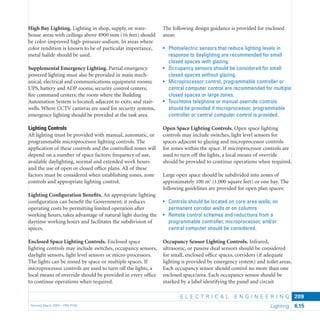
UPD UPD
Area/Activity W/m2
Wft2
Note
Office
Enclosed offices of less than 900 ft2
and all open plan offices
without partitions or with partitions lower than 4.5 ft.
below ceiling
Reading, Typing and Filing 14.0 1.3 d
Drafting 23.6 2.2 d
Accounting 19.4 1.8 d
Open plan offices, 900ft2
or larger, with medium partitions
3.5 to 4.5 ft. below ceiling
Reading, Typing and Filing 16.1 1.5 a
Drafting 28.0 2.6 a
Accounting 22.6 2.1 a
Open plan offices, 900ft2
or larger, with large partitions
higher than 3.5 ft. below ceiling
Reading, Typing and Filing 18.3 1.7 a
Drafting 32.3 3.0 a
Accounting 25.8 2.4 a
Common Activity Areas
Conference/Meeting Room 14.0 1.3 c
Computer/Office Equipment 22.6 2.1
Filing, Inactive 10.7 1.0
Mail Room 19.4 1.8
Shop (Non-Industrial)
Machinery 26.9 2.5
Electrical/Electronic 26.9 2.5
Painting 17.2 1.6
Carpentry 24.7 2.3
Welding 12.9 1.2
Storage and Warehouse
Inactive Storage 2.1 0.2
Active Storage, Bulky 3.2 0.3
Active Storage, Fine 9.7 0.9
Material Handling 10.7 1.0
Unlisted Spaces 2.1 0.2
Notes:
a Area factor of 1.0 shall be used for these spaces.
b Base UPD includes lighting required for clean-up purpose.
c A 1.5 adjustment factor is applicable for multi-function spaces.
d Minimum of 90% of all work stations shall be enclosed with partitions of the height prescribed.
F A C I L I T I E S S T A N D A R D S F O R T H E P U B L I C B U I L D I N G S S E R V I C E
Lighting Revised March 2003 – PBS-P1006.15
208
Fixture Ballasts. Ballasts should have a sound rating
of “A” for 430 MA lamps, “B” for 800 MA lamps and “C”
for 1500 MA lamps. Electronic ballasts should be used
wherever possible.
Exit Signs. Exit signs shall be of the LED type, have an
EnergyStar rating, and meet the requirements of NFPA 101.
Lighting Criteria for Building Spaces
Office Lighting. Office lighting is generally fluorescent
lighting. A lighting layout with a fairly even level of
general illumination is desirable. Modular (plug-in)
wiring for fluorescent lighting fixtures should be used for
office areas to facilitate changes. In open office areas with
systems furniture partitions, the coefficient of utilization
must be reduced to account for the light obstruction and
absorption of the partitions.
Design for glare, contrast, visual comfort and color
rendering and correction must be in compliance with
recommendations contained in the Illuminating
Engineering Society of North America (IES) Lighting
Handbook.
Task lighting will be used in situations, such as areas of
systems furniture, where the general lighting level would
be insufficient for the specific functions required.
ADP Areas. Generally, ADP areas should have the same
lighting as offices. If the area contains special work
stations for computer graphics, dimmable fluorescent
lighting may be required. If a large ADP area is segregated
into areas of high and low personnel activity, switching
design should provide for separate control of lights in
high- and low-activity areas of the space.
Conference Rooms and Training Rooms. These spaces
should have a combination of fluorescent and dimmable
incandescent lighting.
Lobbies, Atria, Tunnels and Public Corridors
Special lighting design concepts are encouraged in these
spaces. The lighting design should be an integral part of
the architecture. Wall fixtures or combination wall and
ceiling fixtures may be considered in corridors and
tunnels to help break the monotony of a long, plain space.
As stated previously, careful consideration must be taken
in the design of lighting systems regarding servicing of
fixtures and replacement of lamps.
Mechanical and Electrical Spaces
Lighting in equipment rooms or closets needs to be
provided by industrial-type fluorescent fixtures. Care
should be taken to locate light fixtures so that lighting is
not obstructed by tall or suspended pieces of equipment.
Dining Areas and Serveries
Ample daylight is the illumination of choice in dining
areas, assisted by fluorescent fixtures. Limited compact
fluorescent lighting for accents is acceptable if comparable
architectural effect to incandescent lighting can be
achieved.
Character-Defining Spaces in Historic Structures.
Spaces that contribute to the character of a historic struc-
ture, as identified the HBPP, should be lighted in a man-
ner that enhances their historic and architectural character.
Maintenance and rehabilitation of historic lighting
fixtures should be considered, and may be required in the
HBPP. Care should be taken to avoid placing fixtures,
switches, conduit, or other electrical facilities through
character-defining architectural elements.
Structured Parking. Fixtures for parking areas may be
fluorescent strip fixtures with wire guards or diffusers.
Care must be taken in locating fixtures to maintain the
required vehicle clearance. Enclosed fluorescent or HID
fixtures should be considered for above-grade parking
structures.
E L E C T R I C A L E N G I N E E R I N G
Revised March 2003 – PBS-P100 Lighting 6.15
209
High Bay Lighting. Lighting in shop, supply, or ware-
house areas with ceilings above 4900 mm (16 feet) should
be color-improved high-pressure sodium. In areas where
color rendition is known to be of particular importance,
metal halide should be used.
Supplemental Emergency Lighting. Partial emergency
powered lighting must also be provided in main mech-
anical, electrical and communications equipment rooms;
UPS, battery and ADP rooms; security control centers;
fire command centers; the room where the Building
Automation System is located; adjacent to exits; and stair-
wells. Where CCTV cameras are used for security systems,
emergency lighting should be provided at the task area.
Lighting Controls
All lighting must be provided with manual, automatic, or
programmable microprocessor lighting controls. The
application of these controls and the controlled zones will
depend on a number of space factors: frequency of use,
available daylighting, normal and extended work hours
and the use of open or closed office plans. All of these
factors must be considered when establishing zones, zone
controls and appropriate lighting control.
Lighting Configuration Benefits. An appropriate lighting
configuration can benefit the Government; it reduces
operating costs by permitting limited operation after
working hours, takes advantage of natural light during the
daytime working hours and facilitates the subdivision of
spaces.
Enclosed Space Lighting Controls. Enclosed space
lighting controls may include switches, occupancy sensors,
daylight sensors, light level sensors or micro-processors.
The lights can be zoned by space or multiple spaces. If
microprocessor controls are used to turn off the lights, a
local means of override should be provided in every office
to continue operations when required.
The following design guidance is provided for enclosed
areas:
• Photoelectric sensors that reduce lighting levels in
response to daylighting are recommended for small
closed spaces with glazing.
• Occupancy sensors should be considered for small
closed spaces without glazing.
• Microprocessor control, programmable controller or
central computer control are recommended for multiple
closed spaces or large zones.
• Touchtone telephone or manual override controls
should be provided if microprocessor, programmable
controller or central computer control is provided.
Open Space Lighting Controls. Open space lighting
controls may include switches, light level sensors for
spaces adjacent to glazing and microprocessor controls
for zones within the space. If microprocessor controls are
used to turn off the lights, a local means of override
should be provided to continue operations when required.
Large open space should be subdivided into zones of
approximately 100 m2
(1,000 square feet) or one bay. The
following guidelines are provided for open plan spaces:
• Controls should be located on core area walls, on
permanent corridor walls or on columns
• Remote control schemes and reductions from a
programmable controller, microprocessor, and/or
central computer should be considered.
Occupancy Sensor Lighting Controls. Infrared,
ultrasonic, or passive dual sensors should be considered
for small, enclosed office spaces, corridors (if adequate
lighting is provided by emergency system) and toilet areas.
Each occupancy sensor should control no more than one
enclosed space/area. Each occupancy sensor should be
marked by a label identifying the panel and circuit
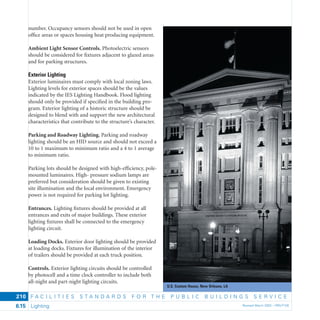
U.S. Custom House, New Orleans, LA
F A C I L I T I E S S T A N D A R D S F O R T H E P U B L I C B U I L D I N G S S E R V I C E
Lighting Revised March 2003 – PBS-P1006.15
210
number. Occupancy sensors should not be used in open
office areas or spaces housing heat producing equipment.
Ambient Light Sensor Controls. Photoelectric sensors
should be considered for fixtures adjacent to glazed areas
and for parking structures.
Exterior Lighting
Exterior luminaires must comply with local zoning laws.
Lighting levels for exterior spaces should be the values
indicated by the IES Lighting Handbook. Flood lighting
should only be provided if specified in the building pro-
gram. Exterior lighting of a historic structure should be
designed to blend with and support the new architectural
characteristics that contribute to the structure’s character.
Parking and Roadway Lighting. Parking and roadway
lighting should be an HID source and should not exceed a
10 to 1 maximum to minimum ratio and a 4 to 1 average
to minimum ratio.
Parking lots should be designed with high-efficiency, pole-
mounted luminaires. High- pressure sodium lamps are
preferred but consideration should be given to existing
site illumination and the local environment. Emergency
power is not required for parking lot lighting.
Entrances. Lighting fixtures should be provided at all
entrances and exits of major buildings. These exterior
lighting fixtures shall be connected to the emergency
lighting circuit.
Loading Docks. Exterior door lighting should be provided
at loading docks. Fixtures for illumination of the interior
of trailers should be provided at each truck position.
Controls. Exterior lighting circuits should be controlled
by photocell and a time clock controller to include both
all-night and part-night lighting circuits.
E L E C T R I C A L E N G I N E E R I N G
Revised March 2003 – PBS-P100 Raceway System for Communications 6.16
211
commercial switch of the type designated by FTS. The
room should be shielded from radio and noise inter-
ferences. (See Chapter 3: Architectural and Interior Design,
Space Planning, Mechanical and Electrical Rooms for
additional information on frame room requirements.)
Communications Closets. Communications closets
shall meet the requirements of EIA/TIA Standard 607:
Commercial Building Grounding (Earthing) And Bonding
Requirements For Telecommunications (and related
bulletins). See Chapter 3: Architectural and Interior Design,
Communications Closets for additional information on
communications closets. Communications and electri-
cal closets should be located adjacent to each other.
Communications closets must be stacked vertically.
Communications closets should be sized to accommo-
date telephone terminal boards and broadband and
narrowband data communications equipment, including
cross-connects, lightwave terminal cabinets, and
equipment racks with patch panels and concentrators.
Telecommunications closets will contain the mechanical
terminations for that portion of the horizontal wiring
system and portion of the backbone wiring system for the
building area served by the closet. It may also contain the
main or intermediate cross-connect for the backbone
wiring system. The telecommunications closet may also
provide the demarcation point or interbuilding entrance
facility. Closets will have the capability for continuous
HVAC service, and be equipped with fire protection per
Chapter 7: Fire Protection Engineering.
6.16 Raceway System
for Communications
Communications systems for all GSA buildings will meet
the requirements of EIA/TIA Standard 569: Commercial
Building Standard For Telecommunications Pathways And
Spaces (and related bulletins). Communications systems
for all GSA buildings will be designed by FTS and
installed by FTS or the tenant. Only the raceway system is
part of the building design and construction. It consists of
manholes, ductbanks, entrance rooms and vaults,
communications equipment room(s), closets, and the
sleeves, ducts, conduits, raceways and outlets that
comprise the horizontal pathways, backbone pathways
and workstation outlets of the technology infrastructure.
Bonding for communication system must comply
with EIA/TIA Standard 607: Commercial Building
Grounding (Earthing) And Bonding Requirements For
Telecommunications (and related bulletins).
Since FTS will manage the design of the communications
systems, all criteria for routing and types of raceways
must be obtained from FTS.
Communications Equipment or Frame Room. A
communications equipment or frame room should be
provided in every building. It must be sized to accommo-
date voice and data distribution and transmission
equipment and support equipment with adequate
equipment access clearances. FTS will provide detailed
information on the communications equipment. A 5 ohm
(maximum) signal ground and an emergency power
receptacle should be provided in the room. The electrical
service should be sized to accommodate the largest
F A C I L I T I E S S T A N D A R D S F O R T H E P U B L I C B U I L D I N G S S E R V I C E
Layout of Main Electrical Rooms Revised March 2003 – PBS-P1006.17
212
Communications Raceways
Raised Access Floor. The standard option for delivering
communications services in Federal buildings is by laying
the cable in a tray for main runs and then branching
directly on the floor slab below the raised access flooring
system.
Above Ceiling Delivery. Communications distribution in
ceilings should be avoided and only used where no other
alternative exists. Where necessary, communications
cabling above ceilings must be run in cable tray and/or
conduit.
Administration of Communications Infrastructure.
Long-term use of the communications infrastructure
requires administration of the systems including placing
identification on all elements, keeping records and
drawings on all elements, and task order information on
work performed on all infrastructure elements. The
administration system must maintain information on
horizontal and backbone pathways, equipment rooms and
closet spaces, cables, termination hardware, termination
positions, splices, grounding system and bonding
conductors. The information should be compatible with
other building management and facility maintenance
systems employed at the site.
6.17 Layout of Main
Electrical Rooms
Separate electrical rooms may be provided for medium
voltage and low voltage switchgear assemblies.
Vertical Clearances. Main electrical equipment rooms
generally should have a clear height to the underside of
the structure for compliance with requirements of the
NEC. Where maintenance or equipment replacement
requires the lifting of heavy parts, hoists should be
installed.
Horizontal Clearances. Electrical equipment rooms
should be planned with clear circulation aisles and
adequate access to all equipment. Layout should be neat,
and the equipment rooms should be easy to clean.
Horizontal clearances should comply with requirements
set forth by the NEC.
Lighting. Lighting in equipment rooms should be laid out
so as not to interfere with equipment. Switched emergency
lighting must be provided in main electrical rooms.
Housekeeping Pads. Housekeeping pads should be at least
75 mm (3 inches) larger than the mounted equipment on
all sides.
Posted Instructions. Posted operating instructions are
required for manually operated electrical systems. They
should consist of simplified instructions and diagrams
of equipment, controls and operation of the systems,
including selector switches, main-tie-main transfers,
ATS by-pass, UPS by-pass, etc.
Instructions should be framed and posted adjacent to the
major equipment of the system.
E L E C T R I C A L E N G I N E E R I N G
Revised March 2003 – PBS-P100 Alterations in Historic Buildings and Historic Structures 6.18
213
6.18 Alterations in
Existing Buildings and
Historic Structures
The goal of GSA’s alteration projects is to approximate
as well as possible the facilities standards described in
this book for new projects. Renovation designs must
satisfy the immediate occupancy needs but should also
anticipate additional future changes. Remodeling should
make building systems more flexible.
Alteration projects can occur at three basic scales: refur-
bishing of an area within a building, such as a floor or a
suite; major renovation of an entire structure; and up-
grade/restoration of historic structures.
In the first instance, the aim should be to satisfy the new
requirements within the parameters and constraints of
the existing systems. The smaller the area in comparison
to the overall building, the less changes to existing systems
should be attempted.
In the second case, the engineer has the opportunity to
design major upgrades into the electrical and communi-
cations systems. The electrical and communications ser-
vices can come close to systems that would be designed
for a new building, within the obvious limits of available
physical space and structural capacity.
Where a historic structure is to be altered, special
documents will be provided by GSA to help guide the
design of the alterations. The most important of these is
the Building Preservation Plan (BPP) which identifies
zones of architectural importance, specific character-
defining elements that should be preserved, and
F A C I L I T I E S S T A N D A R D S F O R T H E P U B L I C B U I L D I N G S S E R V I C E
Alterations in Historic Buildings and Historic Structures Revised March 2003 – PBS-P1006.18
214
E L E C T R I C A L E N G I N E E R I N G
Revised March 2003 – PBS-P100 Alterations in Historic Buildings and Historic Structures 6.18
215
Placing Electrical and Communications Systems
in Renovated Buildings
Even more than in new construction, the optimal
placement of engineering systems in the building struc-
ture is a crucial element in the success of the alteration.
Vertical and horizontal distribution of utilities must be
integrated into the architectural concept from the outset.
Chapter 3: Architectural and Interior Design, Alterations
in Existing Buildings and Historic Structures, Placing
Mechanical and Electrical Systems in Renovated Buildings
describes some of the strategies available for placement
of power, lighting and communications systems.
Vertical Distribution. If new risers are required, they
should preferably be located in or adjacent to existing
closets. Where there is lack of space, communications
risers and electrical risers can perhaps be combined.
Horizontal Distribution. Raised access flooring is highly
recommended for large modernization projects. Most of
the criteria established for raised flooring earlier in this
chapter would apply, except that module sizes may have to
be varied to fit existing conditions.
In buildings where raised access flooring is not feasible,
horizontal electrical and communications distribution
may be located in the ceiling. Fortunately, many older
buildings have high floor-to-floor heights, which permit
an expansion of the existing ceiling space. Vertical zoning
of this space between various engineering systems is
critical. The zoning should be established according to the
principles described earlier in this chapter or according to
existing ceiling zones.
standards to be employed. See Chapter 1: General
Requirements, Applicability of the Facilities Standards,
Types of Facilities, Historic Buildings.
The electrical systems in historic buildings often differ
greatly from today’s design and construction standards,
and frequently these systems need to be upgraded
substantially or completely rebuilt or replaced. The end
result should be a building whose lighting and other
electrical facilities support its modern use while retaining
its historic and architectural character. Historic light
fixtures, hardware and other period features should be
retained and any supplementation shall be inconspicuous
to avoid detracting from existing historic building
ornamental spaces.
The end user requirements are an important part of the
programming information for alteration projects. Close
interaction between designers and users is essential during
the programming and conceptual design phase to meet
the users’ needs without excessive construction costs. The
general policies and standards that an administrator
would give designers are usually not specific enough.
Alteration design requires ingenuity and imagination. It is
inherently unsuited to rigid sets of rules. Each case is
unique. The paragraphs that follow in this section should
be viewed as guidelines and helpful hints to be used when
appropriate and disregarded when not.
See Chapter 3: Architectural and Interior Design,
Alterations in Existing Buildings and Historic Structures.
F A C I L I T I E S S T A N D A R D S F O R T H E P U B L I C B U I L D I N G S S E R V I C E
Alterations in Historic Buildings and Historic Structures Revised March 2003 – PBS-P1006.18
216
In buildings with decorative or inaccessible ceilings,
electrical raceways for power and communications lines
can be located along walls, or be incorporated into the
design of a molding or a special chase between window
sills and floor. Raceways should have some additional
space for future changes to the electrical and
communications systems.
In buildings with fairly close spacing of columns or
masonry walls, it may be possible to locate all receptacles,
phone and data outlets in furred wall space. The furring
should be treated as an architectural feature in historic
buildings. If bay sizes are too large for this solution,
systems furniture with built-in electrical service is an
alternative. Power poles are also an option as long as they
are integrated into the architectural design. Poke-through
and flat cable should be avoided.
Building Service
If new switchgear is provided, consider sizing it according
to the loads provided in the section Electrical Load
Analysis, Table 6-1, of this chapter even if less than the
entire building is being remodeled at the time.
Secondary Power Distribution
New panelboards should be added as required with
ample spare capacity. See section Electrical Load Analysis,
Standards for Sizing Equipment and Systems in this
chapter. In both large and small remodeling projects,
panelboards serving electronic loads should be served
from an isolation transformer and sized with
consideration given to harmonic currents.
Computer Center Power
Non-linear computer loads should be isolated from
normal power. Ensure that the size of the supply
transformer for non-linear loads is rated and protected on
the basis of input and output current. Provide circuit
breakers with true RMS overload protection on the supply
and load sides of the transformer and increase the size of
the neutral to twice the size of the phase conductor.
Lighting
General Renovations. For small remodeling projects,
existing lighting systems should be matched for
uniformity and ease of maintenance. In total building
modernizations, the guidelines established in the section
Lighting of this chapter should be followed.
In structures with ornamental or inaccessible ceilings,
indirect lighting offers many possibilities. Fixtures may
be located in wall coves or at the top of low columns
or partitions.
Historic Structures. In historic buildings, the quality of
the fixtures and the quality of the light are integral to
the architectural integrity of the building. The character
of many old buildings has been compromised by poor
lighting designs. Designers are encouraged to seek
imaginative solutions to achieve required light output
while preserving the essential visual characteristics of
historic lighting, such as variable light levels, highlighting
of architectural features, light source color, reflected
patterns, and the surface reflectivity of historic materials.
Many historic buildings have beautiful plaster ceilings
that do not permit use of lay-in fixtures. Indirect lighting
from coves, combined with task lighting, can be a good
alternative. Wall sconces are another alternative, particu-
larly in corridors. In public spaces, chandeliers or other
decorative fixtures may need to be restored or duplicated.
Metzenbaum Courthouse, Cleveland, OH
E L E C T R I C A L E N G I N E E R I N G
Revised March 2003 – PBS-P100 Alterations in Historic Buildings and Historic Structures 6.18
217
These fixtures may be retro-fitted with compact
fluorescent lamps, reflectors, and other light sources to
increase light output and energy efficiency. Use of halide
lamps as the sole light source in historic fixtures is
discouraged because of differential color shifting that
occurs as lamps age.
Reproduction historic lights for significant spaces such as
courtrooms may be fitted with multiple light sources and
separate switches to allow for multiple light levels. Select
lamps providing color rendition as close as possible to
that of original lighting. In historically significant spaces
requiring increased light levels, apply the following order
of preference:
1. Retrofit historic lights with energy efficient
ballasts/lamps
2. Add discretely designed supplementary lighting,
preferably reflected light, to avoid competing with
period lighting.
In historically significant spaces, supplementing of ceiling-
mounted lights with wall mounted sconces, indirect lights
mounted on furniture, or freestanding lamps is preferable
to installing additional ceiling mounted fixtures.
The light source is another important concern. Typically,
the existing source is incandescent. Where feasible, the
light fixture should be changed to a fluorescent source,
with color rendition as close as possible to that of the
incandescent light.
F A C I L I T I E S S T A N D A R D S F O R T H E P U B L I C B U I L D I N G S S E R V I C E
Alterations in Historic Buildings and Historic Structures Revised March 2003 – PBS-P1006.18
218
Communications Distribution
Communications systems are specified by the client
agency, and they will, therefore, furnish raceway systems
criteria for alteration projects.
Telephone. Generally, older buildings have telephone
closets and wiring. For small alterations, the telephone
system should probably just be extended to meet new
requirements. For major building modernizations, a
new distribution system for phone and data should be
installed, as described in the section Raceway System
for Communications of this chapter.
Data. Data wiring is generally non-existent in older
buildings. A cable tray or raceway system should be
included in even the smallest projects to facilitate
computer networking.
In total building renovations, vertical and horizontal data
and telephone distribution should be provided. If there is
no existing underfloor system, consider a cable tray loop
in the ceiling of the permanent circulation corridors.

6 electrical engineering_r2-e-n1_u_0z5rdz-i34k-pr

  • 1.
  • 2.
    F A CI L I T I E S S T A N D A R D S F O R T H E P U B L I C B U I L D I N G S S E R V I C E Table of Contents Revised March 2003 – PBS-P1006.0 180 6.0 TABLE OF CONTENTS 6.1 General Approach 6.2 Codes and Standards 183 Electrical Design Standards 6.3 Commissioning 6.4 Placing Electrical Systems and Communications Systems in Buildings 6.5 General Design Criteria 6.6 Electrical Load Analysis 188 Standards for Sizing Equipment and Systems 6.7 Utility Coordination and Site Considerations 6.8 Site Distribution 6.9 Primary Distribution 193 Transformers 6.10 Secondary Distribution 194 Secondary Distribution Systems 6.11 Wiring Devices 197 Placement of Receptacles 6.12 Emergency Power Systems 199 Batteries 199 Generator Systems 6.13 Uninterruptible Power Systems 6.14 Computer Center Power Distribution 6.15 Lighting 204 Interior Lighting 204 General Lighting Fixture Criteria 208 Lighting Criteria for Building Spaces 208 Lobbies, Atria, Tunnels and Public Corridors 208 Mechanical and Electrical Spaces 208 Dining Areas and Serveries 209 Lighting Controls 210 Exterior Lighting 6.16 Raceway System for Communications 212 Communications Raceways 6.17 Layout of Main Electrical Rooms 6.18 Alterations in Existing Buildings and Historic Structures 215 Placing Electrical and Communications Systems in Renovated Buildings 216 Building Service 216 Secondary Power Distribution 216 Computer Center Power 216 Lighting 218 Communications Distribution Harry S. Truman Presidential Library and Museum Addition and Renovation Architect: Gould Evans GSA Project Manager: Ann Marie Sweet-Abshire Photo: Mike Sinclair 6
  • 3.
    E L EC T R I C A L E N G I N E E R I N G Revised March 2003 – PBS-P100 General Approach 6.1 181 It is GSA’s goal to build facilities equipped with the latest advances in office technology and communication. This intent should be extended to include the future evolution of automated office and telecommunications equipment as well. Making this concept a reality requires a comprehensive design for engineering systems that goes beyond the requirements of the immediate building program. It also requires a higher level of integration between architecture and engineering systems than one would usually expect in an office building. The trend toward intelligent buildings is gaining momen- tum in the Federal sector. The Government recognizes that communications needs and technology are growing at an increasingly rapid pace. Work stations are becoming more powerful, requiring faster and easier access to more information. GSA must install the wiring and interfaces to support these requirements. It should be noted that the design of all communications systems is the responsibility of GSA’s Federal Technology Service (FTS). A computer-based building automation system (BAS) that monitors and automatically controls lighting, heating, ventilating and air conditioning is critical to the efficient operation of the modern Federal office building. GSA encourages integration of building automation systems generally. Exceptions are the fire alarm and security systems, which shall function as stand-alone systems with a monitoring only interface to the BAS. 6.1 General Approach Electrical and communications systems in GSA buildings provide the infrastructure for an efficient work environment for the occupants. These systems must support the many types of equipment used in a modern office setting in a reliable fashion. There are three characteristics that distinguish GSA buildings: long life span, changing occupancy needs, and the use of a life cycle cost approach to account for total project cost. GSA owns and operates its buildings much longer than the private sector. Consequently, a higher level of durability is required for all systems, as is the ability to replace equipment during the life of the building. During the life span of a typical Federal building, many minor and major alterations are necessary as the missions of Government agencies change. The flexibility to adjust to alterations easily must be designed into the building systems from the outset. Electrical and communications systems should provide ample capacity for increased load concentrations in the future and allow modifications to be made in one area without causing major disruptions in other areas of the facility.
  • 4.
    F A CI L I T I E S S T A N D A R D S F O R T H E P U B L I C B U I L D I N G S S E R V I C E General Approach Revised March 2003 – PBS-P1006.1 182 Architects and engineers should always make environ- mentally responsible choices regarding new building materials and the disposal of discarded products. Recycled material use needs to be maximized to the fullest extent practical within the project requirements. Architects and engineers should consider integrating renewable energy technologies such as photovoltaics and other solar applications, geothermal heat and wind into building systems. Security is an important consideration in electrical engineering systems design. Refer to Chapter 8: Security Design for detailed criteria related to this matter. Consult Chapter 4.1: Installation Standards of the Fine Arts Program Desk Guide for additional information. Submission Requirements. Every project will have unique characteristics and requirements for submission and review. These shall be developed by the GSA Project Manager. The general submission requirements for each phase of project development are described in Appendix A. Atrium, Sandra Day O’Connor U.S. Courthouse, Phoenix, AZ
  • 5.
    E L EC T R I C A L E N G I N E E R I N G Revised March 2003 – PBS-P100 Codes and Standards 6.2 183 Ronald Reagan Building, Washington, D.C. 6.2 Codes and Standards Model codes and standards adopted by GSA are discussed in Chapter 1: General Requirements, Codes and Standards, Building Codes. All electrical and communications systems must meet or exceed the requirements of the National Electric Code (NEC). Electrical Design Standards The standards listed below are intended as guidelines for design only. They are mandatory only where referenced as such in the text of the chapter. The list is not meant to restrict engineers from using additional guides or standards as desired. Electronic Industries Alliance / Telecommunications Industry Association (EIA/TIA) Standards: • EIA/TIA Standard 568: Commercial Building Telecommunications Wiring Standard (and related bulletins) • EIA/TIA Standard 569: Commercial Building Standard For Telecommunications Pathways And Spaces (and related bulletins) • EIA/TIA Standard 606: Administration Standard For The Commercial Telecommunications Infrastructure (and related bulletins) • EIA/TIA Standard 607: Commercial Building Grounding (Earthing) And Bonding Requirements For Telecommunications (and related bulletins)
  • 6.
    Oakland Federal Building,Oakland, CA. F A C I L I T I E S S T A N D A R D S F O R T H E P U B L I C B U I L D I N G S S E R V I C E Commissioning Revised March 2003 – PBS-P1006.3 184 6.3 Commissioning The design team’s electrical engineer shall identify and coordinate commissioning practices with the Construction Manager, Project Manager, and (if con- tracted separately) the Commissioning Authority, for the project’s programmed performance goals. As appropriate, coordinate with other disciplines to fully enable required testing and certifications. Incorporate into construction specifications those testing and certification requirements that involve construction contractors. Examples of possible programmed performance goals, include: • Emergency Power Equipment Modes of Operation. • Clean Power/Grounding Characteristics. • Functionality of Building-wide Communication Systems. • Lighting Levels. • Lighting Control Functions. • Effectiveness of Building Automation System Interface. • Functionality of Applied Innovative Technologies.
  • 7.
    E L EC T R I C A L E N G I N E E R I N G Revised March 2003 – PBS-P100 Placing Electrical Systems and Communications Systems in Buildings 6.4 185 Horizontal Distribution of Power and Communications. In new construction the building shall have raised access flooring. In buildings with access flooring, power circuits should be provided via conduit, modular wire distribu- tion boxes and modular wire cable sets to flush floor receptacles. Communication cables can be laid exposed directly on the slab and grouped together in rows 3600 mm (12 feet) on center. Power, data and telephone cables shall be grouped together in pathways that are separated into channels for each system. Independent channels are required in horizontal pathways for normal power, emergency power, mechanical, fire alarm, security, television and communications. The communications channel includes voice and data. Major zones within the facility should have horizontal distribution capacity for all seven categories described above. Horizontal pathways serving individual work stations must have at least three channels for power, voice and data. EIA/TIA Standard 569: Commercial Building Standard For Telecommunications Pathways And Spaces (and related bulletins) provides detailed requirements for communications pathways, including requirements for underfloor ducts, access floor, conduit, cable trays and wireways, ceiling pathways and perimeter pathways. Provide at least 650 mm2 (1 square inch) of horizontal capacity for power and communi- cations to office areas for every 10 m2 (100 square feet) of occupied area. 6.4 Placing Electrical Systems and Communications Systems in Buildings In order to achieve system flexibility and thorough integra- tion between building architecture and engineering systems, a concept for the power and telecommunications infra- structure that supports the distribution of electrical and communications systems must be established during the architectural schematic design. The locations of vertical backbone pathways, horizontal pathways, closets, equip- ment rooms and utility entrance facilities for electrical and communications distribution equipment must be established before the architectural concept is finalized. Electrical Closets . The spacing of electrical and communications closets in buildings is described in Chapter 3: Architectural and Interior Design, Building Planning, Placement of Core Elements and Distances. Communications Closets. Communications closets shall meet the requirements of EIA/TIA Standard 569: Commercial Building Standard For Telecommunications Pathways And Spaces (and related bulletins). The location and size of communications closets are discussed in Chapter 3: Architectural and Interior Design. Planning Grid, Floor Grid and Ceiling Grid. A common planning grid is to be used in all GSA buildings. Electrical and communications elements in floors and ceilings including lights, power, telephone and data are given precise locations within the planning grid. The relationship of this grid to wall placement, ceiling grids and location of mechanical and electrical elements is described in detail in Chapter 3: Architectural and Interior Design, Building Planning, Planning Grid.
  • 8.
    U.S. Courthouse, KansasCity, KS F A C I L I T I E S S T A N D A R D S F O R T H E P U B L I C B U I L D I N G S S E R V I C E Placing Electrical Systems and Communications Systems in Buildings Revised March 2003 – PBS-P1006.4 186 The placement of outlets in walls or in the partitions of systems furniture should be avoided because of the difficulty it creates for future reconfiguration of the office space. This is true for both closed office and open plan concepts. Light switches likewise should be located on columns and the walls of fixed core elements, to the maximum extent possible. Flat conductors, poke-through and/or power poles shall not be used in new construction. These criteria apply to all occupiable area or net usable space in a GSA building but not to public spaces or support spaces, which can be considered fixed elements and are not subject to frequent changes. Vertical Distribution. Risers for normal power, emergency power and communications should be combined with other core elements to form compact groups and maximize usable floor space. The number and size of risers will depend on the systems chosen, but future flexibility should be an important criterion in the vertical layout as well. Electrical and communication closets shall be vertically stacked. Electrical closets shall have two capped 4-inch spare sleeves through the structural floor for future flexibility. Communications closets shall also have two capped spare sleeves in each closet. Vertical risers for normal power, emergency power, and communications should be aligned throughout the building to minimize conduit bends and additional cabling. Be aware of the requirements to locate fire alarm vertical risers remotely.
  • 9.
    E L EC T R I C A L E N G I N E E R I N G Revised March 2003 – PBS-P100 General Design Criteria 6.5 187 Lightning Protection. Lightning protection shall be provided in accordance with NFPA 780. The system should be carefully designed to ensure that static dis- charges are provided with an adequate path to ground. Surge arresters on the main electrical service should also be considered. Cathodic Protection. The need for corrosion protection for conduits and for all other underground piping and buried metals on the project must be evaluated through soil resistivity and pH testing. Testing for soils resistivity is part of the Geotechnical Report. Cathodic protection shall be provided for all metal underground storage tanks. See Appendix A: Submission Requirements. Cathodic protection should be designed by a qualified specialist. Artwork. Museum standards for lighting works of art range from 5 to 10 foot-candles for extremely light sensitive materials such as paper and textiles, to 20 to 40 foot-candles for moderately sensitive materials such as oil paintings and wood. Please consult Chapter 4.1, Installation Standards, of the Fine Arts Program Desk Guide for additional information. 6.5 General Design Criteria Energy Conservation. The largest factor in the energy consumption of a building is lighting. The overall efficiency of the lighting system depends both on the individual components and on the interaction of components in a system. A good controls strategy that eliminates lighting in unoccupied spaces and reduces it where daylighting is available can contribute significantly to energy conservation. The best way to institute such controls is through a Building Automation System (BAS). See section on Lighting, Lighting Controls in this chapter for further discussion. Designers should check with local power companies and include technologies that qualify for rebates. The Office of Chief Architect assigns an energy goal for each GSA new construction and building modernization. Visual Impact. Options regarding the location and selection of electrical work that will have a visual impact on the interior and exterior of the building should be closely coordinated with the architectural design. This includes colors and finishes of lights, outlets and switches. Equipment Grounding Conductor. All low voltage power distribution systems should be supplemented with a separate, insulated equipment grounding conductor. Grounding for communication systems must follow the requirements in the EIA/TIA Standard 607: Commercial Building Grounding (Earthing) And Bonding Requirements For Telecommunications (and related bulletins).
  • 10.
    F A CI L I T I E S S T A N D A R D S F O R T H E P U B L I C B U I L D I N G S S E R V I C E Electrical Load Analysis Revised March 2003 – PBS-P1006.6 188 Standards for Sizing Equipment and Systems To ensure maximum flexibility for future systems changes, the electrical system must be sized as follows: panelboards for branch circuits must be sized with 50 percent spare ampacity, panelboards serving lighting only with 25 percent space switchboard ampacity, distribution panels with 35 percent spare ampacity and main switchgear with 25 percent spare ampacity. Spare overcurrent devices shall be provided as well as bus extension for installation of future protective devices. Table 6-1 Minimum Connected Receptacle Load Minimum connected receptacle load Type of occupiable area Load per square meter Load per square foot Normal systems Office/Workstation 14 VA 1.3 VA Non-workstation areas such as public and storage 10 VA 1 VA Core and Public areas 5 VA 0.5 VA Electronic systems Office/Workstation 13 VA 1.2 VA Computer rooms 700 VA 65 VA NOTE: Normal and electronic equipment systems are as shown on Figure 6-2 6.6 Electrical Load Analysis In establishing electrical loads for Federal buildings it is important to look beyond the immediate requirements stated in the project program. Future moves and changes have the effect of redistributing electrical loads. The minimum connected receptacle loads indicated in Table 6-1 combined with other building loads multiplied by appropriate demand factors, and with spare capacity added, shall be used for obtaining the overall electrical load of the building. If the load requirements stated in the program are higher, the program requirements must, of course, be satisfied.
  • 11.
    E L EC T R I C A L E N G I N E E R I N G Revised March 2003 – PBS-P100 Utility Coordination and Site Considerations 6.7 189 In the case of large buildings or buildings with large footprints, it may be necessary to have more than one service. In large office buildings and in campus situations, it may also be necessary to distribute medium voltage power. If available, medium voltage, up to 15KV, should be used for primary power distribution to substations. Communications Service Coordination. The Architect/ Engineer shall coordinate with the client agency to determine the enclosure and pathway requirements for telecom systems. The Scope of Services varies with each project; it includes as a minimum design of the infra- structure (pathway and enclosure) and may include full design and specification of the telecom system. 6.7 Utility Coordination and Site Considerations Power Company Coordination. See Chapter 2: Site Planning and Landscape Design, Site Utilities, Utilities Services. These data must be established prior to initial system design. Electrical load estimates must be prepared in conjunction with utility company discussions to establish the capacity of the new electrical services. The service entrance location for commercial electrical power should be determined concurrently with the devel- opment of conceptual design. Space planning documents and standards for equipment furnished by utility companies should be incorporated into the concept design. Locations for transformers, vaults, meters and other utility items must be coordinated with the architectural design to avoid detracting from the building’s appearance. Site Considerations. The routing of site utilities and location of manholes should be determined early in the design process. It is desirable to have the utility company furnish power at the main utilization voltage, i.e., 480/277V or 208/120V (for small buildings). GSA prefers that the utility company own and maintain the transformers.
  • 12.
    The Federal Triangle,Washington, D.C. F A C I L I T I E S S T A N D A R D S F O R T H E P U B L I C B U I L D I N G S S E R V I C E Site Distribution Revised March 2003 – PBS-P1006.8 190
  • 13.
    E L EC T R I C A L E N G I N E E R I N G Revised March 2003 – PBS-P100 Site Distribution 6.8 191 Where it is necessary to run communication cables alongside power cables, two separate systems must be provided with separate manhole compartments. The same holds true for normal and emergency power cables. Ductbanks should be spaced at least 300 mm (1 foot) apart. Site entrance facilities including ductbanks and manholes must comply with requirements stated in Federal Information Processing Standard 175: Federal Building Standard for Telecommunication Pathways and Spaces (see also EIA/TIA [Electronic Industrial Association/Telecommunication Industry Association] Standard 568-A and related bulletins) Electrical and communication ducts should be kept clear of all other underground utilities, especially high temperature water or steam. Duct Sizes. Ducts should be sized as required for the number and size of cables. Inner ducts must be provided inside communication ducts wherever fiber optic cables will be used. A sufficient number of spare ducts should be included for planned future expansion; in addition, a minimum of 25 percent spare ducts must be provided for unknown future expansion. Manholes. Manholes should be spaced no farther than 150 m (500 feet) apart for straight runs. The distance between the service entrance and the first manhole should not exceed 30 m (100 feet). Double manholes should be used where electric power and communication lines follow the same route. Separate manholes should be provided for low and medium voltage systems. Manholes 6.8 Site Distribution Exterior distribution systems must be either direct buried conduit or concrete encased conduit systems. Cable selection should be based on all aspects of cable operation and the installation environment, including corrosion, ambient heat, rodent attack, pulling tensions, and potential mechanical abuse and seismic activity. Direct Buried Conduit. Direct buried PVC, coated intermediate metallic conduit (IMC) or rigid galvanized steel (RGS) is appropriate for the distribution of branch circuits. Direct buried cable should not be used. Concrete-Encased Ductbank. Concrete-encased ductbanks should be used where many circuits follow the same route, for runs under permanent hard pavements and where service reliability is paramount, such as service entrances. Duct line routes should be selected to balance maximum flexibility with minimum cost and to avoid foundations of other buildings and other structures. Ducts should be provided with a cover of at least 600 mm (24 inches). Ductbanks under railroads should be reinforced. Ducts should slope 4 percent toward manholes. Changes in direction should be by sweeps with a radius of 7.5 m (25 feet) or more. Stub-ups into electrical equipment may be installed with manufactured elbows. Duct line routes should be selected to balance maximum flexibility with minimum cost and to avoid foundations of other buildings and other structures.
  • 14.
    F A CI L I T I E S S T A N D A R D S F O R T H E P U B L I C B U I L D I N G S S E R V I C E Primary Distribution Revised March 2003 – PBS-P1006.9 192 should have clear interior dimensions of no less than 1800 mm (6 feet) in depth, 1800 mm (6 feet) in length, and 1800 mm (6 feet) in width with an access opening at the top of not less than 750 mm (30 inches) in diameter. Manholes must have a minimum wall space of 1800 mm (6 feet) on all sides where splices are to be racked. Stubs. Minimum of two spare stubs should be provided (to maintain a square or rectangular ductbank) so that the manhole wall will not need to be disturbed when a future extension is made. Stubs for communications manholes must be coordinated with GSA Federal Technology Service. Smaller manholes may be used for low voltage feeders (600V and below), branch circuits or communications circuits. They should be not less than 1200 mm (4 feet) in depth, 1200 mm (4 feet) in length, and 1200 mm (4 feet) in width with a standard manhole cover and sump of the same type provided for manholes. Generally, at least four racks should be installed. Where more than two splices occur (600V feeders only), a 6 feet by 6 feet by 6 feet manhole may be more appropriate. 6.9 Primary Distribution The selection of a primary distribution system, i.e., radial, loop, primary selective, secondary selective, network, etc., should be evaluated on a case by case basis, with consider- ation given first to safety, then to cost and reliability. Generally, radial or loop systems are preferred. The primary distribution system design should be based on the estimated demand load plus 25 percent spare capacity. See Chapter 7: Fire Protection Engineering for additional requirements. Medium Voltage Switchgear. When required, medium voltage service switchgear may be provided with either air, vacuum or SF6 circuit breakers or fused air interrupter switches. Provide voltmeter, ammeter and watt-hour meter with demand register. Meters should be pulse-type for connection to the BAS. Providing a power monitoring and management system is an acceptable option. Conductors. Conductors should be insulated with cross linked polyethylene (XLP) or ethylene propylene rubber (EPR). 133 percent insulation should be provided. Conductor size should not exceed 240 mm2 (500 Kcmil). Spot Network Transformers. In cases where reliability is an absolutely critical concern - the IRS office that processes refund checks, for example - network transformers should be considered. In large cities, where load densities are very high, utility companies may choose to supply power through network transformers. If so, these systems should be utility owned and maintained.
  • 15.
    E L EC T R I C A L E N G I N E E R I N G Revised March 2003 – PBS-P100 Secondary Distribution 6.10 193 Double-ended Substations. If reliability is critical and spot networks cannot be provided by the utility, double- ended substations should be used. Transformers may be equipped with fans to increase the rated capacity. The sum of the estimated demand load of both ends of the substation must not exceed the rating of either trans- former, and it must not exceed the fan cooling rating. All double-ended substations should be equipped with two secondary main breakers and one tie breaker set up for open transition automatic transfer. Transformers Substation transformers must be dry-type with epoxy resin cast coils or silica oil filled type. Liquid filled transformers may be used outdoors. Substations should be located at least 30 m (100 feet) from communications frame equipment to avoid radio frequency interference. Provide lightning arrestors on the primary side of all transformers. Consider surge suppression on the secondary and/or downstream busses. Transformers located in underground vaults must not be positioned directly adjacent to or beneath an exit way. Where silica oil filled transformers are used, the design must comply with all spillage containment and electrical code requirements. 6.10 Secondary Distribution Main Switchboards. 208V and/or 480V service switchboards as well as substation secondary switchboards should be provided with a single main service disconnect device. This main device should be molded case, insulated case, power air circuit breaker or fusible switch (where appropriate) individually mounted, draw-out type (as applicable). Insulated case and power air circuit breakers should be electrically operated. The meter section should contain a voltmeter, ammeter and watt-hour meter with demand register. Meters should be pulse type for connection to the BAS. Providing a power monitoring and management system is an acceptable option. Feeder devices of switchboards 2,000 AMPS and larger should be molded case, insulated case, power air circuit breakers or fusible switches where appropriate, individually mounted, draw-out type as applicable and electrically operated. Feeder devices of switchboards below 2,000 AMPS may be group-mounted, molded case circuit breakers or fusible switches. Switchboards should be front and rear accessible. In smaller switchboards, front access only is acceptable if space is limited. Grounding. All grounding systems must be carefully coordinated, especially in regard to: NEC grounding electrode systems; lightning protection; communications grounding; and computer room signal reference guide. Power distribution system grounding must be in accor- dance with the National Electrical Code. Also reference general design criteria (this chapter) for equipment grounding conductor. Grounding for communications
  • 16.
    F A CI L I T I E S S T A N D A R D S F O R T H E P U B L I C B U I L D I N G S S E R V I C E Secondary Distribution Revised March 2003 – PBS-P1006.10 194 systems must follow the requirements in EIA/TIA Standard 607: Commercial Building Grounding (Earthing) And Bonding Requirements For Telecommunications (and related bulletins). Ground Sources. The ground source for the electrical power system must have a maximum resistance to ground of 5 ohms, except in small buildings i.e. less than 5000 m2 (50,000 square feet) that have only minimal communi- cations systems. Grounding systems for these buildings may have a resistance up to 10 ohms. The grounding design must be based on a soils resistivity test and ground resistivity calculations. Below-grade connections should be exothermically welded. A wall-mounted, 6 mm by 50 mm (0.25-inch by 2-inch) copper ground bus should be provided in each electrical room. The ground bus should be located in the rear access aisle of the room and should extend at least 1 m (3 feet). It should be interconnected with the ground electrode and ground bus in the switchgear or switchboard. Isolated Grounding Panels. Provide separate panels for computer loads to separate from general electrical loads in lieu of an IG system which is more complex and prone to mis-wiring. Submetering. Electric power meters must be provided on the services to all spaces planned to be outleased, to all computer rooms and to the parking garage, if any. Power Factor Correction. If the utility rate structure has a power factor penalty, non-PCB centralized automatic power factor capacitors should be connected at the main electrical service on the load side of the utility metering. Power factor capacitors should be designed to automatically correct a lagging power factor to a value that will avoid penalty charges. Switching circuits should be specifically designed to prevent electrical noise from entering the electrical power distribution system. Motor Control Centers. Grouped motor controls should be used where more than six starters are required in an equipment room. Motor control center construction should be NEMA Class I, Type B with magnetic (or solid state if appropriate) starters and either circuit breakers or fuses. Minimum starter size should be size 1 in motor control centers. Each starter should have three overload relays. Control circuit voltage should be 120V connected ahead of each starter via control transformer as required. Reduced voltage starters may be used for larger motors to reduce starting KVA. In the design of motor control centers on emergency power, time delay relays should be considered to reduce starting KVA on the generator. Elevator Power. Elevators should be powered from a shunt trip circuit breaker located in the elevator machine rooms. Electrical design standards in elevator standard ANSI/ASME A17.1 must be followed. Secondary Distribution Systems Secondary electrical power distribution systems in Federal buildings are classified as normal, emergency and uninterruptible. Normal power serves the general power and lighting loads in the building. Emergency power is distributed to life safety and critical loads. Uninterruptible power is required for critical loads, which cannot be interrupted. In typical GSA office buildings it is recommended that 208/120V normal power be subdivided to isolate the office electronic equipment load. Figure 6-2 shows a typical power distribution scheme.
  • 17.
    E L EC T R I C A L E N G I N E E R I N G Revised March 2003 – PBS-P100 Secondary Distribution 6.10 195 NORMAL SERVICE GENERATOR ATS EMERGENCY SYSTEMNORMAL SYSTEM ISOLATION TRANSFORMER UPS PDU CRITICAL TECHNICAL SYSTEM EMERGENCY SYSTEM ELECTRONIC EQUIPMENT SYSTEM NORMAL SYSTEM NORMAL SYSTEM Figure 6.2 Typical Power Distribution Scheme
  • 18.
    F A CI L I T I E S S T A N D A R D S F O R T H E P U B L I C B U I L D I N G S S E R V I C E Secondary Distribution Revised March 2003 – PBS-P1006.10 196 Bus Duct. Where plug-in bus duct is used, it should have an integral ground bus, sized at 50 percent of the phase bus to serve as the equipment grounding conductor. Conductors. Aluminum or copper conductors are acceptable for motor windings, transformer windings, switchgear bussing, switchboard bussing and bus duct, where the conductor is purchased as part of the equipment. Aluminum conductors shall not be used for primary feeders, branch feeding or branch circuits. Power Distribution Panels. In general, circuit breaker type panels will be the standard of construction for federal buildings. With the exception of lighting and receptacle panel boards, fusible switches may be considered if specific design considerations warrant their application, such as in electrical coordination of electrical over-current devices. Lighting and Receptacle Panelboards. Lighting and receptacle panelboards shall be circuit breaker type. Provide minimum 30 poles for 100 amps panelboards and minimum 42 poles for 225 amp panelboards. Lighting panelboards shall have minimum of three 20-amp 1-pole spare circuit breakers. Receptacle panelboards should have minimum of six 20-amp 1-pole spare circuit breakers. For initial planning purposes, the number of receptacle circuits may be estimated by assuming 19 m2 (200 square feet) per circuit. All panelboards must be located in closets. In circumstances where horizontal runs would become excessive and another riser is not warranted, shallow closets, at least 600 mm (24inches) deep, may be used for additional panelboards. Panelboards Serving Electronic Equipment. Electronic equipment panelboards serving personal computers, computer terminals or dedicated work stations should have an isolated ground bus. The service to the electronic panelboard should be supplied from an isolation transformer. Consideration shall be given to providing equipment with 200 percent neutrals. For initial planning purposes, the number of receptacle circuits may be estimated by assuming 19 m2 (200 square feet) per circuit. Feeders and branch circuits serving electronic load panels should be provided with isolated ground conductors.
  • 19.
    E L EC T R I C A L E N G I N E E R I N G Revised March 2003 – PBS-P100 Wiring Devices 6.11 197 Number of Receptacles. For initial planning purposes, assume that office space uses systems furniture with a density of two work stations for every 9 m2 (100 square feet). Electrical systems should be designed to allow two duplex outlets for electronic equipment power and two duplex outlets for normal power per work station. Conference Rooms. Conference rooms shall be served in the same fashion as general office space. Maintenance Shops. Maintenance shops require plugmold strips above work benches with outlets 450 mm (18 inches) on center. Electrical and Communications Closets. Electrical closets require one emergency power receptacle that is identified as Emergency Power at the receptacle. The communi- cations closet will contain power and grounding for the passive and active devices used for the telecommuni- cations system, including at least two dedicated 20A, 120 Volt duplex electrical outlets on emergency power, and additional convenience outlets at 1.8m (6 foot) intervals around the walls and direct connection to the main building grounding system. If uninterruptible power is required in communications closets, it will be furnished as part of the communications system. Main Mechanical and Electrical Rooms. Main mechanical and electrical equipment rooms shall each have one emergency power receptacle that is identified as Emergency Power at the receptacle. Exterior Mechanical Equipment. Provide one receptacle adjacent to mechanical equipment exterior to the building. Toilet Rooms. Each toilet room shall have at least one GFI receptacle at the vanity or sink. 6.11 Wiring Devices In GSA buildings, general wiring devices must be specification grade. Emergency receptacles must be red. Isolated grounding receptacles must be orange. Special purpose receptacles must be brown. The color of standard receptacles and switches should be coordinated with the architectural color scheme; for example, white, not ivory, devices should be used if walls are white or light gray. Building standard receptacle must be duplex, specification grade NEMA 5-20R. Special purpose receptacles should be provided as required. Device plates should be plastic, colored to match the receptacles. Placement of Receptacles Corridors. Receptacles in corridors shall be located 15 m (50 feet) on center and 7.5 m (25 feet) from corridor ends. Office Space. Receptacles for housekeeping shall be placed in exterior walls and walls around permanent cores or corridors. Except for these, placement of receptacles in walls should be avoided to the maximum extent possible. See Chapter 3: Architectural and Interior Design, Building Planning, Planning Module, Floor-to-Floor Heights and Vertical Building Zoning, and Space Planning, Office Space, Utility Placement. Raised Access Floor. All wiring beneath a raised access floor shall be routed in metal rigid or flexible conduit to underfloor distribution boxes. One distribution box per bay is recommended (see section Placing Electrical Systems in Buildings, Horizontal Distribution of Power and Communications). Flush-mounted access floor service boxes should be attached to the underfloor distribution boxes by means of a plug-in modular wiring system to facilitate easy relocation.
  • 20.
    F A CI L I T I E S S T A N D A R D S F O R T H E P U B L I C B U I L D I N G S S E R V I C E Emergency Power Systems Revised March 2003 – PBS-P1006.12 198
  • 21.
    E L EC T R I C A L E N G I N E E R I N G Revised March 2003 – PBS-P100 Emergency Power Systems 6.12 199 When installed at high altitudes or in higher-than-rated ambient temperatures, the unit must be derated in accordance with manufacturers’ recommendations. Operation of starting batteries and battery chargers must also be considered in sizing calculations. In humid locations heaters can reduce moisture collection in the generator windings. Silencers are required for all generators. Acoustical treatment of the generator room shall be provided if necessary. Generators should be located at least 30 m (100 feet) from communications frame equipment to avoid radio frequency interference. See Chapter 3: Architectural and Interior Design, Space Planning, Building Support Spaces, Mechanical and Electrical Rooms, Emergency Generator Rooms for additional generator room requirements. Radiators should be unit-mounted if possible. If ventilation is restricted in indoor applications, remote installation is acceptable. Heat recovery and load shedding should not be considered. Capacity. The engine generator should be sized to approximately 110 percent of design load; ideally it should run at 50 percent to 80 percent of its rated capacity after the effect of the inrush current declines. When sizing the generator, consider the inrush current of the motors that are automatically started simultaneously. The initial voltage drop on generator output due to starting currents of loads must not exceed 15 percent. 6.12 Emergency Power Systems All facilities must have an emergency power system for life safety as required by code. It must be designed in accordance with NFPA 110, Emergency and Standby Power Systems. See Chapter 7: Fire Protection Engineering for additional requirements. Batteries Self contained battery units may be used for individual light fixtures in buildings where an emergency generator is not required for other systems. Fire alarm and security systems must be provided with their own battery back-up. Generator Systems The system should consist of a central engine generator and a separate distribution system with automatic transfer switch(es), distribution panels, and 480/277V lighting panel (if applicable) with dry-type transformers feeding 208/120V panels as required. Service Conditions. If the unit is to be installed outdoors, it should be provided with a suitable enclosure and have provisions to ensure reliable starting in cold weather. Starting aids such as jacket-water heaters can be specified to improve reliable starting capability in cold weather.
  • 22.
    F A CI L I T I E S S T A N D A R D S F O R T H E P U B L I C B U I L D I N G S S E R V I C E Emergency Power Systems Revised March 2003 – PBS-P1006.12 200 Emergency Power Loads. Emergency power should be provided for the following functions: • Egress and exit lighting. • Fire alarm system. • Generator auxiliaries. • Smoke control systems (if required by code)1 . • Fire pump. • Lighting2 . • Telephone switch. • Security systems. • Mechanical control systems. • Building Automation System (BAS). • Elevators (one per bank)1 . • Sump pumps. • Sewage ejector pumps. • Exhaust fans removing toxic, explosive or flammable fumes. • Uninterruptible power systems serving computer rooms1 . • Air conditioning systems for computer and UPS rooms1 . • Exhaust fan in UPS battery rooms. • Power and lighting for Fire Control Center and Security Control Center. • Lighting for main electrical room, electrical closets, and communications closets. • Air conditioning systems for communications closets. • Emergency power receptacles. • Horizontal sliding doors. • Other associated equipment designated by code. Notes: 1 Evaluate on a case by case basis. 2 As noted in the Section: Lighting Criteria for Building Spaces of this chapter. Distribution System. The distribution system should be designed so that emergency and auxiliary power sources cannot backfeed energy into the de-energized normal voltage systems under normal, emergency or failure conditions. Generator Derangement Alarms. Generator derangement alarms must be provided in the generator room. All malfunctions should be transmitted to the BAS. In buildings without BAS, a generator alarm annunciator should be located within the Fire Command Center. Automatic Transfer Switches. Automatic transfer switches serving motor loads should be dual motor- operated (adjustable time delay neutral position) or have in-phase monitor (transfer when normal and emergency voltages are in phase) to reduce possible motor damage caused by out-of-phase transfer. They may also have pre- transfer contacts to signal time delay relays in the emergency motor control centers. In order to reduce possible nuisance tripping of ground fault relays, automatic transfer switches serving 3-phase, 4-wire loads should have 4-pole contacts with an overlapping neutral. Automatic transfer switches should include a bypass isolation switch that allows manual bypass of the normal or emergency source to insure continued power to emergency circuits in the event of a switch failure or required maintenance. Load Bank. Generally, generators should be run with the actual load connected. In selected applications where critical loads cannot tolerate a momentary outage, load banks may be considered. Paralleling. For computer centers and other critical facilities, generator paralleling should be considered. Fuel Distribution System. See Chapter 5: Mechanical Engineering, Heating Systems, Boilers and Heat Exchangers, for information on fuel oil piping and underground fuel oil tanks.
  • 23.
    E L EC T R I C A L E N G I N E E R I N G Revised March 2003 – PBS-P100 Uninterruptible Power Systems 6.13 201 Emergency Electrical Power Source Requirements. When the UPS is running on emergency power, the current to recharge the UPS batteries should be limited. This limited battery charging load should be added when sizing the emergency generator. If the UPS system is backed up by a generator to provide for continuous operation, then the generator must also provide power to all necessary auxiliary equipment, i.e., the lighting, ventilation, and air conditioning supplying the UPS and serving the critical technical area. System Status and Control Panel. The UPS should include all instruments and controls for proper system operation. The system status panel should have an appropriate audio/visual alarm to alert operators of potential problems. It should include the following monitoring and alarm functions: system on, system bypassed, system fault, out of phase utility fault, closed generator circuit breaker. It should have an audible alarm and alarm silencer button. Since UPS equipment rooms are usually unattended, an additional remote system status panel must be provided in the space served by the UPS. The alarms should also be transmitted to the BAS. UPS and Battery Room Requirements. Provide emer- gency lighting in both spaces. Provide a telephone in or adjacent to the UPS room. Battery room design must accommodate: proper ventilation; hydrogen detection, spill containment; working clearances. See Chapter 3: Architectural and Interior Design, Space Planning, Spaces for Uninterruptible Power Systems (UPS) and Batteries for additional requirements for UPS and battery room. See NEC and Chapter 7: Fire Protection Engineering for additional requirements. 6.13 Uninterruptible Power Systems In some facilities computer room back-up systems may be designed by the tenant agency. If this is the case, shell space and utility rough-ins should be provided. In facil- ities where uninterruptible power supply (UPS) systems are to be provided as part of the building construction, they should be designed as described in this section. All UPS systems are considered to be above standard for GSA space. Tenant agencies with UPS requirements are advised that a maintenance contract is recommended. Requirements for UPS systems must be evaluated on a case by case basis. If UPS is required, it may or may not require generator back-up. When generator back-up is unnecessary, sufficient battery capacity should be provided to allow for an orderly shut-down. Electrical Service Size. A UPS system should be sized with 25 percent spare capacity. Critical Technical Loads. The nature, size, and locations of critical loads to be supplied by the UPS will be pro- vided in the program. The UPS system should serve critical loads only. Non-critical loads should be served by separate distribution systems supplied from either the normal or electronic distribution system. Section Site Distribution, Secondary Distribution, Secondary Distribu- tion Systems Figure 6-2 of this chapter shows the integra- tion of UPS into the building power distribution system.
  • 24.
    F A CI L I T I E S S T A N D A R D S F O R T H E P U B L I C B U I L D I N G S S E R V I C E Computer Center Power Distribution Revised March 2003 – PBS-P1006.14 202 6.14 Computer Center Power Distribution In some GSA buildings the power distribution system for computer centers will be designed by the tenant agency. In that case utility rough-in should be provided under the construction contract. If distribution is to be provided under the building contract, it should be designed accord- ing to the criteria in this section. Power Distribution Units (PDU’s). PDU’s with internal or remote isolation transformers and output panelboards should be provided in all computer centers. Non-linear Loads. Non-linear loads generate harmonic currents that are reflected into the neutral service con- ductors. Engineers should exercise caution when design- ing circuits and selecting equipment to serve non-linear loads, such as automated data processing equipment in computer centers. It is recommended to size neutrals at twice the size of the phase conductor. PDU’s with internal or remote isolation transformers should also be derated for non-linear loads. The transformer rating must take the increased neutral size into account. Computer Center Grounding. To prevent electrical noise from affecting computer system operation, a low- frequency power system grounding and a high-frequency signal reference grounding system should be provided. The design of the computer room grounding system should be discussed with the computer center staff. Low Frequency Power System Grounding. The primary concern is to provide a safe, low-frequency, single point grounding system which complies with Article 250 of the National Electrical Code. The single point ground must be established to ground the isolation transformer or its associated main service distribution panel. A grounding conductor should be run from the PDU isolation transformer to the nearest effective earth grounding electrode as defined in the NEC. All circuits serving Automated Data Processing (ADP) equipment from a PDU should have grounding conductors equal in size to the phase conductors. High Frequency Power System Grounding. In addition to the low frequency power system grounding, a high frequency signal reference grounding system for radio frequency noise is required (with the two systems bonded together at one point). A grid made up of 600 mm (2 foot) squares will provide an effective signal reference grounding system. The raised floor grid may be used if it has mechanically bolted stringers. Alternatively a grid can be constructed by laying a 600 mm mesh (2-foot squares) of braided copper strap or 1.3 mm (16 gauge, 0.051 inch) by 50 mm (2-inch) copper strip directly on the structural floor below the raised access floor. Data processing equipment should be connected to the reference grid by the most direct route with a braided copper strap. Common Mode Noise Reduction. The reduction of common mode noise is particularly important for the proper operation of computer-based, distributed microprocessor-based systems, i.e., building automation systems, electronic security systems, card access control systems, and local area networks.
  • 25.
    U.S. Census Bureau,Bowie, MD E L E C T R I C A L E N G I N E E R I N G Revised March 2003 – PBS-P100 Computer Center Power Distribution 6.14 203 • Provide isolation transformers, electronic power distri- bution panelboards or power conditioners to serve critical electronics equipment loads. • Provide isolated grounding service on dedicated circuits to critical data terminating or communicating equipment. • Replace metallic data and signal conductors with fiber optic cables where practical. The following guidelines should be considered to reduce common mode noise: • Avoid running unshielded metallic signal or data lines parallel to power feeders. • Where metallic signal or data lines must be routed in noise prone environments, use shielded cables or install wiring in ferrous metal conduit or enclosed cable trays. • Locate metallic signal or data lines and equipment at a safe distance from arc- producing equipment such as line voltage regulators, transformers, battery chargers, motors, generators, and switching devices.
  • 26.
    F A CI L I T I E S S T A N D A R D S F O R T H E P U B L I C B U I L D I N G S S E R V I C E Lighting Revised March 2003 – PBS-P1006.15 204 Light Sources. Generally, interior lighting should be fluorescent. Downlights should be compact fluorescent; high bay lighting should be high intensity discharge (HID) type. HID can also be an appropriate source for indirect lighting of high spaces. However, it should not be used in spaces where instantaneous control is important, such as conference rooms, auditoria or courtrooms. Dimming can be accomplished with incandescent, fluorescent or HID fixtures, although HID and fluorescent dimmers should not be used where harmonics constitute a problem. Incandescent lighting should be used sparingly. It is appropriate where special architectural effects are desired. General Lighting Fixture Criteria Lighting Fixture Features. Lighting fixtures and associated fittings should always be of standard commercial design. Custom-designed fixtures should be avoided. They may only be used with express approval from GSA in cases where available standard units cannot fulfill the required function. Offices and other areas using personal computers or other VDT systems should use indirect or deep-cell parabolic ceiling fixtures. If acrylic lenses or diffusers are used, they should be non-combustible. Baseline Building Fixture. The fixture to be used for baseline cost comparisons for office space is a 600 mm (2-foot) by 1200 mm (4-foot) 3 lamp fixture utilizing T-8 or CFL lamps and electronic ballasts, deep cell parabolic diffuser, and white enamel reflector. The number of fixture types and lamp types in the building must be minimized. 6.15 Lighting Lighting should be designed to enhance both the overall building architecture as well as the effect of individual spaces within the building. Interior Lighting Consideration should be given to the options offered by direct lighting, indirect lighting, downlighting, uplighting and lighting from wall- or floor-mounted fixtures. Illumination Levels. For lighting levels for interior spaces see the values indicated in Table 6-3. For those areas not listed in the table, the IES Lighting Handbook may be used as a guide. In office areas with system furniture, assume that undercabinet task lighting is used and provide general illumination of about 300 Lux (30 footcandles) on the work surface. Ceiling lighting branch circuit capacity, however, should be sufficient to provide levels in Table 6-3 for occupancy changes. Energy Efficient Design. Lighting design must comply with ASHRAE/IES 90.1 as modified by Table 6-4. Power allowances for normal system receptacles include task lighting as shown in Table 6-1. Lighting calculations should show the effect of both general and task lighting assuming that task lighting where it is used has compact fluorescent tubes. Accessibility for Servicing. Careful consideration must be taken in the design of lighting systems regarding servicing of the fixtures and replacement of tubes or bulbs. This issue needs to be discussed with building operation staff to determine the dimensional limits of servicing equipment.
  • 27.
    E L EC T R I C A L E N G I N E E R I N G Revised March 2003 – PBS-P100 Lighting 6.15 205 Table 6-3 Interior Illumination Levels (Average) Area Nominal Illumination Level in Lumens/Square Meter (lux) Office Space Normal work station space, open or closed offices1 500 ADP Areas 500 Conference Rooms 300 Training Rooms 500 Internal Corridors 200 Auditoria 150-200 Public Areas Entrance Lobbies, Atria 200 Elevator Lobbies, Public Corridors 200 Ped. Tunnels and Bridges 200 Stairwells 200 Support Spaces Toilets 200 Staff Locker Rooms 200 Storage Rooms, Janitors’ Closets 200 Electrical Rooms, Generator Rooms 200 Mechanical Rooms 200 Communications Rooms 200 Maintenance Shops 200 Loading Docks 200 Trash Rooms 200 Specialty Areas Dining Areas 150-200 Kitchens 500 Outleased Space 500 Physical Fitness Space 500 Child Care Centers 500 Structured Parking, General Space 50 Structured Parking, Intersections 100 Structured Parking, Entrances 500 1 Level assumes a combination of task and ceiling lighting where systems furniture is used. (This may include a combination of direct/indirect fixtures at the ceiling for ambient lighting.) NOTE: To determine footcandles (fc), divide lux amount by 11.
  • 28.
    F A CI L I T I E S S T A N D A R D S F O R T H E P U B L I C B U I L D I N G S S E R V I C E Lighting Revised March 2003 – PBS-P1006.15 206 Table 6-4 System Performance Unit Lighting Power Allowance Common Activity Areas UPD UPD Area/Activity W/m2 Wft2 Note Auditoriums 15.0 1.4 c Corridor 8.6 0.8 a Classroom/Lecture Hall 19.4 1.8 Elect/Mech Equipment Room General 7.5 0.7 a Control Rooms 16.1 1.5 a Food Service Fast Food/Cafeteria 8.6 0.8 Leisure Dining 15.0 1.4 b Bar/Lounge 14.0 1.3 b Kitchen 15.0 1.4 Recreation/Lounge 5.4 0.5 Stairs Active Traffic 6.5 0.6 Emergency Exit 4.3 0.4 Toilet & Washroom 5.4 0.5 Garage Auto & Pedestrian Circulation 2.7 0.25 Parking Area 2.1 0.2 Laboratories 23.7 2.2 Library Audio Visual 11.8 1.1 Stack Area 16.1 1.5 Card File & Cataloging 8.6 0.8 Reading Area 10.7 1.0 Lobby (General) Reception & Waiting 5.9 0.55 Elevator Lobbies 4.3 0.4 Atrium (Multi-Story) First 3 Floors 4.3 0.4 Each Additional Floor 1.6 0.15 Locker Room & Shower 6.5 0.6
  • 29.
    E L EC T R I C A L E N G I N E E R I N G Revised March 2003 – PBS-P100 Lighting 6.15 207 UPD UPD Area/Activity W/m2 Wft2 Note Office Enclosed offices of less than 900 ft2 and all open plan offices without partitions or with partitions lower than 4.5 ft. below ceiling Reading, Typing and Filing 14.0 1.3 d Drafting 23.6 2.2 d Accounting 19.4 1.8 d Open plan offices, 900ft2 or larger, with medium partitions 3.5 to 4.5 ft. below ceiling Reading, Typing and Filing 16.1 1.5 a Drafting 28.0 2.6 a Accounting 22.6 2.1 a Open plan offices, 900ft2 or larger, with large partitions higher than 3.5 ft. below ceiling Reading, Typing and Filing 18.3 1.7 a Drafting 32.3 3.0 a Accounting 25.8 2.4 a Common Activity Areas Conference/Meeting Room 14.0 1.3 c Computer/Office Equipment 22.6 2.1 Filing, Inactive 10.7 1.0 Mail Room 19.4 1.8 Shop (Non-Industrial) Machinery 26.9 2.5 Electrical/Electronic 26.9 2.5 Painting 17.2 1.6 Carpentry 24.7 2.3 Welding 12.9 1.2 Storage and Warehouse Inactive Storage 2.1 0.2 Active Storage, Bulky 3.2 0.3 Active Storage, Fine 9.7 0.9 Material Handling 10.7 1.0 Unlisted Spaces 2.1 0.2 Notes: a Area factor of 1.0 shall be used for these spaces. b Base UPD includes lighting required for clean-up purpose. c A 1.5 adjustment factor is applicable for multi-function spaces. d Minimum of 90% of all work stations shall be enclosed with partitions of the height prescribed.
  • 30.
    F A CI L I T I E S S T A N D A R D S F O R T H E P U B L I C B U I L D I N G S S E R V I C E Lighting Revised March 2003 – PBS-P1006.15 208 Fixture Ballasts. Ballasts should have a sound rating of “A” for 430 MA lamps, “B” for 800 MA lamps and “C” for 1500 MA lamps. Electronic ballasts should be used wherever possible. Exit Signs. Exit signs shall be of the LED type, have an EnergyStar rating, and meet the requirements of NFPA 101. Lighting Criteria for Building Spaces Office Lighting. Office lighting is generally fluorescent lighting. A lighting layout with a fairly even level of general illumination is desirable. Modular (plug-in) wiring for fluorescent lighting fixtures should be used for office areas to facilitate changes. In open office areas with systems furniture partitions, the coefficient of utilization must be reduced to account for the light obstruction and absorption of the partitions. Design for glare, contrast, visual comfort and color rendering and correction must be in compliance with recommendations contained in the Illuminating Engineering Society of North America (IES) Lighting Handbook. Task lighting will be used in situations, such as areas of systems furniture, where the general lighting level would be insufficient for the specific functions required. ADP Areas. Generally, ADP areas should have the same lighting as offices. If the area contains special work stations for computer graphics, dimmable fluorescent lighting may be required. If a large ADP area is segregated into areas of high and low personnel activity, switching design should provide for separate control of lights in high- and low-activity areas of the space. Conference Rooms and Training Rooms. These spaces should have a combination of fluorescent and dimmable incandescent lighting. Lobbies, Atria, Tunnels and Public Corridors Special lighting design concepts are encouraged in these spaces. The lighting design should be an integral part of the architecture. Wall fixtures or combination wall and ceiling fixtures may be considered in corridors and tunnels to help break the monotony of a long, plain space. As stated previously, careful consideration must be taken in the design of lighting systems regarding servicing of fixtures and replacement of lamps. Mechanical and Electrical Spaces Lighting in equipment rooms or closets needs to be provided by industrial-type fluorescent fixtures. Care should be taken to locate light fixtures so that lighting is not obstructed by tall or suspended pieces of equipment. Dining Areas and Serveries Ample daylight is the illumination of choice in dining areas, assisted by fluorescent fixtures. Limited compact fluorescent lighting for accents is acceptable if comparable architectural effect to incandescent lighting can be achieved. Character-Defining Spaces in Historic Structures. Spaces that contribute to the character of a historic struc- ture, as identified the HBPP, should be lighted in a man- ner that enhances their historic and architectural character. Maintenance and rehabilitation of historic lighting fixtures should be considered, and may be required in the HBPP. Care should be taken to avoid placing fixtures, switches, conduit, or other electrical facilities through character-defining architectural elements. Structured Parking. Fixtures for parking areas may be fluorescent strip fixtures with wire guards or diffusers. Care must be taken in locating fixtures to maintain the required vehicle clearance. Enclosed fluorescent or HID fixtures should be considered for above-grade parking structures.
  • 31.
    E L EC T R I C A L E N G I N E E R I N G Revised March 2003 – PBS-P100 Lighting 6.15 209 High Bay Lighting. Lighting in shop, supply, or ware- house areas with ceilings above 4900 mm (16 feet) should be color-improved high-pressure sodium. In areas where color rendition is known to be of particular importance, metal halide should be used. Supplemental Emergency Lighting. Partial emergency powered lighting must also be provided in main mech- anical, electrical and communications equipment rooms; UPS, battery and ADP rooms; security control centers; fire command centers; the room where the Building Automation System is located; adjacent to exits; and stair- wells. Where CCTV cameras are used for security systems, emergency lighting should be provided at the task area. Lighting Controls All lighting must be provided with manual, automatic, or programmable microprocessor lighting controls. The application of these controls and the controlled zones will depend on a number of space factors: frequency of use, available daylighting, normal and extended work hours and the use of open or closed office plans. All of these factors must be considered when establishing zones, zone controls and appropriate lighting control. Lighting Configuration Benefits. An appropriate lighting configuration can benefit the Government; it reduces operating costs by permitting limited operation after working hours, takes advantage of natural light during the daytime working hours and facilitates the subdivision of spaces. Enclosed Space Lighting Controls. Enclosed space lighting controls may include switches, occupancy sensors, daylight sensors, light level sensors or micro-processors. The lights can be zoned by space or multiple spaces. If microprocessor controls are used to turn off the lights, a local means of override should be provided in every office to continue operations when required. The following design guidance is provided for enclosed areas: • Photoelectric sensors that reduce lighting levels in response to daylighting are recommended for small closed spaces with glazing. • Occupancy sensors should be considered for small closed spaces without glazing. • Microprocessor control, programmable controller or central computer control are recommended for multiple closed spaces or large zones. • Touchtone telephone or manual override controls should be provided if microprocessor, programmable controller or central computer control is provided. Open Space Lighting Controls. Open space lighting controls may include switches, light level sensors for spaces adjacent to glazing and microprocessor controls for zones within the space. If microprocessor controls are used to turn off the lights, a local means of override should be provided to continue operations when required. Large open space should be subdivided into zones of approximately 100 m2 (1,000 square feet) or one bay. The following guidelines are provided for open plan spaces: • Controls should be located on core area walls, on permanent corridor walls or on columns • Remote control schemes and reductions from a programmable controller, microprocessor, and/or central computer should be considered. Occupancy Sensor Lighting Controls. Infrared, ultrasonic, or passive dual sensors should be considered for small, enclosed office spaces, corridors (if adequate lighting is provided by emergency system) and toilet areas. Each occupancy sensor should control no more than one enclosed space/area. Each occupancy sensor should be marked by a label identifying the panel and circuit
  • 32.
    U.S. Custom House,New Orleans, LA F A C I L I T I E S S T A N D A R D S F O R T H E P U B L I C B U I L D I N G S S E R V I C E Lighting Revised March 2003 – PBS-P1006.15 210 number. Occupancy sensors should not be used in open office areas or spaces housing heat producing equipment. Ambient Light Sensor Controls. Photoelectric sensors should be considered for fixtures adjacent to glazed areas and for parking structures. Exterior Lighting Exterior luminaires must comply with local zoning laws. Lighting levels for exterior spaces should be the values indicated by the IES Lighting Handbook. Flood lighting should only be provided if specified in the building pro- gram. Exterior lighting of a historic structure should be designed to blend with and support the new architectural characteristics that contribute to the structure’s character. Parking and Roadway Lighting. Parking and roadway lighting should be an HID source and should not exceed a 10 to 1 maximum to minimum ratio and a 4 to 1 average to minimum ratio. Parking lots should be designed with high-efficiency, pole- mounted luminaires. High- pressure sodium lamps are preferred but consideration should be given to existing site illumination and the local environment. Emergency power is not required for parking lot lighting. Entrances. Lighting fixtures should be provided at all entrances and exits of major buildings. These exterior lighting fixtures shall be connected to the emergency lighting circuit. Loading Docks. Exterior door lighting should be provided at loading docks. Fixtures for illumination of the interior of trailers should be provided at each truck position. Controls. Exterior lighting circuits should be controlled by photocell and a time clock controller to include both all-night and part-night lighting circuits.
  • 33.
    E L EC T R I C A L E N G I N E E R I N G Revised March 2003 – PBS-P100 Raceway System for Communications 6.16 211 commercial switch of the type designated by FTS. The room should be shielded from radio and noise inter- ferences. (See Chapter 3: Architectural and Interior Design, Space Planning, Mechanical and Electrical Rooms for additional information on frame room requirements.) Communications Closets. Communications closets shall meet the requirements of EIA/TIA Standard 607: Commercial Building Grounding (Earthing) And Bonding Requirements For Telecommunications (and related bulletins). See Chapter 3: Architectural and Interior Design, Communications Closets for additional information on communications closets. Communications and electri- cal closets should be located adjacent to each other. Communications closets must be stacked vertically. Communications closets should be sized to accommo- date telephone terminal boards and broadband and narrowband data communications equipment, including cross-connects, lightwave terminal cabinets, and equipment racks with patch panels and concentrators. Telecommunications closets will contain the mechanical terminations for that portion of the horizontal wiring system and portion of the backbone wiring system for the building area served by the closet. It may also contain the main or intermediate cross-connect for the backbone wiring system. The telecommunications closet may also provide the demarcation point or interbuilding entrance facility. Closets will have the capability for continuous HVAC service, and be equipped with fire protection per Chapter 7: Fire Protection Engineering. 6.16 Raceway System for Communications Communications systems for all GSA buildings will meet the requirements of EIA/TIA Standard 569: Commercial Building Standard For Telecommunications Pathways And Spaces (and related bulletins). Communications systems for all GSA buildings will be designed by FTS and installed by FTS or the tenant. Only the raceway system is part of the building design and construction. It consists of manholes, ductbanks, entrance rooms and vaults, communications equipment room(s), closets, and the sleeves, ducts, conduits, raceways and outlets that comprise the horizontal pathways, backbone pathways and workstation outlets of the technology infrastructure. Bonding for communication system must comply with EIA/TIA Standard 607: Commercial Building Grounding (Earthing) And Bonding Requirements For Telecommunications (and related bulletins). Since FTS will manage the design of the communications systems, all criteria for routing and types of raceways must be obtained from FTS. Communications Equipment or Frame Room. A communications equipment or frame room should be provided in every building. It must be sized to accommo- date voice and data distribution and transmission equipment and support equipment with adequate equipment access clearances. FTS will provide detailed information on the communications equipment. A 5 ohm (maximum) signal ground and an emergency power receptacle should be provided in the room. The electrical service should be sized to accommodate the largest
  • 34.
    F A CI L I T I E S S T A N D A R D S F O R T H E P U B L I C B U I L D I N G S S E R V I C E Layout of Main Electrical Rooms Revised March 2003 – PBS-P1006.17 212 Communications Raceways Raised Access Floor. The standard option for delivering communications services in Federal buildings is by laying the cable in a tray for main runs and then branching directly on the floor slab below the raised access flooring system. Above Ceiling Delivery. Communications distribution in ceilings should be avoided and only used where no other alternative exists. Where necessary, communications cabling above ceilings must be run in cable tray and/or conduit. Administration of Communications Infrastructure. Long-term use of the communications infrastructure requires administration of the systems including placing identification on all elements, keeping records and drawings on all elements, and task order information on work performed on all infrastructure elements. The administration system must maintain information on horizontal and backbone pathways, equipment rooms and closet spaces, cables, termination hardware, termination positions, splices, grounding system and bonding conductors. The information should be compatible with other building management and facility maintenance systems employed at the site. 6.17 Layout of Main Electrical Rooms Separate electrical rooms may be provided for medium voltage and low voltage switchgear assemblies. Vertical Clearances. Main electrical equipment rooms generally should have a clear height to the underside of the structure for compliance with requirements of the NEC. Where maintenance or equipment replacement requires the lifting of heavy parts, hoists should be installed. Horizontal Clearances. Electrical equipment rooms should be planned with clear circulation aisles and adequate access to all equipment. Layout should be neat, and the equipment rooms should be easy to clean. Horizontal clearances should comply with requirements set forth by the NEC. Lighting. Lighting in equipment rooms should be laid out so as not to interfere with equipment. Switched emergency lighting must be provided in main electrical rooms. Housekeeping Pads. Housekeeping pads should be at least 75 mm (3 inches) larger than the mounted equipment on all sides. Posted Instructions. Posted operating instructions are required for manually operated electrical systems. They should consist of simplified instructions and diagrams of equipment, controls and operation of the systems, including selector switches, main-tie-main transfers, ATS by-pass, UPS by-pass, etc. Instructions should be framed and posted adjacent to the major equipment of the system.
  • 35.
    E L EC T R I C A L E N G I N E E R I N G Revised March 2003 – PBS-P100 Alterations in Historic Buildings and Historic Structures 6.18 213 6.18 Alterations in Existing Buildings and Historic Structures The goal of GSA’s alteration projects is to approximate as well as possible the facilities standards described in this book for new projects. Renovation designs must satisfy the immediate occupancy needs but should also anticipate additional future changes. Remodeling should make building systems more flexible. Alteration projects can occur at three basic scales: refur- bishing of an area within a building, such as a floor or a suite; major renovation of an entire structure; and up- grade/restoration of historic structures. In the first instance, the aim should be to satisfy the new requirements within the parameters and constraints of the existing systems. The smaller the area in comparison to the overall building, the less changes to existing systems should be attempted. In the second case, the engineer has the opportunity to design major upgrades into the electrical and communi- cations systems. The electrical and communications ser- vices can come close to systems that would be designed for a new building, within the obvious limits of available physical space and structural capacity. Where a historic structure is to be altered, special documents will be provided by GSA to help guide the design of the alterations. The most important of these is the Building Preservation Plan (BPP) which identifies zones of architectural importance, specific character- defining elements that should be preserved, and
  • 36.
    F A CI L I T I E S S T A N D A R D S F O R T H E P U B L I C B U I L D I N G S S E R V I C E Alterations in Historic Buildings and Historic Structures Revised March 2003 – PBS-P1006.18 214
  • 37.
    E L EC T R I C A L E N G I N E E R I N G Revised March 2003 – PBS-P100 Alterations in Historic Buildings and Historic Structures 6.18 215 Placing Electrical and Communications Systems in Renovated Buildings Even more than in new construction, the optimal placement of engineering systems in the building struc- ture is a crucial element in the success of the alteration. Vertical and horizontal distribution of utilities must be integrated into the architectural concept from the outset. Chapter 3: Architectural and Interior Design, Alterations in Existing Buildings and Historic Structures, Placing Mechanical and Electrical Systems in Renovated Buildings describes some of the strategies available for placement of power, lighting and communications systems. Vertical Distribution. If new risers are required, they should preferably be located in or adjacent to existing closets. Where there is lack of space, communications risers and electrical risers can perhaps be combined. Horizontal Distribution. Raised access flooring is highly recommended for large modernization projects. Most of the criteria established for raised flooring earlier in this chapter would apply, except that module sizes may have to be varied to fit existing conditions. In buildings where raised access flooring is not feasible, horizontal electrical and communications distribution may be located in the ceiling. Fortunately, many older buildings have high floor-to-floor heights, which permit an expansion of the existing ceiling space. Vertical zoning of this space between various engineering systems is critical. The zoning should be established according to the principles described earlier in this chapter or according to existing ceiling zones. standards to be employed. See Chapter 1: General Requirements, Applicability of the Facilities Standards, Types of Facilities, Historic Buildings. The electrical systems in historic buildings often differ greatly from today’s design and construction standards, and frequently these systems need to be upgraded substantially or completely rebuilt or replaced. The end result should be a building whose lighting and other electrical facilities support its modern use while retaining its historic and architectural character. Historic light fixtures, hardware and other period features should be retained and any supplementation shall be inconspicuous to avoid detracting from existing historic building ornamental spaces. The end user requirements are an important part of the programming information for alteration projects. Close interaction between designers and users is essential during the programming and conceptual design phase to meet the users’ needs without excessive construction costs. The general policies and standards that an administrator would give designers are usually not specific enough. Alteration design requires ingenuity and imagination. It is inherently unsuited to rigid sets of rules. Each case is unique. The paragraphs that follow in this section should be viewed as guidelines and helpful hints to be used when appropriate and disregarded when not. See Chapter 3: Architectural and Interior Design, Alterations in Existing Buildings and Historic Structures.
  • 38.
    F A CI L I T I E S S T A N D A R D S F O R T H E P U B L I C B U I L D I N G S S E R V I C E Alterations in Historic Buildings and Historic Structures Revised March 2003 – PBS-P1006.18 216 In buildings with decorative or inaccessible ceilings, electrical raceways for power and communications lines can be located along walls, or be incorporated into the design of a molding or a special chase between window sills and floor. Raceways should have some additional space for future changes to the electrical and communications systems. In buildings with fairly close spacing of columns or masonry walls, it may be possible to locate all receptacles, phone and data outlets in furred wall space. The furring should be treated as an architectural feature in historic buildings. If bay sizes are too large for this solution, systems furniture with built-in electrical service is an alternative. Power poles are also an option as long as they are integrated into the architectural design. Poke-through and flat cable should be avoided. Building Service If new switchgear is provided, consider sizing it according to the loads provided in the section Electrical Load Analysis, Table 6-1, of this chapter even if less than the entire building is being remodeled at the time. Secondary Power Distribution New panelboards should be added as required with ample spare capacity. See section Electrical Load Analysis, Standards for Sizing Equipment and Systems in this chapter. In both large and small remodeling projects, panelboards serving electronic loads should be served from an isolation transformer and sized with consideration given to harmonic currents. Computer Center Power Non-linear computer loads should be isolated from normal power. Ensure that the size of the supply transformer for non-linear loads is rated and protected on the basis of input and output current. Provide circuit breakers with true RMS overload protection on the supply and load sides of the transformer and increase the size of the neutral to twice the size of the phase conductor. Lighting General Renovations. For small remodeling projects, existing lighting systems should be matched for uniformity and ease of maintenance. In total building modernizations, the guidelines established in the section Lighting of this chapter should be followed. In structures with ornamental or inaccessible ceilings, indirect lighting offers many possibilities. Fixtures may be located in wall coves or at the top of low columns or partitions. Historic Structures. In historic buildings, the quality of the fixtures and the quality of the light are integral to the architectural integrity of the building. The character of many old buildings has been compromised by poor lighting designs. Designers are encouraged to seek imaginative solutions to achieve required light output while preserving the essential visual characteristics of historic lighting, such as variable light levels, highlighting of architectural features, light source color, reflected patterns, and the surface reflectivity of historic materials. Many historic buildings have beautiful plaster ceilings that do not permit use of lay-in fixtures. Indirect lighting from coves, combined with task lighting, can be a good alternative. Wall sconces are another alternative, particu- larly in corridors. In public spaces, chandeliers or other decorative fixtures may need to be restored or duplicated.
  • 39.
    Metzenbaum Courthouse, Cleveland,OH E L E C T R I C A L E N G I N E E R I N G Revised March 2003 – PBS-P100 Alterations in Historic Buildings and Historic Structures 6.18 217 These fixtures may be retro-fitted with compact fluorescent lamps, reflectors, and other light sources to increase light output and energy efficiency. Use of halide lamps as the sole light source in historic fixtures is discouraged because of differential color shifting that occurs as lamps age. Reproduction historic lights for significant spaces such as courtrooms may be fitted with multiple light sources and separate switches to allow for multiple light levels. Select lamps providing color rendition as close as possible to that of original lighting. In historically significant spaces requiring increased light levels, apply the following order of preference: 1. Retrofit historic lights with energy efficient ballasts/lamps 2. Add discretely designed supplementary lighting, preferably reflected light, to avoid competing with period lighting. In historically significant spaces, supplementing of ceiling- mounted lights with wall mounted sconces, indirect lights mounted on furniture, or freestanding lamps is preferable to installing additional ceiling mounted fixtures. The light source is another important concern. Typically, the existing source is incandescent. Where feasible, the light fixture should be changed to a fluorescent source, with color rendition as close as possible to that of the incandescent light.
  • 40.
    F A CI L I T I E S S T A N D A R D S F O R T H E P U B L I C B U I L D I N G S S E R V I C E Alterations in Historic Buildings and Historic Structures Revised March 2003 – PBS-P1006.18 218 Communications Distribution Communications systems are specified by the client agency, and they will, therefore, furnish raceway systems criteria for alteration projects. Telephone. Generally, older buildings have telephone closets and wiring. For small alterations, the telephone system should probably just be extended to meet new requirements. For major building modernizations, a new distribution system for phone and data should be installed, as described in the section Raceway System for Communications of this chapter. Data. Data wiring is generally non-existent in older buildings. A cable tray or raceway system should be included in even the smallest projects to facilitate computer networking. In total building renovations, vertical and horizontal data and telephone distribution should be provided. If there is no existing underfloor system, consider a cable tray loop in the ceiling of the permanent circulation corridors.