Blocher,Stout,Cokins,Chen, Cost Management 4e ©The McGraw-Hill Companies 2008
Cost-Volume-Profit Analysis
Chapter Seven
Blocher,Stout,Cokins,Chen, Cost Management 4e ©The McGraw-Hill Companies 2008
2
• CVP analysis is a method for analyzing how
operating decisions and marketing decisions
affect profit
• CVP relies on an understanding of the
relationship between variable costs, fixed
costs, unit selling price, and output level
(volume)
CVP Analysis
Blocher,Stout,Cokins,Chen, Cost Management 4e ©The McGraw-Hill Companies 2008
3
CVP analysis can be used in:
– Setting prices for products and services
– Determining whether to introduce a new product or
service
– Replacing a piece of equipment
– Determining breakeven point
– Making “Make-or-buy” (i.e., sourcing) decisions
– Determining the best product mix
– Performing strategic “what-if” (sensitivity) analysis
CVP Analysis (continued)
Blocher,Stout,Cokins,Chen, Cost Management 4e ©The McGraw-Hill Companies 2008
4
The CVP model is as follows:
CVP Analysis (continued)
Operating profit = Sales - Total costs
or
Sales = Fixed costs + Variable costs + Operating profit
or
(Units sold x unit sp) = Fixed costs + (Units sold x Unit v.c.) + Operating profit
Blocher,Stout,Cokins,Chen, Cost Management 4e ©The McGraw-Hill Companies 2008
5
CVP Analysis (continued)
(p x Q) = F + (v x Q) + N
Where:
Q = units sold
p = unit selling price
F = total fixed cost
v = unit variable cost
N = operating profit
For convenience, the model is commonly shown in
symbolic form:
Blocher,Stout,Cokins,Chen, Cost Management 4e ©The McGraw-Hill Companies 2008
6
Three additional concepts regarding the CVP model:
– Contribution margin:
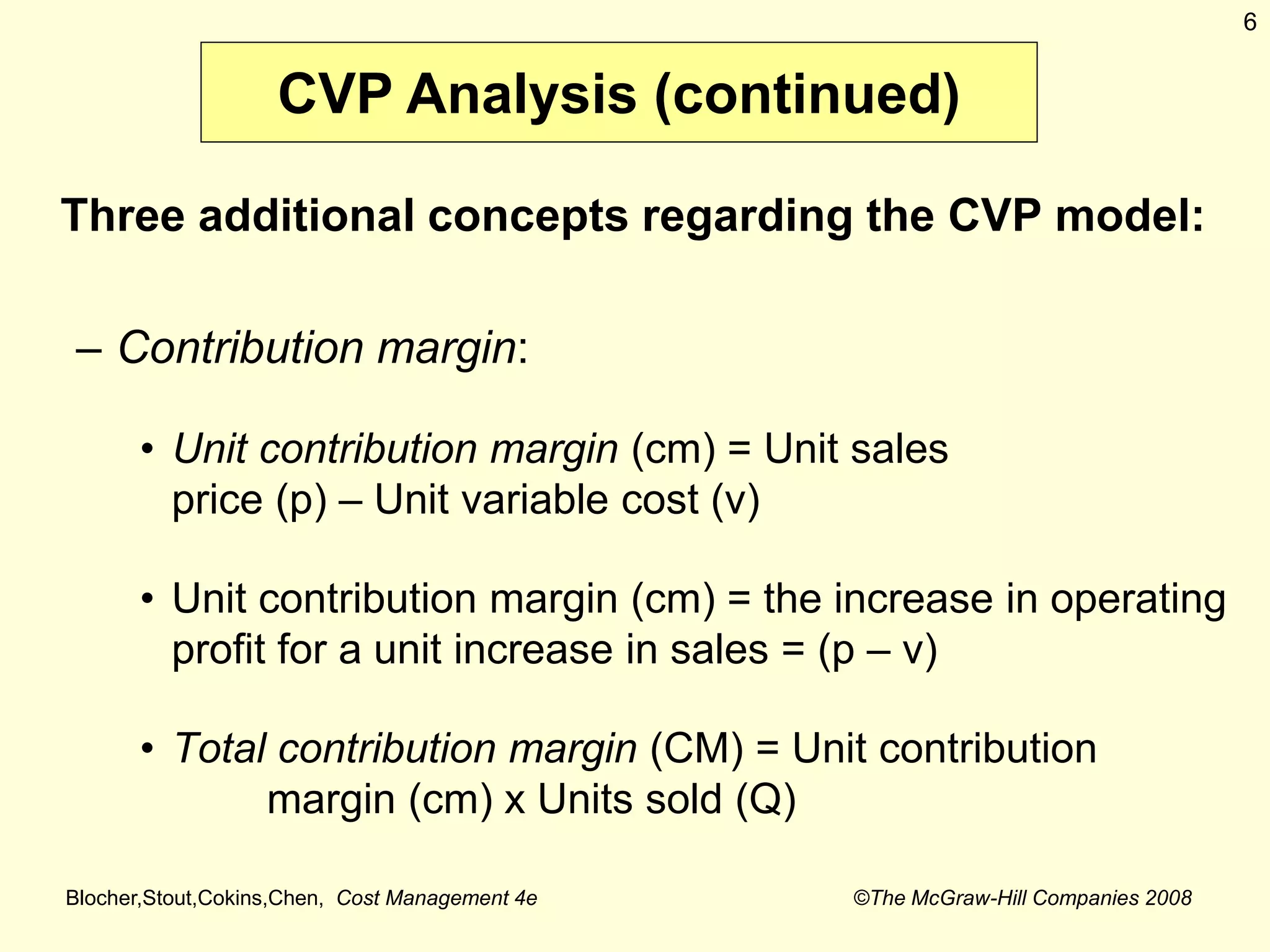
• Unit contribution margin (cm) = Unit sales
price (p) – Unit variable cost (v)
• Unit contribution margin (cm) = the increase in operating
profit for a unit increase in sales = (p – v)
• Total contribution margin (CM) = Unit contribution
margin (cm) x Units sold (Q)
CVP Analysis (continued)
Blocher,Stout,Cokins,Chen, Cost Management 4e ©The McGraw-Hill Companies 2008
7
– Contribution margin ratio = Unit contribution margin
(cm)/unit sales price (p)
= (p – v)/p = cm/p
– The contribution income statement:
• A useful way to show information developed in CVP
analysis
• Classifies costs based on cost behavior (fixed versus
variable) rather than cost type (product versus period)
• Provides an easy and accurate prediction of the effect of
a change in sales on profits
CVP Analysis (continued)
Blocher,Stout,Cokins,Chen, Cost Management 4e ©The McGraw-Hill Companies 2008
8
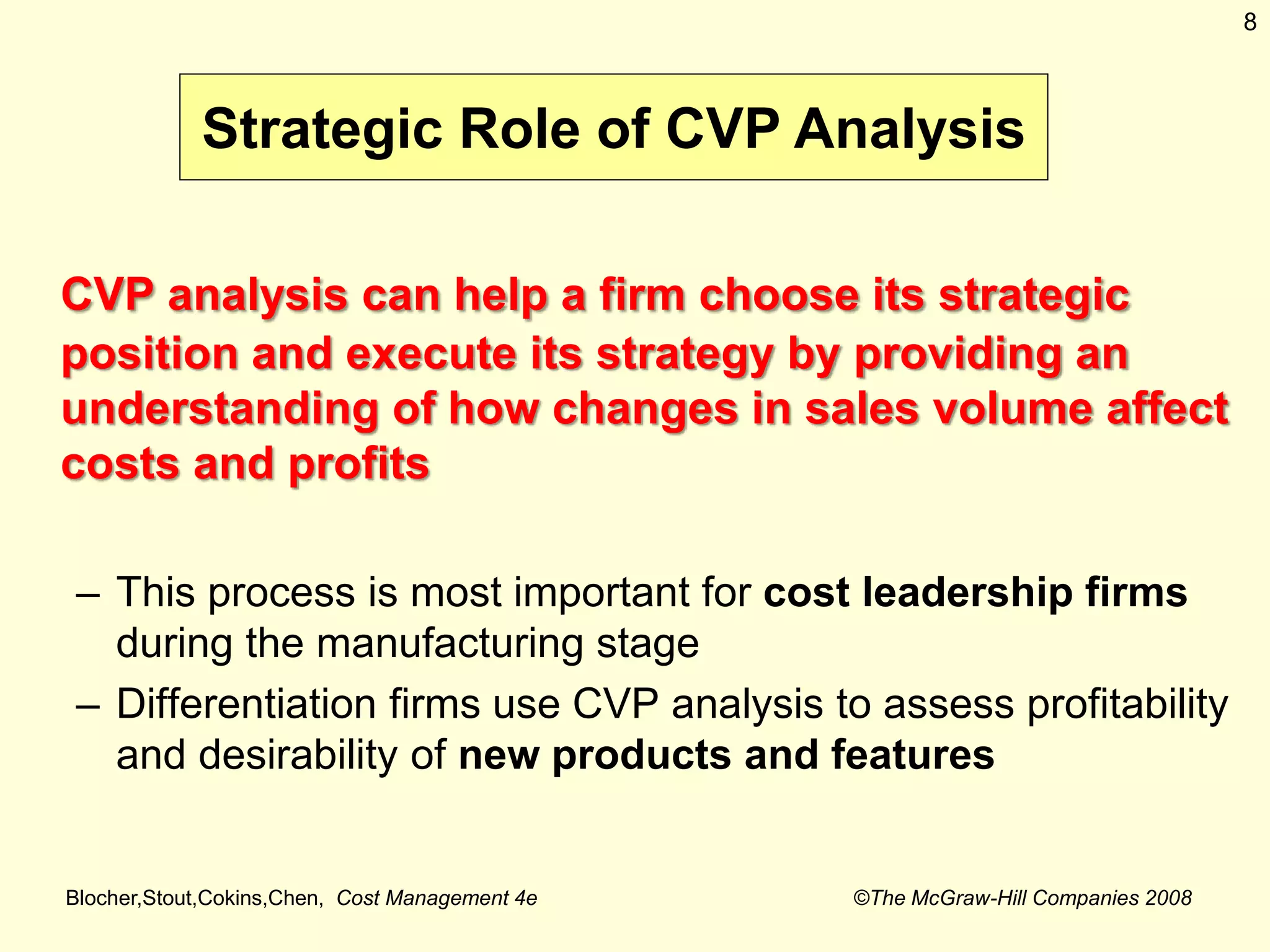
CVP analysis can help a firm choose its strategic
position and execute its strategy by providing an
understanding of how changes in sales volume affect
costs and profits
– This process is most important for cost leadership firms
during the manufacturing stage
– Differentiation firms use CVP analysis to assess profitability
and desirability of new products and features
Strategic Role of CVP Analysis
Blocher,Stout,Cokins,Chen, Cost Management 4e ©The McGraw-Hill Companies 2008
9
CVP analysis is also important in life-cycle costing
and target costing
– CVP analysis can assist in life-cycle costing by helping to
determine whether a product is likely to achieve its desired
profitability, the most cost-effective manufacturing process,
the best marketing and distribution channels, the best
compensation plan, whether to offer discounts, etc.
– CVP analysis can assist in target costing by showing the
effect on profit of alternative product designs that have
different target costs
Strategic Role of CVP Analysis
(continued)
Blocher,Stout,Cokins,Chen, Cost Management 4e ©The McGraw-Hill Companies 2008
10
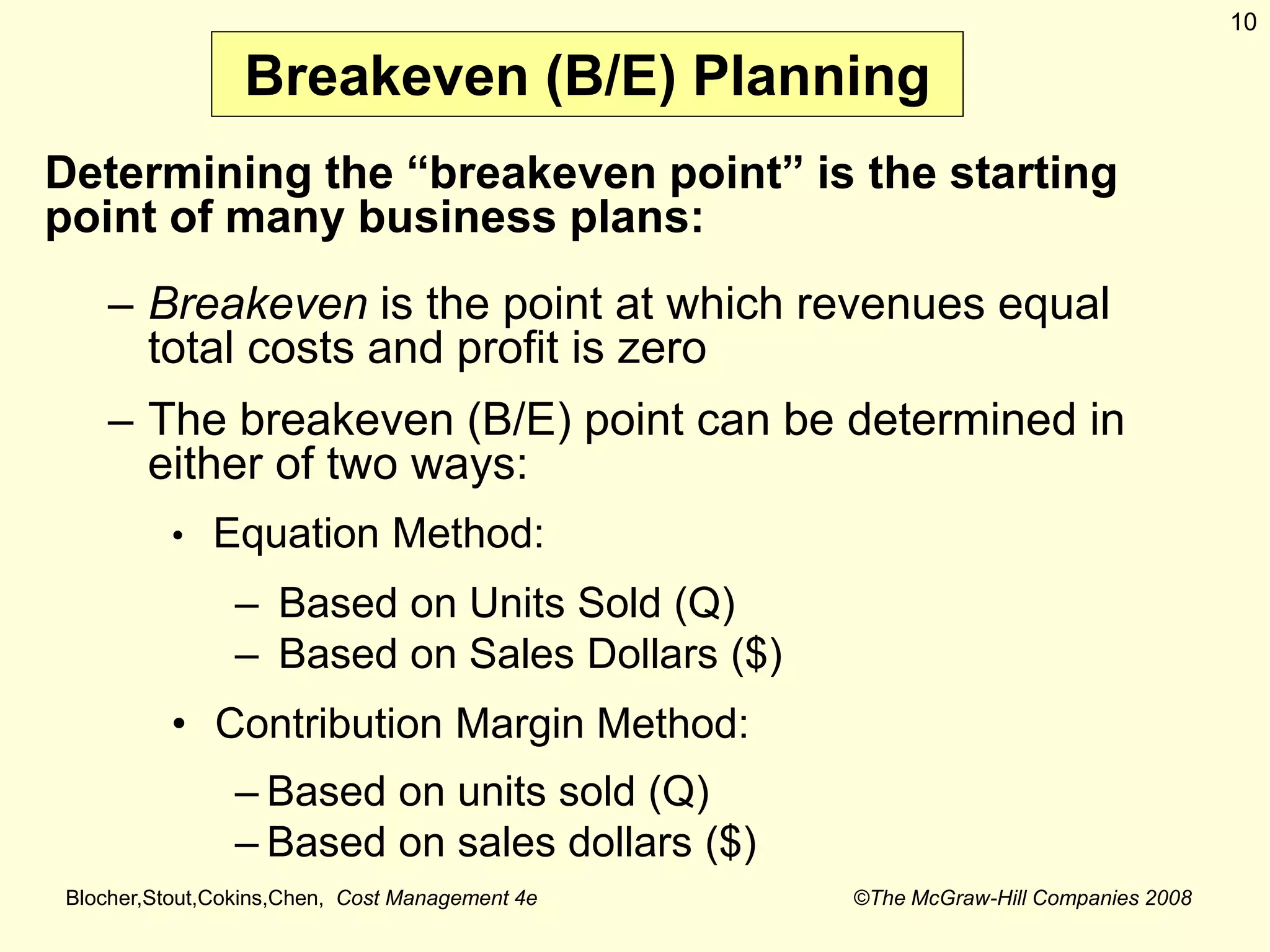
Determining the “breakeven point” is the starting
point of many business plans:
– Breakeven is the point at which revenues equal
total costs and profit is zero
– The breakeven (B/E) point can be determined in
either of two ways:
• Equation Method:
– Based on Units Sold (Q)
– Based on Sales Dollars ($)
• Contribution Margin Method:
– Based on units sold (Q)
– Based on sales dollars ($)
Breakeven (B/E) Planning
Blocher,Stout,Cokins,Chen, Cost Management 4e ©The McGraw-Hill Companies 2008
11
B/E Planning (continued)
The Equation Methods (@ B/E, N = $0)
1) B/E in unit sales (Q = sales in units):
p x Q = (v x Q) + F + N
p x Q = (v x Q) + F
F = total fixed cost, N = operating profit
2) B/E in sales dollars (Y = sales in dollars) :
Y = [(v/p) x Y ] + F + N
Y = [(v/p) x Y ] + F
Blocher,Stout,Cokins,Chen, Cost Management 4e ©The McGraw-Hill Companies 2008
12
B/E Planning (continued)
The Contribution Margin Methods
3) B/E in sales units (Q):
Q = F
p - v
4) B/E in sales dollars (Y):
Y = F
(p - v)/p
Blocher,Stout,Cokins,Chen, Cost Management 4e ©The McGraw-Hill Companies 2008
13
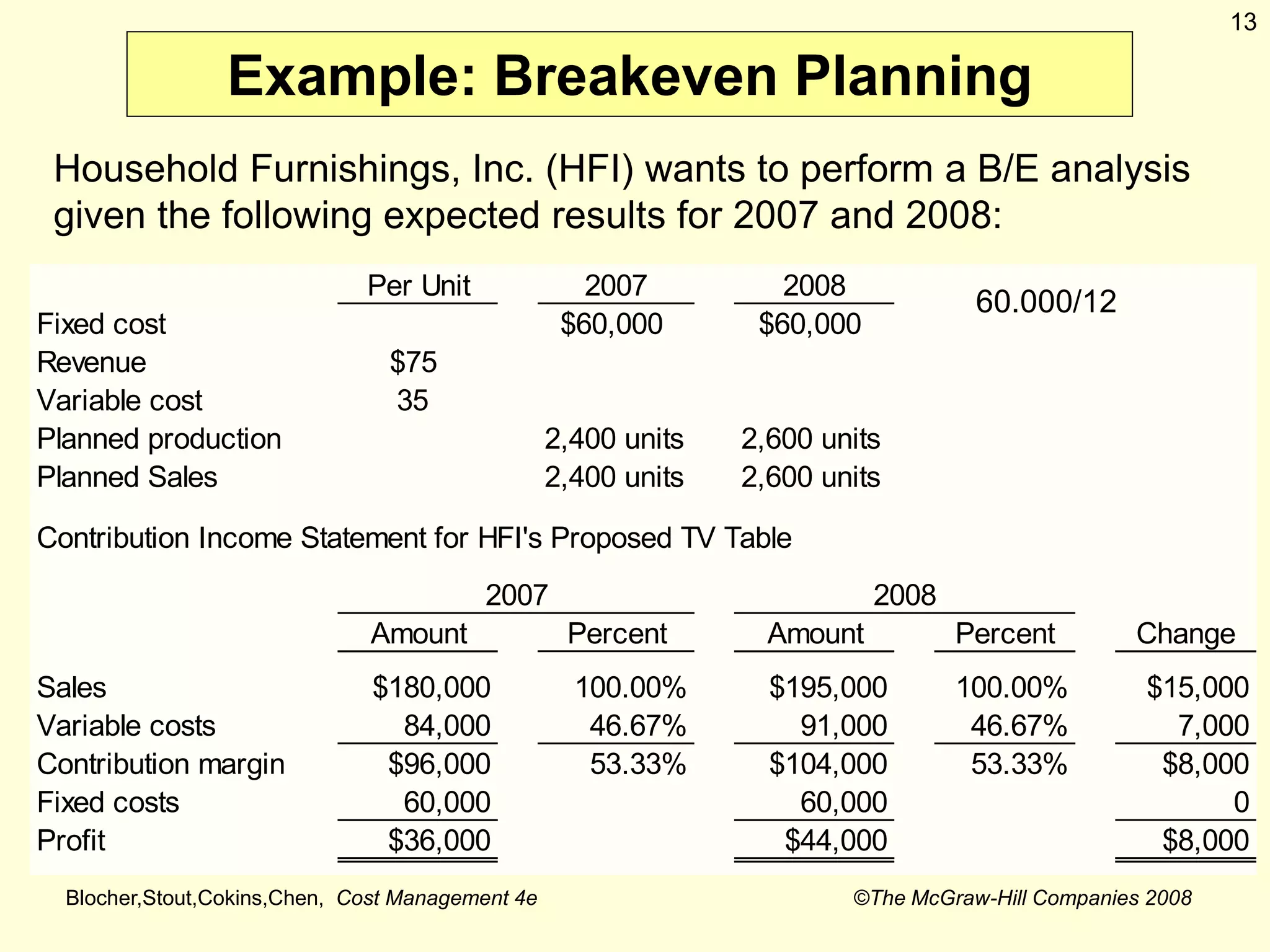
Example: Breakeven Planning
Per Unit 2007 2008
Fixed cost $60,000 $60,000
Revenue $75
Variable cost 35
Planned production 2,400 units 2,600 units
Planned Sales 2,400 units 2,600 units
Contribution Income Statement for HFI's Proposed TV Table
Amount Percent Amount Percent Change
Sales $180,000 100.00% $195,000 100.00% $15,000
Variable costs 84,000 46.67% 91,000 46.67% 7,000
Contribution margin $96,000 53.33% $104,000 53.33% $8,000
Fixed costs 60,000 60,000 0
Profit $36,000 $44,000 $8,000
2007 2008
Household Furnishings, Inc. (HFI) wants to perform a B/E analysis
given the following expected results for 2007 and 2008:
60.000/12
Blocher,Stout,Cokins,Chen, Cost Management 4e ©The McGraw-Hill Companies 2008
14
Breakeven Example (continued)
The Equation Methods
1) Breakeven in sales units (Q = sales in units)
p x Q = (v x Q) + F + N
Assume the management accountant is using the equation method
to analyze the breakeven point (in units) of HFI's sale of TV tables:
p x Q =( v x Q) + F + N
$75 x Q = ($35 x Q) + $5,000 + $0
($75 - $35) x Q = $5,000
Q = $5,000/($75 - $35)
Q = $5,000/$40 = 125 units per month
If N = $1500
Blocher,Stout,Cokins,Chen, Cost Management 4e ©The McGraw-Hill Companies 2008
15
Breakeven Example (continued)
The Equation Methods (Continued)
2) Breakeven in sales dollars (Y = sales in dollars)
Y = [(v/p) x Y] + F + N
Assume the management accountant is using the equation method
to analyze the breakeven point (in sales dollars) of HFI's sale of TV tables
and he/she does not know the unit sales price or the unit variable costs:
Y = [(v/p) x Y] + F + N
Y = [($84,000/$180,000) x Y] + $5,000 + $0
Y = [0.4667 x Y] + $5,000
Y = $9,375 per month
$ 13.927,5
Blocher,Stout,Cokins,Chen, Cost Management 4e ©The McGraw-Hill Companies 2008
16
Breakeven Example (continued)
The Contribution Margin Methods
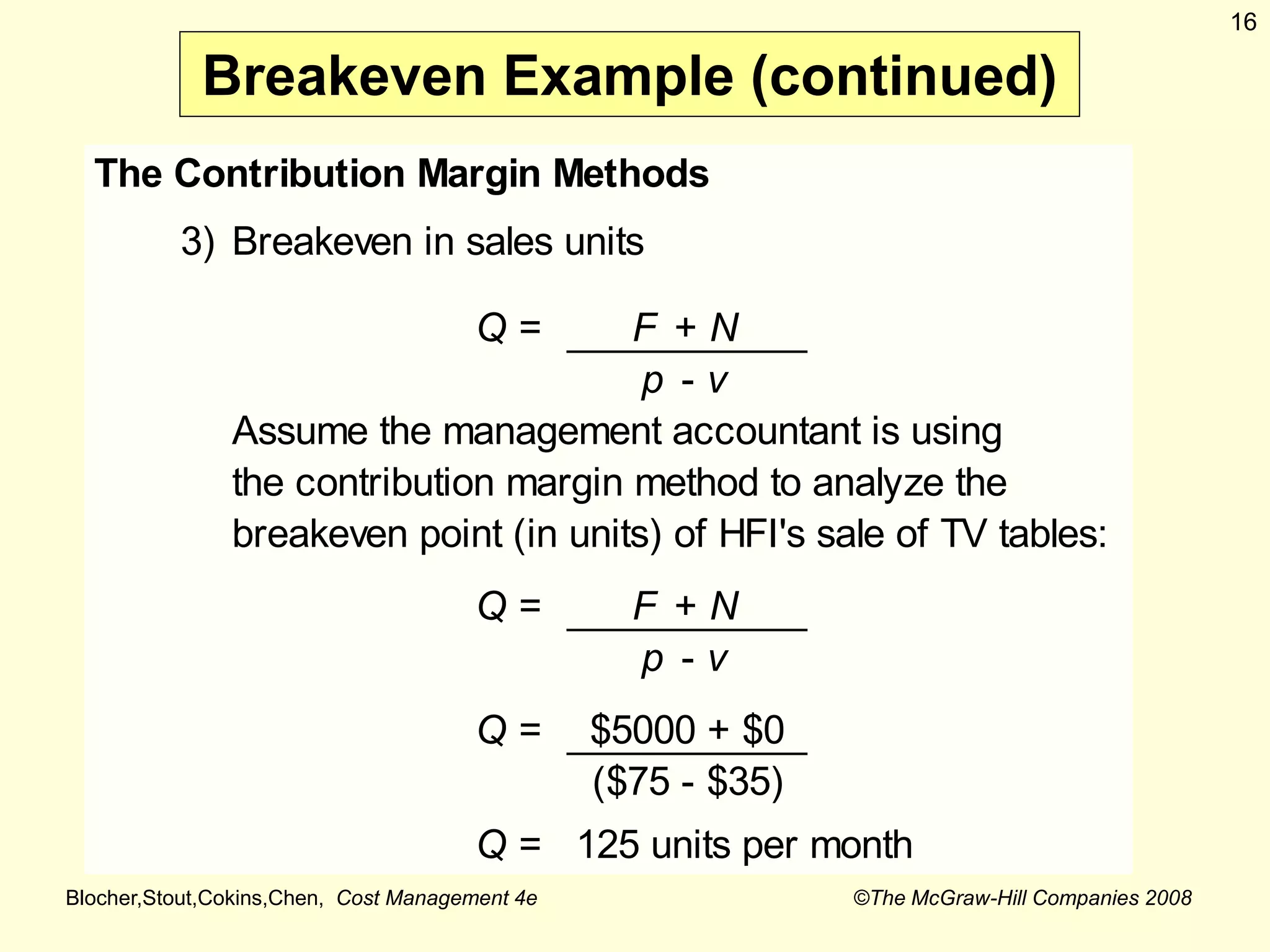
3) Breakeven in sales units
Q = F + N
p - v
Assume the management accountant is using
the contribution margin method to analyze the
breakeven point (in units) of HFI's sale of TV tables:
Q = F + N
p - v
Q = $5000 + $0
($75 - $35)
Q = 125 units per month
Blocher,Stout,Cokins,Chen, Cost Management 4e ©The McGraw-Hill Companies 2008
17
Breakeven Example (continued)
The Contribution Margin Methods (continued):
4) Breakeven in sales dollars
Y = F + N
(p - v)/p
Assume the management accountant is using the
contribution margin method to analyze the breakeven
point (in sales dollars) of HFI's sale of TV tables
and he/she does not know the unit sales price or
Blocher,Stout,Cokins,Chen, Cost Management 4e ©The McGraw-Hill Companies 2008
18
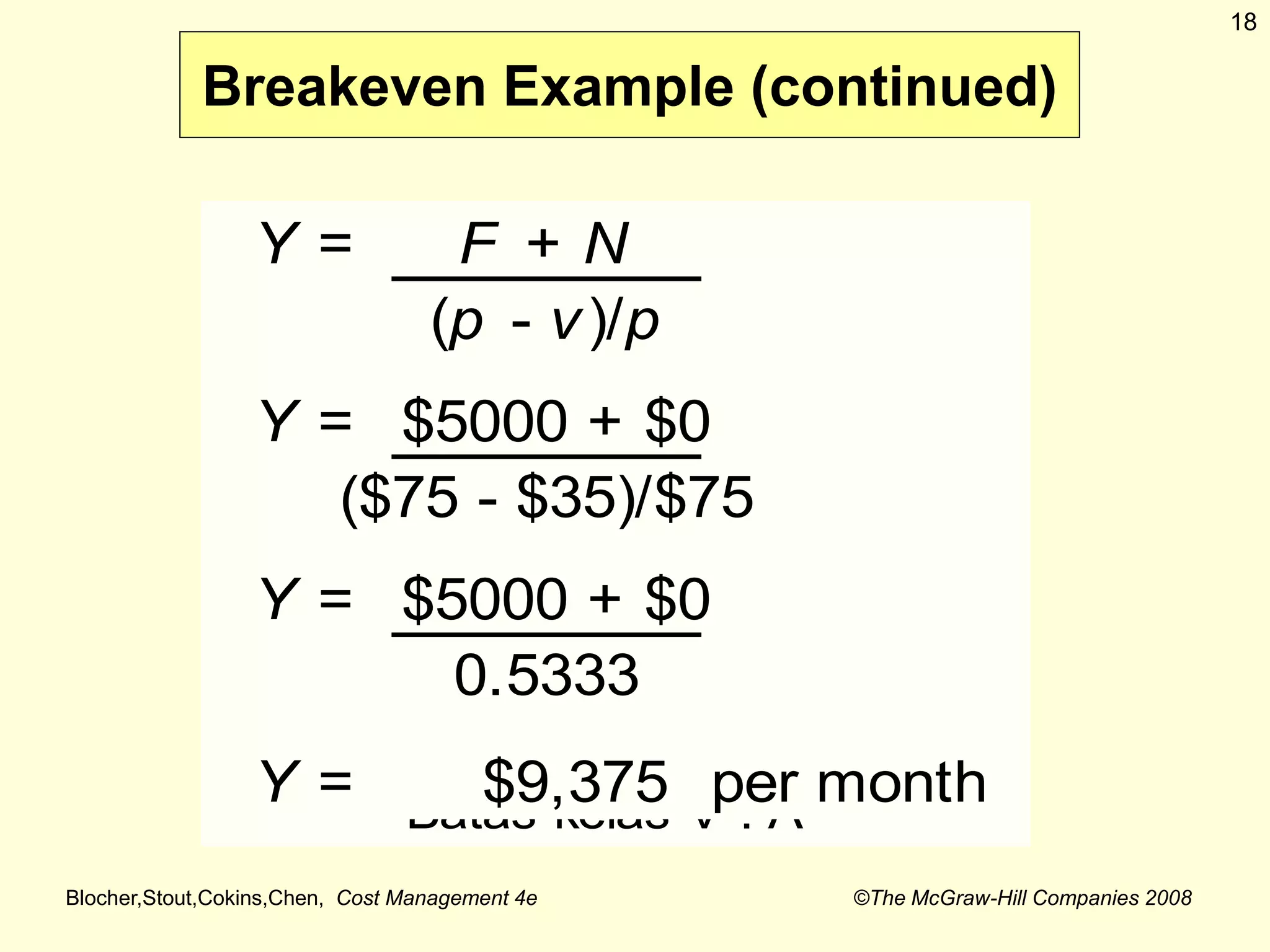
Breakeven Example (continued)
Y = F + N
(p - v)/p
Y = $5000 + $0
($75 - $35)/$75
Y = $5000 + $0
0.5333
Y = $9,375 per month
Batas kelas V . A
Blocher,Stout,Cokins,Chen, Cost Management 4e ©The McGraw-Hill Companies 2008
19
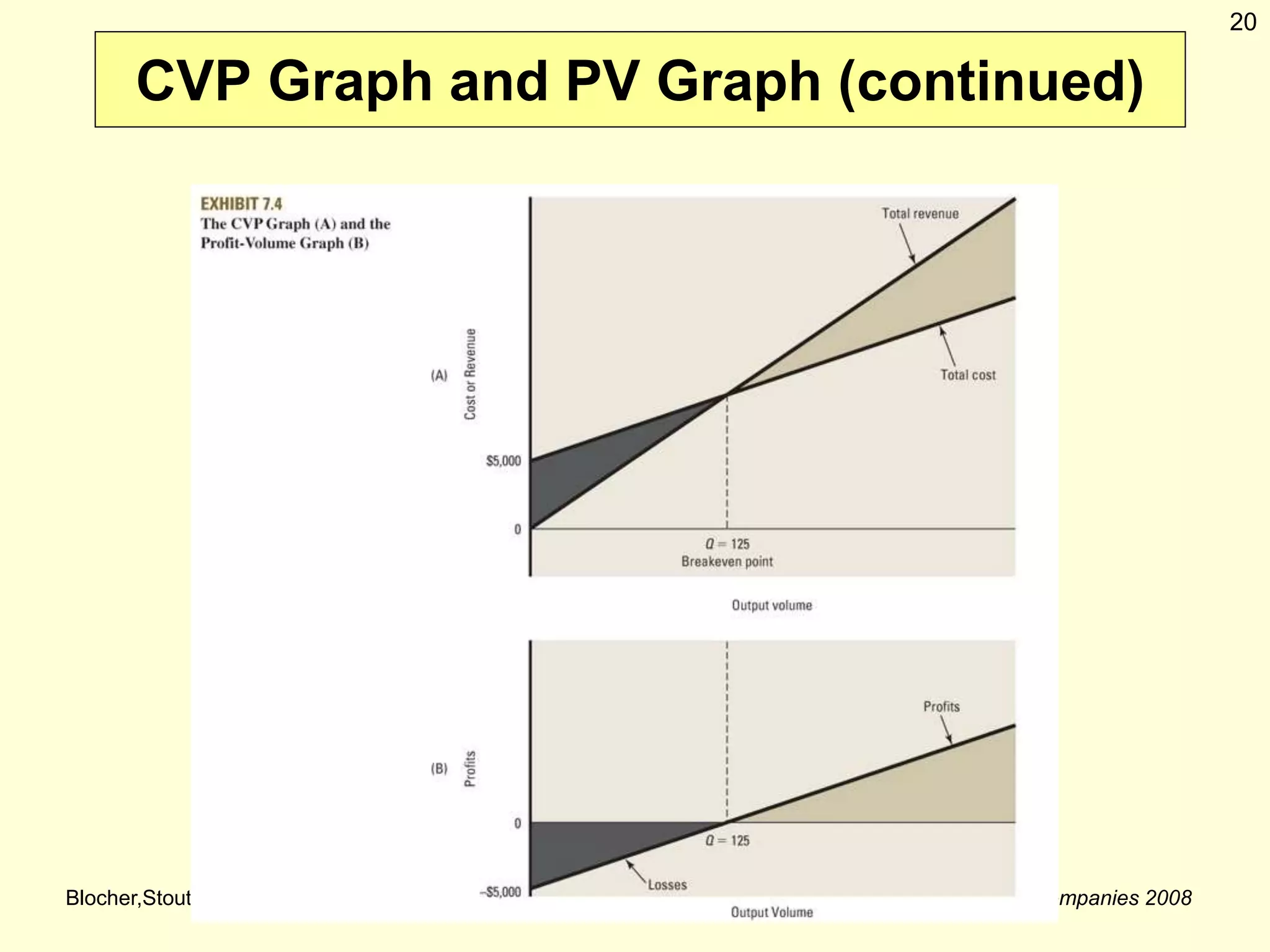
• The CVP graph illustrates how the levels of
revenues and total costs change as output
(sales volume) changes
– Sales below the breakeven point result in a loss for
the firm
• A profit-volume (PV) graph illustrates how the
level of operating profit changes as output
(sales volume) changes
– This graph allows a person to clearly see how total
contribution margin, and therefore profit, changes as
the output level (i.e., volume) changes
CVP Graph and Profit-Volume (PV)
Graph
Blocher,Stout,Cokins,Chen, Cost Management 4e ©The McGraw-Hill Companies 2008
20
CVP Graph and PV Graph (continued)
Blocher,Stout,Cokins,Chen, Cost Management 4e ©The McGraw-Hill Companies 2008
21
CVP Analysis in Profit Planning
CVP analysis can be used to determine the sales
volume needed to achieve a desired level of profit:
For example, if HFI's management needs to know
the revenue required to achieve $48,000 (N) in annual profits.....
Q = F + N
p - v
Q = $60,000 + $48,000
$75 - $35
Q = 2,700 units per year
In sales dollars the result is
p x Q = $75 x 2,700
p x Q = $202,500 per year
Blocher,Stout,Cokins,Chen, Cost Management 4e ©The McGraw-Hill Companies 2008
22
CVP and Profit Planning (continued)
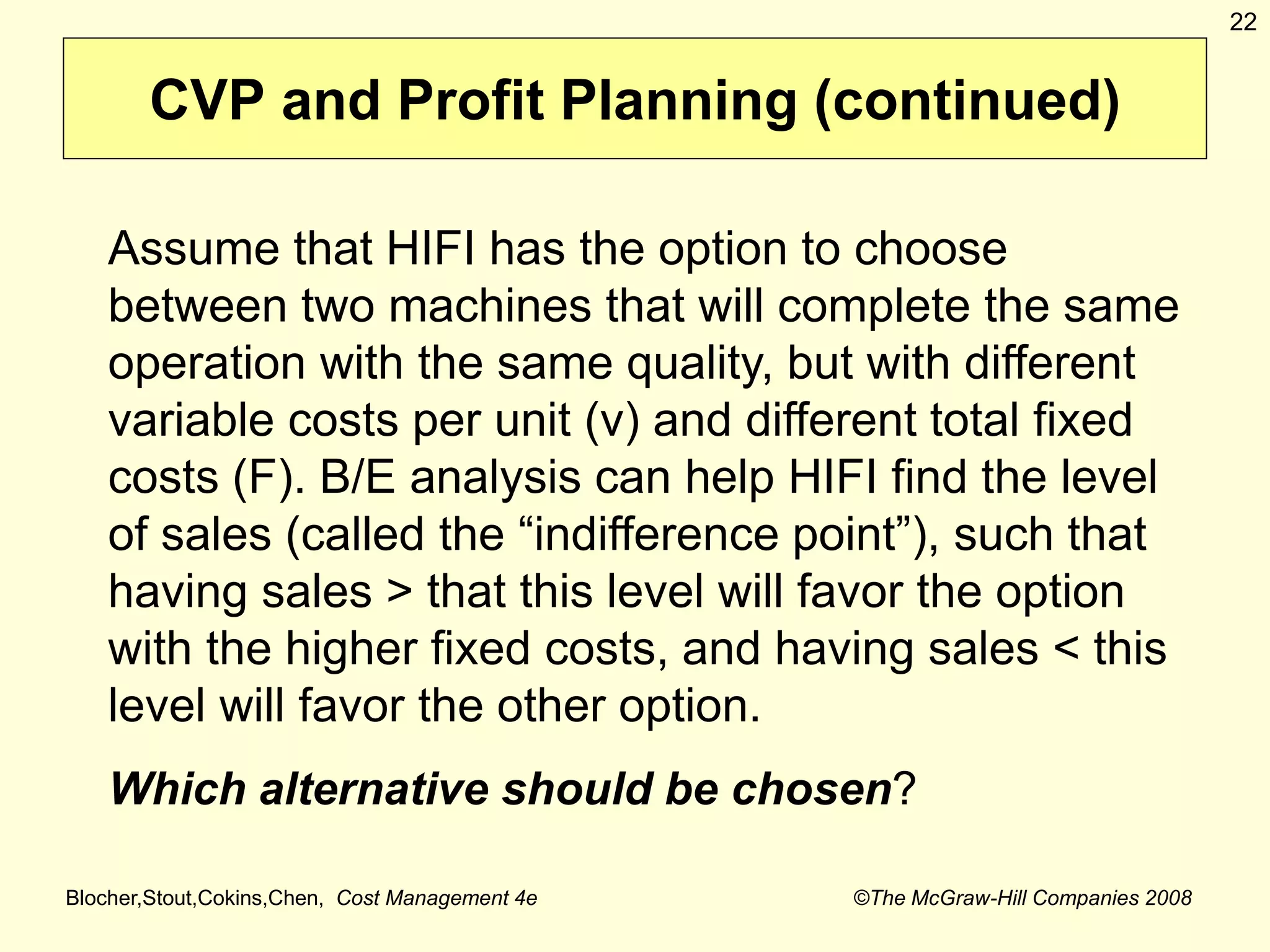
Assume that HIFI has the option to choose
between two machines that will complete the same
operation with the same quality, but with different
variable costs per unit (v) and different total fixed
costs (F). B/E analysis can help HIFI find the level
of sales (called the “indifference point”), such that
having sales > that this level will favor the option
with the higher fixed costs, and having sales < this
level will favor the other option.
Which alternative should be chosen?
Blocher,Stout,Cokins,Chen, Cost Management 4e ©The McGraw-Hill Companies 2008
23
CVP and Profit Planning
(continued)
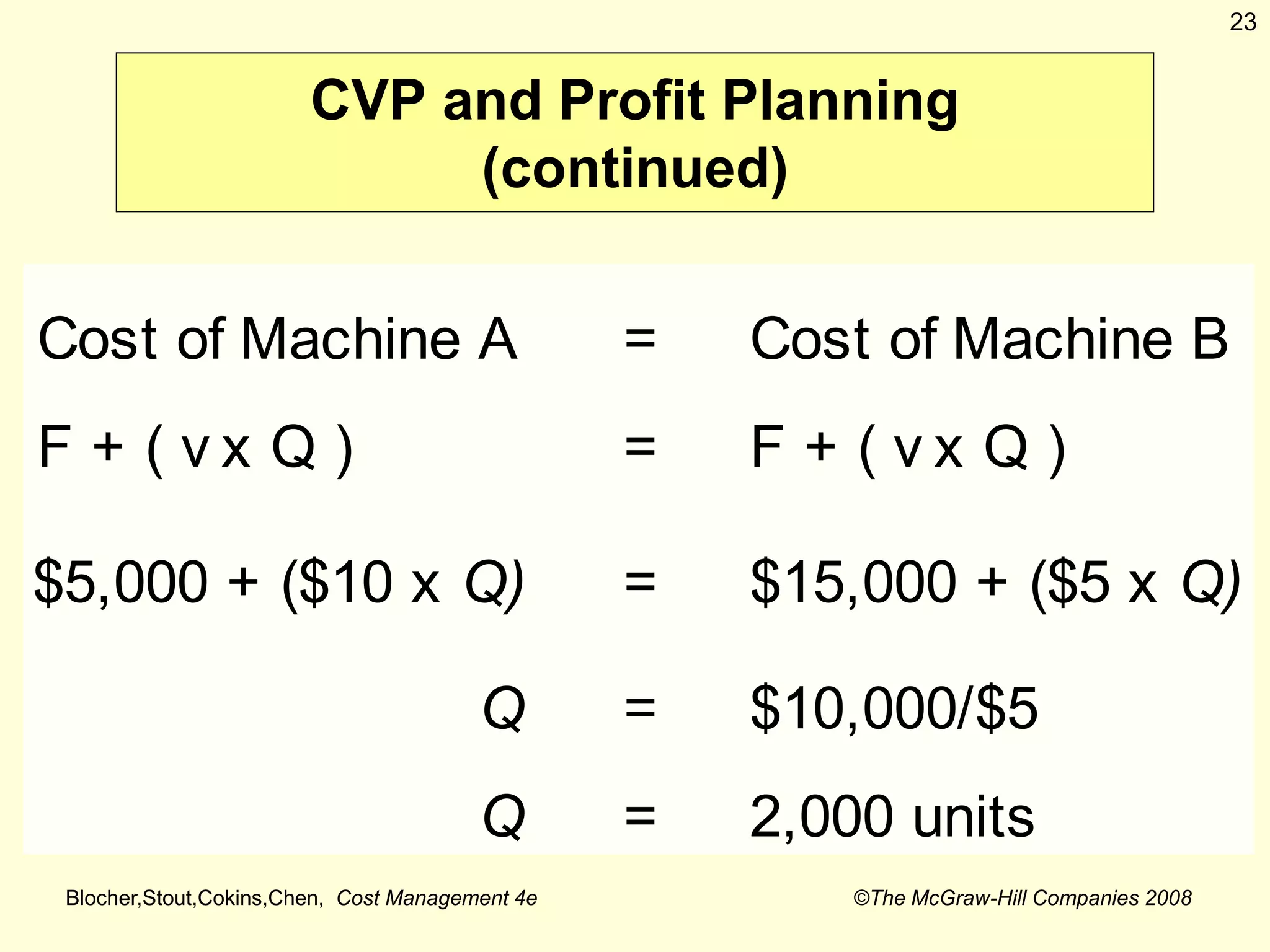
Cost of Machine A = Cost of Machine B
F + ( v x Q ) = F + ( v x Q )
$5,000 + ($10 x Q) = $15,000 + ($5 x Q)
Q = $10,000/$5
Q = 2,000 units
Blocher,Stout,Cokins,Chen, Cost Management 4e ©The McGraw-Hill Companies 2008
24
CVP and Profit Planning (continued)
Management decisions about costs and prices usually
must include income taxes because taxes affect the
amount of net profit at a given level of sales
In the HFI example, if we assume that the average income
tax rate is 20 percent, to achieve the desired annual after-tax
profit of $48,000, HFI must generate before-tax profits of ....
Before-tax profit = After-tax profit/(1 - Tax Rate)
Before-tax profit = $48,000/(1 - 0.2)
Before-tax profit = $60,000
Blocher,Stout,Cokins,Chen, Cost Management 4e ©The McGraw-Hill Companies 2008
25
CVP and Profit Planning
(continued)
In the HFI example, if we assume that the average income
tax rate is 20 percent, to achieve the desired annual after-tax
profit of $48,000, HFI must generate before-tax profits of ....
Before-tax profit = After-tax profit/(1 - Tax Rate)
Before-tax profit = $48,000/(1 - 0.2)
Before-tax profit = $60,000
Blocher,Stout,Cokins,Chen, Cost Management 4e ©The McGraw-Hill Companies 2008
26
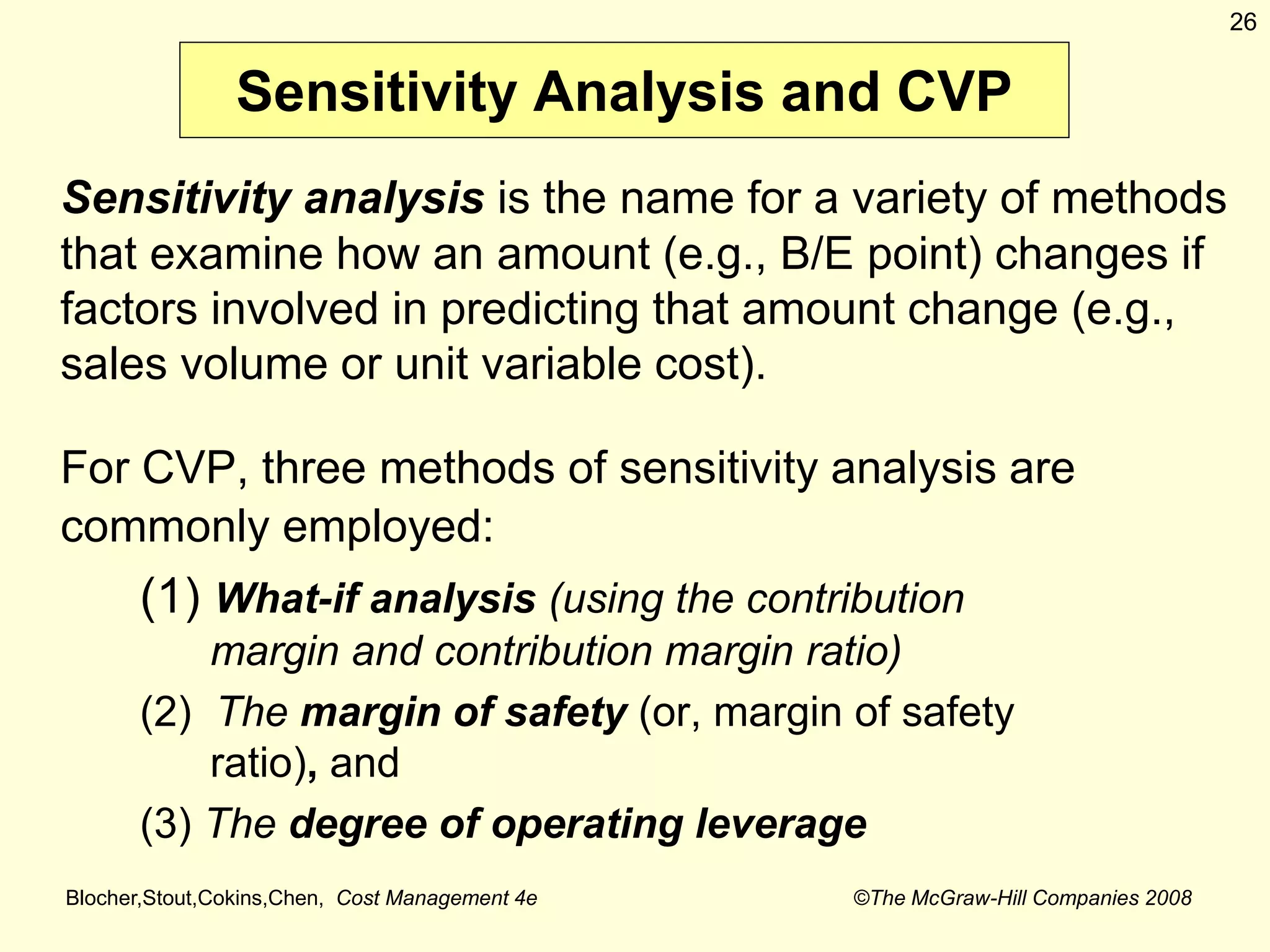
Sensitivity analysis is the name for a variety of methods
that examine how an amount (e.g., B/E point) changes if
factors involved in predicting that amount change (e.g.,
sales volume or unit variable cost).
For CVP, three methods of sensitivity analysis are
commonly employed:
(1) What-if analysis (using the contribution
margin and contribution margin ratio)
(2) The margin of safety (or, margin of safety
ratio), and
(3) The degree of operating leverage
Sensitivity Analysis and CVP
Blocher,Stout,Cokins,Chen, Cost Management 4e ©The McGraw-Hill Companies 2008
27
What-if analysis is the calculation of an amount
given different levels of a factor that influences
that amount
– Example: if contribution margin (cm) is $40 per unit
and the cm ratio is 0.53333, each unit change in
sales volume affects profit by $40 and each dollar
change in sales affects profits by $0.53333
Sensitivity Analysis and CVP
(continued)
Blocher,Stout,Cokins,Chen, Cost Management 4e ©The McGraw-Hill Companies 2008
Exam
• FC 10.000 $/y
• VC ; 1.5$/u
• SP ; 3 $/u
• TAX ; 20% average.
Question :
• Q in BEP =
1.250 unit /0,8 = @ + 1.250.
1.250 x 3 = $ 3.750 ** not
included tax rate 20%.
• Q If HIFI profit $ 15.000 =
28
Blocher,Stout,Cokins,Chen, Cost Management 4e ©The McGraw-Hill Companies 2008
Exam continued
• Sales = 18.750 x $3 = $ 56.250
• VC = 18.750 x $1,5 = $ 28.125
CM = $ 28.125
FC (10.000;12 ) = $ 833,33
EBT $ 27.291,67
Tax ( 20% ) = $ 5.458,33
EAT = $ 21.833,36
if = $ 15.000, EAT = $17.334,34
29
Blocher,Stout,Cokins,Chen, Cost Management 4e ©The McGraw-Hill Companies 2008
30
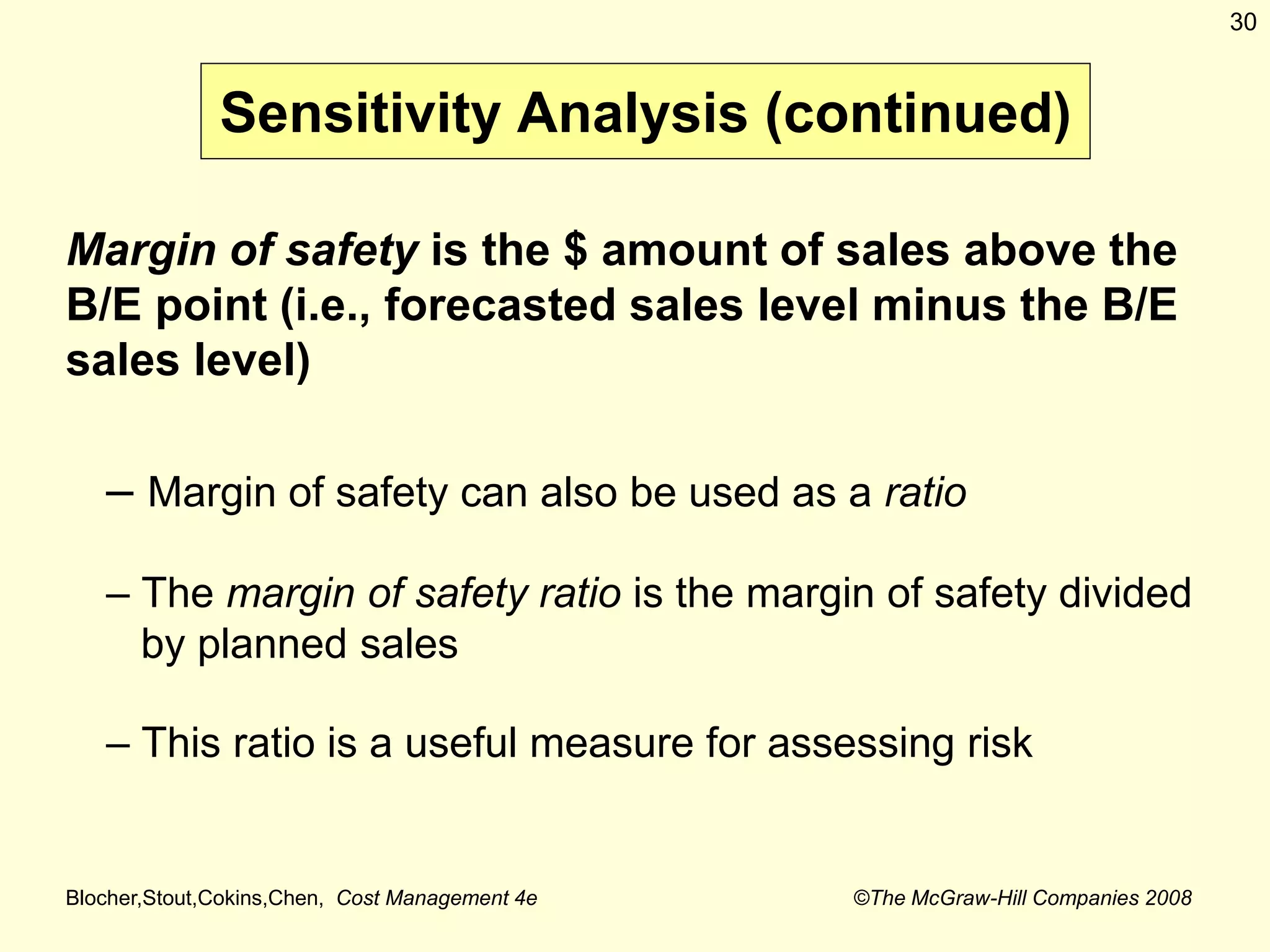
Margin of safety is the $ amount of sales above the
B/E point (i.e., forecasted sales level minus the B/E
sales level)
– Margin of safety can also be used as a ratio
– The margin of safety ratio is the margin of safety divided
by planned sales
– This ratio is a useful measure for assessing risk
Sensitivity Analysis (continued)
Blocher,Stout,Cokins,Chen, Cost Management 4e ©The McGraw-Hill Companies 2008
31
Degree of operating leverage (DOL) is the ratio of CM
to operating profit:
– A higher DOL value indicates a higher risk in the sense
that a given change in sales will have a relatively greater
% impact on profits
– The DOL can be thought of as the extent to which fixed
costs characterize the cost structure of an organization:
the higher the percentage of fixed costs, the higher the
DOL (and therefore the higher the operating risk)
Sensitivity Analysis (continued)
Blocher,Stout,Cokins,Chen, Cost Management 4e ©The McGraw-Hill Companies 2008
32
–The DOL is defined at each sales volume level
– Organizations with high DOL work hard for even small %
increases in sales volume (because these changes are
magnified as % changes in operating profit)
Sensitivity Analysis (continued)
Blocher,Stout,Cokins,Chen, Cost Management 4e ©The McGraw-Hill Companies 2008
33
Multi-Product CVP Analysis
• If all fixed costs are traceable to individual products,
then the organization can develop a separate CVP
model for each product
• Alternatively, the multi-product firm can make an
assumption regarding a standard sales mix in which
its products are sold
• Sales mix can be determined on the basis of sales
dollars or unit sales
• The assumption of sales mix allows the firm to
calculate and use a weighted-average contribution
margin (cm) per unit and weighted average cm ratio
to do multi-product CVP analysis
Blocher,Stout,Cokins,Chen, Cost Management 4e ©The McGraw-Hill Companies 2008
34
Example: Multi-Product CVP Analysis
Windbreakers, Inc. sells light-weight sports/recreational
jackets and currently has three products: Calm, Windy, and
Gale. Total (joint) fixed costs for the period are expected to be
$168,000, and we assume the windbreakers’ sales mix,
measured by sales dollars, will remain constant. Additional
information is provided below.
Calm Windy Gale Total
Last period's sales 750,000
$ 600,000
$ 150,000
$ 1,500,000
$
Percent of sales 50% 40% 10% 100%
Price 30
$ 32
$ 40
$
Unit variable cost 24 24 36
Contribution margin 6
$ 8
$ 4
$
Contribution margin ratio 20% 25% 10%
Blocher,Stout,Cokins,Chen, Cost Management 4e ©The McGraw-Hill Companies 2008
35
Example: Multi-Product CVP (continued)
From this information, we can calculate the wtd. avg. cm ratio:
Weighted-average CMR = 0.5(0.2) + 0.4(0.25) + 0.1(0.1) = 0.21
The breakeven point for all three products can be calculated
as follows:
Y = 168,000/0.21
Y = $800,000
This means that for Windbreakers to break even, $800,000 of all three
products must be sold in the same proportion as last year's sales mix.
The sales for each product need to be as follows:
For Calm 0.5($800,000) = $400,000
For Windy 0.4($800,000) = 320,000
For Gale 0.1($800,000) = 80,000
$800,000
Blocher,Stout,Cokins,Chen, Cost Management 4e ©The McGraw-Hill Companies 2008
36
Example 2: Multi-Product CVP
Analysis
Windbreakers, Inc. sells light-weight sports/recreational
jackets and currently has three products: Calm, Windy, and
Gale. Total (joint) fixed costs for the period are expected to be
$200,000, and we assume the windbreakers’ sales mix,
measured by sales dollars, will remain constant. Additional
information is provided below.
Calm Windy Gale Total
Last period's sales 500,000
$ 350,000
$ 175,000
$ 1,025,000
$
Percent of sales 49% 34% 17% 100%
Price 30
$ 32
$ 40
$
Unit variable cost 25 26 35
Contribution margin 5
$ 6
$ 5
$
Contribution margin ratio 17% 19% 13%
Blocher,Stout,Cokins,Chen, Cost Management 4e ©The McGraw-Hill Companies 2008
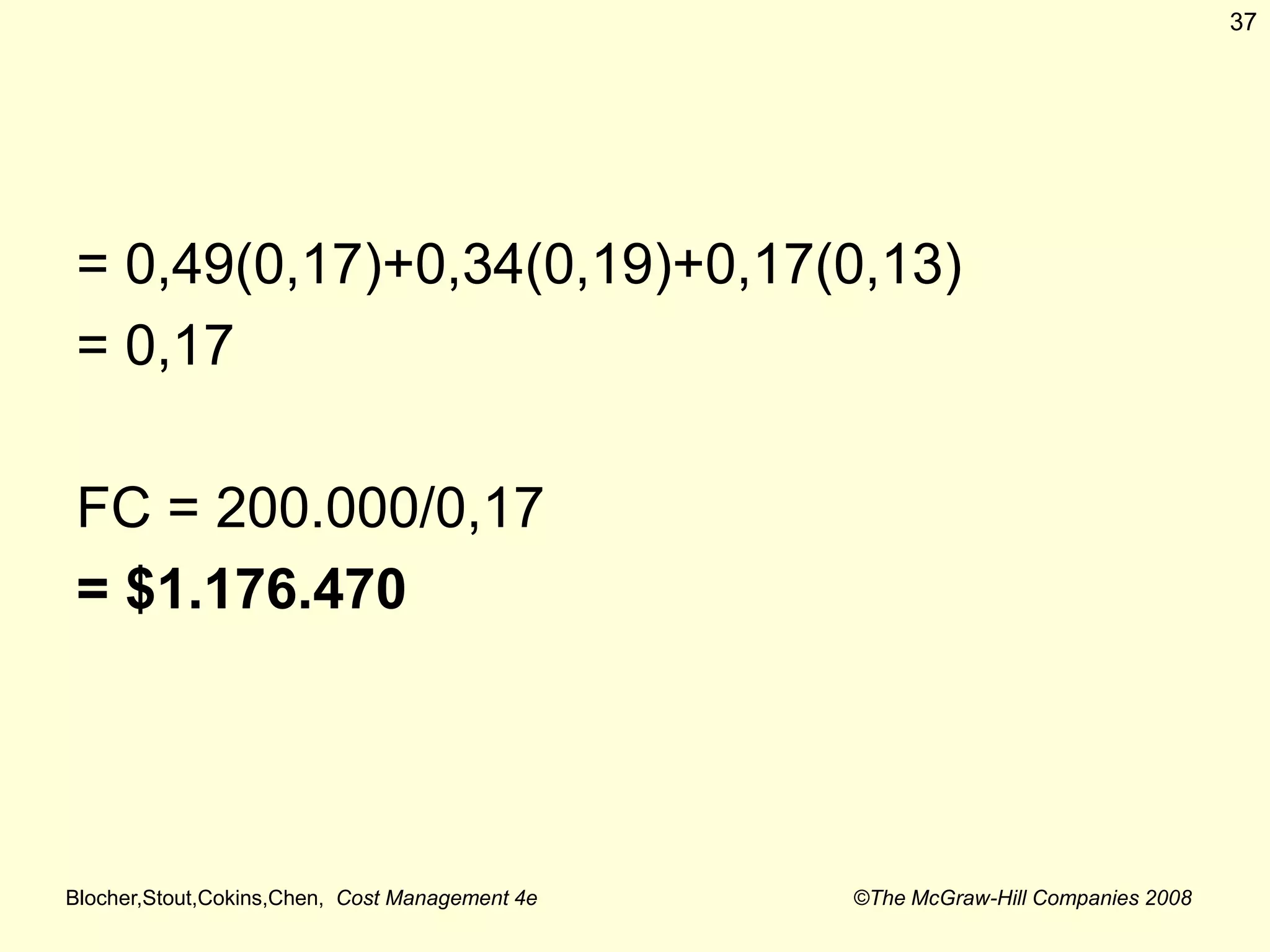
= 0,49(0,17)+0,34(0,19)+0,17(0,13)
= 0,17
FC = 200.000/0,17
= $1.176.470
37
Blocher,Stout,Cokins,Chen, Cost Management 4e ©The McGraw-Hill Companies 2008
38
Assumptions of CVP Analysis
CVP analysis has its limitations as it relies on
assumptions:
– Linearity and the relevant range:
• The CVP model assumes revenues and costs are
linear over a “relevant range” (even though the actual
cost behavior may not be linear)
• Outside the relevant range, these calculations will not
be accurate
• Step costs also make approximation via the relevant
range unworkable; CVP analysis becomes much more
cumbersome
Blocher,Stout,Cokins,Chen, Cost Management 4e ©The McGraw-Hill Companies 2008
39
Assumptions of CVP Analysis
(continued)
– Identifying fixed and variable costs: there are
several issues
• Which fixed costs should be included?
• Should fixed costs be accounted for using the cash
or accrual method?
• Have all relevant unit variable costs been included
(production, selling, distribution, etc.)?
Ended for CPV
Blocher,Stout,Cokins,Chen, Cost Management 4e ©The McGraw-Hill Companies 2008
• THANKS
40

6 CVP anlysis NEW.pptx

  • 1.
    Blocher,Stout,Cokins,Chen, Cost Management4e ©The McGraw-Hill Companies 2008 Cost-Volume-Profit Analysis Chapter Seven
  • 2.
    Blocher,Stout,Cokins,Chen, Cost Management4e ©The McGraw-Hill Companies 2008 2 • CVP analysis is a method for analyzing how operating decisions and marketing decisions affect profit • CVP relies on an understanding of the relationship between variable costs, fixed costs, unit selling price, and output level (volume) CVP Analysis
  • 3.
    Blocher,Stout,Cokins,Chen, Cost Management4e ©The McGraw-Hill Companies 2008 3 CVP analysis can be used in: – Setting prices for products and services – Determining whether to introduce a new product or service – Replacing a piece of equipment – Determining breakeven point – Making “Make-or-buy” (i.e., sourcing) decisions – Determining the best product mix – Performing strategic “what-if” (sensitivity) analysis CVP Analysis (continued)
  • 4.
    Blocher,Stout,Cokins,Chen, Cost Management4e ©The McGraw-Hill Companies 2008 4 The CVP model is as follows: CVP Analysis (continued) Operating profit = Sales - Total costs or Sales = Fixed costs + Variable costs + Operating profit or (Units sold x unit sp) = Fixed costs + (Units sold x Unit v.c.) + Operating profit
  • 5.
    Blocher,Stout,Cokins,Chen, Cost Management4e ©The McGraw-Hill Companies 2008 5 CVP Analysis (continued) (p x Q) = F + (v x Q) + N Where: Q = units sold p = unit selling price F = total fixed cost v = unit variable cost N = operating profit For convenience, the model is commonly shown in symbolic form:
  • 6.
    Blocher,Stout,Cokins,Chen, Cost Management4e ©The McGraw-Hill Companies 2008 6 Three additional concepts regarding the CVP model: – Contribution margin: • Unit contribution margin (cm) = Unit sales price (p) – Unit variable cost (v) • Unit contribution margin (cm) = the increase in operating profit for a unit increase in sales = (p – v) • Total contribution margin (CM) = Unit contribution margin (cm) x Units sold (Q) CVP Analysis (continued)
  • 7.
    Blocher,Stout,Cokins,Chen, Cost Management4e ©The McGraw-Hill Companies 2008 7 – Contribution margin ratio = Unit contribution margin (cm)/unit sales price (p) = (p – v)/p = cm/p – The contribution income statement: • A useful way to show information developed in CVP analysis • Classifies costs based on cost behavior (fixed versus variable) rather than cost type (product versus period) • Provides an easy and accurate prediction of the effect of a change in sales on profits CVP Analysis (continued)
  • 8.
    Blocher,Stout,Cokins,Chen, Cost Management4e ©The McGraw-Hill Companies 2008 8 CVP analysis can help a firm choose its strategic position and execute its strategy by providing an understanding of how changes in sales volume affect costs and profits – This process is most important for cost leadership firms during the manufacturing stage – Differentiation firms use CVP analysis to assess profitability and desirability of new products and features Strategic Role of CVP Analysis
  • 9.
    Blocher,Stout,Cokins,Chen, Cost Management4e ©The McGraw-Hill Companies 2008 9 CVP analysis is also important in life-cycle costing and target costing – CVP analysis can assist in life-cycle costing by helping to determine whether a product is likely to achieve its desired profitability, the most cost-effective manufacturing process, the best marketing and distribution channels, the best compensation plan, whether to offer discounts, etc. – CVP analysis can assist in target costing by showing the effect on profit of alternative product designs that have different target costs Strategic Role of CVP Analysis (continued)
  • 10.
    Blocher,Stout,Cokins,Chen, Cost Management4e ©The McGraw-Hill Companies 2008 10 Determining the “breakeven point” is the starting point of many business plans: – Breakeven is the point at which revenues equal total costs and profit is zero – The breakeven (B/E) point can be determined in either of two ways: • Equation Method: – Based on Units Sold (Q) – Based on Sales Dollars ($) • Contribution Margin Method: – Based on units sold (Q) – Based on sales dollars ($) Breakeven (B/E) Planning
  • 11.
    Blocher,Stout,Cokins,Chen, Cost Management4e ©The McGraw-Hill Companies 2008 11 B/E Planning (continued) The Equation Methods (@ B/E, N = $0) 1) B/E in unit sales (Q = sales in units): p x Q = (v x Q) + F + N p x Q = (v x Q) + F F = total fixed cost, N = operating profit 2) B/E in sales dollars (Y = sales in dollars) : Y = [(v/p) x Y ] + F + N Y = [(v/p) x Y ] + F
  • 12.
    Blocher,Stout,Cokins,Chen, Cost Management4e ©The McGraw-Hill Companies 2008 12 B/E Planning (continued) The Contribution Margin Methods 3) B/E in sales units (Q): Q = F p - v 4) B/E in sales dollars (Y): Y = F (p - v)/p
  • 13.
    Blocher,Stout,Cokins,Chen, Cost Management4e ©The McGraw-Hill Companies 2008 13 Example: Breakeven Planning Per Unit 2007 2008 Fixed cost $60,000 $60,000 Revenue $75 Variable cost 35 Planned production 2,400 units 2,600 units Planned Sales 2,400 units 2,600 units Contribution Income Statement for HFI's Proposed TV Table Amount Percent Amount Percent Change Sales $180,000 100.00% $195,000 100.00% $15,000 Variable costs 84,000 46.67% 91,000 46.67% 7,000 Contribution margin $96,000 53.33% $104,000 53.33% $8,000 Fixed costs 60,000 60,000 0 Profit $36,000 $44,000 $8,000 2007 2008 Household Furnishings, Inc. (HFI) wants to perform a B/E analysis given the following expected results for 2007 and 2008: 60.000/12
  • 14.
    Blocher,Stout,Cokins,Chen, Cost Management4e ©The McGraw-Hill Companies 2008 14 Breakeven Example (continued) The Equation Methods 1) Breakeven in sales units (Q = sales in units) p x Q = (v x Q) + F + N Assume the management accountant is using the equation method to analyze the breakeven point (in units) of HFI's sale of TV tables: p x Q =( v x Q) + F + N $75 x Q = ($35 x Q) + $5,000 + $0 ($75 - $35) x Q = $5,000 Q = $5,000/($75 - $35) Q = $5,000/$40 = 125 units per month If N = $1500
  • 15.
    Blocher,Stout,Cokins,Chen, Cost Management4e ©The McGraw-Hill Companies 2008 15 Breakeven Example (continued) The Equation Methods (Continued) 2) Breakeven in sales dollars (Y = sales in dollars) Y = [(v/p) x Y] + F + N Assume the management accountant is using the equation method to analyze the breakeven point (in sales dollars) of HFI's sale of TV tables and he/she does not know the unit sales price or the unit variable costs: Y = [(v/p) x Y] + F + N Y = [($84,000/$180,000) x Y] + $5,000 + $0 Y = [0.4667 x Y] + $5,000 Y = $9,375 per month $ 13.927,5
  • 16.
    Blocher,Stout,Cokins,Chen, Cost Management4e ©The McGraw-Hill Companies 2008 16 Breakeven Example (continued) The Contribution Margin Methods 3) Breakeven in sales units Q = F + N p - v Assume the management accountant is using the contribution margin method to analyze the breakeven point (in units) of HFI's sale of TV tables: Q = F + N p - v Q = $5000 + $0 ($75 - $35) Q = 125 units per month
  • 17.
    Blocher,Stout,Cokins,Chen, Cost Management4e ©The McGraw-Hill Companies 2008 17 Breakeven Example (continued) The Contribution Margin Methods (continued): 4) Breakeven in sales dollars Y = F + N (p - v)/p Assume the management accountant is using the contribution margin method to analyze the breakeven point (in sales dollars) of HFI's sale of TV tables and he/she does not know the unit sales price or
  • 18.
    Blocher,Stout,Cokins,Chen, Cost Management4e ©The McGraw-Hill Companies 2008 18 Breakeven Example (continued) Y = F + N (p - v)/p Y = $5000 + $0 ($75 - $35)/$75 Y = $5000 + $0 0.5333 Y = $9,375 per month Batas kelas V . A
  • 19.
    Blocher,Stout,Cokins,Chen, Cost Management4e ©The McGraw-Hill Companies 2008 19 • The CVP graph illustrates how the levels of revenues and total costs change as output (sales volume) changes – Sales below the breakeven point result in a loss for the firm • A profit-volume (PV) graph illustrates how the level of operating profit changes as output (sales volume) changes – This graph allows a person to clearly see how total contribution margin, and therefore profit, changes as the output level (i.e., volume) changes CVP Graph and Profit-Volume (PV) Graph
  • 20.
    Blocher,Stout,Cokins,Chen, Cost Management4e ©The McGraw-Hill Companies 2008 20 CVP Graph and PV Graph (continued)
  • 21.
    Blocher,Stout,Cokins,Chen, Cost Management4e ©The McGraw-Hill Companies 2008 21 CVP Analysis in Profit Planning CVP analysis can be used to determine the sales volume needed to achieve a desired level of profit: For example, if HFI's management needs to know the revenue required to achieve $48,000 (N) in annual profits..... Q = F + N p - v Q = $60,000 + $48,000 $75 - $35 Q = 2,700 units per year In sales dollars the result is p x Q = $75 x 2,700 p x Q = $202,500 per year
  • 22.
    Blocher,Stout,Cokins,Chen, Cost Management4e ©The McGraw-Hill Companies 2008 22 CVP and Profit Planning (continued) Assume that HIFI has the option to choose between two machines that will complete the same operation with the same quality, but with different variable costs per unit (v) and different total fixed costs (F). B/E analysis can help HIFI find the level of sales (called the “indifference point”), such that having sales > that this level will favor the option with the higher fixed costs, and having sales < this level will favor the other option. Which alternative should be chosen?
  • 23.
    Blocher,Stout,Cokins,Chen, Cost Management4e ©The McGraw-Hill Companies 2008 23 CVP and Profit Planning (continued) Cost of Machine A = Cost of Machine B F + ( v x Q ) = F + ( v x Q ) $5,000 + ($10 x Q) = $15,000 + ($5 x Q) Q = $10,000/$5 Q = 2,000 units
  • 24.
    Blocher,Stout,Cokins,Chen, Cost Management4e ©The McGraw-Hill Companies 2008 24 CVP and Profit Planning (continued) Management decisions about costs and prices usually must include income taxes because taxes affect the amount of net profit at a given level of sales In the HFI example, if we assume that the average income tax rate is 20 percent, to achieve the desired annual after-tax profit of $48,000, HFI must generate before-tax profits of .... Before-tax profit = After-tax profit/(1 - Tax Rate) Before-tax profit = $48,000/(1 - 0.2) Before-tax profit = $60,000
  • 25.
    Blocher,Stout,Cokins,Chen, Cost Management4e ©The McGraw-Hill Companies 2008 25 CVP and Profit Planning (continued) In the HFI example, if we assume that the average income tax rate is 20 percent, to achieve the desired annual after-tax profit of $48,000, HFI must generate before-tax profits of .... Before-tax profit = After-tax profit/(1 - Tax Rate) Before-tax profit = $48,000/(1 - 0.2) Before-tax profit = $60,000
  • 26.
    Blocher,Stout,Cokins,Chen, Cost Management4e ©The McGraw-Hill Companies 2008 26 Sensitivity analysis is the name for a variety of methods that examine how an amount (e.g., B/E point) changes if factors involved in predicting that amount change (e.g., sales volume or unit variable cost). For CVP, three methods of sensitivity analysis are commonly employed: (1) What-if analysis (using the contribution margin and contribution margin ratio) (2) The margin of safety (or, margin of safety ratio), and (3) The degree of operating leverage Sensitivity Analysis and CVP
  • 27.
    Blocher,Stout,Cokins,Chen, Cost Management4e ©The McGraw-Hill Companies 2008 27 What-if analysis is the calculation of an amount given different levels of a factor that influences that amount – Example: if contribution margin (cm) is $40 per unit and the cm ratio is 0.53333, each unit change in sales volume affects profit by $40 and each dollar change in sales affects profits by $0.53333 Sensitivity Analysis and CVP (continued)
  • 28.
    Blocher,Stout,Cokins,Chen, Cost Management4e ©The McGraw-Hill Companies 2008 Exam • FC 10.000 $/y • VC ; 1.5$/u • SP ; 3 $/u • TAX ; 20% average. Question : • Q in BEP = 1.250 unit /0,8 = @ + 1.250. 1.250 x 3 = $ 3.750 ** not included tax rate 20%. • Q If HIFI profit $ 15.000 = 28
  • 29.
    Blocher,Stout,Cokins,Chen, Cost Management4e ©The McGraw-Hill Companies 2008 Exam continued • Sales = 18.750 x $3 = $ 56.250 • VC = 18.750 x $1,5 = $ 28.125 CM = $ 28.125 FC (10.000;12 ) = $ 833,33 EBT $ 27.291,67 Tax ( 20% ) = $ 5.458,33 EAT = $ 21.833,36 if = $ 15.000, EAT = $17.334,34 29
  • 30.
    Blocher,Stout,Cokins,Chen, Cost Management4e ©The McGraw-Hill Companies 2008 30 Margin of safety is the $ amount of sales above the B/E point (i.e., forecasted sales level minus the B/E sales level) – Margin of safety can also be used as a ratio – The margin of safety ratio is the margin of safety divided by planned sales – This ratio is a useful measure for assessing risk Sensitivity Analysis (continued)
  • 31.
    Blocher,Stout,Cokins,Chen, Cost Management4e ©The McGraw-Hill Companies 2008 31 Degree of operating leverage (DOL) is the ratio of CM to operating profit: – A higher DOL value indicates a higher risk in the sense that a given change in sales will have a relatively greater % impact on profits – The DOL can be thought of as the extent to which fixed costs characterize the cost structure of an organization: the higher the percentage of fixed costs, the higher the DOL (and therefore the higher the operating risk) Sensitivity Analysis (continued)
  • 32.
    Blocher,Stout,Cokins,Chen, Cost Management4e ©The McGraw-Hill Companies 2008 32 –The DOL is defined at each sales volume level – Organizations with high DOL work hard for even small % increases in sales volume (because these changes are magnified as % changes in operating profit) Sensitivity Analysis (continued)
  • 33.
    Blocher,Stout,Cokins,Chen, Cost Management4e ©The McGraw-Hill Companies 2008 33 Multi-Product CVP Analysis • If all fixed costs are traceable to individual products, then the organization can develop a separate CVP model for each product • Alternatively, the multi-product firm can make an assumption regarding a standard sales mix in which its products are sold • Sales mix can be determined on the basis of sales dollars or unit sales • The assumption of sales mix allows the firm to calculate and use a weighted-average contribution margin (cm) per unit and weighted average cm ratio to do multi-product CVP analysis
  • 34.
    Blocher,Stout,Cokins,Chen, Cost Management4e ©The McGraw-Hill Companies 2008 34 Example: Multi-Product CVP Analysis Windbreakers, Inc. sells light-weight sports/recreational jackets and currently has three products: Calm, Windy, and Gale. Total (joint) fixed costs for the period are expected to be $168,000, and we assume the windbreakers’ sales mix, measured by sales dollars, will remain constant. Additional information is provided below. Calm Windy Gale Total Last period's sales 750,000 $ 600,000 $ 150,000 $ 1,500,000 $ Percent of sales 50% 40% 10% 100% Price 30 $ 32 $ 40 $ Unit variable cost 24 24 36 Contribution margin 6 $ 8 $ 4 $ Contribution margin ratio 20% 25% 10%
  • 35.
    Blocher,Stout,Cokins,Chen, Cost Management4e ©The McGraw-Hill Companies 2008 35 Example: Multi-Product CVP (continued) From this information, we can calculate the wtd. avg. cm ratio: Weighted-average CMR = 0.5(0.2) + 0.4(0.25) + 0.1(0.1) = 0.21 The breakeven point for all three products can be calculated as follows: Y = 168,000/0.21 Y = $800,000 This means that for Windbreakers to break even, $800,000 of all three products must be sold in the same proportion as last year's sales mix. The sales for each product need to be as follows: For Calm 0.5($800,000) = $400,000 For Windy 0.4($800,000) = 320,000 For Gale 0.1($800,000) = 80,000 $800,000
  • 36.
    Blocher,Stout,Cokins,Chen, Cost Management4e ©The McGraw-Hill Companies 2008 36 Example 2: Multi-Product CVP Analysis Windbreakers, Inc. sells light-weight sports/recreational jackets and currently has three products: Calm, Windy, and Gale. Total (joint) fixed costs for the period are expected to be $200,000, and we assume the windbreakers’ sales mix, measured by sales dollars, will remain constant. Additional information is provided below. Calm Windy Gale Total Last period's sales 500,000 $ 350,000 $ 175,000 $ 1,025,000 $ Percent of sales 49% 34% 17% 100% Price 30 $ 32 $ 40 $ Unit variable cost 25 26 35 Contribution margin 5 $ 6 $ 5 $ Contribution margin ratio 17% 19% 13%
  • 37.
    Blocher,Stout,Cokins,Chen, Cost Management4e ©The McGraw-Hill Companies 2008 = 0,49(0,17)+0,34(0,19)+0,17(0,13) = 0,17 FC = 200.000/0,17 = $1.176.470 37
  • 38.
    Blocher,Stout,Cokins,Chen, Cost Management4e ©The McGraw-Hill Companies 2008 38 Assumptions of CVP Analysis CVP analysis has its limitations as it relies on assumptions: – Linearity and the relevant range: • The CVP model assumes revenues and costs are linear over a “relevant range” (even though the actual cost behavior may not be linear) • Outside the relevant range, these calculations will not be accurate • Step costs also make approximation via the relevant range unworkable; CVP analysis becomes much more cumbersome
  • 39.
    Blocher,Stout,Cokins,Chen, Cost Management4e ©The McGraw-Hill Companies 2008 39 Assumptions of CVP Analysis (continued) – Identifying fixed and variable costs: there are several issues • Which fixed costs should be included? • Should fixed costs be accounted for using the cash or accrual method? • Have all relevant unit variable costs been included (production, selling, distribution, etc.)? Ended for CPV
  • 40.
    Blocher,Stout,Cokins,Chen, Cost Management4e ©The McGraw-Hill Companies 2008 • THANKS 40