www.fluorotherm.com 
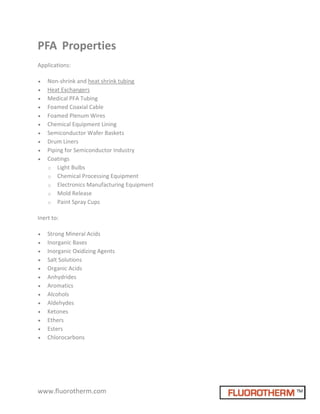
PFA Properties Applications:  Non-shrink and heat shrink tubing  Heat Exchangers  Medical PFA Tubing  Foamed Coaxial Cable  Foamed Plenum Wires  Chemical Equipment Lining  Semiconductor Wafer Baskets  Drum Liners  Piping for Semiconductor Industry  Coatings o Light Bulbs o Chemical Processing Equipment o Electronics Manufacturing Equipment o Mold Release o Paint Spray Cups Inert to:  Strong Mineral Acids  Inorganic Bases  Inorganic Oxidizing Agents  Salt Solutions  Organic Acids  Anhydrides  Aromatics  Alcohols  Aldehydes  Ketones  Ethers  Esters  Chlorocarbons
www.fluorotherm.com 
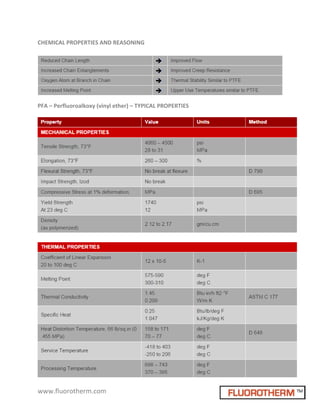
CHEMICAL PROPERTIES AND REASONING 
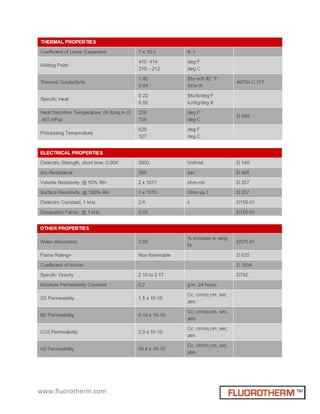
PFA – Perfluoroalkoxy (vinyl ether) – TYPICAL PROPERTIES
www.fluorotherm.com 
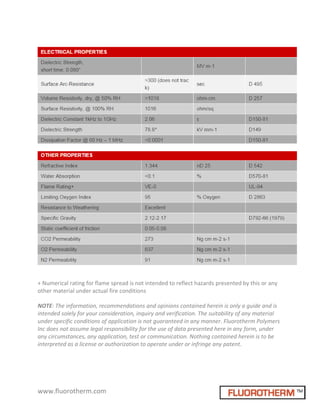
+ Numerical rating for flame spread is not intended to reflect hazards presented by this or any other material under actual fire conditions 
NOTE: The information, recommendations and opinions contained herein is only a guide and is intended solely for your consideration, inquiry and verification. The suitability of any material under specific conditions of application is not guaranteed in any manner. Fluorotherm Polymers Inc does not assume legal responsibility for the use of data presented here in any form, under any circumstances, any application, test or communication. Nothing contained herein is to be interpreted as a license or authorization to operate under or infringe any patent.
www.fluorotherm.com 
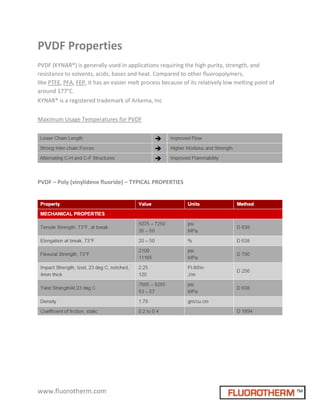
PVDF Properties PVDF (KYNAR®) is generally used in applications requiring the high purity, strength, and resistance to solvents, acids, bases and heat. Compared to other fluoropolymers, like PTFE, PFA, FEP, it has an easier melt process because of its relatively low melting point of around 177°C. KYNAR® is a registered trademark of Arkema, Inc Maximum Usage Temperatures for PVDF 
PVDF – Poly (vinylidene fluoride) – TYPICAL PROPERTIES
www.fluorotherm.com 
Value decreases with increasing thickness of test specimen + Numerical rating for flame spread is not intended to reflect hazards presented by this or any other material under actual fire conditions NOTE: The information, recommendations and opinions contained herein is only a guide and is intended solely for your consideration, inquiry and verification. The suitability of any material under specific conditions of application is not guaranteed in any manner. Fluorotherm Polymers Inc does not assume legal responsibility for the use of data presented here in any form, under any circumstances, any application, test or communication. Nothing contained herein is to be interpreted as a license or authorization to operate under or infringe any patent.
www.fluorotherm.com 
PCTFE Properties PCTFE or CTFE (originally known as Kel-F*) has many of the properties similar to other fluoropolymers such as PTFE, FEP or PFA, but is mechanically superior in rigidity (does not deform easily), and has very low gas permeability . Its dimensional stability makes it attractive for use as a component of a structural part where the high temperature and chemical resistance of fluoropolymers is required. PCTFE shows high compressive strength and low deformation under load. However, its relative cost is one of the major considerations in its selection, since it is quite expensive. PCTFE – Poly (chloro trifluoro ethylene) TYPICAL PROPERTIES
www.fluorotherm.com
www.fluorotherm.com 
+ Numerical rating for flame spread is not intended to reflect hazards presented by this or any other material under actual fire conditions NOTE: The information, recommendations and opinions contained herein is only a guide and is intended solely for your consideration, inquiry and verification. The suitability of any material under specific conditions of application is not guaranteed in any manner. Fluorotherm Polymers Inc does not assume legal responsibility for the use of data presented here in any form, under any circumstances, any application, test or communication. Nothing contained herein is to be interpreted as a license or authorization to operate under or infringe any patent.
www.fluorotherm.com 
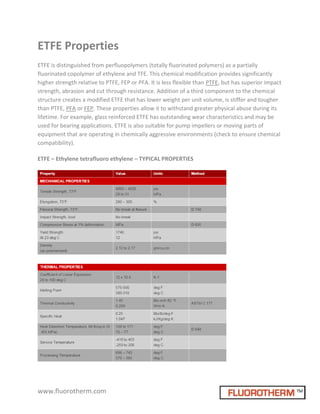
ETFE Properties ETFE is distinguished from perfluopolymers (totally fluorinated polymers) as a partially fluorinated copolymer of ethylene and TFE. This chemical modification provides significantly higher strength relative to PTFE, FEP or PFA. It is less flexible than PTFE, but has superior impact strength, abrasion and cut through resistance. Addition of a third component to the chemical structure creates a modified ETFE that has lower weight per unit volume, is stiffer and tougher than PTFE, PFA or FEP. These properties allow it to withstand greater physical abuse during its lifetime. For example, glass reinforced ETFE has outstanding wear characteristics and may be used for bearing applications. ETFE is also suitable for pump impellers or moving parts of equipment that are operating in chemically aggressive environments (check to ensure chemical compatibility). ETFE – Ethylene tetrafluoro ethylene – TYPICAL PROPERTIES
www.fluorotherm.com 
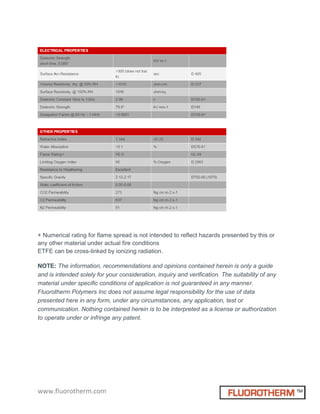
+ Numerical rating for flame spread is not intended to reflect hazards presented by this or any other material under actual fire conditions ETFE can be cross-linked by ionizing radiation. NOTE: The information, recommendations and opinions contained herein is only a guide and is intended solely for your consideration, inquiry and verification. The suitability of any material under specific conditions of application is not guaranteed in any manner. Fluorotherm Polymers Inc does not assume legal responsibility for the use of data presented here in any form, under any circumstances, any application, test or communication. Nothing contained herein is to be interpreted as a license or authorization to operate under or infringe any patent.

PFA ETFE PCTFE PVDF Properties

  • 1.
    www.fluorotherm.com PFA PropertiesApplications:  Non-shrink and heat shrink tubing  Heat Exchangers  Medical PFA Tubing  Foamed Coaxial Cable  Foamed Plenum Wires  Chemical Equipment Lining  Semiconductor Wafer Baskets  Drum Liners  Piping for Semiconductor Industry  Coatings o Light Bulbs o Chemical Processing Equipment o Electronics Manufacturing Equipment o Mold Release o Paint Spray Cups Inert to:  Strong Mineral Acids  Inorganic Bases  Inorganic Oxidizing Agents  Salt Solutions  Organic Acids  Anhydrides  Aromatics  Alcohols  Aldehydes  Ketones  Ethers  Esters  Chlorocarbons
  • 2.
    www.fluorotherm.com CHEMICAL PROPERTIESAND REASONING PFA – Perfluoroalkoxy (vinyl ether) – TYPICAL PROPERTIES
  • 3.
    www.fluorotherm.com + Numericalrating for flame spread is not intended to reflect hazards presented by this or any other material under actual fire conditions NOTE: The information, recommendations and opinions contained herein is only a guide and is intended solely for your consideration, inquiry and verification. The suitability of any material under specific conditions of application is not guaranteed in any manner. Fluorotherm Polymers Inc does not assume legal responsibility for the use of data presented here in any form, under any circumstances, any application, test or communication. Nothing contained herein is to be interpreted as a license or authorization to operate under or infringe any patent.
  • 4.
    www.fluorotherm.com PVDF PropertiesPVDF (KYNAR®) is generally used in applications requiring the high purity, strength, and resistance to solvents, acids, bases and heat. Compared to other fluoropolymers, like PTFE, PFA, FEP, it has an easier melt process because of its relatively low melting point of around 177°C. KYNAR® is a registered trademark of Arkema, Inc Maximum Usage Temperatures for PVDF PVDF – Poly (vinylidene fluoride) – TYPICAL PROPERTIES
  • 5.
    www.fluorotherm.com Value decreaseswith increasing thickness of test specimen + Numerical rating for flame spread is not intended to reflect hazards presented by this or any other material under actual fire conditions NOTE: The information, recommendations and opinions contained herein is only a guide and is intended solely for your consideration, inquiry and verification. The suitability of any material under specific conditions of application is not guaranteed in any manner. Fluorotherm Polymers Inc does not assume legal responsibility for the use of data presented here in any form, under any circumstances, any application, test or communication. Nothing contained herein is to be interpreted as a license or authorization to operate under or infringe any patent.
  • 6.
    www.fluorotherm.com PCTFE PropertiesPCTFE or CTFE (originally known as Kel-F*) has many of the properties similar to other fluoropolymers such as PTFE, FEP or PFA, but is mechanically superior in rigidity (does not deform easily), and has very low gas permeability . Its dimensional stability makes it attractive for use as a component of a structural part where the high temperature and chemical resistance of fluoropolymers is required. PCTFE shows high compressive strength and low deformation under load. However, its relative cost is one of the major considerations in its selection, since it is quite expensive. PCTFE – Poly (chloro trifluoro ethylene) TYPICAL PROPERTIES
  • 7.
  • 8.
    www.fluorotherm.com + Numericalrating for flame spread is not intended to reflect hazards presented by this or any other material under actual fire conditions NOTE: The information, recommendations and opinions contained herein is only a guide and is intended solely for your consideration, inquiry and verification. The suitability of any material under specific conditions of application is not guaranteed in any manner. Fluorotherm Polymers Inc does not assume legal responsibility for the use of data presented here in any form, under any circumstances, any application, test or communication. Nothing contained herein is to be interpreted as a license or authorization to operate under or infringe any patent.
  • 9.
    www.fluorotherm.com ETFE PropertiesETFE is distinguished from perfluopolymers (totally fluorinated polymers) as a partially fluorinated copolymer of ethylene and TFE. This chemical modification provides significantly higher strength relative to PTFE, FEP or PFA. It is less flexible than PTFE, but has superior impact strength, abrasion and cut through resistance. Addition of a third component to the chemical structure creates a modified ETFE that has lower weight per unit volume, is stiffer and tougher than PTFE, PFA or FEP. These properties allow it to withstand greater physical abuse during its lifetime. For example, glass reinforced ETFE has outstanding wear characteristics and may be used for bearing applications. ETFE is also suitable for pump impellers or moving parts of equipment that are operating in chemically aggressive environments (check to ensure chemical compatibility). ETFE – Ethylene tetrafluoro ethylene – TYPICAL PROPERTIES
  • 10.
    www.fluorotherm.com + Numericalrating for flame spread is not intended to reflect hazards presented by this or any other material under actual fire conditions ETFE can be cross-linked by ionizing radiation. NOTE: The information, recommendations and opinions contained herein is only a guide and is intended solely for your consideration, inquiry and verification. The suitability of any material under specific conditions of application is not guaranteed in any manner. Fluorotherm Polymers Inc does not assume legal responsibility for the use of data presented here in any form, under any circumstances, any application, test or communication. Nothing contained herein is to be interpreted as a license or authorization to operate under or infringe any patent.