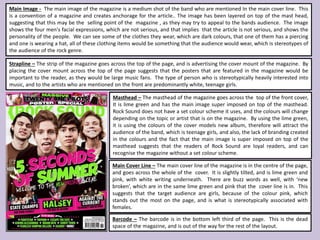
Masthead – The masthead of the magazine goes across the top of the front cover,
It is lime green and has the main image super imposed on top of the masthead.
Rock Sound does not have a set colour scheme it uses, and the colours will change
depending on the topic or artist that is on the magazine. By using the lime green,
it is using the colours of the cover models new album, therefore will attract the
audience of the band, which is teenage girls, and also, the lack of branding created
in the colours and the fact that the main image is super imposed on top of the
masthead suggests that the readers of Rock Sound are loyal readers, and can
recognise the magazine without a set colour scheme.
Strapline – The strip of the magazine goes across the top of the page, and is advertising the cover mount of the magazine. By
placing the cover mount across the top of the page suggests that the posters that are featured in the magazine would be
important to the reader, as they would be large music fans. The type of person who is stereotypically heavily interested into
music, and to the artists who are mentioned on the front are predominantly white, teenage girls.
Main Image - The main image of the magazine is a medium shot of the band who are mentioned In the main cover line. This
is a convention of a magazine and creates anchorage for the article.. The image has been layered on top of the mast head,
suggesting that this may be the selling point of the magazine , as they may try to appeal to the bands audience. The image
shows the four men's facial expressions, which are not serious, and that implies that the article is not serious, and shows the
personality of the people. We can see some of the clothes they wear, which are dark colours, that one of them has a piercing
and one is wearing a hat, all of these clothing items would be something that the audience would wear, which is stereotypes of
the audience of the rock genre.
Main Cover Line – The main cover line of the magazine is in the centre of the page,
and goes across the whole of the cover. It is slightly tilted, and is lime green and
pink, with white writing underneath. There are buzz words as well, with ‘new
broken’, which are in the same lime green and pink that the cover line is in. This
suggests that the target audience are girls, because of the colour pink, which
stands out the most on the page, and is what is stereotypically associated with
females.
Barcode – The barcode is in the bottom left third of the page. This is the dead
space of the magazine, and is out of the way for the rest of the layout.
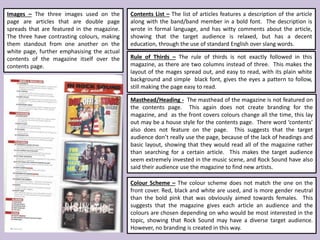
Colour Scheme – The colour scheme does not match the one on the
front cover. Red, black and white are used, and is more gender neutral
than the bold pink that was obviously aimed towards females. This
suggests that the magazine gives each article an audience and the
colours are chosen depending on who would be most interested in the
topic, showing that Rock Sound may have a diverse target audience.
However, no branding is created in this way.
Masthead/Heading - The masthead of the magazine is not featured on
the contents page. This again does not create branding for the
magazine, and as the front covers colours change all the time, this lay
out may be a house style for the contents page. There word ‘contents’
also does not feature on the page. This suggests that the target
audience don’t really use the page, because of the lack of headings and
basic layout, showing that they would read all of the magazine rather
than searching for a certain article. This makes the target audience
seem extremely invested in the music scene, and Rock Sound have also
said their audience use the magazine to find new artists.
Rule of Thirds – The rule of thirds is not exactly followed in this
magazine, as there are two columns instead of three. This makes the
layout of the mages spread out, and easy to read, with its plain white
background and simple black font, gives the eyes a pattern to follow,
still making the page easy to read.
Contents List – The list of articles features a description of the article
along with the band/band member in a bold font. The description is
wrote in formal language, and has witty comments about the article,
showing that the target audience is relaxed, but has a decent
education, through the use of standard English over slang words.
Images – The three images used on the
page are articles that are double page
spreads that are featured in the magazine.
The three have contrasting colours, making
them standout from one another on the
white page, further emphasising the actual
contents of the magazine itself over the
contents page.
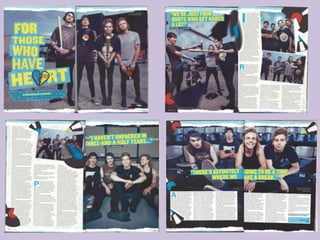
Images – The images on the page are all either
medium shots or long shots of the band. In the images
we see tour busses, and them breaking vinyl records
with a baseball bats. They are seen to be wearing the
stereotypical clothes that the target audience would
wear, skinny jeans, boots or converse, and completely
dark colours. This makes the band seem relatable to
the target audience and draw them into the article
more. The breaking vinyl's is just a pun for the article,
as it partly mentions how them are ‘breaking records’.
By showing the tour bus in the background, it tells the
audience about how they are on tour, which is an
interest for the target audience, who spend lots of
money on tour/festival tickets, showing how they
must be from middle class families.
Colour Scheme – The colour scheme of the article is
blue and yellow. This does not match the
magazines front cover, therefore does not create
branding. The colours are even more gender
neutral than the front cover, with blue being a
stereotypically male colour and yellow a girls,
bringing the attention of all of the readers. It also
matches the colour scheme of the images, which
have a blue hue to them, creating an anchorage in
them.
Drop Capital – Drop capitals are used throughout the
article. They are in the same font as the masthead,
however in a blue colour instead of yellow. The drop
capital separates the article up, and brings attention
to certain parts of the article. It also makes the article
seem more formal, like a book.
Masthead – The masthead of the article is in a blue
and yellow, sans serif, bold font. This makes the
font have sharp edges and lines, and making it look
quite modern, showing the younger target
audience. It features a logo in place of a letter in
the word ‘heart’, which is a symbol they talk about
in the article, again creating anchorage for the
article.
Block Quotes – Several block quotes are used
throughout the article. These bring attention to
certain parts of the article, and people who scan read
the article will be able to get relevant information
about the article. It also gives an insight to certain
people who are in the article, or highlights any main
messages the people want to highlight.
Language – The language in the article is standard
English, with a few swear words in the quotes. This
shows that the audience have a decent education,
however are still laid back. It shows they are
younger as well, as older generations stereotypically
look down on swear and slang words.

5sos work

  • 1.
    Masthead – Themasthead of the magazine goes across the top of the front cover, It is lime green and has the main image super imposed on top of the masthead. Rock Sound does not have a set colour scheme it uses, and the colours will change depending on the topic or artist that is on the magazine. By using the lime green, it is using the colours of the cover models new album, therefore will attract the audience of the band, which is teenage girls, and also, the lack of branding created in the colours and the fact that the main image is super imposed on top of the masthead suggests that the readers of Rock Sound are loyal readers, and can recognise the magazine without a set colour scheme. Strapline – The strip of the magazine goes across the top of the page, and is advertising the cover mount of the magazine. By placing the cover mount across the top of the page suggests that the posters that are featured in the magazine would be important to the reader, as they would be large music fans. The type of person who is stereotypically heavily interested into music, and to the artists who are mentioned on the front are predominantly white, teenage girls. Main Image - The main image of the magazine is a medium shot of the band who are mentioned In the main cover line. This is a convention of a magazine and creates anchorage for the article.. The image has been layered on top of the mast head, suggesting that this may be the selling point of the magazine , as they may try to appeal to the bands audience. The image shows the four men's facial expressions, which are not serious, and that implies that the article is not serious, and shows the personality of the people. We can see some of the clothes they wear, which are dark colours, that one of them has a piercing and one is wearing a hat, all of these clothing items would be something that the audience would wear, which is stereotypes of the audience of the rock genre. Main Cover Line – The main cover line of the magazine is in the centre of the page, and goes across the whole of the cover. It is slightly tilted, and is lime green and pink, with white writing underneath. There are buzz words as well, with ‘new broken’, which are in the same lime green and pink that the cover line is in. This suggests that the target audience are girls, because of the colour pink, which stands out the most on the page, and is what is stereotypically associated with females. Barcode – The barcode is in the bottom left third of the page. This is the dead space of the magazine, and is out of the way for the rest of the layout.
  • 2.
    Colour Scheme –The colour scheme does not match the one on the front cover. Red, black and white are used, and is more gender neutral than the bold pink that was obviously aimed towards females. This suggests that the magazine gives each article an audience and the colours are chosen depending on who would be most interested in the topic, showing that Rock Sound may have a diverse target audience. However, no branding is created in this way. Masthead/Heading - The masthead of the magazine is not featured on the contents page. This again does not create branding for the magazine, and as the front covers colours change all the time, this lay out may be a house style for the contents page. There word ‘contents’ also does not feature on the page. This suggests that the target audience don’t really use the page, because of the lack of headings and basic layout, showing that they would read all of the magazine rather than searching for a certain article. This makes the target audience seem extremely invested in the music scene, and Rock Sound have also said their audience use the magazine to find new artists. Rule of Thirds – The rule of thirds is not exactly followed in this magazine, as there are two columns instead of three. This makes the layout of the mages spread out, and easy to read, with its plain white background and simple black font, gives the eyes a pattern to follow, still making the page easy to read. Contents List – The list of articles features a description of the article along with the band/band member in a bold font. The description is wrote in formal language, and has witty comments about the article, showing that the target audience is relaxed, but has a decent education, through the use of standard English over slang words. Images – The three images used on the page are articles that are double page spreads that are featured in the magazine. The three have contrasting colours, making them standout from one another on the white page, further emphasising the actual contents of the magazine itself over the contents page.
  • 4.
    Images – Theimages on the page are all either medium shots or long shots of the band. In the images we see tour busses, and them breaking vinyl records with a baseball bats. They are seen to be wearing the stereotypical clothes that the target audience would wear, skinny jeans, boots or converse, and completely dark colours. This makes the band seem relatable to the target audience and draw them into the article more. The breaking vinyl's is just a pun for the article, as it partly mentions how them are ‘breaking records’. By showing the tour bus in the background, it tells the audience about how they are on tour, which is an interest for the target audience, who spend lots of money on tour/festival tickets, showing how they must be from middle class families. Colour Scheme – The colour scheme of the article is blue and yellow. This does not match the magazines front cover, therefore does not create branding. The colours are even more gender neutral than the front cover, with blue being a stereotypically male colour and yellow a girls, bringing the attention of all of the readers. It also matches the colour scheme of the images, which have a blue hue to them, creating an anchorage in them. Drop Capital – Drop capitals are used throughout the article. They are in the same font as the masthead, however in a blue colour instead of yellow. The drop capital separates the article up, and brings attention to certain parts of the article. It also makes the article seem more formal, like a book. Masthead – The masthead of the article is in a blue and yellow, sans serif, bold font. This makes the font have sharp edges and lines, and making it look quite modern, showing the younger target audience. It features a logo in place of a letter in the word ‘heart’, which is a symbol they talk about in the article, again creating anchorage for the article. Block Quotes – Several block quotes are used throughout the article. These bring attention to certain parts of the article, and people who scan read the article will be able to get relevant information about the article. It also gives an insight to certain people who are in the article, or highlights any main messages the people want to highlight. Language – The language in the article is standard English, with a few swear words in the quotes. This shows that the audience have a decent education, however are still laid back. It shows they are younger as well, as older generations stereotypically look down on swear and slang words.