The Five-Paragraph Essay: Template for College Writing Dr. Harold William Halbert
How Many of You Remember the Five-Paragraph Essay? Who taught it to you? What were the major elements? What good was it?
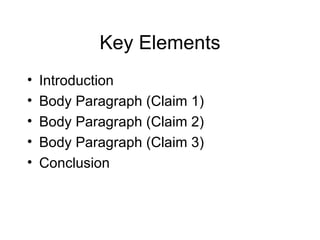
Key Elements Introduction Body Paragraph (Claim 1) Body Paragraph (Claim 2) Body Paragraph (Claim 3) Conclusion
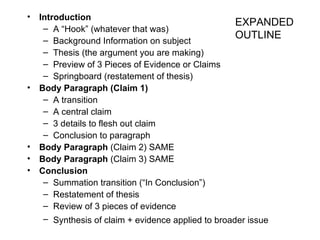
Introduction A “Hook” (whatever that was) Background Information on subject Thesis (the argument you are making) Preview of 3 Pieces of Evidence or Claims Springboard (restatement of thesis) Body Paragraph (Claim 1) A transition A central claim 3 details to flesh out claim Conclusion to paragraph Body Paragraph  (Claim 2) SAME Body Paragraph  (Claim 3) SAME Conclusion Summation transition (“In Conclusion”) Restatement of thesis Review of 3 pieces of evidence Synthesis of claim + evidence applied to broader issue   EXPANDED OUTLINE
Official Uses of Five-Paragraph Essay English class essay (book reviews, short arguments, etc.) In-class essay exams SAT Writing assessment Some editorial or newspaper column pieces
REAL Purpose of Five Paragraph Essay Easy template to American academic writing expectations Easy to teach Easy to grade Easy to remember Easy to finish
PROBLEM: Never Shown Broader Application Instead of thinking “paragraphs,” think “sections” Instead of thinking “five,” think “Introduction--Body--Conclusion” Better still, think “ Context/Claim, Evidence, Synthesis”
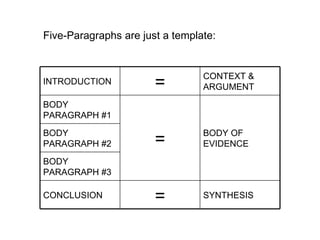
Five-Paragraphs are just a template: SYNTHESIS = CONCLUSION BODY PARAGRAPH #3 BODY PARAGRAPH #2 BODY OF EVIDENCE = BODY PARAGRAPH #1 CONTEXT & ARGUMENT = INTRODUCTION
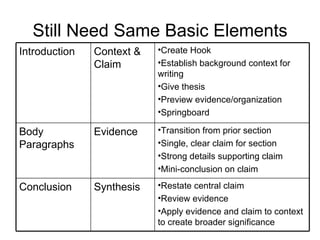
Still Need Same Basic Elements Restate central claim Review evidence Apply evidence and claim to context to create broader significance  Synthesis Conclusion Transition from prior section Single, clear claim for section Strong details supporting claim Mini-conclusion on claim Evidence Body Paragraphs Create Hook Establish background context for writing Give thesis Preview evidence/organization Springboard Context & Claim Introduction

5-paragraph-essay

  • 1.
    The Five-Paragraph Essay:Template for College Writing Dr. Harold William Halbert
  • 2.
    How Many ofYou Remember the Five-Paragraph Essay? Who taught it to you? What were the major elements? What good was it?
  • 3.
    Key Elements IntroductionBody Paragraph (Claim 1) Body Paragraph (Claim 2) Body Paragraph (Claim 3) Conclusion
  • 4.
    Introduction A “Hook”(whatever that was) Background Information on subject Thesis (the argument you are making) Preview of 3 Pieces of Evidence or Claims Springboard (restatement of thesis) Body Paragraph (Claim 1) A transition A central claim 3 details to flesh out claim Conclusion to paragraph Body Paragraph (Claim 2) SAME Body Paragraph (Claim 3) SAME Conclusion Summation transition (“In Conclusion”) Restatement of thesis Review of 3 pieces of evidence Synthesis of claim + evidence applied to broader issue EXPANDED OUTLINE
  • 5.
    Official Uses ofFive-Paragraph Essay English class essay (book reviews, short arguments, etc.) In-class essay exams SAT Writing assessment Some editorial or newspaper column pieces
  • 6.
    REAL Purpose ofFive Paragraph Essay Easy template to American academic writing expectations Easy to teach Easy to grade Easy to remember Easy to finish
  • 7.
    PROBLEM: Never ShownBroader Application Instead of thinking “paragraphs,” think “sections” Instead of thinking “five,” think “Introduction--Body--Conclusion” Better still, think “ Context/Claim, Evidence, Synthesis”
  • 8.
    Five-Paragraphs are justa template: SYNTHESIS = CONCLUSION BODY PARAGRAPH #3 BODY PARAGRAPH #2 BODY OF EVIDENCE = BODY PARAGRAPH #1 CONTEXT & ARGUMENT = INTRODUCTION
  • 9.
    Still Need SameBasic Elements Restate central claim Review evidence Apply evidence and claim to context to create broader significance Synthesis Conclusion Transition from prior section Single, clear claim for section Strong details supporting claim Mini-conclusion on claim Evidence Body Paragraphs Create Hook Establish background context for writing Give thesis Preview evidence/organization Springboard Context & Claim Introduction