How to Use PUE to Improve
Efficiency
The Brands You Trust.
^
Business-wise, Future-drivenTM
Data Centers
Schneider Electric Table of Contents
How to Use PUE to Improve Efficiency
Table of Contents
Introduction..................................................................3
Conclusion...................................................................9
PUE 101.......................................................................4
Putting PUE into action.................................................6
Modeling vs. Measurments......................................6	
Reporting................................................................7
PUE can’t live in a vacuum...........................................8
Business-wise, Future-drivenTM
How to Use PUE to Improve Efficiency
Schneider Electric 3
Data Centers
Introduction
What’s consuming all that power in the data center? IT equipment
uses only about half of the electricity in the data center; power and
cooling infrastructure consumes the other half. As a result, managers
are paying closer attention to power usage effectiveness (PUE), a
metric that indicates the efficiency of a data center’s physical infra-
structure. If managers measure and use PUE effectively, they have
a great tool for ensuring energy is used more efficiently, and when
combined with other management tools, a robust suite to control both
capital and operating costs in the data center.
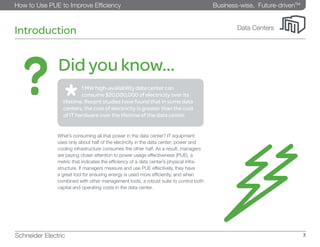
	 1 MW high-availability data center can 		
	 consume $20,000,000 of electricity over its
lifetime. Recent studies have found that in some data
centers, the cost of electricity is greater than the cost
of IT hardware over the lifetime of the data center.
Did you know...
Business-wise, Future-drivenTM
How to Use PUE to Improve Efficiency
Schneider Electric 4
Data Centers
PUE 101
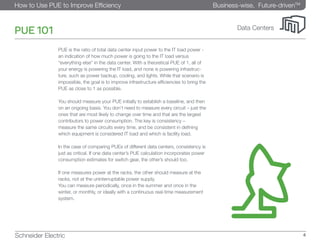
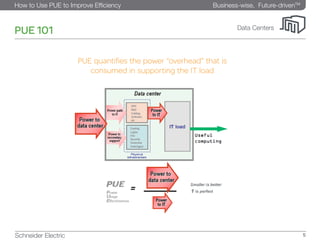
PUE is the ratio of total data center input power to the IT load power -
an indication of how much power is going to the IT load versus
“everything else” in the data center. With a theoretical PUE of 1, all of
your energy is powering the IT load, and none is powering infrastruc-
ture, such as power backup, cooling, and lights. While that scenario is
impossible, the goal is to improve infrastructure efficiencies to bring the
PUE as close to 1 as possible.
You should measure your PUE initially to establish a baseline, and then
on an ongoing basis. You don’t need to measure every circuit – just the
ones that are most likely to change over time and that are the largest
contributors to power consumption. The key is consistency –
measure the same circuits every time, and be consistent in defining
which equipment is considered IT load and which is facility load.
In the case of comparing PUEs of different data centers, consistency is
just as critical. If one data center’s PUE calculation incorporates power
consumption estimates for switch gear, the other’s should too.
If one measures power at the racks, the other should measure at the
racks, not at the uninterruptable power supply.
You can measure periodically, once in the summer and once in the
winter, or monthly, or ideally with a continuous real-time measurement
system.
Business-wise, Future-drivenTM
How to Use PUE to Improve Efficiency
Schneider Electric 5
Data Centers
PUE quantifies the power “overhead” that is
consumed in supporting the IT load
PUE 101
Business-wise, Future-drivenTM
How to Use PUE to Improve Efficiency
Schneider Electric 6
Data Centers
Putting PUE into action
Modeling vs. Measurements
PUE, by itself, is a great way to establish your baseline and measure
improvement, but it doesn’t necessarily help you with the step in
between—knowing where to take action. However, mathematical
models and calculators turn PUE into actionable data. They take
inputs specific to your data center, such as IT load, humidity levels and
outdoor weather statistics, and calculate efficiency based on those
inputs. But, a model will take these calculations a step further, allowing
you to simulate different efficiency scenarios until you find the optimal
one. With an efficiency model you can:
•	 Predict the effect of changes such as adding servers, adding
cooling, or increasing ambient air temperature
•	 Estimate for conditions that are impractical to measure, such as
industry benchmark conditions
•	 Estimate with only partial information
•	 Estimate for various outdoor conditions
•	 Allow averages over time
•	 Identify and quantify the contributions of specific devices
•	 Identify subsystems operating outside expected values
•	 Benchmark and compare models of different data centers at the
same % IT load
Business-wise, Future-drivenTM
How to Use PUE to Improve Efficiency
Schneider Electric 7
Data Centers
Reporting
In additional to simulating efficiency scenarios, a model should also
report on key data points, such as:
•	 Actual annual PUE performance
•	 Expected annual PUE under industry-standard conditions, from
the model
•	 Design value for annual PUE
•	 Annual average IT load (% of rated capacity)
•	 Breakdown of power consumption by major data center
subsystem
•	 Comparison of actual annual PUE to other data centers of similar
classification
•	 Comparison of expected annual PUE to other data centers of
similar classification
•	 Total annual electrical consumption (kW-hr)
•	 Estimated annual electrical cost
•	 Trending actual annual PUE, annual electrical consumption,
and electrical costs
Putting PUE into action
Business-wise, Future-drivenTM
How to Use PUE to Improve Efficiency
Schneider Electric 8
Data Centers
PUE can’t live in a vacuum
Another reason that modeling is so important, is that it puts PUE into
a broader context. We’ve already mentioned that one isolated mea-
surement of PUE doesn’t really yield actionable data: Is it good? Bad?
Are we headed in the right direction?
More than this, PUE can be misleading when out of context. For
instance, it’s possible to reduce your energy consumption, but make
your PUE worse. Without the broader context (such as from a model),
PUE loses it’s meaning and value.
The best approach is more holistic, using PUE as one component of
a system that focuses on the larger objectives around efficiency and
cost containment, including:
•	 Having a dashboard that can integrate metrics from all types of
systems, including data center infrastructure management (DCIM)
tools and systems management software to track application
performance.
•	 Management and planning tools that incorporate PUE,
performance, and physical layout data to support decisions, such
as where to locate additional cooling or how to free stranded
power capacity
Business-wise, Future-drivenTM
How to Use PUE to Improve Efficiency
Schneider Electric 9
Data Centers
Conclusion
Whether your facility is new or existing, saving
energy is a crucial step toward reducing operating
and capital costs.
You can’t control it if you don’t measure it, so the first step in
managing efficiency is knowing and understanding your data center’s
PUE. Finally, using PUE in the proper context and in conjunction with
other key metrics, as part of a holistic dashboard, give data center
operators critical insight into efficiency trending, where inefficiencies
exist, and where the opportunities for improvement are.
	 For more information on how PUE and DCIM tools 		
work together, check out our white paper, “How
Data Center Infrastructure Management Software Improves
Planning and Cuts Operational Costs.”
Business-wise, Future-drivenTM
How to Use PUE to Improve Efficiency
Schneider Electric 10
Data Centers
132 Fairgrounds Rd. - West Kingston, RI 02892 - 800-800-4272 - www.schneider-electric.com
Theglobalspecialistin
energymanagement™

How to Use PUE To Improve Efficiency

  • 1.
    How to UsePUE to Improve Efficiency The Brands You Trust. ^ Business-wise, Future-drivenTM
  • 2.
    Business-wise, Future-drivenTM Data Centers SchneiderElectric Table of Contents How to Use PUE to Improve Efficiency Table of Contents Introduction..................................................................3 Conclusion...................................................................9 PUE 101.......................................................................4 Putting PUE into action.................................................6 Modeling vs. Measurments......................................6 Reporting................................................................7 PUE can’t live in a vacuum...........................................8
  • 3.
    Business-wise, Future-drivenTM How toUse PUE to Improve Efficiency Schneider Electric 3 Data Centers Introduction What’s consuming all that power in the data center? IT equipment uses only about half of the electricity in the data center; power and cooling infrastructure consumes the other half. As a result, managers are paying closer attention to power usage effectiveness (PUE), a metric that indicates the efficiency of a data center’s physical infra- structure. If managers measure and use PUE effectively, they have a great tool for ensuring energy is used more efficiently, and when combined with other management tools, a robust suite to control both capital and operating costs in the data center. 1 MW high-availability data center can consume $20,000,000 of electricity over its lifetime. Recent studies have found that in some data centers, the cost of electricity is greater than the cost of IT hardware over the lifetime of the data center. Did you know...
  • 4.
    Business-wise, Future-drivenTM How toUse PUE to Improve Efficiency Schneider Electric 4 Data Centers PUE 101 PUE is the ratio of total data center input power to the IT load power - an indication of how much power is going to the IT load versus “everything else” in the data center. With a theoretical PUE of 1, all of your energy is powering the IT load, and none is powering infrastruc- ture, such as power backup, cooling, and lights. While that scenario is impossible, the goal is to improve infrastructure efficiencies to bring the PUE as close to 1 as possible. You should measure your PUE initially to establish a baseline, and then on an ongoing basis. You don’t need to measure every circuit – just the ones that are most likely to change over time and that are the largest contributors to power consumption. The key is consistency – measure the same circuits every time, and be consistent in defining which equipment is considered IT load and which is facility load. In the case of comparing PUEs of different data centers, consistency is just as critical. If one data center’s PUE calculation incorporates power consumption estimates for switch gear, the other’s should too. If one measures power at the racks, the other should measure at the racks, not at the uninterruptable power supply. You can measure periodically, once in the summer and once in the winter, or monthly, or ideally with a continuous real-time measurement system.
  • 5.
    Business-wise, Future-drivenTM How toUse PUE to Improve Efficiency Schneider Electric 5 Data Centers PUE quantifies the power “overhead” that is consumed in supporting the IT load PUE 101
  • 6.
    Business-wise, Future-drivenTM How toUse PUE to Improve Efficiency Schneider Electric 6 Data Centers Putting PUE into action Modeling vs. Measurements PUE, by itself, is a great way to establish your baseline and measure improvement, but it doesn’t necessarily help you with the step in between—knowing where to take action. However, mathematical models and calculators turn PUE into actionable data. They take inputs specific to your data center, such as IT load, humidity levels and outdoor weather statistics, and calculate efficiency based on those inputs. But, a model will take these calculations a step further, allowing you to simulate different efficiency scenarios until you find the optimal one. With an efficiency model you can: • Predict the effect of changes such as adding servers, adding cooling, or increasing ambient air temperature • Estimate for conditions that are impractical to measure, such as industry benchmark conditions • Estimate with only partial information • Estimate for various outdoor conditions • Allow averages over time • Identify and quantify the contributions of specific devices • Identify subsystems operating outside expected values • Benchmark and compare models of different data centers at the same % IT load
  • 7.
    Business-wise, Future-drivenTM How toUse PUE to Improve Efficiency Schneider Electric 7 Data Centers Reporting In additional to simulating efficiency scenarios, a model should also report on key data points, such as: • Actual annual PUE performance • Expected annual PUE under industry-standard conditions, from the model • Design value for annual PUE • Annual average IT load (% of rated capacity) • Breakdown of power consumption by major data center subsystem • Comparison of actual annual PUE to other data centers of similar classification • Comparison of expected annual PUE to other data centers of similar classification • Total annual electrical consumption (kW-hr) • Estimated annual electrical cost • Trending actual annual PUE, annual electrical consumption, and electrical costs Putting PUE into action
  • 8.
    Business-wise, Future-drivenTM How toUse PUE to Improve Efficiency Schneider Electric 8 Data Centers PUE can’t live in a vacuum Another reason that modeling is so important, is that it puts PUE into a broader context. We’ve already mentioned that one isolated mea- surement of PUE doesn’t really yield actionable data: Is it good? Bad? Are we headed in the right direction? More than this, PUE can be misleading when out of context. For instance, it’s possible to reduce your energy consumption, but make your PUE worse. Without the broader context (such as from a model), PUE loses it’s meaning and value. The best approach is more holistic, using PUE as one component of a system that focuses on the larger objectives around efficiency and cost containment, including: • Having a dashboard that can integrate metrics from all types of systems, including data center infrastructure management (DCIM) tools and systems management software to track application performance. • Management and planning tools that incorporate PUE, performance, and physical layout data to support decisions, such as where to locate additional cooling or how to free stranded power capacity
  • 9.
    Business-wise, Future-drivenTM How toUse PUE to Improve Efficiency Schneider Electric 9 Data Centers Conclusion Whether your facility is new or existing, saving energy is a crucial step toward reducing operating and capital costs. You can’t control it if you don’t measure it, so the first step in managing efficiency is knowing and understanding your data center’s PUE. Finally, using PUE in the proper context and in conjunction with other key metrics, as part of a holistic dashboard, give data center operators critical insight into efficiency trending, where inefficiencies exist, and where the opportunities for improvement are. For more information on how PUE and DCIM tools work together, check out our white paper, “How Data Center Infrastructure Management Software Improves Planning and Cuts Operational Costs.”
  • 10.
    Business-wise, Future-drivenTM How toUse PUE to Improve Efficiency Schneider Electric 10 Data Centers 132 Fairgrounds Rd. - West Kingston, RI 02892 - 800-800-4272 - www.schneider-electric.com Theglobalspecialistin energymanagement™