Encrypting User Data in the NHS
Survey Report 2016
Survey Partners
Contents
The Survey 3
Survey Methodology and Respondents Profile 4
Key Findings 5
Conclusion 10
Appendix 1: Full Survey Questions 11
Appendix 2: Participating Organisations 15
Page of2 15 Encrypting User Data in the NHS 2016
Acknowledgements
The survey team at iGov Survey would like to take this opportunity to thank all of those who were kind enough to take part - and especially to
those who found the time to offer additional insight through their extra comments. We would also like to thank our partner, Druva, for their
assistance in compiling the survey questions, scrutinising the responses and analysing the results.
Encrypting User Data in the NHS 2016 © copyright
Unless explicitly stated otherwise, all rights including those in copyright in the content of this publication are owned by or controlled for these
purposes by iGov Survey.
Except as otherwise expressly permitted under copyright law or iGov Survey’s Terms of Use, the content of this
publication are owned by or controlled may not be copied, reproduced, republished, downloaded, posted, broadcast or transmitted in any way
without first obtaining iGov Survey’s written permission or that of the copyright owner.
To contact the iGov or Exec Survey team:
Email: dcross@ingenium-ids.org Tel: 0845 094 8567
Address: FAO David Cross, Ingenium IDS Ltd, Mansion House, Wellington Road South, Stockport, Cheshire, SK1 3UA
The Survey
Mass amounts of sensitive data are collected, updated and stored across the NHS every
day, and much of this data often concerns patient information, including demographic
data and health records. This means that while organisations face pressure within the
public sector to follow government legislation, they also face the growing concerns of the
public as data transparency and connectivity becomes more commonplace.
In late 2015, the Information Commissioner’s Office (ICO) published the findings of a
study entitled ‘Data security incident trends’ that reported a brief analysis of their most1
recent cases (559). It found that almost half of reported cases (278) in the second quarter
of the 2015/16 year (July to September 2015) originated in the health sector.
Worryingly, this showed a 44% rise from the previous quarter (193), though the ICO do
note that this is in-line with the overall increase in data security incidents when
compared to the previous quarter. It also notes that the increase could in part be
attributed to a change in the way the NHS handles data security incidents, as it is now
mandatory to report them.
The analysis highlighted two distinct issues regarding data security within the health
sector; the loss and theft of paperwork (27% of health sector incidents) and data being
posted or faxed to the incorrect recipient (23%).
As the connectivity of data grows more commonplace across the public sector and
organisations begin to adopt new technologies such as mobile and cloud, the threat of
data breaches increases. While the NHS battles against tough budget constraints, their
patients expect a consistently high-level of security. To meet this challenge, strategies put
in place must balance the need to create more efficient ways of working with effective
security.
With this in mind, iGov Survey have now teamed with the fastest growing cloud-based
data protection provider, Druva, to further understand the barriers that NHS organisations
face, and benefits meeting this challenge brings to the sector.
With large amounts of data now being stored in a variety of locations such as endpoints
and the Cloud, Druva and iGov launched a research project to examine the data
security and encryption strategies currently in place across the sector. It looked at the use
of mobile devices, along with online and cloud applications, and the security concerns
that were realised due to the use of these technologies. Finally, it also considered the
impact of data legislation put in place by government, and the bearing it has on the
strategies currently being used.
https://ico.org.uk/action-weve-taken/data-security-incident-trends/1
Page of3 15 Encrypting User Data in the NHS 2016
Survey Methodology and
Respondents Profile
This survey was conducted by iGov Survey in collaboration with Druva, and ran from 3rd
November 2015 to 21st December 2015. iGov Survey, a research body comprising of an
independent team of public sector experts, partnered with Druva on the project and all
views and results expressed within this report are from iGov’s impartial view point unless
explicitly stated otherwise.
Survey respondents represent a broad cross-section of seniority levels across NHS
organisations, and job roles include those working with IT departments, Corporate
Services, and at a Chief Executive/Deputy level.
67 individuals participated from 61 unique organisations across the NHS, each of whom
will have received a complimentary copy of the findings report. There was no
inducement to take part, and Druva was not introduced as the survey partner.
The results displayed throughout this report are based on those who fully completed the
questionnaire and are displayed as a percentage unless otherwise stated.
Page of4 15 Encrypting User Data in the NHS 2016
Acute
Community Health
Mental Health
Clinical Commissioning Groups
Other
0 6 12 18 24
Sector Breakdown: Trust Types
Key Findings
Whilst 54% state they are ‘very confident’ that their
sensitive data is secure, confidence drops when asked
whether participants believed their end-users comply with
data protection rules (63%)
Less than a quarter (21%) felt ‘very confident’ that end-users comply with their data
protection rules. Moreover, 13% told us they were ‘not very confident’ in this area.


Page of5 15 Encrypting User Data in the NHS 2016
0 25 50 75 100
Very confident Somewhat confident Not very confident
Not at all confident
Our organisation is able
to secure sensitive data
on end-user devices
Our end-users fully
comply with data
security policies
Question: How confident are you in the following:
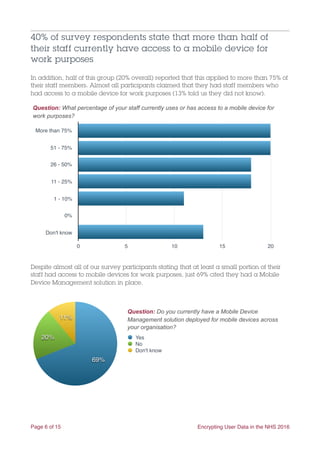
40% of survey respondents state that more than half of
their staff currently have access to a mobile device for
work purposes
In addition, half of this group (20% overall) reported that this applied to more than 75% of
their staff members. Almost all participants claimed that they had staff members who
had access to a mobile device for work purposes (13% told us they did not know).
Despite almost all of our survey participants stating that at least a small portion of their
staff had access to mobile devices for work purposes, just 69% cited they had a Mobile
Device Management solution in place.
Page of6 15 Encrypting User Data in the NHS 2016
More than 75%
51 - 75%
26 - 50%
11 - 25%
1 - 10%
0%
Don't know
0 5 10 15 20
Question: What percentage of your staff currently uses or has access to a mobile device for
work purposes?
11%
20%
69%
Yes
No
Don't know
Question: Do you currently have a Mobile Device
Management solution deployed for mobile devices across
your organisation?
Over three-quarters (77%) were not aware of the use of
Cloud applications such as Office 365 or Dropbox in their
organisation
However, of those who told us they use Cloud applications, just 30% reported that they
were able to monitor the sensitive data that is accessed by end-users through these
applications.


Page of7 15 Encrypting User Data in the NHS 2016
7%
23%
70%
Yes
No
Don't know
Question: Currently, does your organisation use cloud
applications such as Office 365 or Dropbox?
36%
41%
23%
Yes
No
Don't know
Question: Are you able to monitor the sensitive data
accessed by end-users through these applications?
Only 25% of survey respondents told us they had a full
awareness of new data laws soon to be introduced by the
EU under the General Data Protection Regulation (GDPR)
A further 54% reported having a limited awareness of the new data laws, whilst almost a
quarter (21%) told us they were not at all aware of them.
Despite this, 28% reported that their organisation was planning further development of
their data security and data protection measures to meet these new requirements. More
than half (51%) claimed they needed to do more research into what this entails, whilst
just 6% stated they were not planning any developments at all.
Page of8 15 Encrypting User Data in the NHS 2016
21%
54%
25%
Yes - I am fully aware of this
Yes - I have a limited awareness of this
No
Question: Are you aware of the new data laws soon to be
introduced by the European Union under the General Data
Protection Regulation (GDPR)?
15%
6%
51%
28%
Yes
We need to do more research into what this entails
No
Don't know
Question: Is your organisation planning any development
within your data security and data protection to meet these
new requirements?
Over half (54%) also believe that further understanding of
compliance risks would be beneficial to their organisation
A quarter (25%) of surveyed participants felt that their organisation didn’t need any
further knowledge of data protection at this time, whilst 13% told us they felt they needed
a better understanding of how to secure sensitive data to update our strategy in line with
new technologies.


Page of9 15 Encrypting User Data in the NHS 2016
0 12 24 36 48 60
Question: To what extent do you think having a clearer understanding of compliance risk on end-
user systems would benefit your organisation?
I feel our organisation needs a better
understanding of how to secure
sensitive data to update our strategy
in line with new technologies
Further understanding would be
beneficial to us as we review our data
protection strategy
We don’t feel any further knowledge
of data protection is required at this
time
Other - please specify
Don’t know
Conclusion
by Rick Powles, Senior Vice President at Druva EMEA
The NHS collects and stores massive amounts of sensitive data, much of which contains
patient information such as health records and demographic data. As the connectivity of
data grows more commonplace across the public sector and organisations begin to
adopt mobile and Cloud technologies, NHS organisations must consider the impact that
these challenges, along with data legislations put in place by the government, have on
their current data protection strategies in order to ensure a high-level of security.
This survey examined the data security and encryption strategies currently in place
across the sector and how these growing challenges impact their security posture. It
revealed that organisations have limited knowledge of new data privacy laws, but that
they also recognise the need to better understand compliance issues and the resulting
impact upon existing data protection strategies. Protecting sensitive information must
remain a top priority for NHS organisations as well as staying informed of not only
changes in legislation but tools that can better equip them for the future.
Page of10 15 Encrypting User Data in the NHS 2016
Appendix 1: Full Survey Questions
Page of11 15 Encrypting User Data in the NHS 2016
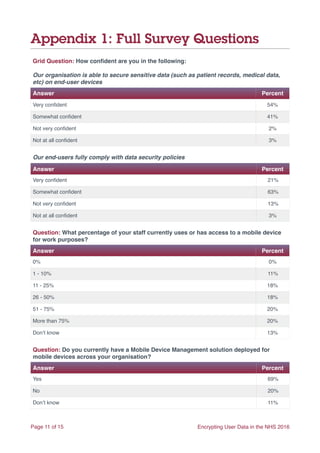
Grid Question: How confident are you in the following:
Our organisation is able to secure sensitive data (such as patient records, medical data,
etc) on end-user devices
Answer Percent
Very confident 54%
Somewhat confident 41%
Not very confident 2%
Not at all confident 3%
Our end-users fully comply with data security policies
Answer Percent
Very confident 21%
Somewhat confident 63%
Not very confident 13%
Not at all confident 3%
Question: What percentage of your staff currently uses or has access to a mobile device
for work purposes?
Answer Percent
0% 0%
1 - 10% 11%
11 - 25% 18%
26 - 50% 18%
51 - 75% 20%
More than 75% 20%
Don’t know 13%
Question: Do you currently have a Mobile Device Management solution deployed for
mobile devices across your organisation?
Answer Percent
Yes 69%
No 20%
Don’t know 11%
Page of12 15 Encrypting User Data in the NHS 2016
Question: In terms of a percentage, how many of your organisation’s mobile devices are
encrypted?
Answer Percent
0% 2%
1 - 10% 3%
11 - 25% 2%
26 - 50% 0%
51 - 75% 8%
More than 75% 74%
Don’t know 11%
Question: On average, how many devices are damaged or lost in your organisation per
year?
Answer Percent
1 - 10 46%
11 - 20 5%
21 - 30 5%
More than 30 10%
Don’t know 34%
Question: Are there any groups in your organisation most prone to losing mobile devices
or subject to theft?
Answer Percent
Frontline staff, such as administration 3%
Nurses 12%
Doctors 8%
Executives 3%
Other - please specify 18%
Don’t know 56%
Question: Currently, does your organisation use Cloud applications such as Office 365 or
Dropbox?
Answer Percent
Yes 23%
No 70%
Don’t know 7%
Page of13 15 Encrypting User Data in the NHS 2016
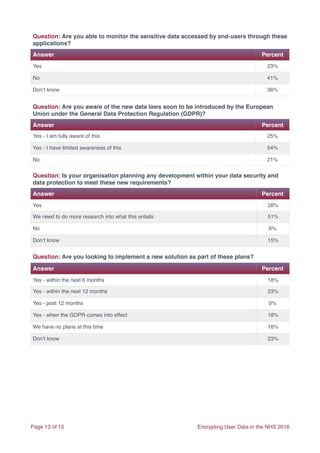
Question: Are you able to monitor the sensitive data accessed by end-users through these
applications?
Answer Percent
Yes 23%
No 41%
Don’t know 36%
Question: Are you aware of the new data laws soon to be introduced by the European
Union under the General Data Protection Regulation (GDPR)?
Answer Percent
Yes - I am fully aware of this 25%
Yes - I have limited awareness of this 54%
No 21%
Question: Is your organisation planning any development within your data security and
data protection to meet these new requirements?
Answer Percent
Yes 28%
We need to do more research into what this entails 51%
No 6%
Don’t know 15%
Question: Are you looking to implement a new solution as part of these plans?
Answer Percent
Yes - within the next 6 months 18%
Yes - within the next 12 months 23%
Yes - post 12 months 0%
Yes - when the GDPR comes into effect 18%
We have no plans at this time 18%
Don’t know 23%
Page of14 15 Encrypting User Data in the NHS 2016
Question: To what extent do you think having a clearer understanding of compliance risk
on end-user systems would benefit your organisation?
Answer Percent
I feel our organisation needs a better understanding of how to secure sensitive data to
update our strategy in line with new technologies
13%
Further understanding would be beneficial as we review our data protection strategy 54%
We don’t feel any further knowledge of data protection is required at this time 25%
Other - please specify 3%
Don’t know 5%
Appendix 2: Participating Organisations
Page of15 15 Encrypting User Data in the NHS 2016
Bedford Hospital NHS Trust

Belfast Health and Social Care Trust

Bristol Community Health CIC

Cardiff and Vale University Health Board

Central and North West London NHS Foundation Trust
Coventry and Warwickshire NHS Partnership Trust

Dorset HealthCare University NHS Foundation Trust
Gloucestershire Hospitals NHS Foundation Trust

Health Education Yorkshire and the Humber

Isle of Wight NHS Trust

Kings College Hospital NHS Foundation Trust

Lewisham and Greenwich NHS Trust

Lincolnshire Partnership NHS Foundation Trust

Liverpool Heart and Chest Hospital NHS Foundation Trust
Locala Community Partnerships

NEL Commissioning Support Unit

NHS Coastal West Sussex CCG

NHS England

NHS Fareham and Gosport CCG

NHS Guildford and Waverley Clinical Commissioning Group
NHS Kingston CCG

NHS Lanarkshire

NHS Liverpool Clinical Commissioning Group

NHS Newbury and District CCG

NHS Newcastle Gateshead Clinical Commissioning Group
NHS North East Hampshire and Farnham CCG

NHS Northumberland Clinical Commissioning Group

NHS Portsmouth CCG

NHS Sheffield CCG

NHS Somerset CCG
NHS South Devon and Torbay CCG
NHS South Eastern Hampshire CCG

NHS West Essex Clinical Commissioning Group

NHS West Lancashire CCG

North of England Commercial Procurement Collaborative
North Somerset Community Partnership

North Staffordshire Combined Healthcare NHS Trust
Nottingham University Hospitals NHS Trust

Oxford University Hospitals NHS Foundation Trust

Poole Hospital NHS Foundation Trust

Provide

Public Health Wales

Sheffield Teaching Hospitals NHS Foundation Trust
Somerset Partnership NHS Foundation Trust

South Tyneside NHS Foundation Trust

South West London and St George's Mental Health NHS Trust

South,Central and West Commissioning Support Unit
Southern Health NHS Foundation Trust

Southport and Ormskirk Hospital NHS Trust

Sussex Partnership NHS Foundation Trust

The Dudley Group NHS Foundation Trust

The Health Informatics Service NHS

The Royal Liverpool and Broadgreen University Hospitals NHS Trust

The Royal Surrey County Hospital NHS Foundation Trust UCL
Partners Academic Health Science Network University College
London Hospitals NHS Foundation Trust University Hospitals
Birmingham NHS Foundation Trust Velindre NHS Trust

West London Mental Health NHS Trust

Yeovil District Hospital NHS Foundation Trust

Encrypting User Data in the NHS 2016

  • 1.
    Encrypting User Datain the NHS Survey Report 2016 Survey Partners
  • 2.
    Contents The Survey 3 SurveyMethodology and Respondents Profile 4 Key Findings 5 Conclusion 10 Appendix 1: Full Survey Questions 11 Appendix 2: Participating Organisations 15 Page of2 15 Encrypting User Data in the NHS 2016 Acknowledgements The survey team at iGov Survey would like to take this opportunity to thank all of those who were kind enough to take part - and especially to those who found the time to offer additional insight through their extra comments. We would also like to thank our partner, Druva, for their assistance in compiling the survey questions, scrutinising the responses and analysing the results. Encrypting User Data in the NHS 2016 © copyright Unless explicitly stated otherwise, all rights including those in copyright in the content of this publication are owned by or controlled for these purposes by iGov Survey. Except as otherwise expressly permitted under copyright law or iGov Survey’s Terms of Use, the content of this publication are owned by or controlled may not be copied, reproduced, republished, downloaded, posted, broadcast or transmitted in any way without first obtaining iGov Survey’s written permission or that of the copyright owner. To contact the iGov or Exec Survey team: Email: dcross@ingenium-ids.org Tel: 0845 094 8567 Address: FAO David Cross, Ingenium IDS Ltd, Mansion House, Wellington Road South, Stockport, Cheshire, SK1 3UA
  • 3.
    The Survey Mass amountsof sensitive data are collected, updated and stored across the NHS every day, and much of this data often concerns patient information, including demographic data and health records. This means that while organisations face pressure within the public sector to follow government legislation, they also face the growing concerns of the public as data transparency and connectivity becomes more commonplace. In late 2015, the Information Commissioner’s Office (ICO) published the findings of a study entitled ‘Data security incident trends’ that reported a brief analysis of their most1 recent cases (559). It found that almost half of reported cases (278) in the second quarter of the 2015/16 year (July to September 2015) originated in the health sector. Worryingly, this showed a 44% rise from the previous quarter (193), though the ICO do note that this is in-line with the overall increase in data security incidents when compared to the previous quarter. It also notes that the increase could in part be attributed to a change in the way the NHS handles data security incidents, as it is now mandatory to report them. The analysis highlighted two distinct issues regarding data security within the health sector; the loss and theft of paperwork (27% of health sector incidents) and data being posted or faxed to the incorrect recipient (23%). As the connectivity of data grows more commonplace across the public sector and organisations begin to adopt new technologies such as mobile and cloud, the threat of data breaches increases. While the NHS battles against tough budget constraints, their patients expect a consistently high-level of security. To meet this challenge, strategies put in place must balance the need to create more efficient ways of working with effective security. With this in mind, iGov Survey have now teamed with the fastest growing cloud-based data protection provider, Druva, to further understand the barriers that NHS organisations face, and benefits meeting this challenge brings to the sector. With large amounts of data now being stored in a variety of locations such as endpoints and the Cloud, Druva and iGov launched a research project to examine the data security and encryption strategies currently in place across the sector. It looked at the use of mobile devices, along with online and cloud applications, and the security concerns that were realised due to the use of these technologies. Finally, it also considered the impact of data legislation put in place by government, and the bearing it has on the strategies currently being used. https://ico.org.uk/action-weve-taken/data-security-incident-trends/1 Page of3 15 Encrypting User Data in the NHS 2016
  • 4.
    Survey Methodology and RespondentsProfile This survey was conducted by iGov Survey in collaboration with Druva, and ran from 3rd November 2015 to 21st December 2015. iGov Survey, a research body comprising of an independent team of public sector experts, partnered with Druva on the project and all views and results expressed within this report are from iGov’s impartial view point unless explicitly stated otherwise. Survey respondents represent a broad cross-section of seniority levels across NHS organisations, and job roles include those working with IT departments, Corporate Services, and at a Chief Executive/Deputy level. 67 individuals participated from 61 unique organisations across the NHS, each of whom will have received a complimentary copy of the findings report. There was no inducement to take part, and Druva was not introduced as the survey partner. The results displayed throughout this report are based on those who fully completed the questionnaire and are displayed as a percentage unless otherwise stated. Page of4 15 Encrypting User Data in the NHS 2016 Acute Community Health Mental Health Clinical Commissioning Groups Other 0 6 12 18 24 Sector Breakdown: Trust Types
  • 5.
    Key Findings Whilst 54%state they are ‘very confident’ that their sensitive data is secure, confidence drops when asked whether participants believed their end-users comply with data protection rules (63%) Less than a quarter (21%) felt ‘very confident’ that end-users comply with their data protection rules. Moreover, 13% told us they were ‘not very confident’ in this area. 
 Page of5 15 Encrypting User Data in the NHS 2016 0 25 50 75 100 Very confident Somewhat confident Not very confident Not at all confident Our organisation is able to secure sensitive data on end-user devices Our end-users fully comply with data security policies Question: How confident are you in the following:
  • 6.
    40% of surveyrespondents state that more than half of their staff currently have access to a mobile device for work purposes In addition, half of this group (20% overall) reported that this applied to more than 75% of their staff members. Almost all participants claimed that they had staff members who had access to a mobile device for work purposes (13% told us they did not know). Despite almost all of our survey participants stating that at least a small portion of their staff had access to mobile devices for work purposes, just 69% cited they had a Mobile Device Management solution in place. Page of6 15 Encrypting User Data in the NHS 2016 More than 75% 51 - 75% 26 - 50% 11 - 25% 1 - 10% 0% Don't know 0 5 10 15 20 Question: What percentage of your staff currently uses or has access to a mobile device for work purposes? 11% 20% 69% Yes No Don't know Question: Do you currently have a Mobile Device Management solution deployed for mobile devices across your organisation?
  • 7.
    Over three-quarters (77%)were not aware of the use of Cloud applications such as Office 365 or Dropbox in their organisation However, of those who told us they use Cloud applications, just 30% reported that they were able to monitor the sensitive data that is accessed by end-users through these applications. 
 Page of7 15 Encrypting User Data in the NHS 2016 7% 23% 70% Yes No Don't know Question: Currently, does your organisation use cloud applications such as Office 365 or Dropbox? 36% 41% 23% Yes No Don't know Question: Are you able to monitor the sensitive data accessed by end-users through these applications?
  • 8.
    Only 25% ofsurvey respondents told us they had a full awareness of new data laws soon to be introduced by the EU under the General Data Protection Regulation (GDPR) A further 54% reported having a limited awareness of the new data laws, whilst almost a quarter (21%) told us they were not at all aware of them. Despite this, 28% reported that their organisation was planning further development of their data security and data protection measures to meet these new requirements. More than half (51%) claimed they needed to do more research into what this entails, whilst just 6% stated they were not planning any developments at all. Page of8 15 Encrypting User Data in the NHS 2016 21% 54% 25% Yes - I am fully aware of this Yes - I have a limited awareness of this No Question: Are you aware of the new data laws soon to be introduced by the European Union under the General Data Protection Regulation (GDPR)? 15% 6% 51% 28% Yes We need to do more research into what this entails No Don't know Question: Is your organisation planning any development within your data security and data protection to meet these new requirements?
  • 9.
    Over half (54%)also believe that further understanding of compliance risks would be beneficial to their organisation A quarter (25%) of surveyed participants felt that their organisation didn’t need any further knowledge of data protection at this time, whilst 13% told us they felt they needed a better understanding of how to secure sensitive data to update our strategy in line with new technologies. 
 Page of9 15 Encrypting User Data in the NHS 2016 0 12 24 36 48 60 Question: To what extent do you think having a clearer understanding of compliance risk on end- user systems would benefit your organisation? I feel our organisation needs a better understanding of how to secure sensitive data to update our strategy in line with new technologies Further understanding would be beneficial to us as we review our data protection strategy We don’t feel any further knowledge of data protection is required at this time Other - please specify Don’t know
  • 10.
    Conclusion by Rick Powles,Senior Vice President at Druva EMEA The NHS collects and stores massive amounts of sensitive data, much of which contains patient information such as health records and demographic data. As the connectivity of data grows more commonplace across the public sector and organisations begin to adopt mobile and Cloud technologies, NHS organisations must consider the impact that these challenges, along with data legislations put in place by the government, have on their current data protection strategies in order to ensure a high-level of security. This survey examined the data security and encryption strategies currently in place across the sector and how these growing challenges impact their security posture. It revealed that organisations have limited knowledge of new data privacy laws, but that they also recognise the need to better understand compliance issues and the resulting impact upon existing data protection strategies. Protecting sensitive information must remain a top priority for NHS organisations as well as staying informed of not only changes in legislation but tools that can better equip them for the future. Page of10 15 Encrypting User Data in the NHS 2016
  • 11.
    Appendix 1: FullSurvey Questions Page of11 15 Encrypting User Data in the NHS 2016 Grid Question: How confident are you in the following: Our organisation is able to secure sensitive data (such as patient records, medical data, etc) on end-user devices Answer Percent Very confident 54% Somewhat confident 41% Not very confident 2% Not at all confident 3% Our end-users fully comply with data security policies Answer Percent Very confident 21% Somewhat confident 63% Not very confident 13% Not at all confident 3% Question: What percentage of your staff currently uses or has access to a mobile device for work purposes? Answer Percent 0% 0% 1 - 10% 11% 11 - 25% 18% 26 - 50% 18% 51 - 75% 20% More than 75% 20% Don’t know 13% Question: Do you currently have a Mobile Device Management solution deployed for mobile devices across your organisation? Answer Percent Yes 69% No 20% Don’t know 11%
  • 12.
    Page of12 15Encrypting User Data in the NHS 2016 Question: In terms of a percentage, how many of your organisation’s mobile devices are encrypted? Answer Percent 0% 2% 1 - 10% 3% 11 - 25% 2% 26 - 50% 0% 51 - 75% 8% More than 75% 74% Don’t know 11% Question: On average, how many devices are damaged or lost in your organisation per year? Answer Percent 1 - 10 46% 11 - 20 5% 21 - 30 5% More than 30 10% Don’t know 34% Question: Are there any groups in your organisation most prone to losing mobile devices or subject to theft? Answer Percent Frontline staff, such as administration 3% Nurses 12% Doctors 8% Executives 3% Other - please specify 18% Don’t know 56% Question: Currently, does your organisation use Cloud applications such as Office 365 or Dropbox? Answer Percent Yes 23% No 70% Don’t know 7%
  • 13.
    Page of13 15Encrypting User Data in the NHS 2016 Question: Are you able to monitor the sensitive data accessed by end-users through these applications? Answer Percent Yes 23% No 41% Don’t know 36% Question: Are you aware of the new data laws soon to be introduced by the European Union under the General Data Protection Regulation (GDPR)? Answer Percent Yes - I am fully aware of this 25% Yes - I have limited awareness of this 54% No 21% Question: Is your organisation planning any development within your data security and data protection to meet these new requirements? Answer Percent Yes 28% We need to do more research into what this entails 51% No 6% Don’t know 15% Question: Are you looking to implement a new solution as part of these plans? Answer Percent Yes - within the next 6 months 18% Yes - within the next 12 months 23% Yes - post 12 months 0% Yes - when the GDPR comes into effect 18% We have no plans at this time 18% Don’t know 23%
  • 14.
    Page of14 15Encrypting User Data in the NHS 2016 Question: To what extent do you think having a clearer understanding of compliance risk on end-user systems would benefit your organisation? Answer Percent I feel our organisation needs a better understanding of how to secure sensitive data to update our strategy in line with new technologies 13% Further understanding would be beneficial as we review our data protection strategy 54% We don’t feel any further knowledge of data protection is required at this time 25% Other - please specify 3% Don’t know 5%
  • 15.
    Appendix 2: ParticipatingOrganisations Page of15 15 Encrypting User Data in the NHS 2016 Bedford Hospital NHS Trust
 Belfast Health and Social Care Trust
 Bristol Community Health CIC
 Cardiff and Vale University Health Board
 Central and North West London NHS Foundation Trust Coventry and Warwickshire NHS Partnership Trust
 Dorset HealthCare University NHS Foundation Trust Gloucestershire Hospitals NHS Foundation Trust
 Health Education Yorkshire and the Humber
 Isle of Wight NHS Trust
 Kings College Hospital NHS Foundation Trust
 Lewisham and Greenwich NHS Trust
 Lincolnshire Partnership NHS Foundation Trust
 Liverpool Heart and Chest Hospital NHS Foundation Trust Locala Community Partnerships
 NEL Commissioning Support Unit
 NHS Coastal West Sussex CCG
 NHS England
 NHS Fareham and Gosport CCG
 NHS Guildford and Waverley Clinical Commissioning Group NHS Kingston CCG
 NHS Lanarkshire
 NHS Liverpool Clinical Commissioning Group
 NHS Newbury and District CCG
 NHS Newcastle Gateshead Clinical Commissioning Group NHS North East Hampshire and Farnham CCG
 NHS Northumberland Clinical Commissioning Group
 NHS Portsmouth CCG
 NHS Sheffield CCG
 NHS Somerset CCG NHS South Devon and Torbay CCG NHS South Eastern Hampshire CCG
 NHS West Essex Clinical Commissioning Group
 NHS West Lancashire CCG
 North of England Commercial Procurement Collaborative North Somerset Community Partnership
 North Staffordshire Combined Healthcare NHS Trust Nottingham University Hospitals NHS Trust
 Oxford University Hospitals NHS Foundation Trust
 Poole Hospital NHS Foundation Trust
 Provide
 Public Health Wales
 Sheffield Teaching Hospitals NHS Foundation Trust Somerset Partnership NHS Foundation Trust
 South Tyneside NHS Foundation Trust
 South West London and St George's Mental Health NHS Trust
 South,Central and West Commissioning Support Unit Southern Health NHS Foundation Trust
 Southport and Ormskirk Hospital NHS Trust
 Sussex Partnership NHS Foundation Trust
 The Dudley Group NHS Foundation Trust
 The Health Informatics Service NHS
 The Royal Liverpool and Broadgreen University Hospitals NHS Trust
 The Royal Surrey County Hospital NHS Foundation Trust UCL Partners Academic Health Science Network University College London Hospitals NHS Foundation Trust University Hospitals Birmingham NHS Foundation Trust Velindre NHS Trust
 West London Mental Health NHS Trust
 Yeovil District Hospital NHS Foundation Trust