Youth at risk:
   Achieving change
through development of
 early intervention and
    diversion tools
                                  Ilona Kronberga
                                      Researcher,
               Centre for Public Policy PROVIDUS
Youth, children, or minors?

It is generally believed that the separation of
   those concepts plays an important role in
   crime prevention, but in reality it only makes
   sense when we think about responsibility and
   the punishment. If we think about prevention,
   these concepts blend into one – this is just a
   person whom we must help to grow up. Our
   own future is highly dependent on our ability
   to carry out this task .
If our aim is to keep young people away from harm caused by crime –
prevention is related to all groups of young people!


                  Child, adolescent, minor, young adult
The relationships among concepts:
What does it mean – Youth at risk?

«80.Young people who live in difficult
  circumstances are often at risk of becoming
  delinquent. Poverty, dysfunctional families,
  substance abuse and the death of family
  members have been demonstrated to be risk
  factors for becoming delinquent. Insecurity due
  to an unstable social environment increases
  vulnerability, and young people with poorly
  developed social skills are less able to protect
  themselves against the negative influences of a
  peer group.»
United Nations World Youth Report (2005)
http://www.un.org/esa/socdev/unyin/wpayjuvenile.htm#WYR2005
Actually we can add some new risks:
      Adults can
      influence
      processes


                        If a child feels
                      well in his family,
                       there is no risk
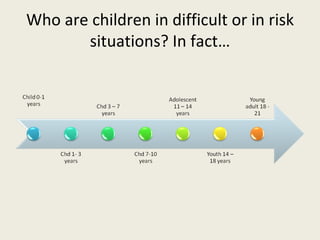
Who are children in difficult or in risk
       situations? In fact…
How does all this link to prevention?
                  (1)
Prevention is a much broader concept than
  generally considered.
Concept of children's crime prevention is
  contained in children's rights violation
  prevention concept.
These observations work in both cases when a
  law is violated by a child (adolescent or young
  person) as well as when the rights of a child
  (adolescent or young person) are violated.
How does all this link to prevention?
                  (2)
In case when we face a situation in which we
  should punish the child, as well as in a
  situation when the child has become a victim
  or witness of crime, the result is equal –
  mechanisms of prevention have not worked.
We have faced conditions that impedes a
  normal development of the child – in one case
  it is trauma, but in the other – punishment.
Which part of the children it is possible to reach
now with preventive mechanisms, but which is
                not available?
Description of the current situation in Latvia or
      why do we need to change anything?

«The child should be blamed for the commission
  of the specific criminal offence, the state and
  the community should be held guilty for
  creating circumstances under which the child
  has decided to resolve his/her problems at the
  expense of the community in violation of
  criminal legal taboos.»
Centre for Public Policy PROVIDUS, Research, 2010
“Restorative Justice in the Aspect of Juvenile Delinquency:
Baltic States in European Dimension.”
http://politika.lv/article/atjaunojosa-justicija-nepilngadigo-noziedzibas-konteksta-baltijas-valstis-eiropas
Opinion of the European Economic and Social Committee on The prevention of juvenile
 delinquency. Ways of dealing with juvenile delinquency and the role of the juvenile justice
                              system in the European Union


Juvenile delinquency is currently an aspect of crime
causing growing concern in European societies and
 has, since the last century, been under continuous
     scrutiny on an international scale. It should
    however be pointed out that young people's
behaviour often has a greater impact than that of
  adults, especially if it is negative, thus prompting
society to take a particularly adverse view of young
   offenders. It is also useful to note that in many
    cases the victims of juvenile delinquency are
             young people themselves.
                 http://eur-lex.europa.eu/LexUriServ/LexUriServ.do?uri=CELEX:52006IE0414:EN:HTML
Opinion of the European Economic and Social Committee on The prevention of juvenile
   delinquency. Ways of dealing with juvenile delinquency and the role of the juvenile justice
                                system in the European Union

As a result, the importance that European
  society attaches to juvenile delinquency
  means that effective responses must be
  found, which will have to be built principally
  on a three-fold foundation:
• prevention,
• punitive-educational measures, and
• the social integration or re-integration of
  minors and young offenders.
http://eur-lex.europa.eu/LexUriServ/LexUriServ.do?uri=CELEX:52006IE0414:EN:HTML
There are many different reasons or
        circumstances that can prompt a minor to
                    commit a crime:
• A broken home, or even difficulty in balancing
  family life and work, both of which
  increasingly often result in a lack of attention
  and an absence of constraints and control for
  children.
• Socio-economic marginalisation or poverty,
  which also makes it difficult for the minor to
  integrate properly into society.
http://eur-lex.europa.eu/LexUriServ/LexUriServ.do?uri=CELEX:52006IE0414:EN:HTML
Why do children commit crimes:
                  (1)
• Truancy and academic failure: at school, this
  already leads to labelling or social
  stigmatisation, which often paves the way for
  antisocial behaviour or delinquency.
• Unemployment, which is at its highest among
  young people and often leads to situations of
  frustration and despair, creating a breeding
  ground for delinquent behaviour.
•   http://eur-lex.europa.eu/LexUriServ/LexUriServ.do?uri=CELEX:52006IE0414:EN:HTML
Why do children commit crimes:
                  (2)
• The broadcasting of violent images and
  attitudes by certain programmes via some
  media, or videogames for minors, which helps
  to create a system of values among young
  people in which violence is seen as acceptable
  behaviour.
•   http://eur-lex.europa.eu/LexUriServ/LexUriServ.do?uri=CELEX:52006IE0414:EN:HTML
Why do children commit crimes:
                   (3)
• Abuse of alcohol, drugs and toxic substances
  which often causes the addict to commit
  crimes in order to support his/her addiction.
• Personality and behaviour disorders, either in
  association with or independently of the
  factor outlined in the previous point.
http://eur-lex.europa.eu/LexUriServ/LexUriServ.do?uri=CELEX:52006IE0414:EN:HTML
Why do children commit crimes:
                 (4)
• Shortcomings in the teaching and passing on
  of social and civic values — such as obeying
  rules, solidarity, generosity, tolerance, respect
  for others, critical self-awareness, empathy,
  high standards of work, etc., which are being
  replaced in our "globalised" societies by more
  utilitarian values like individualism,
  competitiveness or hyper-consumption —
  which in certain circumstances can generate a
  degree of detachment from society.
Children and Justice – an insight into
            Latvian law
Juvenile Justice instruments in Latvia
        are currently fragmented:
«National systems of law are at various
  development levels – in some countries due to
  the rapid development of Juvenile Justice has, in
  actual fact, become an alternative to the
  traditional criminal justice (a), in some countries
  it has been positioned as a sub-branch within the
  frame of criminal justice (b), while in some
  countries, including Latvia, it is understood only
  as a set of some favourable peculiarities that is
  applicable to juvenile delinquents (c).»
Centre for Public Policy PROVIDUS, Research, 2010
“Restorative Justice in the Aspect of Juvenile Delinquency:
Baltic States in European Dimension.”
http://politika.lv/article/atjaunojosa-justicija-nepilngadigo-noziedzibas-konteksta-baltijas-valstis-eiropas-dimensija
Reaction to offences committed by
              minors
Law On Application of Compulsory Measures of a
          Correctional Nature to Children...
… is only one diversion tool from the traditional adult liability system
    which provide the following compulsory measures:
1) to issue a warning;
2) to impose a duty to apologise to the victims if they agree to meet
    with the guilty party;
3) to place a child in the custody of parents or guardians, as well as
    other persons, authorities or organisations;
4) to impose a duty to eliminate by his or her work the consequences
    of the harm caused;
5) for a child who has reached the age of 15 and who has income – to
    impose a duty to reimburse the harm caused;
6) to specify behaviour restrictions (to visit certain public areas...);
7) to impose a duty to perform community services; or
8) to place a child in an educational establishment for social
    correction.
The problem is that with only few exceptions, this law is rarely applied.
Part I
                        Conclusions:
• Only by developing Juvenile Justice it is already likely to get
  effective tools of diversion;
• Juvenile crime prevention grows from child protection policy;
• To have success in children crime prevention we must understand
  that all age groups of children can be exposed to risk situations and
  related behavioural risks;
• The greatest prevention should be done at the place where the
  child lives – from the birth to adulthood;
• When the police must be involved, the major part of prevention
  possibilities is already lost;
• Inclusion and mitigation of social exclusion is not a task which WE
  have to do for THEM, it is vital to our joint tomorrow;
• To achieve effective prevention, every written law has to work.
...and now I would ask you to
(Back to slide 6)


remember previously mentioned...


                    ...almost none of the
                       above mentioned
                    reasons/risks do not
                        apply to police
                         jurisdiction!
Therefore the question is – who
    must be responsible for the
 children delinquency prevention?
We had asked ourselves this question a couple
 of years ago
...and now you will see what we have
              found out!

Preventive measures with young people should be
  taken in each municipality before a law is
  violated or especially when a crime is committed
  but the situation actually turned out to be
  different:
• in many cases in Latvian local municipalities
  social workers do nothing and wait for law
  enforcement agencies to get clients (minors)
  from them after the law violation fact.
Preventive measures with young
   people – problems and difficulties (1)
In the Ombudsman's report on children's rights
  in 2011 in Latvia it was indicated that: in 7
  municipalities from 119 nobody does
  preventive work with children at risk and in
  risk situations (a); only in eight municipalities
  it is the responsibility of the Interinstitutional
  commission (b); in many cases the creation of
  Interinstitutional models was refused from
  local governors, even without going into these
  matters...
http://www.tiesibsargs.lv/lat/tiesibsargs/jaunumi/?doc=366
Preventive measures with young
 people – problems and difficulties (2)
mainly this work has been done by the social
   workers who, at the same time, are responsible
   for all social issues – old people, disabled people,
   poor and large families etc. (c);
in many cases, a municipality has only one social
   worker who is overloaded with responsibilities
   (d);
there are cases when the preventive work is a
   responsibility of officials who do not have any
   knowledge and skills (e).
Taking into account all the above
              mentioned
for the second year in Latvia the
  Interinstitutional method of early intervention
  for prevention of juvenile delinquency has
  been approbated.
What is the Interinstitutional method – It is a
  children's rights protecting (including child
  delinquency prevention) method, which is
  suitable for use in the place where the child
  lives – local municipality.
Interinstitutional
                         cooperation method
is a professional cooperation among different institutions particularly to
                  improve the child's living environment
Interinstitutional
             cooperation method
In the municipalities in which we are introducing the new
   method, Inter-Inst working groups meet once every 2
   weeks;
It consists of professionals who are working in the local
   area with and for children;
Specialists in this collaboration gain greater capacity for
   their professional duties and peer support;
Particularly, it is important to manage the consequences
   of economic crisis, when everyone feels the lack of
   resources, especially professionals working in rural
   areas.
Each working group:
• is attended by all local law enforcement,
  education and other professionals who are
  working with or for children;
• examines all known issues on children with
  behavioural risks;
• defines the risks, identifies children and their
  parents who will be invited to the next meeting;
• in cooperation with parents identifies children's
  needs and develop children's behavioural
  programme.
Children's behavioural programme (1)
Children's behavioural programme (2)
If we say: «That is not the best way how to
   behave,» we must have something to offer. A
   programme to replace wrong behaviour.
For this reason, local governments have established
   the catalog of meaningful activities for youth.
Using this activity book, a behavioural programme
   for the next 8 months is created ​ for every young
   person. For each minor the task description is
   given. Minors should report on each performed
   task and this is evidenced by the activities
   teacher's signature in his or her diary.
Children's behavioral program (3)
When the program is finished children's needs
   and risks are re-evaluated.
Thus, parents, teachers and children's affairs
   professionals have the opportunity to judge
   any further work with these children.
(from 33).           To new program

     • Needs and risks
       assessment
     • Next decisions
                         Back to normal life
Children's behavioral program (4)
Implementation of such a program in the
  municipality requires to set up and develop
  certain instruments - keywords:
                                Risk and                   Catalogue of
   Inter-Inst
                                  need                        useful
    Working
                               Assesment                     activities
    Groups
                                System


                The Program                Cooperation
                management                  Framework
                 and control                 for local
                   system                  professionals
Part II
                 Conclusions:
• Delinquency prevention is not a task that can be
  distributed among the institutions. This must be
  done using a multidisciplinary approach;
• Prevention efforts need to be done in place
  where child / adolescent / young person /
  juvenile living in;
• In each municipality need to be established
  children's behavioral program, which includes all
  above mentioned tools.
Many thanks for your attention!
        For additional information, please visit
           www.providus.lv & www.politika.lv
            Twitter: @providus & @politikalv
        Pinterest: www.pinterest.com/politikalv
    Slideshare: http://www.slideshare.net/providus

Youth at risk

  • 1.
    Youth at risk: Achieving change through development of early intervention and diversion tools Ilona Kronberga Researcher, Centre for Public Policy PROVIDUS
  • 2.
    Youth, children, orminors? It is generally believed that the separation of those concepts plays an important role in crime prevention, but in reality it only makes sense when we think about responsibility and the punishment. If we think about prevention, these concepts blend into one – this is just a person whom we must help to grow up. Our own future is highly dependent on our ability to carry out this task .
  • 3.
    If our aimis to keep young people away from harm caused by crime – prevention is related to all groups of young people! Child, adolescent, minor, young adult
  • 4.
  • 5.
    What does itmean – Youth at risk? «80.Young people who live in difficult circumstances are often at risk of becoming delinquent. Poverty, dysfunctional families, substance abuse and the death of family members have been demonstrated to be risk factors for becoming delinquent. Insecurity due to an unstable social environment increases vulnerability, and young people with poorly developed social skills are less able to protect themselves against the negative influences of a peer group.» United Nations World Youth Report (2005) http://www.un.org/esa/socdev/unyin/wpayjuvenile.htm#WYR2005
  • 6.
    Actually we canadd some new risks: Adults can influence processes If a child feels well in his family, there is no risk
  • 7.
    Who are childrenin difficult or in risk situations? In fact…
  • 8.
    How does allthis link to prevention? (1) Prevention is a much broader concept than generally considered. Concept of children's crime prevention is contained in children's rights violation prevention concept. These observations work in both cases when a law is violated by a child (adolescent or young person) as well as when the rights of a child (adolescent or young person) are violated.
  • 9.
    How does allthis link to prevention? (2) In case when we face a situation in which we should punish the child, as well as in a situation when the child has become a victim or witness of crime, the result is equal – mechanisms of prevention have not worked. We have faced conditions that impedes a normal development of the child – in one case it is trauma, but in the other – punishment.
  • 10.
    Which part ofthe children it is possible to reach now with preventive mechanisms, but which is not available?
  • 11.
    Description of thecurrent situation in Latvia or why do we need to change anything? «The child should be blamed for the commission of the specific criminal offence, the state and the community should be held guilty for creating circumstances under which the child has decided to resolve his/her problems at the expense of the community in violation of criminal legal taboos.» Centre for Public Policy PROVIDUS, Research, 2010 “Restorative Justice in the Aspect of Juvenile Delinquency: Baltic States in European Dimension.” http://politika.lv/article/atjaunojosa-justicija-nepilngadigo-noziedzibas-konteksta-baltijas-valstis-eiropas
  • 12.
    Opinion of theEuropean Economic and Social Committee on The prevention of juvenile delinquency. Ways of dealing with juvenile delinquency and the role of the juvenile justice system in the European Union Juvenile delinquency is currently an aspect of crime causing growing concern in European societies and has, since the last century, been under continuous scrutiny on an international scale. It should however be pointed out that young people's behaviour often has a greater impact than that of adults, especially if it is negative, thus prompting society to take a particularly adverse view of young offenders. It is also useful to note that in many cases the victims of juvenile delinquency are young people themselves. http://eur-lex.europa.eu/LexUriServ/LexUriServ.do?uri=CELEX:52006IE0414:EN:HTML
  • 13.
    Opinion of theEuropean Economic and Social Committee on The prevention of juvenile delinquency. Ways of dealing with juvenile delinquency and the role of the juvenile justice system in the European Union As a result, the importance that European society attaches to juvenile delinquency means that effective responses must be found, which will have to be built principally on a three-fold foundation: • prevention, • punitive-educational measures, and • the social integration or re-integration of minors and young offenders. http://eur-lex.europa.eu/LexUriServ/LexUriServ.do?uri=CELEX:52006IE0414:EN:HTML
  • 14.
    There are manydifferent reasons or circumstances that can prompt a minor to commit a crime: • A broken home, or even difficulty in balancing family life and work, both of which increasingly often result in a lack of attention and an absence of constraints and control for children. • Socio-economic marginalisation or poverty, which also makes it difficult for the minor to integrate properly into society. http://eur-lex.europa.eu/LexUriServ/LexUriServ.do?uri=CELEX:52006IE0414:EN:HTML
  • 15.
    Why do childrencommit crimes: (1) • Truancy and academic failure: at school, this already leads to labelling or social stigmatisation, which often paves the way for antisocial behaviour or delinquency. • Unemployment, which is at its highest among young people and often leads to situations of frustration and despair, creating a breeding ground for delinquent behaviour. • http://eur-lex.europa.eu/LexUriServ/LexUriServ.do?uri=CELEX:52006IE0414:EN:HTML
  • 16.
    Why do childrencommit crimes: (2) • The broadcasting of violent images and attitudes by certain programmes via some media, or videogames for minors, which helps to create a system of values among young people in which violence is seen as acceptable behaviour. • http://eur-lex.europa.eu/LexUriServ/LexUriServ.do?uri=CELEX:52006IE0414:EN:HTML
  • 17.
    Why do childrencommit crimes: (3) • Abuse of alcohol, drugs and toxic substances which often causes the addict to commit crimes in order to support his/her addiction. • Personality and behaviour disorders, either in association with or independently of the factor outlined in the previous point. http://eur-lex.europa.eu/LexUriServ/LexUriServ.do?uri=CELEX:52006IE0414:EN:HTML
  • 18.
    Why do childrencommit crimes: (4) • Shortcomings in the teaching and passing on of social and civic values — such as obeying rules, solidarity, generosity, tolerance, respect for others, critical self-awareness, empathy, high standards of work, etc., which are being replaced in our "globalised" societies by more utilitarian values like individualism, competitiveness or hyper-consumption — which in certain circumstances can generate a degree of detachment from society.
  • 19.
    Children and Justice– an insight into Latvian law
  • 20.
    Juvenile Justice instrumentsin Latvia are currently fragmented: «National systems of law are at various development levels – in some countries due to the rapid development of Juvenile Justice has, in actual fact, become an alternative to the traditional criminal justice (a), in some countries it has been positioned as a sub-branch within the frame of criminal justice (b), while in some countries, including Latvia, it is understood only as a set of some favourable peculiarities that is applicable to juvenile delinquents (c).» Centre for Public Policy PROVIDUS, Research, 2010 “Restorative Justice in the Aspect of Juvenile Delinquency: Baltic States in European Dimension.” http://politika.lv/article/atjaunojosa-justicija-nepilngadigo-noziedzibas-konteksta-baltijas-valstis-eiropas-dimensija
  • 21.
    Reaction to offencescommitted by minors
  • 22.
    Law On Applicationof Compulsory Measures of a Correctional Nature to Children... … is only one diversion tool from the traditional adult liability system which provide the following compulsory measures: 1) to issue a warning; 2) to impose a duty to apologise to the victims if they agree to meet with the guilty party; 3) to place a child in the custody of parents or guardians, as well as other persons, authorities or organisations; 4) to impose a duty to eliminate by his or her work the consequences of the harm caused; 5) for a child who has reached the age of 15 and who has income – to impose a duty to reimburse the harm caused; 6) to specify behaviour restrictions (to visit certain public areas...); 7) to impose a duty to perform community services; or 8) to place a child in an educational establishment for social correction. The problem is that with only few exceptions, this law is rarely applied.
  • 23.
    Part I Conclusions: • Only by developing Juvenile Justice it is already likely to get effective tools of diversion; • Juvenile crime prevention grows from child protection policy; • To have success in children crime prevention we must understand that all age groups of children can be exposed to risk situations and related behavioural risks; • The greatest prevention should be done at the place where the child lives – from the birth to adulthood; • When the police must be involved, the major part of prevention possibilities is already lost; • Inclusion and mitigation of social exclusion is not a task which WE have to do for THEM, it is vital to our joint tomorrow; • To achieve effective prevention, every written law has to work.
  • 24.
    ...and now Iwould ask you to (Back to slide 6) remember previously mentioned... ...almost none of the above mentioned reasons/risks do not apply to police jurisdiction!
  • 25.
    Therefore the questionis – who must be responsible for the children delinquency prevention? We had asked ourselves this question a couple of years ago
  • 26.
    ...and now youwill see what we have found out! Preventive measures with young people should be taken in each municipality before a law is violated or especially when a crime is committed but the situation actually turned out to be different: • in many cases in Latvian local municipalities social workers do nothing and wait for law enforcement agencies to get clients (minors) from them after the law violation fact.
  • 27.
    Preventive measures withyoung people – problems and difficulties (1) In the Ombudsman's report on children's rights in 2011 in Latvia it was indicated that: in 7 municipalities from 119 nobody does preventive work with children at risk and in risk situations (a); only in eight municipalities it is the responsibility of the Interinstitutional commission (b); in many cases the creation of Interinstitutional models was refused from local governors, even without going into these matters... http://www.tiesibsargs.lv/lat/tiesibsargs/jaunumi/?doc=366
  • 28.
    Preventive measures withyoung people – problems and difficulties (2) mainly this work has been done by the social workers who, at the same time, are responsible for all social issues – old people, disabled people, poor and large families etc. (c); in many cases, a municipality has only one social worker who is overloaded with responsibilities (d); there are cases when the preventive work is a responsibility of officials who do not have any knowledge and skills (e).
  • 29.
    Taking into accountall the above mentioned for the second year in Latvia the Interinstitutional method of early intervention for prevention of juvenile delinquency has been approbated. What is the Interinstitutional method – It is a children's rights protecting (including child delinquency prevention) method, which is suitable for use in the place where the child lives – local municipality.
  • 30.
    Interinstitutional cooperation method is a professional cooperation among different institutions particularly to improve the child's living environment
  • 31.
    Interinstitutional cooperation method In the municipalities in which we are introducing the new method, Inter-Inst working groups meet once every 2 weeks; It consists of professionals who are working in the local area with and for children; Specialists in this collaboration gain greater capacity for their professional duties and peer support; Particularly, it is important to manage the consequences of economic crisis, when everyone feels the lack of resources, especially professionals working in rural areas.
  • 32.
    Each working group: •is attended by all local law enforcement, education and other professionals who are working with or for children; • examines all known issues on children with behavioural risks; • defines the risks, identifies children and their parents who will be invited to the next meeting; • in cooperation with parents identifies children's needs and develop children's behavioural programme.
  • 33.
  • 34.
    Children's behavioural programme(2) If we say: «That is not the best way how to behave,» we must have something to offer. A programme to replace wrong behaviour. For this reason, local governments have established the catalog of meaningful activities for youth. Using this activity book, a behavioural programme for the next 8 months is created ​ for every young person. For each minor the task description is given. Minors should report on each performed task and this is evidenced by the activities teacher's signature in his or her diary.
  • 35.
    Children's behavioral program(3) When the program is finished children's needs and risks are re-evaluated. Thus, parents, teachers and children's affairs professionals have the opportunity to judge any further work with these children. (from 33). To new program • Needs and risks assessment • Next decisions Back to normal life
  • 36.
    Children's behavioral program(4) Implementation of such a program in the municipality requires to set up and develop certain instruments - keywords: Risk and Catalogue of Inter-Inst need useful Working Assesment activities Groups System The Program Cooperation management Framework and control for local system professionals
  • 37.
    Part II Conclusions: • Delinquency prevention is not a task that can be distributed among the institutions. This must be done using a multidisciplinary approach; • Prevention efforts need to be done in place where child / adolescent / young person / juvenile living in; • In each municipality need to be established children's behavioral program, which includes all above mentioned tools.
  • 38.
    Many thanks foryour attention! For additional information, please visit www.providus.lv & www.politika.lv Twitter: @providus & @politikalv Pinterest: www.pinterest.com/politikalv Slideshare: http://www.slideshare.net/providus