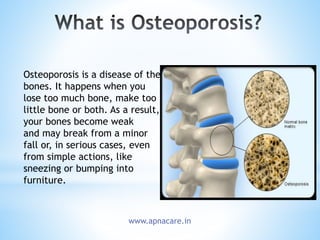
Osteoporosis is a disease of the
bones. It happens when you
lose too much bone, make too
little bone or both. As a result,
your bones become weak
and may break from a minor
fall or, in serious cases, even
from simple actions, like
sneezing or bumping into
furniture.
www.apnacare.in
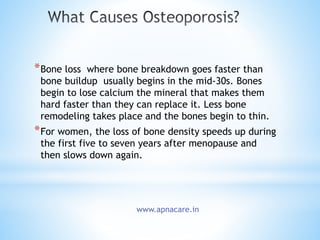
*Bone loss where bone breakdown goes faster than
bone buildup usually begins in the mid-30s. Bones
begin to lose calcium the mineral that makes them
hard faster than they can replace it. Less bone
remodeling takes place and the bones begin to thin.
*For women, the loss of bone density speeds up during
the first five to seven years after menopause and
then slows down again.
www.apnacare.in
Osteoporosis usually develops slowly over
several years, without any symptoms.
However, after a certain amount of bone
loss, the following may occur.
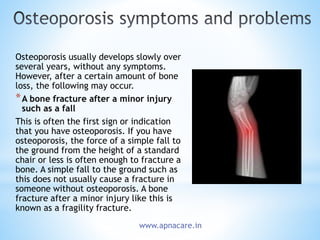
*A bone fracture after a minor injury
such as a fall
This is often the first sign or indication
that you have osteoporosis. If you have
osteoporosis, the force of a simple fall to
the ground from the height of a standard
chair or less is often enough to fracture a
bone. A simple fall to the ground such as
this does not usually cause a fracture in
someone without osteoporosis. A bone
fracture after a minor injury like this is
known as a fragility fracture.
www.apnacare.in
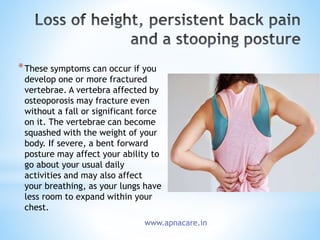
*These symptoms can occur if you
develop one or more fractured
vertebrae. A vertebra affected by
osteoporosis may fracture even
without a fall or significant force
on it. The vertebrae can become
squashed with the weight of your
body. If severe, a bent forward
posture may affect your ability to
go about your usual daily
activities and may also affect
your breathing, as your lungs have
less room to expand within your
chest.
www.apnacare.in
www.apnacare.in
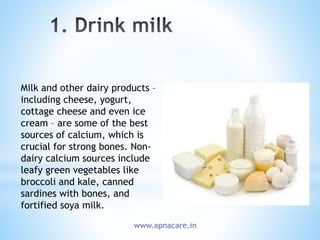
Milk and other dairy products –
including cheese, yogurt,
cottage cheese and even ice
cream – are some of the best
sources of calcium, which is
crucial for strong bones. Non-
dairy calcium sources include
leafy green vegetables like
broccoli and kale, canned
sardines with bones, and
fortified soya milk.
www.apnacare.in
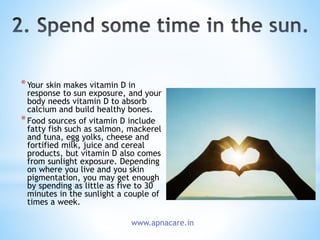
*Your skin makes vitamin D in
response to sun exposure, and your
body needs vitamin D to absorb
calcium and build healthy bones.
*Food sources of vitamin D include
fatty fish such as salmon, mackerel
and tuna, egg yolks, cheese and
fortified milk, juice and cereal
products, but vitamin D also comes
from sunlight exposure. Depending
on where you live and you skin
pigmentation, you may get enough
by spending as little as five to 30
minutes in the sunlight a couple of
times a week.
www.apnacare.in
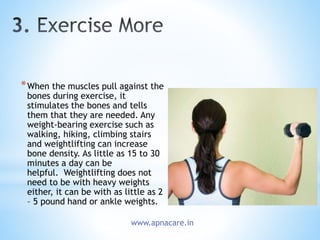
*When the muscles pull against the
bones during exercise, it
stimulates the bones and tells
them that they are needed. Any
weight-bearing exercise such as
walking, hiking, climbing stairs
and weightlifting can increase
bone density. As little as 15 to 30
minutes a day can be
helpful. Weightlifting does not
need to be with heavy weights
either, it can be with as little as 2
– 5 pound hand or ankle weights.
www.apnacare.in
*Corticosteroid medications, such as
prednisone, weaken bones by
decreasing the amount of calcium
absorbed in the intestines and
increasing the amount excreted by
the kidneys. One way to minimize
the risk of bone damage is to take
the lowest dose for the shortest
time possible to decrease
inflammation. If only one or a few
joints are affected, injecting
corticosteroids directly into the
joints may relieve inflammation
without the bone damage of oral
corticosteroids.
www.apnacare.in
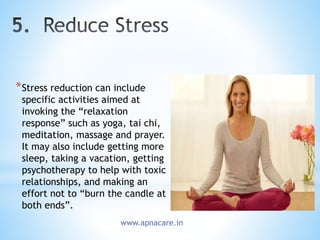
*Stress reduction can include
specific activities aimed at
invoking the “relaxation
response” such as yoga, tai chi,
meditation, massage and prayer.
It may also include getting more
sleep, taking a vacation, getting
psychotherapy to help with toxic
relationships, and making an
effort not to “burn the candle at
both ends”.
www.apnacare.in
5 tips to prevent osteoporosis

5 tips to prevent osteoporosis

  • 2.
    Osteoporosis is adisease of the bones. It happens when you lose too much bone, make too little bone or both. As a result, your bones become weak and may break from a minor fall or, in serious cases, even from simple actions, like sneezing or bumping into furniture. www.apnacare.in
  • 3.
    *Bone loss wherebone breakdown goes faster than bone buildup usually begins in the mid-30s. Bones begin to lose calcium the mineral that makes them hard faster than they can replace it. Less bone remodeling takes place and the bones begin to thin. *For women, the loss of bone density speeds up during the first five to seven years after menopause and then slows down again. www.apnacare.in
  • 4.
    Osteoporosis usually developsslowly over several years, without any symptoms. However, after a certain amount of bone loss, the following may occur. *A bone fracture after a minor injury such as a fall This is often the first sign or indication that you have osteoporosis. If you have osteoporosis, the force of a simple fall to the ground from the height of a standard chair or less is often enough to fracture a bone. A simple fall to the ground such as this does not usually cause a fracture in someone without osteoporosis. A bone fracture after a minor injury like this is known as a fragility fracture. www.apnacare.in
  • 5.
    *These symptoms canoccur if you develop one or more fractured vertebrae. A vertebra affected by osteoporosis may fracture even without a fall or significant force on it. The vertebrae can become squashed with the weight of your body. If severe, a bent forward posture may affect your ability to go about your usual daily activities and may also affect your breathing, as your lungs have less room to expand within your chest. www.apnacare.in
  • 6.
  • 7.
    Milk and otherdairy products – including cheese, yogurt, cottage cheese and even ice cream – are some of the best sources of calcium, which is crucial for strong bones. Non- dairy calcium sources include leafy green vegetables like broccoli and kale, canned sardines with bones, and fortified soya milk. www.apnacare.in
  • 8.
    *Your skin makesvitamin D in response to sun exposure, and your body needs vitamin D to absorb calcium and build healthy bones. *Food sources of vitamin D include fatty fish such as salmon, mackerel and tuna, egg yolks, cheese and fortified milk, juice and cereal products, but vitamin D also comes from sunlight exposure. Depending on where you live and you skin pigmentation, you may get enough by spending as little as five to 30 minutes in the sunlight a couple of times a week. www.apnacare.in
  • 9.
    *When the musclespull against the bones during exercise, it stimulates the bones and tells them that they are needed. Any weight-bearing exercise such as walking, hiking, climbing stairs and weightlifting can increase bone density. As little as 15 to 30 minutes a day can be helpful. Weightlifting does not need to be with heavy weights either, it can be with as little as 2 – 5 pound hand or ankle weights. www.apnacare.in
  • 10.
    *Corticosteroid medications, suchas prednisone, weaken bones by decreasing the amount of calcium absorbed in the intestines and increasing the amount excreted by the kidneys. One way to minimize the risk of bone damage is to take the lowest dose for the shortest time possible to decrease inflammation. If only one or a few joints are affected, injecting corticosteroids directly into the joints may relieve inflammation without the bone damage of oral corticosteroids. www.apnacare.in
  • 11.
    *Stress reduction caninclude specific activities aimed at invoking the “relaxation response” such as yoga, tai chi, meditation, massage and prayer. It may also include getting more sleep, taking a vacation, getting psychotherapy to help with toxic relationships, and making an effort not to “burn the candle at both ends”. www.apnacare.in