www.oeko.de
Flexibility Options for RES-E Integration
Dr. Dierk Bauknecht, David Ritter
Leonardo Energy Webinar
17 March 2015
2
www.oeko.de
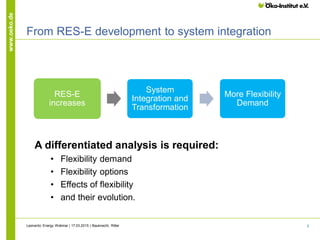
From RES-E development to system integration
Leonardo Energy Webinar | 17.03.2015 | Bauknecht, Ritter
RES-E
increases
System
Integration and
Transformation
More Flexibility
Demand
A differentiated analysis is required:
• Flexibility demand
• Flexibility options
• Effects of flexibility
• and their evolution.
3
www.oeko.de
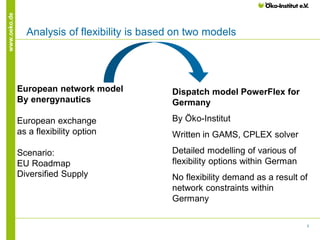
Analysis of flexibility is based on two models
Dispatch model PowerFlex for
Germany
By Öko-Institut
Written in GAMS, CPLEX solver
Detailed modelling of various of
flexibility options within German
No flexibility demand as a result of
network constraints within
Germany
European network model
By energynautics
European exchange
as a flexibility option
Scenario:
EU Roadmap
Diversified Supply
4
www.oeko.de
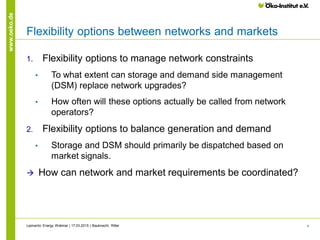
Flexibility options between networks and markets
1. Flexibility options to manage network constraints
• To what extent can storage and demand side management
(DSM) replace network upgrades?
• How often will these options actually be called from network
operators?
2. Flexibility options to balance generation and demand
• Storage and DSM should primarily be dispatched based on
market signals.
 How can network and market requirements be coordinated?
Leonardo Energy Webinar | 17.03.2015 | Bauknecht, Ritter
5
www.oeko.de
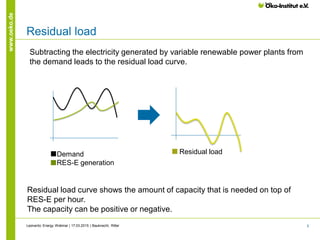
Residual load
Demand
RES-E generation
Residual load
Residual load curve shows the amount of capacity that is needed on top of
RES-E per hour.
The capacity can be positive or negative.
Subtracting the electricity generated by variable renewable power plants from
the demand leads to the residual load curve.
Leonardo Energy Webinar | 17.03.2015 | Bauknecht, Ritter
6
www.oeko.de
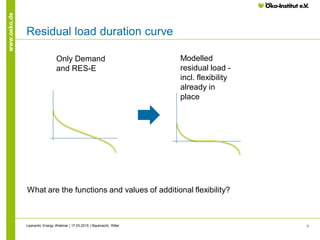
Residual load duration curve
Only Demand
and RES-E
Leonardo Energy Webinar | 17.03.2015 | Bauknecht, Ritter
Modelled
residual load -
incl. flexibility
already in
place
What are the functions and values of additional flexibility?
7
www.oeko.de
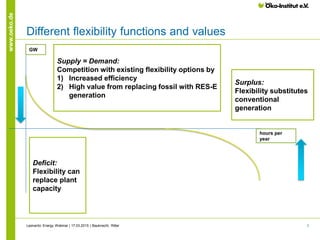
Different flexibility functions and values
Deficit:
Flexibility can
replace plant
capacity
Surplus:
Flexibility substitutes
conventional
generation
Supply = Demand:
Competition with existing flexibility options by
1) Increased efficiency
2) High value from replacing fossil with RES-E
generation
Leonardo Energy Webinar | 17.03.2015 | Bauknecht, Ritter
hours per
year
GW
8
www.oeko.de
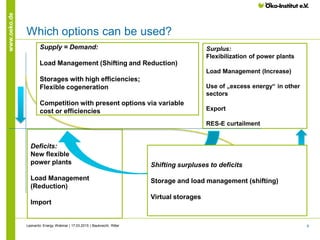
Which options can be used?
Deficits:
New flexible
power plants
Load Management
(Reduction)
Import
Surplus:
Flexibilization of power plants
Load Management (Increase)
Use of „excess energy“ in other
sectors
Export
RES-E curtailment
Supply = Demand:
Load Management (Shifting and Reduction)
Storages with high efficiencies;
Flexible cogeneration
Competition with present options via variable
cost or efficiencies
Shifting surpluses to deficits
Storage and load management (shifting)
Virtual storages
Leonardo Energy Webinar | 17.03.2015 | Bauknecht, Ritter
9
www.oeko.de
Residual load duration curve for Germany
Leonardo Energy Webinar | 17.03.2015 | Bauknecht, Ritter
40 % RES-E 60 % RES-E 75 % RES-E 100 % RES-E
Hours of the year [h]
No significant peak reduction
More hours with RES-E surplus
10
www.oeko.de
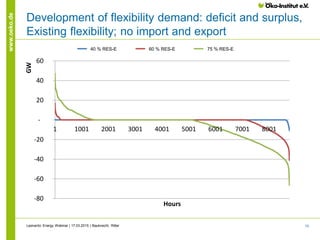
Development of flexibility demand: deficit and surplus,
Existing flexibility; no import and export
Leonardo Energy Webinar | 17.03.2015 | Bauknecht, Ritter
-80
-60
-40
-20
-
20
40
60
1 1001 2001 3001 4001 5001 6001 7001 8001
GW
Hours
ca. 40% RES-E ca. 61% RES-E ca. 75% RES-E40 % RES-E 60 % RES-E 75 % RES-E
11
www.oeko.de
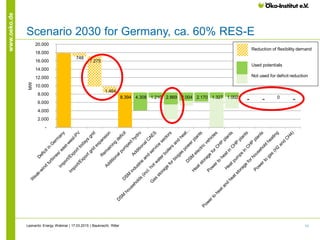
Scenario 2030 for Germany, ca. 60% RES-E
Leonardo Energy Webinar | 17.03.2015 | Bauknecht, Ritter
748
7.275
1.464
8.394 4.308 1.210 2.869 2.004
-1.0022.170 1.327 0
- -
-
2.000
4.000
6.000
8.000
10.000
12.000
14.000
16.000
18.000
20.000
MW
Reduction of flexibility demand
Used potentials
Not used for deficit reduction
12
www.oeko.de
Linking the electricity sector to other sectors
Power-to-Gas, Power-to-heat etc often seen as a way to provide
flexibility to the electricity sector.
However, it is mainly a way to use renewables in other sectors.
• This needs to be done in a flexible way.
Linking sectors can also lead to additional inflexibility, e.g. limited
flexibility of heat demand profile.
Systems that can use power and other sources are preferable,
e.g. power-to-heat.
If additional consumers are introduced too early, there is a
danger of increasing conventional sources
 L2H: Lignite-to-heat
Leonardo Energy Webinar | 17.03.2015 | Bauknecht, Ritter
13
www.oeko.de
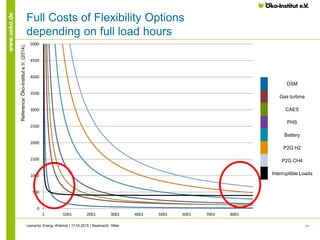
Economic ranking of options
What is the cheapest combination of options to meet flexibility
demand?
• Focussing on the capacity deficit
• 2030 snapshot
Result
• DSM, especially industry and commerce/trade/services
• CHP with heat storage
• Electric vehicles: Smart charging (needed anyway)
• Plus load curtailment for a few hours needed
Other combinations are possible – but storage not yet required.
Leonardo Energy Webinar | 17.03.2015 | Bauknecht, Ritter
14
www.oeko.de
Full Costs of Flexibility Options
depending on full load hours
0
500
1000
1500
2000
2500
3000
3500
4000
4500
5000
1 1001 2001 3001 4001 5001 6001 7001 8001
DSM
Gas turbine
CAES
PHS
Battery
P2G H2
P2G CH4
Interruptible Loads
Reference:Öko-Institute.V.(2014).
Leonardo Energy Webinar | 17.03.2015 | Bauknecht, Ritter
15
www.oeko.de
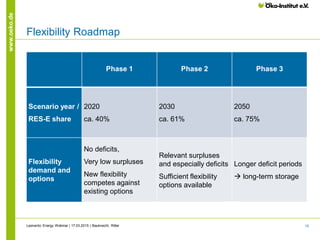
Flexibility Roadmap
Phase 1 Phase 2 Phase 3
Scenario year /
RES-E share
2020
ca. 40%
2030
ca. 61%
2050
ca. 75%
Flexibility
demand and
options
No deficits,
Very low surpluses
New flexibility
competes against
existing options
Relevant surpluses
and especially deficits
Sufficient flexibility
options available
Longer deficit periods
 long-term storage
Leonardo Energy Webinar | 17.03.2015 | Bauknecht, Ritter
16
www.oeko.de
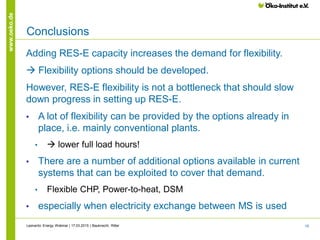
Conclusions
Adding RES-E capacity increases the demand for flexibility.
 Flexibility options should be developed.
However, RES-E flexibility is not a bottleneck that should slow
down progress in setting up RES-E.
• A lot of flexibility can be provided by the options already in
place, i.e. mainly conventional plants.
•  lower full load hours!
• There are a number of additional options available in current
systems that can be exploited to cover that demand.
• Flexible CHP, Power-to-heat, DSM
• especially when electricity exchange between MS is used
Leonardo Energy Webinar | 17.03.2015 | Bauknecht, Ritter
17
www.oeko.de
Contact
Dr. Dierk Bauknecht
Senior Researcher
Öko-Institut e.V.
Postfach 17 71
79017 Freiburg
Telefon: +49 761 45295-230
E-Mail: d.bauknecht@oeko.de
Leonardo Energy Webinar | 17.03.2015 | Bauknecht, Ritter

How demand for flexibility will develop in the German power system

  • 1.
    www.oeko.de Flexibility Options forRES-E Integration Dr. Dierk Bauknecht, David Ritter Leonardo Energy Webinar 17 March 2015
  • 2.
    2 www.oeko.de From RES-E developmentto system integration Leonardo Energy Webinar | 17.03.2015 | Bauknecht, Ritter RES-E increases System Integration and Transformation More Flexibility Demand A differentiated analysis is required: • Flexibility demand • Flexibility options • Effects of flexibility • and their evolution.
  • 3.
    3 www.oeko.de Analysis of flexibilityis based on two models Dispatch model PowerFlex for Germany By Öko-Institut Written in GAMS, CPLEX solver Detailed modelling of various of flexibility options within German No flexibility demand as a result of network constraints within Germany European network model By energynautics European exchange as a flexibility option Scenario: EU Roadmap Diversified Supply
  • 4.
    4 www.oeko.de Flexibility options betweennetworks and markets 1. Flexibility options to manage network constraints • To what extent can storage and demand side management (DSM) replace network upgrades? • How often will these options actually be called from network operators? 2. Flexibility options to balance generation and demand • Storage and DSM should primarily be dispatched based on market signals.  How can network and market requirements be coordinated? Leonardo Energy Webinar | 17.03.2015 | Bauknecht, Ritter
  • 5.
    5 www.oeko.de Residual load Demand RES-E generation Residualload Residual load curve shows the amount of capacity that is needed on top of RES-E per hour. The capacity can be positive or negative. Subtracting the electricity generated by variable renewable power plants from the demand leads to the residual load curve. Leonardo Energy Webinar | 17.03.2015 | Bauknecht, Ritter
  • 6.
    6 www.oeko.de Residual load durationcurve Only Demand and RES-E Leonardo Energy Webinar | 17.03.2015 | Bauknecht, Ritter Modelled residual load - incl. flexibility already in place What are the functions and values of additional flexibility?
  • 7.
    7 www.oeko.de Different flexibility functionsand values Deficit: Flexibility can replace plant capacity Surplus: Flexibility substitutes conventional generation Supply = Demand: Competition with existing flexibility options by 1) Increased efficiency 2) High value from replacing fossil with RES-E generation Leonardo Energy Webinar | 17.03.2015 | Bauknecht, Ritter hours per year GW
  • 8.
    8 www.oeko.de Which options canbe used? Deficits: New flexible power plants Load Management (Reduction) Import Surplus: Flexibilization of power plants Load Management (Increase) Use of „excess energy“ in other sectors Export RES-E curtailment Supply = Demand: Load Management (Shifting and Reduction) Storages with high efficiencies; Flexible cogeneration Competition with present options via variable cost or efficiencies Shifting surpluses to deficits Storage and load management (shifting) Virtual storages Leonardo Energy Webinar | 17.03.2015 | Bauknecht, Ritter
  • 9.
    9 www.oeko.de Residual load durationcurve for Germany Leonardo Energy Webinar | 17.03.2015 | Bauknecht, Ritter 40 % RES-E 60 % RES-E 75 % RES-E 100 % RES-E Hours of the year [h] No significant peak reduction More hours with RES-E surplus
  • 10.
    10 www.oeko.de Development of flexibilitydemand: deficit and surplus, Existing flexibility; no import and export Leonardo Energy Webinar | 17.03.2015 | Bauknecht, Ritter -80 -60 -40 -20 - 20 40 60 1 1001 2001 3001 4001 5001 6001 7001 8001 GW Hours ca. 40% RES-E ca. 61% RES-E ca. 75% RES-E40 % RES-E 60 % RES-E 75 % RES-E
  • 11.
    11 www.oeko.de Scenario 2030 forGermany, ca. 60% RES-E Leonardo Energy Webinar | 17.03.2015 | Bauknecht, Ritter 748 7.275 1.464 8.394 4.308 1.210 2.869 2.004 -1.0022.170 1.327 0 - - - 2.000 4.000 6.000 8.000 10.000 12.000 14.000 16.000 18.000 20.000 MW Reduction of flexibility demand Used potentials Not used for deficit reduction
  • 12.
    12 www.oeko.de Linking the electricitysector to other sectors Power-to-Gas, Power-to-heat etc often seen as a way to provide flexibility to the electricity sector. However, it is mainly a way to use renewables in other sectors. • This needs to be done in a flexible way. Linking sectors can also lead to additional inflexibility, e.g. limited flexibility of heat demand profile. Systems that can use power and other sources are preferable, e.g. power-to-heat. If additional consumers are introduced too early, there is a danger of increasing conventional sources  L2H: Lignite-to-heat Leonardo Energy Webinar | 17.03.2015 | Bauknecht, Ritter
  • 13.
    13 www.oeko.de Economic ranking ofoptions What is the cheapest combination of options to meet flexibility demand? • Focussing on the capacity deficit • 2030 snapshot Result • DSM, especially industry and commerce/trade/services • CHP with heat storage • Electric vehicles: Smart charging (needed anyway) • Plus load curtailment for a few hours needed Other combinations are possible – but storage not yet required. Leonardo Energy Webinar | 17.03.2015 | Bauknecht, Ritter
  • 14.
    14 www.oeko.de Full Costs ofFlexibility Options depending on full load hours 0 500 1000 1500 2000 2500 3000 3500 4000 4500 5000 1 1001 2001 3001 4001 5001 6001 7001 8001 DSM Gas turbine CAES PHS Battery P2G H2 P2G CH4 Interruptible Loads Reference:Öko-Institute.V.(2014). Leonardo Energy Webinar | 17.03.2015 | Bauknecht, Ritter
  • 15.
    15 www.oeko.de Flexibility Roadmap Phase 1Phase 2 Phase 3 Scenario year / RES-E share 2020 ca. 40% 2030 ca. 61% 2050 ca. 75% Flexibility demand and options No deficits, Very low surpluses New flexibility competes against existing options Relevant surpluses and especially deficits Sufficient flexibility options available Longer deficit periods  long-term storage Leonardo Energy Webinar | 17.03.2015 | Bauknecht, Ritter
  • 16.
    16 www.oeko.de Conclusions Adding RES-E capacityincreases the demand for flexibility.  Flexibility options should be developed. However, RES-E flexibility is not a bottleneck that should slow down progress in setting up RES-E. • A lot of flexibility can be provided by the options already in place, i.e. mainly conventional plants. •  lower full load hours! • There are a number of additional options available in current systems that can be exploited to cover that demand. • Flexible CHP, Power-to-heat, DSM • especially when electricity exchange between MS is used Leonardo Energy Webinar | 17.03.2015 | Bauknecht, Ritter
  • 17.
    17 www.oeko.de Contact Dr. Dierk Bauknecht SeniorResearcher Öko-Institut e.V. Postfach 17 71 79017 Freiburg Telefon: +49 761 45295-230 E-Mail: d.bauknecht@oeko.de Leonardo Energy Webinar | 17.03.2015 | Bauknecht, Ritter