Learning Objectives
At theend of this module, you will be able to:
• Identify approved tests in the new algorithm
• Understand the sequence of events the 3-test algorithm
• Determine the HIV status based on the 3-test algorithm
3.
National Rapid HIVTesting Algorithm
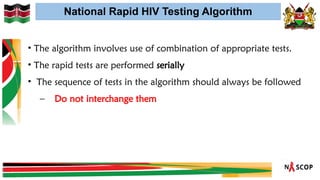
• The algorithm involves use of combination of appropriate tests.
• The rapid tests are performed serially
• The sequence of tests in the algorithm should always be followed
– Do not interchange them
4.
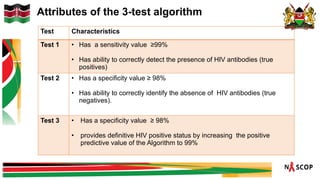
Attributes of the3-test algorithm
Test Characteristics
Test 1 • Has a sensitivity value ≥99%
• Has ability to correctly detect the presence of HIV antibodies (true
positives)
Test 2 • Has a specificity value ≥ 98%
• Has ability to correctly identify the absence of HIV antibodies (true
negatives).
Test 3 • Has a specificity value ≥ 98%
• provides definitive HIV positive status by increasing the positive
predictive value of the Algorithm to 99%
5.
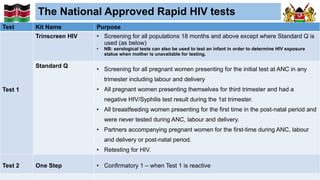
The National ApprovedRapid HIV tests
Test Kit Name Purpose
Test 1
Trinscreen HIV • Screening for all populations 18 months and above except where Standard Q is
used (as below)
• NB: serological tests can also be used to test an infant in order to determine HIV exposure
status when mother is unavailable for testing.
Standard Q
• Screening for all pregnant women presenting for the initial test at ANC in any
trimester including labour and delivery
• All pregnant women presenting themselves for third trimester and had a
negative HIV/Syphilis test result during the 1st trimester.
• All breastfeeding women presenting for the first time in the post-natal period and
were never tested during ANC, labour and delivery.
• Partners accompanying pregnant women for the first-time during ANC, labour
and delivery or post-natal period.
• Retesting for HIV.
Test 2 One Step • Confirmatory 1 – when Test 1 is reactive
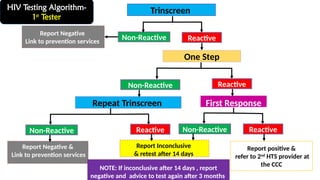
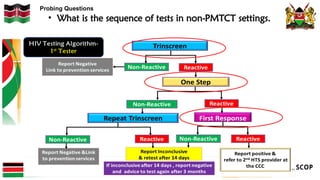
HIV Testing Algorithm-
1st
Tester
Trinscreen
OneStep
Reactive
Non-Reactive
Report Negative
Link to prevention services
Report positive &
refer to 2nd
HTS provider at
the CCC
First Response
Report Negative &
Link to prevention services
Report Inconclusive
& retest after 14 days
Repeat Trinscreen
NOTE: If inconclusive after 14 days , report
negative and advice to test again after 3 months
Reactive
Non-Reactive
Reactive
Non-Reactive
Non-Reactive Reactive
9.
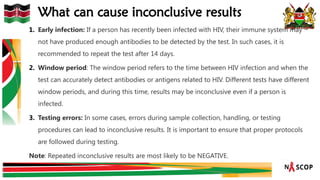
What can causeinconclusive results
1. Early infection: If a person has recently been infected with HIV, their immune system may
not have produced enough antibodies to be detected by the test. In such cases, it is
recommended to repeat the test after 14 days.
2. Window period: The window period refers to the time between HIV infection and when the
test can accurately detect antibodies or antigens related to HIV. Different tests have different
window periods, and during this time, results may be inconclusive even if a person is
infected.
3. Testing errors: In some cases, errors during sample collection, handling, or testing
procedures can lead to inconclusive results. It is important to ensure that proper protocols
are followed during testing.
Note: Repeated inconclusive results are most likely to be NEGATIVE.
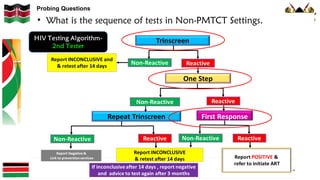
HIV Testing Algorithm-
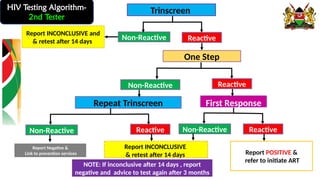
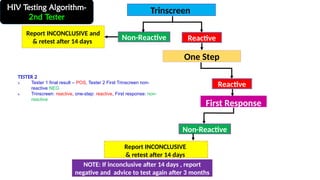
2ndTester
Trinscreen
One Step
Reactive
Non-Reactive
Report INCONCLUSIVE and
& retest after 14 days
Report POSITIVE &
refer to initiate ART
First Response
Report INCONCLUSIVE
& retest after 14 days
Repeat Trinscreen
NOTE: If inconclusive after 14 days , report
negative and advice to test again after 3 months
Reactive
Non-Reactive
Reactive
Non-Reactive
Non-Reactive Reactive
Report Negative &
Link to prevention services
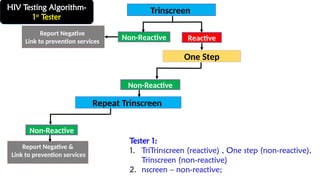
HIV Testing Algorithm-
1st
Tester
Trinscreen
OneStep
Reactive
Non-Reactive
Report Negative
Link to prevention services
Report Negative &
Link to prevention services
Repeat Trinscreen
Non-Reactive
Non-Reactive
Tester 1:
1. TriTrinscreen (reactive) , One step (non-reactive),
Trinscreen (non-reactive)
2. nscreen – non-reactive;
18.
HIV Testing Algorithm-
2ndTester
Trinscreen
One Step
Reactive
Repeat Trinscreen
Non-Reactive
Non-Reactive
Report Negative &
Link to prevention services
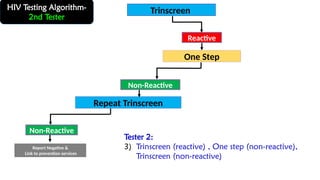
Tester 2:
3) Trinscreen (reactive) , One step (non-reactive),
Trinscreen (non-reactive)
19.
Probing Questions
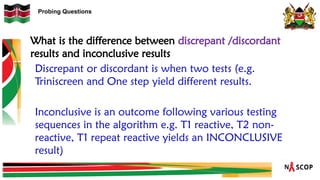
Discrepant ordiscordant is when two tests (e.g.
Triniscreen and One step yield different results.
Inconclusive is an outcome following various testing
sequences in the algorithm e.g. T1 reactive, T2 non-
reactive, T1 repeat reactive yields an INCONCLUSIVE
result)
What is the difference between discrepant /discordant
results and inconclusive results
HIV Testing Algorithm-
1st
Tester
Trinscreen
OneStep
Reactive
First Response
Report Inconclusive
& retest after 14 days
Repeat Trinscreen
NOTE: If inconclusive after 14 days , report negative and
advice to test again after 3 months
Reactive
Non-Reactive
Non-Reactive
Reactive
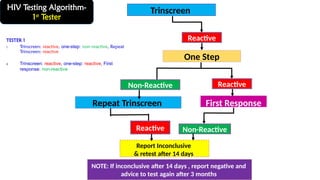
TESTER 1
1. Trinscreen: reactive, one-step: non-reactive, Repeat
Trinscreen: reactive
2. Trinscreen: reactive, one-step: reactive, First
response: non-reactive
22.
HIV Testing Algorithm-
2ndTester
Trinscreen
One Step
Reactive
Non-Reactive
Report INCONCLUSIVE and
& retest after 14 days
First Response
Report INCONCLUSIVE
& retest after 14 days
NOTE: If inconclusive after 14 days , report
negative and advice to test again after 3 months
Reactive
Non-Reactive
TESTER 2
3. Tester 1 final result – POS, Tester 2 First Trinscreen non-
reactive NEG
4. Trinscreen: reactive, one-step: reactive, First response: non-
reactive
23.
Probing Questions
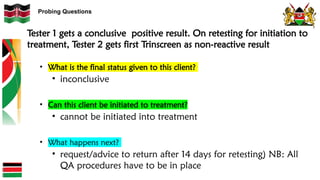
Tester 1gets a conclusive positive result. On retesting for initiation to
treatment, Tester 2 gets first Trinscreen as non-reactive result
• What is the final status given to this client?
• inconclusive
• Can this client be initiated to treatment?
• cannot be initiated into treatment
• What happens next?
• request/advice to return after 14 days for retesting) NB: All
QA procedures have to be in place
24.
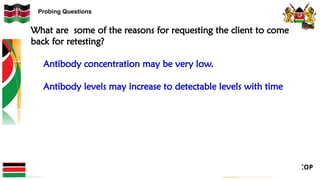
Probing Questions
What aresome of the reasons for requesting the client to come
back for retesting?
Antibody concentration may be very low.
Antibody levels may increase to detectable levels with time
25.
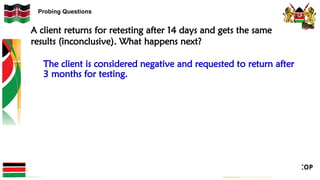
Probing Questions
A clientreturns for retesting after 14 days and gets the same
results (inconclusive). What happens next?
The client is considered negative and requested to return after
3 months for testing.
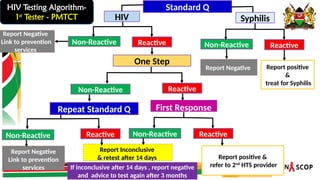
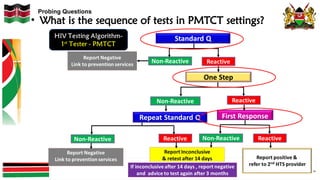
Standard Q
One Step
Reactive
Non-Reactive
ReportNegative
Link to prevention
services
Report positive &
refer to 2nd
HTS provider
First Response
Report Negative
Link to prevention
services
Report Inconclusive
& retest after 14 days
If inconclusive after 14 days , report negative
and advice to test again after 3 months
Reactive
Non-Reactive
Reactive
Non-Reactive
Non-Reactive Reactive
Repeat Standard Q
HIV Syphilis
Reactive
Non-Reactive
Report Negative Report positive
&
treat for Syphilis
HIV Testing Algorithm-
1st
Tester - PMTCT
28.
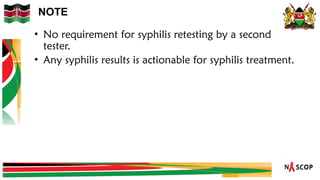
• No requirementfor syphilis retesting by a second
tester.
• Any syphilis results is actionable for syphilis treatment.
NOTE
29.
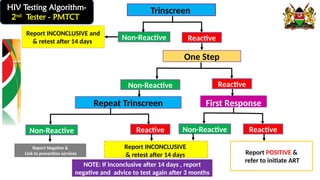
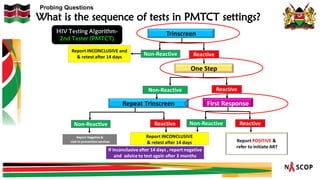
HIV Testing Algorithm-
2nd
Tester- PMTCT
Trinscreen
One Step
Reactive
Non-Reactive
Report INCONCLUSIVE and
& retest after 14 days
Report POSITIVE &
refer to initiate ART
First Response
Report INCONCLUSIVE
& retest after 14 days
Repeat Trinscreen
NOTE: If inconclusive after 14 days , report
negative and advice to test again after 3 months
Reactive
Non-Reactive
Reactive
Non-Reactive
Non-Reactive Reactive
Report Negative &
Link to prevention services
Probing Questions
What canbe used in the absence of Standard Q?
Triniscreen (eg when there is a stock out)
Note that syphilis will not be tested in such a scenario
33.
Probing Questions
What aresome of the scenarios that you get an inconclusive result?
Tester 1
• Std Q reactive, One Step non-reactive, Trinscreen
reactive
• Std Q reactive, One Step reactive, Std Q non-reactive
Tester 2
• Trinscreen NEG
• Tester 2 – any discrepant results
34.
Probing Questions
When isa client requested to come back for retesting after 3
months?
• Returning after 14 days and getting an inconclusive
result (definitive diagnosis not conclusive therefore
follow up testing after 3 months).
35.
FAQs
• Is thethird assay a tie-breaker test?
• NO. The 3rd
assay is a confirmatory test . It helps to rule out
false-positive.
• If someone has been tested with the 2-test algorithm and is
confirmed positive, do they need to be tested again with the
3-test algorithm?
• No. They are tested again based on the current eligibility
criteria
36.
Key Messages
1. Alltests (Test 1, Test 2, Test 3) must be available before testing
2. An individual’s HIV status is concluded as positive when T1, T2 and T3
are all reactive
3. Only those conclusively positive by Tester 1 and Tester 2 are initiated
into treatment
4. Inconclusive results should be retested after 14days
5. If on retesting after 14 days and the results are still inconclusive, the
status is reported as negative, and the client is requested to retest after 3
months
Editor's Notes
#3
_____
All people newly diagnosed with HIV Must be retested by a different testing provider to verify their HIV status prior to starting ART using the same testing strategy and algorithm.
Anyone receiving HIV test should be encouraged to receive their HIV test results in the same session.
#8 For one to be confirmed to have a HIV positive status, all the 3 tests must be reactive
When two kits do not agree, they are discrepant
Conclusive/inconclusive results are a final following the algorithm
If repeatedly inconclusive, report negative. Such clients are reported HIV negative and should therefore be tested with the testing guidelines of the general population
#11 T1 repeated to ensure there were no possible errors with test 1.
For one to be confirmed to have a HIV positive status, all the 3 tests must be reactive
For one to be confirmed to have a HIV negative status, they have to be negative by Triniscreen
Emphasis on the fact that PCR is no longer used
#13 What is the sequence of tests in general settings. (refer to testing algorithm for general settings)
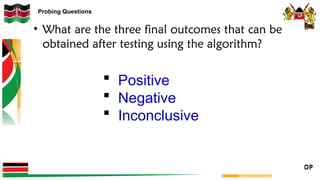
What are the three results that can be obtained after testing (negative, positive, inconclusive)
What is the difference between discrepant /disagreement results and inconclusive results. Dispersant or disagreement is when two tests (eg Triniscreen and One step yield different results. Inconclusive is a final outcome following various testing sequences in the algorithm eg T1 reactive, T2 non-reactive, T1 repeat reactive yields and INCONCLUSIVE result)
Identify the 2 scenarios that lead to an negative result
Tester 1:
Trinscreen – non-reactive;
Trinscreen (reactive) , One step (non-reactive), Trinscreen (non-reactive)
Tester 2:
Trinscreen (reactive) , One step (non-reactive), Trinscreen (non-reactive)
Identify the 2 scenarios that lead to an inconclusive result
T1 reactive, T2 non-reactive, T1 repeat reactive
Tester 1 final result – POS, Tester 2 Trinscreen NEG
Tester 1 gets a conclusive positive result. On retesting for initiation to treatment, Tester 2 gets Trinscreen as non-reactive result
What is the final status given to this client? (inconclusive – hence cannot be initiated into treatment)
What is happens next? (request/advice to return after 14 days for retesting) NB: All QA procedures have to be in place
What are some of the reasons for requesting the client to come for retesting at a later date? (antibody concentration may be very low. Antibody levels may increase to detectable levels with time)
The client returns for retesting after 14 days and gets the same results (inconclusive). What happens next? (request client to return after 30 days for testing).
#14 What is the sequence of tests in general settings. (refer to testing algorithm for Non-PMTCT settings)
What are the three results that can be obtained after testing (negative, positive, inconclusive)
What is the difference between discrepant /disagreement results and inconclusive results. Dispersant or disagreement is when two tests (eg Triniscreen and One step yield different results. Inconclusive is a final outcome following various testing sequences in the algorithm eg T1 reactive, T2 non-reactive, T1 repeat reactive yields and INCONCLUSIVE result)
Identify the 2 scenarios that lead to an negative result
Tester 1:
Trinscreen – non-reactive;
Trinscreen (reactive) , One step (non-reactive), Trinscreen (non-reactive)
Tester 2:
Trinscreen (reactive) , One step (non-reactive), Trinscreen (non-reactive)
Identify the 2 scenarios that lead to an inconclusive result
T1 reactive, T2 non-reactive, T1 repeat reactive
Tester 1 final result – POS, Tester 2 Trinscreen NEG
Tester 1 gets a conclusive positive result. On retesting for initiation to treatment, Tester 2 gets Trinscreen as non-reactive result
What is the final status given to this client? (inconclusive – hence cannot be initiated into treatment)
What is happens next? (request/advice to return after 14 days for retesting) NB: All QA procedures have to be in place
What are some of the reasons for requesting the client to come for retesting at a later date? (antibody concentration may be very low. Antibody levels may increase to detectable levels with time)
The client returns for retesting after 14 days and gets the same results (inconclusive). What happens next? (request client to return after 30 days for testing).
#16 What is the sequence of tests in general settings. (refer to testing algorithm for general settings)
What are the three results that can be obtained after testing (negative, positive, inconclusive)
What is the difference between discrepant /disagreement results and inconclusive results. Dispersant or disagreement is when two tests (eg Triniscreen and One step yield different results. Inconclusive is a final outcome following various testing sequences in the algorithm eg T1 reactive, T2 non-reactive, T1 repeat reactive yields and INCONCLUSIVE result)
Identify the 2 scenarios that lead to an negative result
Tester 1:
Trinscreen – non-reactive;
Trinscreen (reactive) , One step (non-reactive), Trinscreen (non-reactive)
Tester 2:
Trinscreen (reactive) , One step (non-reactive), Trinscreen (non-reactive)
Identify the 2 scenarios that lead to an inconclusive result
T1 reactive, T2 non-reactive, T1 repeat reactive
Tester 1 final result – POS, Tester 2 Trinscreen NEG
Tester 1 gets a conclusive positive result. On retesting for initiation to treatment, Tester 2 gets Trinscreen as non-reactive result
What is the final status given to this client? (inconclusive – hence cannot be initiated into treatment)
What is happens next? (request/advice to return after 14 days for retesting) NB: All QA procedures have to be in place
What are some of the reasons for requesting the client to come for retesting at a later date? (antibody concentration may be very low. Antibody levels may increase to detectable levels with time)
The client returns for retesting after 14 days and gets the same results (inconclusive). What happens next? (request client to return after 30 days for testing).
#19 What is the sequence of tests in general settings. (refer to testing algorithm for general settings)
What are the three results that can be obtained after testing (negative, positive, inconclusive)
What is the difference between discrepant /disagreement results and inconclusive results. Dispersant or disagreement is when two tests (eg Triniscreen and One step yield different results. Inconclusive is a final outcome following various testing sequences in the algorithm eg T1 reactive, T2 non-reactive, T1 repeat reactive yields and INCONCLUSIVE result)
Identify the 2 scenarios that lead to an negative result
Tester 1:
Trinscreen – non-reactive;
Trinscreen (reactive) , One step (non-reactive), Trinscreen (non-reactive)
Tester 2:
Trinscreen (reactive) , One step (non-reactive), Trinscreen (non-reactive)
Identify the 2 scenarios that lead to an inconclusive result
T1 reactive, T2 non-reactive, T1 repeat reactive
Tester 1 final result – POS, Tester 2 Trinscreen NEG
Tester 1 gets a conclusive positive result. On retesting for initiation to treatment, Tester 2 gets Trinscreen as non-reactive result
What is the final status given to this client? (inconclusive – hence cannot be initiated into treatment)
What is happens next? (request/advice to return after 14 days for retesting) NB: All QA procedures have to be in place
What are some of the reasons for requesting the client to come for retesting at a later date? (antibody concentration may be very low. Antibody levels may increase to detectable levels with time)
The client returns for retesting after 14 days and gets the same results (inconclusive). What happens next? (request client to return after 30 days for testing).
#20 What is the sequence of tests in general settings. (refer to testing algorithm for general settings)
What are the three results that can be obtained after testing (negative, positive, inconclusive)
What is the difference between discrepant /disagreement results and inconclusive results. Dispersant or disagreement is when two tests (eg Triniscreen and One step yield different results. Inconclusive is a final outcome following various testing sequences in the algorithm eg T1 reactive, T2 non-reactive, T1 repeat reactive yields and INCONCLUSIVE result)
Identify the 2 scenarios that lead to an negative result
Tester 1:
Trinscreen – non-reactive;
Trinscreen (reactive) , One step (non-reactive), Trinscreen (non-reactive)
Tester 2:
Trinscreen (reactive) , One step (non-reactive), Trinscreen (non-reactive)
Identify the 2 scenarios that lead to an inconclusive result
T1 reactive, T2 non-reactive, T1 repeat reactive
Tester 1 final result – POS, Tester 2 Trinscreen NEG
Tester 1 gets a conclusive positive result. On retesting for initiation to treatment, Tester 2 gets Trinscreen as non-reactive result
What is the final status given to this client? (inconclusive – hence cannot be initiated into treatment)
What is happens next? (request/advice to return after 14 days for retesting) NB: All QA procedures have to be in place
What are some of the reasons for requesting the client to come for retesting at a later date? (antibody concentration may be very low. Antibody levels may increase to detectable levels with time)
The client returns for retesting after 14 days and gets the same results (inconclusive). What happens next? (request client to return after 30 days for testing).
#23 What is the sequence of tests in general settings. (refer to testing algorithm for general settings)
What are the three results that can be obtained after testing (negative, positive, inconclusive)
What is the difference between discrepant /disagreement results and inconclusive results. Dispersant or disagreement is when two tests (eg Triniscreen and One step yield different results. Inconclusive is a final outcome following various testing sequences in the algorithm eg T1 reactive, T2 non-reactive, T1 repeat reactive yields and INCONCLUSIVE result)
Identify the 2 scenarios that lead to an negative result
Tester 1:
Trinscreen – non-reactive;
Trinscreen (reactive) , One step (non-reactive), Trinscreen (non-reactive)
Tester 2:
Trinscreen (reactive) , One step (non-reactive), Trinscreen (non-reactive)
Identify the 2 scenarios that lead to an inconclusive result
T1 reactive, T2 non-reactive, T1 repeat reactive
Tester 1 final result – POS, Tester 2 Trinscreen NEG
Tester 1 gets a conclusive positive result. On retesting for initiation to treatment, Tester 2 gets Trinscreen as non-reactive result
What is the final status given to this client? (inconclusive – hence cannot be initiated into treatment)
What is happens next? (request/advice to return after 14 days for retesting) NB: All QA procedures have to be in place
What are some of the reasons for requesting the client to come for retesting at a later date? (antibody concentration may be very low. Antibody levels may increase to detectable levels with time)
The client returns for retesting after 14 days and gets the same results (inconclusive). What happens next? (request client to return after 30 days for testing).
#24 What is the sequence of tests in general settings. (refer to testing algorithm for general settings)
What are the three results that can be obtained after testing (negative, positive, inconclusive)
What is the difference between discrepant /disagreement results and inconclusive results. Dispersant or disagreement is when two tests (eg Triniscreen and One step yield different results. Inconclusive is a final outcome following various testing sequences in the algorithm eg T1 reactive, T2 non-reactive, T1 repeat reactive yields and INCONCLUSIVE result)
Identify the 2 scenarios that lead to an negative result
Tester 1:
Trinscreen – non-reactive;
Trinscreen (reactive) , One step (non-reactive), Trinscreen (non-reactive)
Tester 2:
Trinscreen (reactive) , One step (non-reactive), Trinscreen (non-reactive)
Identify the 2 scenarios that lead to an inconclusive result
T1 reactive, T2 non-reactive, T1 repeat reactive
Tester 1 final result – POS, Tester 2 Trinscreen NEG
Tester 1 gets a conclusive positive result. On retesting for initiation to treatment, Tester 2 gets Trinscreen as non-reactive result
What is the final status given to this client? (inconclusive – hence cannot be initiated into treatment)
What is happens next? (request/advice to return after 14 days for retesting) NB: All QA procedures have to be in place
What are some of the reasons for requesting the client to come for retesting at a later date? (antibody concentration may be very low. Antibody levels may increase to detectable levels with time)
The client returns for retesting after 14 days and gets the same results (inconclusive). What happens next? (request client to return after 30 days for testing).
#25 What is the sequence of tests in general settings. (refer to testing algorithm for general settings)
What are the three results that can be obtained after testing (negative, positive, inconclusive)
What is the difference between discrepant /disagreement results and inconclusive results. Dispersant or disagreement is when two tests (eg Triniscreen and One step yield different results. Inconclusive is a final outcome following various testing sequences in the algorithm eg T1 reactive, T2 non-reactive, T1 repeat reactive yields and INCONCLUSIVE result)
Identify the 2 scenarios that lead to an negative result
Tester 1:
Trinscreen – non-reactive;
Trinscreen (reactive) , One step (non-reactive), Trinscreen (non-reactive)
Tester 2:
Trinscreen (reactive) , One step (non-reactive), Trinscreen (non-reactive)
Identify the 2 scenarios that lead to an inconclusive result
T1 reactive, T2 non-reactive, T1 repeat reactive
Tester 1 final result – POS, Tester 2 Trinscreen NEG
Tester 1 gets a conclusive positive result. On retesting for initiation to treatment, Tester 2 gets Trinscreen as non-reactive result
What is the final status given to this client? (inconclusive – hence cannot be initiated into treatment)
What is happens next? (request/advice to return after 14 days for retesting) NB: All QA procedures have to be in place
What are some of the reasons for requesting the client to come for retesting at a later date? (antibody concentration may be very low. Antibody levels may increase to detectable levels with time)
The client returns for retesting after 14 days and gets the same results (inconclusive). What happens next? (request client to return after 30 days for testing).
#29 T1 repeated to ensure there were no possible errors with test 1.
For one to be confirmed to have a HIV positive status, all the 3 tests must be reactive
For one to be confirmed to have a HIV negative status, they have to be negative by Triniscreen
Emphasis on the fact that PCR is no longer used
#30 What is the sequence of tests in PMTCT settings.
Note that Standard Q is the first test by Tester 1
If a client is POS by tester 1, Tester 2 will use Trinscreen as the first test
Refer to PMTCT algorithm
What can be used in the absence of Standard Q?
Triniscreen (eg when there is a S/O.), Note that syphilis will not be tested in such a scenario
What are some of the scenarios that you get an inconclusive result
Std Q reactive, One Step non-reactive, repeat Std Q reactive
Tester 1 final result – POS, Tester 2 first Trinscreen NEG
When is a client requested to come back for testing after 3 months
inconclusive after 1st testing
Returning after 14 days and getting an inconclusive result (definitive diagnosis not conclusive therefore follow up testing after 3 months)
#31 What is the sequence of tests in PMTCT settings.
Note that Standard Q is the first test by Tester 1
If Standard Q and Onestep are discrepant by Tester 1, Trinscreen is used to co confirm
If a client is POS by tester 1, Tester 2 will use Trinscreen as the first test
Refer to PMTCT algorithm
What can be used in the absence of Standard Q?
Triniscreen (eg when there is a S/O.), Note that syphilis will not be tested in such a scenario
What are some of the scenarios that you get an inconclusive result
Std Q reactive, One Step non-reactive, Trinscreen reactive
Tester 1 final result – POS, Tester 2 Trinscreen NEG
When is a client requested to come back for testing after 3 months
inconclusive after 1st testing
Returning after 14 days and getting an inconclusive result (definitive diagnosis not conclusive therefore follow up testing after 3 months)
#32 What is the sequence of tests in PMTCT settings.
Note that Standard Q is the first test by Tester 1
If Standard Q and Onsterp are discrepant by Tester 1, Triniscreen is used to co confirm
If a client is POS by tester 1, Tester 2 will use Trinscreen as the first test
Refer to PMTCT algorithm
What can be used in the absence of Standard Q?
Triniscreen (eg when there is a S/O.), Note that syphilis will not be tested in such a scenario
What are some of the scenarios that you get an inconclusive result
Std Q reactive, One Step non-reactive, Trinscreen reactive
Tester 1 final result – POS, Tester 2 Trinscreen NEG
When is a client requested to come back for testing after 3 months
inconclusive after 1st testing
Returning after 14 days and getting an inconclusive result (definitive diagnosis not conclusive therefore follow up testing after 3 months)
#33 What is the sequence of tests in PMTCT settings.
Note that Standard Q is the first test by Tester 1
If a client is POS by tester 1, Tester 2 will use Trinscreen as the first test
Refer to PMTCT algorithm
What can be used in the absence of Standard Q?
Triniscreen (eg when there is a S/O.), Note that syphilis will not be tested in such a scenario
What are some of the scenarios that you get an inconclusive result
Std Q reactive, One Step non-reactive, repeat std Q reactive
Tester 1 final result – POS, Tester 2 Trinscreen NEG
When is a client requested to come back for testing after 3 months
inconclusive after 1st testing
Returning after 14 days and getting an inconclusive result (definitive diagnosis not conclusive therefore follow up testing after 3 months)
#35 Third test not a tie-breaker…. Give more details
Tested again based on the current eligibility criteria