5 GREAT INDIAN
MATHEMATICIAN
S
India has a rich history of producing brilliant
mathematicians who have made significant
contributions to the field of mathematics. Here
are five great Indian mathematicians:
1. Aryabhata (476-550 CE)
2. Srinivasa Ramanujan (1887-1920)
3. Brahmagupta (598-668
CE)
4. Bhaskara II (1114-1185 CE)
5. C.R. Rao (1920-2021)
These are just a few examples of the many great Indian
mathematicians who have contributed to the field. India's
mathematical heritage is vast and continues to inspire and
influence mathematicians around the world.
ARYABHAT
A
Aryabhata was one of the earliest mathematicians in
ancient India. He is known for his work in algebra,
trigonometry, and arithmetic. Aryabhata's most famous
work is the Aryabhatiya, which introduced the concept of
zero and the decimal numeral system.
1. Place-Value System and Zero: Aryabhata introduced the decimal
place-value system to the world, which is the basis of our modern number
system. He used digits and a positional notation system to represent
numbers, where the value of a digit depends on its position. Aryabhata's
use of zero as a placeholder was revolutionary and paved the way for
more advanced mathematical operations.
Here are some of his key contributions:
2. Algebraic Concepts: Aryabhata made important contributions to
algebra. He developed algorithms for solving linear and quadratic
equations and provided rules for manipulating algebraic expressions.
Aryabhata's work laid the foundation for algebraic techniques that were
later expanded upon by other mathematicians.
4. Approximation of Pi (π): Aryabhata was the first mathematician to
provide an accurate approximation of the value of pi (π). He calculated pi
to four decimal places, which was a remarkable achievement during his
time. His approximation of pi was more precise than previous estimates.
3. Trigonometry: Aryabhata made significant
advancements in trigonometry. He developed tables of
trigonometric values, allowing for the calculation of sines
and chords of angles. His work helped in solving
trigonometric problems related to astronomy and other
fields.
5. Arithmetic Operations: Aryabhata contributed to arithmetic operations
and provided algorithms for addition, subtraction, multiplication, and
division. His methods were based on place-value notation and
streamlined the process of performing complex calculations.
Thus, Aryabhata's contributions to mathematics
were groundbreaking and laid the foundation for
future developments in the field. His ideas and
methods influenced subsequent mathematicians in
India and around the world. Aryabhata's work in
number systems, algebra, trigonometry, and
arithmetic set the stage for further advancements
and played a significant role in the progress of
mathematics.
SRINIVASA
RAMANUJAN
Srinivasa Ramanujan, an Indian mathematician born in 1887, made
remarkable contributions to the field of mathematics, particularly in the
areas of number theory, infinite series, and mathematical analysis.
Despite facing significant challenges and limited formal education,
Ramanujan's insights and discoveries have had a lasting impact on
mathematics. Here are some of his notable contributions:
1. Ramanujan's Prime: Ramanujan introduced the
concept of what is now known as "Ramanujan primes."
These are prime numbers that have unique properties
and patterns. His work in this area opened up new
avenues of research in number theory.
2. Partition Function: Ramanujan made significant contributions to the
theory of partitions. He developed a formula for calculating the number of
ways a given integer can be expressed as a sum of positive integers. This
formula, known as the "Ramanujan's partition congruences," has found
applications in various fields, including statistical mechanics and
combinatorics.
3. Ramanujan Theta Function: Ramanujan developed a novel theta
function, now called the "Ramanujan theta function." This function has
properties that make it useful in studying modular forms, elliptic functions,
and related areas of mathematics.
5. Mock Theta Functions: Ramanujan's mock theta functions have played a
crucial role in the development of number theory, modular forms, and the
theory of partitions. These functions are unconventional and have properties
that differ from traditional theta functions. Ramanujan's work on mock theta
functions has inspired further research and opened up new directions in the
study of modular forms.
4. Ramanujan Series: Ramanujan is famous for his
discoveries of numerous infinite series that converge to
well-known mathematical constants. The most famous
example is his formula for the sum of the reciprocal of the
powers of pi, known as the "Ramanujan series for pi." His
series have been instrumental in the field of mathematical
analysis and have led to new insights into the nature of
irrational numbers.
BRAHMAGUPT
A
Brahmagupta, an ancient Indian mathematician and astronomer
who lived between 598 and 668 CE, made significant contributions
to the field of mathematics. His works had a profound impact on
various branches of mathematics, particularly algebra and number
theory. Here are some of Brahmagupta's notable contributions:
1. Rules for Arithmetic Operations: Brahmagupta
developed rules and algorithms for performing
arithmetic operations with zero and negative numbers.
He provided systematic procedures for addition,
subtraction, multiplication, and division involving these
numbers. His work laid the foundation for the modern
understanding and usage of negative numbers.
2. Quadratic Equations: Brahmagupta made advancements in solving quadratic
equations. He provided methods for finding both the positive and negative roots
of quadratic equations, including those with negative coefficients. His
techniques extended the understanding of quadratic equations beyond the
traditional framework.
3. Algebraic Formulas: Brahmagupta introduced algebraic formulas and
identities. He derived formulas for computing the sum of the squares and
cubes of consecutive integers, as well as formulas for solving linear and
quadratic indeterminate equations. These formulas provided valuable
tools for solving mathematical problems and expanded the scope of
algebraic manipulation.
4. Geometry and Geometry of Shadows: Brahmagupta
contributed to the study of geometry. He discussed
geometric principles and the properties of different
shapes, including circles, triangles, and quadrilaterals.
Brahmagupta's work on the geometry of shadows,
known as "Brahmagupta's Theorem," explored the
relationships between the lengths and areas of
intersecting shadows cast by geometric figures.
5. Astronomical Calculations: In addition to his mathematical contributions,
Brahmagupta was also an accomplished astronomer. He developed
methods for accurately calculating the positions of celestial bodies, including
the Sun and planets. His astronomical observations and calculations
influenced the understanding of planetary motion and were crucial for
accurate timekeeping.
Brahmagupta's contributions to mathematics, particularly
in algebra and arithmetic, played a vital role in the
development of mathematical knowledge. His work
advanced the understanding of number systems,
equations, and geometric concepts. Brahmagupta's ideas
and methods have had a lasting impact and continue to be
studied and appreciated in the field of mathematics.
BHASKARA
II
Bhaskara II, also known as Bhaskaracharya, was an
influential Indian mathematician and astronomer who lived
from 1114 to 1185 CE. His contributions to the field of
mathematics were significant and wide-ranging. Here are
some of Bhaskara II's notable contributions:
1. Calculus and Differential Calculus: Bhaskara II
made important contributions to the field of calculus.
He developed techniques for finding derivatives and
applied differential calculus to solve problems related
to motion, such as finding instantaneous rates of
change and tangents to curves. His work laid the
foundation for the development of calculus in India.
2. Indeterminate Equations: Bhaskara II is known for his solutions to
indeterminate equations, particularly the Pell equation. He provided methods
to find integer solutions to equations of the form x^2 - ny^2 = 1, which are now
known as Pell's equations. His techniques for solving indeterminate equations
were innovative and had practical applications.
3. Arithmetic and Algebra: Bhaskara II made significant contributions to
arithmetic and algebra. He developed efficient algorithms for arithmetic
operations, such as addition, subtraction, multiplication, and division. He also
introduced the concept of continued fractions and provided methods for
solving quadratic equations.
4. Trigonometry: Bhaskara II expanded the study of
trigonometry. He introduced trigonometric identities
and provided trigonometric formulas and tables.
Bhaskara II's work on spherical trigonometry and his
advancements in the study of trigonometric functions
laid the groundwork for further developments in the
field.
5. Astronomical Calculations: Bhaskara II was a renowned astronomer and
made important contributions to the field of astronomy. He developed
accurate methods for astronomical calculations, including the computation
of planetary positions and the determination of eclipses. Bhaskara II's
astronomical observations and calculations were highly influential during his
time and contributed to advancements in the understanding of celestial
phenomena.
Bhaskara II's contributions to mathematics were
substantial and had a lasting impact on the field. His
work in calculus, indeterminate equations, arithmetic,
algebra, trigonometry, and astronomy laid the
foundation for further developments and inspired
generations of mathematicians and astronomers.
Bhaskara II's insights and techniques continue to be
studied and appreciated for their mathematical and
practical significance.
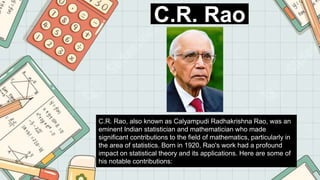
C.R. Rao
C.R. Rao, also known as Calyampudi Radhakrishna Rao, was an
eminent Indian statistician and mathematician who made
significant contributions to the field of mathematics, particularly in
the area of statistics. Born in 1920, Rao's work had a profound
impact on statistical theory and its applications. Here are some of
his notable contributions:
1. Rao-Blackwell Theorem: Rao formulated the
Rao-Blackwell theorem, a fundamental result in
statistics. This theorem provides a method to
improve the efficiency of estimators by using a
conditional expectation. It has applications in
various statistical problems and is widely used in
statistical inference.
2. Cramér-Rao Inequality: Rao derived the Cramér-Rao inequality, which
establishes a lower bound on the variance of unbiased estimators. This
inequality provides a fundamental limit on the accuracy of estimators and has
implications in statistical estimation theory.
3. Multivariate Analysis: Rao made significant contributions to multivariate
analysis. He developed several statistical techniques and methods for
analyzing data involving multiple variables. His work in this field has been
instrumental in areas such as regression analysis, multivariate analysis of
variance, and factor analysis.
4. Theory of Least Squares: Rao extended the
theory of least squares estimation and developed
generalized least squares methods. His contributions
improved the accuracy and efficiency of parameter
estimation in regression models and other statistical
applications.
5. Design of Experiments: Rao made significant contributions to the design
of experiments, an area of statistics concerned with optimal experimental
design. He developed efficient designs for various experimental settings,
including factorial experiments and response surface methodology.
6. Influence on Statistical Practice: In addition to his theoretical
contributions, Rao had a profound impact on the practice of statistics. He
played a pivotal role in shaping statistical research and education globally.
He also founded several statistical organizations and contributed to the
development of statistical institutions in India.
C.R. Rao's contributions to the field of mathematics,
particularly in statistical theory, have earned him
numerous accolades and recognition. His work
continues to have a profound impact on statistical
research, practice, and education, making him one of
the most influential statisticians of his time.
THE
END
BY K SRI VIBHAVANA

5 Great Indian Mathematicians_Maths.pptx

  • 1.
  • 2.
    India has arich history of producing brilliant mathematicians who have made significant contributions to the field of mathematics. Here are five great Indian mathematicians: 1. Aryabhata (476-550 CE) 2. Srinivasa Ramanujan (1887-1920) 3. Brahmagupta (598-668 CE) 4. Bhaskara II (1114-1185 CE) 5. C.R. Rao (1920-2021) These are just a few examples of the many great Indian mathematicians who have contributed to the field. India's mathematical heritage is vast and continues to inspire and influence mathematicians around the world.
  • 3.
    ARYABHAT A Aryabhata was oneof the earliest mathematicians in ancient India. He is known for his work in algebra, trigonometry, and arithmetic. Aryabhata's most famous work is the Aryabhatiya, which introduced the concept of zero and the decimal numeral system.
  • 4.
    1. Place-Value Systemand Zero: Aryabhata introduced the decimal place-value system to the world, which is the basis of our modern number system. He used digits and a positional notation system to represent numbers, where the value of a digit depends on its position. Aryabhata's use of zero as a placeholder was revolutionary and paved the way for more advanced mathematical operations. Here are some of his key contributions: 2. Algebraic Concepts: Aryabhata made important contributions to algebra. He developed algorithms for solving linear and quadratic equations and provided rules for manipulating algebraic expressions. Aryabhata's work laid the foundation for algebraic techniques that were later expanded upon by other mathematicians.
  • 5.
    4. Approximation ofPi (π): Aryabhata was the first mathematician to provide an accurate approximation of the value of pi (π). He calculated pi to four decimal places, which was a remarkable achievement during his time. His approximation of pi was more precise than previous estimates. 3. Trigonometry: Aryabhata made significant advancements in trigonometry. He developed tables of trigonometric values, allowing for the calculation of sines and chords of angles. His work helped in solving trigonometric problems related to astronomy and other fields. 5. Arithmetic Operations: Aryabhata contributed to arithmetic operations and provided algorithms for addition, subtraction, multiplication, and division. His methods were based on place-value notation and streamlined the process of performing complex calculations.
  • 6.
    Thus, Aryabhata's contributionsto mathematics were groundbreaking and laid the foundation for future developments in the field. His ideas and methods influenced subsequent mathematicians in India and around the world. Aryabhata's work in number systems, algebra, trigonometry, and arithmetic set the stage for further advancements and played a significant role in the progress of mathematics.
  • 7.
    SRINIVASA RAMANUJAN Srinivasa Ramanujan, anIndian mathematician born in 1887, made remarkable contributions to the field of mathematics, particularly in the areas of number theory, infinite series, and mathematical analysis. Despite facing significant challenges and limited formal education, Ramanujan's insights and discoveries have had a lasting impact on mathematics. Here are some of his notable contributions:
  • 8.
    1. Ramanujan's Prime:Ramanujan introduced the concept of what is now known as "Ramanujan primes." These are prime numbers that have unique properties and patterns. His work in this area opened up new avenues of research in number theory. 2. Partition Function: Ramanujan made significant contributions to the theory of partitions. He developed a formula for calculating the number of ways a given integer can be expressed as a sum of positive integers. This formula, known as the "Ramanujan's partition congruences," has found applications in various fields, including statistical mechanics and combinatorics. 3. Ramanujan Theta Function: Ramanujan developed a novel theta function, now called the "Ramanujan theta function." This function has properties that make it useful in studying modular forms, elliptic functions, and related areas of mathematics.
  • 9.
    5. Mock ThetaFunctions: Ramanujan's mock theta functions have played a crucial role in the development of number theory, modular forms, and the theory of partitions. These functions are unconventional and have properties that differ from traditional theta functions. Ramanujan's work on mock theta functions has inspired further research and opened up new directions in the study of modular forms. 4. Ramanujan Series: Ramanujan is famous for his discoveries of numerous infinite series that converge to well-known mathematical constants. The most famous example is his formula for the sum of the reciprocal of the powers of pi, known as the "Ramanujan series for pi." His series have been instrumental in the field of mathematical analysis and have led to new insights into the nature of irrational numbers.
  • 10.
    BRAHMAGUPT A Brahmagupta, an ancientIndian mathematician and astronomer who lived between 598 and 668 CE, made significant contributions to the field of mathematics. His works had a profound impact on various branches of mathematics, particularly algebra and number theory. Here are some of Brahmagupta's notable contributions:
  • 11.
    1. Rules forArithmetic Operations: Brahmagupta developed rules and algorithms for performing arithmetic operations with zero and negative numbers. He provided systematic procedures for addition, subtraction, multiplication, and division involving these numbers. His work laid the foundation for the modern understanding and usage of negative numbers. 2. Quadratic Equations: Brahmagupta made advancements in solving quadratic equations. He provided methods for finding both the positive and negative roots of quadratic equations, including those with negative coefficients. His techniques extended the understanding of quadratic equations beyond the traditional framework. 3. Algebraic Formulas: Brahmagupta introduced algebraic formulas and identities. He derived formulas for computing the sum of the squares and cubes of consecutive integers, as well as formulas for solving linear and quadratic indeterminate equations. These formulas provided valuable tools for solving mathematical problems and expanded the scope of algebraic manipulation.
  • 12.
    4. Geometry andGeometry of Shadows: Brahmagupta contributed to the study of geometry. He discussed geometric principles and the properties of different shapes, including circles, triangles, and quadrilaterals. Brahmagupta's work on the geometry of shadows, known as "Brahmagupta's Theorem," explored the relationships between the lengths and areas of intersecting shadows cast by geometric figures. 5. Astronomical Calculations: In addition to his mathematical contributions, Brahmagupta was also an accomplished astronomer. He developed methods for accurately calculating the positions of celestial bodies, including the Sun and planets. His astronomical observations and calculations influenced the understanding of planetary motion and were crucial for accurate timekeeping.
  • 13.
    Brahmagupta's contributions tomathematics, particularly in algebra and arithmetic, played a vital role in the development of mathematical knowledge. His work advanced the understanding of number systems, equations, and geometric concepts. Brahmagupta's ideas and methods have had a lasting impact and continue to be studied and appreciated in the field of mathematics.
  • 14.
    BHASKARA II Bhaskara II, alsoknown as Bhaskaracharya, was an influential Indian mathematician and astronomer who lived from 1114 to 1185 CE. His contributions to the field of mathematics were significant and wide-ranging. Here are some of Bhaskara II's notable contributions:
  • 15.
    1. Calculus andDifferential Calculus: Bhaskara II made important contributions to the field of calculus. He developed techniques for finding derivatives and applied differential calculus to solve problems related to motion, such as finding instantaneous rates of change and tangents to curves. His work laid the foundation for the development of calculus in India. 2. Indeterminate Equations: Bhaskara II is known for his solutions to indeterminate equations, particularly the Pell equation. He provided methods to find integer solutions to equations of the form x^2 - ny^2 = 1, which are now known as Pell's equations. His techniques for solving indeterminate equations were innovative and had practical applications. 3. Arithmetic and Algebra: Bhaskara II made significant contributions to arithmetic and algebra. He developed efficient algorithms for arithmetic operations, such as addition, subtraction, multiplication, and division. He also introduced the concept of continued fractions and provided methods for solving quadratic equations.
  • 16.
    4. Trigonometry: BhaskaraII expanded the study of trigonometry. He introduced trigonometric identities and provided trigonometric formulas and tables. Bhaskara II's work on spherical trigonometry and his advancements in the study of trigonometric functions laid the groundwork for further developments in the field. 5. Astronomical Calculations: Bhaskara II was a renowned astronomer and made important contributions to the field of astronomy. He developed accurate methods for astronomical calculations, including the computation of planetary positions and the determination of eclipses. Bhaskara II's astronomical observations and calculations were highly influential during his time and contributed to advancements in the understanding of celestial phenomena.
  • 17.
    Bhaskara II's contributionsto mathematics were substantial and had a lasting impact on the field. His work in calculus, indeterminate equations, arithmetic, algebra, trigonometry, and astronomy laid the foundation for further developments and inspired generations of mathematicians and astronomers. Bhaskara II's insights and techniques continue to be studied and appreciated for their mathematical and practical significance.
  • 18.
    C.R. Rao C.R. Rao,also known as Calyampudi Radhakrishna Rao, was an eminent Indian statistician and mathematician who made significant contributions to the field of mathematics, particularly in the area of statistics. Born in 1920, Rao's work had a profound impact on statistical theory and its applications. Here are some of his notable contributions:
  • 19.
    1. Rao-Blackwell Theorem:Rao formulated the Rao-Blackwell theorem, a fundamental result in statistics. This theorem provides a method to improve the efficiency of estimators by using a conditional expectation. It has applications in various statistical problems and is widely used in statistical inference. 2. Cramér-Rao Inequality: Rao derived the Cramér-Rao inequality, which establishes a lower bound on the variance of unbiased estimators. This inequality provides a fundamental limit on the accuracy of estimators and has implications in statistical estimation theory. 3. Multivariate Analysis: Rao made significant contributions to multivariate analysis. He developed several statistical techniques and methods for analyzing data involving multiple variables. His work in this field has been instrumental in areas such as regression analysis, multivariate analysis of variance, and factor analysis.

  • 20.
    4. Theory ofLeast Squares: Rao extended the theory of least squares estimation and developed generalized least squares methods. His contributions improved the accuracy and efficiency of parameter estimation in regression models and other statistical applications. 5. Design of Experiments: Rao made significant contributions to the design of experiments, an area of statistics concerned with optimal experimental design. He developed efficient designs for various experimental settings, including factorial experiments and response surface methodology. 6. Influence on Statistical Practice: In addition to his theoretical contributions, Rao had a profound impact on the practice of statistics. He played a pivotal role in shaping statistical research and education globally. He also founded several statistical organizations and contributed to the development of statistical institutions in India.
  • 21.
    C.R. Rao's contributionsto the field of mathematics, particularly in statistical theory, have earned him numerous accolades and recognition. His work continues to have a profound impact on statistical research, practice, and education, making him one of the most influential statisticians of his time.
  • 22.