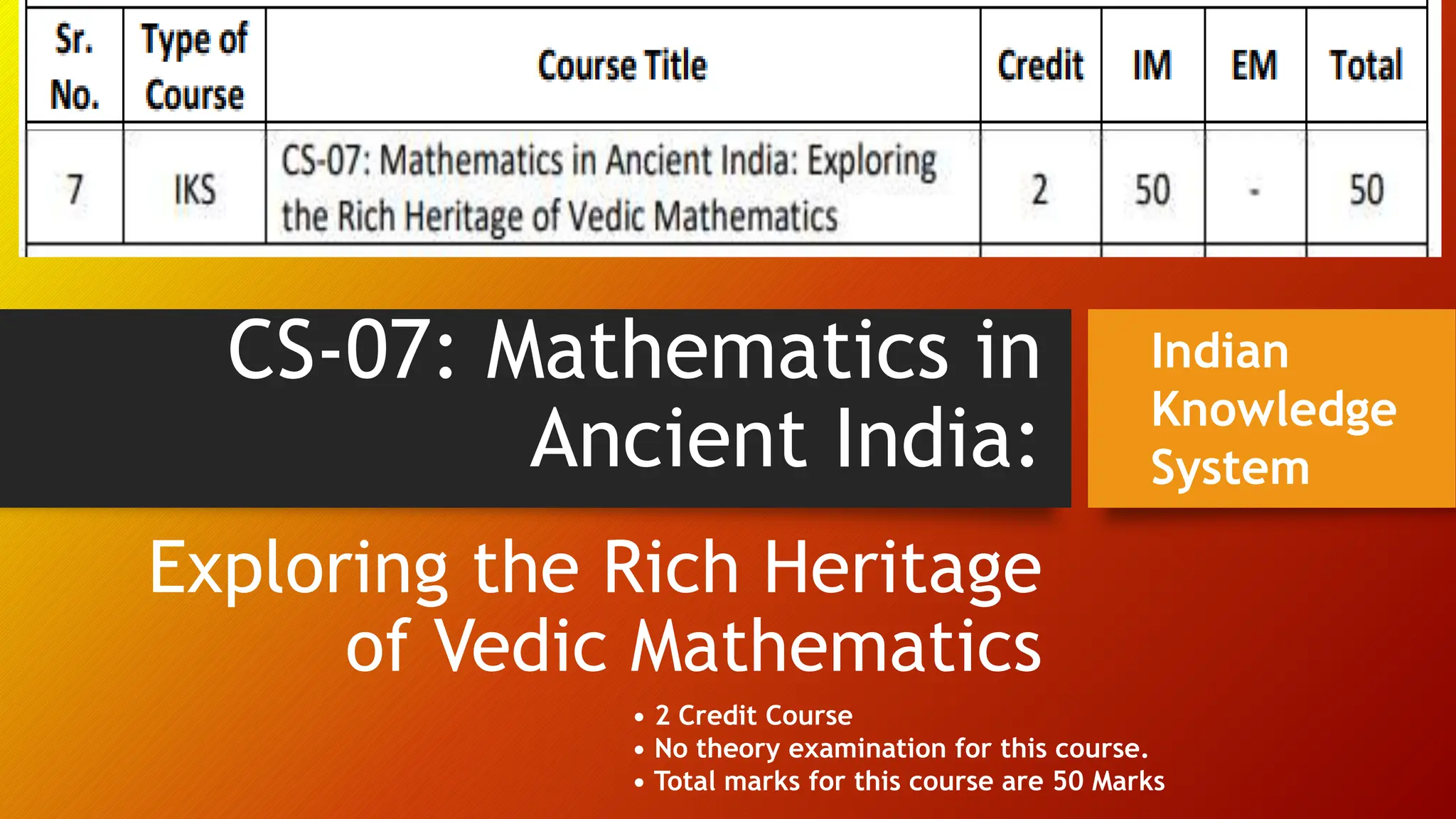
CS-07: Mathematics in
Ancient India:
Exploring the Rich Heritage
of Vedic Mathematics
Indian
Knowledge
System
• 2 Credit Course
• No theory examination for this course.
• Total marks for this course are 50 Marks
Objectives:
• Helps students understand the contributions made by
ancient civilizations to the field of mathematics.
• Ancient mathematics helps to establish connections
between past and present mathematical ideas.
• Exploring Mathematical concepts
Biographies of Ancient
Indian Mathematicians
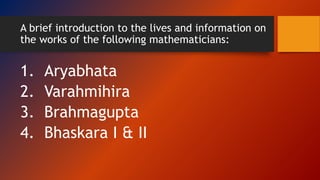
A brief introduction to the lives and information on
the works of the following mathematicians:
1. Aryabhata
2. Varahmihira
3. Brahmagupta
4. Bhaskara I & II
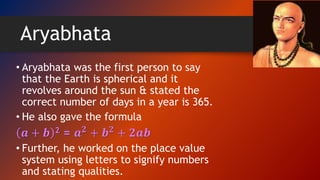
Aryabhata
• Aryabhata was the first person to say
that the Earth is spherical and it
revolves around the sun & stated the
correct number of days in a year is 365.
• He also gave the formula
𝒂 + 𝒃 2 = 𝒂𝟐
+ 𝒃𝟐
+ 𝟐𝒂𝒃
• Further, he worked on the place value
system using letters to signify numbers
and stating qualities.
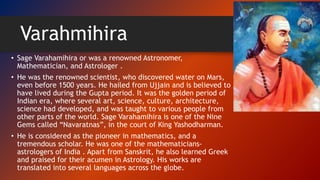
Varahmihira
• Sage Varahamihira or was a renowned Astronomer,
Mathematician, and Astrologer .
• He was the renowned scientist, who discovered water on Mars,
even before 1500 years. He hailed from Ujjain and is believed to
have lived during the Gupta period. It was the golden period of
Indian era, where several art, science, culture, architecture,
science had developed, and was taught to various people from
other parts of the world. Sage Varahamihira is one of the Nine
Gems called “Navaratnas”, in the court of King Yashodharman.
• He is considered as the pioneer in mathematics, and a
tremendous scholar. He was one of the mathematicians-
astrologers of India . Apart from Sanskrit, he also learned Greek
and praised for their acumen in Astrology. His works are
translated into several languages across the globe.
Brahmagupta
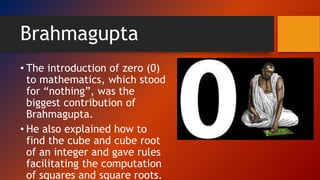
• The introduction of zero (0)
to mathematics, which stood
for “nothing”, was the
biggest contribution of
Brahmagupta.
• He also explained how to
find the cube and cube root
of an integer and gave rules
facilitating the computation
of squares and square roots.
Bhaskara I (7th century)
• Bhaskara 1 was an Indian Mathematician and Astronomer who was
born in c. 600 BC at Valabhi, near modern Bhavnagar, Saurashtra,
Gujarat, India. and died in the c. 680 BC. He was one of the most
famous mathematicians from the 7th-century.
• His father taught him Mathematics when he was young. He worked
as a scholar of Aryabhata’s astronomical school. The first
mathematician who has written numbers in the Hindu decimal
system was him. He Explored the work of Aryabhatta and worked
on the Sine Function and gave a more approximate value of Sine.
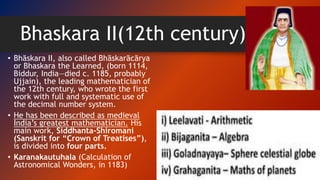
Bhaskara II(12th century)
• Bhāskara II, also called Bhāskarācārya
or Bhaskara the Learned, (born 1114,
Biddur, India—died c. 1185, probably
Ujjain), the leading mathematician of
the 12th century, who wrote the first
work with full and systematic use of
the decimal number system.
• He has been described as medieval
India’s greatest mathematician. His
main work, Siddhanta-Shiromani
(Sanskrit for “Crown of Treatises”),
is divided into four parts.
• Karanakautuhala (Calculation of
Astronomical Wonders, in 1183)
Biographies of
Remarkable Indian
Mathematicians
A brief introduction to the lives and information on
the works of the following mathematicians:
1. Shrinivasa Ramanujan
2. C. R. Rao
3. P. C. Mahalanobis
4. D. R. Kaprekar
5. Satyendranath Bose
6. Shakuntala Devi
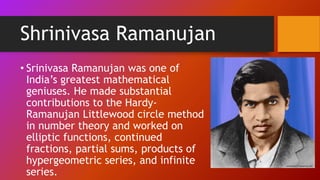
Shrinivasa Ramanujan
• Srinivasa Ramanujan was one of
India’s greatest mathematical
geniuses. He made substantial
contributions to the Hardy-
Ramanujan Littlewood circle method
in number theory and worked on
elliptic functions, continued
fractions, partial sums, products of
hypergeometric series, and infinite
series.
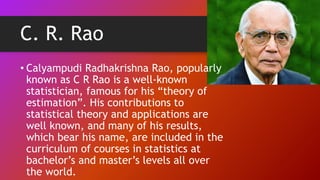
C. R. Rao
• Calyampudi Radhakrishna Rao, popularly
known as C R Rao is a well-known
statistician, famous for his “theory of
estimation”. His contributions to
statistical theory and applications are
well known, and many of his results,
which bear his name, are included in the
curriculum of courses in statistics at
bachelor’s and master’s levels all over
the world.
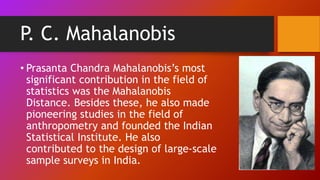
P. C. Mahalanobis
• Prasanta Chandra Mahalanobis’s most
significant contribution in the field of
statistics was the Mahalanobis
Distance. Besides these, he also made
pioneering studies in the field of
anthropometry and founded the Indian
Statistical Institute. He also
contributed to the design of large-scale
sample surveys in India.
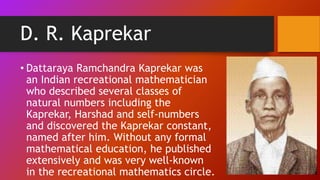
D. R. Kaprekar
• Dattaraya Ramchandra Kaprekar was
an Indian recreational mathematician
who described several classes of
natural numbers including the
Kaprekar, Harshad and self-numbers
and discovered the Kaprekar constant,
named after him. Without any formal
mathematical education, he published
extensively and was very well-known
in the recreational mathematics circle.
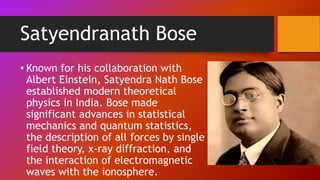
Satyendranath Bose
• Known for his collaboration with
Albert Einstein, Satyendra Nath Bose
established modern theoretical
physics in India. Bose made
significant advances in statistical
mechanics and quantum statistics,
the description of all forces by single
field theory, x-ray diffraction, and
the interaction of electromagnetic
waves with the ionosphere.
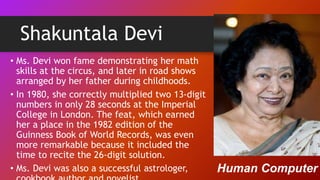
Shakuntala Devi
• Ms. Devi won fame demonstrating her math
skills at the circus, and later in road shows
arranged by her father during childhoods.
• In 1980, she correctly multiplied two 13-digit
numbers in only 28 seconds at the Imperial
College in London. The feat, which earned
her a place in the 1982 edition of the
Guinness Book of World Records, was even
more remarkable because it included the
time to recite the 26-digit solution.
• Ms. Devi was also a successful astrologer, Human Computer
Project : Prepare Assignment Report on any one
personality & submit to your faculty.

Mathematics in Ancient India,Asia...ppsx

  • 1.
    CS-07: Mathematics in AncientIndia: Exploring the Rich Heritage of Vedic Mathematics Indian Knowledge System • 2 Credit Course • No theory examination for this course. • Total marks for this course are 50 Marks
  • 2.
    Objectives: • Helps studentsunderstand the contributions made by ancient civilizations to the field of mathematics. • Ancient mathematics helps to establish connections between past and present mathematical ideas. • Exploring Mathematical concepts
  • 3.
  • 4.
    A brief introductionto the lives and information on the works of the following mathematicians: 1. Aryabhata 2. Varahmihira 3. Brahmagupta 4. Bhaskara I & II
  • 5.
    Aryabhata • Aryabhata wasthe first person to say that the Earth is spherical and it revolves around the sun & stated the correct number of days in a year is 365. • He also gave the formula 𝒂 + 𝒃 2 = 𝒂𝟐 + 𝒃𝟐 + 𝟐𝒂𝒃 • Further, he worked on the place value system using letters to signify numbers and stating qualities.
  • 6.
    Varahmihira • Sage Varahamihiraor was a renowned Astronomer, Mathematician, and Astrologer . • He was the renowned scientist, who discovered water on Mars, even before 1500 years. He hailed from Ujjain and is believed to have lived during the Gupta period. It was the golden period of Indian era, where several art, science, culture, architecture, science had developed, and was taught to various people from other parts of the world. Sage Varahamihira is one of the Nine Gems called “Navaratnas”, in the court of King Yashodharman. • He is considered as the pioneer in mathematics, and a tremendous scholar. He was one of the mathematicians- astrologers of India . Apart from Sanskrit, he also learned Greek and praised for their acumen in Astrology. His works are translated into several languages across the globe.
  • 7.
    Brahmagupta • The introductionof zero (0) to mathematics, which stood for “nothing”, was the biggest contribution of Brahmagupta. • He also explained how to find the cube and cube root of an integer and gave rules facilitating the computation of squares and square roots.
  • 8.
    Bhaskara I (7thcentury) • Bhaskara 1 was an Indian Mathematician and Astronomer who was born in c. 600 BC at Valabhi, near modern Bhavnagar, Saurashtra, Gujarat, India. and died in the c. 680 BC. He was one of the most famous mathematicians from the 7th-century. • His father taught him Mathematics when he was young. He worked as a scholar of Aryabhata’s astronomical school. The first mathematician who has written numbers in the Hindu decimal system was him. He Explored the work of Aryabhatta and worked on the Sine Function and gave a more approximate value of Sine.
  • 9.
    Bhaskara II(12th century) •Bhāskara II, also called Bhāskarācārya or Bhaskara the Learned, (born 1114, Biddur, India—died c. 1185, probably Ujjain), the leading mathematician of the 12th century, who wrote the first work with full and systematic use of the decimal number system. • He has been described as medieval India’s greatest mathematician. His main work, Siddhanta-Shiromani (Sanskrit for “Crown of Treatises”), is divided into four parts. • Karanakautuhala (Calculation of Astronomical Wonders, in 1183)
  • 10.
  • 11.
    A brief introductionto the lives and information on the works of the following mathematicians: 1. Shrinivasa Ramanujan 2. C. R. Rao 3. P. C. Mahalanobis 4. D. R. Kaprekar 5. Satyendranath Bose 6. Shakuntala Devi
  • 12.
    Shrinivasa Ramanujan • SrinivasaRamanujan was one of India’s greatest mathematical geniuses. He made substantial contributions to the Hardy- Ramanujan Littlewood circle method in number theory and worked on elliptic functions, continued fractions, partial sums, products of hypergeometric series, and infinite series.
  • 13.
    C. R. Rao •Calyampudi Radhakrishna Rao, popularly known as C R Rao is a well-known statistician, famous for his “theory of estimation”. His contributions to statistical theory and applications are well known, and many of his results, which bear his name, are included in the curriculum of courses in statistics at bachelor’s and master’s levels all over the world.
  • 14.
    P. C. Mahalanobis •Prasanta Chandra Mahalanobis’s most significant contribution in the field of statistics was the Mahalanobis Distance. Besides these, he also made pioneering studies in the field of anthropometry and founded the Indian Statistical Institute. He also contributed to the design of large-scale sample surveys in India.
  • 15.
    D. R. Kaprekar •Dattaraya Ramchandra Kaprekar was an Indian recreational mathematician who described several classes of natural numbers including the Kaprekar, Harshad and self-numbers and discovered the Kaprekar constant, named after him. Without any formal mathematical education, he published extensively and was very well-known in the recreational mathematics circle.
  • 16.
    Satyendranath Bose • Knownfor his collaboration with Albert Einstein, Satyendra Nath Bose established modern theoretical physics in India. Bose made significant advances in statistical mechanics and quantum statistics, the description of all forces by single field theory, x-ray diffraction, and the interaction of electromagnetic waves with the ionosphere.
  • 17.
    Shakuntala Devi • Ms.Devi won fame demonstrating her math skills at the circus, and later in road shows arranged by her father during childhoods. • In 1980, she correctly multiplied two 13-digit numbers in only 28 seconds at the Imperial College in London. The feat, which earned her a place in the 1982 edition of the Guinness Book of World Records, was even more remarkable because it included the time to recite the 26-digit solution. • Ms. Devi was also a successful astrologer, Human Computer
  • 18.
    Project : PrepareAssignment Report on any one personality & submit to your faculty.