Java course - IAG0040


             Enums, Generics
               & Assertions


Anton Keks                           2011
Arrays helper class
 ●
     Arrays class provides operations on arrays
     –   asList() - provides a view of an array as a List
     –   binarySearch() - searches for an element from a sorted
         array
     –   equals() - checks two arrays for equality
     –   fill() - fills an array with the specified element
     –   sort() - sorts an array (using a tuned QuickSort algorithm)
     –   toString() - can be used for displaying of arrays
     –   deepToString() - the same for multidimensional arrays


Java course – IAG0040                                         Lecture 5
Anton Keks                                                      Slide 2
Collections helper class
 ●
     Provides constants and operations on Collections
      –   EMPTY_XXX or emptyXXX() - immutable empty collection
      –   sort(), binarySearch(), fill(), copy(), min(), max(),
          shuffle(), replaceAll(), rotate(), swap()
      –   singletonXXX() - immutable collection with one element
      –   enumeration() - for support of legacy classes
 ●   Wrappers
      –   checkedXXX() - a dynamically typesafe view
      –   unmodifiableXXX() - an unmodifiable view
      –   synchronizedXXX() - a synchronized view


Java course – IAG0040                                            Lecture 5
Anton Keks                                                         Slide 3
Tips
 ●   Program to interfaces
      –   List list = new ArrayList();
 ●   Copy (or conversion) constructors
      –   Set set = new TreeSet(map.values());
 ●   Checking if the Collection is empty
      –   collection.isEmpty()
      –   collection.size() == 0 may be very expensive
 ●   Remove all nulls (or other elements):
      –   collection.removeAll(Collections.singleton(null))
 ●   Convert to arrays
      –   String[] s = c.toArray(new String[c.size()]);
Java course – IAG0040                                    Lecture 5
Anton Keks                                                 Slide 4
Tips (cont)
 ●   Iterate Maps with Map.Entry if you need both keys and values
      –   for(Map.Entry e : map.entrySet()) {}
 ●   Initial capacity in case of HashSet, HashMap, and ArrayList
      –   new ArrayList(512)
 ●
     Operations on sublists are reflected in the main lists
      –   list.subList(15, 16).remove(object);
 ●   All collections implement toString()
      –   useful for displaying the contents quickly


Java course – IAG0040                                               Lecture 5
Anton Keks                                                            Slide 5
Inner classes
 ●   Inner classes can be defined inside of other classes
     –   class MyClass {
           class InnerClass { }
         }
     –   non static inner classes can access internals of parent
         classes
     –   static inner classes cannot


Java course – IAG0040                                       Lecture 5
Anton Keks                                                    Slide 6
Anonymous inner classes
 ●
     Classes can be created and instantiated 'inline'
      –   Runnable runnable = new Runnable() {
             public void run() {
                System.out.println("Running!");
             }
          };
          runnable.run();
 ●
     Analogous to initialization of arrays: new byte[] {1}
 ●   Very useful for implementation of short interfaces, where the
     code is needed as part of the surrounding code
 ●   Compiled into ParentClass$1.class, where $1 is the index of the
     anonymous class within the ParentClass

Java course – IAG0040                                         Lecture 5
Anton Keks                                                      Slide 7
Annotations
 ●
     Annotations are special type of interfaces
     –   @interface MyAnnotation { }
     –   Allow specification of meta data for source code elements
          ●   Used before the element in question, just like Javadoc
     –   In general, don't have effect at runtime
     –   Built-in: @SupressWarnings, @Deprecated,
                   @Override, @Generated, etc
     –   Can take parameters: @SupressWarnings(“unused”)
         or @SupressWarnings(value=“unused”)
 ●   Very useful in various frameworks, e.g. JUnit4, Spring2,
     Hibernate3, EJB3
Java course – IAG0040                                          Lecture 5
Anton Keks                                                       Slide 8
Enums
 ●   Special type of class (base class is java.lang.Enum)
 ●   enum Season {WINTER, SPRING, SUMMER, AUTUMN}
 ●   Only one instance of each constant is guaranteed; enums cannot be
     instantiated; they are implicitly final (cannot be extended)
 ●   Constructors can be used: WINTER(1), SPRING(“Hello”)
 ●   Accessed like constants: Season.WINTER
 ●   Every enum has the following methods:
      –   int ordinal() - returns an ordinal value of the constant
      –   String name() - returns the name of the constant
      –   static Enum valueOf(String name) - returns the enum constant
      –   static Season[] values() - returns an array of all constants
 ●   See Season and Planet in net.azib.java.lessons.enums
Java course – IAG0040                                                    Lecture 5
Anton Keks                                                                 Slide 9
Introduction to Generics
 ●   Are there any problems with collections?
      –   String s = (String) list.get(3);
 ●
     Java 1.5 introduced generics for type safety checks
      –   List<String> list;
          String s = list.get(3);
 ●   Additionally, generics allow to abstract over types
      –   List<Integer> list = Arrays.asList(
                               new Integer[]{1,2});
      –   List<String> list = Arrays.asList(
                              “a”, “b”, “c”);
 ●   Provide more compile time information for error checking
Java course – IAG0040                                      Lecture 5
Anton Keks                                                  Slide 10
Defining generic classes
 ●   public interface List<E> {
        void add(E x);
        Iterator<E> iterator();
     }
 ●   public interface Iterator<E>{
        E next();
        boolean hasNext();
     }
 ●   Formal type parameters are in the angle brackets <>
 ●
     In invocations of generic types (parametrized types), all occurrences
     of formal types are replaced by the actual argument
 ●
     Primitives cannot be used as arguments, but arrays and wrappers can
      –   Iterator<int[]> i;       List<Integer> intList;

Java course – IAG0040                                             Lecture 5
Anton Keks                                                         Slide 11
Defining generics
 ●
     Generics can be thought of as if they were expanded
     –   public interface ListOfIntegers {
           void add(Integer x);
           Iterator<Integer> iterator();
         }
 ●   Actually they are not: generics introduce no memory or
     performance overhead
 ●   Information about type parameters is stored in class files
     and used during compilation
 ●   Use possibly meaningful single character names
     –   E = Element, T = Type, K = Key, V = Value, etc
Java course – IAG0040                                     Lecture 5
Anton Keks                                                 Slide 12
Generics usage in Java API
 ●
     Collection<E>, Iterable<E>, Iterator<E>
 ●
     Set<E>, List<E>, Queue<E>
      –   Set<String> set = new HashSet<String>();
      –   Queue<Dog> q = new LinkedList<Dog>();
 ●   Map<K, V>
      –   Map<String, Thread> map =
          new HashMap<String, Thread>();
 ●
     Comparator<T>, Comparable<T>
 ●
     Class<T>
      –   Date d = Date.class.newInstance();

Java course – IAG0040                             Lecture 5
Anton Keks                                         Slide 13
Subtyping
 ●   If A extends B, does List<A> extend List<B>?
 ●   List<String> ls = new ArrayList<String>();
     List<Object> lo = ls;
     –   this is illegal – List of Strings is not a List of Objects
 ●   lo.add(new Integer(42)); // adds an illegal object
     String s = ls.get(0);    // this is not a String!
     –   this code would break type safety at runtime!
 ●   However
     –   ls instanceof List & lo instanceof List
     –   Collection<String> cs = ls;                     // legal


Java course – IAG0040                                                 Lecture 5
Anton Keks                                                             Slide 14
Backward compatibility
 ●
     Generics are backward compatible
      –   Java 1.5 still had to be able to run old (unparameterized) code
      –   Backward compatibility has influenced the implementation
 ●   Old-style (unparameterized or raw-type) code can still be written
      –   ArrayList al = new ArrayList<String>();
          ArrayList<String> al = new ArrayList();
 ●   For now, checks are only done at compile time
      –   At runtime, generic collections hold Objects ('type erasure')
      –   Collections.checkedXXX() methods may be used for runtime
          type checking
      –   Implementation may change in future

Java course – IAG0040                                                Lecture 5
Anton Keks                                                            Slide 15
Wildcards
 ●   void printCollection(Collection<Object> c) {
        for (Object e : c)
           System.out.println(e);
     }
 ●   printCollection(new ArrayList<String>()) //           doesn't compile

 ●   void printCollection(Collection<?> c) { // ? is a wildcard
        for (Object e : c)
           System.out.println(e);
     }
 ●   However the following fails (at compile time!)
      –   c.add(new Object());
      –   Collection<?> means “collection of unknown”, it is read-only
      –   Unknown <?> can always be assigned to Object (when reading)

Java course – IAG0040                                          Lecture 5
Anton Keks                                                      Slide 16
Bounded wildcards
 ●
     <? extends T> means “anything that extends T”
     –   upper bounded wildcard, “read-only”
     –   List<? extends Number> vs List<Number>
     –   List<Integer> can be assigned to the first one, but not to the
         second one
     –   add() still doesn't work, because actual type is not known
 ●
     <? super T> means “anything that is a supertype of T”
     –   lower bounded wildcard, “write-only”
     –   List<? super Number> vs List<Number>
     –   add(new Integer(5)) works, because Integer can be
         assigned to any supertype of Number or Number itself

Java course – IAG0040                                             Lecture 5
Anton Keks                                                         Slide 17
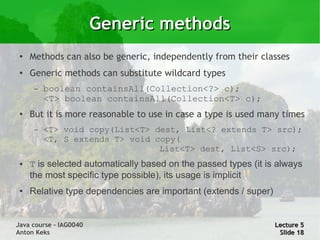
Generic methods
 ●
     Methods can also be generic, independently from their classes
 ●   Generic methods can substitute wildcard types
      –   boolean containsAll(Collection<?> c);
          <T> boolean containsAll(Collection<T> c);
 ●
     But it is more reasonable to use in case a type is used many times
      –   <T> void copy(List<T> dest, List<? extends T> src);
          <T, S extends T> void copy(
                                 List<T> dest, List<S> src);
 ●   T is selected automatically based on the passed types (it is always
     the most specific type possible), its usage is implicit
 ●   Relative type dependencies are important (extends / super)


Java course – IAG0040                                             Lecture 5
Anton Keks                                                         Slide 18
Generics tasks
 ●
     Use generics in
     WordFrequencyCalculatorImpl and
     DuplicateRemoverImpl
 ●   Write some new classes
     –   Circle and Square
          ●   both should extend the provided
              net.azib.java.lessons.collections.Shape
     –   ShapeAggregatorImpl (which should implement
         the ShapeAggregator)


Java course – IAG0040                              Lecture 5
Anton Keks                                          Slide 19
Assertions
 ●
     assert keyword can be used for assertion of validity of
     boolean expressions (a debugging feature)
      –   assert boolean-expression : value-expression;
      –   assert A == 5 : “A is not 5!!!”;
 ●
     If boolean-expression evaluates to false, an AssertionError is
     thrown with the value-expression as detailed message (optional)
 ●
     Assertions are disabled by default, therefore have no runtime
     overhead
 ●
     When enabled, help to write self-documented code and trace
     bugs at runtime
 ●
     java -ea switch enables assertions (specific packages and classes
     may be specified if global activation is not desired)
Java course – IAG0040                                          Lecture 5
Anton Keks                                                      Slide 20

Java Course 5: Enums, Generics, Assertions

  • 1.
    Java course -IAG0040 Enums, Generics & Assertions Anton Keks 2011
  • 2.
    Arrays helper class ● Arrays class provides operations on arrays – asList() - provides a view of an array as a List – binarySearch() - searches for an element from a sorted array – equals() - checks two arrays for equality – fill() - fills an array with the specified element – sort() - sorts an array (using a tuned QuickSort algorithm) – toString() - can be used for displaying of arrays – deepToString() - the same for multidimensional arrays Java course – IAG0040 Lecture 5 Anton Keks Slide 2
  • 3.
    Collections helper class ● Provides constants and operations on Collections – EMPTY_XXX or emptyXXX() - immutable empty collection – sort(), binarySearch(), fill(), copy(), min(), max(), shuffle(), replaceAll(), rotate(), swap() – singletonXXX() - immutable collection with one element – enumeration() - for support of legacy classes ● Wrappers – checkedXXX() - a dynamically typesafe view – unmodifiableXXX() - an unmodifiable view – synchronizedXXX() - a synchronized view Java course – IAG0040 Lecture 5 Anton Keks Slide 3
  • 4.
    Tips ● Program to interfaces – List list = new ArrayList(); ● Copy (or conversion) constructors – Set set = new TreeSet(map.values()); ● Checking if the Collection is empty – collection.isEmpty() – collection.size() == 0 may be very expensive ● Remove all nulls (or other elements): – collection.removeAll(Collections.singleton(null)) ● Convert to arrays – String[] s = c.toArray(new String[c.size()]); Java course – IAG0040 Lecture 5 Anton Keks Slide 4
  • 5.
    Tips (cont) ● Iterate Maps with Map.Entry if you need both keys and values – for(Map.Entry e : map.entrySet()) {} ● Initial capacity in case of HashSet, HashMap, and ArrayList – new ArrayList(512) ● Operations on sublists are reflected in the main lists – list.subList(15, 16).remove(object); ● All collections implement toString() – useful for displaying the contents quickly Java course – IAG0040 Lecture 5 Anton Keks Slide 5
  • 6.
    Inner classes ● Inner classes can be defined inside of other classes – class MyClass { class InnerClass { } } – non static inner classes can access internals of parent classes – static inner classes cannot Java course – IAG0040 Lecture 5 Anton Keks Slide 6
  • 7.
    Anonymous inner classes ● Classes can be created and instantiated 'inline' – Runnable runnable = new Runnable() { public void run() { System.out.println("Running!"); } }; runnable.run(); ● Analogous to initialization of arrays: new byte[] {1} ● Very useful for implementation of short interfaces, where the code is needed as part of the surrounding code ● Compiled into ParentClass$1.class, where $1 is the index of the anonymous class within the ParentClass Java course – IAG0040 Lecture 5 Anton Keks Slide 7
  • 8.
    Annotations ● Annotations are special type of interfaces – @interface MyAnnotation { } – Allow specification of meta data for source code elements ● Used before the element in question, just like Javadoc – In general, don't have effect at runtime – Built-in: @SupressWarnings, @Deprecated, @Override, @Generated, etc – Can take parameters: @SupressWarnings(“unused”) or @SupressWarnings(value=“unused”) ● Very useful in various frameworks, e.g. JUnit4, Spring2, Hibernate3, EJB3 Java course – IAG0040 Lecture 5 Anton Keks Slide 8
  • 9.
    Enums ● Special type of class (base class is java.lang.Enum) ● enum Season {WINTER, SPRING, SUMMER, AUTUMN} ● Only one instance of each constant is guaranteed; enums cannot be instantiated; they are implicitly final (cannot be extended) ● Constructors can be used: WINTER(1), SPRING(“Hello”) ● Accessed like constants: Season.WINTER ● Every enum has the following methods: – int ordinal() - returns an ordinal value of the constant – String name() - returns the name of the constant – static Enum valueOf(String name) - returns the enum constant – static Season[] values() - returns an array of all constants ● See Season and Planet in net.azib.java.lessons.enums Java course – IAG0040 Lecture 5 Anton Keks Slide 9
  • 10.
    Introduction to Generics ● Are there any problems with collections? – String s = (String) list.get(3); ● Java 1.5 introduced generics for type safety checks – List<String> list; String s = list.get(3); ● Additionally, generics allow to abstract over types – List<Integer> list = Arrays.asList( new Integer[]{1,2}); – List<String> list = Arrays.asList( “a”, “b”, “c”); ● Provide more compile time information for error checking Java course – IAG0040 Lecture 5 Anton Keks Slide 10
  • 11.
    Defining generic classes ● public interface List<E> { void add(E x); Iterator<E> iterator(); } ● public interface Iterator<E>{ E next(); boolean hasNext(); } ● Formal type parameters are in the angle brackets <> ● In invocations of generic types (parametrized types), all occurrences of formal types are replaced by the actual argument ● Primitives cannot be used as arguments, but arrays and wrappers can – Iterator<int[]> i; List<Integer> intList; Java course – IAG0040 Lecture 5 Anton Keks Slide 11
  • 12.
    Defining generics ● Generics can be thought of as if they were expanded – public interface ListOfIntegers { void add(Integer x); Iterator<Integer> iterator(); } ● Actually they are not: generics introduce no memory or performance overhead ● Information about type parameters is stored in class files and used during compilation ● Use possibly meaningful single character names – E = Element, T = Type, K = Key, V = Value, etc Java course – IAG0040 Lecture 5 Anton Keks Slide 12
  • 13.
    Generics usage inJava API ● Collection<E>, Iterable<E>, Iterator<E> ● Set<E>, List<E>, Queue<E> – Set<String> set = new HashSet<String>(); – Queue<Dog> q = new LinkedList<Dog>(); ● Map<K, V> – Map<String, Thread> map = new HashMap<String, Thread>(); ● Comparator<T>, Comparable<T> ● Class<T> – Date d = Date.class.newInstance(); Java course – IAG0040 Lecture 5 Anton Keks Slide 13
  • 14.
    Subtyping ● If A extends B, does List<A> extend List<B>? ● List<String> ls = new ArrayList<String>(); List<Object> lo = ls; – this is illegal – List of Strings is not a List of Objects ● lo.add(new Integer(42)); // adds an illegal object String s = ls.get(0); // this is not a String! – this code would break type safety at runtime! ● However – ls instanceof List & lo instanceof List – Collection<String> cs = ls; // legal Java course – IAG0040 Lecture 5 Anton Keks Slide 14
  • 15.
    Backward compatibility ● Generics are backward compatible – Java 1.5 still had to be able to run old (unparameterized) code – Backward compatibility has influenced the implementation ● Old-style (unparameterized or raw-type) code can still be written – ArrayList al = new ArrayList<String>(); ArrayList<String> al = new ArrayList(); ● For now, checks are only done at compile time – At runtime, generic collections hold Objects ('type erasure') – Collections.checkedXXX() methods may be used for runtime type checking – Implementation may change in future Java course – IAG0040 Lecture 5 Anton Keks Slide 15
  • 16.
    Wildcards ● void printCollection(Collection<Object> c) { for (Object e : c) System.out.println(e); } ● printCollection(new ArrayList<String>()) // doesn't compile ● void printCollection(Collection<?> c) { // ? is a wildcard for (Object e : c) System.out.println(e); } ● However the following fails (at compile time!) – c.add(new Object()); – Collection<?> means “collection of unknown”, it is read-only – Unknown <?> can always be assigned to Object (when reading) Java course – IAG0040 Lecture 5 Anton Keks Slide 16
  • 17.
    Bounded wildcards ● <? extends T> means “anything that extends T” – upper bounded wildcard, “read-only” – List<? extends Number> vs List<Number> – List<Integer> can be assigned to the first one, but not to the second one – add() still doesn't work, because actual type is not known ● <? super T> means “anything that is a supertype of T” – lower bounded wildcard, “write-only” – List<? super Number> vs List<Number> – add(new Integer(5)) works, because Integer can be assigned to any supertype of Number or Number itself Java course – IAG0040 Lecture 5 Anton Keks Slide 17
  • 18.
    Generic methods ● Methods can also be generic, independently from their classes ● Generic methods can substitute wildcard types – boolean containsAll(Collection<?> c); <T> boolean containsAll(Collection<T> c); ● But it is more reasonable to use in case a type is used many times – <T> void copy(List<T> dest, List<? extends T> src); <T, S extends T> void copy( List<T> dest, List<S> src); ● T is selected automatically based on the passed types (it is always the most specific type possible), its usage is implicit ● Relative type dependencies are important (extends / super) Java course – IAG0040 Lecture 5 Anton Keks Slide 18
  • 19.
    Generics tasks ● Use generics in WordFrequencyCalculatorImpl and DuplicateRemoverImpl ● Write some new classes – Circle and Square ● both should extend the provided net.azib.java.lessons.collections.Shape – ShapeAggregatorImpl (which should implement the ShapeAggregator) Java course – IAG0040 Lecture 5 Anton Keks Slide 19
  • 20.
    Assertions ● assert keyword can be used for assertion of validity of boolean expressions (a debugging feature) – assert boolean-expression : value-expression; – assert A == 5 : “A is not 5!!!”; ● If boolean-expression evaluates to false, an AssertionError is thrown with the value-expression as detailed message (optional) ● Assertions are disabled by default, therefore have no runtime overhead ● When enabled, help to write self-documented code and trace bugs at runtime ● java -ea switch enables assertions (specific packages and classes may be specified if global activation is not desired) Java course – IAG0040 Lecture 5 Anton Keks Slide 20