Java course - IAG0040


              Advanced stuff:
              Ant, Scripting,
             Spring, Hibernate


Anton Keks                            2011
Ant
 ●
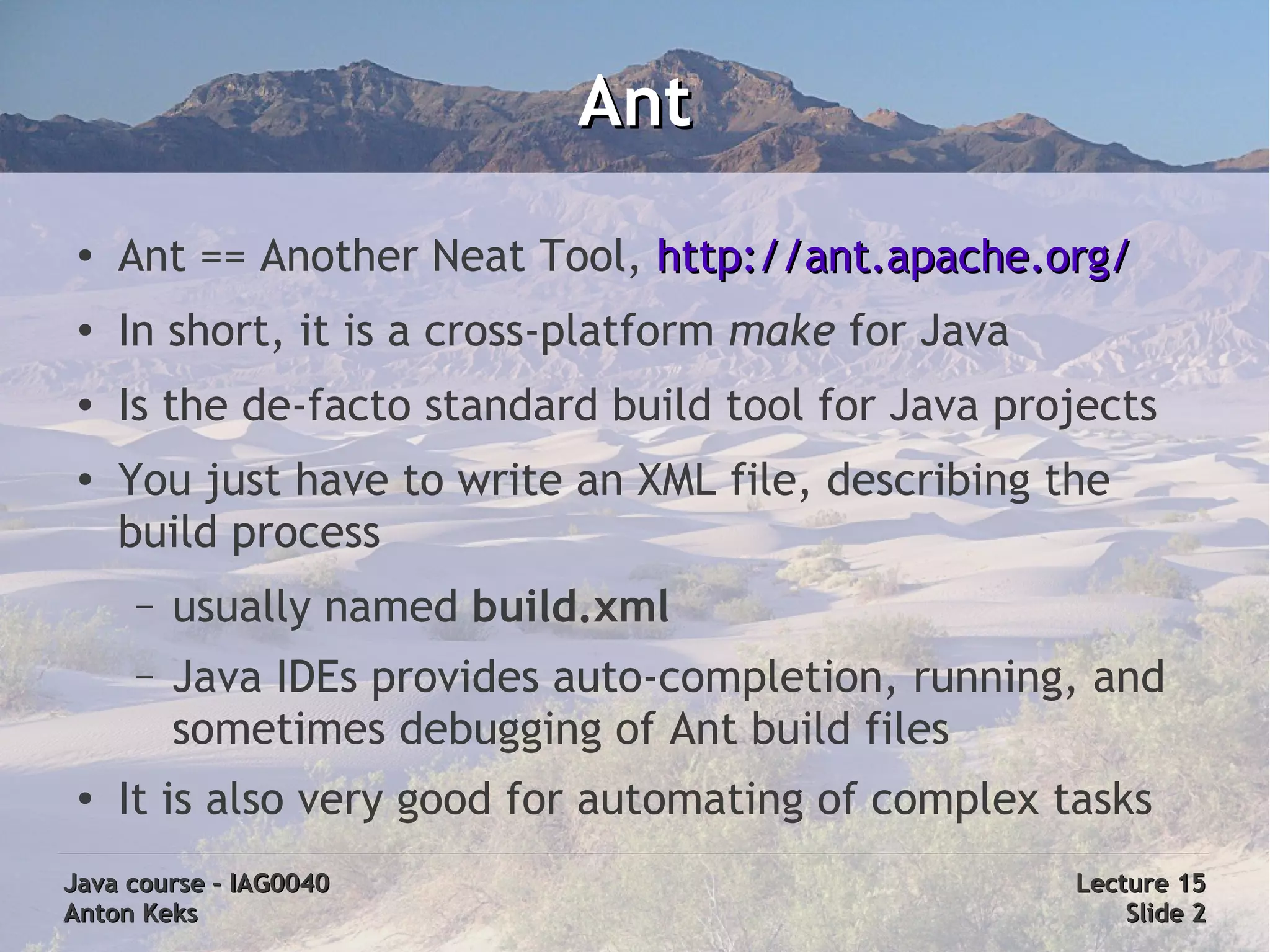
     Ant == Another Neat Tool, http://ant.apache.org/
 ●
     In short, it is a cross-platform make for Java
 ●
     Is the de-facto standard build tool for Java projects
 ●   You just have to write an XML file, describing the
     build process
     –   usually named build.xml
     –   Java IDEs provides auto-completion, running, and
         sometimes debugging of Ant build files
 ●
     It is also very good for automating of complex tasks
Java course – IAG0040                                 Lecture 15
Anton Keks                                                Slide 2
Hello, Ant!
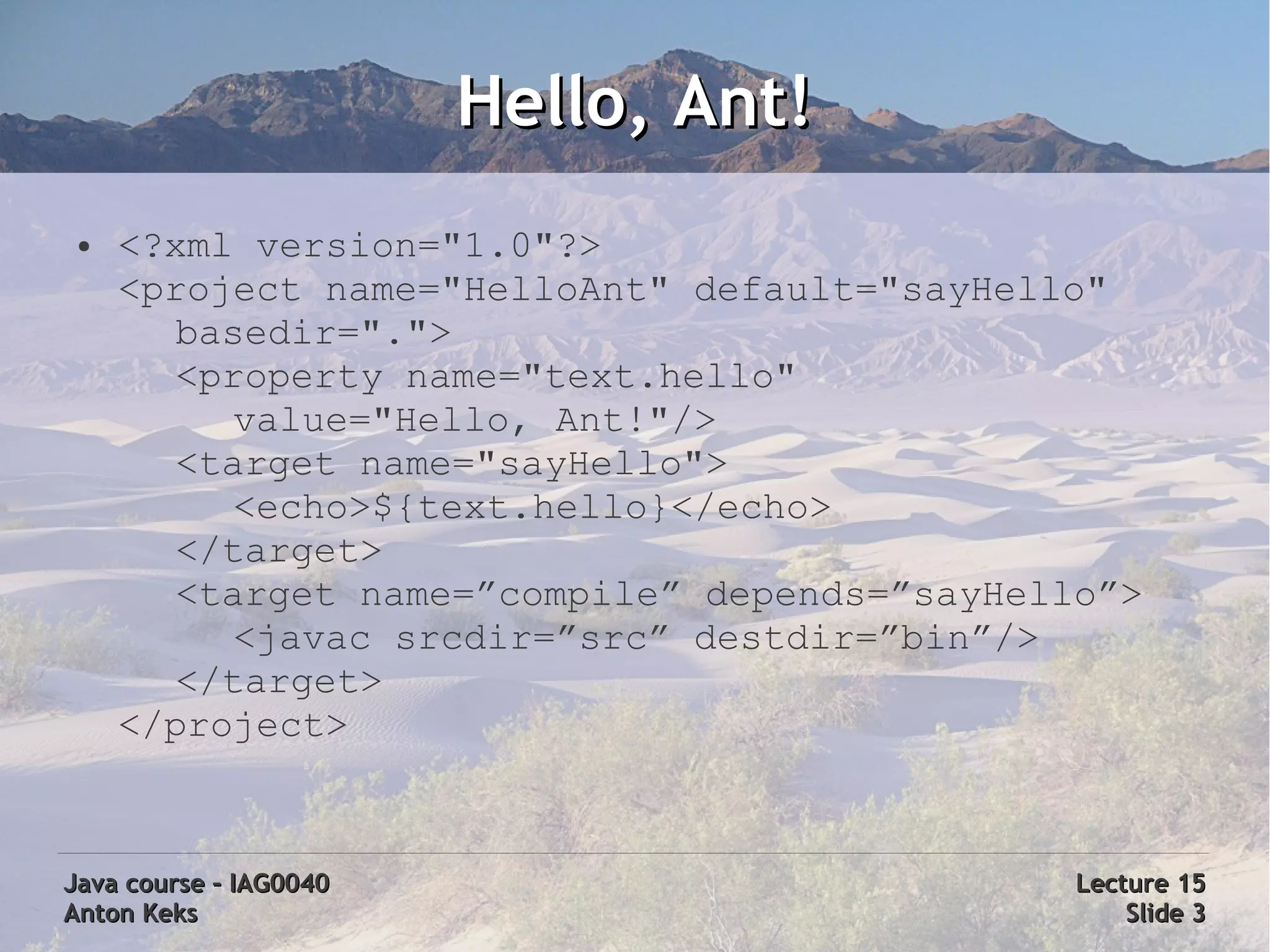
 ●   <?xml version="1.0"?>
     <project name="HelloAnt" default="sayHello"
        basedir=".">
        <property name="text.hello"
          value="Hello, Ant!"/>
        <target name="sayHello">
          <echo>${text.hello}</echo>
        </target>
        <target name=”compile” depends=”sayHello”>
          <javac srcdir=”src” destdir=”bin”/>
        </target>
     </project>


Java course – IAG0040                          Lecture 15
Anton Keks                                         Slide 3
Ant essentials
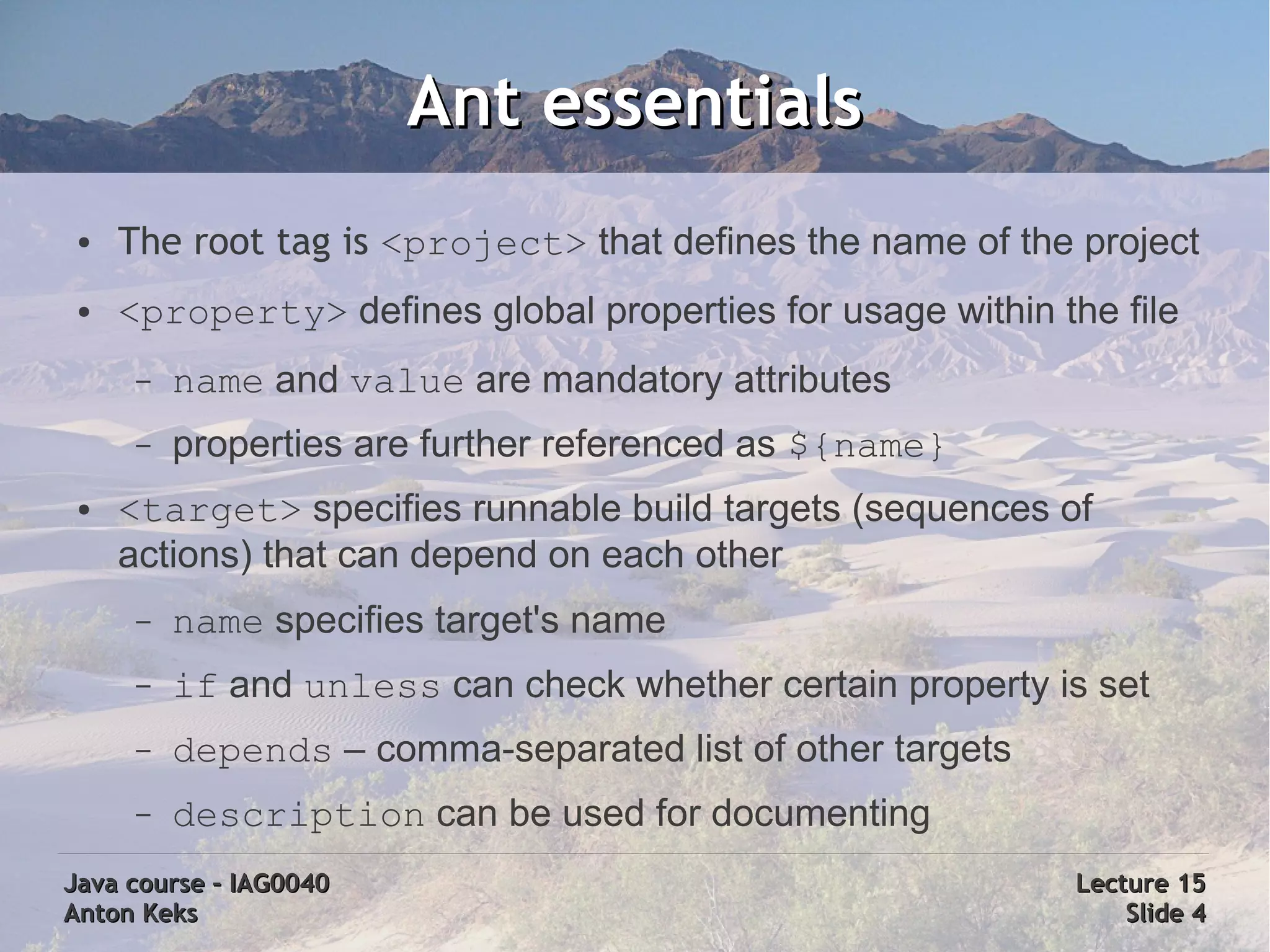
 ●   The root tag is <project> that defines the name of the project
 ●   <property> defines global properties for usage within the file
      –   name and value are mandatory attributes
      –   properties are further referenced as ${name}
 ●   <target> specifies runnable build targets (sequences of
     actions) that can depend on each other
      –   name specifies target's name
      –   if and unless can check whether certain property is set
      –   depends – comma-separated list of other targets
      –   description can be used for documenting
Java course – IAG0040                                       Lecture 15
Anton Keks                                                      Slide 4
Ant essentials (cont)
 ●   Within targets, Ant tasks can be used
      –   There are many predefined tasks, e.g. echo
      –   You can define tasks yourself or run other targets with
          <antcall>
      –   You can use 3rd-party tasks from jar files
 ●   Many tasks use FileSets
      –   they are filters using patterns to select specific files
      –   ? matches a character, * matches zero or more characters, **
          matches zero or more directories (processed recursively)
      –   <fileset dir=”${basedir}” includes=”**/*.java”/>
           ●   <include> and <exclude> can be specified within

Java course – IAG0040                                                Lecture 15
Anton Keks                                                               Slide 5
Most common Ant tasks
●   Filesystem tasks:
     –   copy, delete, get, mkdir, move, rename, touch, chmod
●   Remote tasks:
     –   ftp, scp, sshexec, telnet, setproxy, mail, cvs, cvschangelog
●   Compilation and Deployment:
     –   javac, javadoc, rmic, depend, jar, tar, zip, war, gzip
●   Testing
     –   junit, junitreport
●   Miscellaneous
     –   echo, exec, fail, sleep, buildnumber, condition
●   More info at http://ant.apache.org/manual/tasksoverview.html
●
    Tons of 3rd party tasks available

Java course – IAG0040                                                   Lecture 15
Anton Keks                                                                  Slide 6
Java Scripting
 ●
     Java 1.6 introduced embedded scripting
     –   allows running of scripts inside of the JVM
          ●
              scripts can be written in many languages, e.g.
              JavaScript, Ruby, Groovy, Python, etc
          ●   each language needs its engine to be available
          ●
              JavaScript is available by default (Mozilla Rhino)
     –   Scripts and Java classes can interoperate
 ●   Reasons
     –   Java is a platform, not only a language
     –   interoperability, faster development of non-critical code,
         specific domain usage, etc
Java course – IAG0040                                              Lecture 15
Anton Keks                                                             Slide 7
Java Scripting API
●
    Java Scripting API is in javax.script package
●
    ScriptEngine – interface for implementing of different
    scripting languages
●
    ScriptEngineFactory – interface for implementing
    ScriptEngine factories, provides detailed information about
    the language
●
    ScriptEngineManager – class for registering and obtaining of
    ScriptEngines
●   ScriptEngineManager mgr = new ScriptEngineManager();
    ScriptEngine jsEngine =
         mgr.getEngineByName("JavaScript");
    jsEngine.eval("print('Hello, world!')");
Java course – IAG0040                                  Lecture 15
Anton Keks                                                 Slide 8
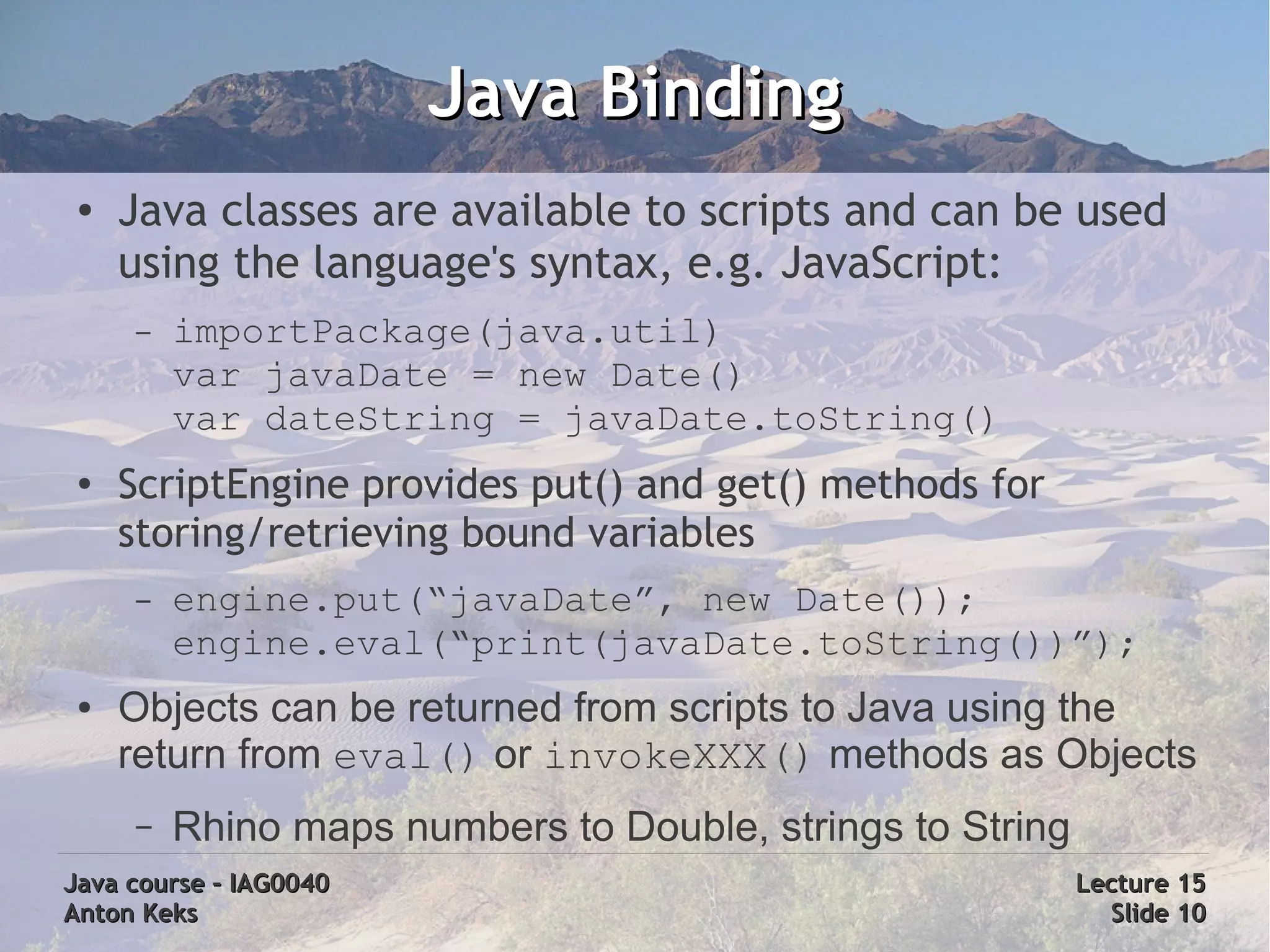
Evaluation / Invocation
●   ScriptEngine's eval() method accepts both String and Reader
    –   so the script can come from virtually any source
    –   ScriptEngine engine = mgr.getEngineByExtension("js");
        engine.eval(new InputStreamReader(
           this.getClass().getResourceAsStream(“runme.js”)));
●   Engines implementing Invocable can invoke individual
    functions or methods
    –   engine.eval(   "function sayHello() {" +
                       " println('Hello, world!');" +
                       "}");
        ((Invocable)engine).invokeFunction("sayHello");
●   Engines implementing Compilable can precompile scripts
    –   ((Compilable)engine).compile("print('Hello')").eval();
Java course – IAG0040                                      Lecture 15
Anton Keks                                                     Slide 9
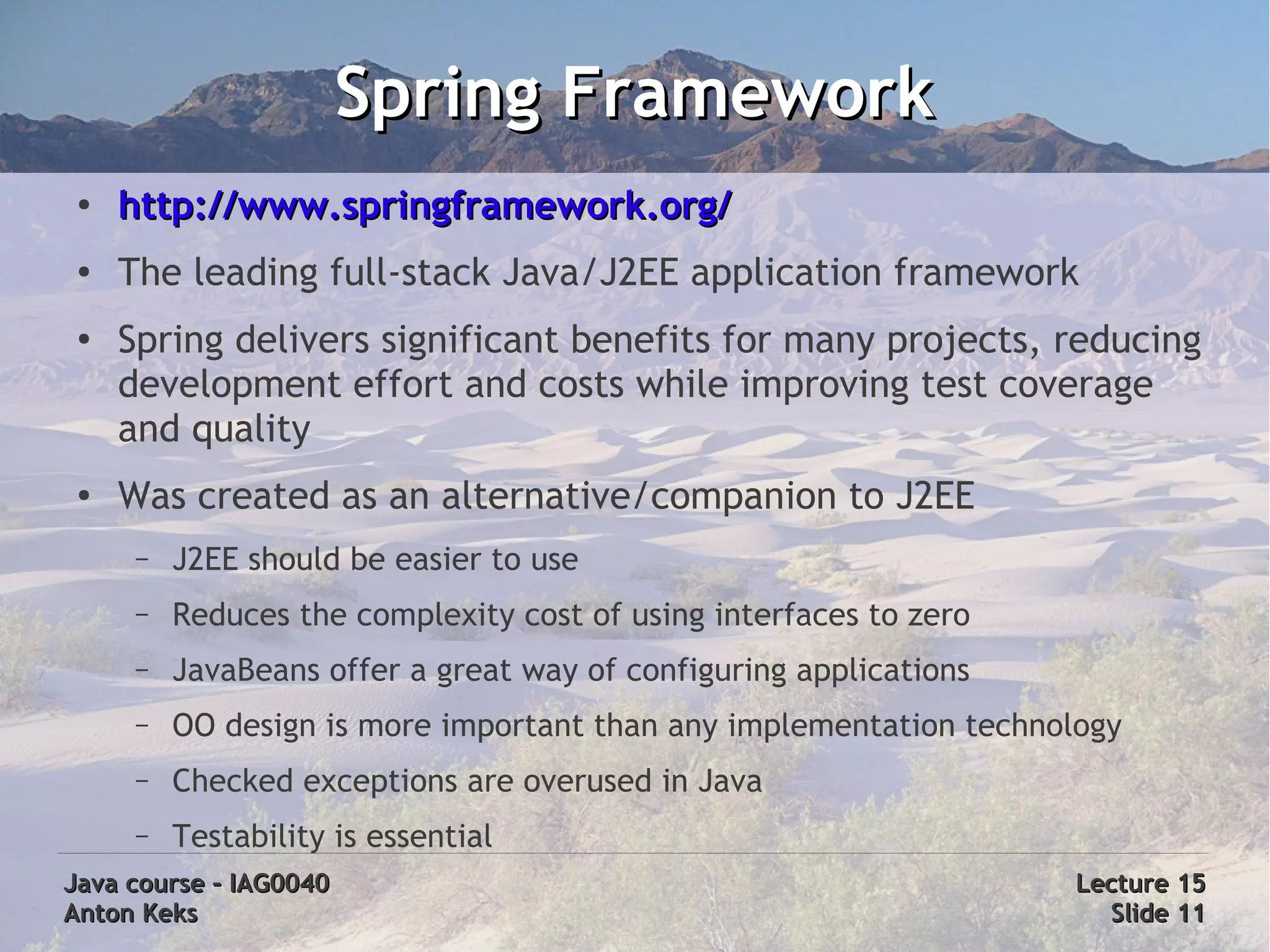
Java Binding
 ●   Java classes are available to scripts and can be used
     using the language's syntax, e.g. JavaScript:
     –   importPackage(java.util)
         var javaDate = new Date()
         var dateString = javaDate.toString()
 ●
     ScriptEngine provides put() and get() methods for
     storing/retrieving bound variables
     –   engine.put(“javaDate”, new Date());
         engine.eval(“print(javaDate.toString())”);
 ●   Objects can be returned from scripts to Java using the
     return from eval() or invokeXXX() methods as Objects
     –   Rhino maps numbers to Double, strings to String
Java course – IAG0040                                      Lecture 15
Anton Keks                                                   Slide 10
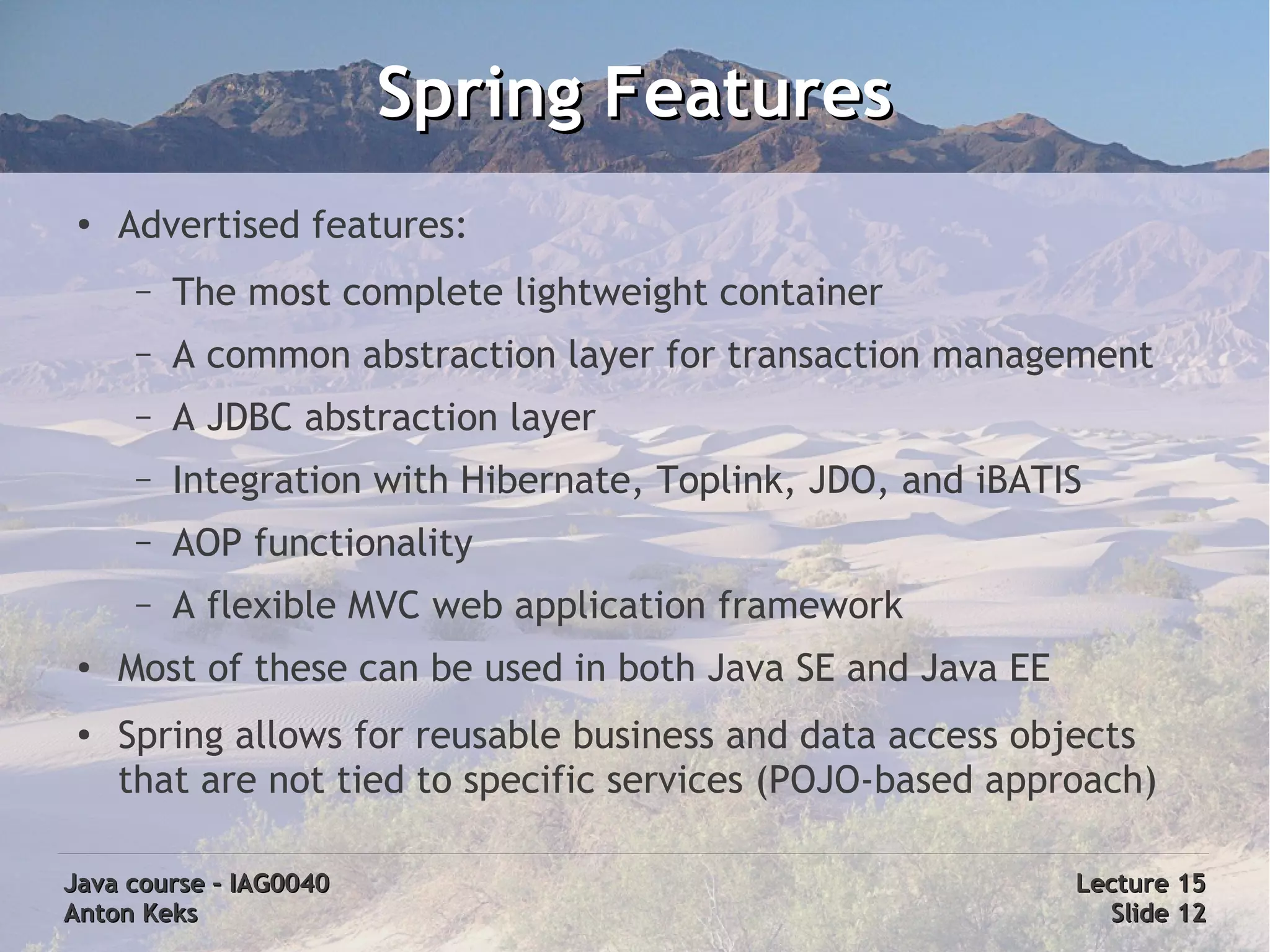
Spring Framework
 ●   http://www.springframework.org/
 ●   The leading full-stack Java/J2EE application framework
 ●
     Spring delivers significant benefits for many projects, reducing
     development effort and costs while improving test coverage
     and quality
 ●   Was created as an alternative/companion to J2EE
      –   J2EE should be easier to use
      –   Reduces the complexity cost of using interfaces to zero
      –   JavaBeans offer a great way of configuring applications
      –   OO design is more important than any implementation technology
      –   Checked exceptions are overused in Java
      –   Testability is essential
Java course – IAG0040                                               Lecture 15
Anton Keks                                                            Slide 11
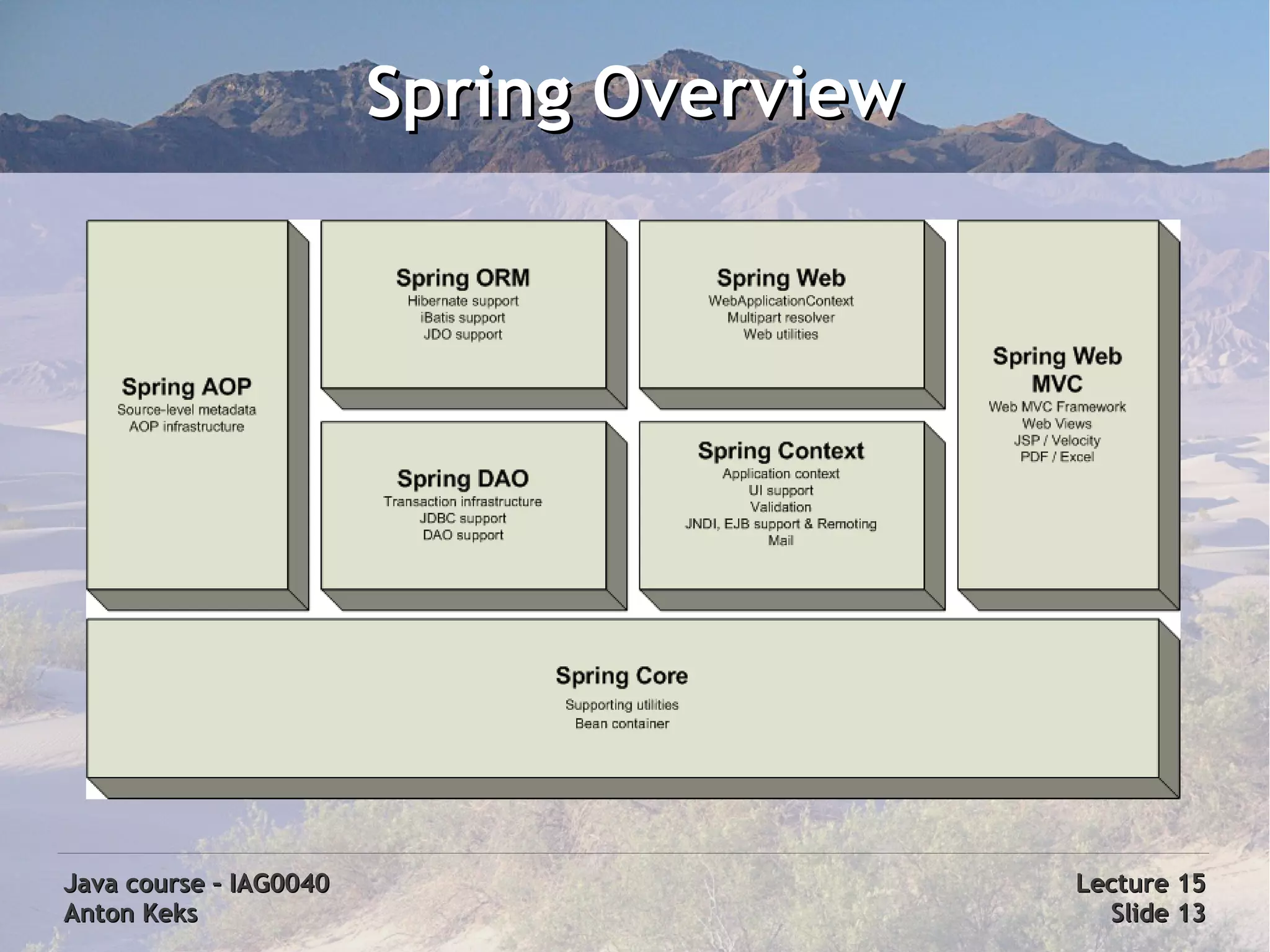
Spring Features
 ●
     Advertised features:
      –   The most complete lightweight container
      –   A common abstraction layer for transaction management
      –   A JDBC abstraction layer
      –   Integration with Hibernate, Toplink, JDO, and iBATIS
      –   AOP functionality
      –   A flexible MVC web application framework
 ●
     Most of these can be used in both Java SE and Java EE
 ●
     Spring allows for reusable business and data access objects
     that are not tied to specific services (POJO-based approach)

Java course – IAG0040                                        Lecture 15
Anton Keks                                                     Slide 12
Spring Overview


Java course – IAG0040                     Lecture 15
Anton Keks                                  Slide 13
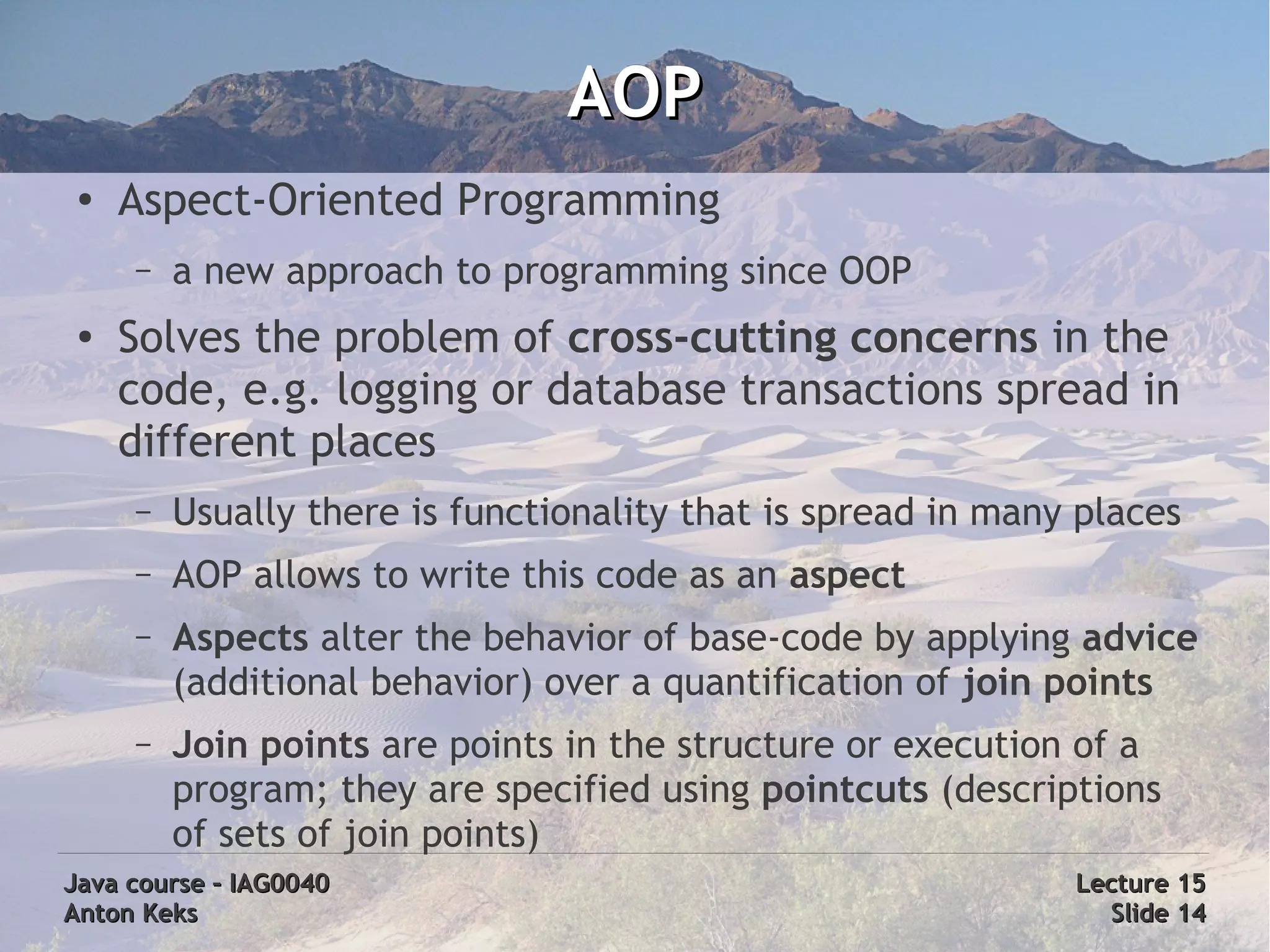
AOP
 ●
     Aspect-Oriented Programming
     –   a new approach to programming since OOP
 ●   Solves the problem of cross-cutting concerns in the
     code, e.g. logging or database transactions spread in
     different places
     –   Usually there is functionality that is spread in many places
     –   AOP allows to write this code as an aspect
     –   Aspects alter the behavior of base-code by applying advice
         (additional behavior) over a quantification of join points
     –   Join points are points in the structure or execution of a
         program; they are specified using pointcuts (descriptions
         of sets of join points)
Java course – IAG0040                                         Lecture 15
Anton Keks                                                      Slide 14
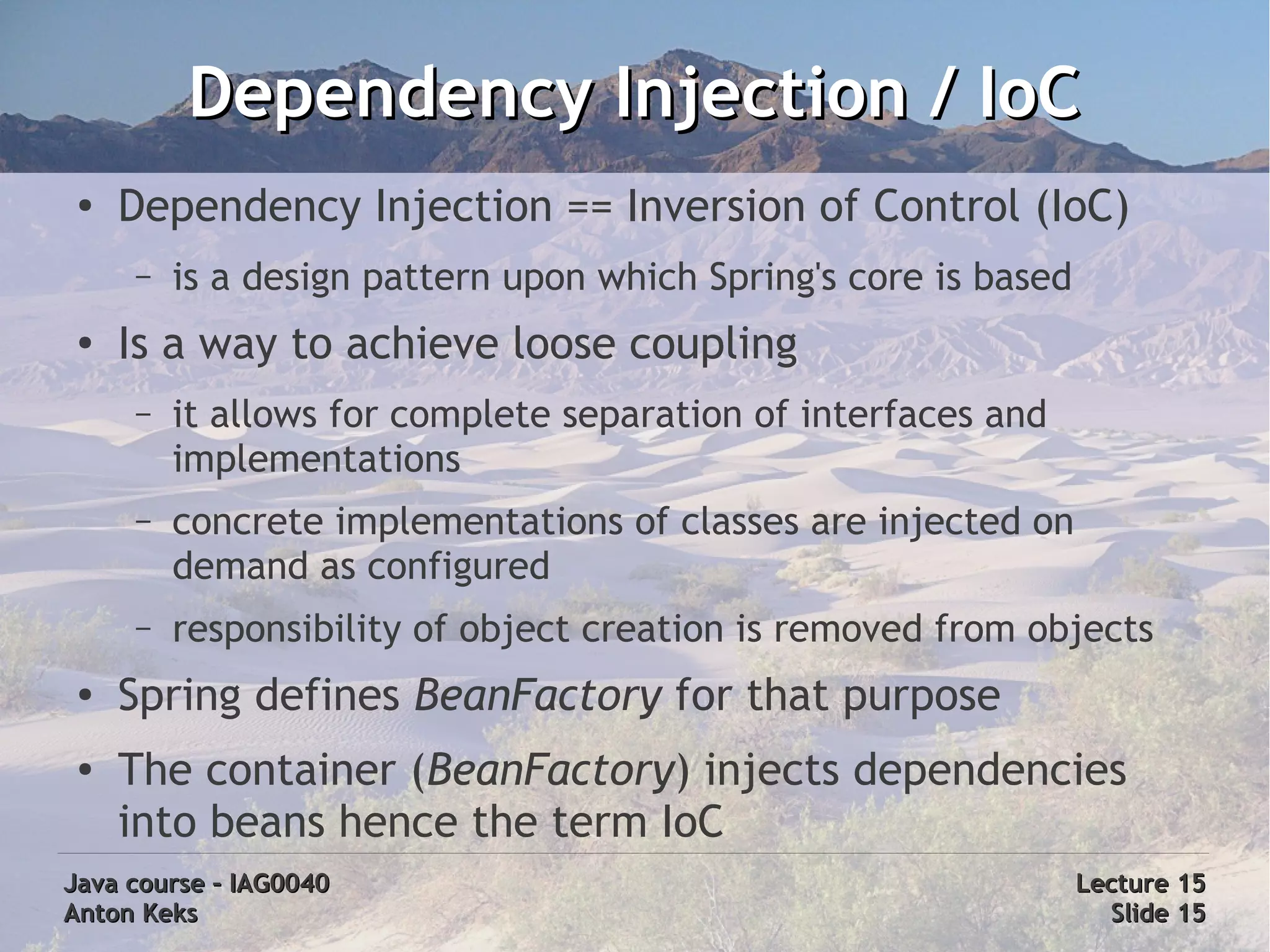
Dependency Injection / IoC
 ●
     Dependency Injection == Inversion of Control (IoC)
     –   is a design pattern upon which Spring's core is based
 ●
     Is a way to achieve loose coupling
     –   it allows for complete separation of interfaces and
         implementations
     –   concrete implementations of classes are injected on
         demand as configured
     –   responsibility of object creation is removed from objects
 ●   Spring defines BeanFactory for that purpose
 ●   The container (BeanFactory) injects dependencies
     into beans hence the term IoC
Java course – IAG0040                                            Lecture 15
Anton Keks                                                         Slide 15
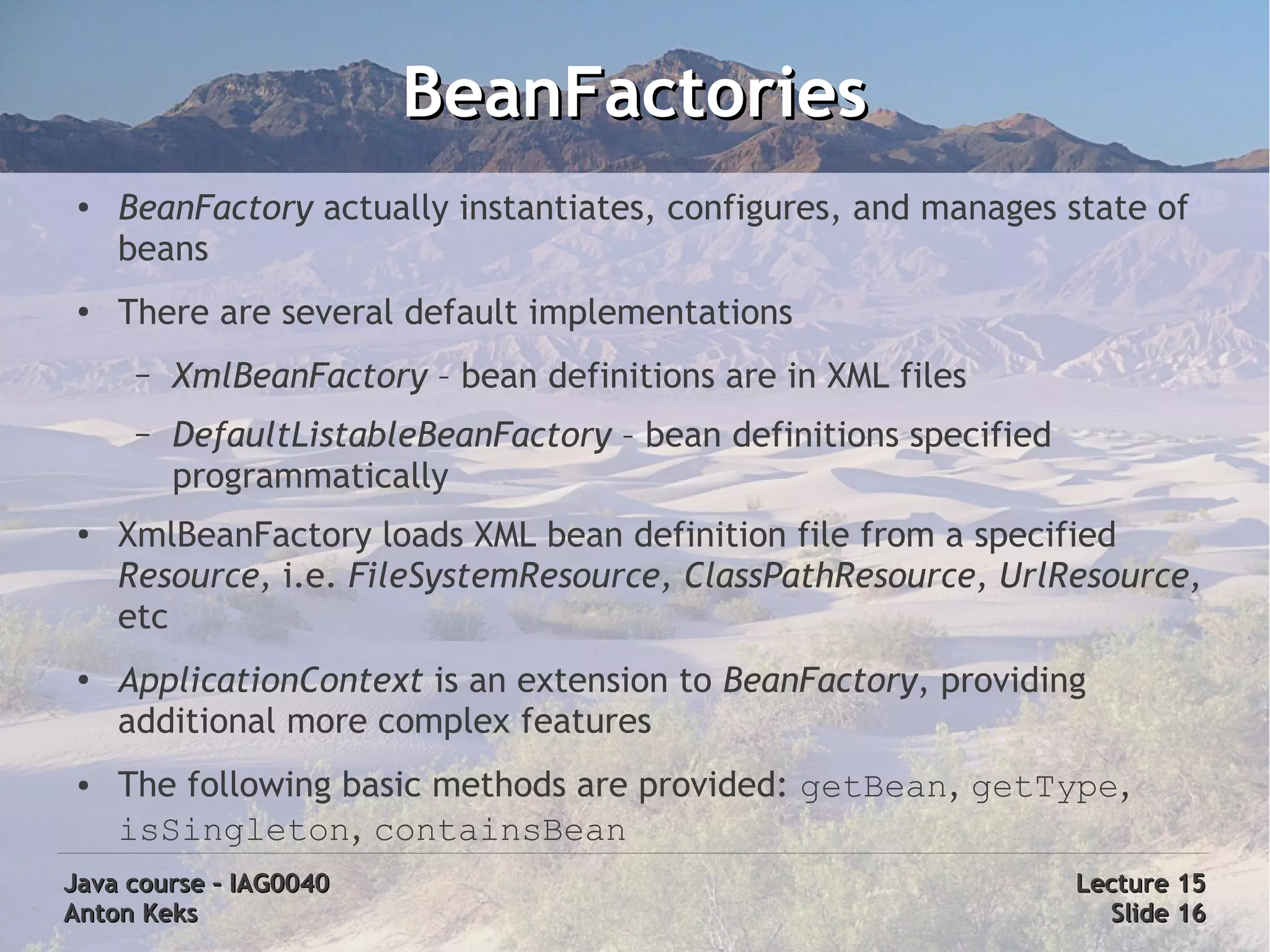
BeanFactories
 ●   BeanFactory actually instantiates, configures, and manages state of
     beans
 ●
     There are several default implementations
      –   XmlBeanFactory – bean definitions are in XML files
      –   DefaultListableBeanFactory – bean definitions specified
          programmatically
 ●
     XmlBeanFactory loads XML bean definition file from a specified
     Resource, i.e. FileSystemResource, ClassPathResource, UrlResource,
     etc
 ●
     ApplicationContext is an extension to BeanFactory, providing
     additional more complex features
 ●   The following basic methods are provided: getBean, getType,
     isSingleton, containsBean
Java course – IAG0040                                               Lecture 15
Anton Keks                                                            Slide 16
Bean definition XML
 ●   Bean definition file:
     <?xml version="1.0" encoding="UTF-8"?>
     <beans xmlns="http://www.springframework.org/schema/beans">
        <bean id="..." class="...">...</bean>
        <bean id="..." class="...">...</bean>
        ...
     </beans>
 ●   Many beans can be defined and configured this way
 ●   Beans define class names, properties, constructor arguments, collaborator
     beans (dependencies), etc
 ●   Beans can be singletons (scope=”singleton”, default) or prototypes
 ●   Autowiring means injection of dependencies automatically either byName or
     byType (autowire attribute, default is none)
 ●   A bean can have FactoryBean specified that creates bean instances


Java course – IAG0040                                                  Lecture 15
Anton Keks                                                               Slide 17
ORM
 ●
     Object-Relational Mapping
      –   links relational databases to object-oriented language concepts,
          creating a “virtual object database”
 ●   The goal is to be able to store and retrieve Java objects or
     their hierarchies using the database
 ●   The most basic scenario:
      –   Java class corresponds to a DB table
      –   Class fields correspond to columns in the table
      –   Java object (instance) corresponds to a row in the table
 ●
     Basic usage (storing and retrieving):
      –   orm.save(myObject);
      –   myObject = orm.load(MyObject.class, objectId);
Java course – IAG0040                                                Lecture 15
Anton Keks                                                             Slide 18
Hibernate
 ●
     http://www.hibernate.org/
 ●
     Is the de-facto standard open-source ORM
     (Object-Relational Mapping) tool
     –   Lets you develop persistent classes following OO
         idiom, including association, inheritance,
         polymorphism, composition, and collections
     –   Provides its own portable object-oriented HQL
         language in addition to native SQL as well as Criteria
         and Example APIs
 ●
     Can be used for persisting of POJOs to database
Java course – IAG0040                                  Lecture 15
Anton Keks                                               Slide 19
Hibernate Mapping
 ●
     Mappings are usually expressed as XML files
 ●   Mapping of class Dog to table DOGS using mapping file Dog.hbm.xml:
 ●   <?xml version="1.0"?>
     <!DOCTYPE hibernate-mapping PUBLIC
     "-//Hibernate/Hibernate Mapping DTD 3.0//EN"
     "http://hibernate.sourceforge.net/hibernate-mapping-3.0.dtd">
     <hibernate-mapping>
        <class name="net.azib.Dog" table="DOGS">
            <id name="id" column="uid" type="long">
               <generator class="increment"/>
            </id>
            <property name="name"/>
            <property name="dateOfBirth" type="date"/>
            <property name="weight" column="mass"/>
        </class>
     </hibernate-mapping>


Java course – IAG0040                                            Lecture 15
Anton Keks                                                         Slide 20
Hibernate Sessions
 ●
     Session is a conversation between the application and the
     persistent store (short-lived, single-threaded)
      –   wraps and hides the real JDBC connection
      –   is used for storing/retrieving of persistent objects
 ●
     SessionFactory is used for creation of Sessions. It caches
     compiled mappings (long-lived, thread-safe)
 ●
     Persistent objects are POJOs, they can be attached to a Session
      –   Upon retrieval, objects are automatically attached to the
          session
      –   Attached objects are automatically checked for changes and
          stored if needed
 ●   Session provides methods like: get, load, save, update, find, etc
Java course – IAG0040                                            Lecture 15
Anton Keks                                                         Slide 21
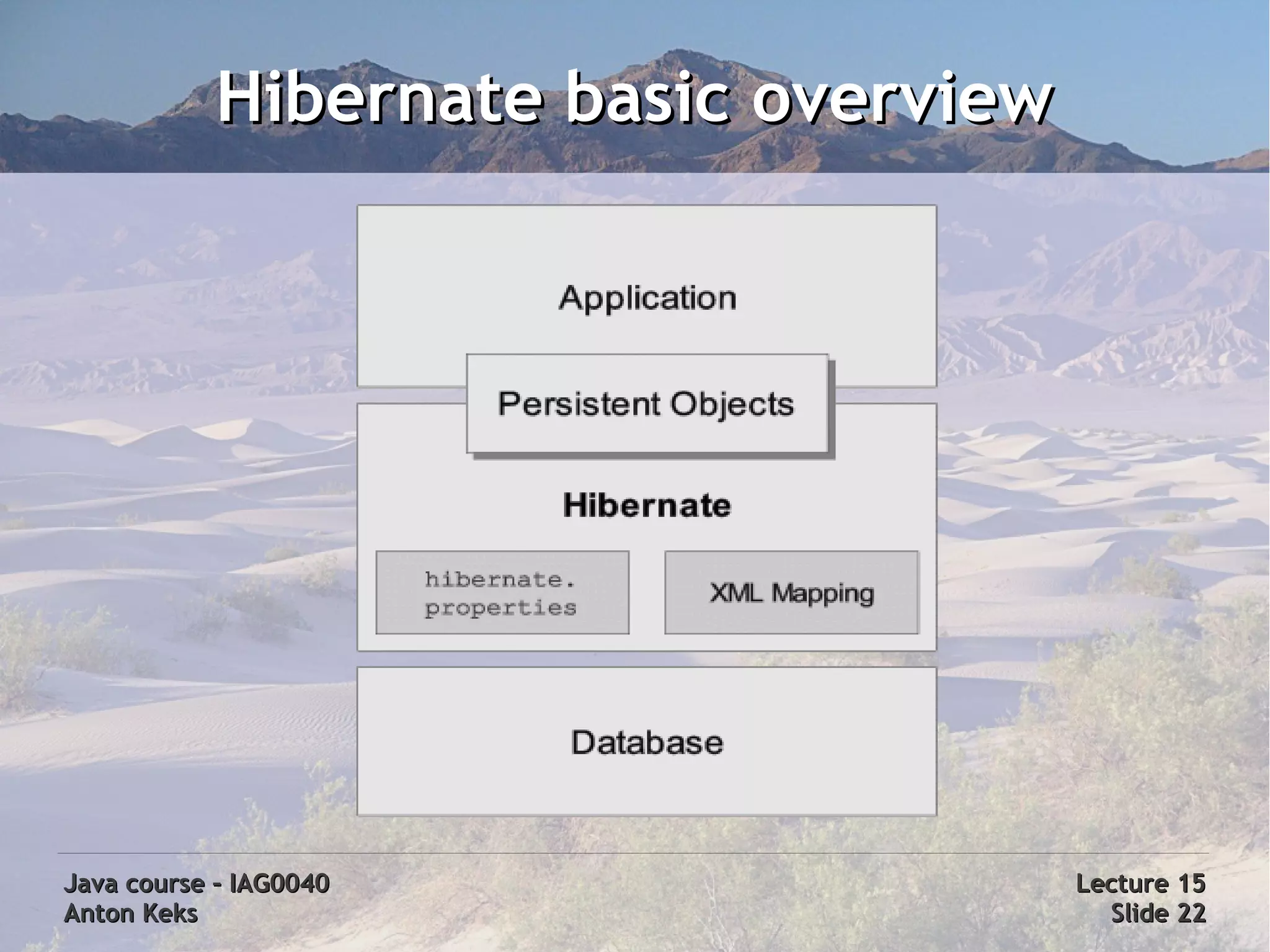
Hibernate basic overview


Java course – IAG0040                 Lecture 15
Anton Keks                              Slide 22
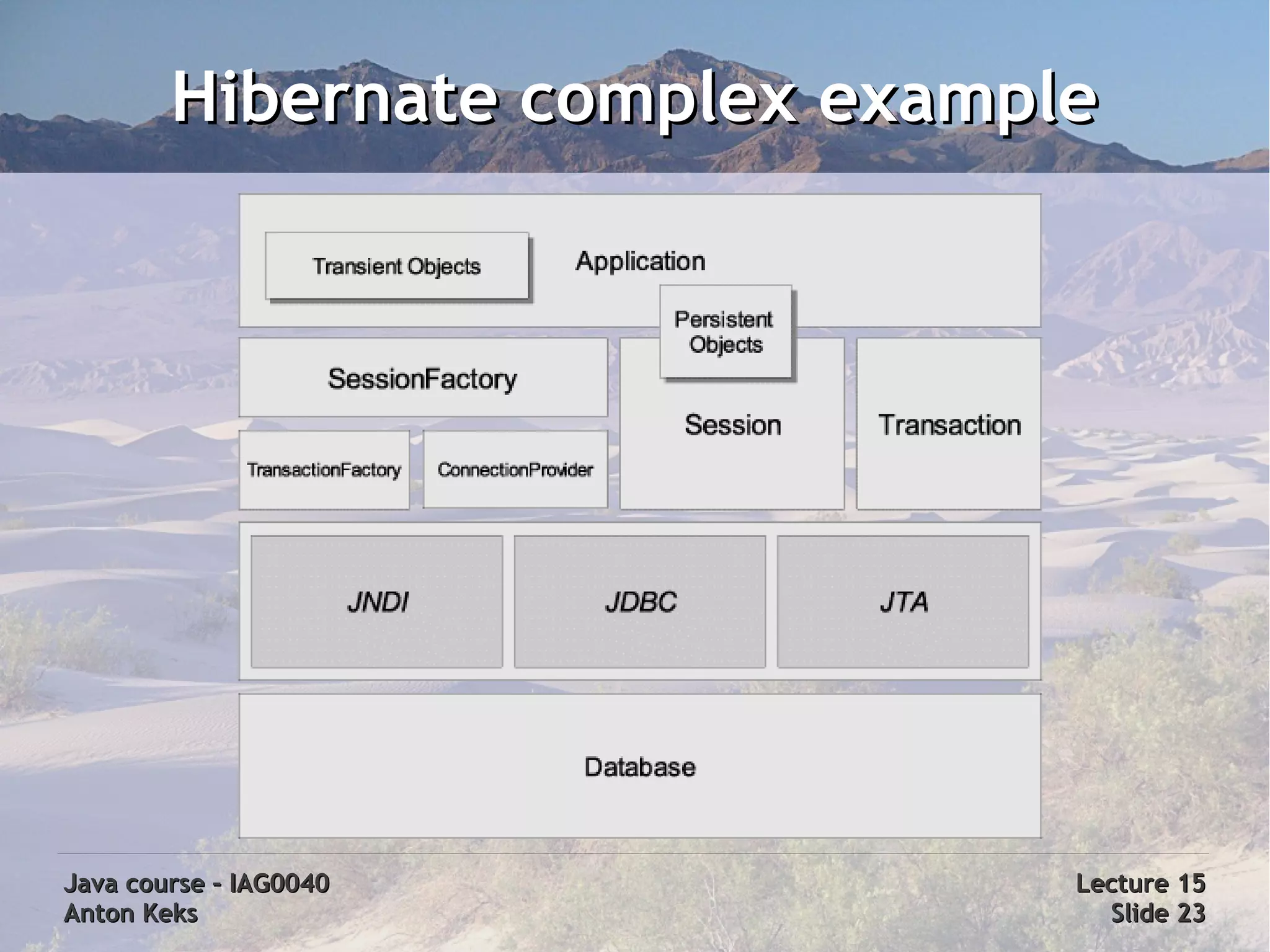
Hibernate complex example


Java course – IAG0040           Lecture 15
Anton Keks                        Slide 23

Java Course 15: Ant, Scripting, Spring, Hibernate

  • 1.
    Java course -IAG0040 Advanced stuff: Ant, Scripting, Spring, Hibernate Anton Keks 2011
  • 2.
    Ant ● Ant == Another Neat Tool, http://ant.apache.org/ ● In short, it is a cross-platform make for Java ● Is the de-facto standard build tool for Java projects ● You just have to write an XML file, describing the build process – usually named build.xml – Java IDEs provides auto-completion, running, and sometimes debugging of Ant build files ● It is also very good for automating of complex tasks Java course – IAG0040 Lecture 15 Anton Keks Slide 2
  • 3.
    Hello, Ant! ● <?xml version="1.0"?> <project name="HelloAnt" default="sayHello" basedir="."> <property name="text.hello" value="Hello, Ant!"/> <target name="sayHello"> <echo>${text.hello}</echo> </target> <target name=”compile” depends=”sayHello”> <javac srcdir=”src” destdir=”bin”/> </target> </project> Java course – IAG0040 Lecture 15 Anton Keks Slide 3
  • 4.
    Ant essentials ● The root tag is <project> that defines the name of the project ● <property> defines global properties for usage within the file – name and value are mandatory attributes – properties are further referenced as ${name} ● <target> specifies runnable build targets (sequences of actions) that can depend on each other – name specifies target's name – if and unless can check whether certain property is set – depends – comma-separated list of other targets – description can be used for documenting Java course – IAG0040 Lecture 15 Anton Keks Slide 4
  • 5.
    Ant essentials (cont) ● Within targets, Ant tasks can be used – There are many predefined tasks, e.g. echo – You can define tasks yourself or run other targets with <antcall> – You can use 3rd-party tasks from jar files ● Many tasks use FileSets – they are filters using patterns to select specific files – ? matches a character, * matches zero or more characters, ** matches zero or more directories (processed recursively) – <fileset dir=”${basedir}” includes=”**/*.java”/> ● <include> and <exclude> can be specified within Java course – IAG0040 Lecture 15 Anton Keks Slide 5
  • 6.
    Most common Anttasks ● Filesystem tasks: – copy, delete, get, mkdir, move, rename, touch, chmod ● Remote tasks: – ftp, scp, sshexec, telnet, setproxy, mail, cvs, cvschangelog ● Compilation and Deployment: – javac, javadoc, rmic, depend, jar, tar, zip, war, gzip ● Testing – junit, junitreport ● Miscellaneous – echo, exec, fail, sleep, buildnumber, condition ● More info at http://ant.apache.org/manual/tasksoverview.html ● Tons of 3rd party tasks available Java course – IAG0040 Lecture 15 Anton Keks Slide 6
  • 7.
    Java Scripting ● Java 1.6 introduced embedded scripting – allows running of scripts inside of the JVM ● scripts can be written in many languages, e.g. JavaScript, Ruby, Groovy, Python, etc ● each language needs its engine to be available ● JavaScript is available by default (Mozilla Rhino) – Scripts and Java classes can interoperate ● Reasons – Java is a platform, not only a language – interoperability, faster development of non-critical code, specific domain usage, etc Java course – IAG0040 Lecture 15 Anton Keks Slide 7
  • 8.
    Java Scripting API ● Java Scripting API is in javax.script package ● ScriptEngine – interface for implementing of different scripting languages ● ScriptEngineFactory – interface for implementing ScriptEngine factories, provides detailed information about the language ● ScriptEngineManager – class for registering and obtaining of ScriptEngines ● ScriptEngineManager mgr = new ScriptEngineManager(); ScriptEngine jsEngine = mgr.getEngineByName("JavaScript"); jsEngine.eval("print('Hello, world!')"); Java course – IAG0040 Lecture 15 Anton Keks Slide 8
  • 9.
    Evaluation / Invocation ● ScriptEngine's eval() method accepts both String and Reader – so the script can come from virtually any source – ScriptEngine engine = mgr.getEngineByExtension("js"); engine.eval(new InputStreamReader( this.getClass().getResourceAsStream(“runme.js”))); ● Engines implementing Invocable can invoke individual functions or methods – engine.eval( "function sayHello() {" + " println('Hello, world!');" + "}"); ((Invocable)engine).invokeFunction("sayHello"); ● Engines implementing Compilable can precompile scripts – ((Compilable)engine).compile("print('Hello')").eval(); Java course – IAG0040 Lecture 15 Anton Keks Slide 9
  • 10.
    Java Binding ● Java classes are available to scripts and can be used using the language's syntax, e.g. JavaScript: – importPackage(java.util) var javaDate = new Date() var dateString = javaDate.toString() ● ScriptEngine provides put() and get() methods for storing/retrieving bound variables – engine.put(“javaDate”, new Date()); engine.eval(“print(javaDate.toString())”); ● Objects can be returned from scripts to Java using the return from eval() or invokeXXX() methods as Objects – Rhino maps numbers to Double, strings to String Java course – IAG0040 Lecture 15 Anton Keks Slide 10
  • 11.
    Spring Framework ● http://www.springframework.org/ ● The leading full-stack Java/J2EE application framework ● Spring delivers significant benefits for many projects, reducing development effort and costs while improving test coverage and quality ● Was created as an alternative/companion to J2EE – J2EE should be easier to use – Reduces the complexity cost of using interfaces to zero – JavaBeans offer a great way of configuring applications – OO design is more important than any implementation technology – Checked exceptions are overused in Java – Testability is essential Java course – IAG0040 Lecture 15 Anton Keks Slide 11
  • 12.
    Spring Features ● Advertised features: – The most complete lightweight container – A common abstraction layer for transaction management – A JDBC abstraction layer – Integration with Hibernate, Toplink, JDO, and iBATIS – AOP functionality – A flexible MVC web application framework ● Most of these can be used in both Java SE and Java EE ● Spring allows for reusable business and data access objects that are not tied to specific services (POJO-based approach) Java course – IAG0040 Lecture 15 Anton Keks Slide 12
  • 13.
    Spring Overview Java course– IAG0040 Lecture 15 Anton Keks Slide 13
  • 14.
    AOP ● Aspect-Oriented Programming – a new approach to programming since OOP ● Solves the problem of cross-cutting concerns in the code, e.g. logging or database transactions spread in different places – Usually there is functionality that is spread in many places – AOP allows to write this code as an aspect – Aspects alter the behavior of base-code by applying advice (additional behavior) over a quantification of join points – Join points are points in the structure or execution of a program; they are specified using pointcuts (descriptions of sets of join points) Java course – IAG0040 Lecture 15 Anton Keks Slide 14
  • 15.
    Dependency Injection /IoC ● Dependency Injection == Inversion of Control (IoC) – is a design pattern upon which Spring's core is based ● Is a way to achieve loose coupling – it allows for complete separation of interfaces and implementations – concrete implementations of classes are injected on demand as configured – responsibility of object creation is removed from objects ● Spring defines BeanFactory for that purpose ● The container (BeanFactory) injects dependencies into beans hence the term IoC Java course – IAG0040 Lecture 15 Anton Keks Slide 15
  • 16.
    BeanFactories ● BeanFactory actually instantiates, configures, and manages state of beans ● There are several default implementations – XmlBeanFactory – bean definitions are in XML files – DefaultListableBeanFactory – bean definitions specified programmatically ● XmlBeanFactory loads XML bean definition file from a specified Resource, i.e. FileSystemResource, ClassPathResource, UrlResource, etc ● ApplicationContext is an extension to BeanFactory, providing additional more complex features ● The following basic methods are provided: getBean, getType, isSingleton, containsBean Java course – IAG0040 Lecture 15 Anton Keks Slide 16
  • 17.
    Bean definition XML ● Bean definition file: <?xml version="1.0" encoding="UTF-8"?> <beans xmlns="http://www.springframework.org/schema/beans"> <bean id="..." class="...">...</bean> <bean id="..." class="...">...</bean> ... </beans> ● Many beans can be defined and configured this way ● Beans define class names, properties, constructor arguments, collaborator beans (dependencies), etc ● Beans can be singletons (scope=”singleton”, default) or prototypes ● Autowiring means injection of dependencies automatically either byName or byType (autowire attribute, default is none) ● A bean can have FactoryBean specified that creates bean instances Java course – IAG0040 Lecture 15 Anton Keks Slide 17
  • 18.
    ORM ● Object-Relational Mapping – links relational databases to object-oriented language concepts, creating a “virtual object database” ● The goal is to be able to store and retrieve Java objects or their hierarchies using the database ● The most basic scenario: – Java class corresponds to a DB table – Class fields correspond to columns in the table – Java object (instance) corresponds to a row in the table ● Basic usage (storing and retrieving): – orm.save(myObject); – myObject = orm.load(MyObject.class, objectId); Java course – IAG0040 Lecture 15 Anton Keks Slide 18
  • 19.
    Hibernate ● http://www.hibernate.org/ ● Is the de-facto standard open-source ORM (Object-Relational Mapping) tool – Lets you develop persistent classes following OO idiom, including association, inheritance, polymorphism, composition, and collections – Provides its own portable object-oriented HQL language in addition to native SQL as well as Criteria and Example APIs ● Can be used for persisting of POJOs to database Java course – IAG0040 Lecture 15 Anton Keks Slide 19
  • 20.
    Hibernate Mapping ● Mappings are usually expressed as XML files ● Mapping of class Dog to table DOGS using mapping file Dog.hbm.xml: ● <?xml version="1.0"?> <!DOCTYPE hibernate-mapping PUBLIC "-//Hibernate/Hibernate Mapping DTD 3.0//EN" "http://hibernate.sourceforge.net/hibernate-mapping-3.0.dtd"> <hibernate-mapping> <class name="net.azib.Dog" table="DOGS"> <id name="id" column="uid" type="long"> <generator class="increment"/> </id> <property name="name"/> <property name="dateOfBirth" type="date"/> <property name="weight" column="mass"/> </class> </hibernate-mapping> Java course – IAG0040 Lecture 15 Anton Keks Slide 20
  • 21.
    Hibernate Sessions ● Session is a conversation between the application and the persistent store (short-lived, single-threaded) – wraps and hides the real JDBC connection – is used for storing/retrieving of persistent objects ● SessionFactory is used for creation of Sessions. It caches compiled mappings (long-lived, thread-safe) ● Persistent objects are POJOs, they can be attached to a Session – Upon retrieval, objects are automatically attached to the session – Attached objects are automatically checked for changes and stored if needed ● Session provides methods like: get, load, save, update, find, etc Java course – IAG0040 Lecture 15 Anton Keks Slide 21
  • 22.
    Hibernate basic overview Javacourse – IAG0040 Lecture 15 Anton Keks Slide 22
  • 23.
    Hibernate complex example Javacourse – IAG0040 Lecture 15 Anton Keks Slide 23