5G Wireless Technology
Presented by:
NAME:
1. Shreyash Ganeshkar
2. Rehan Shaikh
A.G. PATIL POLYTECHNIC INSTITUTE
SOLAPUR.
Contents…
▶ Introduction to 5G
▶ Evolution from 1G to 5G
▶ Key Concepts
▶ Architecture
▶ Hardware and Software of 5g
▶ Features
▶ Advantages
▶ Applications
▶ Conclusion
Introduction to 5G
▶ What is 5G ?
▶ What does it offer ?
What is 5G ?
 5G Wireless is 5th generation wireless
technology
 It is a complete wireless communication with
almost no limitations
 Can be also called as REAL wireless world
 Has incredible transmission speed
 Higher and better performance
What does it offer ?
 Worldwide cellular phones
 Extraordinary data capabilities
 High connectivity
 More power and features in hand held phones
 Large phone memory, more dialing speed,
higher clarity in audio and video
Evolution from 1G to 5G
 1G
 2G
 3G
 4G
 5G
1G
• Developed in 1980s & was completed in the
early 1990s
• Based on analog system
• Speed up to 2.4 kbps
• AMPS was launched by the US & it was the
first 1G mobile system
• Allowed users to make voice calls within the
country only
2G
• Developed in late 1980s and completed in
late 1990s
• Based on digital system
• Speed up to 64 kbps
• Services such as digital voice and SMS
had more clarity
• Semi global facility
3G
• Developed between late 1990s & early 2000s
until present day
• Transmission speed from 125 kbps to 2 Mbps
• Superior voice quality
• Good clarity in video conferences
• Enabled features such as E-mail, PDA,
information surfing, online shopping/banking,
games, etc.
• Global roaming facility
4G
• Developed in 2010
• Faster and more reliable
• Speed up to 100 Mbps
• High performance
• Easy roaming
• Low cost
5G
• Next major phase of mobile
telecommunication and wireless system
• T
en times more capacity than others
• Expected speed up to 1 Gbps
• More faster and reliable than 4G
• Lower cost than previous generations
Key concepts…
▶ Real wireless world with no more limitations with access and
zone issues
▶ Wearable devices
▶ IPv6, where a visiting care of mobile IP address is assigned
according to location and connected network
▶ One unified global standard
▶ Smart radio
▶ The user can simultaneously be connected with several
wireless access technology
▶ Multiple concurrent data transfer path
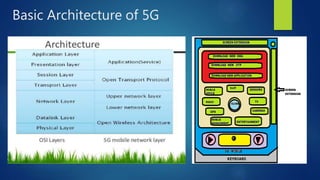
Basic Architecture of 5G
Open Wireless Architecture (OWA)
▶OSI layer 1 & OSI layer 2 define the wireless
technology
▶For these two layers the 5G mobile networks
is likely to be based on Open Wireless
Architecture(OWA)
▶Physical layer + Data link Layer = OWA
Reference:
https://www.geeksforgeeks.org
https://en.wikipedia.org
https://www.javatpoint.com
https://www.youtube.com

Introduction to Artificial intelligence and data science

  • 1.
    5G Wireless Technology Presentedby: NAME: 1. Shreyash Ganeshkar 2. Rehan Shaikh A.G. PATIL POLYTECHNIC INSTITUTE SOLAPUR.
  • 3.
    Contents… ▶ Introduction to5G ▶ Evolution from 1G to 5G ▶ Key Concepts ▶ Architecture ▶ Hardware and Software of 5g ▶ Features ▶ Advantages ▶ Applications ▶ Conclusion
  • 4.
    Introduction to 5G ▶What is 5G ? ▶ What does it offer ?
  • 5.
    What is 5G?  5G Wireless is 5th generation wireless technology  It is a complete wireless communication with almost no limitations  Can be also called as REAL wireless world  Has incredible transmission speed  Higher and better performance
  • 6.
    What does itoffer ?  Worldwide cellular phones  Extraordinary data capabilities  High connectivity  More power and features in hand held phones  Large phone memory, more dialing speed, higher clarity in audio and video
  • 7.
    Evolution from 1Gto 5G  1G  2G  3G  4G  5G
  • 8.
    1G • Developed in1980s & was completed in the early 1990s • Based on analog system • Speed up to 2.4 kbps • AMPS was launched by the US & it was the first 1G mobile system • Allowed users to make voice calls within the country only
  • 9.
    2G • Developed inlate 1980s and completed in late 1990s • Based on digital system • Speed up to 64 kbps • Services such as digital voice and SMS had more clarity • Semi global facility
  • 10.
    3G • Developed betweenlate 1990s & early 2000s until present day • Transmission speed from 125 kbps to 2 Mbps • Superior voice quality • Good clarity in video conferences • Enabled features such as E-mail, PDA, information surfing, online shopping/banking, games, etc. • Global roaming facility
  • 11.
    4G • Developed in2010 • Faster and more reliable • Speed up to 100 Mbps • High performance • Easy roaming • Low cost
  • 12.
    5G • Next majorphase of mobile telecommunication and wireless system • T en times more capacity than others • Expected speed up to 1 Gbps • More faster and reliable than 4G • Lower cost than previous generations
  • 13.
    Key concepts… ▶ Realwireless world with no more limitations with access and zone issues ▶ Wearable devices ▶ IPv6, where a visiting care of mobile IP address is assigned according to location and connected network ▶ One unified global standard ▶ Smart radio ▶ The user can simultaneously be connected with several wireless access technology ▶ Multiple concurrent data transfer path
  • 14.
  • 15.
    Open Wireless Architecture(OWA) ▶OSI layer 1 & OSI layer 2 define the wireless technology ▶For these two layers the 5G mobile networks is likely to be based on Open Wireless Architecture(OWA) ▶Physical layer + Data link Layer = OWA
  • 16.