Webinar Panel
Brad Douglas, CEO Mark Wigginton, RVPMallary Price, Moderator Daryl Jones, SVP
Receive CEUs for maintaining APMP Certification
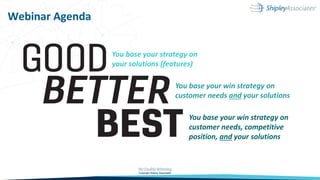
You base your strategy on
your solutions (features)
You base your win strategy on
customer needs and your solutions
You base your win strategy on
customer needs, competitive
position, and your solutions
Webinar Agenda
A win strategy is built around our strengths –
we leverage strengths while mitigating weaknesses.
A win strategy also helps us fill gaps in our solution
or competitive position.
A win strategy helps us identify actions
we can take to improve our Pwin.
A Win Strategy is Not…
 A theme statement
 A hunch
 Your best guess
 Low price (sometimes)
 Based only on compliance
 All about us
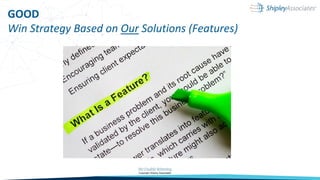
GOOD
Win Strategy Based on Our Solutions (Features)
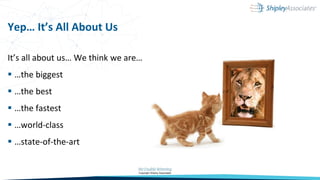
Yep… It’s All About Us
It’s all about us… We think we are…
 …the biggest
 …the best
 …the fastest
 …world-class
 …state-of-the-art
Good May Not Be Good Enough to Win
 If you don’t know customer needs, you’re guessing
 Hope is not a strategy
 Entering the race late? Proceed with caution
 Opportunity qualification is a must on all pursuits
 What message are you sending to the customer?
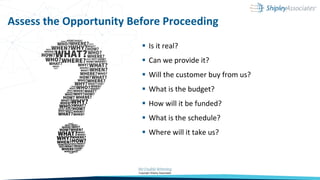
Assess the Opportunity Before Proceeding
 Is it real?
 Can we provide it?
 Will the customer buy from us?
 What is the budget?
 How will it be funded?
 What is the schedule?
 Where will it take us?
BETTER
Win Strategy Based on Your Solutions and Customer Needs
Solutions Based on Needs = Benefits
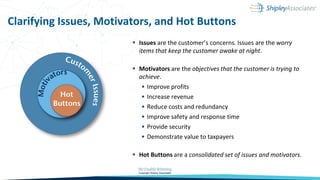
Clarifying Issues, Motivators, and Hot Buttons
 Issues are the customer’s concerns. Issues are the worry
items that keep the customer awake at night.
 Motivators are the objectives that the customer is trying to
achieve.
• Improve profits
• Increase revenue
• Reduce costs and redundancy
• Improve safety and response time
• Provide security
• Demonstrate value to taxpayers
 Hot Buttons are a consolidated set of issues and motivators.
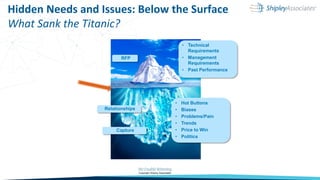
Hidden Needs and Issues: Below the Surface
What Sank the Titanic?
• Technical
Requirements
• Management
Requirements
• Past Performance
• Hot Buttons
• Biases
• Problems/Pain
• Trends
• Price to Win
• Politics
RFP
Relationships
Capture
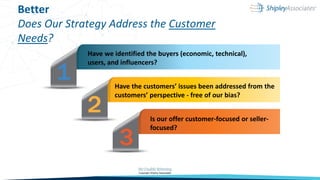
Better
Does Our Strategy Address the Customer
Needs?
Have we identified the buyers (economic, technical),
users, and influencers?
Have the customers’ issues been addressed from the
customers’ perspective - free of our bias?
Is our offer customer-focused or seller-
focused?
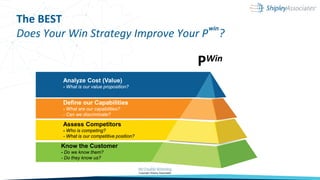
The BEST
Does Your Win Strategy Improve Your P ?
PWin
win
Analyze Cost (Value)
- What is our value proposition?
Define our Capabilities
- What are our capabilities?
- Can we discriminate?
Assess Competitors
- Who is competing?
- What is our competitive position?
Know the Customer
- Do we know them?
- Do they know us?
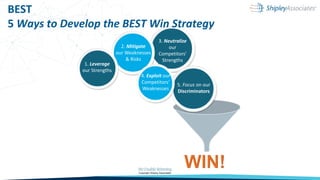
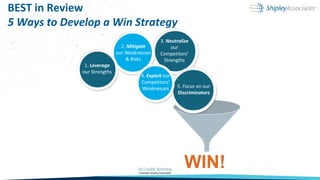
3. Neutralize
our
Competitors’
Strengths
BEST
5 Ways to Develop the BEST Win Strategy
1. Leverage
our Strengths
2. Mitigate
our Weaknesses
& Risks
5. Focus on our
Discriminators
4. Exploit our
Competitors’
Weaknesses
What strategy is all about—what distinguishes it
from all other kinds of plans—is, in a word,
competitive advantage.
Without competitors there would be no need for
strategy, for the sole purpose of strategic
planning is to enable the company to gain, as
efficiently as possible, a sustainable edge over
its competitors.
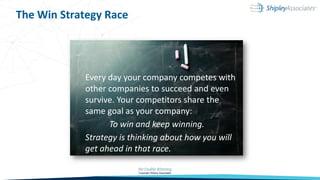
The Win Strategy Race
Every day your company competes with
other companies to succeed and even
survive. Your competitors share the
same goal as your company:
To win and keep winning.
Strategy is thinking about how you will
get ahead in that race.
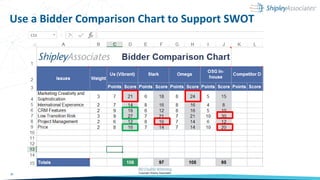
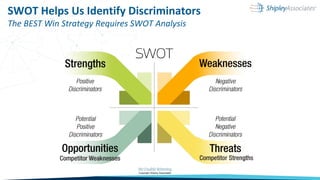
SWOT Helps Us Identify Discriminators
The BEST Win Strategy Requires SWOT Analysis
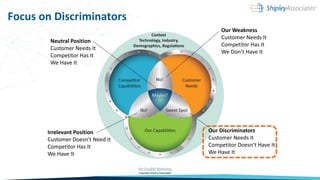
Focus on Discriminators
Neutral Position
Customer Needs It
Competitor Has It
We Have It
Irrelevant Position
Customer Doesn’t Need It
Competitor Has It
We Have It
Our Weakness
Customer Needs It
Competitor Has It
We Don’t Have It
Our Discriminators
Customer Needs It
Competitor Doesn’t Have It
We Have It
Use a Bidder Comparison Chart to Support SWOT
21
3. Neutralize
our
Competitors’
Strengths
BEST in Review
5 Ways to Develop a Win Strategy
1. Leverage
our Strengths
2. Mitigate
our Weaknesses
& Risks
5. Focus on our
Discriminators
4. Exploit our
Competitors’
Weaknesses
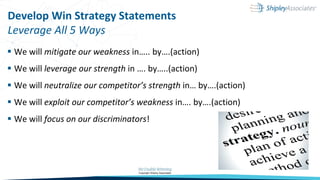
Develop Win Strategy Statements
Leverage All 5 Ways
 We will mitigate our weakness in….. by….(action)
 We will leverage our strength in …. by…..(action)
 We will neutralize our competitor’s strength in… by….(action)
 We will exploit our competitor’s weakness in…. by….(action)
 We will focus on our discriminators!
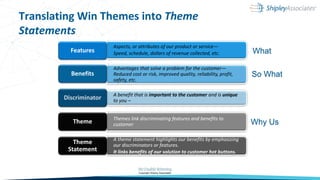
Translating Win Themes into Theme
Statements
A benefit that is important to the customer and is unique
to you –Discriminator
A theme statement highlights our benefits by emphasizing
our discriminators or features.
It links benefits of our solution to customer hot buttons.
Theme
Statement
Aspects, or attributes of our product or service—
Speed, schedule, dollars of revenue collected, etc.Features What
Advantages that solve a problem for the customer—
Reduced cost or risk, improved quality, reliability, profit,
safety, etc.
Benefits So What
Themes link discriminating features and benefits to
customerTheme Why Us
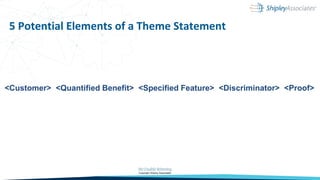
5 Potential Elements of a Theme Statement
<Customer> <Quantified Benefit> <Specified Feature> <Discriminator> <Proof>
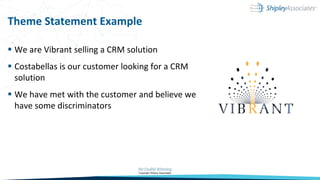
Theme Statement Example
 We are Vibrant selling a CRM solution
 Costabellas is our customer looking for a CRM
solution
 We have met with the customer and believe we
have some discriminators
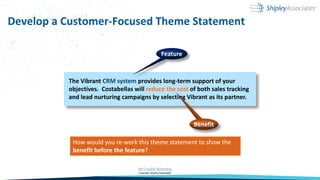
Develop a Customer-Focused Theme Statement
The Vibrant CRM system provides long-term support of your
objectives. Costabellas will reduce the cost of both sales tracking
and lead nurturing campaigns by selecting Vibrant as its partner.
Feature
Benefit
How would you re-work this theme statement to show the
benefit before the feature?
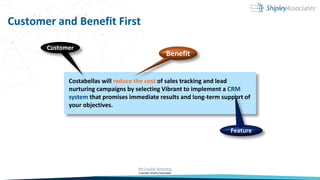
Customer and Benefit First
Costabellas will reduce the cost of sales tracking and lead
nurturing campaigns by selecting Vibrant to implement a CRM
system that promises immediate results and long-term support of
your objectives.
Feature
Benefit
Customer
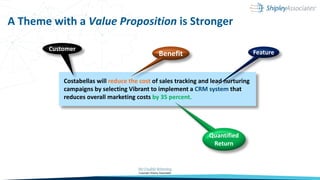
A Theme with a Value Proposition is Stronger
Costabellas will reduce the cost of sales tracking and lead nurturing
campaigns by selecting Vibrant to implement a CRM system that
reduces overall marketing costs by 35 percent.
Feature
Quantified
Return
Benefit
Customer
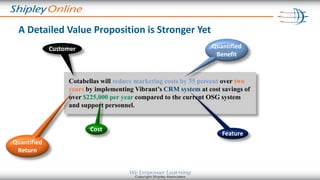
Cotabellas will reduce marketing costs by 35 percent over two
years by implementing Vibrant’s CRM system at cost savings of
over $225,000 per year compared to the current OSG system
and support personnel.
A Detailed Value Proposition is Stronger Yet
Feature
Cost
Quantified
Return
Quantified
Benefit
Customer
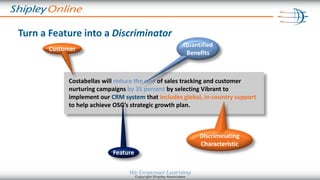
Costabellas will reduce the cost of sales tracking and customer
nurturing campaigns by 35 percent by selecting Vibrant to
implement our CRM system that includes global, in-country support
to help achieve OSG’s strategic growth plan.
Turn a Feature into a Discriminator
Discriminating
Characteristic
Feature
Quantified
Benefits
Customer
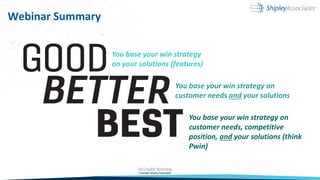
You base your win strategy
on your solutions (features)
You base your win strategy on
customer needs and your solutions
You base your win strategy on
customer needs, competitive
position, and your solutions (think
Pwin)
Webinar Summary
Follow Shipley on social media:
ShipleyAssociates
@shipleywins
Shipley Associates
Shipley University
Shipley Associates
Questions
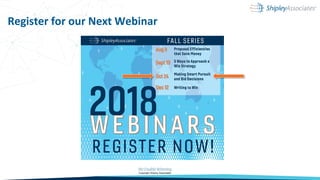
Register for our Next Webinar
Thank You!
questions@shipleywins.com
www.shipleywins.com

5 Ways to Approach a Win Strategy

  • 2.
    Webinar Panel Brad Douglas,CEO Mark Wigginton, RVPMallary Price, Moderator Daryl Jones, SVP Receive CEUs for maintaining APMP Certification
  • 3.
    You base yourstrategy on your solutions (features) You base your win strategy on customer needs and your solutions You base your win strategy on customer needs, competitive position, and your solutions Webinar Agenda
  • 4.
    A win strategyis built around our strengths – we leverage strengths while mitigating weaknesses. A win strategy also helps us fill gaps in our solution or competitive position. A win strategy helps us identify actions we can take to improve our Pwin.
  • 5.
    A Win Strategyis Not…  A theme statement  A hunch  Your best guess  Low price (sometimes)  Based only on compliance  All about us
  • 6.
    GOOD Win Strategy Basedon Our Solutions (Features)
  • 7.
    Yep… It’s AllAbout Us It’s all about us… We think we are…  …the biggest  …the best  …the fastest  …world-class  …state-of-the-art
  • 8.
    Good May NotBe Good Enough to Win  If you don’t know customer needs, you’re guessing  Hope is not a strategy  Entering the race late? Proceed with caution  Opportunity qualification is a must on all pursuits  What message are you sending to the customer?
  • 9.
    Assess the OpportunityBefore Proceeding  Is it real?  Can we provide it?  Will the customer buy from us?  What is the budget?  How will it be funded?  What is the schedule?  Where will it take us?
  • 10.
    BETTER Win Strategy Basedon Your Solutions and Customer Needs Solutions Based on Needs = Benefits
  • 11.
    Clarifying Issues, Motivators,and Hot Buttons  Issues are the customer’s concerns. Issues are the worry items that keep the customer awake at night.  Motivators are the objectives that the customer is trying to achieve. • Improve profits • Increase revenue • Reduce costs and redundancy • Improve safety and response time • Provide security • Demonstrate value to taxpayers  Hot Buttons are a consolidated set of issues and motivators.
  • 12.
    Hidden Needs andIssues: Below the Surface What Sank the Titanic? • Technical Requirements • Management Requirements • Past Performance • Hot Buttons • Biases • Problems/Pain • Trends • Price to Win • Politics RFP Relationships Capture
  • 13.
    Better Does Our StrategyAddress the Customer Needs? Have we identified the buyers (economic, technical), users, and influencers? Have the customers’ issues been addressed from the customers’ perspective - free of our bias? Is our offer customer-focused or seller- focused?
  • 14.
    The BEST Does YourWin Strategy Improve Your P ? PWin win Analyze Cost (Value) - What is our value proposition? Define our Capabilities - What are our capabilities? - Can we discriminate? Assess Competitors - Who is competing? - What is our competitive position? Know the Customer - Do we know them? - Do they know us?
  • 15.
    3. Neutralize our Competitors’ Strengths BEST 5 Waysto Develop the BEST Win Strategy 1. Leverage our Strengths 2. Mitigate our Weaknesses & Risks 5. Focus on our Discriminators 4. Exploit our Competitors’ Weaknesses
  • 16.
    What strategy isall about—what distinguishes it from all other kinds of plans—is, in a word, competitive advantage. Without competitors there would be no need for strategy, for the sole purpose of strategic planning is to enable the company to gain, as efficiently as possible, a sustainable edge over its competitors.
  • 17.
    The Win StrategyRace Every day your company competes with other companies to succeed and even survive. Your competitors share the same goal as your company: To win and keep winning. Strategy is thinking about how you will get ahead in that race.
  • 18.
    SWOT Helps UsIdentify Discriminators The BEST Win Strategy Requires SWOT Analysis
  • 19.
    Focus on Discriminators NeutralPosition Customer Needs It Competitor Has It We Have It Irrelevant Position Customer Doesn’t Need It Competitor Has It We Have It Our Weakness Customer Needs It Competitor Has It We Don’t Have It Our Discriminators Customer Needs It Competitor Doesn’t Have It We Have It
  • 20.
    Use a BidderComparison Chart to Support SWOT 21
  • 21.
    3. Neutralize our Competitors’ Strengths BEST inReview 5 Ways to Develop a Win Strategy 1. Leverage our Strengths 2. Mitigate our Weaknesses & Risks 5. Focus on our Discriminators 4. Exploit our Competitors’ Weaknesses
  • 22.
    Develop Win StrategyStatements Leverage All 5 Ways  We will mitigate our weakness in….. by….(action)  We will leverage our strength in …. by…..(action)  We will neutralize our competitor’s strength in… by….(action)  We will exploit our competitor’s weakness in…. by….(action)  We will focus on our discriminators!
  • 23.
    Translating Win Themesinto Theme Statements A benefit that is important to the customer and is unique to you –Discriminator A theme statement highlights our benefits by emphasizing our discriminators or features. It links benefits of our solution to customer hot buttons. Theme Statement Aspects, or attributes of our product or service— Speed, schedule, dollars of revenue collected, etc.Features What Advantages that solve a problem for the customer— Reduced cost or risk, improved quality, reliability, profit, safety, etc. Benefits So What Themes link discriminating features and benefits to customerTheme Why Us
  • 24.
    5 Potential Elementsof a Theme Statement <Customer> <Quantified Benefit> <Specified Feature> <Discriminator> <Proof>
  • 25.
    Theme Statement Example We are Vibrant selling a CRM solution  Costabellas is our customer looking for a CRM solution  We have met with the customer and believe we have some discriminators
  • 26.
    Develop a Customer-FocusedTheme Statement The Vibrant CRM system provides long-term support of your objectives. Costabellas will reduce the cost of both sales tracking and lead nurturing campaigns by selecting Vibrant as its partner. Feature Benefit How would you re-work this theme statement to show the benefit before the feature?
  • 27.
    Customer and BenefitFirst Costabellas will reduce the cost of sales tracking and lead nurturing campaigns by selecting Vibrant to implement a CRM system that promises immediate results and long-term support of your objectives. Feature Benefit Customer
  • 28.
    A Theme witha Value Proposition is Stronger Costabellas will reduce the cost of sales tracking and lead nurturing campaigns by selecting Vibrant to implement a CRM system that reduces overall marketing costs by 35 percent. Feature Quantified Return Benefit Customer
  • 29.
    Cotabellas will reducemarketing costs by 35 percent over two years by implementing Vibrant’s CRM system at cost savings of over $225,000 per year compared to the current OSG system and support personnel. A Detailed Value Proposition is Stronger Yet Feature Cost Quantified Return Quantified Benefit Customer
  • 30.
    Costabellas will reducethe cost of sales tracking and customer nurturing campaigns by 35 percent by selecting Vibrant to implement our CRM system that includes global, in-country support to help achieve OSG’s strategic growth plan. Turn a Feature into a Discriminator Discriminating Characteristic Feature Quantified Benefits Customer
  • 31.
    You base yourwin strategy on your solutions (features) You base your win strategy on customer needs and your solutions You base your win strategy on customer needs, competitive position, and your solutions (think Pwin) Webinar Summary
  • 32.
    Follow Shipley onsocial media: ShipleyAssociates @shipleywins Shipley Associates Shipley University Shipley Associates Questions
  • 33.
    Register for ourNext Webinar
  • 34.