4th MaterialsReported Speech(Direct and Indirect Speech)YudhieIndra G S.Pd
STANDARD COMPETENCYThis course aims at able to understand some english structure for their use and form correctly.
Students understand the form and use of direct and indirect speechBASIC COMPETENCY
Students are able to understand the reporting verbs and direct speechStudents are able to understand reporting verb and indirect speechStudents are able to do the exercises correctlyINDICATOR
Students study from grammar chart and its examplesStudents listen to the teacher’s explanation about direct and indirect speechStudents learn from the grammar notesStudents rewrite the statements as indirect speechLEARNING ACTIVITY
Reported speech divided into two groups:Direct SpeechIndirect SpeechREPORTED SPEECH
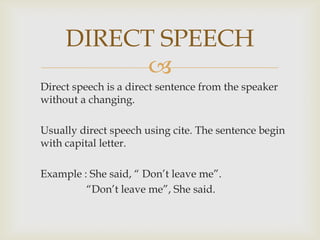
Direct speech is a direct sentence from the speaker without a changing.Usually direct speech using cite. The sentence begin with capital letter. Example: She said, “ Don’t leave me”.“Don’t leave me”, She said.DIRECT SPEECH
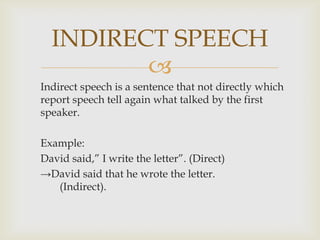
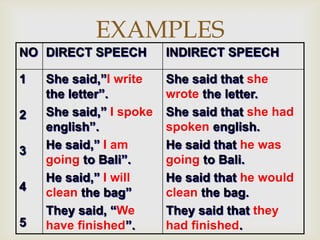
Indirect speech is a sentence that not directly which report speech tell again what talked by the first speaker.Example:	David said,” I write the letter”. (Direct)	->David said that he wrote the letter.      	(Indirect).INDIRECT SPEECH
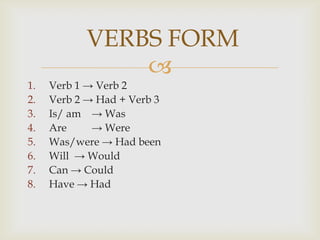
 VERBS FORMVerb 1 -> Verb 2Verb 2 -> Had + Verb 3Is/ am	-> WasAre	-> WereWas/were -> Had beenWill  -> WouldCan -> CouldHave -> Had
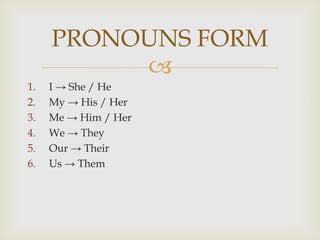
PRONOUNS FORMI -> She / HeMy -> His / HerMe -> Him / HerWe -> TheyOur -> TheirUs -> Them
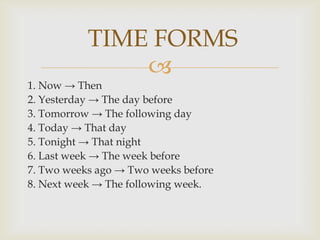
 TIME FORMS1. Now -> Then2. Yesterday -> The day before3. Tomorrow -> The following day4. Today -> That day5. Tonight -> That night6. Last week -> The week before7. Two weeks ago -> Two weeks before8. Next week -> The following week.
EXAMPLES

4th material structure

  • 1.
    4th MaterialsReported Speech(Directand Indirect Speech)YudhieIndra G S.Pd
  • 2.
    STANDARD COMPETENCYThis courseaims at able to understand some english structure for their use and form correctly.
  • 3.
    Students understand theform and use of direct and indirect speechBASIC COMPETENCY
  • 4.
    Students are ableto understand the reporting verbs and direct speechStudents are able to understand reporting verb and indirect speechStudents are able to do the exercises correctlyINDICATOR
  • 5.
    Students study fromgrammar chart and its examplesStudents listen to the teacher’s explanation about direct and indirect speechStudents learn from the grammar notesStudents rewrite the statements as indirect speechLEARNING ACTIVITY
  • 6.
    Reported speech dividedinto two groups:Direct SpeechIndirect SpeechREPORTED SPEECH
  • 7.
    Direct speech isa direct sentence from the speaker without a changing.Usually direct speech using cite. The sentence begin with capital letter. Example: She said, “ Don’t leave me”.“Don’t leave me”, She said.DIRECT SPEECH
  • 8.
    Indirect speech isa sentence that not directly which report speech tell again what talked by the first speaker.Example: David said,” I write the letter”. (Direct) ->David said that he wrote the letter. (Indirect).INDIRECT SPEECH
  • 9.
    VERBS FORMVerb1 -> Verb 2Verb 2 -> Had + Verb 3Is/ am -> WasAre -> WereWas/were -> Had beenWill -> WouldCan -> CouldHave -> Had
  • 10.
    PRONOUNS FORMI ->She / HeMy -> His / HerMe -> Him / HerWe -> TheyOur -> TheirUs -> Them
  • 11.
    TIME FORMS1.Now -> Then2. Yesterday -> The day before3. Tomorrow -> The following day4. Today -> That day5. Tonight -> That night6. Last week -> The week before7. Two weeks ago -> Two weeks before8. Next week -> The following week.
  • 12.