Intro to Fundraising 
Tom Soto 
Managing Partner 
TCW/Craton
A bit of TCW background 
• Established in 1971 in Los Angeles, California 
• $135.5 billion in assets under management 
• Approximately 1,100 institutional and private clients 
TCW/Craton is a private equity platform focused on growth investments in 
technology and/or technology-enabled service companies that promote 
sustainability and/or social responsibility
What we look for 
• Team with experience and domain expertise 
• Proven and visible track record 
• Technology that solves a problem 
• Environmental benefit and/or social impact 
• Carbon reduction, resource conservation, social 
mobility 
• Opportunities where we can add strategic value 
• Regulatory expertise, capital strategies, business 
development
Trends impacting early stage investing 
• The costs of starting a business have declined 
• Startups have become commonplace 
As a result, there are more startups and investment 
opportunities today than ever before. 
• Competition is fierce, but rewards are greater
What are the implications? 
• Startups are more capital efficient, requiring less 
investment 
• Startups are further developed at an earlier stage with 
significant user growth, activity, retention and 
revenue 
• Investment decisions based on results instead of 
perceived opportunity 
• Startup founders now often have more leverage than 
investors
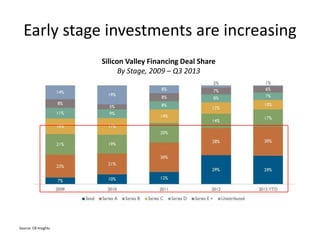
Early stage investments are increasing 
Silicon Valley Financing Deal Share 
By Stage, 2009 – Q3 2013 
Source: CB Insights
Small business is critical to economy 
• SBA defines small business as an enterprise having 
fewer than 500 employees 
• 28 million small businesses in the US 
• Over 50% of the working population works in a small 
business 
• Small businesses have generated over 65% of net 
new jobs since 1995 
• Approximately 543,000 new business get started 
each month – but more employer shutdown than 
startup 
Source: U.S. Small Business Administration
Some DOs and DON’Ts 
• DOs: 
– Know your audience – no one is impressed by hoodies 
– Keep presentations simple and concise – NO 40 page PowerPoint 
– Send materials in advance to accelerate discussion 
– Backup assertions with quantitative results – footnotes & appendices 
– Demonstrate domain and market expertise 
– Track and understand key metrics at granular level 
• DON’Ts: 
– Cold call investors – network, conferences, social media 
– Accept just anyone’s money – must have strategic value add 
– Say and/or believe there is no competition – there is always competition 
– Get hung up on valuation - big slice of small pie vs. small slice of big pie 
– Be unrealistic with market expectations and international opportunity
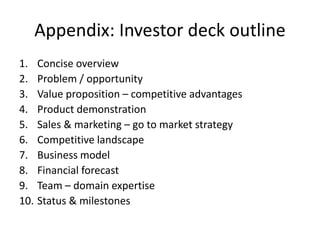
Appendix: Investor deck outline 
1. Concise overview 
2. Problem / opportunity 
3. Value proposition – competitive advantages 
4. Product demonstration 
5. Sales & marketing – go to market strategy 
6. Competitive landscape 
7. Business model 
8. Financial forecast 
9. Team – domain expertise 
10. Status & milestones

GloSho'14: Investment Bootcamp - Tom Soto

  • 1.
    Intro to Fundraising Tom Soto Managing Partner TCW/Craton
  • 2.
    A bit ofTCW background • Established in 1971 in Los Angeles, California • $135.5 billion in assets under management • Approximately 1,100 institutional and private clients TCW/Craton is a private equity platform focused on growth investments in technology and/or technology-enabled service companies that promote sustainability and/or social responsibility
  • 3.
    What we lookfor • Team with experience and domain expertise • Proven and visible track record • Technology that solves a problem • Environmental benefit and/or social impact • Carbon reduction, resource conservation, social mobility • Opportunities where we can add strategic value • Regulatory expertise, capital strategies, business development
  • 4.
    Trends impacting earlystage investing • The costs of starting a business have declined • Startups have become commonplace As a result, there are more startups and investment opportunities today than ever before. • Competition is fierce, but rewards are greater
  • 5.
    What are theimplications? • Startups are more capital efficient, requiring less investment • Startups are further developed at an earlier stage with significant user growth, activity, retention and revenue • Investment decisions based on results instead of perceived opportunity • Startup founders now often have more leverage than investors
  • 6.
    Early stage investmentsare increasing Silicon Valley Financing Deal Share By Stage, 2009 – Q3 2013 Source: CB Insights
  • 7.
    Small business iscritical to economy • SBA defines small business as an enterprise having fewer than 500 employees • 28 million small businesses in the US • Over 50% of the working population works in a small business • Small businesses have generated over 65% of net new jobs since 1995 • Approximately 543,000 new business get started each month – but more employer shutdown than startup Source: U.S. Small Business Administration
  • 8.
    Some DOs andDON’Ts • DOs: – Know your audience – no one is impressed by hoodies – Keep presentations simple and concise – NO 40 page PowerPoint – Send materials in advance to accelerate discussion – Backup assertions with quantitative results – footnotes & appendices – Demonstrate domain and market expertise – Track and understand key metrics at granular level • DON’Ts: – Cold call investors – network, conferences, social media – Accept just anyone’s money – must have strategic value add – Say and/or believe there is no competition – there is always competition – Get hung up on valuation - big slice of small pie vs. small slice of big pie – Be unrealistic with market expectations and international opportunity
  • 9.
    Appendix: Investor deckoutline 1. Concise overview 2. Problem / opportunity 3. Value proposition – competitive advantages 4. Product demonstration 5. Sales & marketing – go to market strategy 6. Competitive landscape 7. Business model 8. Financial forecast 9. Team – domain expertise 10. Status & milestones