Course 1: Overview of  Secure Programming, Section 4 Pascal Meunier, Ph.D., M.Sc., CISSP May 2004; updated August 12, 2004 Developed thanks to support and contributions from Symantec Corporation, support from the NSF SFS Capacity Building Program (Award Number 0113725) and the Purdue e-Enterprise Center Copyright (2004) Purdue Research Foundation. All rights reserved.
Course 1 Learning Plan Security overview and patching Public vulnerability databases and resources  Secure software engineering Security assessment and testing Shell and environment Resource management Trust management
Learning objectives Understand the challenges and methods for assessing software security.
Security Assessment and Testing: Outline Security Assessment Architecture and Assurance Code analysis Definitions Reviews Automated checkers Code complexity Style History of vulnerabilities and patches Testing
Architecture If there happened to be a vulnerability in a given part of the code, what would be the consequences? Design and architecture can mitigate the consequences of a vulnerability e.g., correct application of compartmentalization and principle of least privilege Example: chroot in UNIX limits the resources (files and libraries) accessible by a process, so that even if a vulnerability is exploited, damage can be limited Use of stored procedures in SQL databases, instead of generating all SQL code dynamically, may limit how the database can be attacked (see code injection vulnerabilities in another unit)
Question One of the roles of architecture in  secure  software engineering is to structure the application or system so it : a) Is easier to implement, test and maintain b) Gives the best performance and code reuse c) Mitigates exploits
Question One of the roles of architecture in  secure  software engineering is to structure the application or system so it : a) Is easier to implement, test and maintain b) Gives the best performance and code reuse c) Mitigates exploits (Answer "a" can also help security inasmuch as complexity makes security issues more likely)
Discussion Give an example of something else architecture can do to improve the security of applications and systems. (Instructor: Limit this discussion to less than 10 minutes)
Discussion examples Organize the code into layers and units (libraries, kernels, headers, objects, etc...) whose security properties are more understandable, systematically guaranteed, or can even be proven Choose languages that support declarative security restrictions (Java security manager;  mechanism external to the code) instead of programmatic restrictions (C/C++) That is, if you will actually use those features! Does the application you are assessing do that?
Assurance Correcting security problems after implementation has known security limitations Cost and time Some corrections would require rewriting everything Superficial patch is usually applied instead "Products claiming security that are created from previous versions without security cannot achieve high trust because they lack the fundamental and structural concepts required for high assurance" (Sullivan 2003)
Other Assurance Considerations Has security been hacked into the artifact being evaluated, or was it part of the original design and architecture? Has the artifact been certified with the Common Criteria? Was it architected and designed using a valid threat model?
Security Assessment and Testing: Outline Security Assessment Architecture and Assurance Code analysis Definitions Reviews Automated checkers Code complexity Style History of vulnerabilities and patches Testing
Code Analysis Static: examining the code without executing it Examples: Design and code reviews Syntax and style checkers Most automated security auditors finds "stupid" coding mistakes Model Checking: run code within model checker check if rules and invariants ("properties") are obeyed e.g., all allocated memory must be freed Security auditors using static analysis or model checking tend to find different types of bugs Reference: Engler and Musuvathi 2003
Code Analysis: Definitions A false positive occurs when an alert is given in the absence of what we want to detect. false positives incur the cost of activating response processes A false negative occurs when no alert is given in the presence of what we want to detect. false negatives allow a threat to become real
Question Given busy locations where the great majority of people are honest citizens, what makes computerized face-recognition systems unusable? a) False negatives, because criminals can get past them b) False positives, because the number of alerts (and their cost) is unmanageable c) They work well enough
Code Analysis: Code and Design Reviews Dependent on skills of reviewers Best to have critical, unintimidated reviewers with different skills and perspective than the authors With current technology they produce Least false positives Least false negatives Can transfer skills (learning opportunity) Starting code reviews early may be cheaper than later Most effective... (according to Microsoft) In 90 minute sessions With no more than three people
Costs of Reviews Can be hard on developer morale and self-esteem Expensive Time consuming Focusing on risky code, as determined by a threat analysis, can yield a higher return Need setup and followup Reviewers may need training Risks of  Group-think (reviewers become "yes-men") Same-skills reviews ("inbred" code reviews) Stale reviews (loss of lateral thinking capability)
Question What can you do to avoid the dangers of "inbred" code or design reviews? a) Invite an external participant with different skills b) Study the genealogy of the code c) Provide a constructive atmosphere during the review that welcomes and rewards criticism
Code Analysis: Automated Code Checkers What targets? Binaries Source code Users Developers Most code checkers are designed to be used by developers and some require annotations in the source code Third parties Third-party verification is difficult Theory:  Undecidable problem Program analysis is undecidable in the general case Which approximations were made to make the problem tractable?
Automated Code Checkers Hot area Before 2003, their usefulness for third-party security auditing was very low (Heffley and Meunier 2003) Many new players in 2003-2004 Significant advances in lowering false positives and false negatives Becoming a good way to catch security bugs some vulnerabilities will never be caught because they result from interactions that can't be deducted from the code or model Ultimately all results from automated checkers require manual review but much cheaper than full code reviews
Security Assessment and Testing: Outline Security Assessment Architecture and Assurance Code analysis Definitions Reviews Automated checkers Code complexity Style History of vulnerabilities and patches Testing
Code Complexity Premise:  the more the code is complex (loops, branches, entry points, etc...) the greater the chance of vulnerabilities Many complexity metrics available and used for software quality Practice:  vulnerabilities correlate with defects, as security bugs are defects, but it is difficult to find metrics that specifically relate to security bugs Indirect relationship -- causality of each metric vs vulnerabilities is unproven Little-explored research area (one Ph.D. student at CERIAS is working on this problem)
Security Assessment and Testing: Outline Security Assessment Architecture and Assurance Code analysis Definitions Reviews Automated checkers Code complexity Style History of vulnerabilities and patches Testing
Style:  Cognitive Science All human dialects can be proper languages However people using different dialects have difficulty understanding each other and tend to judge the other as "wrong" Is everyone in your team or company using the same dialect?
Style There isn’t an absolutely wrong or right coding style; however to reduce the occurrence of bugs, code should be produced to be easily understandable: by as many people as possible  as quickly as possible  with the least chance of misunderstandings  Maintaining a consistent coding style throughout a project also speeds up code reviews.
Ambiguous Coding Style In PHP, some functions mean two completely different things when returning false or zero strpos returns position of substring in a string may return false if the string is not found! How do  you know if the return value is 0 or false? "===" checks type A "C" programmer starting to code in PHP might use constructs such as: if (!$a) and get unexpected results!
Ambiguous Coding Style if (!$a) ...  Did the author mean: if ($a === false) if ($a === 0) if ($a === NULL) if ($b == "") ...  Did the author mean: if ($b === "") if ($b === NULL) Are there ambiguities in the code you are assessing?  Ambiguities lead to vulnerabilities "mean what you write and write what you mean"
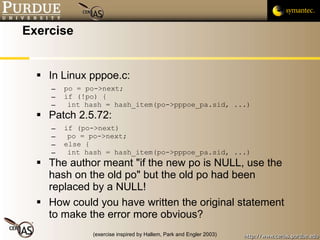
Exercise In Linux pppoe.c: po = po->next; if (!po) { int hash = hash_item(po->pppoe_pa.sid, ...) Patch 2.5.72: if (po->next)  po = po->next; else { int hash = hash_item(po->pppoe_pa.sid, ...) The author meant "if the new po is NULL, use the hash on the old po" but the old po had been replaced by a NULL! How could you have written the original statement to make the error more obvious? (exercise inspired by Hallem, Park and Engler 2003)
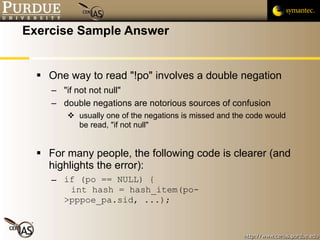
Exercise Sample Answer One way to read "!po" involves a double negation "if not not null" double negations are notorious sources of confusion usually one of the negations is missed and the code would be read, "if not null" For many people, the following code is clearer (and highlights the error): if (po == NULL) {   int hash = hash_item(po->pppoe_pa.sid, ...);
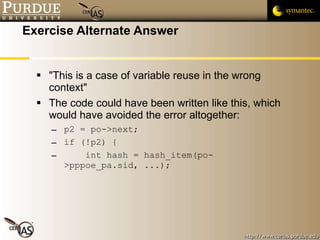
Exercise Alternate Answer "This is a case of variable reuse in the wrong context" The code could have been written like this, which would have avoided the error altogether: p2 = po->next; if (!p2) { int hash = hash_item(po->pppoe_pa.sid, ...);
Style:  Conclusion It may be difficult to assess someone else's code due to different styles Differences may lead to an undeserved perception of sloppiness Look for ambiguities and assumptions Adopt a style as standard and stick to it consistently throughout a project A new individual may need training for your coding style
Security Assessment and Testing: Outline Security Assessment Architecture and Assurance Code analysis Definitions Reviews Automated checkers Code complexity Style History of vulnerabilities and patches Testing
History of Vulnerabilities and Patches Premise:  The development process that produced an artifact with vulnerabilities is similar to the one that produced other artifacts from the same company or unit. If one product has vulnerabilities, it is likely that others do if a product has vulnerabilities, it is likely that it contains more patches were narrowly developed, or were developed using the same processes that let the vulnerabilities through originally Statistical hypothesis:  the likelihood that an artifact has many vulnerabilities is higher if some have already been found "Bugs cluster"
Security Assessment and Testing: Outline Security Assessment Architecture and Assurance Code analysis Definitions Static Dynamic Code complexity Style History of vulnerabilities and patches Testing
Testing Testing is a costly part of development efforts How are these testing efforts used in secure programming? Scenario testing Specification testing In-line testing Unit testing Integration testing Human interaction testing Final testing Acceptance testing
Scenario Testing Used to ensure that requirements capture is complete and consistent Validation effort Example: Abuse and Misuse cases (UML) If I was a hacker, what would I try? Identify trust relationships and attack them see unit on trust management Which resources are open to me?  How can they be abused? see unit on resource management Are there insecure defaults or things that could easily be misconfigured or badly coded? see unit on operations management and best practices
Question Scenario testing requires from the tester: a) A solid understanding of the programming language b) An imagination and inventiveness for possible risks  c) Experience being a hacker
Question Scenario testing requires from the tester: a) A solid understanding of the programming language b) An imagination and inventiveness for possible risks   c) Experience being a cracker and "owning" hosts
Specification Testing Prove the completeness and correctness of the specification Formal proof Symbolic execution This is usually done only for high-assurance efforts and out of the scope of this tutorial Many networking protocols lacked specification testing for security and are riddled with vulnerabilities See track 3, "Network security in depth" Making your own (secure) communication protocols is not trivial!
In-line Testing Execution testing e.g., ASSERT Verify that the internal state of the software is: allowed (security policies) expected self-consistent Verify invariants and rules "Manual" model checking
Disadvantages of Inline Testing Usually turned off in deployed applications (e.g., Java) Verifying invariants can incur significant overhead Errors may not be user-friendly Data integrity could be compromised Need to cover as much code as possible "No run == no bug" (D. Engler) Manual placement of ASSERTs and tests may miss violations Some rules and assumptions are difficult to test  Won't help if execution is transfered successfully to malicious code
Question Inline testing is useful for security because it: a) Allows the verification of invariants b) Is usually turned off in the final product c) Happens earlier than other forms of testing
Question Inline testing is useful for security because it: a) Allows the verification of invariants b) Is usually turned off in the final product c) Happens earlier than other forms of testing Comment:  c) is indirectly true in the sense that it's better to catch bugs early.  However the primary reason is a).
Exercises Can you give examples of security-related inline tests? Can you give an example of an invariant that is difficult to code into an inline test?
Exercises Can you give examples of security-related inline tests? Verify input length or index variable vs buffer length Can you give an example of an invariant that is difficult to code into an inline test? That all allocated memory has been freed
Unit Testing Local testing of functions, etc... Good time to test against buffer overflows and other low-level coding mistakes  see track 2, "Secure programming practices and vulnerabilities" C programming language issues Code injection, canonicalization issues Securing the file system
Human Interaction Testing Does the UI lead users to make the correct security decisions?  Does the UI properly and effectively convey security information to the user?  Are error messages informative and pertinent? Click-through syndrome Resilience to User Interface Abuse Phishing, social engineering Colored text so human-readable message is different from machine interpretation Obscured links, file names
Integration Testing Interfaces, linking & loading Test for discrepancies in assumptions and security models who was supposed to do authentication and access control? Security testing Ensure that all operations that should be denied, are denied Verify that partial accesses can only access what they should
Acceptance Testing Customer validation step (ET - external test in beta) Should include tests for likely threats Also, flaw-hypothesis testing Make hypotheses as to where flaws are likely and try to expose them Customer may not possess necessary skills! Customer trusts reviewer Reviewer responsibility to find flaws Is the reviewer hamstrung by an "obligation" to be nice to the vendor providing the software for review? Supposedly well-intentioned researchers or hackers might do so "for the public's sake"
Final Testing Test cases run against entire project Fault injection Random input What happens if input is nonsense? Denial of service (crashes), etc... may indicate possible compromises (buffer overflows) Bug isolation can be difficult Binary search: Bug is in X sequence of inputs, but not in first half nor second half Depends on internal state of project State of system unknown  Grammar-generated input Exercise all "legal" kinds of inputs
Question Describe limitations of using random input for final (security) testing.
Question Sample Answers Describe limitations of using random input for final (security) testing. Not all execution paths are tested Pseudo-random input is not completely random It may be difficult to identify and locate the bug, because random input long before a crash may have produced a special internal state of the software
Question In black box testing, the tester has no knowledge of the internal workings of the compiled, final artifact.  Which kind of testing CAN'T you do in black box testing? a) Final testing b) Acceptance testing c) Inline testing
About These Slides You are free to copy, distribute, display, and perform the work; and to make derivative works, under the following conditions. You must give the original author and other contributors credit The work will be used for personal or non-commercial educational uses only, and not for commercial activities and purposes For any reuse or distribution, you must make clear to others the terms of use for this work Derivative works must retain and be subject to the same conditions, and contain a note identifying the new contributor(s) and date of modification For other uses please contact the Purdue Office of Technology Commercialization.  Developed thanks to the support of Symantec Corporation
Pascal Meunier [email_address] Contributors: Jared Robinson, Alan Krassowski, Craig Ozancin, Tim Brown, Wes Higaki, Melissa Dark, Chris Clifton, Gustavo Rodriguez-Rivera

4.Security Assessment And Testing

  • 1.
    Course 1: Overviewof Secure Programming, Section 4 Pascal Meunier, Ph.D., M.Sc., CISSP May 2004; updated August 12, 2004 Developed thanks to support and contributions from Symantec Corporation, support from the NSF SFS Capacity Building Program (Award Number 0113725) and the Purdue e-Enterprise Center Copyright (2004) Purdue Research Foundation. All rights reserved.
  • 2.
    Course 1 LearningPlan Security overview and patching Public vulnerability databases and resources Secure software engineering Security assessment and testing Shell and environment Resource management Trust management
  • 3.
    Learning objectives Understandthe challenges and methods for assessing software security.
  • 4.
    Security Assessment andTesting: Outline Security Assessment Architecture and Assurance Code analysis Definitions Reviews Automated checkers Code complexity Style History of vulnerabilities and patches Testing
  • 5.
    Architecture If therehappened to be a vulnerability in a given part of the code, what would be the consequences? Design and architecture can mitigate the consequences of a vulnerability e.g., correct application of compartmentalization and principle of least privilege Example: chroot in UNIX limits the resources (files and libraries) accessible by a process, so that even if a vulnerability is exploited, damage can be limited Use of stored procedures in SQL databases, instead of generating all SQL code dynamically, may limit how the database can be attacked (see code injection vulnerabilities in another unit)
  • 6.
    Question One ofthe roles of architecture in secure software engineering is to structure the application or system so it : a) Is easier to implement, test and maintain b) Gives the best performance and code reuse c) Mitigates exploits
  • 7.
    Question One ofthe roles of architecture in secure software engineering is to structure the application or system so it : a) Is easier to implement, test and maintain b) Gives the best performance and code reuse c) Mitigates exploits (Answer "a" can also help security inasmuch as complexity makes security issues more likely)
  • 8.
    Discussion Give anexample of something else architecture can do to improve the security of applications and systems. (Instructor: Limit this discussion to less than 10 minutes)
  • 9.
    Discussion examples Organizethe code into layers and units (libraries, kernels, headers, objects, etc...) whose security properties are more understandable, systematically guaranteed, or can even be proven Choose languages that support declarative security restrictions (Java security manager; mechanism external to the code) instead of programmatic restrictions (C/C++) That is, if you will actually use those features! Does the application you are assessing do that?
  • 10.
    Assurance Correcting securityproblems after implementation has known security limitations Cost and time Some corrections would require rewriting everything Superficial patch is usually applied instead "Products claiming security that are created from previous versions without security cannot achieve high trust because they lack the fundamental and structural concepts required for high assurance" (Sullivan 2003)
  • 11.
    Other Assurance ConsiderationsHas security been hacked into the artifact being evaluated, or was it part of the original design and architecture? Has the artifact been certified with the Common Criteria? Was it architected and designed using a valid threat model?
  • 12.
    Security Assessment andTesting: Outline Security Assessment Architecture and Assurance Code analysis Definitions Reviews Automated checkers Code complexity Style History of vulnerabilities and patches Testing
  • 13.
    Code Analysis Static:examining the code without executing it Examples: Design and code reviews Syntax and style checkers Most automated security auditors finds "stupid" coding mistakes Model Checking: run code within model checker check if rules and invariants ("properties") are obeyed e.g., all allocated memory must be freed Security auditors using static analysis or model checking tend to find different types of bugs Reference: Engler and Musuvathi 2003
  • 14.
    Code Analysis: DefinitionsA false positive occurs when an alert is given in the absence of what we want to detect. false positives incur the cost of activating response processes A false negative occurs when no alert is given in the presence of what we want to detect. false negatives allow a threat to become real
  • 15.
    Question Given busylocations where the great majority of people are honest citizens, what makes computerized face-recognition systems unusable? a) False negatives, because criminals can get past them b) False positives, because the number of alerts (and their cost) is unmanageable c) They work well enough
  • 16.
    Question Given busylocations where the great majority of people are honest citizens, what makes computerized face-recognition systems unusable? a) False negatives, because criminals can get past them b) False positives, because the number of alerts (and their cost) is unmanageable c) They work well enough
  • 17.
    Code Analysis: Codeand Design Reviews Dependent on skills of reviewers Best to have critical, unintimidated reviewers with different skills and perspective than the authors With current technology they produce Least false positives Least false negatives Can transfer skills (learning opportunity) Starting code reviews early may be cheaper than later Most effective... (according to Microsoft) In 90 minute sessions With no more than three people
  • 18.
    Costs of ReviewsCan be hard on developer morale and self-esteem Expensive Time consuming Focusing on risky code, as determined by a threat analysis, can yield a higher return Need setup and followup Reviewers may need training Risks of Group-think (reviewers become "yes-men") Same-skills reviews ("inbred" code reviews) Stale reviews (loss of lateral thinking capability)
  • 19.
    Question What canyou do to avoid the dangers of "inbred" code or design reviews? a) Invite an external participant with different skills b) Study the genealogy of the code c) Provide a constructive atmosphere during the review that welcomes and rewards criticism
  • 20.
    Question What canyou do to avoid the dangers of "inbred" code or design reviews? a) Invite an external participant with different skills b) Study the genealogy of the code c) Provide a constructive atmosphere during the review that welcomes and rewards criticism
  • 21.
    Code Analysis: AutomatedCode Checkers What targets? Binaries Source code Users Developers Most code checkers are designed to be used by developers and some require annotations in the source code Third parties Third-party verification is difficult Theory: Undecidable problem Program analysis is undecidable in the general case Which approximations were made to make the problem tractable?
  • 22.
    Automated Code CheckersHot area Before 2003, their usefulness for third-party security auditing was very low (Heffley and Meunier 2003) Many new players in 2003-2004 Significant advances in lowering false positives and false negatives Becoming a good way to catch security bugs some vulnerabilities will never be caught because they result from interactions that can't be deducted from the code or model Ultimately all results from automated checkers require manual review but much cheaper than full code reviews
  • 23.
    Security Assessment andTesting: Outline Security Assessment Architecture and Assurance Code analysis Definitions Reviews Automated checkers Code complexity Style History of vulnerabilities and patches Testing
  • 24.
    Code Complexity Premise: the more the code is complex (loops, branches, entry points, etc...) the greater the chance of vulnerabilities Many complexity metrics available and used for software quality Practice: vulnerabilities correlate with defects, as security bugs are defects, but it is difficult to find metrics that specifically relate to security bugs Indirect relationship -- causality of each metric vs vulnerabilities is unproven Little-explored research area (one Ph.D. student at CERIAS is working on this problem)
  • 25.
    Security Assessment andTesting: Outline Security Assessment Architecture and Assurance Code analysis Definitions Reviews Automated checkers Code complexity Style History of vulnerabilities and patches Testing
  • 26.
    Style: CognitiveScience All human dialects can be proper languages However people using different dialects have difficulty understanding each other and tend to judge the other as "wrong" Is everyone in your team or company using the same dialect?
  • 27.
    Style There isn’tan absolutely wrong or right coding style; however to reduce the occurrence of bugs, code should be produced to be easily understandable: by as many people as possible as quickly as possible with the least chance of misunderstandings Maintaining a consistent coding style throughout a project also speeds up code reviews.
  • 28.
    Ambiguous Coding StyleIn PHP, some functions mean two completely different things when returning false or zero strpos returns position of substring in a string may return false if the string is not found! How do you know if the return value is 0 or false? "===" checks type A "C" programmer starting to code in PHP might use constructs such as: if (!$a) and get unexpected results!
  • 29.
    Ambiguous Coding Styleif (!$a) ... Did the author mean: if ($a === false) if ($a === 0) if ($a === NULL) if ($b == "") ... Did the author mean: if ($b === "") if ($b === NULL) Are there ambiguities in the code you are assessing? Ambiguities lead to vulnerabilities "mean what you write and write what you mean"
  • 30.
    Exercise In Linuxpppoe.c: po = po->next; if (!po) { int hash = hash_item(po->pppoe_pa.sid, ...) Patch 2.5.72: if (po->next) po = po->next; else { int hash = hash_item(po->pppoe_pa.sid, ...) The author meant "if the new po is NULL, use the hash on the old po" but the old po had been replaced by a NULL! How could you have written the original statement to make the error more obvious? (exercise inspired by Hallem, Park and Engler 2003)
  • 31.
    Exercise Sample AnswerOne way to read "!po" involves a double negation "if not not null" double negations are notorious sources of confusion usually one of the negations is missed and the code would be read, "if not null" For many people, the following code is clearer (and highlights the error): if (po == NULL) { int hash = hash_item(po->pppoe_pa.sid, ...);
  • 32.
    Exercise Alternate Answer"This is a case of variable reuse in the wrong context" The code could have been written like this, which would have avoided the error altogether: p2 = po->next; if (!p2) { int hash = hash_item(po->pppoe_pa.sid, ...);
  • 33.
    Style: ConclusionIt may be difficult to assess someone else's code due to different styles Differences may lead to an undeserved perception of sloppiness Look for ambiguities and assumptions Adopt a style as standard and stick to it consistently throughout a project A new individual may need training for your coding style
  • 34.
    Security Assessment andTesting: Outline Security Assessment Architecture and Assurance Code analysis Definitions Reviews Automated checkers Code complexity Style History of vulnerabilities and patches Testing
  • 35.
    History of Vulnerabilitiesand Patches Premise: The development process that produced an artifact with vulnerabilities is similar to the one that produced other artifacts from the same company or unit. If one product has vulnerabilities, it is likely that others do if a product has vulnerabilities, it is likely that it contains more patches were narrowly developed, or were developed using the same processes that let the vulnerabilities through originally Statistical hypothesis: the likelihood that an artifact has many vulnerabilities is higher if some have already been found "Bugs cluster"
  • 36.
    Security Assessment andTesting: Outline Security Assessment Architecture and Assurance Code analysis Definitions Static Dynamic Code complexity Style History of vulnerabilities and patches Testing
  • 37.
    Testing Testing isa costly part of development efforts How are these testing efforts used in secure programming? Scenario testing Specification testing In-line testing Unit testing Integration testing Human interaction testing Final testing Acceptance testing
  • 38.
    Scenario Testing Usedto ensure that requirements capture is complete and consistent Validation effort Example: Abuse and Misuse cases (UML) If I was a hacker, what would I try? Identify trust relationships and attack them see unit on trust management Which resources are open to me? How can they be abused? see unit on resource management Are there insecure defaults or things that could easily be misconfigured or badly coded? see unit on operations management and best practices
  • 39.
    Question Scenario testingrequires from the tester: a) A solid understanding of the programming language b) An imagination and inventiveness for possible risks c) Experience being a hacker
  • 40.
    Question Scenario testingrequires from the tester: a) A solid understanding of the programming language b) An imagination and inventiveness for possible risks c) Experience being a cracker and "owning" hosts
  • 41.
    Specification Testing Provethe completeness and correctness of the specification Formal proof Symbolic execution This is usually done only for high-assurance efforts and out of the scope of this tutorial Many networking protocols lacked specification testing for security and are riddled with vulnerabilities See track 3, "Network security in depth" Making your own (secure) communication protocols is not trivial!
  • 42.
    In-line Testing Executiontesting e.g., ASSERT Verify that the internal state of the software is: allowed (security policies) expected self-consistent Verify invariants and rules "Manual" model checking
  • 43.
    Disadvantages of InlineTesting Usually turned off in deployed applications (e.g., Java) Verifying invariants can incur significant overhead Errors may not be user-friendly Data integrity could be compromised Need to cover as much code as possible "No run == no bug" (D. Engler) Manual placement of ASSERTs and tests may miss violations Some rules and assumptions are difficult to test Won't help if execution is transfered successfully to malicious code
  • 44.
    Question Inline testingis useful for security because it: a) Allows the verification of invariants b) Is usually turned off in the final product c) Happens earlier than other forms of testing
  • 45.
    Question Inline testingis useful for security because it: a) Allows the verification of invariants b) Is usually turned off in the final product c) Happens earlier than other forms of testing Comment: c) is indirectly true in the sense that it's better to catch bugs early. However the primary reason is a).
  • 46.
    Exercises Can yougive examples of security-related inline tests? Can you give an example of an invariant that is difficult to code into an inline test?
  • 47.
    Exercises Can yougive examples of security-related inline tests? Verify input length or index variable vs buffer length Can you give an example of an invariant that is difficult to code into an inline test? That all allocated memory has been freed
  • 48.
    Unit Testing Localtesting of functions, etc... Good time to test against buffer overflows and other low-level coding mistakes see track 2, "Secure programming practices and vulnerabilities" C programming language issues Code injection, canonicalization issues Securing the file system
  • 49.
    Human Interaction TestingDoes the UI lead users to make the correct security decisions? Does the UI properly and effectively convey security information to the user? Are error messages informative and pertinent? Click-through syndrome Resilience to User Interface Abuse Phishing, social engineering Colored text so human-readable message is different from machine interpretation Obscured links, file names
  • 50.
    Integration Testing Interfaces,linking & loading Test for discrepancies in assumptions and security models who was supposed to do authentication and access control? Security testing Ensure that all operations that should be denied, are denied Verify that partial accesses can only access what they should
  • 51.
    Acceptance Testing Customervalidation step (ET - external test in beta) Should include tests for likely threats Also, flaw-hypothesis testing Make hypotheses as to where flaws are likely and try to expose them Customer may not possess necessary skills! Customer trusts reviewer Reviewer responsibility to find flaws Is the reviewer hamstrung by an "obligation" to be nice to the vendor providing the software for review? Supposedly well-intentioned researchers or hackers might do so "for the public's sake"
  • 52.
    Final Testing Testcases run against entire project Fault injection Random input What happens if input is nonsense? Denial of service (crashes), etc... may indicate possible compromises (buffer overflows) Bug isolation can be difficult Binary search: Bug is in X sequence of inputs, but not in first half nor second half Depends on internal state of project State of system unknown Grammar-generated input Exercise all "legal" kinds of inputs
  • 53.
    Question Describe limitationsof using random input for final (security) testing.
  • 54.
    Question Sample AnswersDescribe limitations of using random input for final (security) testing. Not all execution paths are tested Pseudo-random input is not completely random It may be difficult to identify and locate the bug, because random input long before a crash may have produced a special internal state of the software
  • 55.
    Question In blackbox testing, the tester has no knowledge of the internal workings of the compiled, final artifact. Which kind of testing CAN'T you do in black box testing? a) Final testing b) Acceptance testing c) Inline testing
  • 56.
    Question In blackbox testing, the tester has no knowledge of the internal workings of the compiled, final artifact. Which kind of testing CAN'T you do in black box testing? a) Final testing b) Acceptance testing c) Inline testing
  • 57.
    About These SlidesYou are free to copy, distribute, display, and perform the work; and to make derivative works, under the following conditions. You must give the original author and other contributors credit The work will be used for personal or non-commercial educational uses only, and not for commercial activities and purposes For any reuse or distribution, you must make clear to others the terms of use for this work Derivative works must retain and be subject to the same conditions, and contain a note identifying the new contributor(s) and date of modification For other uses please contact the Purdue Office of Technology Commercialization. Developed thanks to the support of Symantec Corporation
  • 58.
    Pascal Meunier [email_address]Contributors: Jared Robinson, Alan Krassowski, Craig Ozancin, Tim Brown, Wes Higaki, Melissa Dark, Chris Clifton, Gustavo Rodriguez-Rivera

Editor's Notes

  • #18 The 90 minute sessions with three people is what Microsoft reports as being effective. After 90 minutes, productivity drops sharply. With too many reviewers, productivity also drops. Code reviews and fixes must be timed at the appropriate stage of the development lifecycle. Waiting until code complete will likely frustrate QA and product management.
  • #39 An example of scenario testing is the recent 802.11 wireless vulnerability announced by the Australians (RTS DoS). It usually starts by saying "What if I do this instead of what's expected?" What if I try to enter more numbers than a PIN is supposed to have? What if I keep punching keys on the ATM while it is counting money? What if I insert an oversized card or envelope, or insert them sideways, or insert something made of another material than the expected plastic (e.g. to jam and disable a competitor's ATMs)? Do the requirements deal with or expect these situations (abuse cases)? If I'm designing a network, what if a user sends a ping to a broadcast address? What if I send SYN packets without completing the connection? etc... Most of the 802.11 and TCP/IP vulnerabilities were found by scenario testing, just using the researchers' imagination with the high-level description of the mechanism or protocol. The requirements didn't capture or address malicious users; benevolent users, or users incapable of interacting with the networks at those levels, were assumed.
  • #42 Specifications testing is what the Finland Codenomicon/OUSPG/PROTOS specialize in; their formal work resulted in the flood of vulnerability announcements for SNMP, etc... Some findings from specifications testing are usually less obvious than those of scenario testing. They overlap -- specifications testing should a) report all the vulnerabilities found in scenario testing and b) be comprehensive and exhaustive.
  • #43 Definition of invariant: an assertion that must be true both before and after the execution of each operation (e.g., application use case, class method). See also postcondition and precondition. An assertion that should always be true for a specified segment or at a specified point of a computer program. From [IEEE90].
  • #52 Symantec calls this ET for external testing. There are tiers of customers, Tier1 ET customers promise to interact at a much higher level than Tier 3 testers. We expect low rates of feedback from most testers because they are busy people with their own agendas and time pressures.