Ron Baker, Founder
 VeraSage Institute
                          Profit Starts
                              with
                           Pricing on
                            Purpose


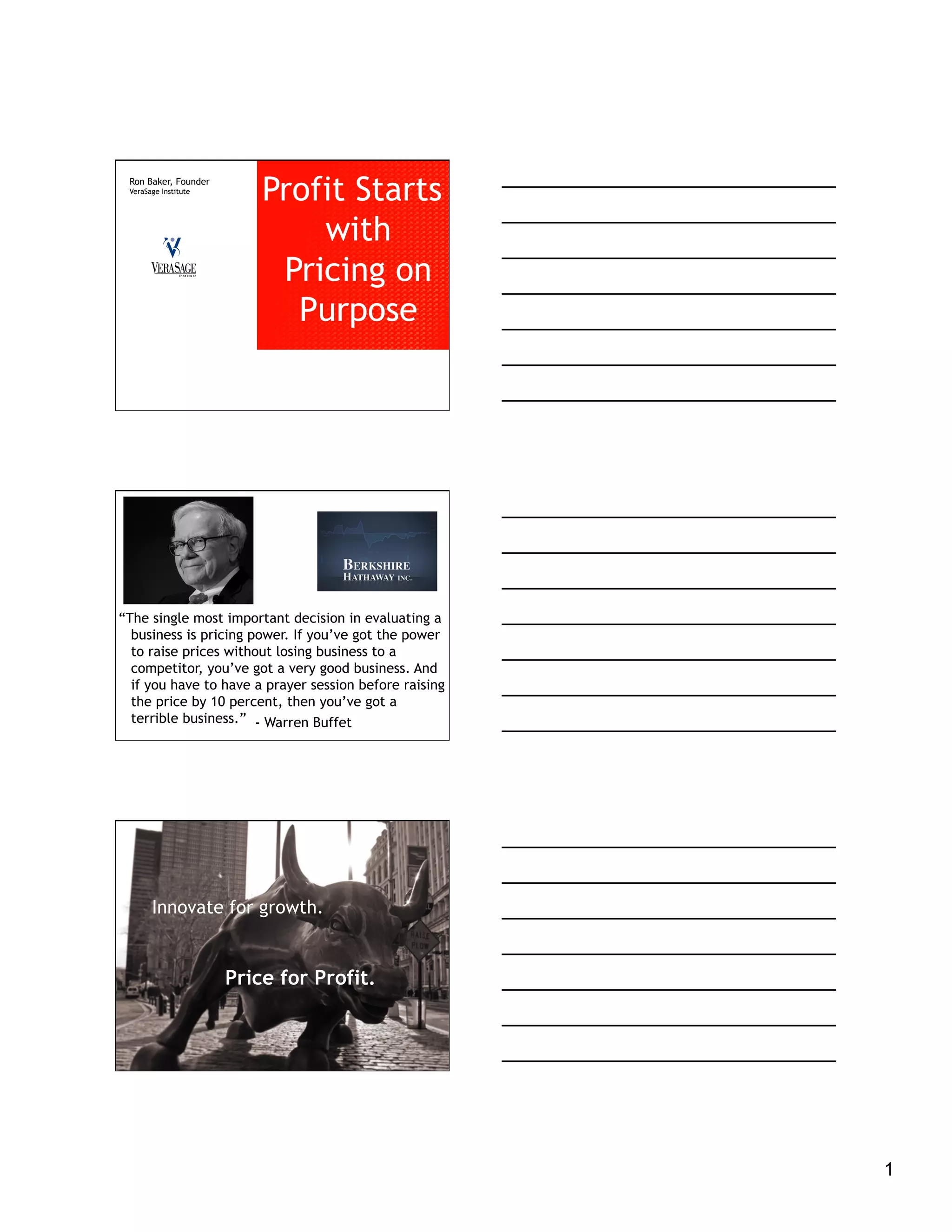
“The single most important decision in evaluating a
  business is pricing power. If you’ve got the power
  to raise prices without losing business to a
  competitor, you’ve got a very good business. And
  if you have to have a prayer session before raising
  the price by 10 percent, then you’ve got a
  terrible business.” - Warren Buffet


       Innovate for growth.


                      Price for Profit.


                                                        1
The default purpose of
  marketing is not to
   increase sales.

                   It’s to increase profits.


1.  Profit is a marketer’s ultimate objective.

2.  Profit is driven mostly by price.

3.  Price is driven mostly by brand perception.

4.  Brand perception is driven mostly by what
    agencies do for their clients.


         The value of agencies


                                                     Harvard Business Review
            “If Brands Are Built Over Years, Why Are They Managed Over Quarters?”
                                                   By Leonard Lodish and Carl Mela


                                                                                     2
What are you
                           really selling?

                          What are your
                            customers
                          really buying?


“The customer never buys a product. By
definition the customer buys the satisfaction of
a want. He buys value.” - Peter Drucker


                                                   3
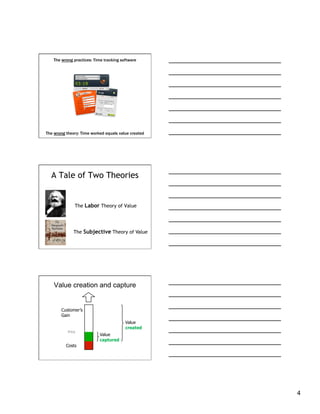
The wrong practices: Time tracking software


 Paradigms
 drive
 practices
The wrong theory: Time worked equals value created


  A Tale of Two Theories


               The Labor Theory of Value


              The Subjective Theory of Value


    Value creation and capture


       Customer’s
       Gain
                                        Value
                                        created
           Price
                           Value
                           captured
          Costs


                                                     4
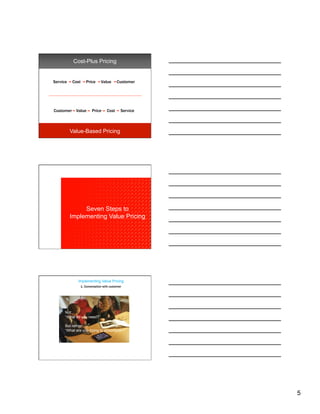
Cost-Plus Pricing


Service    Cost      Price      Value      Customer


Customer Value            Price     Cost      Service


          Value-Based Pricing


               Seven Steps to
          Implementing Value Pricing


             Implementing Value Pricing
                  1. Conversation with customer


      Not:
      “What do you need?”

      But rather:
      “What are you trying to accomplish?”


                                                        5
Implementing Value Pricing
                1. Conversation with customer


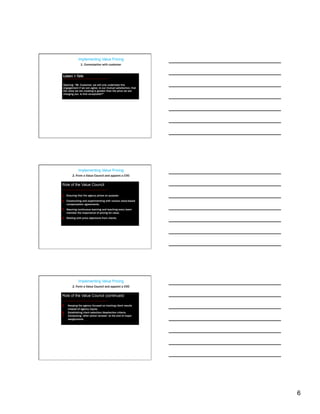
 Listen > Talk

 Opening: “Mr. Customer, we will only undertake this
 engagement if we can agree, to our mutual satisfaction, that
 the value we are creating is greater than the price we are
 charging you. Is that acceptable?”


              Implementing Value Pricing
         2. Form a Value Council and appoint a CVO

Role of the Value Council

1.  Ensuring that the agency prices on purpose.
2.  Constructing and experimenting with various value-based
    compensation agreements.
3.  Assuring continuous learning and teaching every team
    member the importance of pricing for value.
4.  Dealing with price objections from clients.


              Implementing Value Pricing
         2. Form a Value Council and appoint a CVO

Role of the Value Council (continued)

5.    Keeping the agency focused on tracking client results
      instead of agency inputs.
6.    Establishing client selection/deselection criteria.
7.    Conducting “after action reviews” at the end of major
      assignments.


                                                                6
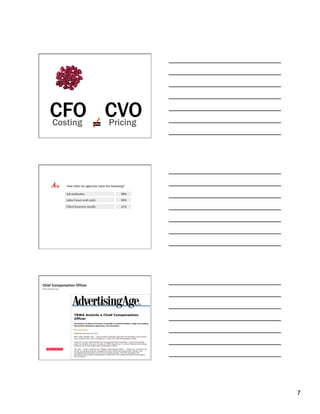
AAAA PRICING PRACTICES SURVEY


     CFO CVO
     Costing Pricing              =


                How often do agencies track the following?


Chief Compensation Officer
Neal Grossman


                                                             7
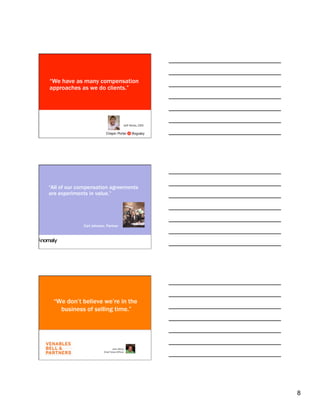
“We have as many compensation
approaches as we do clients.”


                                           Jeff Hicks, CEO


“All of our compensation agreements
are experiments in value.”


             Carl Johnson, Partner


 “We don’t believe we’re in the
   business of selling time.”


                                 John Minty
                         Chief Value Officer


                                                             8
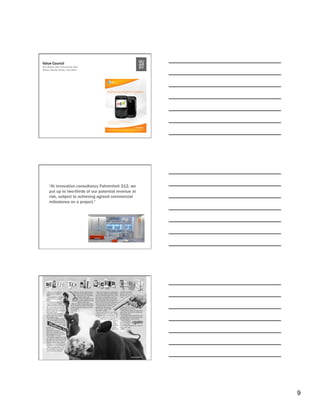
Value Council
Ken Whyte, Glen Drummond, Bob
Wilbur, Mandy Moote, Tony Mohr


     “At innovation consultancy Fahrenheit 212, we
     put up to two-thirds of our potential revenue at
     risk, subject to achieving agreed commercial
     milestones on a project.”


                                                        9
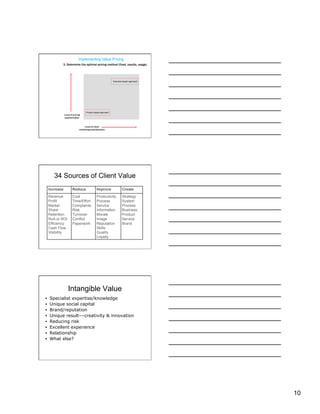
Implementing Value Pricing
            3. Determine the optimal pricing method (fixed, results, usage)


                Not:
                “What do you need?”

                But rather:
                “What are you trying to accomplish?”


        34 Sources of Client Value
     Increase       Reduce           Improve            Create
     Revenue        Cost             Productivity       Strategy
     Profit         Time/Effort      Process            System
     Market         Complaints       Service            Process
     Share          Risk             Information        Business
     Retention      Turnover         Morale             Product
     RoA or ROI     Conflict         Image              Service
     Efficiency     Paperwork        Reputation         Brand
     Cash Flow                       Skills
     Visibility                      Quality
                                     Loyalty


                  Intangible Value
•    Specialist expertise/knowledge
•    Unique social capital
•    Brand/reputation
•    Unique result––creativity & innovation
•    Reducing risk
•    Excellent experience
•    Relationship
•    What else?


                                                                              10
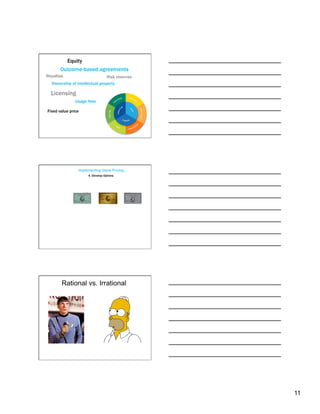
Equity
       Outcome-based agreements
Royalties                         Risk reserves
  Ownership of intellectual property

  Licensing
               Usage fees

Fixed value price


                Implementing Value Pricing
                     4. Develop Options


        Rational vs. Irrational


                                                  11
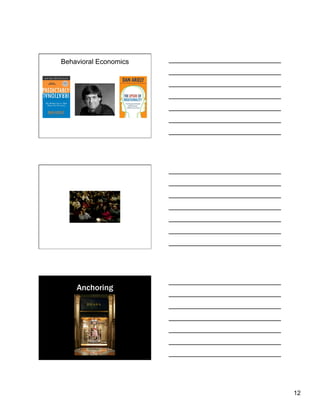
Behavioral Economics


    Anchoring


                       12
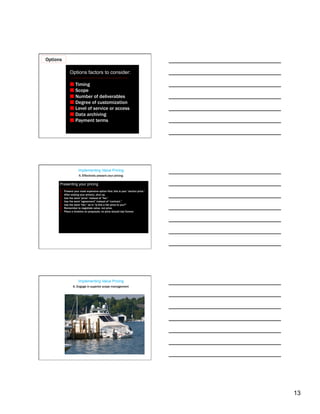
Options

                Options factors to consider:

                 Timing
                 Scope
                 Number of deliverables
                 Degree of customization
                 Level of service or access
                 Data archiving
                 Payment terms


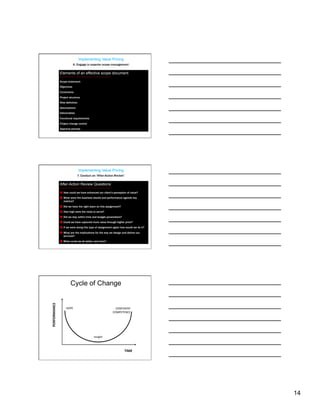
                        Implementing Value Pricing
                        5. Effectively present your pricing

      Presenting your pricing
      1.    Present your most expensive option first; this is your “anchor price.”
      2.    After stating your price(s), shut up.
      3.    Use the word “price” instead of “fee.”
      4.    Use the word “agreement” instead of “contract.”
      5.    Use the word “fair,” as in “Is this a fair price to you?”
      6.    Remember to negotiate value, not price.
      7.    Place a timeline on proposals; no price should last forever.


                        Implementing Value Pricing
                   6. Engage in superior scope management


                                                                                     13
Implementing Value Pricing
                               6. Engage in superior scope management

                  Elements of an effective scope document

                  Scope statement
                  Objectives
                  Constraints
                  Project structure
                  Role definition
                  Assumptions
                  Deliverables
                  Functional requirements
                  Project change control
                  Approval process


                                    Implementing Value Pricing
                                  7. Conduct an “After-Action Review”

                  After-Action Review Questions

                    How could we have enhanced our client’s perception of value?
                    What were the business results and performance against key
                     metrics?
                    Did we have the right team on this assignment?
                    How high were the costs to serve?
                    Did we stay within time and budget parameters?
                    Could we have captured more value through higher price?
                    If we were doing this type of assignment again how would we do it?
                    What are the implications for the way we design and deliver our
                     services?
                    What could we do better next time?


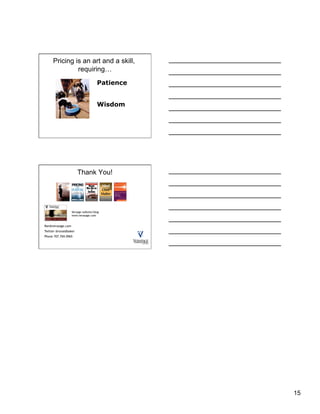
                           Cycle of Change
PERFORMANCE	


                       HOPE	
                                  CONFIDENT	
  
                                                             COMPETENCE	


                                              Insight	


                                                                           TIME	


                                                                                          14
Pricing is an art and a skill,
              requiring…
                                     Patience


                                     Wisdom


                       Thank You!


                   Versage website/blog
                   www.verasage.com


Ron@verasage.com
Twitter @ronaldbaker
Phone 707.769.0965


                                                15

4Ps of Business Development: Value Pricing

  • 1.
    Ron Baker, Founder VeraSage Institute Profit Starts with Pricing on Purpose “The single most important decision in evaluating a business is pricing power. If you’ve got the power to raise prices without losing business to a competitor, you’ve got a very good business. And if you have to have a prayer session before raising the price by 10 percent, then you’ve got a terrible business.” - Warren Buffet Innovate for growth. Price for Profit. 1
  • 2.
    The default purposeof marketing is not to increase sales. It’s to increase profits. 1.  Profit is a marketer’s ultimate objective. 2.  Profit is driven mostly by price. 3.  Price is driven mostly by brand perception. 4.  Brand perception is driven mostly by what agencies do for their clients. The value of agencies Harvard Business Review “If Brands Are Built Over Years, Why Are They Managed Over Quarters?” By Leonard Lodish and Carl Mela 2
  • 3.
    What are you really selling? What are your customers really buying? “The customer never buys a product. By definition the customer buys the satisfaction of a want. He buys value.” - Peter Drucker 3
  • 4.
    The wrong practices:Time tracking software Paradigms drive practices The wrong theory: Time worked equals value created A Tale of Two Theories The Labor Theory of Value The Subjective Theory of Value Value creation and capture Customer’s Gain Value created Price Value captured Costs 4
  • 5.
    Cost-Plus Pricing Service Cost Price Value Customer Customer Value Price Cost Service Value-Based Pricing Seven Steps to Implementing Value Pricing Implementing Value Pricing 1. Conversation with customer Not: “What do you need?” But rather: “What are you trying to accomplish?” 5
  • 6.
    Implementing Value Pricing 1. Conversation with customer Listen > Talk Opening: “Mr. Customer, we will only undertake this engagement if we can agree, to our mutual satisfaction, that the value we are creating is greater than the price we are charging you. Is that acceptable?” Implementing Value Pricing 2. Form a Value Council and appoint a CVO Role of the Value Council 1.  Ensuring that the agency prices on purpose. 2.  Constructing and experimenting with various value-based compensation agreements. 3.  Assuring continuous learning and teaching every team member the importance of pricing for value. 4.  Dealing with price objections from clients. Implementing Value Pricing 2. Form a Value Council and appoint a CVO Role of the Value Council (continued) 5.  Keeping the agency focused on tracking client results instead of agency inputs. 6.  Establishing client selection/deselection criteria. 7.  Conducting “after action reviews” at the end of major assignments. 6
  • 7.
    AAAA PRICING PRACTICESSURVEY CFO CVO Costing Pricing = How often do agencies track the following? Chief Compensation Officer Neal Grossman 7
  • 8.
    “We have asmany compensation approaches as we do clients.” Jeff Hicks, CEO “All of our compensation agreements are experiments in value.” Carl Johnson, Partner “We don’t believe we’re in the business of selling time.” John Minty Chief Value Officer 8
  • 9.
    Value Council Ken Whyte,Glen Drummond, Bob Wilbur, Mandy Moote, Tony Mohr “At innovation consultancy Fahrenheit 212, we put up to two-thirds of our potential revenue at risk, subject to achieving agreed commercial milestones on a project.” 9
  • 10.
    Implementing Value Pricing 3. Determine the optimal pricing method (fixed, results, usage) Not: “What do you need?” But rather: “What are you trying to accomplish?” 34 Sources of Client Value Increase Reduce Improve Create Revenue Cost Productivity Strategy Profit Time/Effort Process System Market Complaints Service Process Share Risk Information Business Retention Turnover Morale Product RoA or ROI Conflict Image Service Efficiency Paperwork Reputation Brand Cash Flow Skills Visibility Quality Loyalty Intangible Value •  Specialist expertise/knowledge •  Unique social capital •  Brand/reputation •  Unique result––creativity & innovation •  Reducing risk •  Excellent experience •  Relationship •  What else? 10
  • 11.
    Equity Outcome-based agreements Royalties Risk reserves Ownership of intellectual property Licensing Usage fees Fixed value price Implementing Value Pricing 4. Develop Options Rational vs. Irrational 11
  • 12.
  • 13.
    Options Options factors to consider:  Timing  Scope  Number of deliverables  Degree of customization  Level of service or access  Data archiving  Payment terms Implementing Value Pricing 5. Effectively present your pricing Presenting your pricing 1.  Present your most expensive option first; this is your “anchor price.” 2.  After stating your price(s), shut up. 3.  Use the word “price” instead of “fee.” 4.  Use the word “agreement” instead of “contract.” 5.  Use the word “fair,” as in “Is this a fair price to you?” 6.  Remember to negotiate value, not price. 7.  Place a timeline on proposals; no price should last forever. Implementing Value Pricing 6. Engage in superior scope management 13
  • 14.
    Implementing Value Pricing 6. Engage in superior scope management Elements of an effective scope document Scope statement Objectives Constraints Project structure Role definition Assumptions Deliverables Functional requirements Project change control Approval process Implementing Value Pricing 7. Conduct an “After-Action Review” After-Action Review Questions   How could we have enhanced our client’s perception of value?   What were the business results and performance against key metrics?   Did we have the right team on this assignment?   How high were the costs to serve?   Did we stay within time and budget parameters?   Could we have captured more value through higher price?   If we were doing this type of assignment again how would we do it?   What are the implications for the way we design and deliver our services?   What could we do better next time? Cycle of Change PERFORMANCE   HOPE   CONFIDENT   COMPETENCE         Insight   TIME   14
  • 15.
    Pricing is anart and a skill, requiring… Patience Wisdom Thank You! Versage website/blog www.verasage.com Ron@verasage.com Twitter @ronaldbaker Phone 707.769.0965 15