VALUE–PRICING
Jakob Persson
Leancept AB
www.leancept.com
As presented at the
Stockholm Value-Pricing
Meetup on May 10, 2016.
What is value?
Why are diamonds
valuable?
http://www.freeimages.com/photo/diamond-ring-1539860
1947
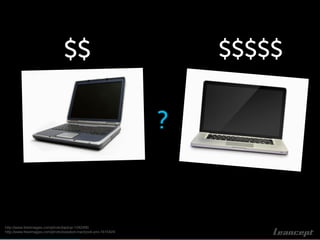
http://www.freeimages.com/photo/laptop-1242490
http://www.freeimages.com/photo/isolated-macbook-pro-1615424
$$ $$$$$
?
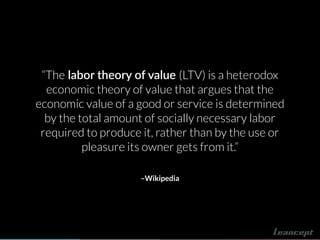
–Wikipedia
“The labor theory of value (LTV) is a heterodox
economic theory of value that argues that the
economic value of a good or service is determined
by the total amount of socially necessary labor
required to produce it, rather than by the use or
pleasure its owner gets from it.”
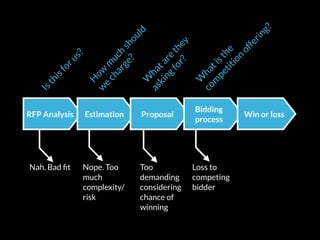
RFP Analysis
Nah. Bad fit
Isthisforus?
Estimation
Nope. Too
much
complexity/
risk
H
ow
m
uch
should
w
e
charge?
Proposal
Too
demanding
considering
chance of
winning
W
hatare
they
askingfor?
Bidding
process
Loss to
competing
bidder
W
hatisthe
com
petition
offering?
Win or loss
High customer acquisition cost that
was almost never fully recovered
since we weren’t focused on building
lasting relationships.
Our interests were largely
in opposition to the
customer’s.
It was almost impossible to
implement true agile and
story points.
Our KPI’s concerned team
billability, not customer
value created.
People in the company
adopted an inside–out
mindset.
Not knowing better?
http://www.freeimages.com/photo/face-dumbfounded-1438542
Laziness?
http://www.freeimages.com/photo/sleepy-lucy-1387909
Not wanting to
understand our
customers?
http://www.freeimages.com/photo/the-wall-1221477
http://www.freeimages.com/photo/escort-car-inside-2-1425603
“Family pricing”
Click to read “The birthday gift”
Where would you have to
pay the least for a bag of
garden soil mix?
Store A
Store B
Value-pricing joins
genuine rela!onships with
marke!ng concepts
The purpose of any organization—from
a governmental agency or nonprofit
foundation, to a corporation—exists to
create results outside of itself.
Address customer
pain points
http://www.freeimages.com/photo/frustrated-look-1474618
Find a problem-
solution fit for the right
problems
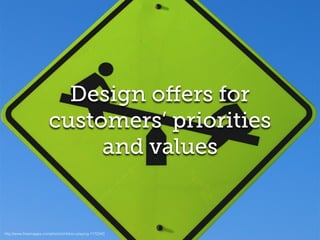
Design offers for
customers’ priorities
and values
http://www.freeimages.com/photo/children-playing-1172340
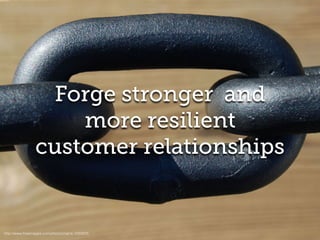
Forge stronger and
more resilient
customer relationships
http://www.freeimages.com/photo/chains-1220833
Value-pricing isn’t a
method
It’s a mindset and a set of principles
• Comprehend value to customers
• Create value for customers
• Communicate the value you create
• Convince customers they must pay for value
• Capture value with strategic pricing based on value,
not costs and efforts
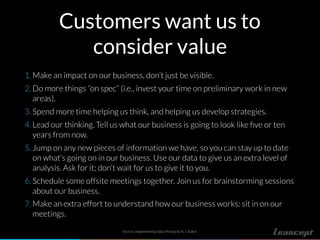
Customers want us to
consider value
1. Make an impact on our business, don’t just be visible.
2. Do more things “on spec” (i.e., invest your time on preliminary work in new
areas).
3. Spend more time helping us think, and helping us develop strategies.
4. Lead our thinking. Tell us what our business is going to look like five or ten
years from now.
5. Jump on any new pieces of information we have, so you can stay up to date
on what’s going on in our business. Use our data to give us an extra level of
analysis. Ask for it; don’t wait for us to give it to you.
6. Schedule some offsite meetings together. Join us for brainstorming sessions
about our business.
7. Make an extra effort to understand how our business works: sit in on our
meetings.
Source: Implementing Value Pricing by R. J. Baker.
Becoming a value-
pricer
It requires empathy
You need to have an active interest in other
people
Being of service to
others
A reward in itself
Gain appreciation of what
is valuable to other people
Enriches your own life
Take an honest interest
“How can I be of service to you?”
Click to read “Be interested, not interesting”
Authentic relationship
Practice being present and a good listener
Recognize their
humanity
You always deal with other people
Own your challenges
Don’t “outsource” things to your customer
just because they’re hard to figure out
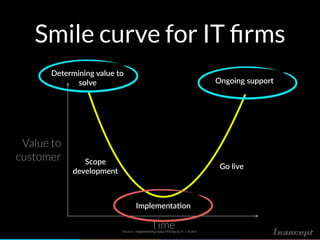
Smile curve for IT firms
Determining value to
solve
Value to
customer
Time
Scope
development
Implementa!on
Go live
Ongoing support
Source: Implementing Value Pricing by R. J. Baker.
The airliner metaphor
Why will people pay 3x the coach class price
only to arrive at exactly the same time?
Solve the right
problems
Not all problems are worth solving, especially
if margins are slim
Be confident
Believe that you add value and know its worth
Before you can charge a premium price, you
first have to believe, internally, that you are
worth it. If you do not think you are worth
multiples of your hourly rate, your customers
never will believe it either.
If the customer says your price is too high,
what they are really saying is, “I don’t see the
value in your offering.”
It is not a ques!on of money; rather, it is
lack of belief.
Most professionals underprice
their intellectual capital
• “We do not have enough
quality customers.”
• “Customers view what we do
as a commodity.”
• “Customers do not
understand the value we
provide.”
• “Our people do not
understand their worth.”
• “When customers engage in
hardball negotiation tactics,
we capitulate.”
• “Our profession has too
much capacity, which drives
prices down.”
• “We operate in what
economists call “perfect
competition,” where no one
firm is a price maker; rather,
we are all price takers.”
Source: Implementing Value Pricing by R. J. Baker.
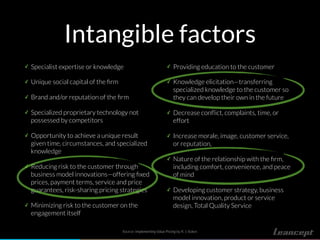
Intangible factors
✓ Specialist expertise or knowledge
✓ Unique social capital of the firm
✓ Brand and/or reputation of the firm
✓ Specialized proprietary technology not
possessed by competitors
✓ Opportunity to achieve a unique result
given time, circumstances, and specialized
knowledge
✓ Reducing risk to the customer through
business model innovations—offering fixed
prices, payment terms, service and price
guarantees, risk-sharing pricing strategies
✓ Minimizing risk to the customer on the
engagement itself
✓ Providing education to the customer
✓ Knowledge elicitation—transferring
specialized knowledge to the customer so
they can develop their own in the future
✓ Decrease conflict, complaints, time, or
effort
✓ Increase morale, image, customer service,
or reputation,
✓ Nature of the relationship with the firm,
including comfort, convenience, and peace
of mind
✓ Developing customer strategy, business
model innovation, product or service
design, Total Quality Service
Source: Implementing Value Pricing by R. J. Baker.
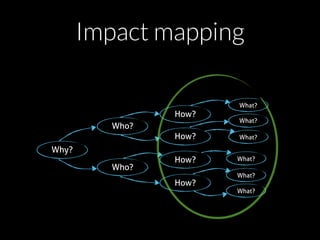
Explore impacts
What desired outcomes motivate the project
as an investment?
Why?
Who?
Who?
How?
How?
How?
How?
What?
What?
What?
What?
What?
What?
Impact mapping
Time vs value
Why hourly billing is flawed
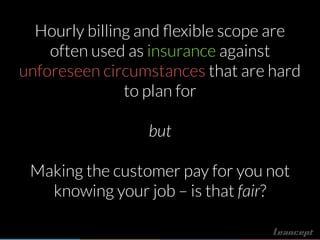
Hourly billing and flexible scope are
often used as insurance against
unforeseen circumstances that are hard
to plan for
but
Making the customer pay for you not
knowing your job – is that fair?
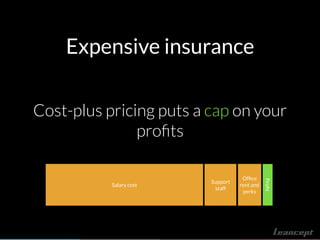
Expensive insurance
Cost-plus pricing puts a cap on your
profits
Salary cost
Profit
Office
rent and
perks
Support
staff
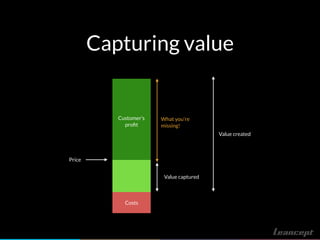
Customer’s
profit
Price
Capturing value
Costs
Price
Value captured
Value created
What you’re
missing!
Value-pricing projects
Do the research
Understand challenges common to the
customer’s field
Aim to understand
Listen twice as much as you talk
Qualify the customer
Not every customer is worth having
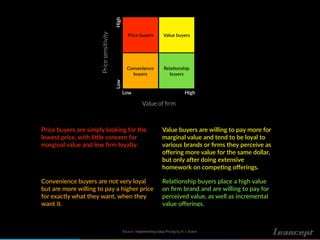
Price buyers are simply looking for the
lowest price, with li"le concern for
marginal value and low firm loyalty.
Value buyers are willing to pay more for
marginal value and tend to be loyal to
various brands or firms they perceive as
offering more value for the same dollar,
but only a$er doing extensive
homework on compe!ng offerings.
Convenience buyers are not very loyal
but are more willing to pay a higher price
for exactly what they want, when they
want it.
Rela!onship buyers place a high value
on firm brand and are willing to pay for
perceived value, as well as incremental
value offerings.
Price buyers Value buyers
Convenience
buyers
Rela!onship
buyers
Value of firmPricesensitivity
Low
Low
High
High
Source: Implementing Value Pricing by R. J. Baker.
Use the right language
If you don’t discuss value, you’ll be discussing
costs and it’s a debate the customer always wins
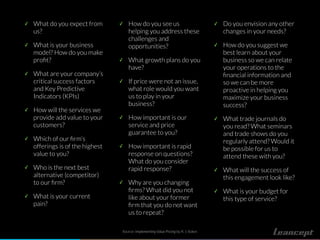
✓ What do you expect from
us?
✓ What is your business
model? How do you make
profit?
✓ What are your company’s
critical success factors
and Key Predictive
Indicators (KPIs)
✓ How will the services we
provide add value to your
customers?
✓ Which of our firm’s
offerings is of the highest
value to you?
✓ Who is the next best
alternative (competitor)
to our firm?
✓ What is your current
pain?
✓ How do you see us
helping you address these
challenges and
opportunities?
✓ What growth plans do you
have?
✓ If price were not an issue,
what role would you want
us to play in your
business?
✓ How important is our
service and price
guarantee to you?
✓ How important is rapid
response on questions?
What do you consider
rapid response?
✓ Why are you changing
firms? What did you not
like about your former
firm that you do not want
us to repeat?
✓ Do you envision any other
changes in your needs?
✓ How do you suggest we
best learn about your
business so we can relate
your operations to the
financial information and
so we can be more
proactive in helping you
maximize your business
success?
✓ What trade journals do
you read? What seminars
and trade shows do you
regularly attend? Would it
be possible for us to
attend these with you?
✓ What will the success of
this engagement look like?
✓ What is your budget for
this type of service?
Source: Implementing Value Pricing by R. J. Baker.
Learn to ask the right
questions and be comfortable
not having all the answers.
Design proposals
around benefits
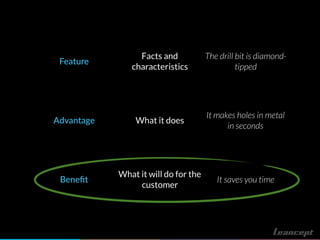
Feature - Advantage - Benefit
Feature
Facts and
characteristics
The drill bit is diamond-
tipped
Advantage What it does
It makes holes in metal
in seconds
Benefit
What it will do for the
customer
It saves you time
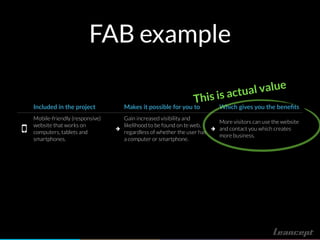
FAB example
Included in the project Makes it possible for you to Which gives you the benefits
Mobile-friendly (responsive)
website that works on
computers, tablets and
smartphones.
Gain increased visibility and
likelihood to be found on te web,
regardless of whether the user has
a computer or smartphone.
More visitors can use the website
and contact you which creates
more business.
This is actual value
Don’t work for
customers you don’t like
You need to genuinely care
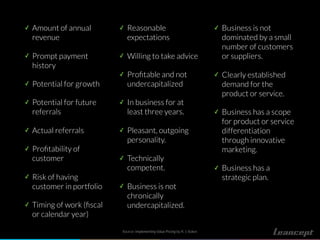
✓ Amount of annual
revenue
✓ Prompt payment
history
✓ Potential for growth
✓ Potential for future
referrals
✓ Actual referrals
✓ Profitability of
customer
✓ Risk of having
customer in portfolio
✓ Timing of work (fiscal
or calendar year)
✓ Reasonable
expectations
✓ Willing to take advice
✓ Profitable and not
undercapitalized
✓ In business for at
least three years.
✓ Pleasant, outgoing
personality.
✓ Technically
competent.
✓ Business is not
chronically
undercapitalized.
✓ Business is not
dominated by a small
number of customers
or suppliers.
✓ Clearly established
demand for the
product or service.
✓ Business has a scope
for product or service
differentiation
through innovative
marketing.
✓ Business has a
strategic plan.
Source: Implementing Value Pricing by R. J. Baker.
Price the customer
There’s no such thing as a “standard price”
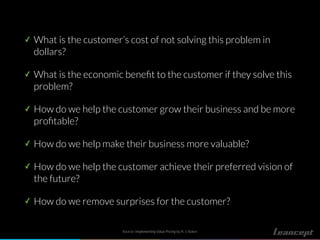
✓ What is the customer’s cost of not solving this problem in
dollars?
✓ What is the economic benefit to the customer if they solve this
problem?
✓ How do we help the customer grow their business and be more
profitable?
✓ How do we help make their business more valuable?
✓ How do we help the customer achieve their preferred vision of
the future?
✓ How do we remove surprises for the customer?
Source: Implementing Value Pricing by R. J. Baker.
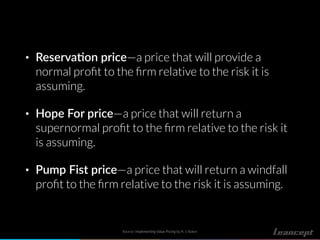
• Reserva!on price—a price that will provide a
normal profit to the firm relative to the risk it is
assuming.
• Hope For price—a price that will return a
supernormal profit to the firm relative to the risk it
is assuming.
• Pump Fist price—a price that will return a windfall
profit to the firm relative to the risk it is assuming.
Source: Implementing Value Pricing by R. J. Baker.
Develop options
Give the customer a choice
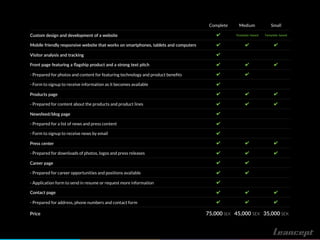
Complete Medium Small
Custom design and development of a website ✔ Template-based Template-based
Mobile friendly responsive website that works on smartphones, tablets and computers ✔ ✔ ✔
Visitor analysis and tracking ✔
Front page featuring a flagship product and a strong text pitch ✔ ✔ ✔
- Prepared for photos and content for featuring technology and product benefits ✔ ✔
- Form to signup to receive information as it becomes available ✔
Products page ✔ ✔ ✔
- Prepared for content about the products and product lines ✔ ✔ ✔
Newsfeed/blog page ✔
- Prepared for a list of news and press content ✔
- Form to signup to receive news by email ✔
Press center ✔ ✔ ✔
- Prepared for downloads of photos, logos and press releases ✔ ✔ ✔
Career page ✔ ✔
- Prepared for career opportunities and positions available ✔ ✔
- Application form to send in resume or request more information ✔
Contact page ✔ ✔ ✔
- Prepared for address, phone numbers and contact form ✔ ✔ ✔
Price 75,000 SEK 45,000 SEK 35,000 SEK
Remember, after showing or
stating your price, shut up. The
ball is now in the customer’s court.
Handle risk by breaking
work down
Work with manageable chunks
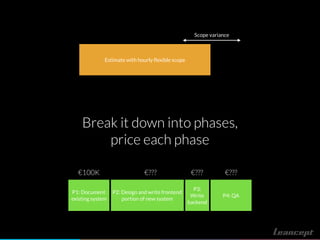
Estimate with hourly flexible scope
P1: Document
existing system
P4: QA
P3:
Write
backend
P2: Design and write frontend
portion of new system
Scope variance
€100K
Break it down into phases,
price each phase
€??? €??? €???
Beware of contingent
pricing
Percentages sow dissent
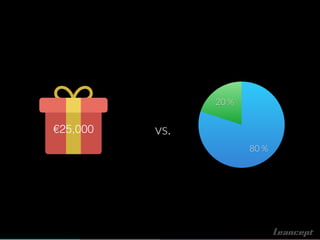
20 %
80 %
€25,000 vs.
Contact us for training, mentoring
and consulting services in value-
pricing and customer intimacy.
www.leancept.com
Twitter: @leancept
www.leancept.com
Twitter: @leancept
Simply be"er business
We help make firms and agencies more valuable,
their customers happier
and their teams more effec!ve

Introduction to value-pricing

  • 1.
  • 2.
    As presented atthe Stockholm Value-Pricing Meetup on May 10, 2016.
  • 3.
  • 4.
  • 5.
  • 6.
  • 7.
    –Wikipedia “The labor theoryof value (LTV) is a heterodox economic theory of value that argues that the economic value of a good or service is determined by the total amount of socially necessary labor required to produce it, rather than by the use or pleasure its owner gets from it.”
  • 8.
    RFP Analysis Nah. Badfit Isthisforus? Estimation Nope. Too much complexity/ risk H ow m uch should w e charge? Proposal Too demanding considering chance of winning W hatare they askingfor? Bidding process Loss to competing bidder W hatisthe com petition offering? Win or loss
  • 9.
    High customer acquisitioncost that was almost never fully recovered since we weren’t focused on building lasting relationships.
  • 10.
    Our interests werelargely in opposition to the customer’s.
  • 11.
    It was almostimpossible to implement true agile and story points.
  • 12.
    Our KPI’s concernedteam billability, not customer value created.
  • 13.
    People in thecompany adopted an inside–out mindset.
  • 14.
  • 15.
  • 16.
    Not wanting to understandour customers? http://www.freeimages.com/photo/the-wall-1221477
  • 17.
  • 18.
    Where would youhave to pay the least for a bag of garden soil mix?
  • 19.
  • 20.
  • 21.
  • 22.
    The purpose ofany organization—from a governmental agency or nonprofit foundation, to a corporation—exists to create results outside of itself.
  • 23.
  • 24.
    Find a problem- solutionfit for the right problems
  • 25.
    Design offers for customers’priorities and values http://www.freeimages.com/photo/children-playing-1172340
  • 26.
    Forge stronger and moreresilient customer relationships http://www.freeimages.com/photo/chains-1220833
  • 27.
    Value-pricing isn’t a method It’sa mindset and a set of principles
  • 28.
    • Comprehend valueto customers • Create value for customers • Communicate the value you create • Convince customers they must pay for value • Capture value with strategic pricing based on value, not costs and efforts
  • 29.
    Customers want usto consider value 1. Make an impact on our business, don’t just be visible. 2. Do more things “on spec” (i.e., invest your time on preliminary work in new areas). 3. Spend more time helping us think, and helping us develop strategies. 4. Lead our thinking. Tell us what our business is going to look like five or ten years from now. 5. Jump on any new pieces of information we have, so you can stay up to date on what’s going on in our business. Use our data to give us an extra level of analysis. Ask for it; don’t wait for us to give it to you. 6. Schedule some offsite meetings together. Join us for brainstorming sessions about our business. 7. Make an extra effort to understand how our business works: sit in on our meetings. Source: Implementing Value Pricing by R. J. Baker.
  • 30.
  • 31.
    It requires empathy Youneed to have an active interest in other people
  • 32.
    Being of serviceto others A reward in itself
  • 33.
    Gain appreciation ofwhat is valuable to other people Enriches your own life
  • 34.
    Take an honestinterest “How can I be of service to you?” Click to read “Be interested, not interesting”
  • 35.
    Authentic relationship Practice beingpresent and a good listener
  • 36.
  • 37.
    Own your challenges Don’t“outsource” things to your customer just because they’re hard to figure out
  • 38.
    Smile curve forIT firms Determining value to solve Value to customer Time Scope development Implementa!on Go live Ongoing support Source: Implementing Value Pricing by R. J. Baker.
  • 39.
    The airliner metaphor Whywill people pay 3x the coach class price only to arrive at exactly the same time?
  • 40.
    Solve the right problems Notall problems are worth solving, especially if margins are slim
  • 41.
    Be confident Believe thatyou add value and know its worth
  • 42.
    Before you cancharge a premium price, you first have to believe, internally, that you are worth it. If you do not think you are worth multiples of your hourly rate, your customers never will believe it either.
  • 43.
    If the customersays your price is too high, what they are really saying is, “I don’t see the value in your offering.” It is not a ques!on of money; rather, it is lack of belief.
  • 44.
    Most professionals underprice theirintellectual capital • “We do not have enough quality customers.” • “Customers view what we do as a commodity.” • “Customers do not understand the value we provide.” • “Our people do not understand their worth.” • “When customers engage in hardball negotiation tactics, we capitulate.” • “Our profession has too much capacity, which drives prices down.” • “We operate in what economists call “perfect competition,” where no one firm is a price maker; rather, we are all price takers.” Source: Implementing Value Pricing by R. J. Baker.
  • 45.
    Intangible factors ✓ Specialistexpertise or knowledge ✓ Unique social capital of the firm ✓ Brand and/or reputation of the firm ✓ Specialized proprietary technology not possessed by competitors ✓ Opportunity to achieve a unique result given time, circumstances, and specialized knowledge ✓ Reducing risk to the customer through business model innovations—offering fixed prices, payment terms, service and price guarantees, risk-sharing pricing strategies ✓ Minimizing risk to the customer on the engagement itself ✓ Providing education to the customer ✓ Knowledge elicitation—transferring specialized knowledge to the customer so they can develop their own in the future ✓ Decrease conflict, complaints, time, or effort ✓ Increase morale, image, customer service, or reputation, ✓ Nature of the relationship with the firm, including comfort, convenience, and peace of mind ✓ Developing customer strategy, business model innovation, product or service design, Total Quality Service Source: Implementing Value Pricing by R. J. Baker.
  • 46.
    Explore impacts What desiredoutcomes motivate the project as an investment?
  • 47.
  • 48.
    Time vs value Whyhourly billing is flawed
  • 49.
    Hourly billing andflexible scope are often used as insurance against unforeseen circumstances that are hard to plan for but Making the customer pay for you not knowing your job – is that fair?
  • 50.
    Expensive insurance Cost-plus pricingputs a cap on your profits Salary cost Profit Office rent and perks Support staff
  • 51.
  • 52.
  • 53.
    Do the research Understandchallenges common to the customer’s field
  • 54.
    Aim to understand Listentwice as much as you talk
  • 55.
    Qualify the customer Notevery customer is worth having
  • 56.
    Price buyers aresimply looking for the lowest price, with li"le concern for marginal value and low firm loyalty. Value buyers are willing to pay more for marginal value and tend to be loyal to various brands or firms they perceive as offering more value for the same dollar, but only a$er doing extensive homework on compe!ng offerings. Convenience buyers are not very loyal but are more willing to pay a higher price for exactly what they want, when they want it. Rela!onship buyers place a high value on firm brand and are willing to pay for perceived value, as well as incremental value offerings. Price buyers Value buyers Convenience buyers Rela!onship buyers Value of firmPricesensitivity Low Low High High Source: Implementing Value Pricing by R. J. Baker.
  • 57.
    Use the rightlanguage If you don’t discuss value, you’ll be discussing costs and it’s a debate the customer always wins
  • 58.
    ✓ What doyou expect from us? ✓ What is your business model? How do you make profit? ✓ What are your company’s critical success factors and Key Predictive Indicators (KPIs) ✓ How will the services we provide add value to your customers? ✓ Which of our firm’s offerings is of the highest value to you? ✓ Who is the next best alternative (competitor) to our firm? ✓ What is your current pain? ✓ How do you see us helping you address these challenges and opportunities? ✓ What growth plans do you have? ✓ If price were not an issue, what role would you want us to play in your business? ✓ How important is our service and price guarantee to you? ✓ How important is rapid response on questions? What do you consider rapid response? ✓ Why are you changing firms? What did you not like about your former firm that you do not want us to repeat? ✓ Do you envision any other changes in your needs? ✓ How do you suggest we best learn about your business so we can relate your operations to the financial information and so we can be more proactive in helping you maximize your business success? ✓ What trade journals do you read? What seminars and trade shows do you regularly attend? Would it be possible for us to attend these with you? ✓ What will the success of this engagement look like? ✓ What is your budget for this type of service? Source: Implementing Value Pricing by R. J. Baker.
  • 59.
    Learn to askthe right questions and be comfortable not having all the answers.
  • 60.
  • 61.
    Feature Facts and characteristics The drillbit is diamond- tipped Advantage What it does It makes holes in metal in seconds Benefit What it will do for the customer It saves you time
  • 62.
    FAB example Included inthe project Makes it possible for you to Which gives you the benefits Mobile-friendly (responsive) website that works on computers, tablets and smartphones. Gain increased visibility and likelihood to be found on te web, regardless of whether the user has a computer or smartphone. More visitors can use the website and contact you which creates more business. This is actual value
  • 63.
    Don’t work for customersyou don’t like You need to genuinely care
  • 64.
    ✓ Amount ofannual revenue ✓ Prompt payment history ✓ Potential for growth ✓ Potential for future referrals ✓ Actual referrals ✓ Profitability of customer ✓ Risk of having customer in portfolio ✓ Timing of work (fiscal or calendar year) ✓ Reasonable expectations ✓ Willing to take advice ✓ Profitable and not undercapitalized ✓ In business for at least three years. ✓ Pleasant, outgoing personality. ✓ Technically competent. ✓ Business is not chronically undercapitalized. ✓ Business is not dominated by a small number of customers or suppliers. ✓ Clearly established demand for the product or service. ✓ Business has a scope for product or service differentiation through innovative marketing. ✓ Business has a strategic plan. Source: Implementing Value Pricing by R. J. Baker.
  • 65.
    Price the customer There’sno such thing as a “standard price”
  • 66.
    ✓ What isthe customer’s cost of not solving this problem in dollars? ✓ What is the economic benefit to the customer if they solve this problem? ✓ How do we help the customer grow their business and be more profitable? ✓ How do we help make their business more valuable? ✓ How do we help the customer achieve their preferred vision of the future? ✓ How do we remove surprises for the customer? Source: Implementing Value Pricing by R. J. Baker.
  • 67.
    • Reserva!on price—aprice that will provide a normal profit to the firm relative to the risk it is assuming. • Hope For price—a price that will return a supernormal profit to the firm relative to the risk it is assuming. • Pump Fist price—a price that will return a windfall profit to the firm relative to the risk it is assuming. Source: Implementing Value Pricing by R. J. Baker.
  • 68.
    Develop options Give thecustomer a choice
  • 69.
    Complete Medium Small Customdesign and development of a website ✔ Template-based Template-based Mobile friendly responsive website that works on smartphones, tablets and computers ✔ ✔ ✔ Visitor analysis and tracking ✔ Front page featuring a flagship product and a strong text pitch ✔ ✔ ✔ - Prepared for photos and content for featuring technology and product benefits ✔ ✔ - Form to signup to receive information as it becomes available ✔ Products page ✔ ✔ ✔ - Prepared for content about the products and product lines ✔ ✔ ✔ Newsfeed/blog page ✔ - Prepared for a list of news and press content ✔ - Form to signup to receive news by email ✔ Press center ✔ ✔ ✔ - Prepared for downloads of photos, logos and press releases ✔ ✔ ✔ Career page ✔ ✔ - Prepared for career opportunities and positions available ✔ ✔ - Application form to send in resume or request more information ✔ Contact page ✔ ✔ ✔ - Prepared for address, phone numbers and contact form ✔ ✔ ✔ Price 75,000 SEK 45,000 SEK 35,000 SEK
  • 70.
    Remember, after showingor stating your price, shut up. The ball is now in the customer’s court.
  • 71.
    Handle risk bybreaking work down Work with manageable chunks
  • 72.
    Estimate with hourlyflexible scope P1: Document existing system P4: QA P3: Write backend P2: Design and write frontend portion of new system Scope variance €100K Break it down into phases, price each phase €??? €??? €???
  • 73.
  • 74.
  • 75.
    Contact us fortraining, mentoring and consulting services in value- pricing and customer intimacy. www.leancept.com Twitter: @leancept
  • 76.
    www.leancept.com Twitter: @leancept Simply be"erbusiness We help make firms and agencies more valuable, their customers happier and their teams more effec!ve