4D BIM for Construction Planning and
Environmental Planning
Svetlana Sheina1,*
, Ekaterina Seraya1
, Viktor Krikunov1
, and Nikita Saltykov1
1
Don State Technical University, Sotsialisticheskaya. 162, 344022 Rostov-on-Don, Russia
Abstract. In order to develop an algorithm for selecting the most optimal
organizational and technical solutions during design process, and the
following automatization of this process, the problem of using 4D
modeling programs in the organization and technology of construction is
considered. A 4D -model cannot exist without detailed 3D-model and
allows taking into account different variable factors in real time. In
addition, software that uses 4D-modeling makes it possible to reduce
significantly the time needed to prepare a project, to take into account
flaws and mistakes at the different design stages. The concept of the 4D
model connects in real time the elements of the model with the elements of
the plan, which are recorded by means of programming. Algorithm
proposed by us includes a control-system, when each subsequent stage
implies the complete completion of the previous one. Unlike traditional
design technology, when the object options may differ in the scope of
work, preliminary cost, etc., the use of a simplified 4D model allows pre-
determining the best option. Also, BIM technology minimizes time costs
by allowing designers and geodesic surveyors to work together. The
information collected in the 4D model is saved by the operation company
and is used during the operation of the object. The 4D programming allows
us to optimize production processes, to visualize the construction of
objects, and to solve the problems of the economic efficiency of the real
estate objects construction with a high degree of probability.
1 Introduction
Innovative BIM technology is the construction of buildings and structures in the infor-
mation space, high-quality control of operations carried out on all object life cycles. BIM-
technologies allow solving problems of a different spectrum: to visualize in details the in-
ternal and external appearance of the building, using images and to manage construction
equipment in automatic mode.
BIM technologies make it possible to implement architectural concepts as close as pos-
sible to the capabilities of modern technologies and to predict in real time the probability of
building construction with given characteristics while keeping the original architectural
idea [2-5]. Before the advent of BIM technology, architectural design in the implementation
of technological and organizational capabilities was based solely on experience and exper-
*
Corresponding author: rgsu-gsh@mail.ru
, 0 2019)
E3S Web of Conferences https://doi.org/10.1051/e3sconf/2019
(
110 1100
-2018
10 10
SPbWOSCE
1 1
2 2
ยฉ The Authors, published by EDP Sciences. This is an open access article distributed under the terms of the Creative
Commons Attribution License 4.0 (http://creativecommons.org/licenses/by/4.0/).
iment. At present, the construction of prognostic models is possible based on computer
multifunctional and multi-level modeling of architectural and construction reality.
Nowadays, in the world, the actual problem of design and arrangement of construction
is the consideration of variable factors in real time. BIM-technologies allow making this
account with the help of modern innovative methods of 4D-modeling.
The 4D-modeling method developed in the early 2000s, on the one hand, turned out to
be in demand, and on the other hand, is too complicated for the widespread implementation.
The authors of the article propose a simplified 4D-modeling system using BIM-
technology in the organization of construction.
2 Materials and Methods
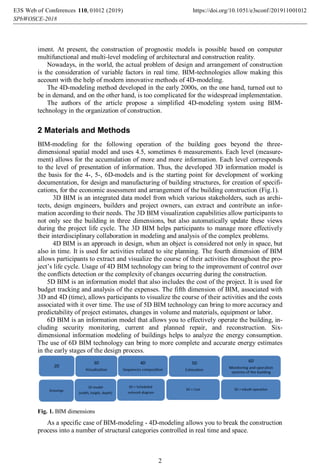
BIM-modeling for the following operation of the building goes beyond the three-
dimensional spatial model and uses 4.5, sometimes 6 measurements. Each level (measure-
ment) allows for the accumulation of more and more information. Each level corresponds
to the level of presentation of information. Thus, the developed 3D information model is
the basis for the 4-, 5-, 6D-models and is the starting point for development of working
documentation, for design and manufacturing of building structures, for creation of specifi-
cations, for the economic assessment and arrangement of the building construction (Fig.1).
3D BIM is an integrated data model from which various stakeholders, such as archi-
tects, design engineers, builders and project owners, can extract and contribute an infor-
mation according to their needs. The 3D BIM visualization capabilities allow participants to
not only see the building in three dimensions, but also automatically update these views
during the project life cycle. The 3D BIM helps participants to manage more effectively
their interdisciplinary collaboration in modeling and analysis of the complex problems.
4D BIM is an approach in design, when an object is considered not only in space, but
also in time. It is used for activities related to site planning. The fourth dimension of BIM
allows participants to extract and visualize the course of their activities throughout the pro-
jectโ€™s life cycle. Usage of 4D BIM technology can bring to the improvement of control over
the conflicts detection or the complexity of changes occurring during the construction.
5D BIM is an information model that also includes the cost of the project. It is used for
budget tracking and analysis of the expenses. The fifth dimension of BIM, associated with
3D and 4D (time), allows participants to visualize the course of their activities and the costs
associated with it over time. The use of 5D BIM technology can bring to more accuracy and
predictability of project estimates, changes in volume and materials, equipment or labor.
6D BIM is an information model that allows you to effectively operate the building, in-
cluding security monitoring, current and planned repair, and reconstruction. Six-
dimensional information modeling of buildings helps to analyze the energy consumption.
The use of 6D BIM technology can bring to more complete and accurate energy estimates
in the early stages of the design process.
Fig. 1. BIM dimensions
As a specific case of BIM-modeling - 4D-modeling allows you to break the construction
process into a number of structural categories controlled in real time and space.
, 0 2019)
E3S Web of Conferences https://doi.org/10.1051/e3sconf/2019
(
110 1100
-2018
10 10
SPbWOSCE
1 1
2 2
2
The nominal 4D-modeling system includes the actual 3D model of the object and the
network model (scheduled network diagram) of its construction. The three-dimensional
model transfers the basic information of the object into an intuitively understandable form,
and the network model shows the technological and time component of the work done [1].
The calculation of resources, which allows you to select the main building technologies,
economically rational organization of work, is an obligatory part of the creation of 4D-
model. Modern information technologies make it possible to automate the calculations and
application of solutions, the installation of main and auxiliary equipment on the site. When
selecting the most rational location of the crane, temporary roads, storage sites, it becomes
possible to move equipment between objects during the construction of complexes.
Visualization of the distribution of resources in the information model, as well as cost
and material and technical indicators allows accelerating the planning and organization of
object or complex of objects construction. The system offered by us allows us to take into
account flaws and mistakes at the stages of construction management in all specific areas
(Fig.2).
, 0 2019)
E3S Web of Conferences https://doi.org/10.1051/e3sconf/2019
(
110 1100
-2018
10 10
SPbWOSCE
1 1
2 2
3
Fig. 2. Optimal organizational and technological solutions
As a result, control of the content of plans and projects as a whole becomes much sim-
pler, since the analysis of the model at the same time highlights missing elements or unreal-
ized links. The process of automatic search for optimal solutions, by using rationally re-
sources and technics, optimizes the object construction process. Software using 4D-
modeling makes it possible to significantly reduce the time for project preparation [3-5].
3 Results
We consider the situation when the graphic 4D model significantly simplifies the visual
comparison. The second task is to compare visually the plan with the fact or options of
organizational and technological solutions. This is especially true for the construction of
facilities network when works are being performed in parallel on several sites, which leads
to significant differences with the construction plan of facilities. It is impossible to develop
a realistic approach to the objects construction without proper visualization of the process,
which is much simpler with 4D simulation programs [6].
For example, let us consider the load associated with entering the site. It often happens
when a large equipment unit in conditions of high density of construction limits the traffic
of trucks with materials and other equipment, which leads to delays in the construction
process. 4D modeling also allows you to adjust and optimize this process.
The process of creating a 4D model is simplified by creating a detailed 3D model com-
parable to a detailed work plan. Individual elements (or groups) of 3D-models are associat-
ed with combinatorial tasks and deadlines. It can be computational, preparatory or installa-
tion works, depending on the characteristics of the combinatorial problem. The proposed
concept of 4D model links the elements of the model with the elements of the plan in real
time, which are recorded by means of programming.
The algorithm proposed by us (Fig.2) that includes a control-system, when each subse-
quent stage assumes the complete completion of the previous one. The following technolo-
gy of using the information model is also proposed: to save the information model in the
electronic technical passport of the object, tied to the electronic map of the city, built in the
ArcGIS environment.
With the tools of currently popular software systems, such as MS Project + Autodesk, JI
Orbiter, IndorCAD, it is possible to envisage such scenarios in which the introduction of
this algorithm becomes mandatory and the monitoring of the maintenance of the planned
work is automated at all stages of the plan.
Thus, problem solution is being automated, which is facilitated by preliminary prepared
options of the implementation paths selection, for example, all of the same transport access
to the site, taking into consideration spatial interferences. Until this signal factor will not be
passed through in the algorithm, the transition to the next level of project development is
, 0 2019)
E3S Web of Conferences https://doi.org/10.1051/e3sconf/2019
(
110 1100
-2018
10 10
SPbWOSCE
1 1
2 2
4
impossible, and the high visualization and self-learning software allows you to quickly
select the optimal scheme for solving the problem using the analogy method.
Therefore, when creating a model, it is always important to imagine what the result
should be and how to achieve it.
For the convenience of work with the program, the developers made sure that it was
possible to combine the objects of the 3D model directly in the program, eventually work-
ing with a specific type of work or splitting the element into stages becomes easier, since
there is no need to rearrange the model according with the schedule.
4D model is visualized both completely and in parts. A complete visualization is a pro-
ject as a whole, and parts represent different stages of the design. Thus, user can see the
events he needs at any time interval, including changes made on different stages.
Visualization of the construction process in real time allows all project participants to
see both the complete picture and various details. This helps to perceive the process better
and reduces the number of errors that might be made both in the design and in construction
of the objects directly.
The technological algorithm for simplifying 4D modeling assumes:
๏‚ท Preparation of the composition of the calculation tools, including the schedule calcula-
tion, calendars, possibility of splitting the elements of the model into the construction
staging, etc.;
๏‚ท Verification within the general 4Dmodel of 3D elements and fragments of sched-
uled network diagram, integration with the most advanced for today Microsoft Project
system;
๏‚ท Usage of the system does not consider a long process of applying and rejection of other
systems. In most cases, it simply complements existing CAD and project management
systems.
๏‚ท Complementation of existing CAD by the developed algorithm.
In practice, this means the use of 4D-modeling in conjunction with traditional technolo-
gies that provide additional control.
4 Discussion
The proposed technology has been implemented as follows.
Instead of the traditional development of several object-planning options, one is chosen,
with pre-calculated characteristics, which is facilitated by the automated processing of the
proposed model based on the entered data. If, as a result of designing by a traditional meth-
od, the options of an object may differ in the amount of work, preliminary cost, etc., then
using a simplified 4D model allows you to pre-determine the optimal option.
At the design stage, the results of engineering surveys are automatically transformed in-
to a digital terrain model, which immediately assumes the choice of the optimal building
scheme, foundation structures, calculation of the scope of work, etc. depending on the in-
tended object of construction.
The traditional approach to design implies that the development of the project begins
only after the completion of the digital terrain model (DTM), which inevitably entails con-
siderable time costs. BIM technology minimizes time costs by doing the job of specifying
the DTM and actual design independently.
Parallel work of designers and topographic surveyors is possible using a common data
environment (COD), which provides a terrain model prepared separately as a DTM layer.
When filling out a digital model with information about buildings, engineering communica-
tions and other significant objects, design engineers using SOD obtain changes in the model
and can adjust design decisions based on these changes. This allows you to notice conflicts
, 0 2019)
E3S Web of Conferences https://doi.org/10.1051/e3sconf/2019
(
110 1100
-2018
10 10
SPbWOSCE
1 1
2 2
5
in the early stages of the design process and make appropriate changes in the design solu-
tion long before construction will start.
Designed objects of the model are fully parameterized: in the design process, all param-
eters of the object can be changed without additional calculations.
Using a common data environment allows all the process participants not only to see the
actual information about the designed object, but also makes it possible to comment on
individual project objects at different stages. In turn, designers can see these comments
directly during the design and immediately make the necessary changes to the model.
Designed objects of the model are fully parameterized: in the design process, all param-
eters of the object can be changed without additional calculations.
Usage of the common data environment allows all participants in the process not only to
see the actual information about the designed object, but also makes it possible to comment
on individual project objects at different stages. In their turn, designers can see these com-
ments directly during the design and immediately make the necessary changes to the model.
After construction is completed, the stage of building operation begins. At this stage in-
formation models controlled by object information systems are created in common. The 4D
model created earlier can be used during the operation of the object. Content of the data
needed to eliminate problems at different stages of life cycle has different requirements.
As soon as the operational phase begins, all 4D model data that can be used at this stage
is transferred to the database of the operating company. The project itself is also located in
a shared data storage. At the same time, connection of the various elements of the project
and their corresponding objects in the database is not lost. The company continue to sup-
plement the data with certification, diagnostic and other information materials for all build-
ings and structures.
During the process of reconstruction or other work bringing changes to the object, all
information about the updated characteristics, new documentation and other new data are
entered into the 4D model.
The basis for the need for repair or reconstruction works is the data on the results of di-
agnostics, which are saved by the operating company in the relevant sections of the 4D
model. These data become initial when performing repairs in the CAD system. Also, in
addition to the information already accumulated at the operation stage, the data created at
the design stage are used. Thus, in order to develop a repair or reconstruction project, the
operating company must ensure the transfer of the accumulated data to the design and con-
struction organization.
4D-modeling practically excludes all types of collisions, even complex ones, for spe-
cialists and space-time specialists, thanks to the rendering of dynamic visualization and
automatic detection of intersections.
5 Conclusions
The key benefits of BIM technology are a significant reduction in human factors to ensure
high quality, avoiding errors and improving the accuracy of results, as well as reduction of
time and labor costs.
Thus, objects modeled and built using BIM-technologies have much more efficiency.
This is proved by the fact that the complex model is guaranteed to ensure transparent and
productive construction and operation of the property object [4, p. 334]. Effective design
and operation allows for a high degree of financial transparency at all stages of the object
construction. Contractor is protected from unreasonable costs and unverified losses.
Thus, 4D programming makes it possible to optimize production processes, to visualize
construction of objects, and to solve problems of the economic efficiency of the real estate
construction with a high degree of probability.
, 0 2019)
E3S Web of Conferences https://doi.org/10.1051/e3sconf/2019
(
110 1100
-2018
10 10
SPbWOSCE
1 1
2 2
6
References
1. O. Gaybarian, G. Myasishchev, The practical application of client-oriented
technologies of linguistic communication. Engineering journal of don 4(47), p.193
(2017).
2. G. Goddess, The Model of Linguistic persona and Its Relation to Different Types of
Texts, p. 144. Moscow (2010).
3. E. Shirina, O. Gaybarian, G. Myasischev, Effective management of construction
company in terms of linguistic communication IOP Conf. Series: Earth and
Environmental Science 90 (2017) 012077.
4. M. Bloch, Pragmatism, Ethics and Aesthetics of Communication. Linguistics and
language education in modern Russia, pp. 43-67. Moscow (2004).
5. I. Sokolov, PhD Thesis abstract, p. 28. Moscow (2007).
6. V. Kostyuchenko, The System Organization and Management of Construction
Rostov/Don, p. 115 (2007).
7. O. Kliuchnikova, O. Pobegaylov, Procedia Engineering 150, pp. 2168 โ€“ 2172 (2016).
8. D. Hussey, Strategic Management, p. 384. Moscow (2007).
9. O. Pobegaylov, G. Myasishchev, O. Gaybarian, Procedia Engineering 150, pp. 2173-
2177 (2016).
10. K. Abulkhanova, Russian mentality: cross-cultural and typological approaches.
Russian mentality: issues of psychological theory and practice, p. 37. Moscow:
Institute of psychology RAS (1997).
11. A. Babanov, The dynamics of the development of sustainable investment climate in
regions with unstable economies, p. 374. Moscow: ITKOR (2011).
12. A. Babanov, Cyclic backwardness in infrastructure investment in the regions Economic
and Legal. Magazine "Business-in-law", p.3. Moscow, Media โ€“ WAC (2011).
13. I. Blank, Fundamentals of Financial Management, p. 226. Kiev, Nika-Tsentr (2008).
14. P. Richard, Underhile Ric, A. Wall., Keeling Liberal Education 93(4), pp. 22-31
(2007).
15. G. Grice, Linguistic pragmatics Vol. XVI, pp. 217-237 (2009).
16. V. Kolesov, Language and mentality, p. 357. Saint-Petersburg: Petersburg Oriental
Studies (2004).
17. T. Kolmykova, Investment analysis, p. 204. Moscow, INFRA-M (2009).
18. A. Shmelev, Russian language model of the world: materials for the dictionary, p. 178.
Moscow: Languages of Slavonic culture (2007).
19. A. Leont'ev, Psychophysiological mechanisms of speech. General linguistics: forms of
existence, function, language history, pp. 314-375. Moscow (2012).
20. T. Vladimirova, Called into the fellowship: the Russian discourse in the intercultural
communication 56, p. 13. Moscow: Book house "LIBROKOM" (2010).
, 0 2019)
E3S Web of Conferences https://doi.org/10.1051/e3sconf/2019
(
110 1100
-2018
10 10
SPbWOSCE
1 1
2 2
7

4D_BIM_for_Construction_Planning_and_Environmental.pdf

  • 1.
    4D BIM forConstruction Planning and Environmental Planning Svetlana Sheina1,* , Ekaterina Seraya1 , Viktor Krikunov1 , and Nikita Saltykov1 1 Don State Technical University, Sotsialisticheskaya. 162, 344022 Rostov-on-Don, Russia Abstract. In order to develop an algorithm for selecting the most optimal organizational and technical solutions during design process, and the following automatization of this process, the problem of using 4D modeling programs in the organization and technology of construction is considered. A 4D -model cannot exist without detailed 3D-model and allows taking into account different variable factors in real time. In addition, software that uses 4D-modeling makes it possible to reduce significantly the time needed to prepare a project, to take into account flaws and mistakes at the different design stages. The concept of the 4D model connects in real time the elements of the model with the elements of the plan, which are recorded by means of programming. Algorithm proposed by us includes a control-system, when each subsequent stage implies the complete completion of the previous one. Unlike traditional design technology, when the object options may differ in the scope of work, preliminary cost, etc., the use of a simplified 4D model allows pre- determining the best option. Also, BIM technology minimizes time costs by allowing designers and geodesic surveyors to work together. The information collected in the 4D model is saved by the operation company and is used during the operation of the object. The 4D programming allows us to optimize production processes, to visualize the construction of objects, and to solve the problems of the economic efficiency of the real estate objects construction with a high degree of probability. 1 Introduction Innovative BIM technology is the construction of buildings and structures in the infor- mation space, high-quality control of operations carried out on all object life cycles. BIM- technologies allow solving problems of a different spectrum: to visualize in details the in- ternal and external appearance of the building, using images and to manage construction equipment in automatic mode. BIM technologies make it possible to implement architectural concepts as close as pos- sible to the capabilities of modern technologies and to predict in real time the probability of building construction with given characteristics while keeping the original architectural idea [2-5]. Before the advent of BIM technology, architectural design in the implementation of technological and organizational capabilities was based solely on experience and exper- * Corresponding author: rgsu-gsh@mail.ru , 0 2019) E3S Web of Conferences https://doi.org/10.1051/e3sconf/2019 ( 110 1100 -2018 10 10 SPbWOSCE 1 1 2 2 ยฉ The Authors, published by EDP Sciences. This is an open access article distributed under the terms of the Creative Commons Attribution License 4.0 (http://creativecommons.org/licenses/by/4.0/).
  • 2.
    iment. At present,the construction of prognostic models is possible based on computer multifunctional and multi-level modeling of architectural and construction reality. Nowadays, in the world, the actual problem of design and arrangement of construction is the consideration of variable factors in real time. BIM-technologies allow making this account with the help of modern innovative methods of 4D-modeling. The 4D-modeling method developed in the early 2000s, on the one hand, turned out to be in demand, and on the other hand, is too complicated for the widespread implementation. The authors of the article propose a simplified 4D-modeling system using BIM- technology in the organization of construction. 2 Materials and Methods BIM-modeling for the following operation of the building goes beyond the three- dimensional spatial model and uses 4.5, sometimes 6 measurements. Each level (measure- ment) allows for the accumulation of more and more information. Each level corresponds to the level of presentation of information. Thus, the developed 3D information model is the basis for the 4-, 5-, 6D-models and is the starting point for development of working documentation, for design and manufacturing of building structures, for creation of specifi- cations, for the economic assessment and arrangement of the building construction (Fig.1). 3D BIM is an integrated data model from which various stakeholders, such as archi- tects, design engineers, builders and project owners, can extract and contribute an infor- mation according to their needs. The 3D BIM visualization capabilities allow participants to not only see the building in three dimensions, but also automatically update these views during the project life cycle. The 3D BIM helps participants to manage more effectively their interdisciplinary collaboration in modeling and analysis of the complex problems. 4D BIM is an approach in design, when an object is considered not only in space, but also in time. It is used for activities related to site planning. The fourth dimension of BIM allows participants to extract and visualize the course of their activities throughout the pro- jectโ€™s life cycle. Usage of 4D BIM technology can bring to the improvement of control over the conflicts detection or the complexity of changes occurring during the construction. 5D BIM is an information model that also includes the cost of the project. It is used for budget tracking and analysis of the expenses. The fifth dimension of BIM, associated with 3D and 4D (time), allows participants to visualize the course of their activities and the costs associated with it over time. The use of 5D BIM technology can bring to more accuracy and predictability of project estimates, changes in volume and materials, equipment or labor. 6D BIM is an information model that allows you to effectively operate the building, in- cluding security monitoring, current and planned repair, and reconstruction. Six- dimensional information modeling of buildings helps to analyze the energy consumption. The use of 6D BIM technology can bring to more complete and accurate energy estimates in the early stages of the design process. Fig. 1. BIM dimensions As a specific case of BIM-modeling - 4D-modeling allows you to break the construction process into a number of structural categories controlled in real time and space. , 0 2019) E3S Web of Conferences https://doi.org/10.1051/e3sconf/2019 ( 110 1100 -2018 10 10 SPbWOSCE 1 1 2 2 2
  • 3.
    The nominal 4D-modelingsystem includes the actual 3D model of the object and the network model (scheduled network diagram) of its construction. The three-dimensional model transfers the basic information of the object into an intuitively understandable form, and the network model shows the technological and time component of the work done [1]. The calculation of resources, which allows you to select the main building technologies, economically rational organization of work, is an obligatory part of the creation of 4D- model. Modern information technologies make it possible to automate the calculations and application of solutions, the installation of main and auxiliary equipment on the site. When selecting the most rational location of the crane, temporary roads, storage sites, it becomes possible to move equipment between objects during the construction of complexes. Visualization of the distribution of resources in the information model, as well as cost and material and technical indicators allows accelerating the planning and organization of object or complex of objects construction. The system offered by us allows us to take into account flaws and mistakes at the stages of construction management in all specific areas (Fig.2). , 0 2019) E3S Web of Conferences https://doi.org/10.1051/e3sconf/2019 ( 110 1100 -2018 10 10 SPbWOSCE 1 1 2 2 3
  • 4.
    Fig. 2. Optimalorganizational and technological solutions As a result, control of the content of plans and projects as a whole becomes much sim- pler, since the analysis of the model at the same time highlights missing elements or unreal- ized links. The process of automatic search for optimal solutions, by using rationally re- sources and technics, optimizes the object construction process. Software using 4D- modeling makes it possible to significantly reduce the time for project preparation [3-5]. 3 Results We consider the situation when the graphic 4D model significantly simplifies the visual comparison. The second task is to compare visually the plan with the fact or options of organizational and technological solutions. This is especially true for the construction of facilities network when works are being performed in parallel on several sites, which leads to significant differences with the construction plan of facilities. It is impossible to develop a realistic approach to the objects construction without proper visualization of the process, which is much simpler with 4D simulation programs [6]. For example, let us consider the load associated with entering the site. It often happens when a large equipment unit in conditions of high density of construction limits the traffic of trucks with materials and other equipment, which leads to delays in the construction process. 4D modeling also allows you to adjust and optimize this process. The process of creating a 4D model is simplified by creating a detailed 3D model com- parable to a detailed work plan. Individual elements (or groups) of 3D-models are associat- ed with combinatorial tasks and deadlines. It can be computational, preparatory or installa- tion works, depending on the characteristics of the combinatorial problem. The proposed concept of 4D model links the elements of the model with the elements of the plan in real time, which are recorded by means of programming. The algorithm proposed by us (Fig.2) that includes a control-system, when each subse- quent stage assumes the complete completion of the previous one. The following technolo- gy of using the information model is also proposed: to save the information model in the electronic technical passport of the object, tied to the electronic map of the city, built in the ArcGIS environment. With the tools of currently popular software systems, such as MS Project + Autodesk, JI Orbiter, IndorCAD, it is possible to envisage such scenarios in which the introduction of this algorithm becomes mandatory and the monitoring of the maintenance of the planned work is automated at all stages of the plan. Thus, problem solution is being automated, which is facilitated by preliminary prepared options of the implementation paths selection, for example, all of the same transport access to the site, taking into consideration spatial interferences. Until this signal factor will not be passed through in the algorithm, the transition to the next level of project development is , 0 2019) E3S Web of Conferences https://doi.org/10.1051/e3sconf/2019 ( 110 1100 -2018 10 10 SPbWOSCE 1 1 2 2 4
  • 5.
    impossible, and thehigh visualization and self-learning software allows you to quickly select the optimal scheme for solving the problem using the analogy method. Therefore, when creating a model, it is always important to imagine what the result should be and how to achieve it. For the convenience of work with the program, the developers made sure that it was possible to combine the objects of the 3D model directly in the program, eventually work- ing with a specific type of work or splitting the element into stages becomes easier, since there is no need to rearrange the model according with the schedule. 4D model is visualized both completely and in parts. A complete visualization is a pro- ject as a whole, and parts represent different stages of the design. Thus, user can see the events he needs at any time interval, including changes made on different stages. Visualization of the construction process in real time allows all project participants to see both the complete picture and various details. This helps to perceive the process better and reduces the number of errors that might be made both in the design and in construction of the objects directly. The technological algorithm for simplifying 4D modeling assumes: ๏‚ท Preparation of the composition of the calculation tools, including the schedule calcula- tion, calendars, possibility of splitting the elements of the model into the construction staging, etc.; ๏‚ท Verification within the general 4Dmodel of 3D elements and fragments of sched- uled network diagram, integration with the most advanced for today Microsoft Project system; ๏‚ท Usage of the system does not consider a long process of applying and rejection of other systems. In most cases, it simply complements existing CAD and project management systems. ๏‚ท Complementation of existing CAD by the developed algorithm. In practice, this means the use of 4D-modeling in conjunction with traditional technolo- gies that provide additional control. 4 Discussion The proposed technology has been implemented as follows. Instead of the traditional development of several object-planning options, one is chosen, with pre-calculated characteristics, which is facilitated by the automated processing of the proposed model based on the entered data. If, as a result of designing by a traditional meth- od, the options of an object may differ in the amount of work, preliminary cost, etc., then using a simplified 4D model allows you to pre-determine the optimal option. At the design stage, the results of engineering surveys are automatically transformed in- to a digital terrain model, which immediately assumes the choice of the optimal building scheme, foundation structures, calculation of the scope of work, etc. depending on the in- tended object of construction. The traditional approach to design implies that the development of the project begins only after the completion of the digital terrain model (DTM), which inevitably entails con- siderable time costs. BIM technology minimizes time costs by doing the job of specifying the DTM and actual design independently. Parallel work of designers and topographic surveyors is possible using a common data environment (COD), which provides a terrain model prepared separately as a DTM layer. When filling out a digital model with information about buildings, engineering communica- tions and other significant objects, design engineers using SOD obtain changes in the model and can adjust design decisions based on these changes. This allows you to notice conflicts , 0 2019) E3S Web of Conferences https://doi.org/10.1051/e3sconf/2019 ( 110 1100 -2018 10 10 SPbWOSCE 1 1 2 2 5
  • 6.
    in the earlystages of the design process and make appropriate changes in the design solu- tion long before construction will start. Designed objects of the model are fully parameterized: in the design process, all param- eters of the object can be changed without additional calculations. Using a common data environment allows all the process participants not only to see the actual information about the designed object, but also makes it possible to comment on individual project objects at different stages. In turn, designers can see these comments directly during the design and immediately make the necessary changes to the model. Designed objects of the model are fully parameterized: in the design process, all param- eters of the object can be changed without additional calculations. Usage of the common data environment allows all participants in the process not only to see the actual information about the designed object, but also makes it possible to comment on individual project objects at different stages. In their turn, designers can see these com- ments directly during the design and immediately make the necessary changes to the model. After construction is completed, the stage of building operation begins. At this stage in- formation models controlled by object information systems are created in common. The 4D model created earlier can be used during the operation of the object. Content of the data needed to eliminate problems at different stages of life cycle has different requirements. As soon as the operational phase begins, all 4D model data that can be used at this stage is transferred to the database of the operating company. The project itself is also located in a shared data storage. At the same time, connection of the various elements of the project and their corresponding objects in the database is not lost. The company continue to sup- plement the data with certification, diagnostic and other information materials for all build- ings and structures. During the process of reconstruction or other work bringing changes to the object, all information about the updated characteristics, new documentation and other new data are entered into the 4D model. The basis for the need for repair or reconstruction works is the data on the results of di- agnostics, which are saved by the operating company in the relevant sections of the 4D model. These data become initial when performing repairs in the CAD system. Also, in addition to the information already accumulated at the operation stage, the data created at the design stage are used. Thus, in order to develop a repair or reconstruction project, the operating company must ensure the transfer of the accumulated data to the design and con- struction organization. 4D-modeling practically excludes all types of collisions, even complex ones, for spe- cialists and space-time specialists, thanks to the rendering of dynamic visualization and automatic detection of intersections. 5 Conclusions The key benefits of BIM technology are a significant reduction in human factors to ensure high quality, avoiding errors and improving the accuracy of results, as well as reduction of time and labor costs. Thus, objects modeled and built using BIM-technologies have much more efficiency. This is proved by the fact that the complex model is guaranteed to ensure transparent and productive construction and operation of the property object [4, p. 334]. Effective design and operation allows for a high degree of financial transparency at all stages of the object construction. Contractor is protected from unreasonable costs and unverified losses. Thus, 4D programming makes it possible to optimize production processes, to visualize construction of objects, and to solve problems of the economic efficiency of the real estate construction with a high degree of probability. , 0 2019) E3S Web of Conferences https://doi.org/10.1051/e3sconf/2019 ( 110 1100 -2018 10 10 SPbWOSCE 1 1 2 2 6
  • 7.
    References 1. O. Gaybarian,G. Myasishchev, The practical application of client-oriented technologies of linguistic communication. Engineering journal of don 4(47), p.193 (2017). 2. G. Goddess, The Model of Linguistic persona and Its Relation to Different Types of Texts, p. 144. Moscow (2010). 3. E. Shirina, O. Gaybarian, G. Myasischev, Effective management of construction company in terms of linguistic communication IOP Conf. Series: Earth and Environmental Science 90 (2017) 012077. 4. M. Bloch, Pragmatism, Ethics and Aesthetics of Communication. Linguistics and language education in modern Russia, pp. 43-67. Moscow (2004). 5. I. Sokolov, PhD Thesis abstract, p. 28. Moscow (2007). 6. V. Kostyuchenko, The System Organization and Management of Construction Rostov/Don, p. 115 (2007). 7. O. Kliuchnikova, O. Pobegaylov, Procedia Engineering 150, pp. 2168 โ€“ 2172 (2016). 8. D. Hussey, Strategic Management, p. 384. Moscow (2007). 9. O. Pobegaylov, G. Myasishchev, O. Gaybarian, Procedia Engineering 150, pp. 2173- 2177 (2016). 10. K. Abulkhanova, Russian mentality: cross-cultural and typological approaches. Russian mentality: issues of psychological theory and practice, p. 37. Moscow: Institute of psychology RAS (1997). 11. A. Babanov, The dynamics of the development of sustainable investment climate in regions with unstable economies, p. 374. Moscow: ITKOR (2011). 12. A. Babanov, Cyclic backwardness in infrastructure investment in the regions Economic and Legal. Magazine "Business-in-law", p.3. Moscow, Media โ€“ WAC (2011). 13. I. Blank, Fundamentals of Financial Management, p. 226. Kiev, Nika-Tsentr (2008). 14. P. Richard, Underhile Ric, A. Wall., Keeling Liberal Education 93(4), pp. 22-31 (2007). 15. G. Grice, Linguistic pragmatics Vol. XVI, pp. 217-237 (2009). 16. V. Kolesov, Language and mentality, p. 357. Saint-Petersburg: Petersburg Oriental Studies (2004). 17. T. Kolmykova, Investment analysis, p. 204. Moscow, INFRA-M (2009). 18. A. Shmelev, Russian language model of the world: materials for the dictionary, p. 178. Moscow: Languages of Slavonic culture (2007). 19. A. Leont'ev, Psychophysiological mechanisms of speech. General linguistics: forms of existence, function, language history, pp. 314-375. Moscow (2012). 20. T. Vladimirova, Called into the fellowship: the Russian discourse in the intercultural communication 56, p. 13. Moscow: Book house "LIBROKOM" (2010). , 0 2019) E3S Web of Conferences https://doi.org/10.1051/e3sconf/2019 ( 110 1100 -2018 10 10 SPbWOSCE 1 1 2 2 7