Values and Ethics
 What do you believe in?
 Who do you care about?
 What motivates you?
 Are you a spiritual person?
 Why are you really in college?
 How do you tell the
difference between right and wrong?
Let’s take a
look at
what really
matters to
you.
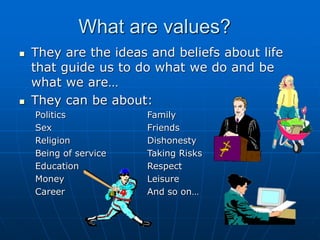
What are values?
 They are the ideas and beliefs about life
that guide us to do what we do and be
what we are…
 They can be about:
Politics Family
Sex Friends
Religion Dishonesty
Being of service Taking Risks
Education Respect
Money Leisure
Career And so on…
Different kinds of Values
 Moral Values:
• Values you hold for yourself but
don’t force on others such as right
vs. wrong, honesty vs. dishonesty,
being of service to others
 Aesthetic Values:
• Personal standards of beauty as
seen in nature, art, music, personal
appearance
 Performance Values:
• Benchmarks you set for yourself
such as accuracy, speed, reward for
achievement, self-discipline and
overall accomplishment
Means & Ends Values
 Instrumental Values (the means):
• Objectives used to reach goals such as
being responsible, obedient, loving,
ambitious, independent, honest
 Intrinsic Values (the end):
• Personal happiness, a comfortable life,
personal freedom, true friendship, a
successful career
Values Checklist
 Having good friends
 Having a positive relationship
 Having self-respect & the
respect of others
 Being financially secure
 Being spiritual
 Making a meaningful
contribution to mankind
 Being a moral person
 Being a great athlete
 Being physically attractive
 Being creative
 Being personally responsible
 Getting along well with people
in general
 Having freedom and
independence
 Being well educated
 Serving others
 Having peace of mind
 Getting recognition (being
famous)
 Being a good citizen
 Being healthy
 Being intelligent
 Having strong family ties
 Being honest & having
integrity
 Being dedicated and
committed
Values for College Success
 Connecting your personal values to being
successful in college:
• Clarify your values to be sure you really understand
them-
 As strange as it may seem, many people operate on values
without thinking them through.
 Truly understanding your values is key to applying them
successfully in college, in a career, or in life.
• Make a forthright self-evaluation-
 Are your values workable in college?
 Do you need to change or re-figure them?
• If necessary, change your values to make them more
productive and effective…
Forging Academic Values:
Participate Fully
 College takes much more time and work
than high school.
 You also have much more freedom which
requires much more personal responsibility.
 Avoid being unnecessarily frivolous, make
yourself stay “on-task”!
 And, unless you honestly have no choice,
DON’T SKIP CLASS!
Forging Academic Values:
Participate Honorably #1
 Let’s be frank: If you cheat or plagiarize, you are
side-stepping the real reason you came to
college: to get an education.
 Academic dishonesty myths:
• The risk of getting caught is small.
 It only takes getting caught once and you could be out.
• There is no other way to be “successful.”
 No? Then dishonesty should be the hallmark of all human
endeavor.
• It doesn’t matter in the long run.
 Not if you don’t have a conscience.
• The penalty for getting caught won’t be severe.
 Is this something you want to find out the hard way?
Forging Academic Values:
Participate Honorably #2
 If, on the other hand, you honestly give it your
“best shot”:
• Practicing academic integrity builds moral character.
 There’s nothing like having your conscience tell you did it
right!
• Choosing moral actions builds others’ trust in you.
 Having people believe in you is a major plus.
• Making bogus grades masks real feedback about
learning.
 How will you ever know what you are really capable of?
• Improving integrity in the classroom can rebuild national
character.
 The college classroom is an excellent place to begin
stemming the tide of corporate greed and corruption.
The Eleventh Commandment
Thou shalt not
get caught!
Challenges to your Values
 At college, you are going to meet new people whose values
may be quite different, if not totally opposite, to your own.
• You may be politically liberal and find yourself
befriending a staunch conservative.
 Are you going to pass judgment and walk away?
 Or are you going to be tolerant and try to see the person in
a new way?
 Tolerance is a very positive trait, but even it can be carried
too far.
 If you see your new friend show a really self-destructive
tendency, like excessive drinking, it is probably best not to
aid and abet them in their weakness, but rather to tell them
what you really think.
 Your challenge is to balance your personal welfare, your
tolerance for diversity and your freedom of choice.
Values in Conflict: Dualisms
 Values of a society are often in conflict:
• Poverty vs. “Rugged Individualism”
• The Death Penalty vs. Deterrence of Major Crimes
• And so on…
 An individual’s values can also be in conflict, often
personal values reflect the two-sided nature of our
culture’s unresolved contradictory values.
 Who is right? Who is wrong? – These are a matter of
individual choice, based on both conscience and
careful critical thinking.
 Think on this duality:
• Earning excellent grades in college is critical to
success in life.
• The most important decision you make in college
is about the kind of person you want to be.
 “Grades?” Or “Who do you want to be?” How do you
resolve this enigma?
Changing Society, Changing Values
 American values are changing, caused by:
• Demographic changes caused by much immigration from
other countries
• Globalization of the world economy
• Growing environmental concerns
• Political polarization
• Breakup of the family
• Computer technology and the Internet
• The Feminist movement
• Federal intervention in state’s rights
• Terrorism
• And on and on…
 All of these, and many more, will greatly affect the values
of the individual.
Service Learning and Values
 Service Learning is a teaching method that
combines meaningful service to the
community with curriculum-based learning.
• Serving: To be effective, it should serve a genuine
community need, seen by a student-led
assessment and it should serve a real need.
• Linking: The program needs to have a strong link
between the community need and classroom
goals.
• Learning: Reflection is a key element in service
learning. The instructor sets time and methods for
students to reflect on and analyze their service
experience.
• It includes the best of both worlds into one:
community service and internships into one
learning experience.
Think about your legacy…
 In order to aid you to understand if you are truly
living up to your values, Stephen Covey, author
of the bestseller The 7 Habits of Highly Successful
People, suggests you ask yourself this question:
• Imagine that you are attending your own funeral,
looking down at yourself in the casket.
• After you sit down, four people:
 A family member
 A friend
 A co-worker
 Someone from your church or community organization
give a eulogy for you.
• What would you want them to say about you?
Value Assessment Web Resources
 College Success Factors Index
• http://www.csfi-wadsworth.com
 Steps to Successful Career Planning
• http://career.asu.edu/S/careerplan/selfdiscovery/ValuesAssessment.htm
 Journal of College and Character
• http://collegevalues.org/center.cfm
 Rutgers Value Assessment
• http://careerservices.rutgers.edu/OCAvaluesassessment.html
 Ohio Learning Network: Values Assessment
• http://www.oln.org/student_services/plan_your_education/assess_values.php
Values & Ethics
 In the preceding presentation about values, the
words morals and morality came up regularly.
 Is there a connection between morality and
ethics?
 Generally, the words are used interchangeably.
There is, however, a difference:
• Morality is usually more theoretical; it is a philosophical
concept.
• Ethics are the practical application of morality in daily
life.
 The difference is that of theory and practice.
 If a person has a moral character, he or she will
generally deal with other people in an ethical
manner.
A 28 Day Project
 In order to determine what you believe is the most
important personal value of all, here is a method originally
developed by the ancient Greeks for determining something
really important.
 At the same time every day (for instance, upon rising in the
morning or at bedtime) for 28 days, keep a journal and
write down: “The personal value I consider most important
is ______” Try to keep it to as few items as possible. One
thing is best, but if you have several items, write them
down. Limit yourself to no more than three.
 At about the 25th or 26th day of the procedure, one
particular value should emerge as the predominant one.
 Enjoy, learn and grow!

chapter13.ppt

  • 1.
    Values and Ethics What do you believe in?  Who do you care about?  What motivates you?  Are you a spiritual person?  Why are you really in college?  How do you tell the difference between right and wrong? Let’s take a look at what really matters to you.
  • 2.
    What are values? They are the ideas and beliefs about life that guide us to do what we do and be what we are…  They can be about: Politics Family Sex Friends Religion Dishonesty Being of service Taking Risks Education Respect Money Leisure Career And so on…
  • 3.
    Different kinds ofValues  Moral Values: • Values you hold for yourself but don’t force on others such as right vs. wrong, honesty vs. dishonesty, being of service to others  Aesthetic Values: • Personal standards of beauty as seen in nature, art, music, personal appearance  Performance Values: • Benchmarks you set for yourself such as accuracy, speed, reward for achievement, self-discipline and overall accomplishment
  • 4.
    Means & EndsValues  Instrumental Values (the means): • Objectives used to reach goals such as being responsible, obedient, loving, ambitious, independent, honest  Intrinsic Values (the end): • Personal happiness, a comfortable life, personal freedom, true friendship, a successful career
  • 5.
    Values Checklist  Havinggood friends  Having a positive relationship  Having self-respect & the respect of others  Being financially secure  Being spiritual  Making a meaningful contribution to mankind  Being a moral person  Being a great athlete  Being physically attractive  Being creative  Being personally responsible  Getting along well with people in general  Having freedom and independence  Being well educated  Serving others  Having peace of mind  Getting recognition (being famous)  Being a good citizen  Being healthy  Being intelligent  Having strong family ties  Being honest & having integrity  Being dedicated and committed
  • 6.
    Values for CollegeSuccess  Connecting your personal values to being successful in college: • Clarify your values to be sure you really understand them-  As strange as it may seem, many people operate on values without thinking them through.  Truly understanding your values is key to applying them successfully in college, in a career, or in life. • Make a forthright self-evaluation-  Are your values workable in college?  Do you need to change or re-figure them? • If necessary, change your values to make them more productive and effective…
  • 7.
    Forging Academic Values: ParticipateFully  College takes much more time and work than high school.  You also have much more freedom which requires much more personal responsibility.  Avoid being unnecessarily frivolous, make yourself stay “on-task”!  And, unless you honestly have no choice, DON’T SKIP CLASS!
  • 8.
    Forging Academic Values: ParticipateHonorably #1  Let’s be frank: If you cheat or plagiarize, you are side-stepping the real reason you came to college: to get an education.  Academic dishonesty myths: • The risk of getting caught is small.  It only takes getting caught once and you could be out. • There is no other way to be “successful.”  No? Then dishonesty should be the hallmark of all human endeavor. • It doesn’t matter in the long run.  Not if you don’t have a conscience. • The penalty for getting caught won’t be severe.  Is this something you want to find out the hard way?
  • 9.
    Forging Academic Values: ParticipateHonorably #2  If, on the other hand, you honestly give it your “best shot”: • Practicing academic integrity builds moral character.  There’s nothing like having your conscience tell you did it right! • Choosing moral actions builds others’ trust in you.  Having people believe in you is a major plus. • Making bogus grades masks real feedback about learning.  How will you ever know what you are really capable of? • Improving integrity in the classroom can rebuild national character.  The college classroom is an excellent place to begin stemming the tide of corporate greed and corruption.
  • 10.
    The Eleventh Commandment Thoushalt not get caught!
  • 11.
    Challenges to yourValues  At college, you are going to meet new people whose values may be quite different, if not totally opposite, to your own. • You may be politically liberal and find yourself befriending a staunch conservative.  Are you going to pass judgment and walk away?  Or are you going to be tolerant and try to see the person in a new way?  Tolerance is a very positive trait, but even it can be carried too far.  If you see your new friend show a really self-destructive tendency, like excessive drinking, it is probably best not to aid and abet them in their weakness, but rather to tell them what you really think.  Your challenge is to balance your personal welfare, your tolerance for diversity and your freedom of choice.
  • 12.
    Values in Conflict:Dualisms  Values of a society are often in conflict: • Poverty vs. “Rugged Individualism” • The Death Penalty vs. Deterrence of Major Crimes • And so on…  An individual’s values can also be in conflict, often personal values reflect the two-sided nature of our culture’s unresolved contradictory values.  Who is right? Who is wrong? – These are a matter of individual choice, based on both conscience and careful critical thinking.  Think on this duality: • Earning excellent grades in college is critical to success in life. • The most important decision you make in college is about the kind of person you want to be.  “Grades?” Or “Who do you want to be?” How do you resolve this enigma?
  • 13.
    Changing Society, ChangingValues  American values are changing, caused by: • Demographic changes caused by much immigration from other countries • Globalization of the world economy • Growing environmental concerns • Political polarization • Breakup of the family • Computer technology and the Internet • The Feminist movement • Federal intervention in state’s rights • Terrorism • And on and on…  All of these, and many more, will greatly affect the values of the individual.
  • 14.
    Service Learning andValues  Service Learning is a teaching method that combines meaningful service to the community with curriculum-based learning. • Serving: To be effective, it should serve a genuine community need, seen by a student-led assessment and it should serve a real need. • Linking: The program needs to have a strong link between the community need and classroom goals. • Learning: Reflection is a key element in service learning. The instructor sets time and methods for students to reflect on and analyze their service experience. • It includes the best of both worlds into one: community service and internships into one learning experience.
  • 15.
    Think about yourlegacy…  In order to aid you to understand if you are truly living up to your values, Stephen Covey, author of the bestseller The 7 Habits of Highly Successful People, suggests you ask yourself this question: • Imagine that you are attending your own funeral, looking down at yourself in the casket. • After you sit down, four people:  A family member  A friend  A co-worker  Someone from your church or community organization give a eulogy for you. • What would you want them to say about you?
  • 16.
    Value Assessment WebResources  College Success Factors Index • http://www.csfi-wadsworth.com  Steps to Successful Career Planning • http://career.asu.edu/S/careerplan/selfdiscovery/ValuesAssessment.htm  Journal of College and Character • http://collegevalues.org/center.cfm  Rutgers Value Assessment • http://careerservices.rutgers.edu/OCAvaluesassessment.html  Ohio Learning Network: Values Assessment • http://www.oln.org/student_services/plan_your_education/assess_values.php
  • 17.
    Values & Ethics In the preceding presentation about values, the words morals and morality came up regularly.  Is there a connection between morality and ethics?  Generally, the words are used interchangeably. There is, however, a difference: • Morality is usually more theoretical; it is a philosophical concept. • Ethics are the practical application of morality in daily life.  The difference is that of theory and practice.  If a person has a moral character, he or she will generally deal with other people in an ethical manner.
  • 18.
    A 28 DayProject  In order to determine what you believe is the most important personal value of all, here is a method originally developed by the ancient Greeks for determining something really important.  At the same time every day (for instance, upon rising in the morning or at bedtime) for 28 days, keep a journal and write down: “The personal value I consider most important is ______” Try to keep it to as few items as possible. One thing is best, but if you have several items, write them down. Limit yourself to no more than three.  At about the 25th or 26th day of the procedure, one particular value should emerge as the predominant one.  Enjoy, learn and grow!