

BY
DR. AHMED ABDELTAWAB AZAB
Emergency Consultant
American Heart Association Instructor
Emergency lecturer
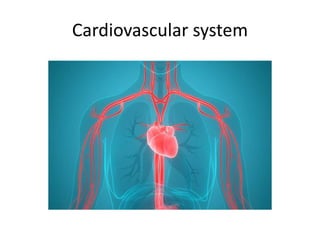
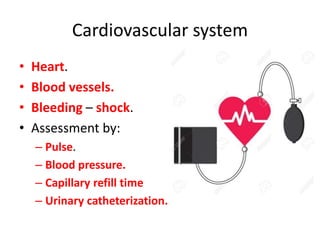
Cardiovascular system
• Heart.
• Blood vessels.
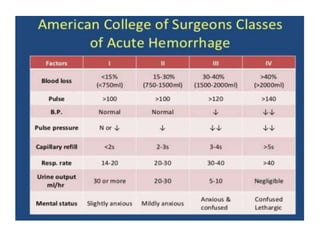
• Bleeding – shock.
• Assessment by:
– Pulse.
– Blood pressure.
– Capillary refill time
– Urinary catheterization.
Arrested patient.
• CPR:
– Safety.
– Check Response.
– Pulse detection.
– Code blue – false code blue.
– High quality CPR.
Arrested patient.
• High quality CPR:
– Hand position – finger position.
– Depth – 1/3 antero posterior diameter.
– Rate: 100 – 120 / minute.
– Alone: adult – child – infant.
– Two rescue: adult – child – infant.
– After advanced airway: compression – breathing.
– Adequate chest recoil.
– Minimize interruption: 10 second max.
– Shockable VS non – shockable rhythms.
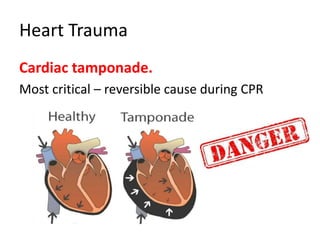
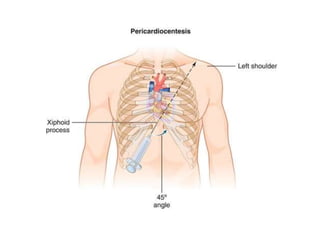
Heart Trauma
Cardiac tamponade.
Most critical – reversible cause during CPR
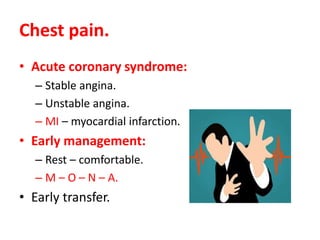
Chest pain.
• Acute coronary syndrome:
– Stable angina.
– Unstable angina.
– MI – myocardial infarction.
• Early management:
– Rest – comfortable.
– M – O – N – A.
• Early transfer.
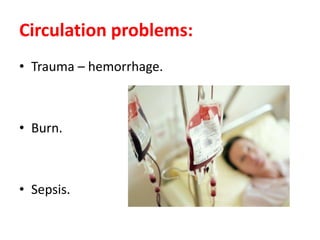
Circulation problems:
• Trauma – hemorrhage.
• Burn.
• Sepsis.
Trauma – hemorrhage.
• Minimal trauma
– Compression over bleeding site.
• Moderate trauma:
– Stitching.
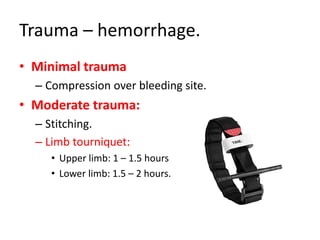
– Limb tourniquet:
• Upper limb: 1 – 1.5 hours
• Lower limb: 1.5 – 2 hours.
Trauma – hemorrhage.
• Massive hemorrhage:
– Internal – external.
– Shock.
– Need rapid surgical intervention
Burn.
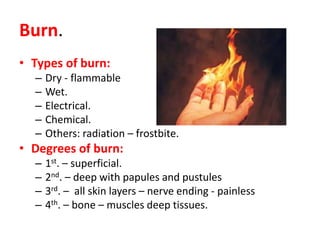
• Types of burn:
– Dry - flammable
– Wet.
– Electrical.
– Chemical.
– Others: radiation – frostbite.
• Degrees of burn:
– 1st. – superficial.
– 2nd. – deep with papules and pustules
– 3rd. – all skin layers – nerve ending - painless
– 4th. – bone – muscles deep tissues.
Burn
• Pre hospital management:
– Safety.
– Stop burning process.
– Assessment.
– Cooling – 10 – 60 minutes + analgesics
– Dressing.
– Transportation.
• Inform receiving hospital – give O2 elevate the head –
elevate the limb – vascular access (once) – ORS.
Burn
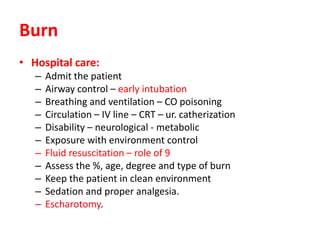
• Hospital care:
– Admit the patient
– Airway control – early intubation
– Breathing and ventilation – CO poisoning
– Circulation – IV line – CRT – ur. catherization
– Disability – neurological - metabolic
– Exposure with environment control
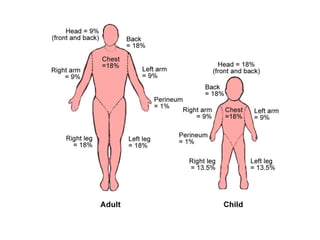
– Fluid resuscitation – role of 9
– Assess the %, age, degree and type of burn
– Keep the patient in clean environment
– Sedation and proper analgesia.
– Escharotomy.
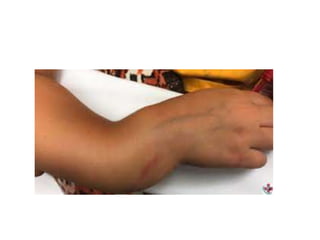
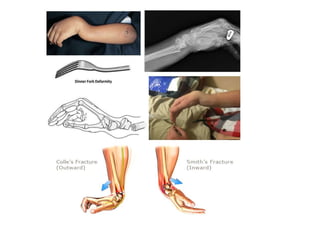
Bone fractures
• Closed fractures:
– pain
– Nerve injury.
– Vascular injury.
– Compartmental syndrome.
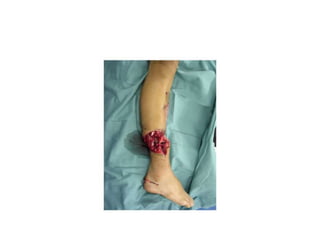
• Open fractures:
– The same complications like closed but more
sever.
Bone fractures
• Assessment:
– Airway – C- spine.
– Breathing.
– Circulation – shock.
• Limb examination.
• Peripheral pulse.
• Peripheral CRT.
– Disability.
– Exposure – missed fractures.
Bone fractures
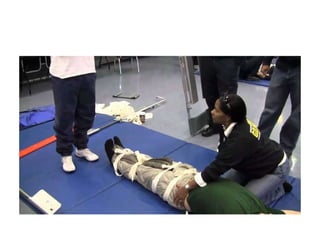
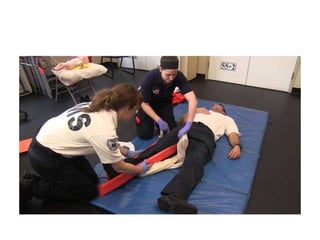
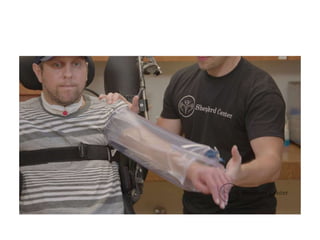
• Reduction.
• Fixation.
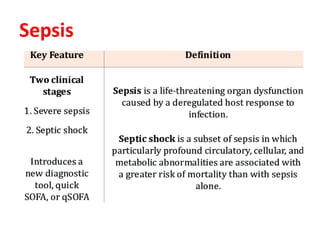
Sepsis
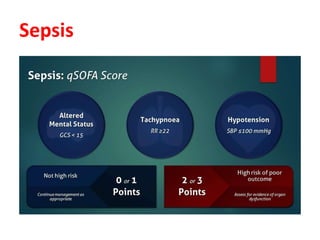
Sepsis
Sepsis
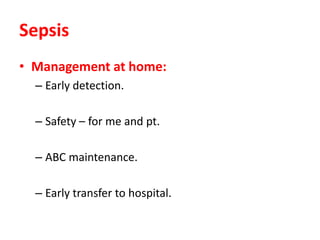
• Management at home:
– Early detection.
– Safety – for me and pt.
– ABC maintenance.
– Early transfer to hospital.
Sepsis
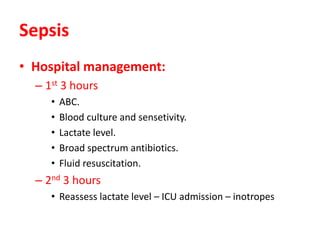
• Hospital management:
– 1st 3 hours
• ABC.
• Blood culture and sensetivity.
• Lactate level.
• Broad spectrum antibiotics.
• Fluid resuscitation.
– 2nd 3 hours
• Reassess lactate level – ICU admission – inotropes
Capillary refill
time
CALL FOR HELP
4-circulation emergencies.pptx

4-circulation emergencies.pptx

  • 1.
    BY DR. AHMED ABDELTAWABAZAB Emergency Consultant American Heart Association Instructor Emergency lecturer
  • 3.
  • 4.
    Cardiovascular system • Heart. •Blood vessels. • Bleeding – shock. • Assessment by: – Pulse. – Blood pressure. – Capillary refill time – Urinary catheterization.
  • 5.
    Arrested patient. • CPR: –Safety. – Check Response. – Pulse detection. – Code blue – false code blue. – High quality CPR.
  • 6.
    Arrested patient. • Highquality CPR: – Hand position – finger position. – Depth – 1/3 antero posterior diameter. – Rate: 100 – 120 / minute. – Alone: adult – child – infant. – Two rescue: adult – child – infant. – After advanced airway: compression – breathing. – Adequate chest recoil. – Minimize interruption: 10 second max. – Shockable VS non – shockable rhythms.
  • 7.
    Heart Trauma Cardiac tamponade. Mostcritical – reversible cause during CPR
  • 9.
    Chest pain. • Acutecoronary syndrome: – Stable angina. – Unstable angina. – MI – myocardial infarction. • Early management: – Rest – comfortable. – M – O – N – A. • Early transfer.
  • 10.
    Circulation problems: • Trauma– hemorrhage. • Burn. • Sepsis.
  • 11.
    Trauma – hemorrhage. •Minimal trauma – Compression over bleeding site. • Moderate trauma: – Stitching. – Limb tourniquet: • Upper limb: 1 – 1.5 hours • Lower limb: 1.5 – 2 hours.
  • 12.
    Trauma – hemorrhage. •Massive hemorrhage: – Internal – external. – Shock. – Need rapid surgical intervention
  • 14.
    Burn. • Types ofburn: – Dry - flammable – Wet. – Electrical. – Chemical. – Others: radiation – frostbite. • Degrees of burn: – 1st. – superficial. – 2nd. – deep with papules and pustules – 3rd. – all skin layers – nerve ending - painless – 4th. – bone – muscles deep tissues.
  • 15.
    Burn • Pre hospitalmanagement: – Safety. – Stop burning process. – Assessment. – Cooling – 10 – 60 minutes + analgesics – Dressing. – Transportation. • Inform receiving hospital – give O2 elevate the head – elevate the limb – vascular access (once) – ORS.
  • 16.
    Burn • Hospital care: –Admit the patient – Airway control – early intubation – Breathing and ventilation – CO poisoning – Circulation – IV line – CRT – ur. catherization – Disability – neurological - metabolic – Exposure with environment control – Fluid resuscitation – role of 9 – Assess the %, age, degree and type of burn – Keep the patient in clean environment – Sedation and proper analgesia. – Escharotomy.
  • 18.
    Bone fractures • Closedfractures: – pain – Nerve injury. – Vascular injury. – Compartmental syndrome. • Open fractures: – The same complications like closed but more sever.
  • 19.
    Bone fractures • Assessment: –Airway – C- spine. – Breathing. – Circulation – shock. • Limb examination. • Peripheral pulse. • Peripheral CRT. – Disability. – Exposure – missed fractures.
  • 23.
  • 27.
  • 28.
  • 29.
    Sepsis • Management athome: – Early detection. – Safety – for me and pt. – ABC maintenance. – Early transfer to hospital.
  • 30.
    Sepsis • Hospital management: –1st 3 hours • ABC. • Blood culture and sensetivity. • Lactate level. • Broad spectrum antibiotics. • Fluid resuscitation. – 2nd 3 hours • Reassess lactate level – ICU admission – inotropes
  • 31.
  • 32.