








4b: Use formulas and strategies, such as decomposition, to compute the perimeter and area of triangles, parallelograms, trapezoids, the circumference and area of circles, and find the area of more complex shapes. (DOK 2)By:  Deia Sanders
PerimeterThe Perimeter of a polygon is the distance around it.Because a square and a rectangle are special types of polygons, they have a special perimeter formula.  The triangle and any other unknown-sided polygon will use the “sum of all the sides” as the formula.Square = 4s (s is the length of the side)Rectangle = 2(l + w) (l is the length and w is the width)All other polygons = add the sides
Let’s Review Examples on Page 66
Homework:Handout #1 Page 93
Day 2Area of Polygons!!!
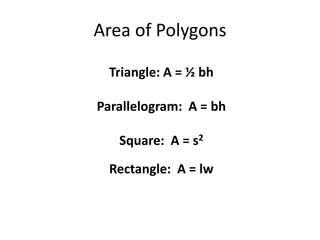
Area of PolygonsTriangle: A = ½ bhParallelogram:  A = bhSquare:  A = s2Rectangle:  A = lw
Let’s work examples on pages 67-69
HomeworkHandout #2 Page 95
Day 3Area of Trapezoids!!!
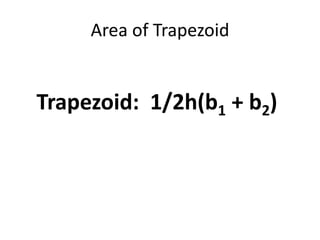
Area of TrapezoidTrapezoid:  1/2h(b1 + b2)
Let’s work examples on pages 69-72!!
Homework Handout #3 Page 97
Day 4Circumference and Area of Circles!!!
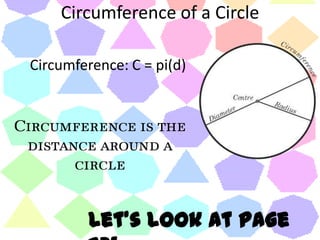
Circumference of a CircleCircumference: C = pi(d)Circumference is the distance around a circleLet’s look at page 73!
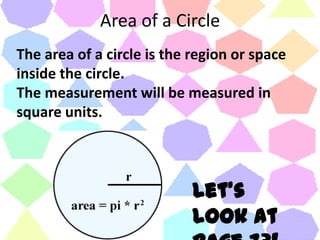
Area of a CircleThe area of a circle is the region or space inside the circle. The measurement will be measured in square units.Let’s look at page 73!
HomeworkHandout #4Page 99
Day 5Irregular Polygons!!!
Irregularly Shaped PolygonsStep 1.  Break down the original figure into more basic shapes, such as squares, rectangles, triangles, or circles.Step 2.  Find the area of the basic shapes using the formulas.Step 3.  Combine the areas of the basic shapes so that the area of the irregularly shaped polygon can be determined.
Lets look at pages 74 and 75!!!
HomeworkHandout #5Page 101

4b area of polygons