3a: Classify and Compare three-dimensional shapes using their properties3b: Construct two-dimensional representations of three-dimensional objectsBy: Deia Sanders
VocabularyPolyhedra (polyhedron – singular form) – geometric solid with flat surfaces called faces that are shaped like polygonsTo us… they look like 3-D shapes!
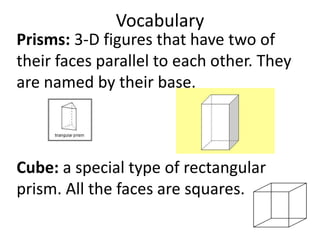
VocabularyPrisms: 3-D figures that have two of their faces parallel to each other. They are named by their base.Cube: a special type of rectangular prism. All the faces are squares.
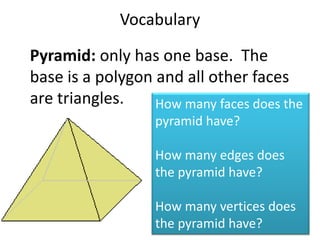
VocabularyPyramid: only has one base.  The base is a polygon and all other faces are triangles.  How many faces does the pyramid have?How many edges does the pyramid have?How many vertices does the pyramid have?
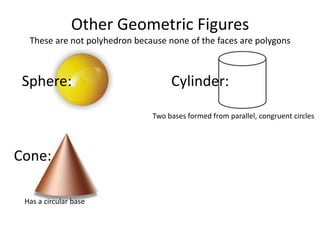
Other Geometric FiguresThese are not polyhedron because none of the faces are polygonsSphere:Cylinder:Two bases formed from parallel, congruent circlesCone:Has a circular base
Complete Buckle Down Pages
Day 23a: Classify and Compare three-dimensional shapes using their properties3b: Construct two-dimensional representations of three-dimensional objects
Let’s Review Vocabulary
ActivityMrs. Sanders will place you in groups of 5 (2 min.)Each team member will construct one of the items listed on the worksheet (10-15 mins.)The group will complete the chart and discuss answers based on the figures constructed. (10 mins.)
ClosureClean up your group areaReturn desks to their usual positionPut away binders and pack up

3a and 3b classify and construct 3 d shapes

  • 1.
    3a: Classify andCompare three-dimensional shapes using their properties3b: Construct two-dimensional representations of three-dimensional objectsBy: Deia Sanders
  • 2.
    VocabularyPolyhedra (polyhedron –singular form) – geometric solid with flat surfaces called faces that are shaped like polygonsTo us… they look like 3-D shapes!
  • 3.
    VocabularyPrisms: 3-D figuresthat have two of their faces parallel to each other. They are named by their base.Cube: a special type of rectangular prism. All the faces are squares.
  • 4.
    VocabularyPyramid: only hasone base. The base is a polygon and all other faces are triangles. How many faces does the pyramid have?How many edges does the pyramid have?How many vertices does the pyramid have?
  • 5.
    Other Geometric FiguresTheseare not polyhedron because none of the faces are polygonsSphere:Cylinder:Two bases formed from parallel, congruent circlesCone:Has a circular base
  • 6.
  • 7.
    Day 23a: Classifyand Compare three-dimensional shapes using their properties3b: Construct two-dimensional representations of three-dimensional objects
  • 8.
  • 9.
    ActivityMrs. Sanders willplace you in groups of 5 (2 min.)Each team member will construct one of the items listed on the worksheet (10-15 mins.)The group will complete the chart and discuss answers based on the figures constructed. (10 mins.)
  • 10.
    ClosureClean up yourgroup areaReturn desks to their usual positionPut away binders and pack up