2
Chapter 8. Classification:Basic Concepts
Classification: Basic Concepts
Decision Tree Induction
Bayes Classification Methods
Rule-Based Classification
Model Evaluation and Selection
Techniques to Improve Classification Accuracy:
Ensemble Methods
Summary
3.
3
Supervised vs. UnsupervisedLearning
Supervised learning (classification)
Supervision: The training data (observations,
measurements, etc.) are accompanied by labels indicating
the class of the observations
New data is classified based on the training set
Unsupervised learning (clustering)
The class labels of training data is unknown
Given a set of measurements, observations, etc. with the
aim of establishing the existence of classes or clusters in the
data
4.
4
Classification
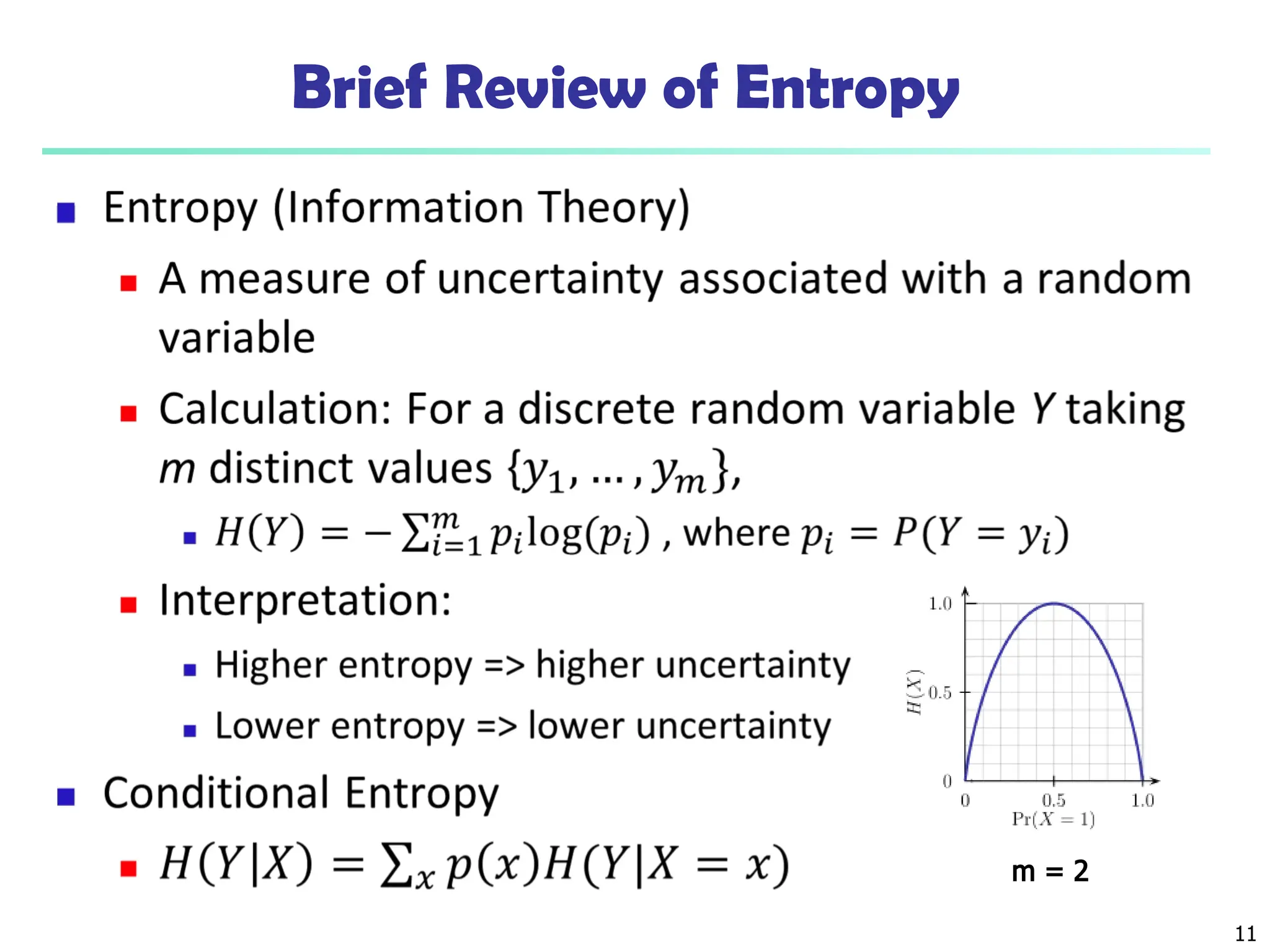
predictscategorical class labels (discrete or nominal)
classifies data (constructs a model) based on the training
set and the values (class labels) in a classifying attribute and
uses it in classifying new data
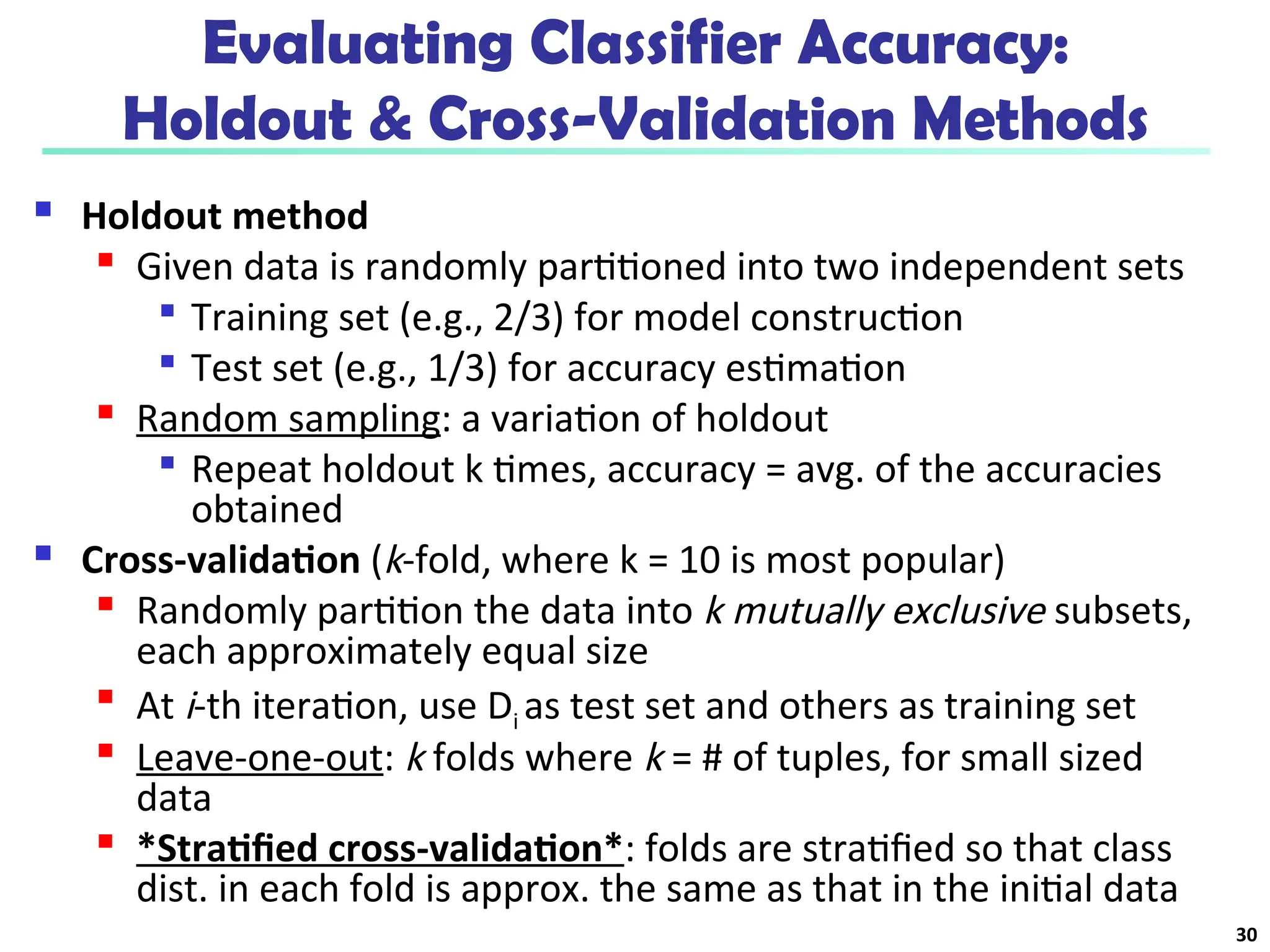
Numeric Prediction
models continuous-valued functions, i.e., predicts unknown
or missing values
Typical applications
Credit/loan approval:
Medical diagnosis: if a tumor is cancerous or benign
Fraud detection: if a transaction is fraudulent
Web page categorization: which category it is
Prediction Problems: Classification vs.
Numeric Prediction
5.
5
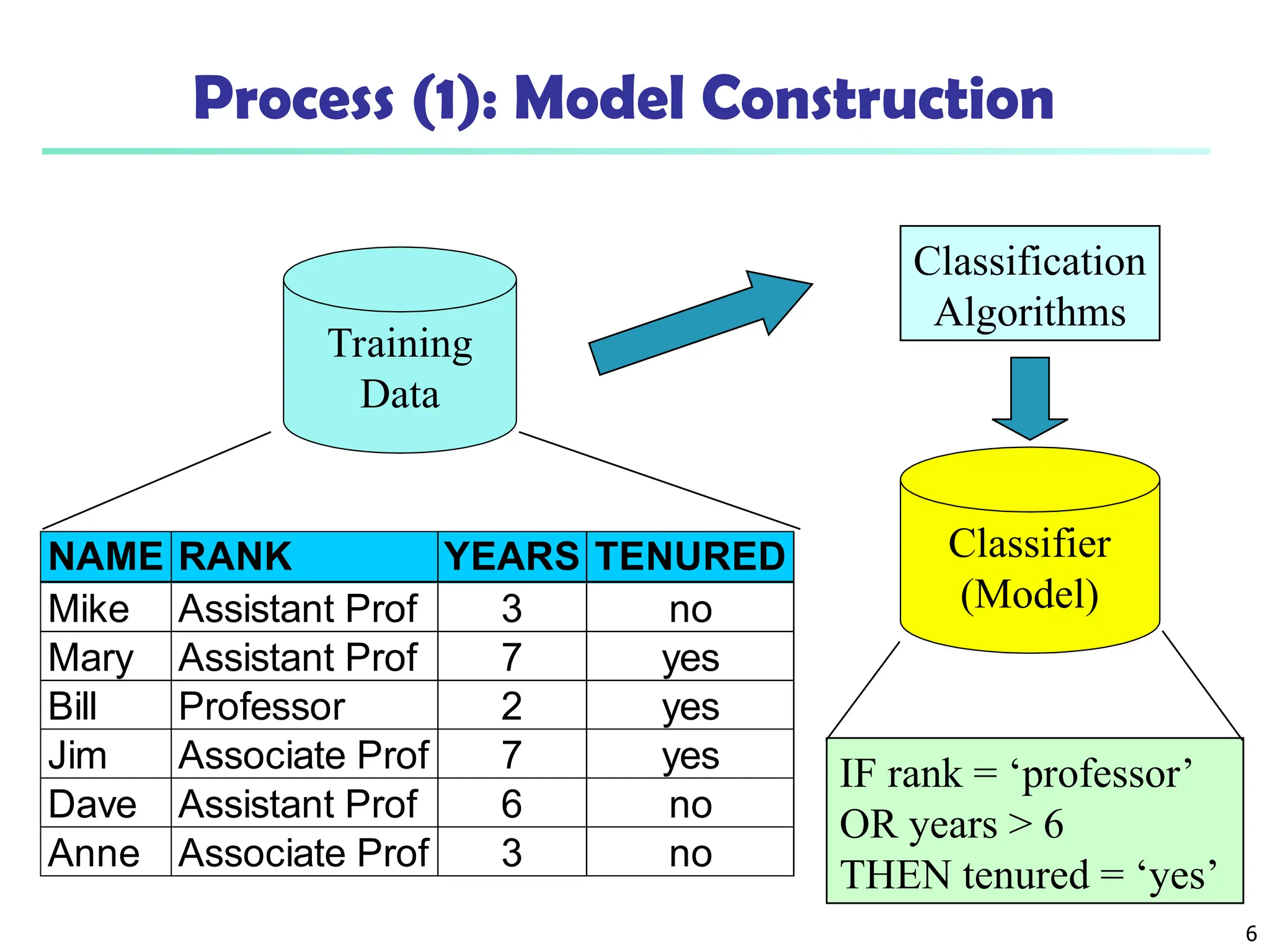
Classification—A Two-Step Process
Model construction: describing a set of predetermined classes
Each tuple/sample is assumed to belong to a predefined class, as
determined by the class label attribute
The set of tuples used for model construction is training set
The model is represented as classification rules, decision trees, or
mathematical formulae
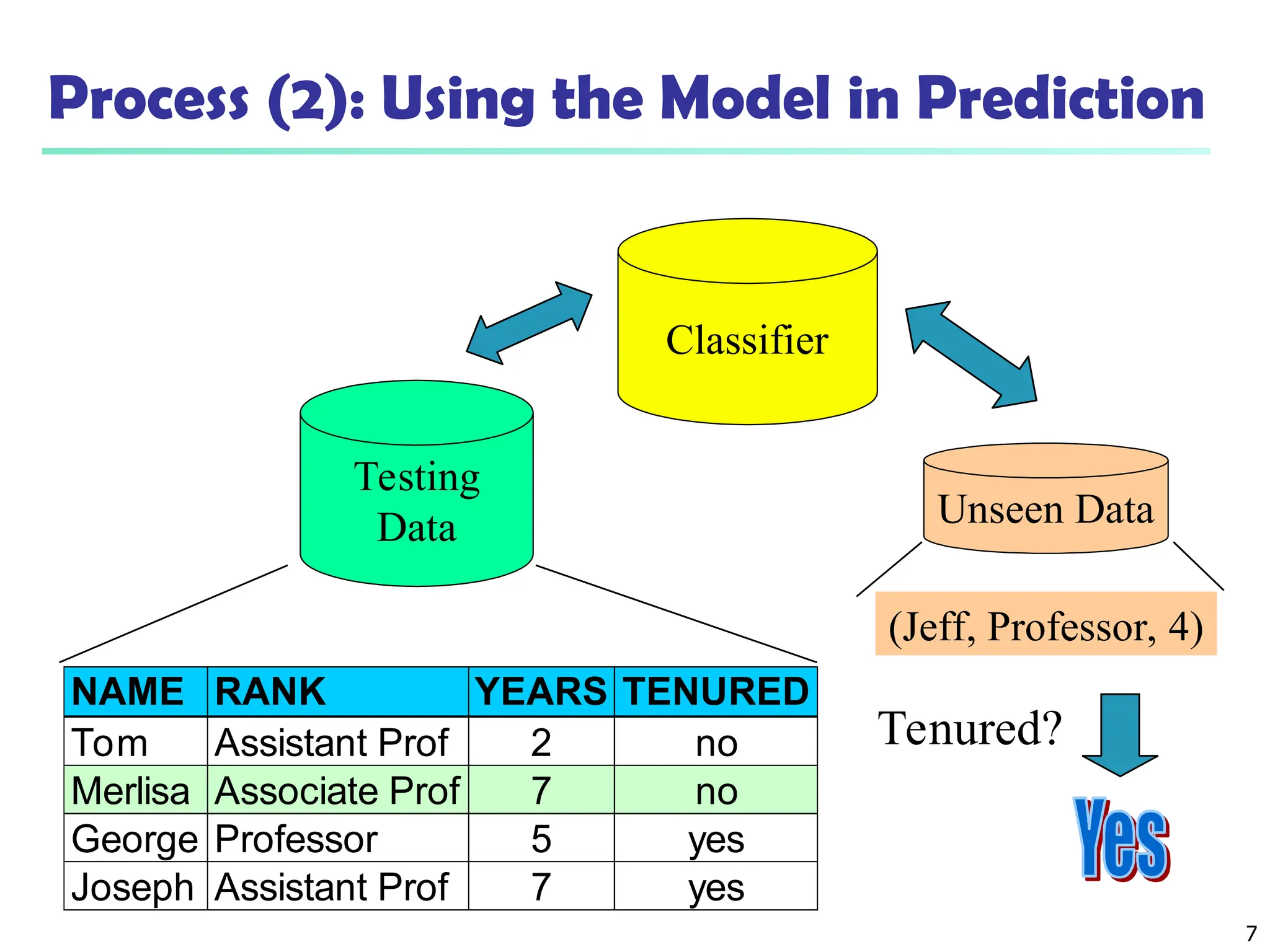
Model usage: for classifying future or unknown objects
Estimate accuracy of the model
The known label of test sample is compared with the classified result
from the model
Accuracy rate is the percentage of test set samples that are correctly
classified by the model
Test set is independent of training set (otherwise overfitting)
If the accuracy is acceptable, use the model to classify new data
Note: If the test set is used to select models, it is called validation (test) set
6.
6
Process (1): ModelConstruction
Training
Data
NAME RANK YEARS TENURED
Mike Assistant Prof 3 no
Mary Assistant Prof 7 yes
Bill Professor 2 yes
Jim Associate Prof 7 yes
Dave Assistant Prof 6 no
Anne Associate Prof 3 no
Classification
Algorithms
IF rank = ‘professor’
OR years > 6
THEN tenured = ‘yes’
Classifier
(Model)
7.
7
Process (2): Usingthe Model in Prediction
Classifier
Testing
Data
NAME RANK YEARS TENURED
Tom Assistant Prof 2 no
Merlisa Associate Prof 7 no
George Professor 5 yes
Joseph Assistant Prof 7 yes
Unseen Data
(Jeff, Professor, 4)
Tenured?
8.
8
Chapter 8. Classification:Basic Concepts
Classification: Basic Concepts
Decision Tree Induction
Bayes Classification Methods
Rule-Based Classification
Model Evaluation and Selection
Techniques to Improve Classification Accuracy:
Ensemble Methods
Summary
9.
9
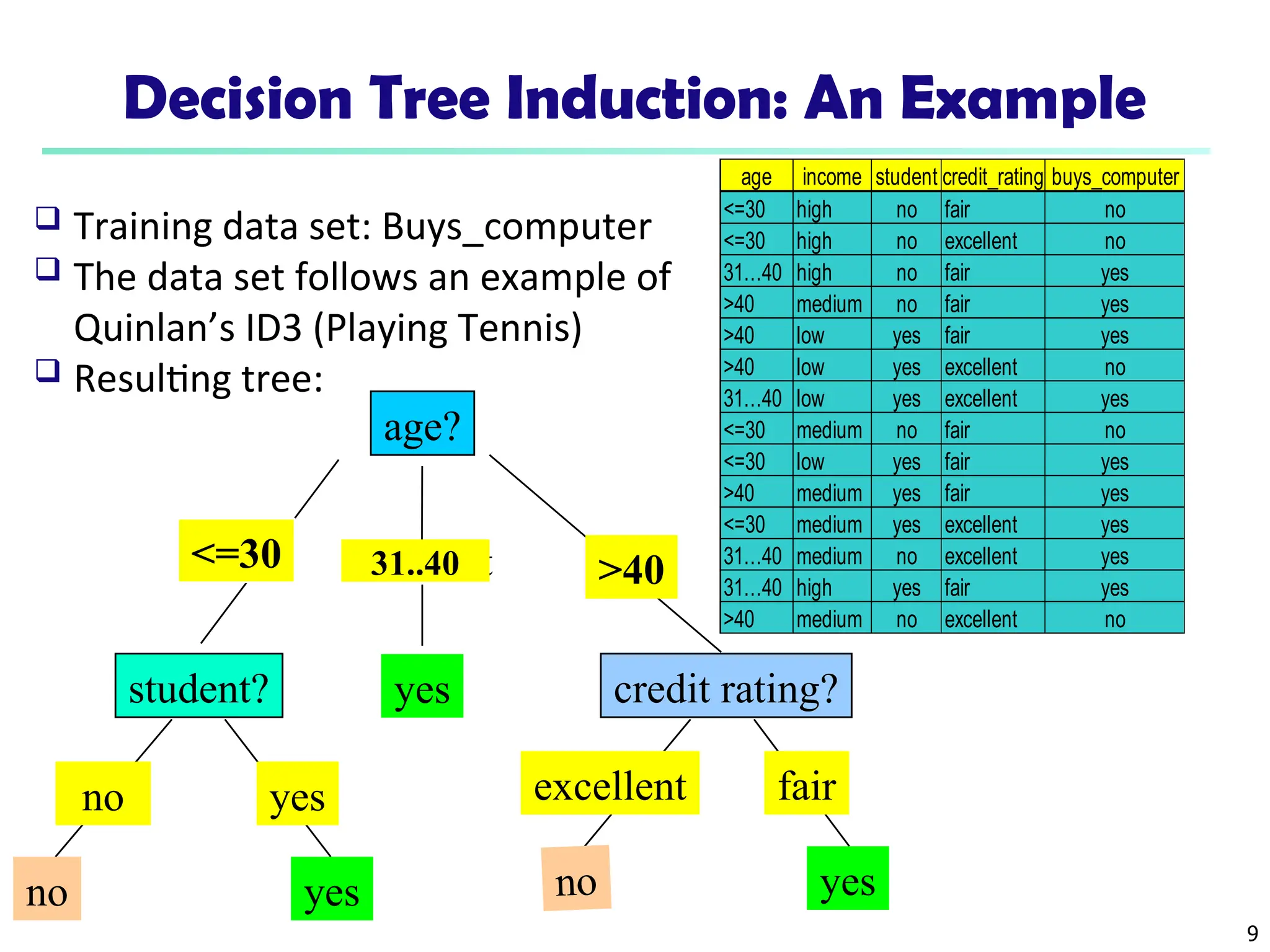
Decision Tree Induction:An Example
age?
overcast
student? credit rating?
<=30 >40
no yes yes
yes
31..40
no
fair
excellent
yes
no
age income student credit_rating buys_computer
<=30 high no fair no
<=30 high no excellent no
31…40 high no fair yes
>40 medium no fair yes
>40 low yes fair yes
>40 low yes excellent no
31…40 low yes excellent yes
<=30 medium no fair no
<=30 low yes fair yes
>40 medium yes fair yes
<=30 medium yes excellent yes
31…40 medium no excellent yes
31…40 high yes fair yes
>40 medium no excellent no
Training data set: Buys_computer
The data set follows an example of
Quinlan’s ID3 (Playing Tennis)
Resulting tree:
10.
10
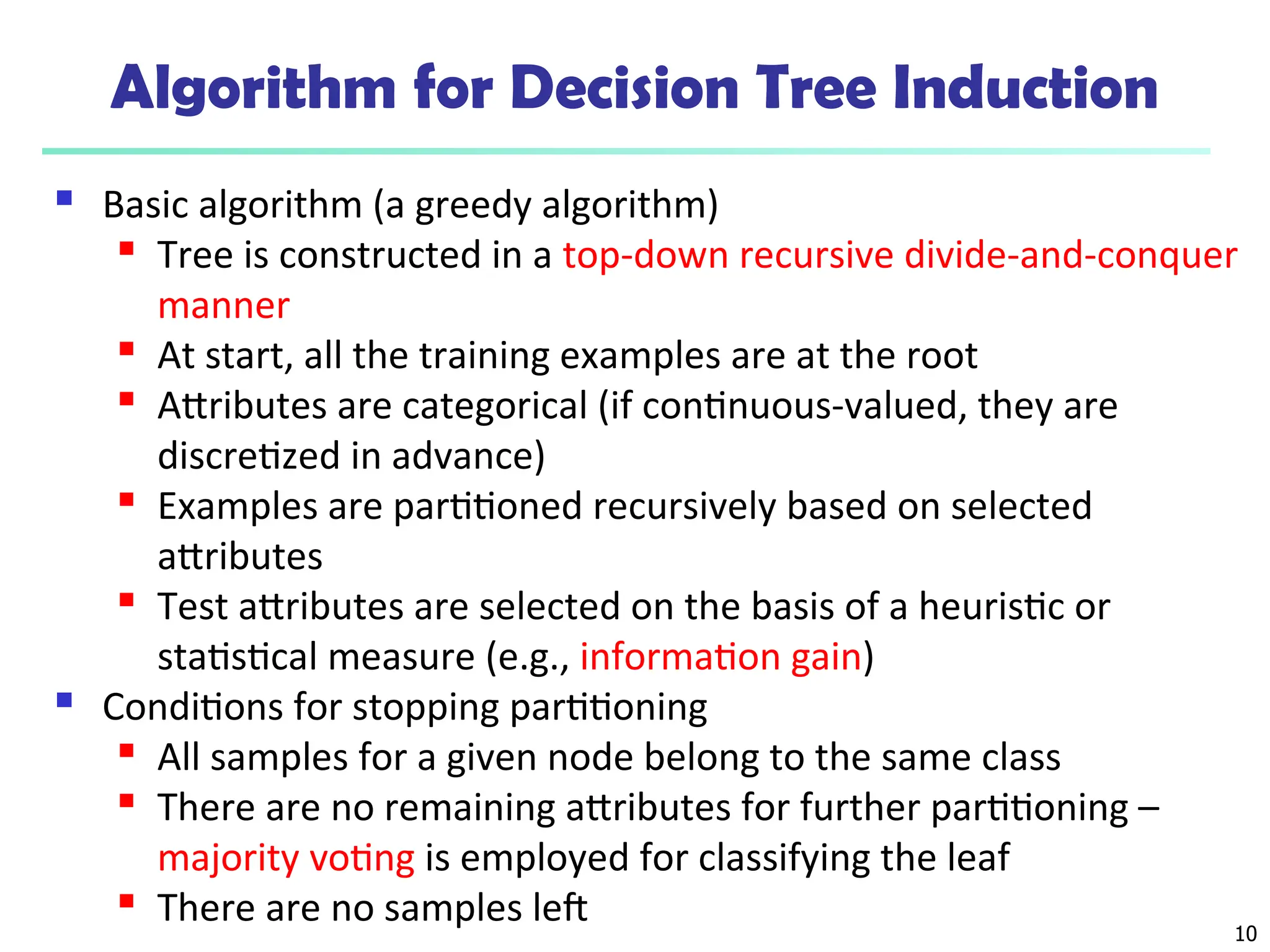
Algorithm for DecisionTree Induction
Basic algorithm (a greedy algorithm)
Tree is constructed in a top-down recursive divide-and-conquer
manner
At start, all the training examples are at the root
Attributes are categorical (if continuous-valued, they are
discretized in advance)
Examples are partitioned recursively based on selected
attributes
Test attributes are selected on the basis of a heuristic or
statistical measure (e.g., information gain)
Conditions for stopping partitioning
All samples for a given node belong to the same class
There are no remaining attributes for further partitioning –
majority voting is employed for classifying the leaf
There are no samples left
12
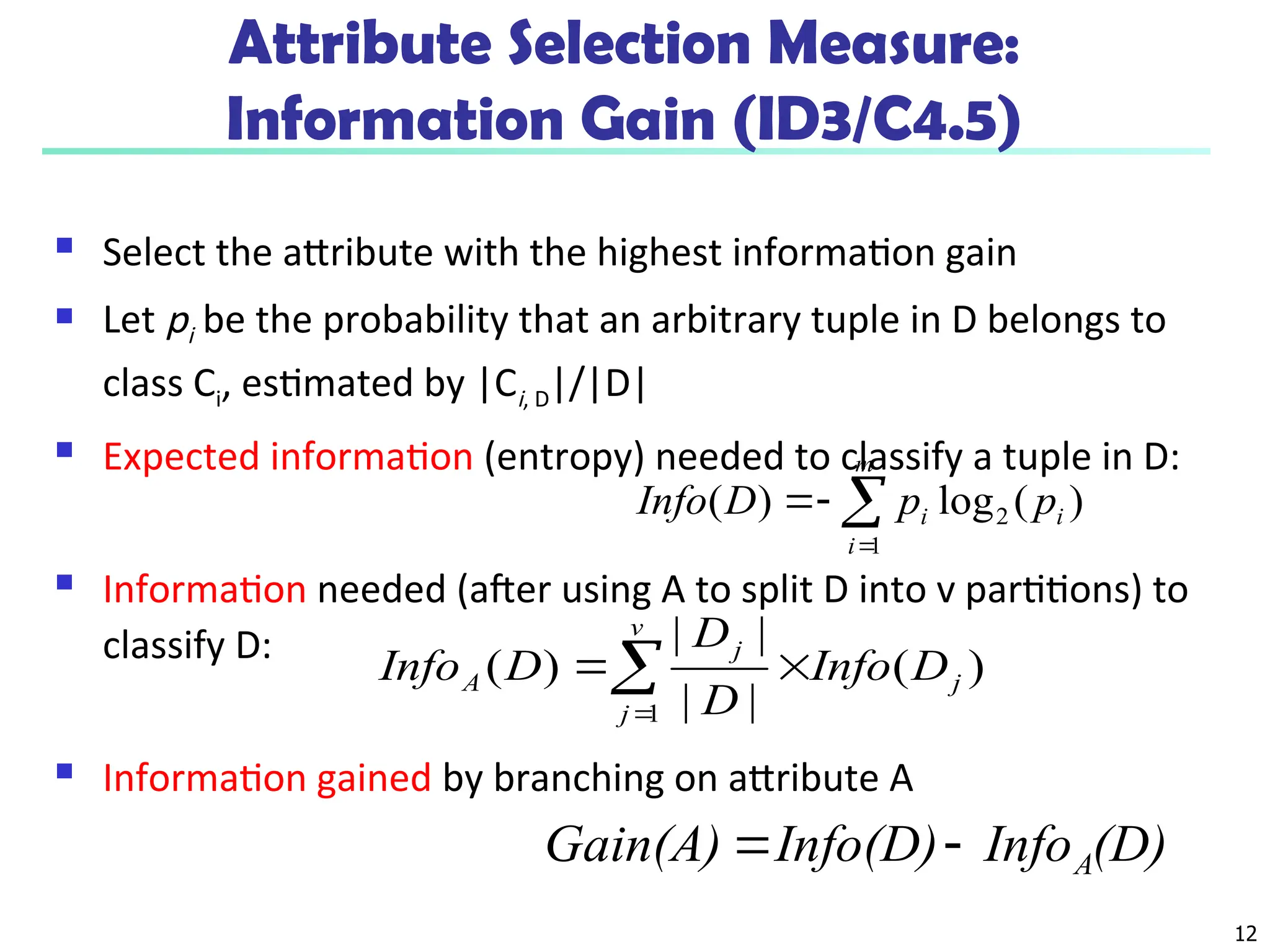
Attribute Selection Measure:
InformationGain (ID3/C4.5)
Select the attribute with the highest information gain
Let pi be the probability that an arbitrary tuple in D belongs to
class Ci, estimated by |Ci, D|/|D|
Expected information (entropy) needed to classify a tuple in D:
Information needed (after using A to split D into v partitions) to
classify D:
Information gained by branching on attribute A
)
(
log
)
( 2
1
i
m
i
i p
p
D
Info
)
(
|
|
|
|
)
(
1
j
v
j
j
A D
Info
D
D
D
Info
(D)
Info
Info(D)
Gain(A) A
13.
13
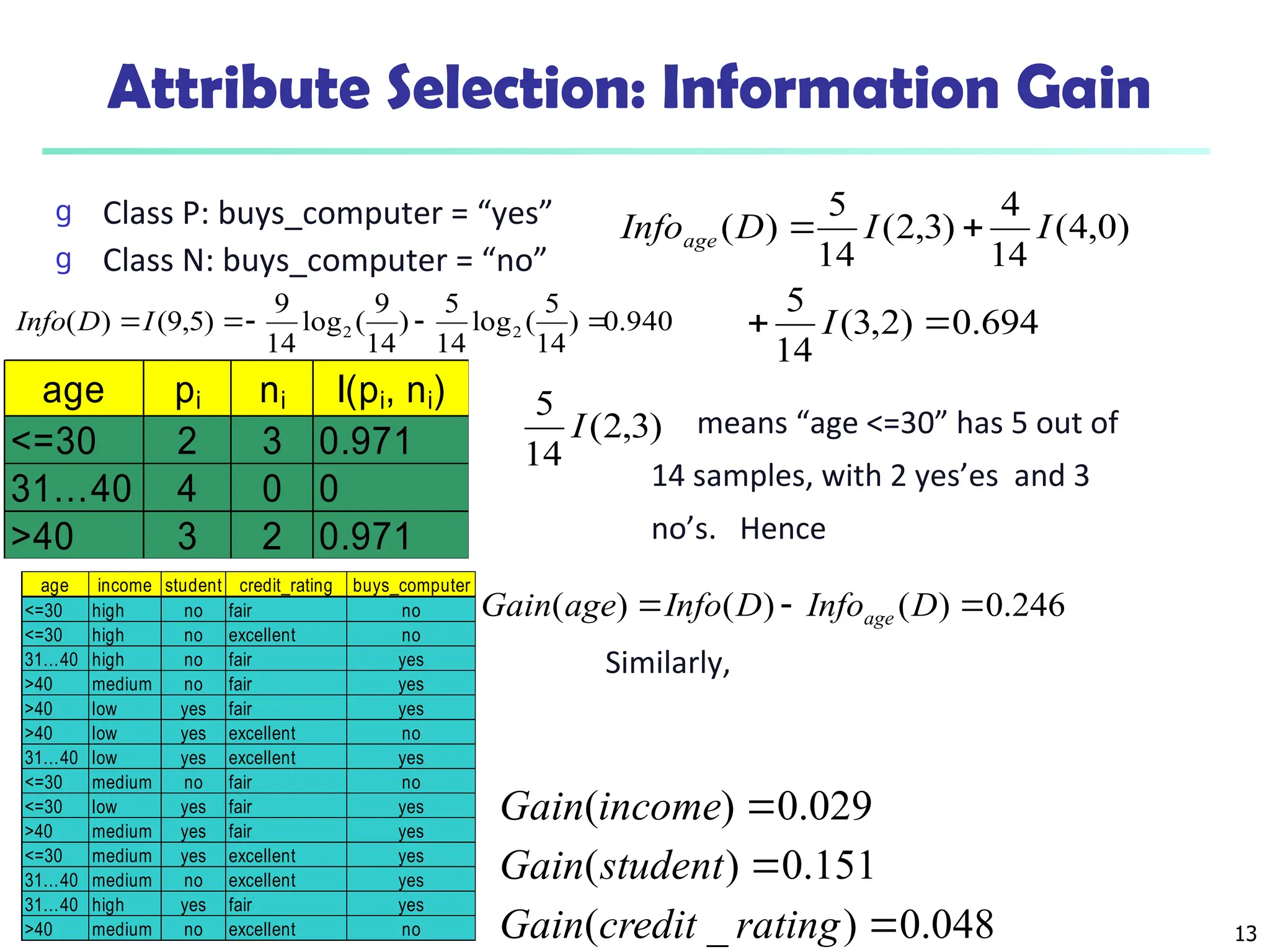
Attribute Selection: InformationGain
g Class P: buys_computer = “yes”
g Class N: buys_computer = “no”
means “age <=30” has 5 out of
14 samples, with 2 yes’es and 3
no’s. Hence
Similarly,
age pi ni I(pi, ni)
<=30 2 3 0.971
31…40 4 0 0
>40 3 2 0.971
694
.
0
)
2
,
3
(
14
5
)
0
,
4
(
14
4
)
3
,
2
(
14
5
)
(
I
I
I
D
Infoage
048
.
0
)
_
(
151
.
0
)
(
029
.
0
)
(
rating
credit
Gain
student
Gain
income
Gain
246
.
0
)
(
)
(
)
(
D
Info
D
Info
age
Gain age
age income student credit_rating buys_computer
<=30 high no fair no
<=30 high no excellent no
31…40 high no fair yes
>40 medium no fair yes
>40 low yes fair yes
>40 low yes excellent no
31…40 low yes excellent yes
<=30 medium no fair no
<=30 low yes fair yes
>40 medium yes fair yes
<=30 medium yes excellent yes
31…40 medium no excellent yes
31…40 high yes fair yes
>40 medium no excellent no
)
3
,
2
(
14
5
I
940
.
0
)
14
5
(
log
14
5
)
14
9
(
log
14
9
)
5
,
9
(
)
( 2
2
I
D
Info
14.
14
Chapter 8. Classification:Basic Concepts
Classification: Basic Concepts
Decision Tree Induction
Bayes Classification Methods
Rule-Based Classification
Model Evaluation and Selection
Techniques to Improve Classification Accuracy:
Ensemble Methods
Summary
15.
15
Bayesian Classification: Why?
A statistical classifier: performs probabilistic prediction, i.e.,
predicts class membership probabilities
Foundation: Based on Bayes’ Theorem.
Performance: A simple Bayesian classifier, naïve Bayesian
classifier, has comparable performance with decision tree and
selected neural network classifiers
Incremental: Each training example can incrementally
increase/decrease the probability that a hypothesis is correct —
prior knowledge can be combined with observed data
Standard: Even when Bayesian methods are computationally
intractable, they can provide a standard of optimal decision
making against which other methods can be measured
16.
16
Bayes’ Theorem: Basics
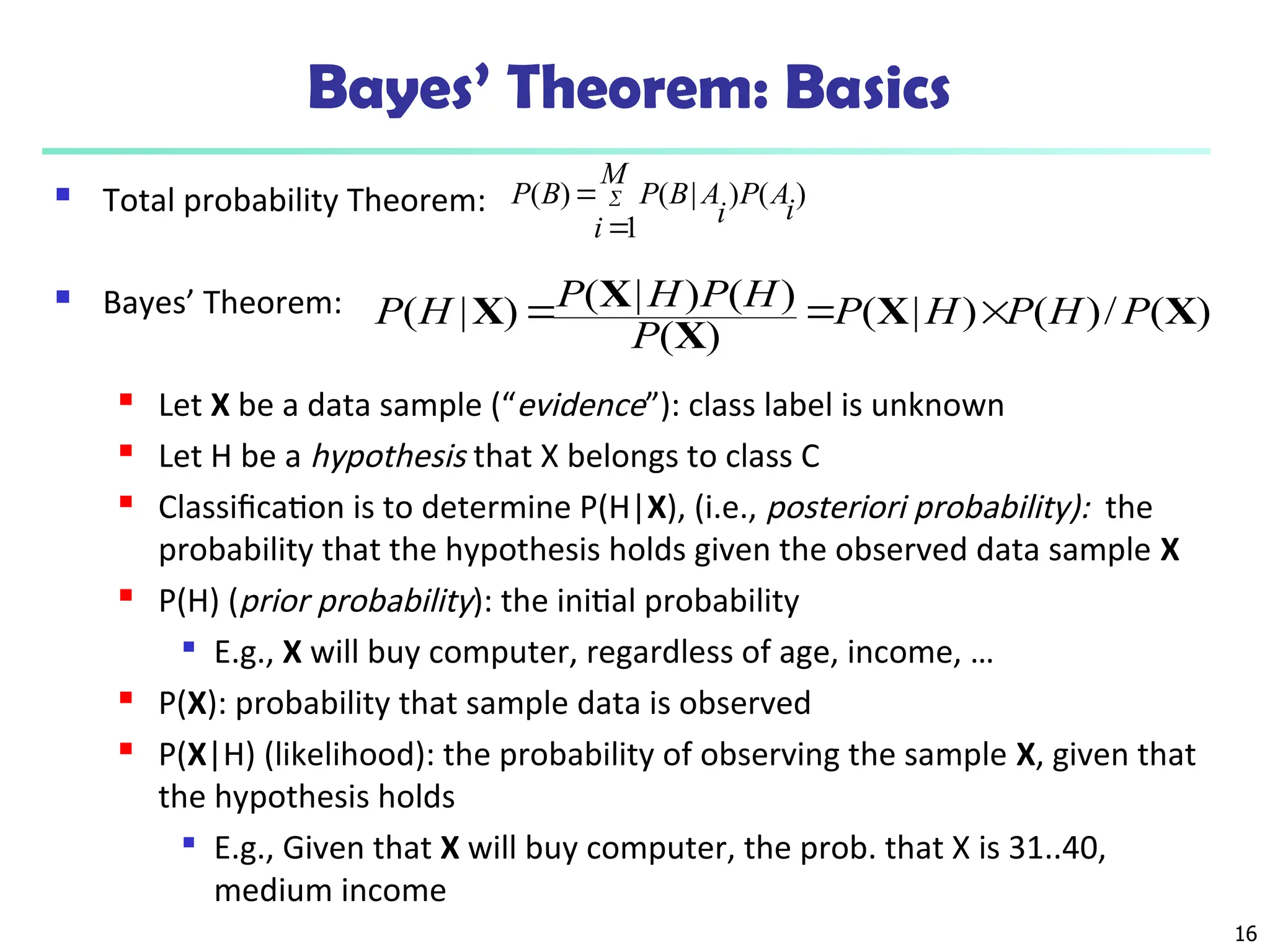
Total probability Theorem:
Bayes’ Theorem:
Let X be a data sample (“evidence”): class label is unknown
Let H be a hypothesis that X belongs to class C
Classification is to determine P(H|X), (i.e., posteriori probability): the
probability that the hypothesis holds given the observed data sample X
P(H) (prior probability): the initial probability
E.g., X will buy computer, regardless of age, income, …
P(X): probability that sample data is observed
P(X|H) (likelihood): the probability of observing the sample X, given that
the hypothesis holds
E.g., Given that X will buy computer, the prob. that X is 31..40,
medium income
)
(
)
1
|
(
)
(
i
A
P
M
i i
A
B
P
B
P
)
(
/
)
(
)
|
(
)
(
)
(
)
|
(
)
|
( X
X
X
X
X P
H
P
H
P
P
H
P
H
P
H
P
17.
17
Prediction Based onBayes’ Theorem
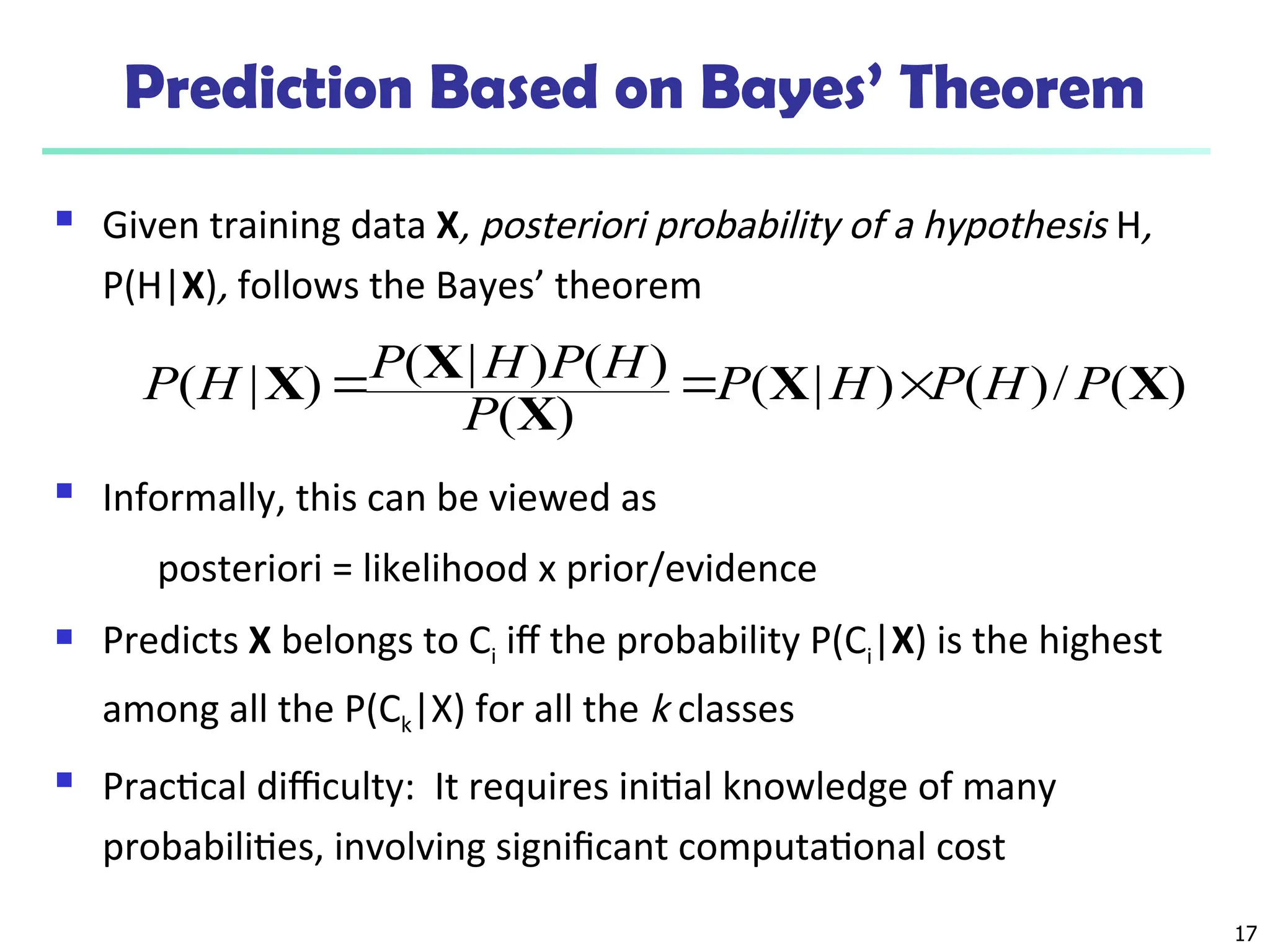
Given training data X, posteriori probability of a hypothesis H,
P(H|X), follows the Bayes’ theorem
Informally, this can be viewed as
posteriori = likelihood x prior/evidence
Predicts X belongs to Ci iff the probability P(Ci|X) is the highest
among all the P(Ck|X) for all the k classes
Practical difficulty: It requires initial knowledge of many
probabilities, involving significant computational cost
)
(
/
)
(
)
|
(
)
(
)
(
)
|
(
)
|
( X
X
X
X
X P
H
P
H
P
P
H
P
H
P
H
P
18.
18
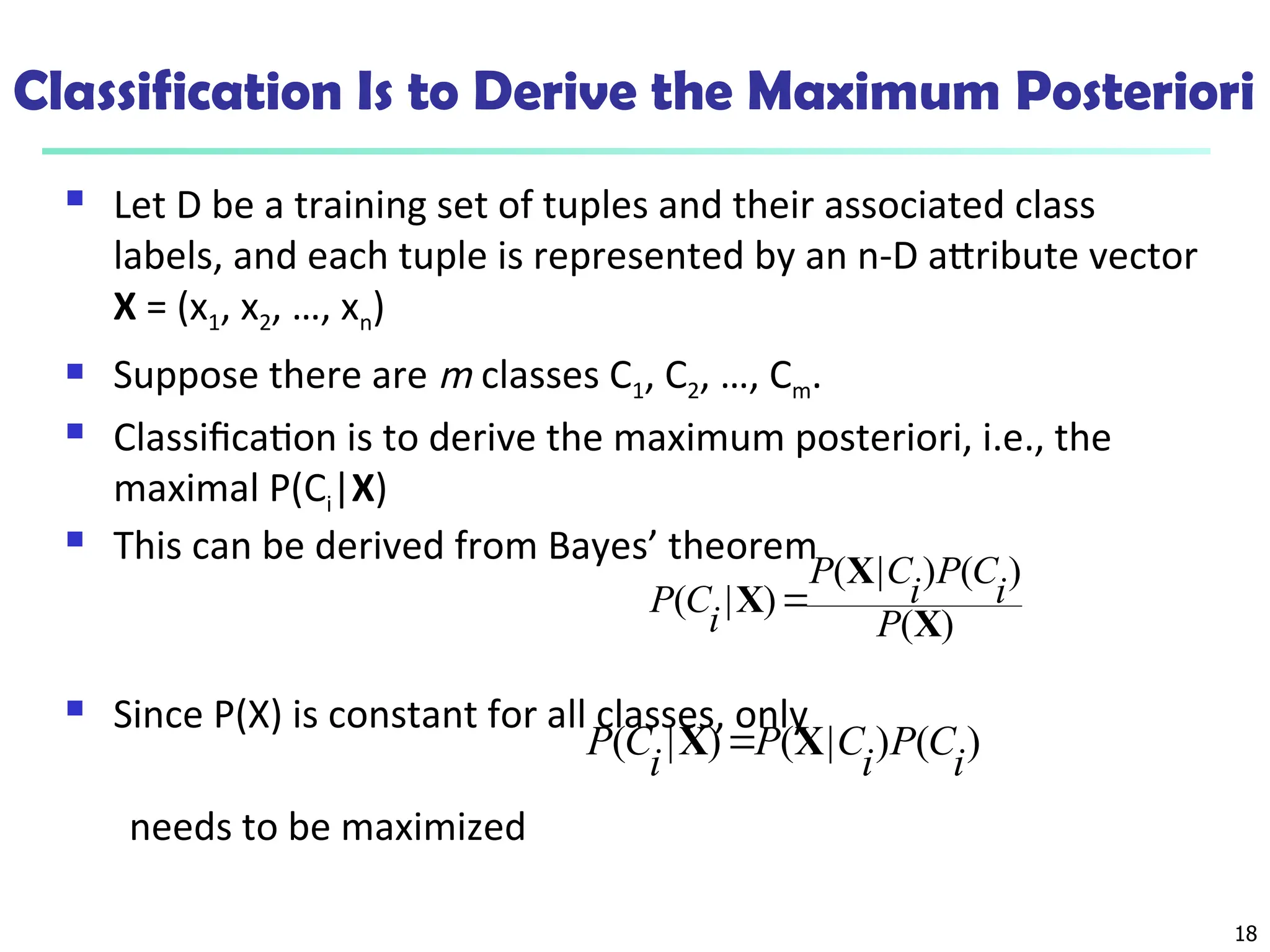
Classification Is toDerive the Maximum Posteriori
Let D be a training set of tuples and their associated class
labels, and each tuple is represented by an n-D attribute vector
X = (x1, x2, …, xn)
Suppose there are m classes C1, C2, …, Cm.
Classification is to derive the maximum posteriori, i.e., the
maximal P(Ci|X)
This can be derived from Bayes’ theorem
Since P(X) is constant for all classes, only
needs to be maximized
)
(
)
(
)
|
(
)
|
(
X
X
X
P
i
C
P
i
C
P
i
C
P
)
(
)
|
(
)
|
(
i
C
P
i
C
P
i
C
P X
X
19.
19
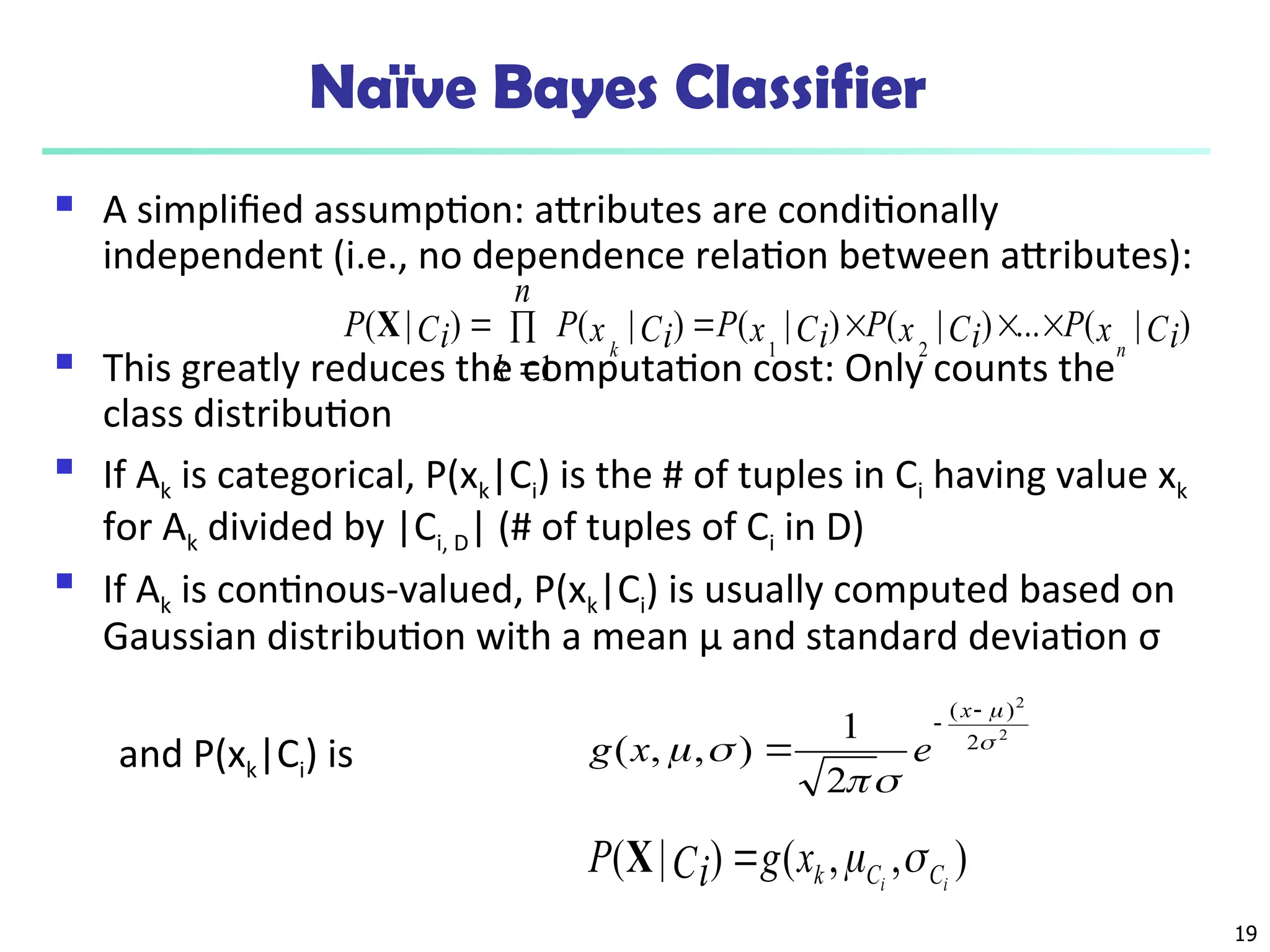
Naïve Bayes Classifier
A simplified assumption: attributes are conditionally
independent (i.e., no dependence relation between attributes):
This greatly reduces the computation cost: Only counts the
class distribution
If Ak is categorical, P(xk|Ci) is the # of tuples in Ci having value xk
for Ak divided by |Ci, D| (# of tuples of Ci in D)
If Ak is continous-valued, P(xk|Ci) is usually computed based on
Gaussian distribution with a mean μ and standard deviation σ
and P(xk|Ci) is
)
|
(
...
)
|
(
)
|
(
1
)
|
(
)
|
(
2
1
Ci
x
P
Ci
x
P
Ci
x
P
n
k
Ci
x
P
Ci
P
n
k
X
2
2
2
)
(
2
1
)
,
,
(
x
e
x
g
)
,
,
(
)
|
( i
i C
C
k
x
g
Ci
P
X
20.
20
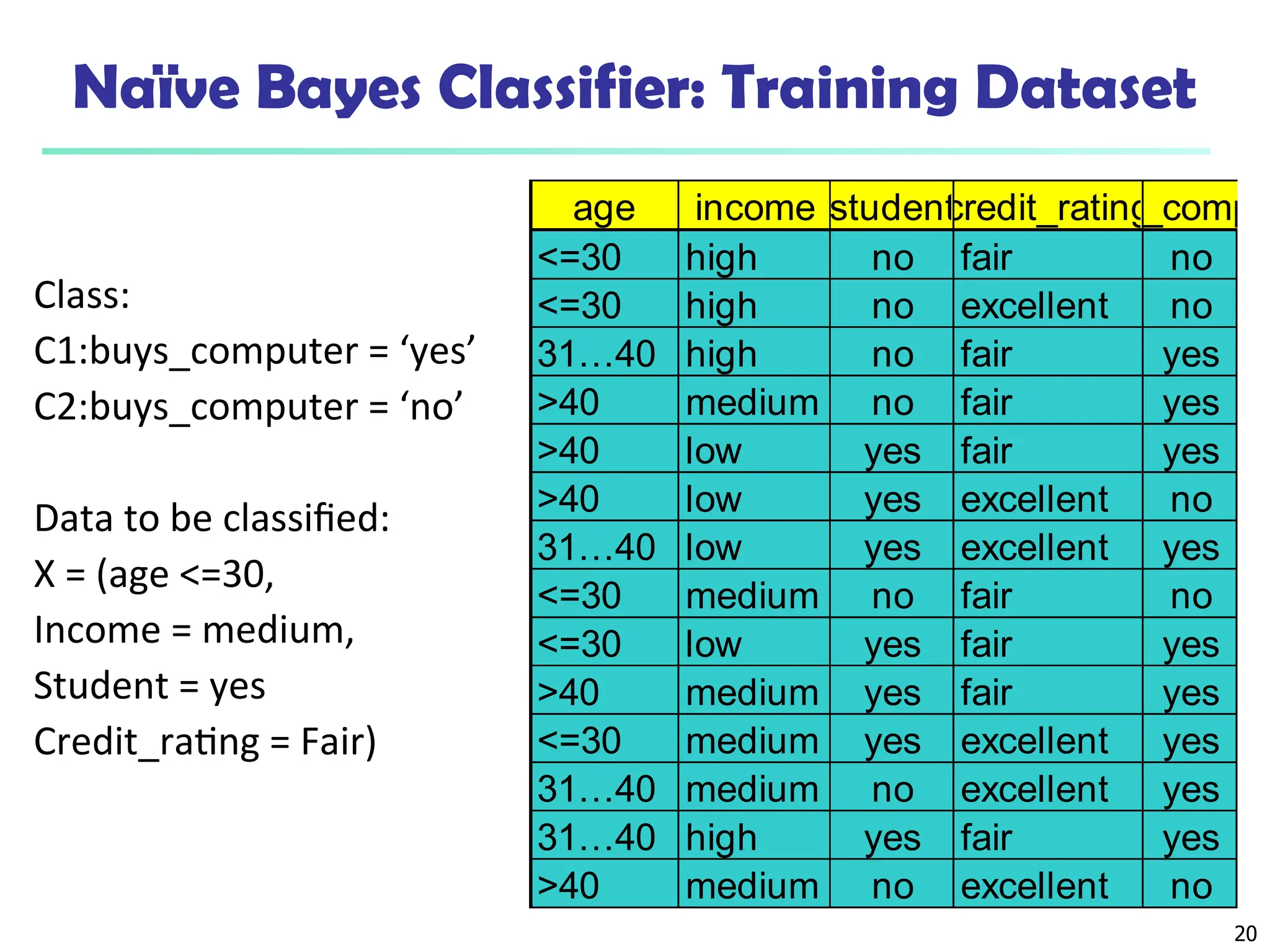
Naïve Bayes Classifier:Training Dataset
Class:
C1:buys_computer = ‘yes’
C2:buys_computer = ‘no’
Data to be classified:
X = (age <=30,
Income = medium,
Student = yes
Credit_rating = Fair)
age income student
credit_rating
buys_compu
<=30 high no fair no
<=30 high no excellent no
31…40 high no fair yes
>40 medium no fair yes
>40 low yes fair yes
>40 low yes excellent no
31…40 low yes excellent yes
<=30 medium no fair no
<=30 low yes fair yes
>40 medium yes fair yes
<=30 medium yes excellent yes
31…40 medium no excellent yes
31…40 high yes fair yes
>40 medium no excellent no
21.
21
Naïve Bayes Classifier:An Example
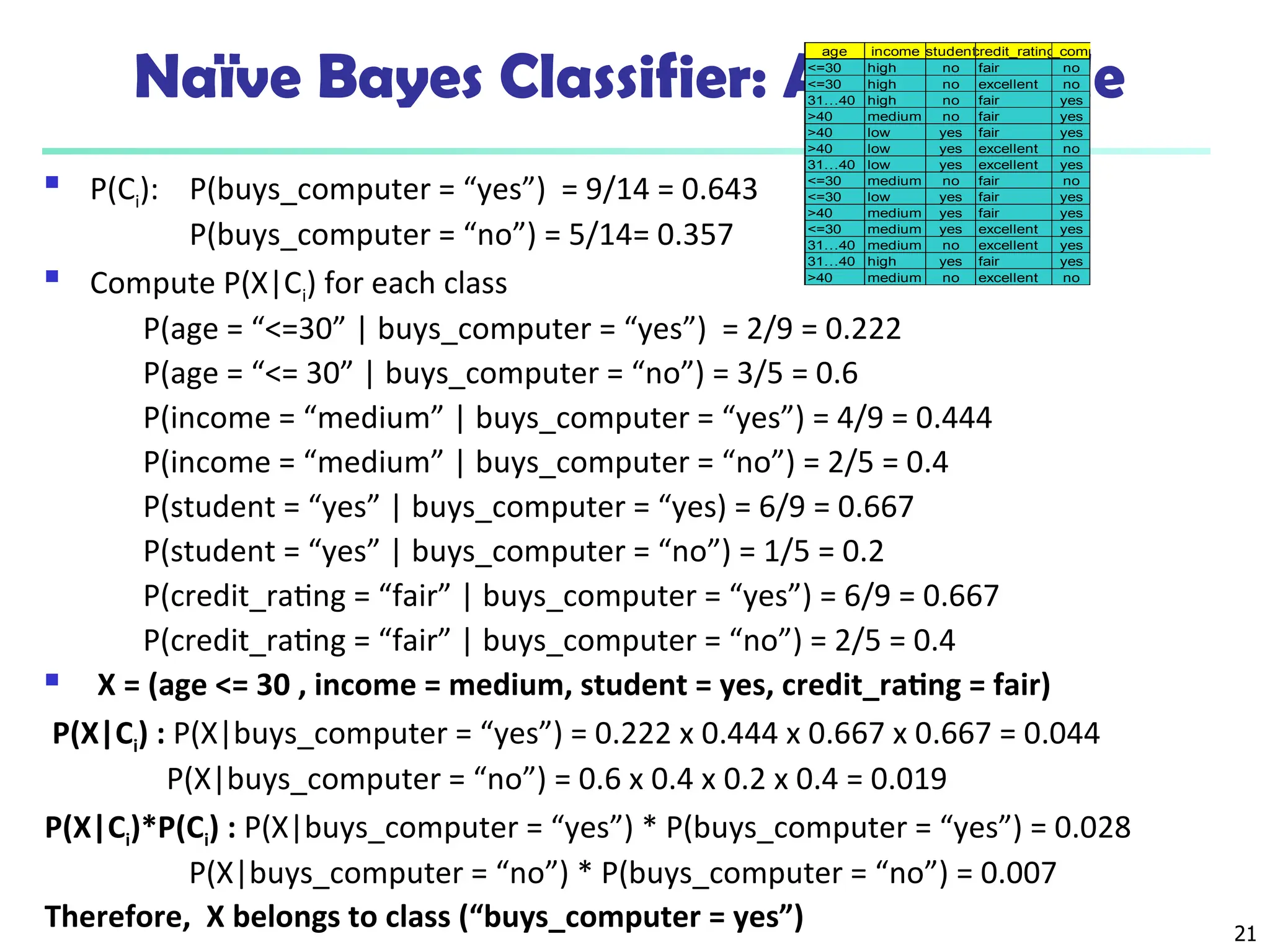
P(Ci): P(buys_computer = “yes”) = 9/14 = 0.643
P(buys_computer = “no”) = 5/14= 0.357
Compute P(X|Ci) for each class
P(age = “<=30” | buys_computer = “yes”) = 2/9 = 0.222
P(age = “<= 30” | buys_computer = “no”) = 3/5 = 0.6
P(income = “medium” | buys_computer = “yes”) = 4/9 = 0.444
P(income = “medium” | buys_computer = “no”) = 2/5 = 0.4
P(student = “yes” | buys_computer = “yes) = 6/9 = 0.667
P(student = “yes” | buys_computer = “no”) = 1/5 = 0.2
P(credit_rating = “fair” | buys_computer = “yes”) = 6/9 = 0.667
P(credit_rating = “fair” | buys_computer = “no”) = 2/5 = 0.4
X = (age <= 30 , income = medium, student = yes, credit_rating = fair)
P(X|Ci) : P(X|buys_computer = “yes”) = 0.222 x 0.444 x 0.667 x 0.667 = 0.044
P(X|buys_computer = “no”) = 0.6 x 0.4 x 0.2 x 0.4 = 0.019
P(X|Ci)*P(Ci) : P(X|buys_computer = “yes”) * P(buys_computer = “yes”) = 0.028
P(X|buys_computer = “no”) * P(buys_computer = “no”) = 0.007
Therefore, X belongs to class (“buys_computer = yes”)
age income student
credit_rating
buys_computer
<=30 high no fair no
<=30 high no excellent no
31…40 high no fair yes
>40 medium no fair yes
>40 low yes fair yes
>40 low yes excellent no
31…40 low yes excellent yes
<=30 medium no fair no
<=30 low yes fair yes
>40 medium yes fair yes
<=30 medium yes excellent yes
31…40 medium no excellent yes
31…40 high yes fair yes
>40 medium no excellent no
22.
22
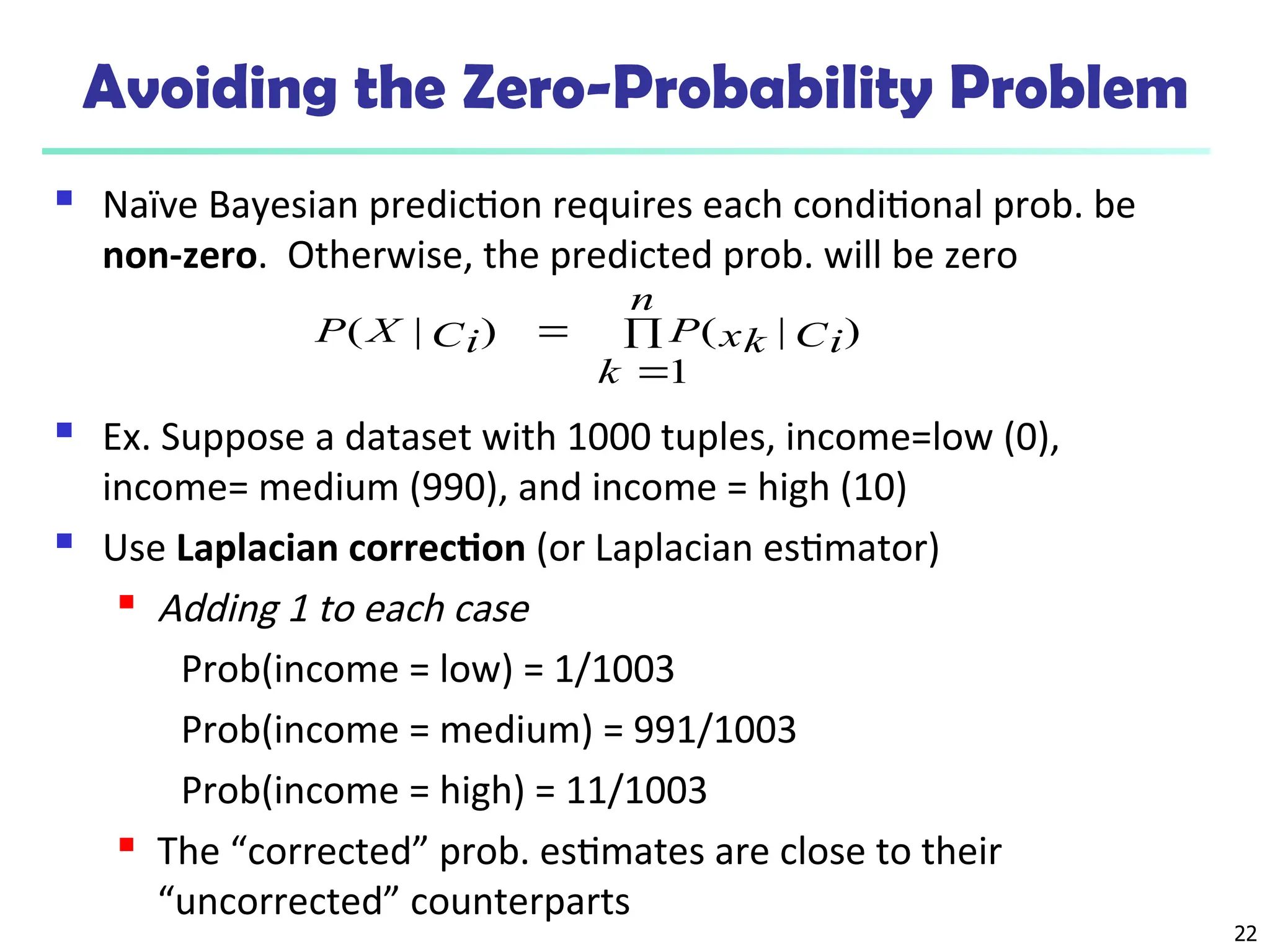
Avoiding the Zero-ProbabilityProblem
Naïve Bayesian prediction requires each conditional prob. be
non-zero. Otherwise, the predicted prob. will be zero
Ex. Suppose a dataset with 1000 tuples, income=low (0),
income= medium (990), and income = high (10)
Use Laplacian correction (or Laplacian estimator)
Adding 1 to each case
Prob(income = low) = 1/1003
Prob(income = medium) = 991/1003
Prob(income = high) = 11/1003
The “corrected” prob. estimates are close to their
“uncorrected” counterparts
n
k
Ci
xk
P
Ci
X
P
1
)
|
(
)
|
(
23.
23
Naïve Bayes Classifier:Comments
Advantages
Easy to implement
Good results obtained in most of the cases
Disadvantages
Assumption: class conditional independence, therefore loss of
accuracy
Practically, dependencies exist among variables
E.g., hospitals: patients: Profile: age, family history, etc.
Symptoms: fever, cough etc., Disease: lung cancer, diabetes,
etc.
Dependencies among these cannot be modeled by Naïve
Bayes Classifier
How to deal with these dependencies? Bayesian Belief Networks
(Chapter 9)
24.
24
Chapter 8. Classification:Basic Concepts
Classification: Basic Concepts
Decision Tree Induction
Bayes Classification Methods
Rule-Based Classification
Model Evaluation and Selection
Techniques to Improve Classification Accuracy:
Ensemble Methods
Summary
25.
Model Evaluation andSelection
Evaluation metrics: How can we measure accuracy? Other
metrics to consider?
Use validation test set of class-labeled tuples instead of
training set when assessing accuracy
Methods for estimating a classifier’s accuracy:
Holdout method, random subsampling
Cross-validation
Bootstrap
Comparing classifiers:
Confidence intervals
Cost-benefit analysis and ROC Curves
25
26.
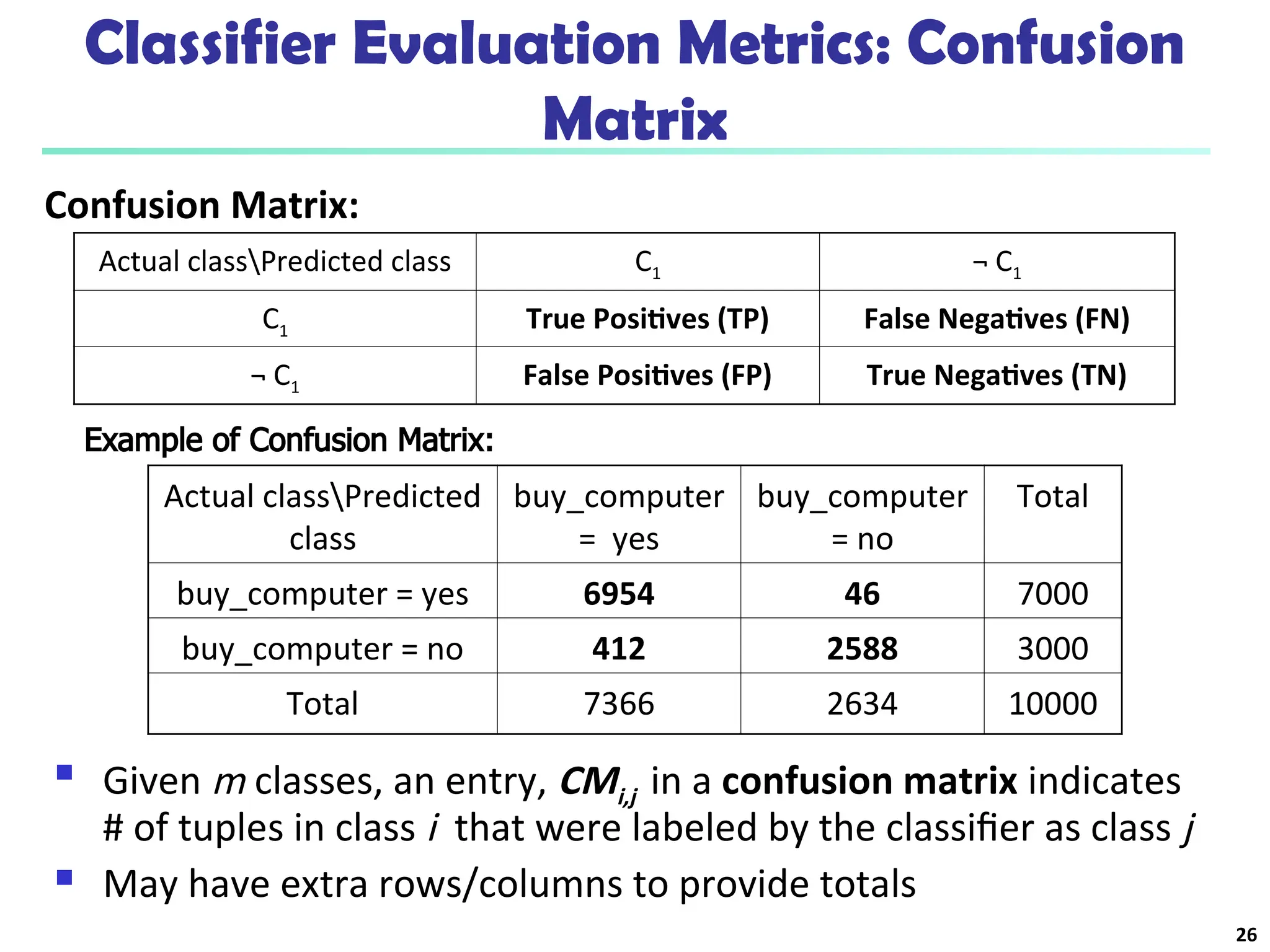
Classifier Evaluation Metrics:Confusion
Matrix
Actual classPredicted
class
buy_computer
= yes
buy_computer
= no
Total
buy_computer = yes 6954 46 7000
buy_computer = no 412 2588 3000
Total 7366 2634 10000
Given m classes, an entry, CMi,j in a confusion matrix indicates
# of tuples in class i that were labeled by the classifier as class j
May have extra rows/columns to provide totals
Confusion Matrix:
Actual classPredicted class C1 ¬ C1
C1 True Positives (TP) False Negatives (FN)
¬ C1 False Positives (FP) True Negatives (TN)
Example of Confusion Matrix:
26
27.
Classifier Evaluation Metrics:Accuracy,
Error Rate, Sensitivity and Specificity
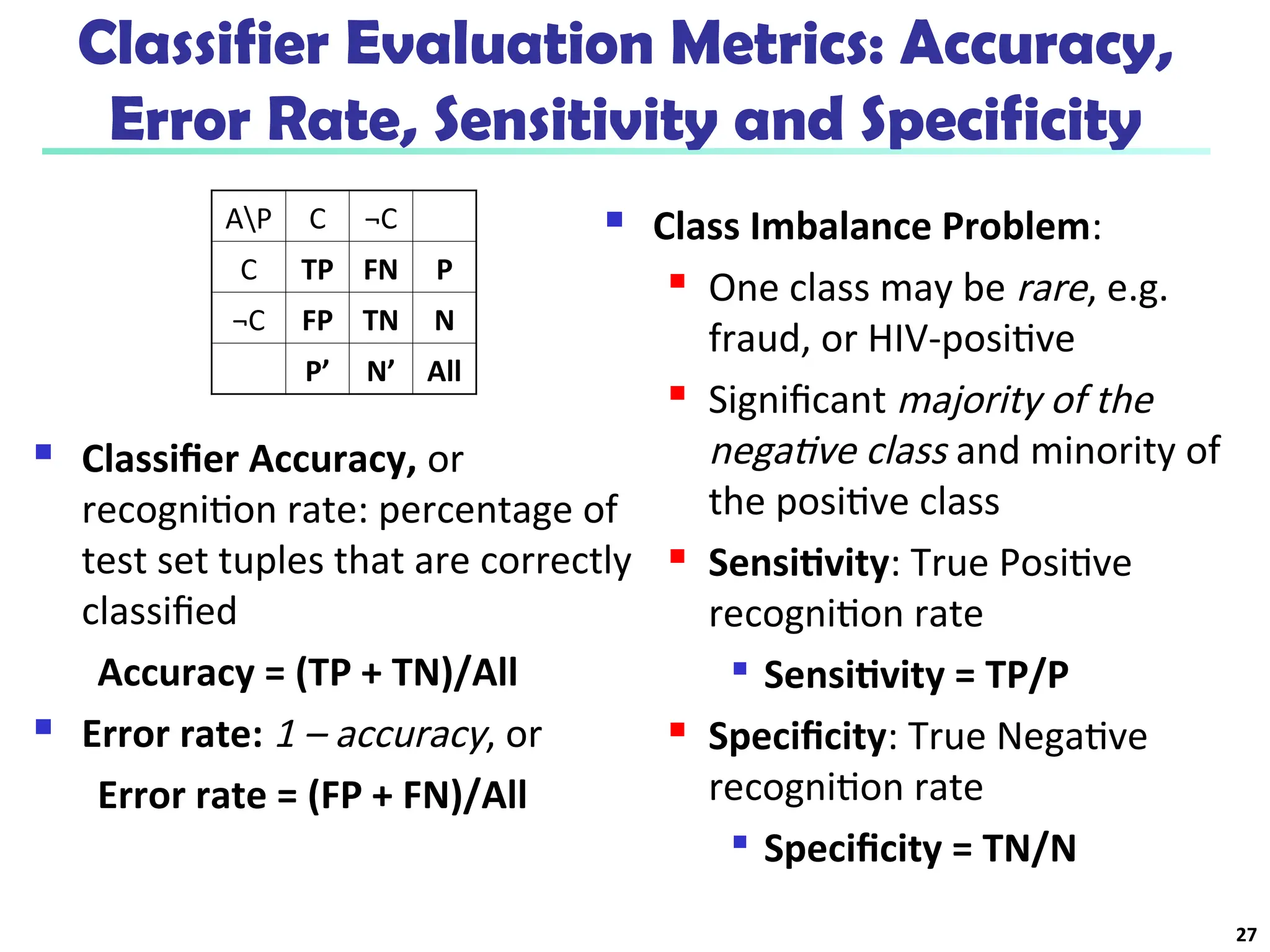
Classifier Accuracy, or
recognition rate: percentage of
test set tuples that are correctly
classified
Accuracy = (TP + TN)/All
Error rate: 1 – accuracy, or
Error rate = (FP + FN)/All
Class Imbalance Problem:
One class may be rare, e.g.
fraud, or HIV-positive
Significant majority of the
negative class and minority of
the positive class
Sensitivity: True Positive
recognition rate
Sensitivity = TP/P
Specificity: True Negative
recognition rate
Specificity = TN/N
AP C ¬C
C TP FN P
¬C FP TN N
P’ N’ All
27
28.
Classifier Evaluation Metrics:
Precisionand Recall, and F-measures
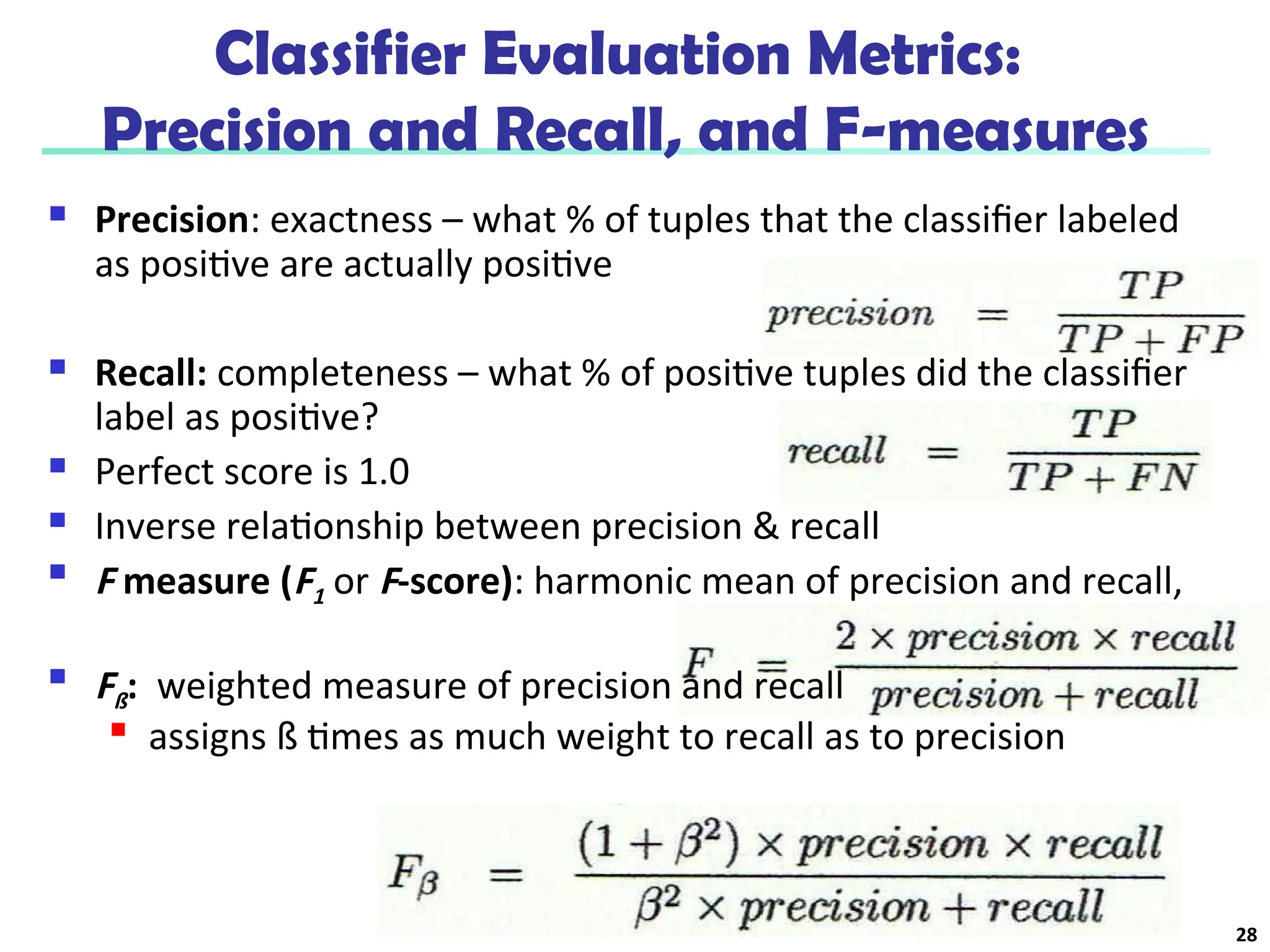
Precision: exactness – what % of tuples that the classifier labeled
as positive are actually positive
Recall: completeness – what % of positive tuples did the classifier
label as positive?
Perfect score is 1.0
Inverse relationship between precision & recall
F measure (F1 or F-score): harmonic mean of precision and recall,
Fß: weighted measure of precision and recall
assigns ß times as much weight to recall as to precision
28
29.
Classifier Evaluation Metrics:Example
29
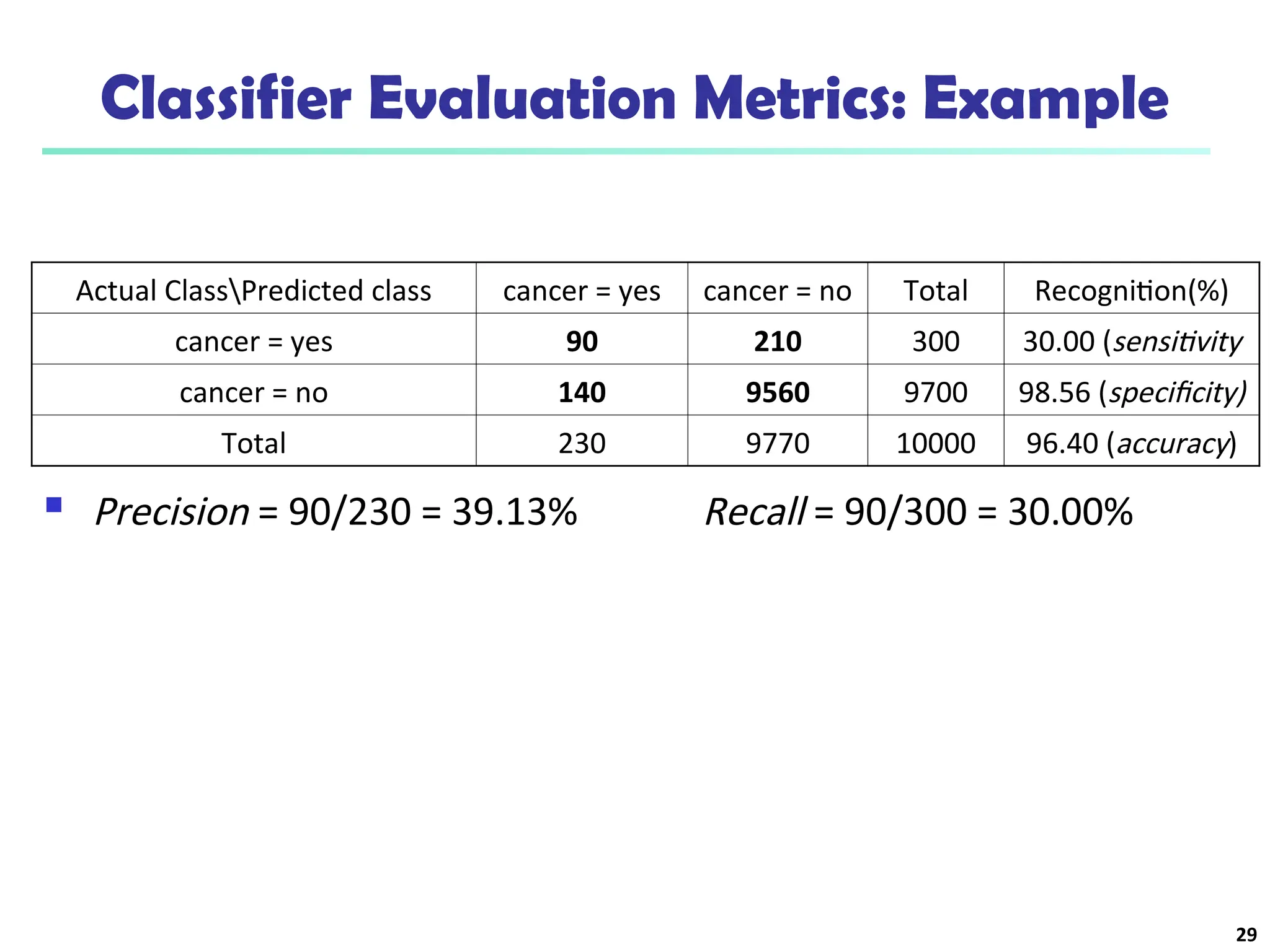
Precision = 90/230 = 39.13% Recall = 90/300 = 30.00%
Actual ClassPredicted class cancer = yes cancer = no Total Recognition(%)
cancer = yes 90 210 300 30.00 (sensitivity
cancer = no 140 9560 9700 98.56 (specificity)
Total 230 9770 10000 96.40 (accuracy)
30.
Evaluating Classifier Accuracy:
Holdout& Cross-Validation Methods
Holdout method
Given data is randomly partitioned into two independent sets
Training set (e.g., 2/3) for model construction
Test set (e.g., 1/3) for accuracy estimation
Random sampling: a variation of holdout
Repeat holdout k times, accuracy = avg. of the accuracies
obtained
Cross-validation (k-fold, where k = 10 is most popular)
Randomly partition the data into k mutually exclusive subsets,
each approximately equal size
At i-th iteration, use Di as test set and others as training set
Leave-one-out: k folds where k = # of tuples, for small sized
data
*Stratified cross-validation*: folds are stratified so that class
dist. in each fold is approx. the same as that in the initial data
30
31.
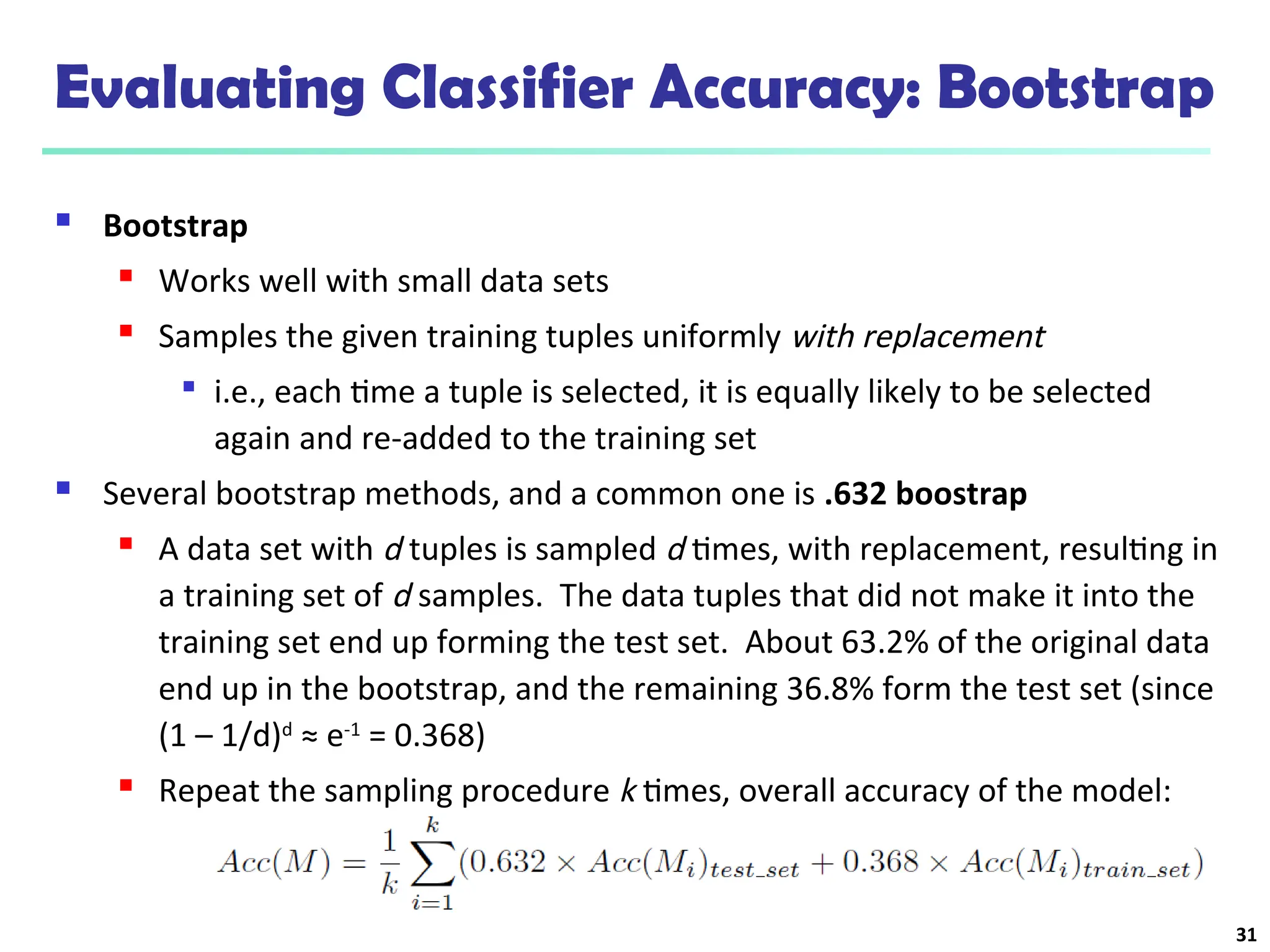
Evaluating Classifier Accuracy:Bootstrap
Bootstrap
Works well with small data sets
Samples the given training tuples uniformly with replacement
i.e., each time a tuple is selected, it is equally likely to be selected
again and re-added to the training set
Several bootstrap methods, and a common one is .632 boostrap
A data set with d tuples is sampled d times, with replacement, resulting in
a training set of d samples. The data tuples that did not make it into the
training set end up forming the test set. About 63.2% of the original data
end up in the bootstrap, and the remaining 36.8% form the test set (since
(1 – 1/d)d
≈ e-1
= 0.368)
Repeat the sampling procedure k times, overall accuracy of the model:
31
32.
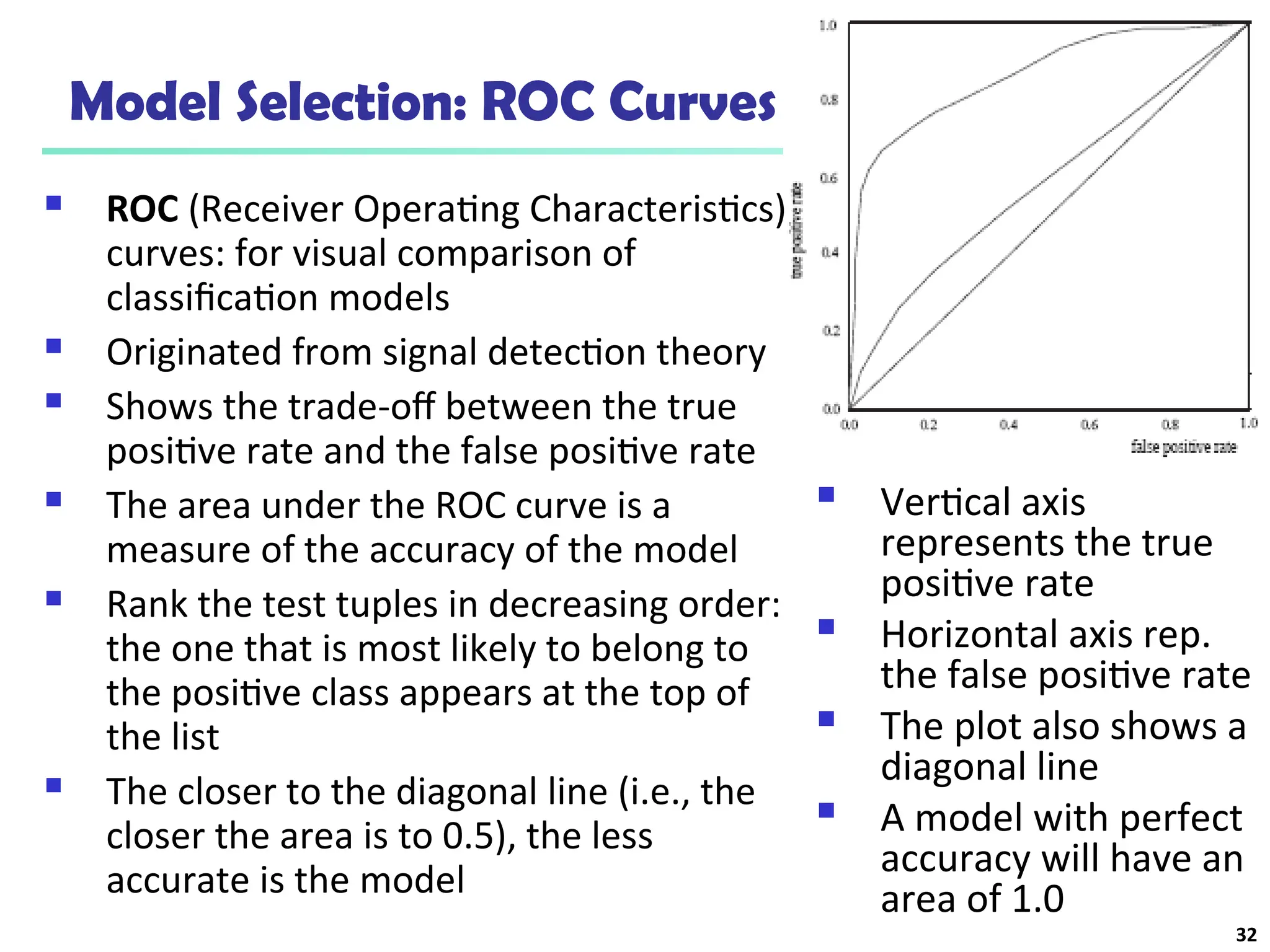
Model Selection: ROCCurves
ROC (Receiver Operating Characteristics)
curves: for visual comparison of
classification models
Originated from signal detection theory
Shows the trade-off between the true
positive rate and the false positive rate
The area under the ROC curve is a
measure of the accuracy of the model
Rank the test tuples in decreasing order:
the one that is most likely to belong to
the positive class appears at the top of
the list
The closer to the diagonal line (i.e., the
closer the area is to 0.5), the less
accurate is the model
Vertical axis
represents the true
positive rate
Horizontal axis rep.
the false positive rate
The plot also shows a
diagonal line
A model with perfect
accuracy will have an
area of 1.0
32
33.
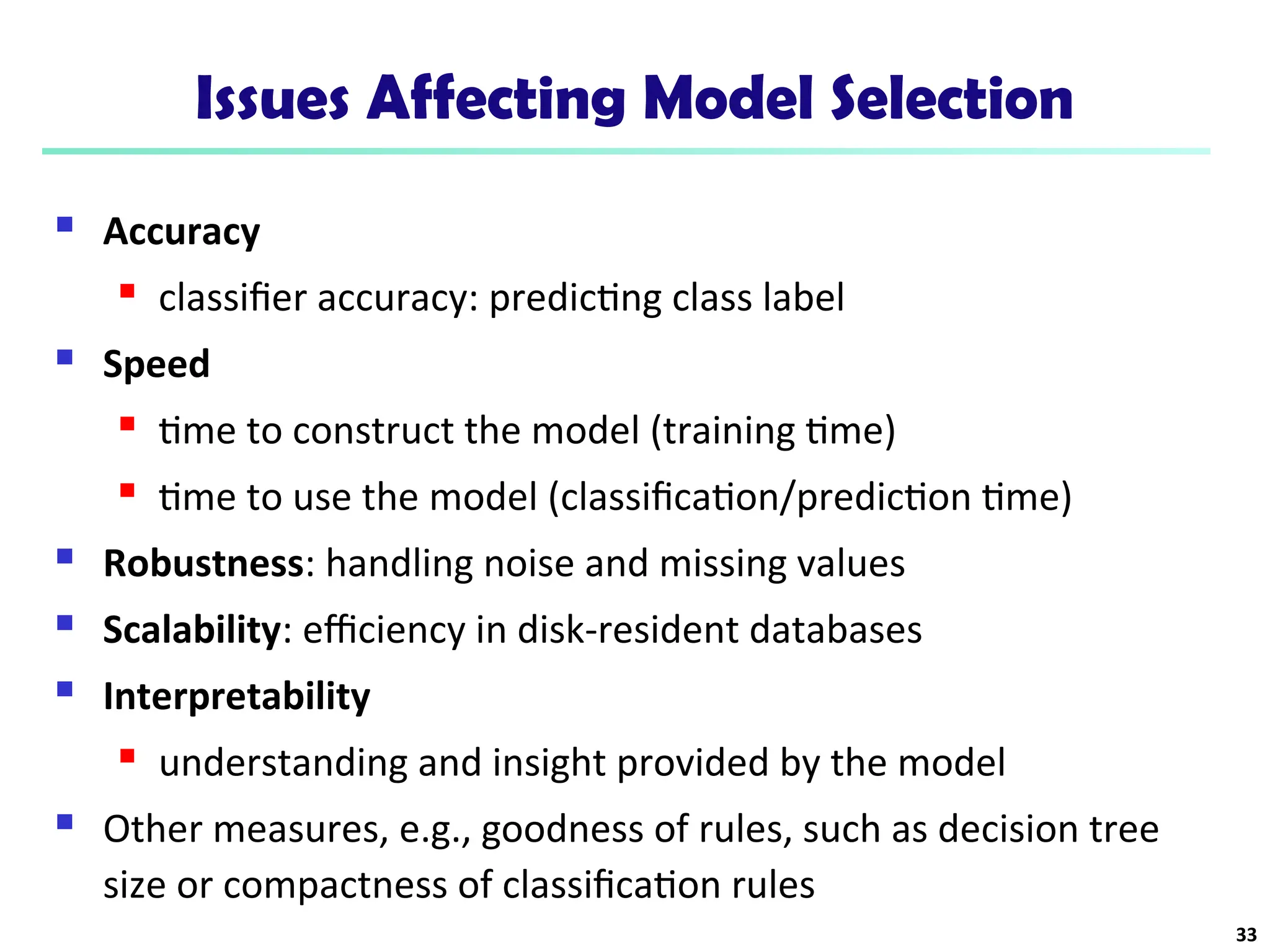
Issues Affecting ModelSelection
Accuracy
classifier accuracy: predicting class label
Speed
time to construct the model (training time)
time to use the model (classification/prediction time)
Robustness: handling noise and missing values
Scalability: efficiency in disk-resident databases
Interpretability
understanding and insight provided by the model
Other measures, e.g., goodness of rules, such as decision tree
size or compactness of classification rules
33
34.
34
Chapter 8. Classification:Basic Concepts
Classification: Basic Concepts
Decision Tree Induction
Bayes Classification Methods
Rule-Based Classification
Model Evaluation and Selection
Techniques to Improve Classification Accuracy:
Ensemble Methods
Summary
35.
Ensemble Methods: Increasingthe Accuracy
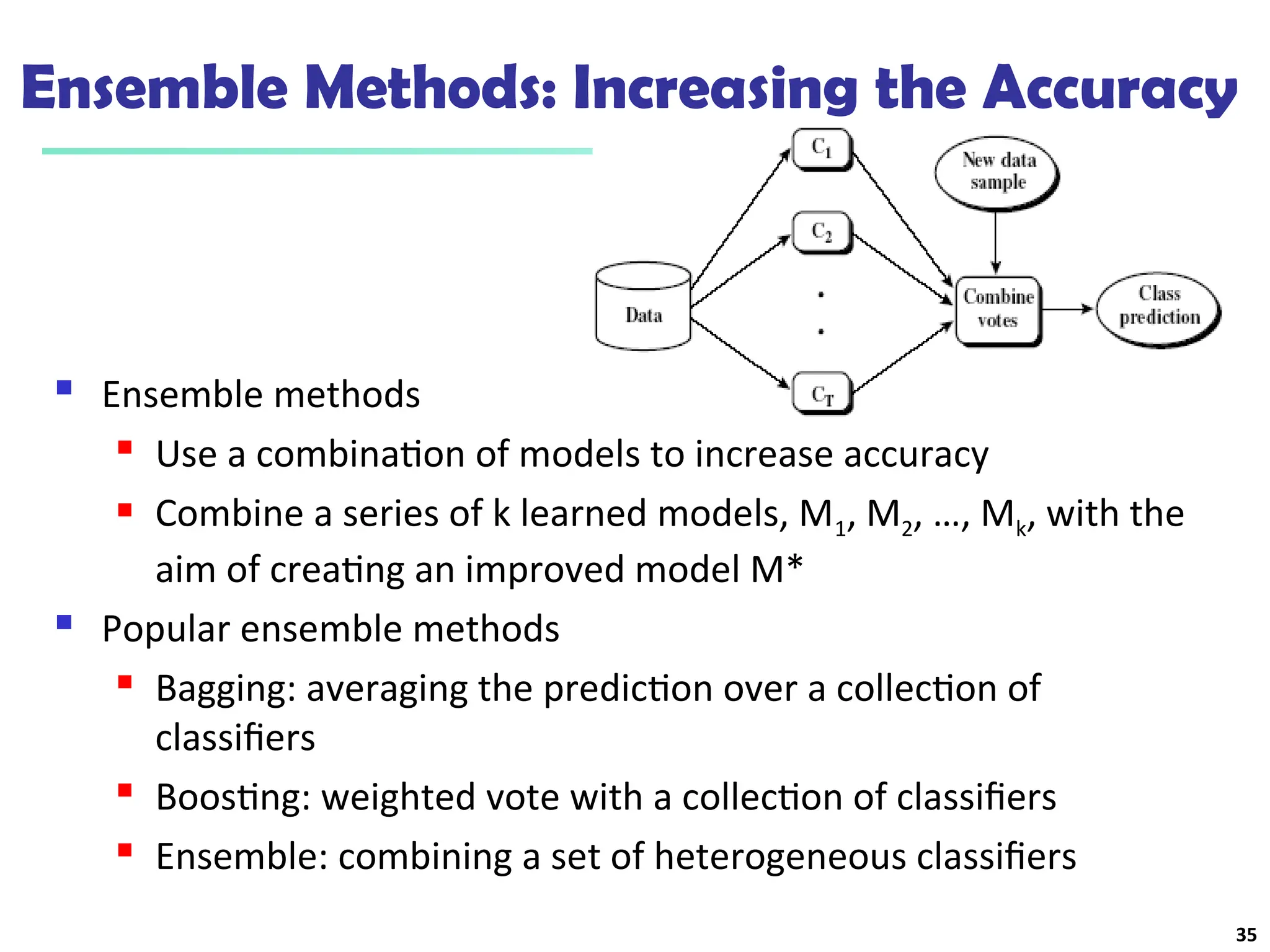
Ensemble methods
Use a combination of models to increase accuracy
Combine a series of k learned models, M1, M2, …, Mk, with the
aim of creating an improved model M*
Popular ensemble methods
Bagging: averaging the prediction over a collection of
classifiers
Boosting: weighted vote with a collection of classifiers
Ensemble: combining a set of heterogeneous classifiers
35
36.
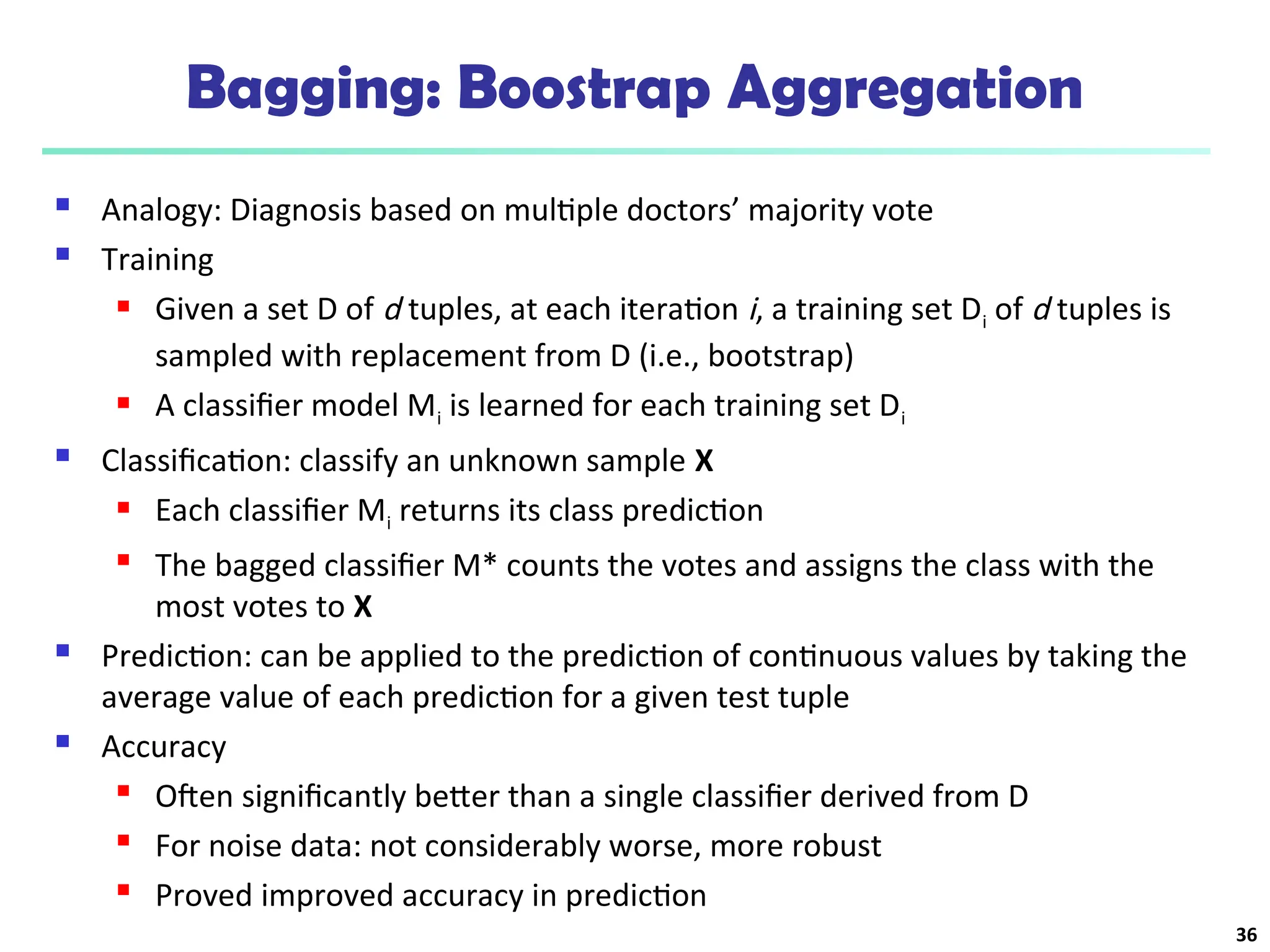
Bagging: Boostrap Aggregation
Analogy: Diagnosis based on multiple doctors’ majority vote
Training
Given a set D of d tuples, at each iteration i, a training set Di of d tuples is
sampled with replacement from D (i.e., bootstrap)
A classifier model Mi is learned for each training set Di
Classification: classify an unknown sample X
Each classifier Mi returns its class prediction
The bagged classifier M* counts the votes and assigns the class with the
most votes to X
Prediction: can be applied to the prediction of continuous values by taking the
average value of each prediction for a given test tuple
Accuracy
Often significantly better than a single classifier derived from D
For noise data: not considerably worse, more robust
Proved improved accuracy in prediction
36
37.
Boosting
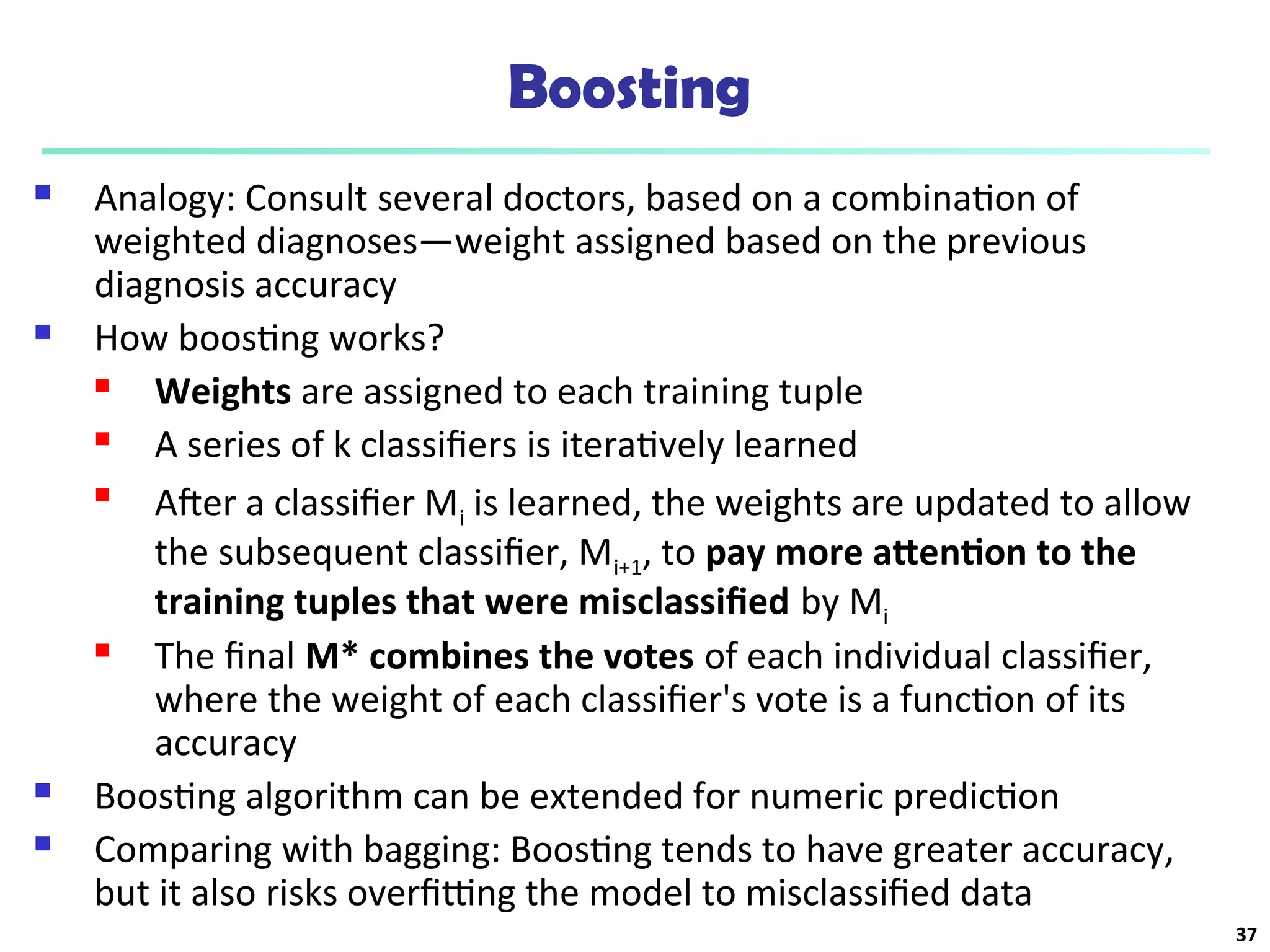
Analogy: Consultseveral doctors, based on a combination of
weighted diagnoses—weight assigned based on the previous
diagnosis accuracy
How boosting works?
Weights are assigned to each training tuple
A series of k classifiers is iteratively learned
After a classifier Mi is learned, the weights are updated to allow
the subsequent classifier, Mi+1, to pay more attention to the
training tuples that were misclassified by Mi
The final M* combines the votes of each individual classifier,
where the weight of each classifier's vote is a function of its
accuracy
Boosting algorithm can be extended for numeric prediction
Comparing with bagging: Boosting tends to have greater accuracy,
but it also risks overfitting the model to misclassified data
37
38.
38
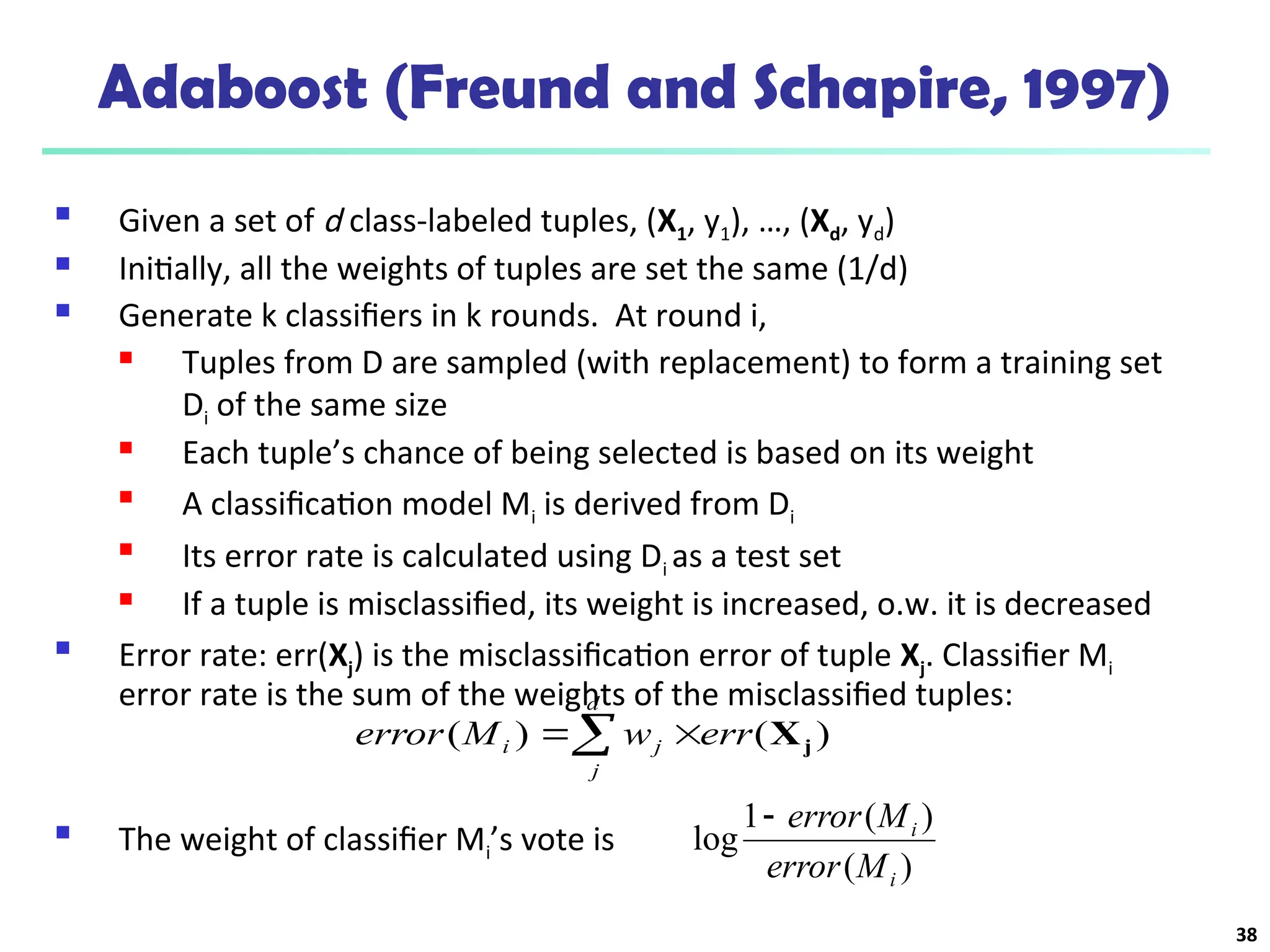
Adaboost (Freund andSchapire, 1997)
Given a set of d class-labeled tuples, (X1, y1), …, (Xd, yd)
Initially, all the weights of tuples are set the same (1/d)
Generate k classifiers in k rounds. At round i,
Tuples from D are sampled (with replacement) to form a training set
Di of the same size
Each tuple’s chance of being selected is based on its weight
A classification model Mi is derived from Di
Its error rate is calculated using Di as a test set
If a tuple is misclassified, its weight is increased, o.w. it is decreased
Error rate: err(Xj) is the misclassification error of tuple Xj. Classifier Mi
error rate is the sum of the weights of the misclassified tuples:
The weight of classifier Mi’s vote is
)
(
)
(
1
log
i
i
M
error
M
error
d
j
j
i err
w
M
error )
(
)
( j
X
39.
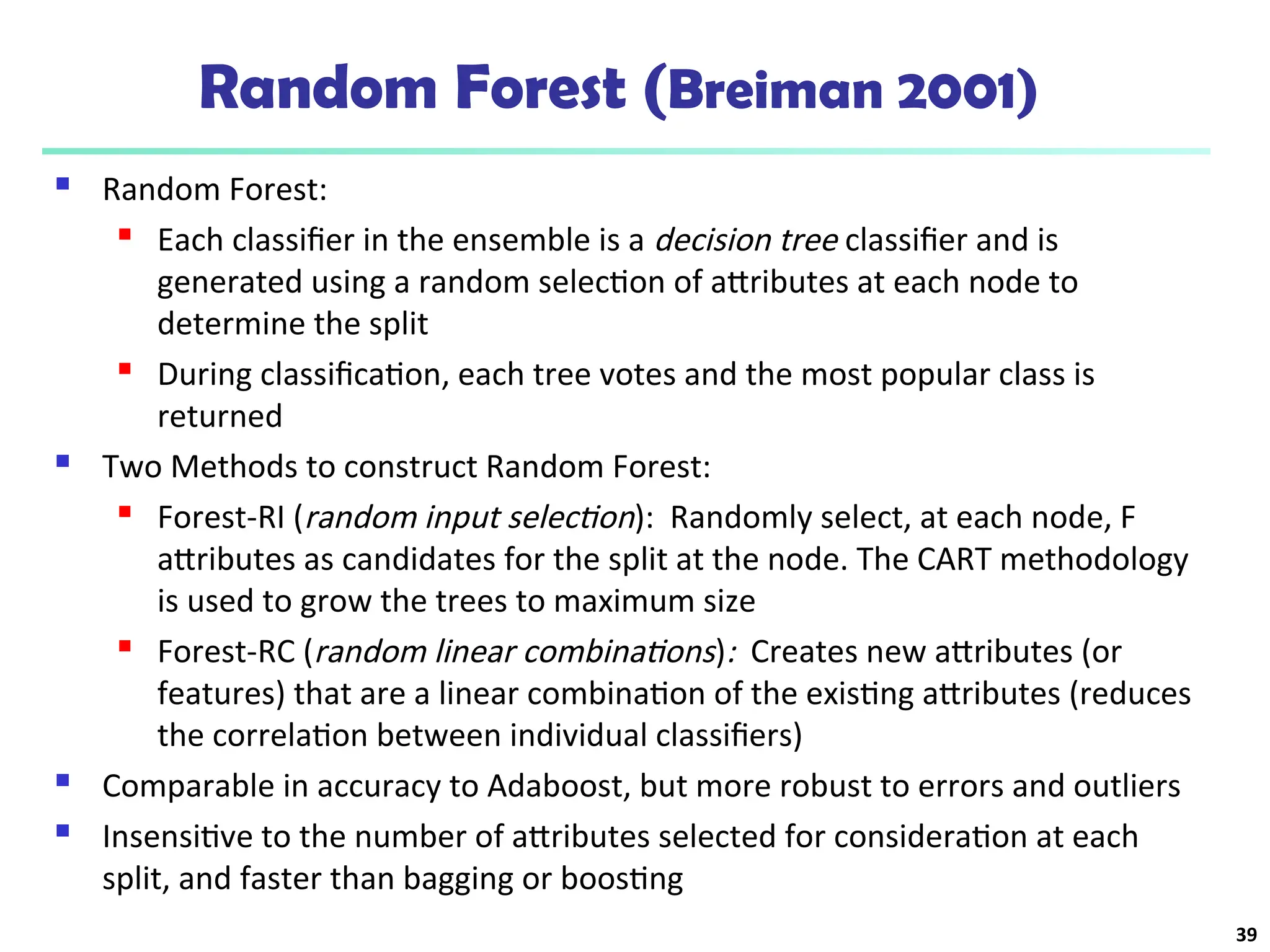
Random Forest (Breiman2001)
Random Forest:
Each classifier in the ensemble is a decision tree classifier and is
generated using a random selection of attributes at each node to
determine the split
During classification, each tree votes and the most popular class is
returned
Two Methods to construct Random Forest:
Forest-RI (random input selection): Randomly select, at each node, F
attributes as candidates for the split at the node. The CART methodology
is used to grow the trees to maximum size
Forest-RC (random linear combinations): Creates new attributes (or
features) that are a linear combination of the existing attributes (reduces
the correlation between individual classifiers)
Comparable in accuracy to Adaboost, but more robust to errors and outliers
Insensitive to the number of attributes selected for consideration at each
split, and faster than bagging or boosting
39
40.
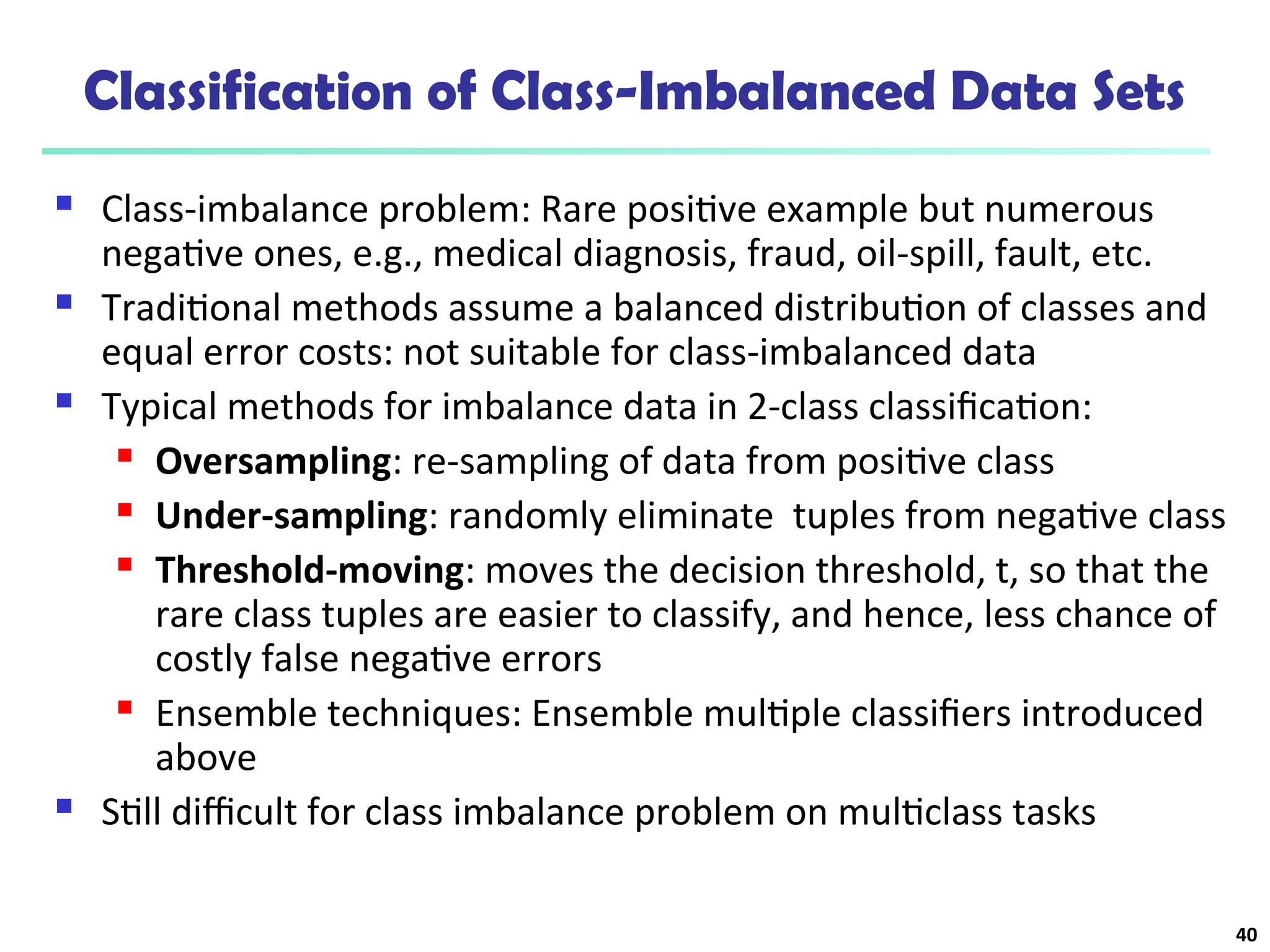
Classification of Class-ImbalancedData Sets
Class-imbalance problem: Rare positive example but numerous
negative ones, e.g., medical diagnosis, fraud, oil-spill, fault, etc.
Traditional methods assume a balanced distribution of classes and
equal error costs: not suitable for class-imbalanced data
Typical methods for imbalance data in 2-class classification:
Oversampling: re-sampling of data from positive class
Under-sampling: randomly eliminate tuples from negative class
Threshold-moving: moves the decision threshold, t, so that the
rare class tuples are easier to classify, and hence, less chance of
costly false negative errors
Ensemble techniques: Ensemble multiple classifiers introduced
above
Still difficult for class imbalance problem on multiclass tasks
40
41.
41
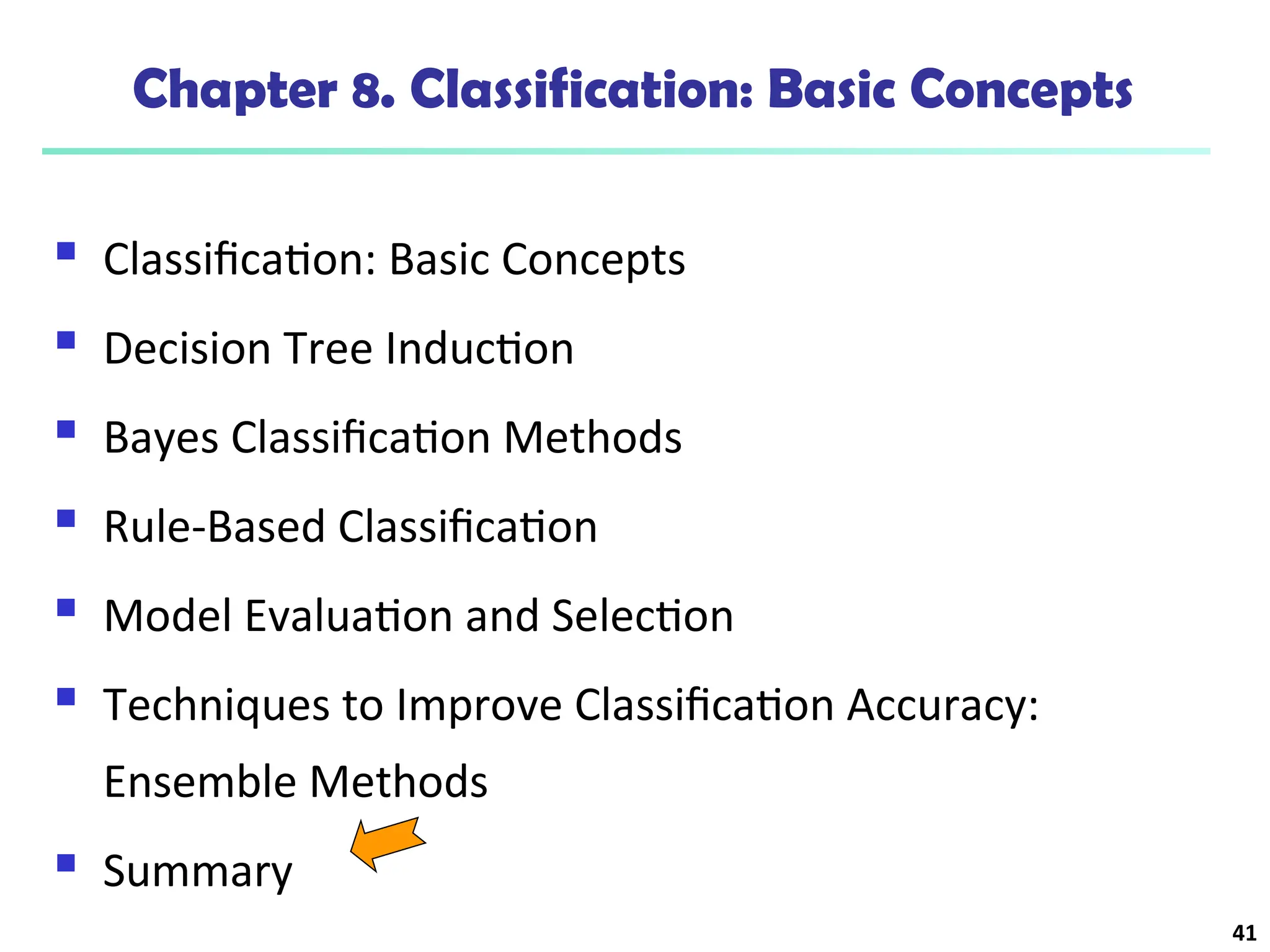
Chapter 8. Classification:Basic Concepts
Classification: Basic Concepts
Decision Tree Induction
Bayes Classification Methods
Rule-Based Classification
Model Evaluation and Selection
Techniques to Improve Classification Accuracy:
Ensemble Methods
Summary
42.
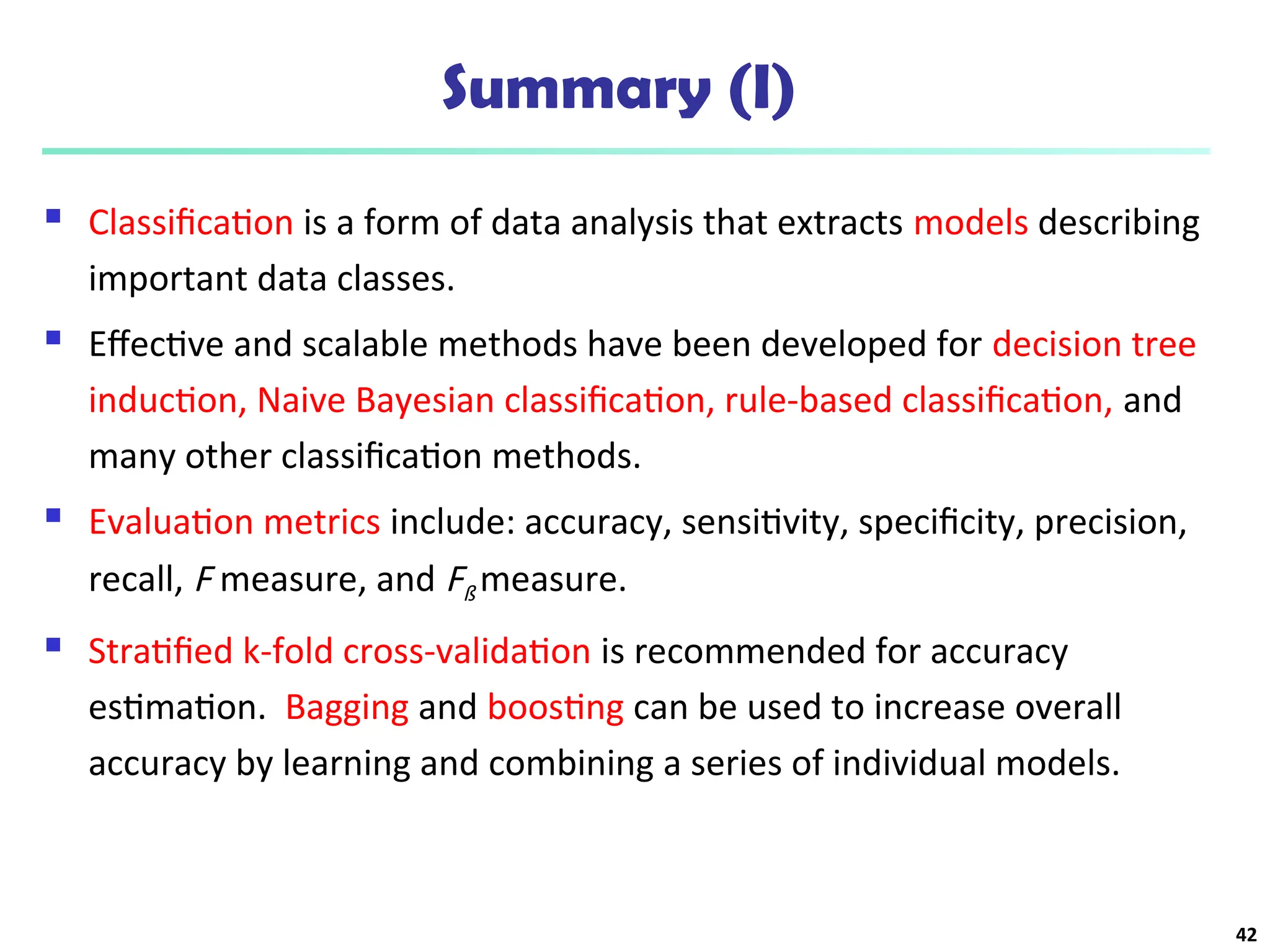
Summary (I)
Classificationis a form of data analysis that extracts models describing
important data classes.
Effective and scalable methods have been developed for decision tree
induction, Naive Bayesian classification, rule-based classification, and
many other classification methods.
Evaluation metrics include: accuracy, sensitivity, specificity, precision,
recall, F measure, and Fß measure.
Stratified k-fold cross-validation is recommended for accuracy
estimation. Bagging and boosting can be used to increase overall
accuracy by learning and combining a series of individual models.
42
43.
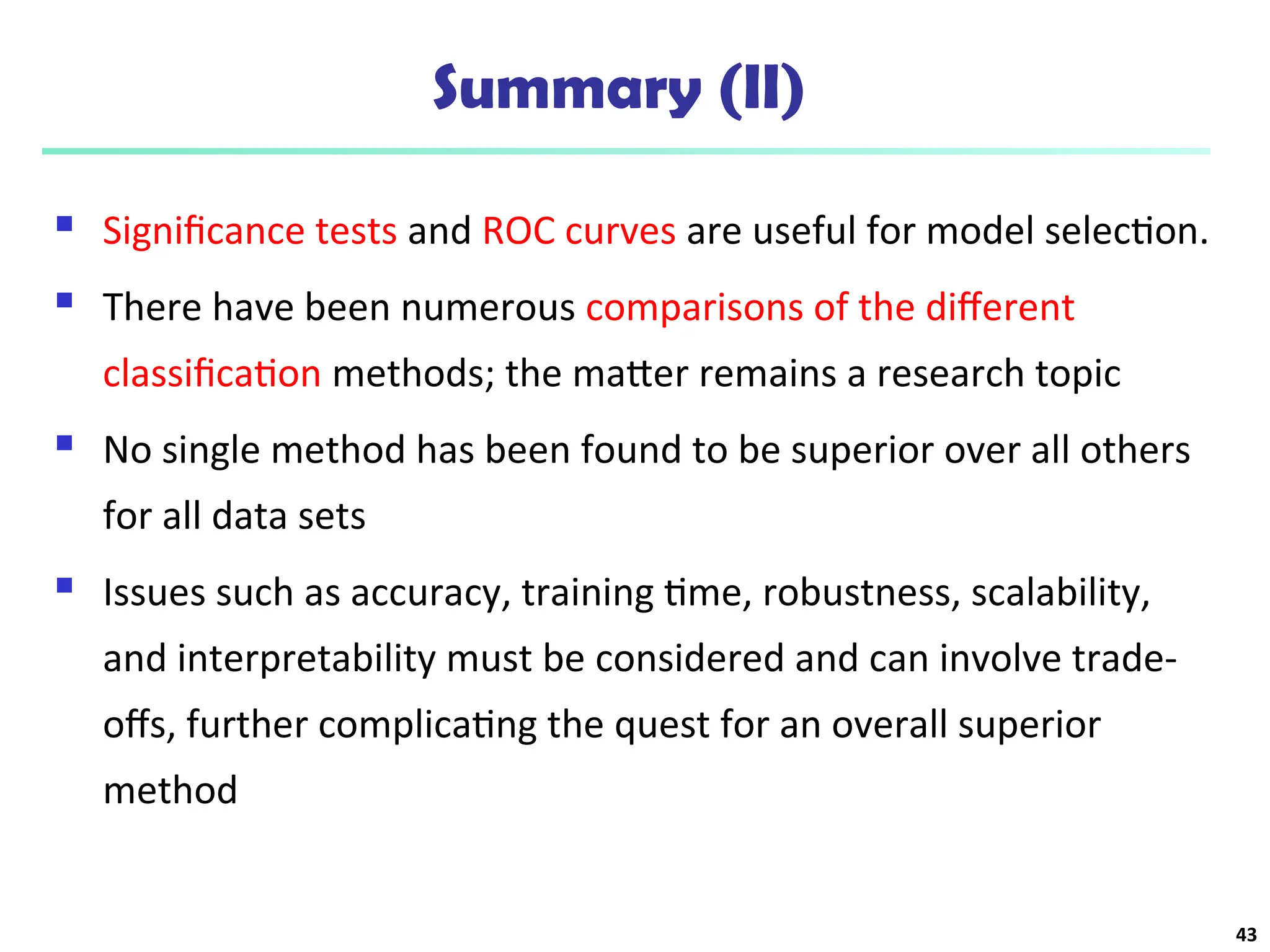
Summary (II)
Significancetests and ROC curves are useful for model selection.
There have been numerous comparisons of the different
classification methods; the matter remains a research topic
No single method has been found to be superior over all others
for all data sets
Issues such as accuracy, training time, robustness, scalability,
and interpretability must be considered and can involve trade-
offs, further complicating the quest for an overall superior
method
43
Editor's Notes
#12 I : the expected information needed to classify a given sample
E (entropy) : expected information based on the partitioning into subsets by A