Module 2 –
Part2
Understanding Hadoop Ecosystem:
Hadoop Ecosystem, Hadoop Distributed File System,
MapReduce, Hadoop YARN, Introducing HBase(db), Combing
HBase and HDFS, Hive(query language), Pig(script) and Pig
Latin, Sqoop, ZooKeeper (security)
Flume(trump)Oozie(security)
Understanding Hadoop Ecosystem
Hadoop
• Hadoop is not Big Data, however, it is true that Hadoop plays an
integral part in almost all Big Data processes.
• Hadoop is a ‘software library’ that allows its users to process large
datasets across distributed clusters of computers, thereby enabling
them to gather, store and analyse huge sets of data.
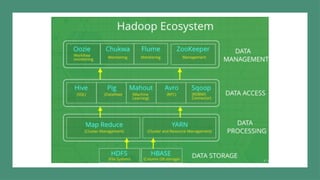
• Hadoop provides various tools and technologies, collectively termed
as Hadoop ecosystem, to enable the development and deployment of
Big Data solutions.
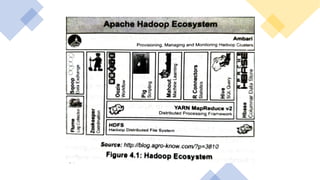
Hadoop Ecosystem
• Framework of various types of complex and evolving tools and components.
• Defined as “Comprehensive collection of tools and technologies that can be
effectively implemented and deployed to provide Big Data solutions in a
cost-effective manner”
• The base of Hadoop is HDFS and MapReduce(similar to the building with a
strong base)
• MapReduce and Hadoop Distributed File System(HDFS) are two core
components of Hadoop Ecosystem, however, not sufficient to deal with Big
data challenges.
• Along with MapReduce and Hadoop, Hadoop ecosystem provides a
collection of various elements to support the complete development and
deployment of Big Data solutions.
Hadoop
Distributed File
System(HDFS)
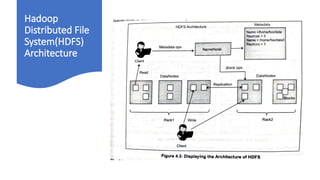
Architecture
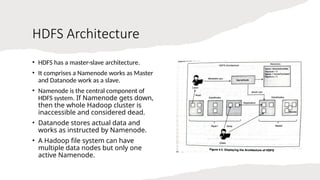
HDFS Architecture
• HDFS has a master-slave architecture.
• It comprises a Namenode works as Master
and Datanode work as a slave.
• Namenode is the central component of
HDFS system. If Namenode gets down,
then the whole Hadoop cluster is
inaccessible and considered dead.
• Datanode stores actual data and
works as instructed by Namenode.
• A Hadoop file system can have
multiple data nodes but only one
active Namenode.
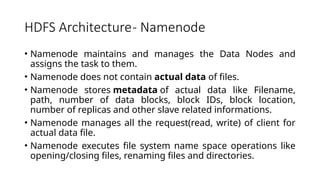
HDFS Architecture- Namenode
• Namenode maintains and manages the Data Nodes and
assigns the task to them.
• Namenode does not contain actual data of files.
• Namenode stores metadata of actual data like Filename,
path, number of data blocks, block IDs, block location,
number of replicas and other slave related informations.
• Namenode manages all the request(read, write) of client for
actual data file.
• Namenode executes file system name space operations like
opening/closing files, renaming files and directories.
HDFS Architecture- Datanode
• Datanodes is responsible of storing actual data.
• Upon instruction from Namenode, it performs operations
like creation/replication/deletion of data blocks.
• When one of Datanode gets down then it will not make any
effect on Hadoop cluster due to replication.
• All Datanodes are synchronized in the Hadoop cluster in a
way that they can communicate with each other for various
operations.
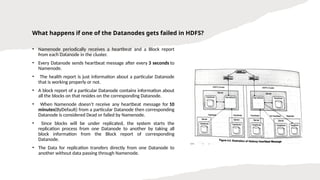
What happens if one of the Datanodes gets failed in HDFS?
• Namenode periodically receives a heartbeat and a Block report
from each Datanode in the cluster.
• Every Datanode sends heartbeat message after every 3 seconds to
Namenode.
• The health report is just information about a particular Datanode
that is working properly or not.
• A block report of a particular Datanode contains information about
all the blocks on that resides on the corresponding Datanode.
• When Namenode doesn’t receive any heartbeat message for 10
minutes(ByDefault) from a particular Datanode then corresponding
Datanode is considered Dead or failed by Namenode.
• Since blocks will be under replicated, the system starts the
replication process from one Datanode to another by taking all
block information from the Block report of corresponding
Datanode.
• The Data for replication transfers directly from one Datanode to
another without data passing through Namenode.
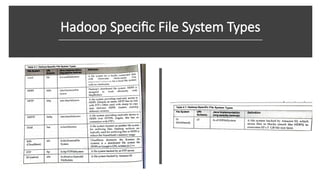
Hadoop Specific File System Types
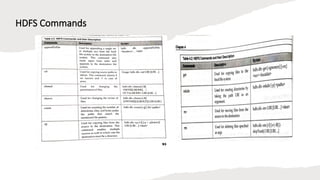
HDFS Commands
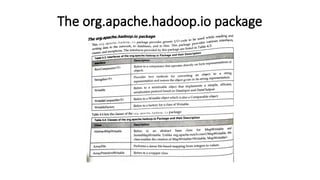
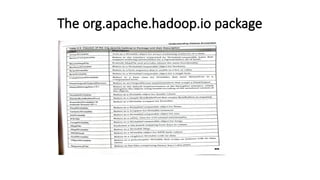
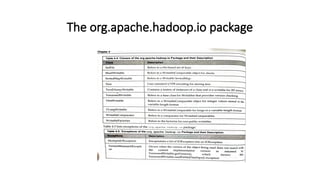
The org.apache.hadoop.io package

Module 2 - Part2.pptx

  • 1.
    Module 2 – Part2 UnderstandingHadoop Ecosystem: Hadoop Ecosystem, Hadoop Distributed File System, MapReduce, Hadoop YARN, Introducing HBase(db), Combing HBase and HDFS, Hive(query language), Pig(script) and Pig Latin, Sqoop, ZooKeeper (security) Flume(trump)Oozie(security)
  • 2.
  • 3.
    Hadoop • Hadoop isnot Big Data, however, it is true that Hadoop plays an integral part in almost all Big Data processes. • Hadoop is a ‘software library’ that allows its users to process large datasets across distributed clusters of computers, thereby enabling them to gather, store and analyse huge sets of data. • Hadoop provides various tools and technologies, collectively termed as Hadoop ecosystem, to enable the development and deployment of Big Data solutions.
  • 4.
    Hadoop Ecosystem • Frameworkof various types of complex and evolving tools and components. • Defined as “Comprehensive collection of tools and technologies that can be effectively implemented and deployed to provide Big Data solutions in a cost-effective manner” • The base of Hadoop is HDFS and MapReduce(similar to the building with a strong base) • MapReduce and Hadoop Distributed File System(HDFS) are two core components of Hadoop Ecosystem, however, not sufficient to deal with Big data challenges. • Along with MapReduce and Hadoop, Hadoop ecosystem provides a collection of various elements to support the complete development and deployment of Big Data solutions.
  • 7.
  • 8.
    HDFS Architecture • HDFShas a master-slave architecture. • It comprises a Namenode works as Master and Datanode work as a slave. • Namenode is the central component of HDFS system. If Namenode gets down, then the whole Hadoop cluster is inaccessible and considered dead. • Datanode stores actual data and works as instructed by Namenode. • A Hadoop file system can have multiple data nodes but only one active Namenode.
  • 9.
    HDFS Architecture- Namenode •Namenode maintains and manages the Data Nodes and assigns the task to them. • Namenode does not contain actual data of files. • Namenode stores metadata of actual data like Filename, path, number of data blocks, block IDs, block location, number of replicas and other slave related informations. • Namenode manages all the request(read, write) of client for actual data file. • Namenode executes file system name space operations like opening/closing files, renaming files and directories.
  • 10.
    HDFS Architecture- Datanode •Datanodes is responsible of storing actual data. • Upon instruction from Namenode, it performs operations like creation/replication/deletion of data blocks. • When one of Datanode gets down then it will not make any effect on Hadoop cluster due to replication. • All Datanodes are synchronized in the Hadoop cluster in a way that they can communicate with each other for various operations.
  • 11.
    What happens ifone of the Datanodes gets failed in HDFS? • Namenode periodically receives a heartbeat and a Block report from each Datanode in the cluster. • Every Datanode sends heartbeat message after every 3 seconds to Namenode. • The health report is just information about a particular Datanode that is working properly or not. • A block report of a particular Datanode contains information about all the blocks on that resides on the corresponding Datanode. • When Namenode doesn’t receive any heartbeat message for 10 minutes(ByDefault) from a particular Datanode then corresponding Datanode is considered Dead or failed by Namenode. • Since blocks will be under replicated, the system starts the replication process from one Datanode to another by taking all block information from the Block report of corresponding Datanode. • The Data for replication transfers directly from one Datanode to another without data passing through Namenode.
  • 12.
  • 13.
  • 14.
  • 15.
  • 16.