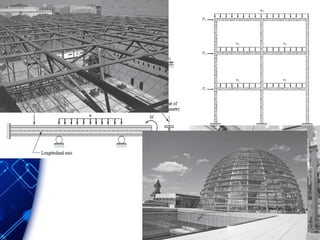
MATRIX STRUCTURAL
ANALYSIS
STRUCTURAL ANALYSIS
It is the process of predicting the
performance of a given structure under a
prescribed loading condition.
(a) stresses or stress resultants (i.e., axial forces,
shears, and bending moments);
(b) deflections; and
(c) support reactions
SIGNIFICANCE OF
LEARNING THE COURSE
1. ETABS
2. MIDAS GEN
3. STAAD
4. GRASP
It is therefore essential that structural
engineers understand the basic principles of
matrix analysis, so that they can develop their
own computer programs and/or properly use
commercially available software—and
appreciate the physical significance of the
analytical results.
Methods of
Structural Analysis
1. Classical Method
2. Matrix Method
3. Finite Element Method
Classical versus
Matrix Methods
Classical:
• Intended for hand
calculations
• often involve certain
assumptions to reduce
the amount of
computational effort
required for analysis.
• Gets complicated
Matrix:
• Systematic, so that they
can be conveniently
programmed.
• General, in the sense
that the same overall
format of the analytical
procedure can be
applied to the various
types of framed
structures.
MATRIX VERSUS:
Finite Element Method
i. Matrix analyze framed structures only whereas FEM
has been developed to the extent that it can be
applied to structures and solids of practically any
shape or form.
ii. in matrix methods, the member force–displacement
relationships are based on the exact solutions of the
underlying differential equations, whereas in finite el
ement methods, such relations are generally
derived by work-energy principles from assumed
displacement or stress functions.
MATRIX METHODS|
FLEXIBILITY AND STIFFNESS METHODS
1. Flexibility method (force or compatibility
method)
 In this approach, the primary unknowns are the
redundant forces, which are calculated first by
solving the structure’s compatibility equations.
2. Stiffness method (displacement or equilibrium
method)
 In this approach, the primary unknowns are the joint
displacements, which are determined first by solving
the structure’s equations of equilibrium.
*this course will focus on stiffness method (direct stiffness
method)
CLASSIFICATION OF
FRAMED STRUCTURES
• Framed structures are composed of straight members
whose lengths are significantly larger than their cross-
sectional dimensions.
• Common framed structures can be classified into six
basic categories based on the arrangement of their
members, and the types of primary stresses that may
develop in their members under major design loads.
CLASSIFICATION OF
FRAMED STRUCTURES
1. Plane Trusses
2. Beams
3. Plane Frames (Rigid Frames)
4. Space Trusses
5. Grids
6. Space Frames
ANALYTICAL MODELS
• An analytical model is an idealized representation of a
real structure for the purpose of analysis represented by
LINE DIAGRAMS
• In matrix methods of analysis, a structure is modeled as
an assemblage of straight members connected at their
ends to joints.
1. A member is defined as a part of the structure for which the
member force-displacement relationships to be used in the anal
ysis are valid.
2. A joint is defined as a structural part of infinitesimal size to which
the ends of the members are connected.
*(In finite-element terminology, the members and joints of structures are
generally referred to as elements and nodes, respectively.)
ANALYTICAL MODELS
ANALYTICAL MODELS|
LINE DIAGRAMS
•each member is depicted by a
l i n e c o i n c i d i n g w i t h i t s
centroidal axis
•the member dimensions and
the size of connections are not
shown
•r i g i d j o i n t s a r e u s u a l l y
represented by points, and
hinged joints by small circles, at
the intersections of members.
•the joints and members
o f t h e s t r u c t u r e a r e
identified by numbers in
which the joint numbers
are enclosed within circles
to distinguish them from
the member numbers
e n c l o s e d w i t h i n
rectangles.
FUNDAMENTAL
RELATIONSHIPS FOR
STRUCTURAL ANALYSIS
Structural analysis, in general, involves the use of
three types of relationships:
• Equilibrium equations,
• compatibility conditions, and
• constitutive relations.
Equilibrium Equations
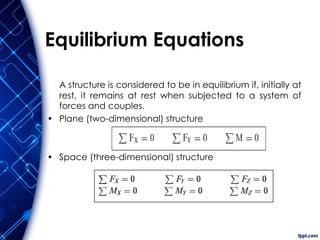
A structure is considered to be in equilibrium if, initially at
rest, it remains at rest when subjected to a system of
forces and couples.
• Plane (two-dimensional) structure
• Space (three-dimensional) structure
Compatibility Conditions
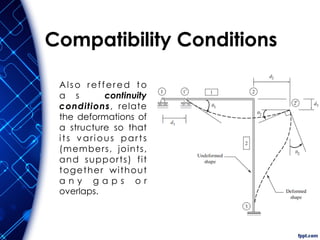
Also reffered to
a s continuity
conditions, relate
the deformations of
a structure so that
its various parts
(members, joints,
and supports) fit
together without
a n y g a p s o r
overlaps.
Constitutive Relations
• Also known as stress-strain relations, describe the
relationships between the stresses and strains of a
structure in accordance with the stress-strain properties
of the structural material
• It provides link between the equilibrium equations and
compatibility conditions that is necessary to establish
the load-deformation relationships for a structure or a
member
MATRIX ALGEBRA
DEFINITION OF A MATRIX
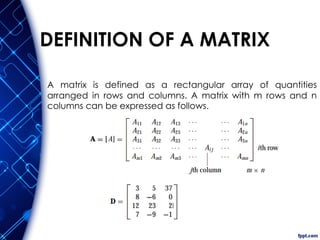
A matrix is defined as a rectangular array of quantities
arranged in rows and columns. A matrix with m rows and n
columns can be expressed as follows.
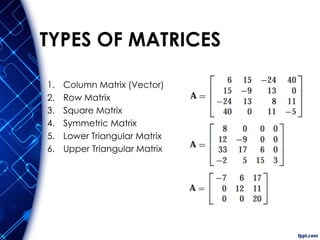
TYPES OF MATRICES
1. Column Matrix (Vector)
2. Row Matrix
3. Square Matrix
TYPES OF MATRICES
1. Column Matrix (Vector)
2. Row Matrix
3. Square Matrix
4. Symmetric Matrix
5. Lower Triangular Matrix
6. Upper Triangular Matrix
TYPES OF MATRICES
1. Column Matrix (Vector)
2. Row Matrix
3. Square Matrix
4. Symmetric Matrix
5. Lower Triangular Matrix
6. Upper Triangular Matrix
7. Diagonal Matrix
8. Unit or Identity Matrix
9. Null Matrix
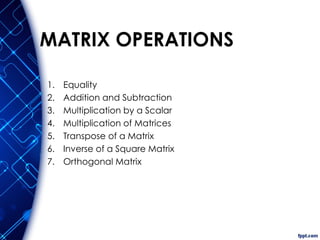
MATRIX OPERATIONS
1. Equality
2. Addition and Subtraction
3. Multiplication by a Scalar
4. Multiplication of Matrices
5. Transpose of a Matrix
6. Inverse of a Square Matrix
7. Orthogonal Matrix
MATRIX OPERATIONS||
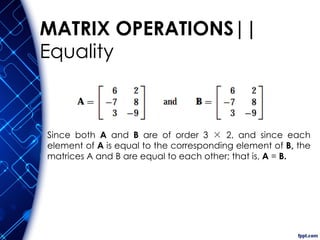
Equality
Since both A and B are of order 3 × 2, and since each
element of A is equal to the corresponding element of B, the
matrices A and B are equal to each other; that is, A = B.
MATRIX OPERATIONS||
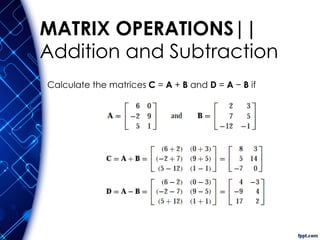
Addition and Subtraction
Calculate the matrices C = A + B and D = A − B if
MATRIX OPERATIONS||
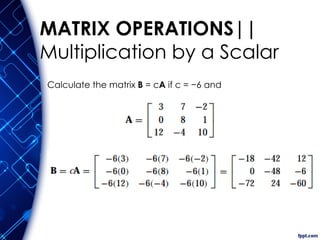
Multiplication by a Scalar
Calculate the matrix B = cA if c = −6 and
MATRIX OPERATIONS||
Multiplication of Matrices
Two matrices can be multiplied only if the number of columns
of the first matrix equals the number of rows of the second
matrix.
Ex. Calculate the product C = AB of the matrices A and B.
MATRIX OPERATIONS||
Multiplication of Matrices
An important application of matrix multiplication is to express
simultaneous equations in compact matrix form. Consider the
following system of linear simultaneous equations.
or symbolically
in matrix form:
NOTE:
• Matrix multiplication is generally
not commutative.
• Matrix multiplication is
associative and distributive,
provided that the sequential
order in which the matrices are
to be multiplied is maintained.
Calculate the products AB and BA if
Are the products AB and BA equal?
MATRIX OPERATIONS||
Multiplication of Matrices
MATRIX OPERATIONS||
Transpose of a Matrix
The transpose of a matrix is obtained by interchanging its
corresponding rows and columns. The transposed matrix is
commonly identified by placing a superscript T on the symbol
of the original matrix.
Example:
1.
2.
The transpose of a
product of matrices
equals the product of the
transposed matrices in
reverse order
MATRIX OPERATIONS||
Inverse of a Square Matrix
The inverse of a square matrix A is defined as a matrix A−1 with
elements of such magnitudes that the product of the original
matrix A and its inverse A-1 equals a unit matrix I; that is,
The operation of inversion is defined only for square
matrices, with the inverse of such a matrix also being a
square matrix of the same order as the original matrix.
MATRIX OPERATIONS||
Orthogonal Matrix
If the inverse of a matrix is equal to its transpose, the matrix is
referred to as an orthogonal matrix. In other words, a matrix A
is orthogonal if
Example.
Determine whether matrix A given below is an orthogonal
matrix.
EXERCISES
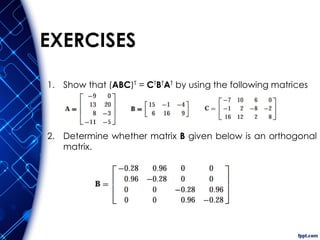
1. Show that (ABC)T = CTBTAT by using the following matrices
2. Determine whether matrix B given below is an orthogonal
matrix.
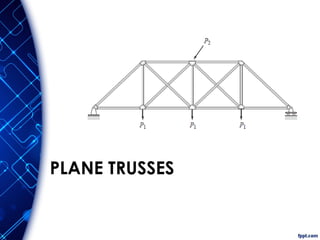
PLANE TRUSSES
OUTLINE:
1. Global and Local Coordinate Systems
2. Degrees of Freedom
3. Stiffness method of analysis
1. Member Stiffness Relations (Local Coordinate System)
2. Coordinate Transformations
3. Member Stiffness Relations (Global Coordinate System)
4. Structure Stiffness Relations
5. Procedure for Analysis
Summary
Problems
1. GLOBAL AND LOCAL
COORDINATE SYSTEMS
Global Coordinate System
The overall geometry and the load–deformation
relationships for an entire structure are described with
reference to a Cartesian or rectangular global
coordinate system.
Local Coordinate System
Defined for each member of the structure to derive the
basic member force–displacement relationships in terms
of the forces and displacements in the directions along
and perpendicular to members.
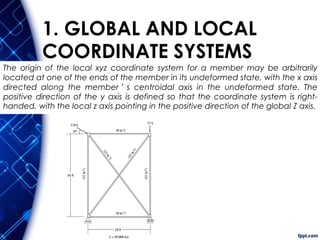
The origin of the local xyz coordinate system for a member may be arbitrarily
located at one of the ends of the member in its undeformed state, with the x axis
directed along the member’s centroidal axis in the undeformed state. The
positive direction of the y axis is defined so that the coordinate system is right-
handed, with the local z axis pointing in the positive direction of the global Z axis.
1. GLOBAL AND LOCAL
COORDINATE SYSTEMS
OUTLINE:
1. Global and Local Coordinate Systems
2. Degrees of Freedom
3. Stiffness method of analysis
1. Member Stiffness Relations (Local Coordinate System)
2. Coordinate Transformations
3. Member Stiffness Relations (Global Coordinate System)
4. Structure Stiffness Relations
5. Procedure for Analysis
Summary
Problems
2. DEGREES OF FREEDOM
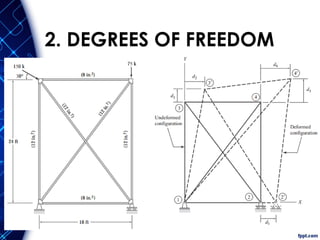
The degrees of freedom of a structure, in general, are
defined as the independent joint displacements
(translations and rotations) that are necessary to specify
the deformed shape of the structure when subjected to an
arbitrary loading.
2. DEGREES OF FREEDOM
NDOF = NSC (NJ) – NR
Where:
•NDOF = number of degrees of freedom of the structure (someti
mes referred to as the degree of kinematic indeterminacy of the
structure);
•NSC = number of degrees of freedom of a free joint (also called
the number of structure coordinates per joint);
•NJ = number of joints;
•NR = number of joint displacements restrained by supports.
For plane trusses:
NDOF = 2 NJ – NR
Number of Degrees of Freedom (NDOF)
2. DEGREES OF FREEDOM
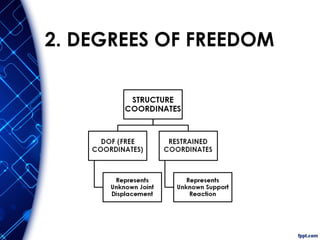
DOF – represented by
Restrained Coordinate
1.DOF is numbered starting at the lowest numbered joint that
has a DOF, and proceeding sequentially to the
highest-numbered joint.
In the case of more than one DOF at a joint, the translation in the X direction
is numbered first, followed by the translation in the Y direction. The first DOF is
assigned as “1”, and the last DOF is assigned a number equal to NDOF.
2.Once all the DOF of the structure have been numbered, we
number the restrained coordinates in a similar manner, but
begin with a number equal to NDOF+1. We start at the lowest-
numbered joint that is attached to a support, and proceed
sequentially to the highest-numbered joint.
In the case of more than one restrained coordinate at a joint, the coordinate
in the X direction is numbered first, followed by the coordinate in the Y
direction.
2. DEGREES OF FREEDOM|
Numbering of DOF & Restrained Coordinates
/
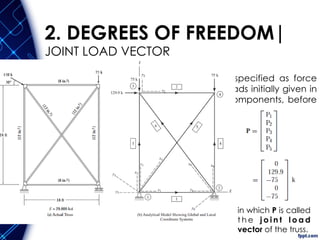
External loads applied to the joints of trusses are specified as force
components in the global X and Y directions. Any loads initially given in
inclined directions are resolved into their X and Y components, before
proceeding with an analysis.
2. DEGREES OF FREEDOM|
JOINT LOAD VECTOR
in which P is called
t h e j o i n t l o a d
vector of the truss.
2. DEGREES OF FREEDOM|
REACTION VECTOR
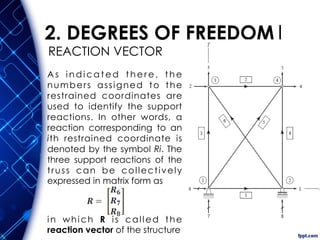
A s i n di c a t e d t h e r e , t h e
numbers assigned to the
restrained coordinates are
used to identify the support
reactions. In other words, a
reaction corresponding to an
ith restrained coordinate is
denoted by the symbol Ri. The
three support reactions of the
truss can be collectively
expressed in matrix form as
in which R is called the
reaction vector of the structure
ACTIVITY 2
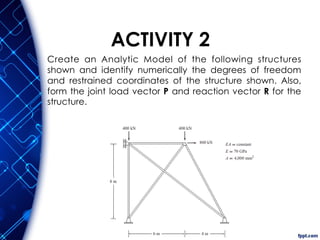
Create an Analytic Model of the following structures
shown and identify numerically the degrees of freedom
and restrained coordinates of the structure shown. Also,
form the joint load vector P and reaction vector R for the
structure.
ACTIVITY 2
Create an Analytic Model of the
following structures shown and identify
numerically the degrees of freedom and
restrained coordinates of the structure
shown. Also, form the joint load vector P
and reaction vector R for the structure.
1.
2.
OUTLINE:
1. Global and Local Coordinate Systems
2. Degrees of Freedom
3. Stiffness method of analysis
1. Member Stiffness Relations (Local Coordinate System)
2. Coordinate Transformations
3. Member Stiffness Relations (Global Coordinate System)
4. Structure Stiffness Relations
5. Procedure for Analysis
Summary
Problems
3. STIFFNESS METHOD OF
ANALYSIS
(A.K.A. DIRECT STIFFNESS METHOD)
3. STIFFNESS METHOD OF ANALYSIS
In the stiffness method of analysis, the joint displacements,
d, of a structure due to an external loading, P, are
determined by solving a system of simultaneous equations,
expressed in the form
P = Sd
In which S is called the structure stiffness matrix.
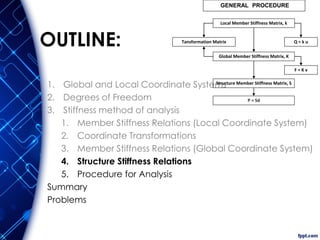
Structure stiffness matrix is formed by assembling the
stiffness matrices for its individual member in global
coordinate system.
3. STIFFNESS METHOD OF ANALYSIS
GENERAL PROCEDURE
Local Member Stiffness Matrix, k
Global Member Stiffness Matrix, K
Structure Member Stiffness Matrix, S
P = Sd
Tansformation Matrix Q = k u
F = K v
Where:
k = member stiffness matrix in the LCS
u = member end displacement vector in the LCS
Q = member end force vector in the LCS (Axial Force)
K = member stiffness matrix in the GCS
v = member end displacement vector in the GCS
F = member end force vector in the GCS
S = Structure stiffness matrix
d = joint displacements
P = external loading
GENERAL PROCEDURE
Local Member Stiffness Matrix, k
Global Member Stiffness Matrix, K
Structure Member Stiffness Matrix, S
P = Sd
Tansformation Matrix Q = k u
F = K v
OUTLINE:
1. Global and Local Coordinate Systems
2. Degrees of Freedom
3. Stiffness method of analysis
1. Member Stiffness Relations (Local Coordinate System)
2. Coordinate Transformations
3. Member Stiffness Relations (Global Coordinate System)
4. Structure Stiffness Relations
5. Procedure for Analysis
Summary
Problems
GENERAL PROCEDURE
Local Member Stiffness Matrix, k
Global Member Stiffness Matrix, K
Structure Member Stiffness Matrix, S
P = Sd
Tansformation Matrix Q = k u
F = K v
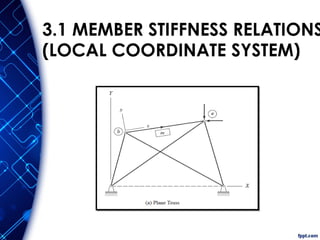
3.1 MEMBER STIFFNESS RELATIONS
(LOCAL COORDINATE SYSTEM)
Objective:
Derive the stiffness matrix for the members of plane
trusses in the local coordinate system.
3.1 MEMBER STIFFNESS RELATIONS
(LOCAL COORDINATE SYSTEM)
3.1 MEMBER STIFFNESS RELATIONS
(LOCAL COORDINATE SYSTEM)
3.1 MEMBER STIFFNESS RELATIONS
(LOCAL COORDINATE SYSTEM)
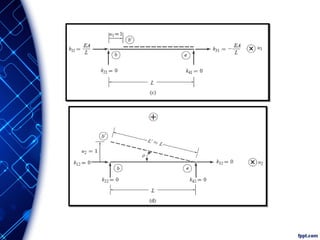
From Figs. b through f, we can see that
Q1 = k11u1 + k12u2 + k13u3 + k14u4
Q2 = k21u1 + k22u2 + k23u3 + k24u4
Q3 = k31u1 + k32u2 + k33u3 + k34u4
Q4 = k41u1 + k42u2 + k43u3 + k44u4
in which kij represents the FORCE at the location and in the direction of ki
required, along with other end forces, to cause a unit value of
displacement uj, while all other end displacements are zero.
These kij are called stiffness coefficients expressed in forces per unit
displacement (ex. N/m, lb/in)
Double subscript , kij : i = force and j = displacement)
3.1 MEMBER STIFFNESS RELATIONS
(LOCAL COORDINATE SYSTEM)
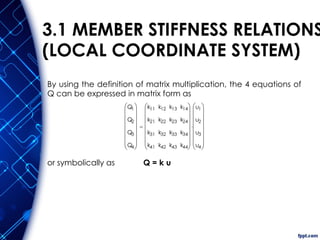
By using the definition of matrix multiplication, the 4 equations of
Q can be expressed in matrix form as
or symbolically as Q = k u
3.1 MEMBER STIFFNESS RELATIONS
(LOCAL COORDINATE SYSTEM)
Relate the axial force kij to axial deformation uj using the stress–strain
relationship for linearly elastic materials given by Hooke’s law as
σ = E ε
Where:
Thus,

1
L

3.1 MEMBER STIFFNESS RELATIONS
(LOCAL COORDINATE SYSTEM)
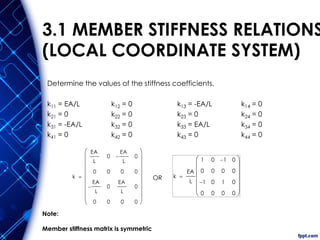
Determine the values of the stiffness coefficients.
k11 = EA/L k12 = 0 k13 = -EA/L k14 = 0
k21 = 0 k22 = 0 k23 = 0 k24 = 0
k31 = -EA/L k32 = 0 k33 = EA/L k34 = 0
k41 = 0 k42 = 0 k43 = 0 k44 = 0
OR
Note:
Member stiffness matrix is symmetric
ACTIVITY 3
(FOR 20 MINUTES)
The displaced position of member 8 of the truss in Fig. (a) is
given in Fig. (b). Calculate the axial force, Q, in this
member. Is it under tension or compression?
ACTIVITY 3
If end displacements in
the local coordinate
system for member 9 of
the truss shown are
Calculate the axial force
in the member.
What is the global
member end force?
OUTLINE:
1. Global and Local Coordinate Systems
2. Degrees of Freedom
3. Stiffness method of analysis
1. Member Stiffness Relations (Local Coordinate System)
2. Coordinate Transformations
3. Member Stiffness Relations (Global Coordinate System)
4. Structure Stiffness Relations
5. Procedure for Analysis
Summary
Problems
GENERAL PROCEDURE
Local Member Stiffness Matrix, k
Global Member Stiffness Matrix, K
Structure Member Stiffness Matrix, S
P = Sd
Tansformation Matrix Q = k u
F = K v
3.2 Coordinate Transformations
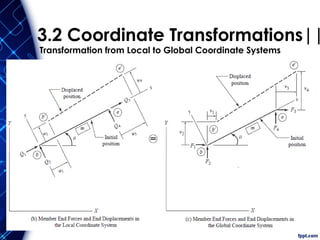
When members of a structure are oriented in
different directions, it becomes necessary to transform the
stiffness relations for each member from its local
coordinate system to a single global coordinate system
selected for the entire structure. The member stiffness
relations as expressed in the global coordinate system are
then combined to establish the stiffness relations for the
whole structure.
3.2 Coordinate Transformations||
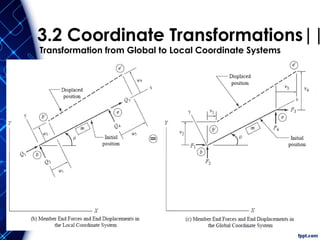
Transformation from Global to Local Coordinate Systems
3.2 Coordinate Transformations||
Transformation from Global to Local Coordinate Systems||
Member End Forces
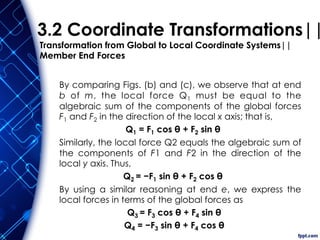
By comparing Figs. (b) and (c), we observe that at end
b of m, the local force Q1 must be equal to the
algebraic sum of the components of the global forces
F1 and F2 in the direction of the local x axis; that is,
Q1 = F1 cos θ + F2 sin θ
Similarly, the local force Q2 equals the algebraic sum of
the components of F1 and F2 in the direction of the
local y axis. Thus,
Q2 = −F1 sin θ + F2 cos θ
By using a similar reasoning at end e, we express the
local forces in terms of the global forces as
Q3 = F3 cos θ + F4 sin θ
Q4 = −F3 sin θ + F4 cos θ
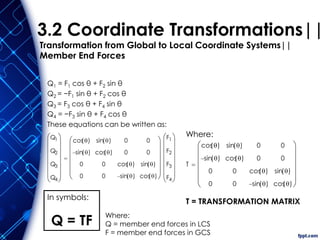
Where:
T = TRANSFORMATION MATRIX
3.2 Coordinate Transformations||
Transformation from Global to Local Coordinate Systems||
Member End Forces
Q1 = F1 cos θ + F2 sin θ
Q2 = −F1 sin θ + F2 cos θ
Q3 = F3 cos θ + F4 sin θ
Q4 = −F3 sin θ + F4 cos θ
These equations can be written as:
In symbols:
Q = TF
Where:
Q = member end forces in LCS
F = member end forces in GCS
3.2 Coordinate Transformations||
Transformation from Global to Local Coordinate Systems||
Member End Forces
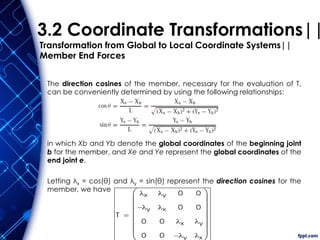
The direction cosines of the member, necessary for the evaluation of T,
can be conveniently determined by using the following relationships:
in which Xb and Yb denote the global coordinates of the beginning joint
b for the member, and Xe and Ye represent the global coordinates of the
end joint e.
Letting λx = cos(θ) and λy = sin(θ) represent the direction cosines for the
member, we have
T
x
y

0
0
y
x
0
0
0
0
x
y

0
0
y
x













3.2 Coordinate Transformations||
Transformation from Global to Local Coordinate Systems||
Member End Displacement
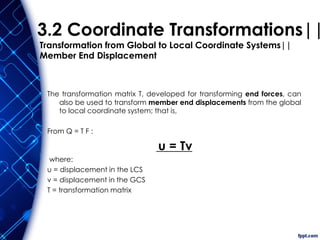
The transformation matrix T, developed for transforming end forces, can
also be used to transform member end displacements from the global
to local coordinate system; that is,
From Q = T F :
u = Tv
where:
u = displacement in the LCS
v = displacement in the GCS
T = transformation matrix
3.2 Coordinate Transformations||
Transformation from Local to Global Coordinate Systems
3.2 Coordinate Transformations||
Transformation from Local to Global Coordinate Systems ||
Member End Forces
A comparison of Figs. (b) and (c) indicates that at end b of m,
F1 = Q1 cos θ − Q2 sin θ
F2 = Q1 sin θ + Q2 cos θ
F3 = Q3 cos θ − Q4 sin θ
F4 = Q3 sin θ + Q4 cos θ
These equations can be written as:
Where:
In symbols:
F = TT Q
3.2 Coordinate Transformations||
Transformation from Local to Global Coordinate Systems ||
Member End Displacement
As discussed previously, because the member end
displacements are also vectors, which are defined in the same
directions as the corresponding forces, the matrix T also defines
the transformation of member end displacements from the local
to the global coordinate system; that is,
v = TT u
Where:
v = displacement in the GCS
u = displacement in the LCS
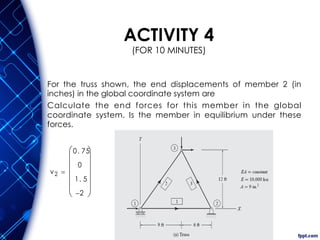
ACTIVITY 4
(FOR 10 MINUTES)
For the truss shown, the end displacements of member 2 (in
inches) in the global coordinate system are
Calculate the end forces for this member in the global
coordinate system. Is the member in equilibrium under these
forces.
v2
0. 75
0
1. 5
2
















OUTLINE:
1. Global and Local Coordinate Systems
2. Degrees of Freedom
3. Stiffness method of analysis
1. Member Stiffness Relations (Local Coordinate System)
2. Coordinate Transformations
3. Member Stiffness Relations (Global Coordinate System)
4. Structure Stiffness Relations
5. Procedure for Analysis
Summary
Problems
GENERAL PROCEDURE
Local Member Stiffness Matrix, k
Global Member Stiffness Matrix, K
Structure Member Stiffness Matrix, S
P = Sd
Tansformation Matrix Q = k u
F = K v
3.3 Member Stiffness Relations
(Global Coordinate System)
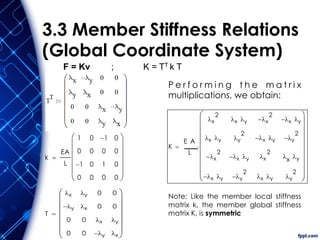
First, we substitute the local stiffness relations Q = ku into
the force transformation relations F = TTQ to obtain
F = TT (ku)
Then, by substituting the displacement transformation
relations, u = Tv into it, we determine that the desired
relationship between the member end forces F and end
displacements v, in the global coordinate system, is
F = TT [k(Tv)]
F = Kv Where:
K = TT k T
K = global member stiffness matrix
3.3 Member Stiffness Relations
(Global Coordinate System)
P e r f o r m i n g t h e m a t r i x
multiplications, we obtain:
Note: Like the member local stiffness
matrix k, the member global stiffness
matrix K, is symmetric
T
x
y

0
0
y
x
0
0
0
0
x
y

0
0
y
x















K
E A
L
x
2
x y
x
2

x
 y
x y
y
2
x
 y
y
2

x
2

x
 y
x
2
x y
x
 y
y
2

x y
y
2






















F = Kv ; K = TT k T
ACTIVITY 5
(FOR 10 MINUTES)
For the truss shown, the end displacements of member 2 (in
inches) in the global coordinate system are
Calculate the end forces for this member in the global
coordinate system. Is the member in equilibrium under these
forces. (This time, use Global Member stiffnes matrix)
v2
0. 75
0
1. 5
2
















OUTLINE:
1. Global and Local Coordinate Systems
2. Degrees of Freedom
3. Stiffness method of analysis
1. Member Stiffness Relations (Local Coordinate System)
2. Coordinate Transformations
3. Member Stiffness Relations (Global Coordinate System)
4. Structure Stiffness Relations
5. Procedure for Analysis
Summary
Problems
GENERAL PROCEDURE
Local Member Stiffness Matrix, k
Global Member Stiffness Matrix, K
Structure Member Stiffness Matrix, S
P = Sd
Tansformation Matrix Q = k u
F = K v
3.4 STRUCTURE STIFFNESS
RELATIONS
3.4 Structure Stiffness Relations||
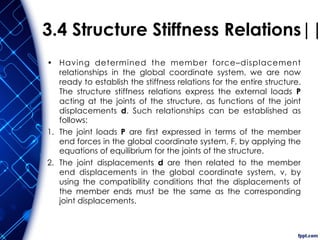
• Having determined the member force–displacement
relationships in the global coordinate system, we are now
ready to establish the stiffness relations for the entire structure.
The structure stiffness relations express the external loads P
acting at the joints of the structure, as functions of the joint
displacements d. Such relationships can be established as
follows:
1. The joint loads P are first expressed in terms of the member
end forces in the global coordinate system, F, by applying the
equations of equilibrium for the joints of the structure.
2. The joint displacements d are then related to the member
end displacements in the global coordinate system, v, by
using the compatibility conditions that the displacements of
the member ends must be the same as the corresponding
joint displacements.
3.4 Structure Stiffness Relations||
3. Next, the compatibility equations are substituted into the
member force–displacement relations, F = Kv, to express the
member global end forces in terms of the joint displacements d.
The F–d relations thus obtained are then substituted into the joint
equilibrium equations to establish the desired structure stiffness
relationships between the joint loads P and the joint
displacements d.
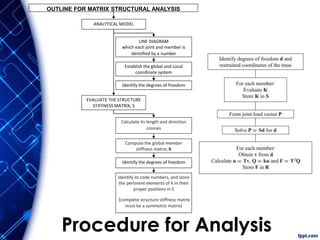
OUTLINE FOR MATRIX STRUCTURAL ANALYSIS
ANALYTICAL MODEL
LINE DIAGRAM
which each joint and member is
identified by a number
Establish the global and Local
coordinate system
Identify the degrees of freedom
EVALUATE THE STRUCTURE
STIFFNESS MATRIX, S
Calculate its length and direction
cosines
Compute the global member
stiffness matrix, K
Identify the degrees of freedom
Identify its code numbers, and store
the pertinent elements of K in their
proper positions in S
(complete structure stiffness matrix
must be a symmetric matrix)
Procedure for Analysis
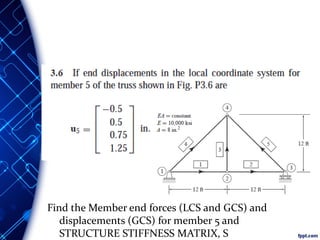
Find the Member end forces (LCS and GCS) and
displacements (GCS) for member 5 and
STRUCTURE STIFFNESS MATRIX, S
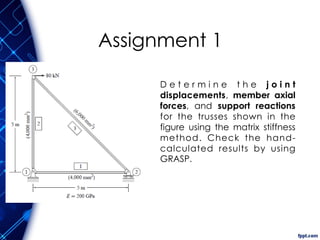
Assignment 1
D e t e r m i n e t h e j o i n t
displacements, member axial
forces, and support reactions
for the trusses shown in the
figure using the matrix stiffness
method. Check the hand-
calculated results by using
GRASP.
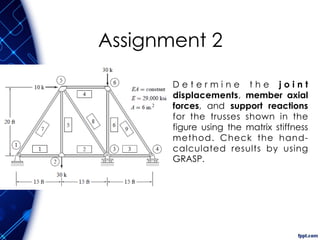
Assignment 2
D e t e r m i n e t h e j o i n t
displacements, member axial
forces, and support reactions
for the trusses shown in the
figure using the matrix stiffness
method. Check the hand-
calculated results by using
GRASP.
1. 2.

494999246-Matrix-structural-analysis-Truss.pdf

  • 1.
  • 2.
    STRUCTURAL ANALYSIS It isthe process of predicting the performance of a given structure under a prescribed loading condition. (a) stresses or stress resultants (i.e., axial forces, shears, and bending moments); (b) deflections; and (c) support reactions
  • 3.
    SIGNIFICANCE OF LEARNING THECOURSE 1. ETABS 2. MIDAS GEN 3. STAAD 4. GRASP It is therefore essential that structural engineers understand the basic principles of matrix analysis, so that they can develop their own computer programs and/or properly use commercially available software—and appreciate the physical significance of the analytical results.
  • 4.
    Methods of Structural Analysis 1.Classical Method 2. Matrix Method 3. Finite Element Method
  • 5.
    Classical versus Matrix Methods Classical: •Intended for hand calculations • often involve certain assumptions to reduce the amount of computational effort required for analysis. • Gets complicated Matrix: • Systematic, so that they can be conveniently programmed. • General, in the sense that the same overall format of the analytical procedure can be applied to the various types of framed structures.
  • 6.
    MATRIX VERSUS: Finite ElementMethod i. Matrix analyze framed structures only whereas FEM has been developed to the extent that it can be applied to structures and solids of practically any shape or form. ii. in matrix methods, the member force–displacement relationships are based on the exact solutions of the underlying differential equations, whereas in finite el ement methods, such relations are generally derived by work-energy principles from assumed displacement or stress functions.
  • 7.
    MATRIX METHODS| FLEXIBILITY ANDSTIFFNESS METHODS 1. Flexibility method (force or compatibility method)  In this approach, the primary unknowns are the redundant forces, which are calculated first by solving the structure’s compatibility equations. 2. Stiffness method (displacement or equilibrium method)  In this approach, the primary unknowns are the joint displacements, which are determined first by solving the structure’s equations of equilibrium. *this course will focus on stiffness method (direct stiffness method)
  • 8.
    CLASSIFICATION OF FRAMED STRUCTURES •Framed structures are composed of straight members whose lengths are significantly larger than their cross- sectional dimensions. • Common framed structures can be classified into six basic categories based on the arrangement of their members, and the types of primary stresses that may develop in their members under major design loads.
  • 9.
    CLASSIFICATION OF FRAMED STRUCTURES 1.Plane Trusses 2. Beams 3. Plane Frames (Rigid Frames) 4. Space Trusses 5. Grids 6. Space Frames
  • 11.
    ANALYTICAL MODELS • Ananalytical model is an idealized representation of a real structure for the purpose of analysis represented by LINE DIAGRAMS • In matrix methods of analysis, a structure is modeled as an assemblage of straight members connected at their ends to joints. 1. A member is defined as a part of the structure for which the member force-displacement relationships to be used in the anal ysis are valid. 2. A joint is defined as a structural part of infinitesimal size to which the ends of the members are connected. *(In finite-element terminology, the members and joints of structures are generally referred to as elements and nodes, respectively.)
  • 12.
  • 13.
    ANALYTICAL MODELS| LINE DIAGRAMS •eachmember is depicted by a l i n e c o i n c i d i n g w i t h i t s centroidal axis •the member dimensions and the size of connections are not shown •r i g i d j o i n t s a r e u s u a l l y represented by points, and hinged joints by small circles, at the intersections of members. •the joints and members o f t h e s t r u c t u r e a r e identified by numbers in which the joint numbers are enclosed within circles to distinguish them from the member numbers e n c l o s e d w i t h i n rectangles.
  • 14.
    FUNDAMENTAL RELATIONSHIPS FOR STRUCTURAL ANALYSIS Structuralanalysis, in general, involves the use of three types of relationships: • Equilibrium equations, • compatibility conditions, and • constitutive relations.
  • 15.
    Equilibrium Equations A structureis considered to be in equilibrium if, initially at rest, it remains at rest when subjected to a system of forces and couples. • Plane (two-dimensional) structure • Space (three-dimensional) structure
  • 16.
    Compatibility Conditions Also refferedto a s continuity conditions, relate the deformations of a structure so that its various parts (members, joints, and supports) fit together without a n y g a p s o r overlaps.
  • 17.
    Constitutive Relations • Alsoknown as stress-strain relations, describe the relationships between the stresses and strains of a structure in accordance with the stress-strain properties of the structural material • It provides link between the equilibrium equations and compatibility conditions that is necessary to establish the load-deformation relationships for a structure or a member
  • 18.
  • 19.
    DEFINITION OF AMATRIX A matrix is defined as a rectangular array of quantities arranged in rows and columns. A matrix with m rows and n columns can be expressed as follows.
  • 20.
    TYPES OF MATRICES 1.Column Matrix (Vector) 2. Row Matrix 3. Square Matrix
  • 21.
    TYPES OF MATRICES 1.Column Matrix (Vector) 2. Row Matrix 3. Square Matrix 4. Symmetric Matrix 5. Lower Triangular Matrix 6. Upper Triangular Matrix
  • 22.
    TYPES OF MATRICES 1.Column Matrix (Vector) 2. Row Matrix 3. Square Matrix 4. Symmetric Matrix 5. Lower Triangular Matrix 6. Upper Triangular Matrix 7. Diagonal Matrix 8. Unit or Identity Matrix 9. Null Matrix
  • 23.
    MATRIX OPERATIONS 1. Equality 2.Addition and Subtraction 3. Multiplication by a Scalar 4. Multiplication of Matrices 5. Transpose of a Matrix 6. Inverse of a Square Matrix 7. Orthogonal Matrix
  • 24.
    MATRIX OPERATIONS|| Equality Since bothA and B are of order 3 × 2, and since each element of A is equal to the corresponding element of B, the matrices A and B are equal to each other; that is, A = B.
  • 25.
    MATRIX OPERATIONS|| Addition andSubtraction Calculate the matrices C = A + B and D = A − B if
  • 26.
    MATRIX OPERATIONS|| Multiplication bya Scalar Calculate the matrix B = cA if c = −6 and
  • 27.
    MATRIX OPERATIONS|| Multiplication ofMatrices Two matrices can be multiplied only if the number of columns of the first matrix equals the number of rows of the second matrix. Ex. Calculate the product C = AB of the matrices A and B.
  • 28.
    MATRIX OPERATIONS|| Multiplication ofMatrices An important application of matrix multiplication is to express simultaneous equations in compact matrix form. Consider the following system of linear simultaneous equations. or symbolically in matrix form: NOTE: • Matrix multiplication is generally not commutative. • Matrix multiplication is associative and distributive, provided that the sequential order in which the matrices are to be multiplied is maintained.
  • 29.
    Calculate the productsAB and BA if Are the products AB and BA equal? MATRIX OPERATIONS|| Multiplication of Matrices
  • 30.
    MATRIX OPERATIONS|| Transpose ofa Matrix The transpose of a matrix is obtained by interchanging its corresponding rows and columns. The transposed matrix is commonly identified by placing a superscript T on the symbol of the original matrix. Example: 1. 2. The transpose of a product of matrices equals the product of the transposed matrices in reverse order
  • 31.
    MATRIX OPERATIONS|| Inverse ofa Square Matrix The inverse of a square matrix A is defined as a matrix A−1 with elements of such magnitudes that the product of the original matrix A and its inverse A-1 equals a unit matrix I; that is, The operation of inversion is defined only for square matrices, with the inverse of such a matrix also being a square matrix of the same order as the original matrix.
  • 32.
    MATRIX OPERATIONS|| Orthogonal Matrix Ifthe inverse of a matrix is equal to its transpose, the matrix is referred to as an orthogonal matrix. In other words, a matrix A is orthogonal if Example. Determine whether matrix A given below is an orthogonal matrix.
  • 33.
    EXERCISES 1. Show that(ABC)T = CTBTAT by using the following matrices 2. Determine whether matrix B given below is an orthogonal matrix.
  • 34.
  • 35.
    OUTLINE: 1. Global andLocal Coordinate Systems 2. Degrees of Freedom 3. Stiffness method of analysis 1. Member Stiffness Relations (Local Coordinate System) 2. Coordinate Transformations 3. Member Stiffness Relations (Global Coordinate System) 4. Structure Stiffness Relations 5. Procedure for Analysis Summary Problems
  • 36.
    1. GLOBAL ANDLOCAL COORDINATE SYSTEMS Global Coordinate System The overall geometry and the load–deformation relationships for an entire structure are described with reference to a Cartesian or rectangular global coordinate system. Local Coordinate System Defined for each member of the structure to derive the basic member force–displacement relationships in terms of the forces and displacements in the directions along and perpendicular to members.
  • 37.
    The origin ofthe local xyz coordinate system for a member may be arbitrarily located at one of the ends of the member in its undeformed state, with the x axis directed along the member’s centroidal axis in the undeformed state. The positive direction of the y axis is defined so that the coordinate system is right- handed, with the local z axis pointing in the positive direction of the global Z axis. 1. GLOBAL AND LOCAL COORDINATE SYSTEMS
  • 38.
    OUTLINE: 1. Global andLocal Coordinate Systems 2. Degrees of Freedom 3. Stiffness method of analysis 1. Member Stiffness Relations (Local Coordinate System) 2. Coordinate Transformations 3. Member Stiffness Relations (Global Coordinate System) 4. Structure Stiffness Relations 5. Procedure for Analysis Summary Problems
  • 39.
    2. DEGREES OFFREEDOM The degrees of freedom of a structure, in general, are defined as the independent joint displacements (translations and rotations) that are necessary to specify the deformed shape of the structure when subjected to an arbitrary loading.
  • 40.
  • 41.
    2. DEGREES OFFREEDOM NDOF = NSC (NJ) – NR Where: •NDOF = number of degrees of freedom of the structure (someti mes referred to as the degree of kinematic indeterminacy of the structure); •NSC = number of degrees of freedom of a free joint (also called the number of structure coordinates per joint); •NJ = number of joints; •NR = number of joint displacements restrained by supports. For plane trusses: NDOF = 2 NJ – NR Number of Degrees of Freedom (NDOF)
  • 42.
  • 43.
    DOF – representedby Restrained Coordinate 1.DOF is numbered starting at the lowest numbered joint that has a DOF, and proceeding sequentially to the highest-numbered joint. In the case of more than one DOF at a joint, the translation in the X direction is numbered first, followed by the translation in the Y direction. The first DOF is assigned as “1”, and the last DOF is assigned a number equal to NDOF. 2.Once all the DOF of the structure have been numbered, we number the restrained coordinates in a similar manner, but begin with a number equal to NDOF+1. We start at the lowest- numbered joint that is attached to a support, and proceed sequentially to the highest-numbered joint. In the case of more than one restrained coordinate at a joint, the coordinate in the X direction is numbered first, followed by the coordinate in the Y direction. 2. DEGREES OF FREEDOM| Numbering of DOF & Restrained Coordinates /
  • 44.
    External loads appliedto the joints of trusses are specified as force components in the global X and Y directions. Any loads initially given in inclined directions are resolved into their X and Y components, before proceeding with an analysis. 2. DEGREES OF FREEDOM| JOINT LOAD VECTOR in which P is called t h e j o i n t l o a d vector of the truss.
  • 45.
    2. DEGREES OFFREEDOM| REACTION VECTOR A s i n di c a t e d t h e r e , t h e numbers assigned to the restrained coordinates are used to identify the support reactions. In other words, a reaction corresponding to an ith restrained coordinate is denoted by the symbol Ri. The three support reactions of the truss can be collectively expressed in matrix form as in which R is called the reaction vector of the structure
  • 46.
    ACTIVITY 2 Create anAnalytic Model of the following structures shown and identify numerically the degrees of freedom and restrained coordinates of the structure shown. Also, form the joint load vector P and reaction vector R for the structure.
  • 47.
    ACTIVITY 2 Create anAnalytic Model of the following structures shown and identify numerically the degrees of freedom and restrained coordinates of the structure shown. Also, form the joint load vector P and reaction vector R for the structure. 1. 2.
  • 48.
    OUTLINE: 1. Global andLocal Coordinate Systems 2. Degrees of Freedom 3. Stiffness method of analysis 1. Member Stiffness Relations (Local Coordinate System) 2. Coordinate Transformations 3. Member Stiffness Relations (Global Coordinate System) 4. Structure Stiffness Relations 5. Procedure for Analysis Summary Problems
  • 49.
    3. STIFFNESS METHODOF ANALYSIS (A.K.A. DIRECT STIFFNESS METHOD)
  • 50.
    3. STIFFNESS METHODOF ANALYSIS In the stiffness method of analysis, the joint displacements, d, of a structure due to an external loading, P, are determined by solving a system of simultaneous equations, expressed in the form P = Sd In which S is called the structure stiffness matrix. Structure stiffness matrix is formed by assembling the stiffness matrices for its individual member in global coordinate system.
  • 51.
    3. STIFFNESS METHODOF ANALYSIS GENERAL PROCEDURE Local Member Stiffness Matrix, k Global Member Stiffness Matrix, K Structure Member Stiffness Matrix, S P = Sd Tansformation Matrix Q = k u F = K v Where: k = member stiffness matrix in the LCS u = member end displacement vector in the LCS Q = member end force vector in the LCS (Axial Force) K = member stiffness matrix in the GCS v = member end displacement vector in the GCS F = member end force vector in the GCS S = Structure stiffness matrix d = joint displacements P = external loading
  • 52.
    GENERAL PROCEDURE Local MemberStiffness Matrix, k Global Member Stiffness Matrix, K Structure Member Stiffness Matrix, S P = Sd Tansformation Matrix Q = k u F = K v
  • 53.
    OUTLINE: 1. Global andLocal Coordinate Systems 2. Degrees of Freedom 3. Stiffness method of analysis 1. Member Stiffness Relations (Local Coordinate System) 2. Coordinate Transformations 3. Member Stiffness Relations (Global Coordinate System) 4. Structure Stiffness Relations 5. Procedure for Analysis Summary Problems GENERAL PROCEDURE Local Member Stiffness Matrix, k Global Member Stiffness Matrix, K Structure Member Stiffness Matrix, S P = Sd Tansformation Matrix Q = k u F = K v
  • 54.
    3.1 MEMBER STIFFNESSRELATIONS (LOCAL COORDINATE SYSTEM) Objective: Derive the stiffness matrix for the members of plane trusses in the local coordinate system.
  • 55.
    3.1 MEMBER STIFFNESSRELATIONS (LOCAL COORDINATE SYSTEM)
  • 56.
    3.1 MEMBER STIFFNESSRELATIONS (LOCAL COORDINATE SYSTEM)
  • 57.
    3.1 MEMBER STIFFNESSRELATIONS (LOCAL COORDINATE SYSTEM) From Figs. b through f, we can see that Q1 = k11u1 + k12u2 + k13u3 + k14u4 Q2 = k21u1 + k22u2 + k23u3 + k24u4 Q3 = k31u1 + k32u2 + k33u3 + k34u4 Q4 = k41u1 + k42u2 + k43u3 + k44u4 in which kij represents the FORCE at the location and in the direction of ki required, along with other end forces, to cause a unit value of displacement uj, while all other end displacements are zero. These kij are called stiffness coefficients expressed in forces per unit displacement (ex. N/m, lb/in) Double subscript , kij : i = force and j = displacement)
  • 58.
    3.1 MEMBER STIFFNESSRELATIONS (LOCAL COORDINATE SYSTEM) By using the definition of matrix multiplication, the 4 equations of Q can be expressed in matrix form as or symbolically as Q = k u
  • 59.
    3.1 MEMBER STIFFNESSRELATIONS (LOCAL COORDINATE SYSTEM) Relate the axial force kij to axial deformation uj using the stress–strain relationship for linearly elastic materials given by Hooke’s law as σ = E ε Where: Thus,  1 L 
  • 60.
    3.1 MEMBER STIFFNESSRELATIONS (LOCAL COORDINATE SYSTEM) Determine the values of the stiffness coefficients. k11 = EA/L k12 = 0 k13 = -EA/L k14 = 0 k21 = 0 k22 = 0 k23 = 0 k24 = 0 k31 = -EA/L k32 = 0 k33 = EA/L k34 = 0 k41 = 0 k42 = 0 k43 = 0 k44 = 0 OR Note: Member stiffness matrix is symmetric
  • 63.
    ACTIVITY 3 (FOR 20MINUTES) The displaced position of member 8 of the truss in Fig. (a) is given in Fig. (b). Calculate the axial force, Q, in this member. Is it under tension or compression?
  • 64.
    ACTIVITY 3 If enddisplacements in the local coordinate system for member 9 of the truss shown are Calculate the axial force in the member. What is the global member end force?
  • 65.
    OUTLINE: 1. Global andLocal Coordinate Systems 2. Degrees of Freedom 3. Stiffness method of analysis 1. Member Stiffness Relations (Local Coordinate System) 2. Coordinate Transformations 3. Member Stiffness Relations (Global Coordinate System) 4. Structure Stiffness Relations 5. Procedure for Analysis Summary Problems GENERAL PROCEDURE Local Member Stiffness Matrix, k Global Member Stiffness Matrix, K Structure Member Stiffness Matrix, S P = Sd Tansformation Matrix Q = k u F = K v
  • 66.
    3.2 Coordinate Transformations Whenmembers of a structure are oriented in different directions, it becomes necessary to transform the stiffness relations for each member from its local coordinate system to a single global coordinate system selected for the entire structure. The member stiffness relations as expressed in the global coordinate system are then combined to establish the stiffness relations for the whole structure.
  • 67.
    3.2 Coordinate Transformations|| Transformationfrom Global to Local Coordinate Systems
  • 68.
    3.2 Coordinate Transformations|| Transformationfrom Global to Local Coordinate Systems|| Member End Forces By comparing Figs. (b) and (c), we observe that at end b of m, the local force Q1 must be equal to the algebraic sum of the components of the global forces F1 and F2 in the direction of the local x axis; that is, Q1 = F1 cos θ + F2 sin θ Similarly, the local force Q2 equals the algebraic sum of the components of F1 and F2 in the direction of the local y axis. Thus, Q2 = −F1 sin θ + F2 cos θ By using a similar reasoning at end e, we express the local forces in terms of the global forces as Q3 = F3 cos θ + F4 sin θ Q4 = −F3 sin θ + F4 cos θ
  • 69.
    Where: T = TRANSFORMATIONMATRIX 3.2 Coordinate Transformations|| Transformation from Global to Local Coordinate Systems|| Member End Forces Q1 = F1 cos θ + F2 sin θ Q2 = −F1 sin θ + F2 cos θ Q3 = F3 cos θ + F4 sin θ Q4 = −F3 sin θ + F4 cos θ These equations can be written as: In symbols: Q = TF Where: Q = member end forces in LCS F = member end forces in GCS
  • 70.
    3.2 Coordinate Transformations|| Transformationfrom Global to Local Coordinate Systems|| Member End Forces The direction cosines of the member, necessary for the evaluation of T, can be conveniently determined by using the following relationships: in which Xb and Yb denote the global coordinates of the beginning joint b for the member, and Xe and Ye represent the global coordinates of the end joint e. Letting λx = cos(θ) and λy = sin(θ) represent the direction cosines for the member, we have T x y  0 0 y x 0 0 0 0 x y  0 0 y x             
  • 71.
    3.2 Coordinate Transformations|| Transformationfrom Global to Local Coordinate Systems|| Member End Displacement The transformation matrix T, developed for transforming end forces, can also be used to transform member end displacements from the global to local coordinate system; that is, From Q = T F : u = Tv where: u = displacement in the LCS v = displacement in the GCS T = transformation matrix
  • 72.
    3.2 Coordinate Transformations|| Transformationfrom Local to Global Coordinate Systems
  • 73.
    3.2 Coordinate Transformations|| Transformationfrom Local to Global Coordinate Systems || Member End Forces A comparison of Figs. (b) and (c) indicates that at end b of m, F1 = Q1 cos θ − Q2 sin θ F2 = Q1 sin θ + Q2 cos θ F3 = Q3 cos θ − Q4 sin θ F4 = Q3 sin θ + Q4 cos θ These equations can be written as: Where: In symbols: F = TT Q
  • 74.
    3.2 Coordinate Transformations|| Transformationfrom Local to Global Coordinate Systems || Member End Displacement As discussed previously, because the member end displacements are also vectors, which are defined in the same directions as the corresponding forces, the matrix T also defines the transformation of member end displacements from the local to the global coordinate system; that is, v = TT u Where: v = displacement in the GCS u = displacement in the LCS
  • 75.
    ACTIVITY 4 (FOR 10MINUTES) For the truss shown, the end displacements of member 2 (in inches) in the global coordinate system are Calculate the end forces for this member in the global coordinate system. Is the member in equilibrium under these forces. v2 0. 75 0 1. 5 2                
  • 76.
    OUTLINE: 1. Global andLocal Coordinate Systems 2. Degrees of Freedom 3. Stiffness method of analysis 1. Member Stiffness Relations (Local Coordinate System) 2. Coordinate Transformations 3. Member Stiffness Relations (Global Coordinate System) 4. Structure Stiffness Relations 5. Procedure for Analysis Summary Problems GENERAL PROCEDURE Local Member Stiffness Matrix, k Global Member Stiffness Matrix, K Structure Member Stiffness Matrix, S P = Sd Tansformation Matrix Q = k u F = K v
  • 77.
    3.3 Member StiffnessRelations (Global Coordinate System) First, we substitute the local stiffness relations Q = ku into the force transformation relations F = TTQ to obtain F = TT (ku) Then, by substituting the displacement transformation relations, u = Tv into it, we determine that the desired relationship between the member end forces F and end displacements v, in the global coordinate system, is F = TT [k(Tv)] F = Kv Where: K = TT k T K = global member stiffness matrix
  • 78.
    3.3 Member StiffnessRelations (Global Coordinate System) P e r f o r m i n g t h e m a t r i x multiplications, we obtain: Note: Like the member local stiffness matrix k, the member global stiffness matrix K, is symmetric T x y  0 0 y x 0 0 0 0 x y  0 0 y x                K E A L x 2 x y x 2  x  y x y y 2 x  y y 2  x 2  x  y x 2 x y x  y y 2  x y y 2                       F = Kv ; K = TT k T
  • 79.
    ACTIVITY 5 (FOR 10MINUTES) For the truss shown, the end displacements of member 2 (in inches) in the global coordinate system are Calculate the end forces for this member in the global coordinate system. Is the member in equilibrium under these forces. (This time, use Global Member stiffnes matrix) v2 0. 75 0 1. 5 2                
  • 80.
    OUTLINE: 1. Global andLocal Coordinate Systems 2. Degrees of Freedom 3. Stiffness method of analysis 1. Member Stiffness Relations (Local Coordinate System) 2. Coordinate Transformations 3. Member Stiffness Relations (Global Coordinate System) 4. Structure Stiffness Relations 5. Procedure for Analysis Summary Problems GENERAL PROCEDURE Local Member Stiffness Matrix, k Global Member Stiffness Matrix, K Structure Member Stiffness Matrix, S P = Sd Tansformation Matrix Q = k u F = K v
  • 81.
  • 82.
    3.4 Structure StiffnessRelations|| • Having determined the member force–displacement relationships in the global coordinate system, we are now ready to establish the stiffness relations for the entire structure. The structure stiffness relations express the external loads P acting at the joints of the structure, as functions of the joint displacements d. Such relationships can be established as follows: 1. The joint loads P are first expressed in terms of the member end forces in the global coordinate system, F, by applying the equations of equilibrium for the joints of the structure. 2. The joint displacements d are then related to the member end displacements in the global coordinate system, v, by using the compatibility conditions that the displacements of the member ends must be the same as the corresponding joint displacements.
  • 83.
    3.4 Structure StiffnessRelations|| 3. Next, the compatibility equations are substituted into the member force–displacement relations, F = Kv, to express the member global end forces in terms of the joint displacements d. The F–d relations thus obtained are then substituted into the joint equilibrium equations to establish the desired structure stiffness relationships between the joint loads P and the joint displacements d.
  • 84.
    OUTLINE FOR MATRIXSTRUCTURAL ANALYSIS ANALYTICAL MODEL LINE DIAGRAM which each joint and member is identified by a number Establish the global and Local coordinate system Identify the degrees of freedom EVALUATE THE STRUCTURE STIFFNESS MATRIX, S Calculate its length and direction cosines Compute the global member stiffness matrix, K Identify the degrees of freedom Identify its code numbers, and store the pertinent elements of K in their proper positions in S (complete structure stiffness matrix must be a symmetric matrix) Procedure for Analysis
  • 85.
    Find the Memberend forces (LCS and GCS) and displacements (GCS) for member 5 and STRUCTURE STIFFNESS MATRIX, S
  • 86.
    Assignment 1 D et e r m i n e t h e j o i n t displacements, member axial forces, and support reactions for the trusses shown in the figure using the matrix stiffness method. Check the hand- calculated results by using GRASP.
  • 87.
    Assignment 2 D et e r m i n e t h e j o i n t displacements, member axial forces, and support reactions for the trusses shown in the figure using the matrix stiffness method. Check the hand- calculated results by using GRASP.
  • 88.