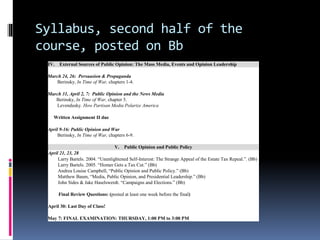
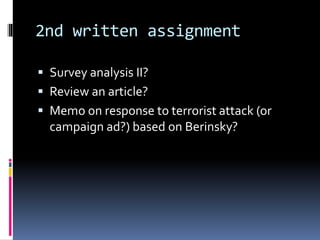
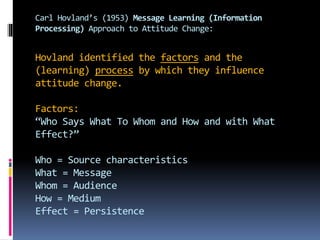
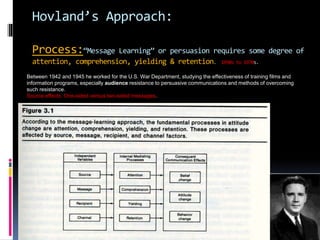
This document provides an overview of a college course on persuasion, propaganda, and public opinion. It includes the syllabus and schedule for the second half of the course. It discusses potential topics for a second written assignment and examples of political propaganda. It also defines propaganda and discusses theories of political persuasion, including source, message, and audience characteristics based on Hovland's message-learning approach. Questions are raised about the role of credible sources and conflicts of interest in political persuasion.
![The Isis propaganda war: a hi-tech
media jihad
In 1941, Hollywood director Frank Capra was commissioned
to make a series of propaganda films for the US war effort.
His resulting seven-film documentary series, Why We Fight, repurposed
footage fromTriumphOfTheWill and other propaganda films to show “our
boys” what they were up against. He even copied Riefenstahl’s editing
rhythms and rousing use of music. “Let their own films kill them,” Capra
said. “Let the enemy prove to our soldiers the enormity of his cause – and
the justness of ours.”
Leni Riefenstahl:Triumph of theWill (1935) –YouTube
Just as Islamic State (Isis) has used captured American
artillery against its enemies in Iraq, so it is using the west’s
media tools and techniques against it. Isis has proved fluent in
YouTube,Twitter, Instagram,Tumblr, internet memes (see:
#catsofjihad) and other social media.
A recent example was a recruitment video consisting of edited footage
from GrandTheft Auto. “Your games which are producing from you, we do
the same actions in the battlefields!! [sic]”
Beheadings of US journalists James Foley and Steven Sotloff, and aid
workers David Haines andAlan Henning](https://image.slidesharecdn.com/4732015persuasionandpropagandaup-150331190246-conversion-gate01/85/473-2015-persuasion-and-propaganda-up-9-320.jpg)

![McGraw Hill Education, World Cultures &
Geography [Teacher Version] (Grade 6)
Is the earth flat? Can pigs fly? Some scientists disagree.](https://image.slidesharecdn.com/4732015persuasionandpropagandaup-150331190246-conversion-gate01/85/473-2015-persuasion-and-propaganda-up-25-320.jpg)

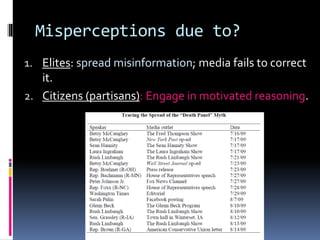
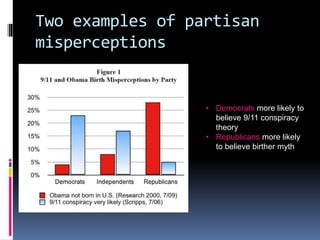
![Two examples of partisan
misperceptions
July, 2006: widespread support for the
conspiracy theory that Bush administration
officials were complicit in the 9/11 terrorist
attacks.
“likely” that “[p]eople in the federal government
either assisted in the 9/11 attacks or took no action to
stop the attacks because they wanted the United
States to go to war in the Middle East.”
Apr 21, 2011: CBS News/ NewYorkTimes poll:
25% of all Americans incorrectly think President
Obama was not born in the United States.](https://image.slidesharecdn.com/4732015persuasionandpropagandaup-150331190246-conversion-gate01/85/473-2015-persuasion-and-propaganda-up-46-320.jpg)
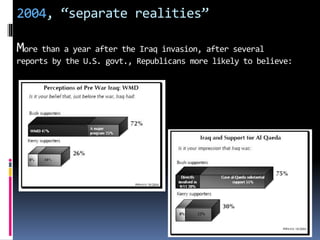
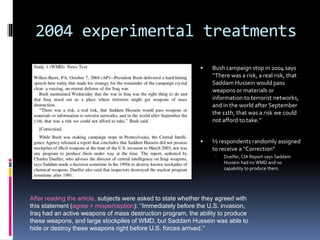
![Findings of Commissions on Iraq War, WMD
& al-Qaeda, prior to 2004 election
1/28/04: U.S. Iraq Survey Group inspector David Kay resigns:
stating that he believed WMD stockpiles would not be found in Iraq. "I
don't think they existed," commented Kay. “It turns out that we were all
wrong, probably in my judgment, and that is most disturbing. [Kay,]
3/5/04: Former chief U.N. weapons inspector declares Iraq war illegal
10/7/04: Final Iraq Survey Group (Duelfer) Report (U.S.): Iraq did not
haveWMD
“Saddam Hussein did not possess stockpiles of illicit weapons at the time
of the U.S. invasion in March 2003 and had not begun any program to
produce them.”
June, 2004, 9/11 Commission:
"to date we have seen no evidence of a collaborative operational relationship
between Iraqi government & al-Qaeda. Nor have we seen evidence indicating
that Iraq cooperated with al Qaeda in developing or carrying out any attacks
against the United States.](https://image.slidesharecdn.com/4732015persuasionandpropagandaup-150331190246-conversion-gate01/85/473-2015-persuasion-and-propaganda-up-49-320.jpg)