1  www.oecd.dac/gender


ECONOMICS AND FINANCE: INFRASTRUCTURE1
 
Gender division of labour 
Often  it  is  assumed  that  women  will  automatically  benefit  from  new  infrastructure,  without 
acknowledging that it has a significant social impact. Both men and women tend to be considered 
mainly  as  beneficiaries  of  infrastructure  projects,  rather  than  as  active  participants,  or  as  specific 
groups whose daily and seasonal tasks can be substantially affected. For example, a transport project 
will usually impact on women as transportors of products for household use and as small traders. 
Improved  transport  facilities  may  also  impact  on  women  and  men  by  promoting  or  encouraging 
changes to agricultural production, such as a shift to cash crop production. If infrastructure is not 
designed  in  view  of  the  range  of  needs  of  its  different  users,  the  impact  on  women  and  their 
workload can be immense. For example, in irrigation projects, competing household uses for water 
for  cropping,  livestock  and  cooking/washing  should  be  addressed  as  well  as  arrangements  for 
collecting and carrying water. The design and location of water systems may fulfil multiple purposes 
if these different uses are taken into account (Hunt 1997: 71). 
Access and control of resources and benefits 
Access to information and employment opportunities in an infrastructure project can be limited for 
women. Women are employed as construction labourers in a number of regions and both women 
and  men  may  need  to  migrate  to  construction  sites.  Construction  camps  are  frequently  poorly 
serviced  and  unsafe  for  children,  and  construction  sites  may  give  little  attention  to  occupational 
health and safety. As potential beneficiaries of infrastructure projects, constraints affecting women 
can include: lack of credit and other collateral, such as money for a fare or a bicycle; the location of a 
facility such as a water pump; and the gender composition of project management groups, such as 
water  user  groups  or  community‐based  advisory  committees.  New  infrastructure  may  adversely 
affect  the  existing  access  of  women  to  land  for  agricultural  production,  housing,  fuel  and  wood 
collection  among  other  things.  Transport  studies  undertaken  by  other  donors  have  shown  that 
women tend to use cheaper forms of public transport. Males and females of all ages use roads as 
pedestrians.  Renters  and  street  vendors  tend  to  be  most  seriously  disadvantaged  by  transport 
construction, since they generally receive no compensation from land expropriation or disruption to 
business sites, and have little access to credit to assist with relocation. 
Factors and trends 
Professional  representation  of  women  in  technical,  supervisory  and  managerial  positions  in 
construction  and  infrastructure  development  tends  to  be  limited.  This  can  often  be  attributed  to 
social and cultural attitudes towards women's participation in technical and engineering fields. There 
is  also  a  tendency  for  women  to  experience  discrimination  regarding  education  and  training  in 
technical  areas  due  to  gender  stereotyping.  Employment  in  field  work  may  depend  on  whether 
1. Prepared for the Australian Agency for International Development (AusAID), 1997. 
facilities are socially acceptable for women and address their needs (e.g. separate dormitories for 
field  workers).  Large‐scale  infrastructure  projects  can  result  in  environmental  degradation,  the 
effects of which tend to fall most heavily on poor women and children. 
Implementing a gender and development policy 
Key aspects of a development policy, as it relates to infrastructure can be: 
Goal: 
 
Objectives: 
 
• to  promote  equal  opportunities  for  women  and  men  as  participants  and  beneficiaries  of 
development 
• to improve women’s access to education and health care 
• to improve women’s access to economic resources 
• to promote women’s participation and leadership in decision making at all levels 
• to assist efforts to eliminate discrimination against women 
Guiding questions for the preparation and identification of activities and policies 
• These questions are to be used as a guide only. It is not expected that every question will be 
relevant to all activities or all economic reports. 
• The questions are designed to assist activity managers with their assessment and appraisal of 
infrastructure development activities. 
• The questions are also designed to assist aid officers to incorporate gender perspectives into 
infrastructure activity preparation and design. 
2  www.oecd.dac/gender
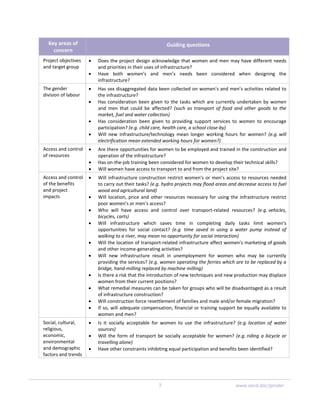
Key areas of 
concern 
Guiding questions 
Project objectives 
and target group 
• Does the project design acknowledge that women and men may have different needs 
and priorities in their uses of infrastructure? 
• Have  both  women's  and  men’s  needs  been  considered  when  designing  the 
infrastructure? 
The gender 
division of labour 
• Has sex disaggregated data been collected on women's and men’s activities related to 
the infrastructure? 
• Has consideration been given to the tasks which are currently undertaken by women 
and  men  that  could  be  affected?  (such  as  transport  of  food  and  other  goods  to  the 
market, fuel and water collection) 
• Has  consideration  been  given  to  providing  support  services  to  women  to  encourage 
participation? (e.g. child care, health care, a school close‐by) 
• Will  new  infrastructure/technology  mean  longer  working  hours  for  women?  (e.g. will 
electrification mean extended working hours for women?) 
Access and control 
of resources 
• Are there opportunities for women to be employed and trained in the construction and 
operation of the infrastructure? 
• Has on‐the‐job training been considered for women to develop their technical skills? 
• Will women have access to transport to and from the project site? 
Access and control 
of the benefits 
and project 
impacts 
 
• Will infrastructure construction restrict women's or men’s access to resources needed 
to carry out their tasks? (e.g. hydro projects may flood areas and decrease access to fuel 
wood and agricultural land) 
• Will location, price and other resources necessary for using the infrastructure restrict 
poor women's or men’s access? 
• Who  will  have  access  and  control  over  transport‐related  resources?  (e.g. vehicles, 
bicycles, carts) 
• Will  infrastructure  which  saves  time  in  completing  daily  tasks  limit  women's 
opportunities  for  social  contact?  (e.g.  time  saved  in  using  a  water  pump  instead  of 
walking to a river, may mean no opportunity for social interaction) 
• Will the location of transport‐related infrastructure affect women's marketing of goods 
and other income‐generating activities? 
• Will  new  infrastructure  result  in  unemployment  for  women  who  may  be  currently 
providing the services? (e.g. women operating the ferries which are to be replaced by a 
bridge, hand‐milling replaced by machine milling) 
• Is there a risk that the introduction of new techniques and new production may displace 
women from their current positions? 
• What remedial measures can be taken for groups who will be disadvantaged as a result 
of infrastructure construction? 
• Will construction force resettlement of families and male and/or female migration? 
• If so, will adequate compensation, financial or training support be equally available to 
women and men? 
Social, cultural, 
religious, 
economic, 
environmental 
and demographic 
factors and trends 
• Is  it  socially  acceptable  for  women  to  use  the  infrastructure?  (e.g. location  of  water 
sources)  
• Will the form  of transport be socially acceptable for women? (e.g. riding a bicycle or 
travelling alone) 
• Have other constraints inhibiting equal participation and benefits been identified? 
3  www.oecd.dac/gender
4  www.oecd.dac/gender
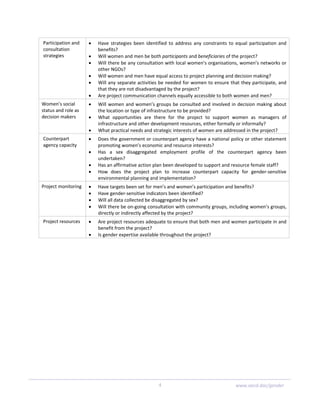
Participation and 
consultation 
strategies 
• Have  strategies  been  identified  to  address  any  constraints  to  equal  participation  and 
benefits? 
• Will women and men be both participants and beneficiaries of the project? 
• Will there be any consultation with local women’s organisations, women’s networks or 
other NGOs? 
• Will women and men have equal access to project planning and decision making? 
• Will any separate activities be needed for women to ensure that they participate, and 
that they are not disadvantaged by the project? 
• Are project communication channels equally accessible to both women and men? 
Women’s social 
status and role as 
decision makers 
• Will women and women’s groups be consulted and involved in decision making about 
the location or type of infrastructure to be provided? 
• What  opportunities  are  there  for  the  project  to  support  women  as  managers  of 
infrastructure and other development resources, either formally or informally? 
• What practical needs and strategic interests of women are addressed in the project? 
Counterpart 
agency capacity 
• Does the government or counterpart agency have a national policy or other statement 
promoting women’s economic and resource interests? 
• Has  a  sex  disaggregated  employment  profile  of  the  counterpart  agency  been 
undertaken? 
• Has an affirmative action plan been developed to support and resource female staff? 
• How  does  the  project  plan  to  increase  counterpart  capacity  for  gender‐sensitive 
environmental planning and implementation? 
Project monitoring  • Have targets been set for men’s and women’s participation and benefits? 
• Have gender‐sensitive indicators been identified? 
• Will all data collected be disaggregated by sex? 
• Will there be on‐going consultation with community groups, including women’s groups, 
directly or indirectly affected by the project? 
Project resources  • Are project resources adequate to ensure that both men and women participate in and 
benefit from the project? 
• Is gender expertise available throughout the project? 
 

ECONOMICS AND FINANCE: INFRASTRUCTURE

  • 1.
    1  www.oecd.dac/gender       ECONOMICS AND FINANCE: INFRASTRUCTURE1   Gender division of labour  Often  it is  assumed  that  women  will  automatically  benefit  from  new  infrastructure,  without  acknowledging that it has a significant social impact. Both men and women tend to be considered  mainly  as  beneficiaries  of  infrastructure  projects,  rather  than  as  active  participants,  or  as  specific  groups whose daily and seasonal tasks can be substantially affected. For example, a transport project  will usually impact on women as transportors of products for household use and as small traders.  Improved  transport  facilities  may  also  impact  on  women  and  men  by  promoting  or  encouraging  changes to agricultural production, such as a shift to cash crop production. If infrastructure is not  designed  in  view  of  the  range  of  needs  of  its  different  users,  the  impact  on  women  and  their  workload can be immense. For example, in irrigation projects, competing household uses for water  for  cropping,  livestock  and  cooking/washing  should  be  addressed  as  well  as  arrangements  for  collecting and carrying water. The design and location of water systems may fulfil multiple purposes  if these different uses are taken into account (Hunt 1997: 71).  Access and control of resources and benefits  Access to information and employment opportunities in an infrastructure project can be limited for  women. Women are employed as construction labourers in a number of regions and both women  and  men  may  need  to  migrate  to  construction  sites.  Construction  camps  are  frequently  poorly  serviced  and  unsafe  for  children,  and  construction  sites  may  give  little  attention  to  occupational  health and safety. As potential beneficiaries of infrastructure projects, constraints affecting women  can include: lack of credit and other collateral, such as money for a fare or a bicycle; the location of a  facility such as a water pump; and the gender composition of project management groups, such as  water  user  groups  or  community‐based  advisory  committees.  New  infrastructure  may  adversely  affect  the  existing  access  of  women  to  land  for  agricultural  production,  housing,  fuel  and  wood  collection  among  other  things.  Transport  studies  undertaken  by  other  donors  have  shown  that  women tend to use cheaper forms of public transport. Males and females of all ages use roads as  pedestrians.  Renters  and  street  vendors  tend  to  be  most  seriously  disadvantaged  by  transport  construction, since they generally receive no compensation from land expropriation or disruption to  business sites, and have little access to credit to assist with relocation.  Factors and trends  Professional  representation  of  women  in  technical,  supervisory  and  managerial  positions  in  construction  and  infrastructure  development  tends  to  be  limited.  This  can  often  be  attributed  to  social and cultural attitudes towards women's participation in technical and engineering fields. There  is  also  a  tendency  for  women  to  experience  discrimination  regarding  education  and  training  in  technical  areas  due  to  gender  stereotyping.  Employment  in  field  work  may  depend  on  whether  1. Prepared for the Australian Agency for International Development (AusAID), 1997. 
  • 2.
    facilities are socially acceptable for women and address their needs (e.g. separate dormitories for  field  workers).  Large‐scale infrastructure  projects  can  result  in  environmental  degradation,  the  effects of which tend to fall most heavily on poor women and children.  Implementing a gender and development policy  Key aspects of a development policy, as it relates to infrastructure can be:  Goal:    Objectives:    • to  promote  equal  opportunities  for  women  and  men  as  participants  and  beneficiaries  of  development  • to improve women’s access to education and health care  • to improve women’s access to economic resources  • to promote women’s participation and leadership in decision making at all levels  • to assist efforts to eliminate discrimination against women  Guiding questions for the preparation and identification of activities and policies  • These questions are to be used as a guide only. It is not expected that every question will be  relevant to all activities or all economic reports.  • The questions are designed to assist activity managers with their assessment and appraisal of  infrastructure development activities.  • The questions are also designed to assist aid officers to incorporate gender perspectives into  infrastructure activity preparation and design.  2  www.oecd.dac/gender
  • 3.
    Key areas of  concern  Guiding questions  Project objectives  and target group  • Does the project design acknowledge that women and men may have different needs  and priorities in their uses of infrastructure?  • Have both  women's  and  men’s  needs  been  considered  when  designing  the  infrastructure?  The gender  division of labour  • Has sex disaggregated data been collected on women's and men’s activities related to  the infrastructure?  • Has consideration been given to the tasks which are currently undertaken by women  and  men  that  could  be  affected?  (such  as  transport  of  food  and  other  goods  to  the  market, fuel and water collection)  • Has  consideration  been  given  to  providing  support  services  to  women  to  encourage  participation? (e.g. child care, health care, a school close‐by)  • Will  new  infrastructure/technology  mean  longer  working  hours  for  women?  (e.g. will  electrification mean extended working hours for women?)  Access and control  of resources  • Are there opportunities for women to be employed and trained in the construction and  operation of the infrastructure?  • Has on‐the‐job training been considered for women to develop their technical skills?  • Will women have access to transport to and from the project site?  Access and control  of the benefits  and project  impacts    • Will infrastructure construction restrict women's or men’s access to resources needed  to carry out their tasks? (e.g. hydro projects may flood areas and decrease access to fuel  wood and agricultural land)  • Will location, price and other resources necessary for using the infrastructure restrict  poor women's or men’s access?  • Who  will  have  access  and  control  over  transport‐related  resources?  (e.g. vehicles,  bicycles, carts)  • Will  infrastructure  which  saves  time  in  completing  daily  tasks  limit  women's  opportunities  for  social  contact?  (e.g.  time  saved  in  using  a  water  pump  instead  of  walking to a river, may mean no opportunity for social interaction)  • Will the location of transport‐related infrastructure affect women's marketing of goods  and other income‐generating activities?  • Will  new  infrastructure  result  in  unemployment  for  women  who  may  be  currently  providing the services? (e.g. women operating the ferries which are to be replaced by a  bridge, hand‐milling replaced by machine milling)  • Is there a risk that the introduction of new techniques and new production may displace  women from their current positions?  • What remedial measures can be taken for groups who will be disadvantaged as a result  of infrastructure construction?  • Will construction force resettlement of families and male and/or female migration?  • If so, will adequate compensation, financial or training support be equally available to  women and men?  Social, cultural,  religious,  economic,  environmental  and demographic  factors and trends  • Is  it  socially  acceptable  for  women  to  use  the  infrastructure?  (e.g. location  of  water  sources)   • Will the form  of transport be socially acceptable for women? (e.g. riding a bicycle or  travelling alone)  • Have other constraints inhibiting equal participation and benefits been identified?  3  www.oecd.dac/gender
  • 4.
    4  www.oecd.dac/gender Participation and  consultation  strategies  • Have strategies  been  identified  to  address  any  constraints  to  equal  participation  and  benefits?  • Will women and men be both participants and beneficiaries of the project?  • Will there be any consultation with local women’s organisations, women’s networks or  other NGOs?  • Will women and men have equal access to project planning and decision making?  • Will any separate activities be needed for women to ensure that they participate, and  that they are not disadvantaged by the project?  • Are project communication channels equally accessible to both women and men?  Women’s social  status and role as  decision makers  • Will women and women’s groups be consulted and involved in decision making about  the location or type of infrastructure to be provided?  • What  opportunities  are  there  for  the  project  to  support  women  as  managers  of  infrastructure and other development resources, either formally or informally?  • What practical needs and strategic interests of women are addressed in the project?  Counterpart  agency capacity  • Does the government or counterpart agency have a national policy or other statement  promoting women’s economic and resource interests?  • Has  a  sex  disaggregated  employment  profile  of  the  counterpart  agency  been  undertaken?  • Has an affirmative action plan been developed to support and resource female staff?  • How  does  the  project  plan  to  increase  counterpart  capacity  for  gender‐sensitive  environmental planning and implementation?  Project monitoring  • Have targets been set for men’s and women’s participation and benefits?  • Have gender‐sensitive indicators been identified?  • Will all data collected be disaggregated by sex?  • Will there be on‐going consultation with community groups, including women’s groups,  directly or indirectly affected by the project?  Project resources  • Are project resources adequate to ensure that both men and women participate in and  benefit from the project?  • Is gender expertise available throughout the project?