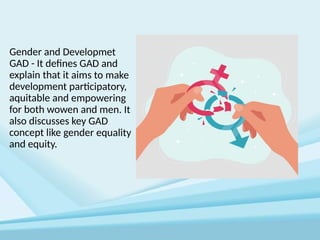
Gender and Developmet
GAD - It defines GAD and
explain that it aims to make
development participatory,
aquitable and empowering
for both wowen and men. It
also discusses key GAD
concept like gender equality
and equity.
GAD
•Focuses on gender relations
•Designs developing programs to
respond gender issues
•Commits to the goal of gender
equality and women's
empowerment and improvement
Background
1993 - the Guidelines for Developing and Impementing
Gender responsive program and project was produce by
NEDA with the National Commission on the role of Filipino
Women (NCRFW) in cooperation with various philippine
Government agencies. The document tool to help
impementing agencies in complying with RA 7192 known as
the Women in Development and Nation-Building Act and
its implementing rules and regulation.
In mid 2003, NEDA and ODA-GAD network came up with
new GAD guidelines that reflect the evoltion of assistance
framework from Women in Development (WID) to GAD and
the current focus on Wemon's Rights.
Objectives and Contents
The harmonized GAD guidelines seek to promote the twin
goal of gender equality and Women's Empowerment.
• Provide for common set of analytical concept and
intergrating gender concern into development programs
and poject for NEDA and government agencies, donors,
and development practioners.
• Helps in achieving gender equality and empowerment of
women through project programs.
• Inclusivity checklist
• Goals: Do the golas reflect both men's and women's
aspiration and desired result?
• Empowerment: Do the activities encourage women's
leadership? Will women be given opportunity to
participate in decision-making?
• Neutral: Is the language used gender-fair?
• Developmental: Are there any activities specifically
directed to encourage women's development, address
women's issues?
• Encompassing: Do the project activities encourage
women's participation from design to completion? are the
actovities inclusive?
• Results: How will/di the activity impact on women?
PART 1: PROGRAM AND PROJECT DEVELOPMENT: GENERAL
1. AGRICULTURE AND AGRARIAN REFORM
Agrarian reform, agriculture, environment and natural
resources management form part of the country's poverty
reduction and rural development strategy the comprise the
distribution of resources ( land title, sterrdship contracts,
crdits, agriculture, inputs).
GENDER ISSUES AND GENDER EQUALITY RESULTS:
Gender Issues
a) Access to education and health; b) Access to resources and
service for improvement in productive and
productive work; c) Norms, attitude and institution that limit
women's and men's life option; d) Involvement in organization
and collective action; e) Controls of limited resources and
decision-making process.
Gender Equality Results
a) Improved capacity for agricultural productio; b) Enhanced
economic option for women framer; c) Increased number of
women in rural production activities or enterprises; d)
Improved leadership capacity of women in farmer group and
similar organization
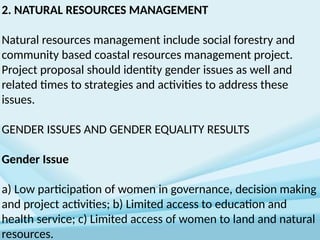
2. NATURAL RESOURCES MANAGEMENT
Natural resources management include social forestry and
community based coastal resources management project.
Project proposal should identity gender issues as well and
related times to strategies and activities to address these
issues.
GENDER ISSUES AND GENDER EQUALITY RESULTS
Gender Issue
a) Low participation of women in governance, decision making
and project activities; b) Limited access to education and
health service; c) Limited access of women to land and natural
resources.
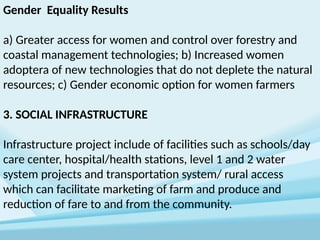
Gender Equality Results
a) Greater access for women and control over forestry and
coastal management technologies; b) Increased women
adoptera of new technologies that do not deplete the natural
resources; c) Gender economic option for women farmers
3. SOCIAL INFRASTRUCTURE
Infrastructure project include of facilities such as schools/day
care center, hospital/health stations, level 1 and 2 water
system projects and transportation system/ rural access
which can facilitate marketing of farm and produce and
reduction of fare to and from the community.
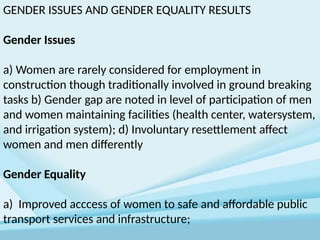
GENDER ISSUES AND GENDER EQUALITY RESULTS
Gender Issues
a) Women are rarely considered for employment in
construction though traditionally involved in ground breaking
tasks b) Gender gap are noted in level of participation of men
and women maintaining facilities (health center, watersystem,
and irrigation system); d) Involuntary resettlement affect
women and men differently
Gender Equality
a) Improved acccess of women to safe and affordable public
transport services and infrastructure;
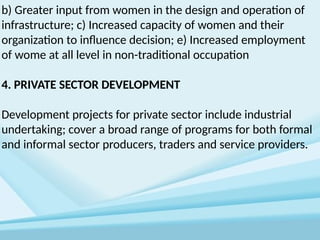
b) Greater input from women in the design and operation of
infrastructure; c) Increased capacity of women and their
organization to influence decision; e) Increased employment
of wome at all level in non-traditional occupation
4. PRIVATE SECTOR DEVELOPMENT
Development projects for private sector include industrial
undertaking; cover a broad range of programs for both formal
and informal sector producers, traders and service providers.
GENDER ISSUES AND GENDER EQUALITY RESULTS
Gender Issues
a) Low appreciation of the valeu of sex disaggragated data as
inputs to planning and prepation of programs and projectd b)
Awareness to gender issues limited to those involved in GAD
mainstreaming c) Little understanding of the need and
concerns of women and their participation in the project
Gender Equality Results
a) Greater productivity of women owned or operated
enterprises b) Sexual harassment, occupational health and
safety problem are addressed;
c) Higher self confidence among women enterpreneurs and
workers
5. EDUCATION
GENDER ISSUES AND GENDER EQUALITY RESULTS
Gender Issues
a) Deteriorating quality of education in rural area of all levels;
b) Higher drop outs among boys. School participation of
children is often bound with work responsibilities in their
family; c) Gender harassment is found among student,
teacher and their superior d) While women outnumber male
teacher, decision-making in the sector is still reserved for men
Gender Equality
a) Longer stay of boys at school b) Increased enrollment for
girls c) Increased capacity of women to influence decision in
the sector d) Improved capacity of public amd private schools
to address gender issues
6. HEALTH PROJECT
Development Challenges
a) Hight mortality rates of women and children in all region of
Mindanao particularly in rural areas b) Declining nutritional
status of young adult women c) higher migration notes of
health professionals
It envisioned that parity in gender concern may result due to
group and community - based otganizing and related
empowerment methodologies: a) Decreased maternal and
child mortality rates b) Increased capacity of women to
influence decisions in the health sector; c) Increased use of
contraceptives and increased access to family planning or
reproductives health care services d) Increased capacity of
the health sector to handle gender based violence
7. HOUSING AND SETTLEMENT
GENDER ISSUES AND GENDER EQUALITY RESULTS
Women are comsidered major stakeholder but are minimally
consulted or invited to user's organization.
Their concern like access to employment in construction and
other stages of the project should also be addressed.
Gender Issues
a) Limited access to housing due to ignorance that men and
women can equality apply for housing b) Design of housing
units should address the activities for women in terms of
space and utilization c) Cost of housing in terms of cash and
time including considerable documentation affect women's
application for housing
Gender-sensitive Community organizing work should address
women's right to shelter and debelopment. The following
approaches should be explored: a) easier to
affordable yet decent housing through community mortgage
program; b) Accessible facilities and properly designed house
space to provide more efficient use of women's time c)
Increased employment, alternatives livelihood in housing
communities
8. WOMEN IN AREAS UNDER ARMED CONFLICT
GENDER ISSUES AND GENDER EQUALITY RESULTS
Development interventions under armed conflict are wide
ranging. These include the reconstruction of physical
infrastructure, resettlement of evecuees, rahabilitation and
recovery of traumatized civilian ( particularly women and
children) and peace negotiations.
Gender Issues
a) Vulnerability of women and children to sexual abuse
during the conflict; b) non-inclusion of women in decision
making process and peace negotiation panels; and c)
psychosocial trauma of women and girls brought about by
constant exposure to violence and women
This issue may be matched by interventions, strategies, ar
activities the will reduce gender gaps and empower women
such as involving women in the identification of peace and
conflict issues, project design and project planning and
decision making.
9. JUSTICE PROJECTS
Gender issues on access to justice project pertain to gender-
based biases or inequalities in the treatment of cae,
complaints and dependents, insensitivity to gendered
differences in the status and circumstances of women and
men seeking or dispensing justice.
Other issue are: a) Low or lack of awareness of gender issues
or new laws on gender equality and women's right; b)
possible bises against gender-based crimes
10. MICROFINANCE RESULTS
Microfinance programs have emloyed any of the three
approaches of paradigm:
a. Associated with poverty reduction and increased well-
being of families living in poverty
b. Financial stability/sustainability paradigm in which
women's economic empowerment will result from "virtous
spiral" that connect access to savings and credits to increased
women control over decision
c. Uses microfinance as a point of entry for promotions of
gender equality and human rights
Women's empowerment results of microfinance programs:
a) enhanced ability of women to negotiate change in gender
relations and productivity of micro enterprises; b) improved
status and division of labor between women and men, and
their well being and of
their families c) increased control of women over decision on
savings/credit use anf income
11. DECENT WORK LABOR AND EMPLOYMENT SECTOR
The international Labor Organization has a special advocacy
for the promotion of women in the labor and employment
sector. In the Philippines, the ILO works with the government,
employee group and workers organization to promote the
four interlinked aims of decemt work :
• Emloyment creation with emphasis on greater
opportunities to secure decent employment and income
for women and men
• Need for solid legal framework for respecting basic
economic and social rights
• Enhance the coverage and effectiveness of social
protection for all
• Social dislogue needed to bring together representatives
of government, employers and workers to create
cooperation and deliver "real wolrd" knowledge about
employment and work
Rural and Urban communities gender issues
a) significant differences in labor force participation; b) low
valuation or the absence of it for women's work at home c)
differences in membership and participation in trade unions;
d) little understanding of the needs and concern of women
especially in rural areas.
Priority areas of the countey should be on:
• Child victims of human trafficking
• Children rmployed in mining and quarrying
• Children trapped in prostitution
• Children engaged in deep-sea diving
The development facilitator musj reckon the following issues
before venturing into sub-projects and related initiatives:
• More than half of four million working children are in
hadardous conditons, many of whom are boys in rural
areas.
• There are higher school drop outs among boys than girls
due to boy being drawn to work in farms.
• Half of the 32 million children are girls whom are mostly
victim of child abuse, prostitution, and traffucking.
• Peer education are mostly composed of girls in children's
organization.
• Child labor pilicies and programs are drawn from limited
sex disaggregated data and information and child labor
surveys.
12. MIGRATION PROGRAM AND PROJECTS
Based in migration reports and studies the following gender
issues are highlighted:
• Service jobs put women in individualized, isolated and
highly vulnerable position
• Migration of women have resulted in new family structure
with man managing their homes and caring for the family
(feminization of labor)
• Lack of safety and secutiy nets for migrant both local level,
national level, and international
• Human trafficking of women and girls remain hogh despite
strict immigration and labor pilicies
• Descrimination, contractualization and gender-based
violence affecting women workers and migrants both
locally and international

Tarfahcghgscgsgchbsbcusbckjhasichshcjdcdhjs

  • 2.
    Gender and Developmet GAD- It defines GAD and explain that it aims to make development participatory, aquitable and empowering for both wowen and men. It also discusses key GAD concept like gender equality and equity.
  • 3.
    GAD •Focuses on genderrelations •Designs developing programs to respond gender issues •Commits to the goal of gender equality and women's empowerment and improvement
  • 4.
    Background 1993 - theGuidelines for Developing and Impementing Gender responsive program and project was produce by NEDA with the National Commission on the role of Filipino Women (NCRFW) in cooperation with various philippine Government agencies. The document tool to help impementing agencies in complying with RA 7192 known as the Women in Development and Nation-Building Act and its implementing rules and regulation.
  • 5.
    In mid 2003,NEDA and ODA-GAD network came up with new GAD guidelines that reflect the evoltion of assistance framework from Women in Development (WID) to GAD and the current focus on Wemon's Rights. Objectives and Contents The harmonized GAD guidelines seek to promote the twin goal of gender equality and Women's Empowerment. • Provide for common set of analytical concept and intergrating gender concern into development programs and poject for NEDA and government agencies, donors, and development practioners.
  • 6.
    • Helps inachieving gender equality and empowerment of women through project programs. • Inclusivity checklist • Goals: Do the golas reflect both men's and women's aspiration and desired result? • Empowerment: Do the activities encourage women's leadership? Will women be given opportunity to participate in decision-making? • Neutral: Is the language used gender-fair? • Developmental: Are there any activities specifically directed to encourage women's development, address women's issues? • Encompassing: Do the project activities encourage women's participation from design to completion? are the actovities inclusive? • Results: How will/di the activity impact on women?
  • 7.
    PART 1: PROGRAMAND PROJECT DEVELOPMENT: GENERAL 1. AGRICULTURE AND AGRARIAN REFORM Agrarian reform, agriculture, environment and natural resources management form part of the country's poverty reduction and rural development strategy the comprise the distribution of resources ( land title, sterrdship contracts, crdits, agriculture, inputs). GENDER ISSUES AND GENDER EQUALITY RESULTS: Gender Issues a) Access to education and health; b) Access to resources and service for improvement in productive and
  • 8.
    productive work; c)Norms, attitude and institution that limit women's and men's life option; d) Involvement in organization and collective action; e) Controls of limited resources and decision-making process. Gender Equality Results a) Improved capacity for agricultural productio; b) Enhanced economic option for women framer; c) Increased number of women in rural production activities or enterprises; d) Improved leadership capacity of women in farmer group and similar organization
  • 9.
    2. NATURAL RESOURCESMANAGEMENT Natural resources management include social forestry and community based coastal resources management project. Project proposal should identity gender issues as well and related times to strategies and activities to address these issues. GENDER ISSUES AND GENDER EQUALITY RESULTS Gender Issue a) Low participation of women in governance, decision making and project activities; b) Limited access to education and health service; c) Limited access of women to land and natural resources.
  • 10.
    Gender Equality Results a)Greater access for women and control over forestry and coastal management technologies; b) Increased women adoptera of new technologies that do not deplete the natural resources; c) Gender economic option for women farmers 3. SOCIAL INFRASTRUCTURE Infrastructure project include of facilities such as schools/day care center, hospital/health stations, level 1 and 2 water system projects and transportation system/ rural access which can facilitate marketing of farm and produce and reduction of fare to and from the community.
  • 11.
    GENDER ISSUES ANDGENDER EQUALITY RESULTS Gender Issues a) Women are rarely considered for employment in construction though traditionally involved in ground breaking tasks b) Gender gap are noted in level of participation of men and women maintaining facilities (health center, watersystem, and irrigation system); d) Involuntary resettlement affect women and men differently Gender Equality a) Improved acccess of women to safe and affordable public transport services and infrastructure;
  • 12.
    b) Greater inputfrom women in the design and operation of infrastructure; c) Increased capacity of women and their organization to influence decision; e) Increased employment of wome at all level in non-traditional occupation 4. PRIVATE SECTOR DEVELOPMENT Development projects for private sector include industrial undertaking; cover a broad range of programs for both formal and informal sector producers, traders and service providers.
  • 13.
    GENDER ISSUES ANDGENDER EQUALITY RESULTS Gender Issues a) Low appreciation of the valeu of sex disaggragated data as inputs to planning and prepation of programs and projectd b) Awareness to gender issues limited to those involved in GAD mainstreaming c) Little understanding of the need and concerns of women and their participation in the project Gender Equality Results a) Greater productivity of women owned or operated enterprises b) Sexual harassment, occupational health and safety problem are addressed;
  • 14.
    c) Higher selfconfidence among women enterpreneurs and workers 5. EDUCATION GENDER ISSUES AND GENDER EQUALITY RESULTS Gender Issues a) Deteriorating quality of education in rural area of all levels; b) Higher drop outs among boys. School participation of children is often bound with work responsibilities in their family; c) Gender harassment is found among student, teacher and their superior d) While women outnumber male teacher, decision-making in the sector is still reserved for men
  • 15.
    Gender Equality a) Longerstay of boys at school b) Increased enrollment for girls c) Increased capacity of women to influence decision in the sector d) Improved capacity of public amd private schools to address gender issues 6. HEALTH PROJECT Development Challenges a) Hight mortality rates of women and children in all region of Mindanao particularly in rural areas b) Declining nutritional status of young adult women c) higher migration notes of health professionals
  • 16.
    It envisioned thatparity in gender concern may result due to group and community - based otganizing and related empowerment methodologies: a) Decreased maternal and child mortality rates b) Increased capacity of women to influence decisions in the health sector; c) Increased use of contraceptives and increased access to family planning or reproductives health care services d) Increased capacity of the health sector to handle gender based violence 7. HOUSING AND SETTLEMENT GENDER ISSUES AND GENDER EQUALITY RESULTS Women are comsidered major stakeholder but are minimally consulted or invited to user's organization.
  • 17.
    Their concern likeaccess to employment in construction and other stages of the project should also be addressed. Gender Issues a) Limited access to housing due to ignorance that men and women can equality apply for housing b) Design of housing units should address the activities for women in terms of space and utilization c) Cost of housing in terms of cash and time including considerable documentation affect women's application for housing Gender-sensitive Community organizing work should address women's right to shelter and debelopment. The following approaches should be explored: a) easier to
  • 18.
    affordable yet decenthousing through community mortgage program; b) Accessible facilities and properly designed house space to provide more efficient use of women's time c) Increased employment, alternatives livelihood in housing communities 8. WOMEN IN AREAS UNDER ARMED CONFLICT GENDER ISSUES AND GENDER EQUALITY RESULTS Development interventions under armed conflict are wide ranging. These include the reconstruction of physical infrastructure, resettlement of evecuees, rahabilitation and recovery of traumatized civilian ( particularly women and children) and peace negotiations.
  • 19.
    Gender Issues a) Vulnerabilityof women and children to sexual abuse during the conflict; b) non-inclusion of women in decision making process and peace negotiation panels; and c) psychosocial trauma of women and girls brought about by constant exposure to violence and women This issue may be matched by interventions, strategies, ar activities the will reduce gender gaps and empower women such as involving women in the identification of peace and conflict issues, project design and project planning and decision making.
  • 20.
    9. JUSTICE PROJECTS Genderissues on access to justice project pertain to gender- based biases or inequalities in the treatment of cae, complaints and dependents, insensitivity to gendered differences in the status and circumstances of women and men seeking or dispensing justice. Other issue are: a) Low or lack of awareness of gender issues or new laws on gender equality and women's right; b) possible bises against gender-based crimes 10. MICROFINANCE RESULTS Microfinance programs have emloyed any of the three approaches of paradigm:
  • 21.
    a. Associated withpoverty reduction and increased well- being of families living in poverty b. Financial stability/sustainability paradigm in which women's economic empowerment will result from "virtous spiral" that connect access to savings and credits to increased women control over decision c. Uses microfinance as a point of entry for promotions of gender equality and human rights Women's empowerment results of microfinance programs: a) enhanced ability of women to negotiate change in gender relations and productivity of micro enterprises; b) improved status and division of labor between women and men, and their well being and of
  • 22.
    their families c)increased control of women over decision on savings/credit use anf income 11. DECENT WORK LABOR AND EMPLOYMENT SECTOR The international Labor Organization has a special advocacy for the promotion of women in the labor and employment sector. In the Philippines, the ILO works with the government, employee group and workers organization to promote the four interlinked aims of decemt work : • Emloyment creation with emphasis on greater opportunities to secure decent employment and income for women and men
  • 23.
    • Need forsolid legal framework for respecting basic economic and social rights • Enhance the coverage and effectiveness of social protection for all • Social dislogue needed to bring together representatives of government, employers and workers to create cooperation and deliver "real wolrd" knowledge about employment and work Rural and Urban communities gender issues a) significant differences in labor force participation; b) low valuation or the absence of it for women's work at home c) differences in membership and participation in trade unions; d) little understanding of the needs and concern of women especially in rural areas.
  • 24.
    Priority areas ofthe countey should be on: • Child victims of human trafficking • Children rmployed in mining and quarrying • Children trapped in prostitution • Children engaged in deep-sea diving The development facilitator musj reckon the following issues before venturing into sub-projects and related initiatives: • More than half of four million working children are in hadardous conditons, many of whom are boys in rural areas. • There are higher school drop outs among boys than girls due to boy being drawn to work in farms.
  • 25.
    • Half ofthe 32 million children are girls whom are mostly victim of child abuse, prostitution, and traffucking. • Peer education are mostly composed of girls in children's organization. • Child labor pilicies and programs are drawn from limited sex disaggregated data and information and child labor surveys. 12. MIGRATION PROGRAM AND PROJECTS Based in migration reports and studies the following gender issues are highlighted: • Service jobs put women in individualized, isolated and highly vulnerable position
  • 26.
    • Migration ofwomen have resulted in new family structure with man managing their homes and caring for the family (feminization of labor) • Lack of safety and secutiy nets for migrant both local level, national level, and international • Human trafficking of women and girls remain hogh despite strict immigration and labor pilicies • Descrimination, contractualization and gender-based violence affecting women workers and migrants both locally and international