444 PART 4 Compensating Human Resources
L*? Explain how to
choose the contents ol
an employee benefits
pa c kage.
the employee's current job or {uture careet at tl'rc organization.
Ernployees are reirn-
bursed for rhese expenses a{ter rhey demonstrate rhey have
.o,,lpl"r"j an approvecl
course.
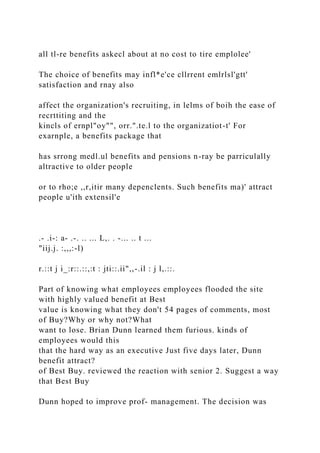
- .Especially for demanding, high-stress jobs, organizarions
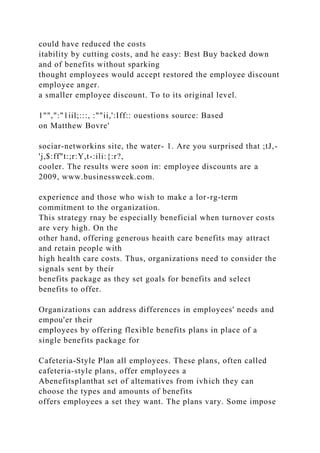
rnay look for benefits rhat
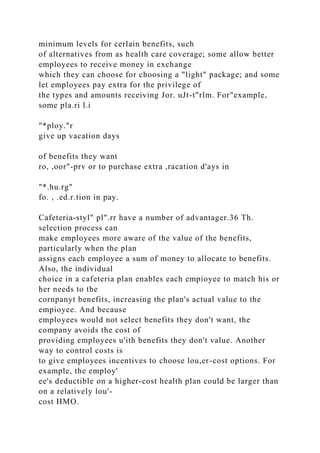
help employees put in the necessary |or-r* hours and alleyiate
stress. Recreational acriv-
ities such as on-sire basketball courts or con-)pany-sponsored
sofrball teams provide for
social interaction as u'ell as physical activity. Ernployers may
reward hard-working
groups or individuals with a rip for a weekend, a meai, or any
acrivity empl0yees arr
iikely to enjoy. Some companies, including Minneapolis design
agency Sevlthsil ar-rcj
Vancouver Web site designer Mezine, ailow ernployees to b.ilg
their pets to work.
Mezine cofounder Dean Gagnon explains the benefitr "lt's
almoir impossible to have
a bad day u'irl-r a dog i,valking around rhe office."Jl
Seleetf mg Hmp{oys# ffisffieffts
Aithor"rgh the governtnent requires certain benefits, employers
have r.vide latitude
in creating the toral benefits prackage rhe1, sffgr employe"s.sz
Decisions about rvhich
benefits to inciude shor-rld take into account the organization's
goals, its budget, and
the expectarions of the organization's current emploJ,e.s and
thole it wishes to recruir
in the future. Employees have corne to expecr ceriain things
from employers. An orga-
nization that does r-rot offer the expected benefits rvill have
rnore difficulty attractlng
and keeping talented workers. Also, if ernployees believe their
ernployer feels ,'ro .o*l
mitment to their ivelfare, they are less likely to feel committed
to-their employer.
The Organ fzaf ion's Objectfves
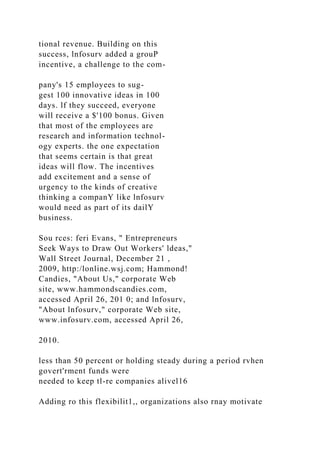
A logicai place to begin selecting employee benefits is to
establisl-r objectiyes for rhe
ber-refits package. This helps an organization select the most
effective benefits ar-rd
monitor whether the benefits are doing what they should. Table
13.2 is an example
of one organizationt benefits objectives. tJr-rfortunately,
research suggesrs that 6rost
organizations do not have written benefits objectives.
_ Among cotnpanies that do set goals, the rnost common
objectives include coirtrol-
ling the cost of health care benefits and retaining ernployeer.i'
Th" firsr goal explains
the growing use of wellness progralns and consumei.directed
health plur-,s. Fo, the
second goal, empioyers need to learn r.vhat employees care
abogt. I1 soroe .nser, the
approach rnay be indirect, helping the cornpany distinguish
itself as an employer that
certain kinds of employees wiil be attracted to and cornmitted
ro. For ."uir1pl", ,
company that establishes itself as committed to the environment
could offer benefits
in line rvitir that. goal-say, bicycle storage for cornrnuters and
vouchers for takilg
the bus-to *otk'14 Employees with a passion for the
environrnenr rvould be especialli
engaged by such offerings.
Employees' Expectations and Values
ErnPloYees expect to receive benefits that are legally required
ar-rd widely ayailable,
and they value benefirs rhey are likely ro use. For example, rhe
,,HR oopri" box illus-
trates the vaiue ernployees. place on product discounti. To rneet
ernpioyee expecra-
tions alrour benefits, it can be helpftrl to see lvhat orher
organizarions off.r. E*pioy.r,
can purchase survey inforrnation about benefits packagei from
private .o.,r,-,1tur-rtr.
In addition, the Bureau of Labor Statistics garhers bet-tefits
data. The BLS Web site
(u'ri'urbls.gov) is therefole a good place to check for free
infonnarion aborrt employee
{
I
ol
I
ol
€
ol
r*
fscus on
$*tr'fff
resp*nsfbifity
SOURC
Dearbo
rights re
benefir
benefir
cially c
emplo1
or visit
emplol
thernse
Ernp
is likel,
factors
older rv
insuran
ing age
women
general
olvn elr
Llse sLlr
be carel
all the I
The
affect tl
kinds o1
has stro
of to th
CHAPTER '1 3 Providing Employee Bene{its 405
'l*i:i*
1"i^;1.
An 0rganization's
Benelits 0biectives
I are re11n-
appror,ed
nefits that
rnal actir'-
rrovide for
d-rl'orking
rloyees are
rthsin and
s to rvork.
le to have
e latitr-rde
rr-rt u,hich
rdget, and
to recnrit
An orga.
attracting
s no colll-
1t11,s1.
es for the
refits and
exanrpie
hat most
: control-
explains
. For the
tases, the
oyer rhar
ample, a
benefirs
rr taking
:speciaily
vailable,
rox illus-
expecta-
nploysl5
sultants.
Veb site
rnployee
. To establish and maintain an employee benefit program that is
based primarily on the
employees' needs f0r leisure time and 0n protection againstthe
risks of old age,
l0ss 0f
health, and loss of life.
. To establish and maintain an employee benefit program that
complements the efforts of
employees on their own behalf.
. T0 evaluate the emplOyee benefit plan annually for its effect
on employee morale and
productivity, giving'consideration io turnover, unfilled
positions, attendance, employees'
complaints, and employees' 0pinions.
. To compare the employee benefit plan annually with that of
other leading companies in
the same {ield and to maintain a benefit plan with an overall
level of benefits based on
cost per employee that falls within the second quintile of these
companies.
. To maintain a level of bene{its for nonunion employees that
represents the same level of
expenditures per employee as for union employees'
. To determine annuallythe costs 0f neW changed, and existing
pr0grams as.percentaqes
of salaries and wages and to maintain these percentages as much
as
possible.
. To self-fund benefits t0 the extent that a l0ng-run cost savings
can be expected for the
firm and catastrophic losses can be avoided'
. To coordinate all benefits with social insurance programs to
which the
payments.
company makes
. To provide benefits on a noncontributory basis except for
dependent coverage, for which
employees should pay a portion of the cost.
. To maintain cOntinual cOmmunications with all employees
concerning benefit programs.
soURCE: Adapted from B. T. Beam Jr. and J. J. McFadden,
Employee Benefits,3rd
ed. @ 1992 by
Dearborn Financial Publishing, Inc. Published by Dearborn
Financial Publishing, lnc, Chicago All
rights reserved.
benefits in the United States. !flith regard to value, medical
insurance is a high'r'alue
benefit because ernployees usually ,.alir. tl-rat sulgery or a
majo[ ilh-Less can be finan-
cialiy deyastarir-rg. Vision a1d deltal care tend to be much less
expensive' bLlt many
.r11plioy.., appreciate tl-Lis type of coyerage because so many
people receire dental
o. uirior-r .^.. ir-, the course of "
y.".. As a result, rnany employers ale finding that
ernploVees are e/en happy ttt pay the rnoclest prelliums for
clental and vision coverage
rhemselr,es because of ii-r. u"l.,e'tl-re1, place on this benefit.li
Enplol,ers shoulcl also consitler thal the valre etlployees place
on various benefits
is likeb, to cliffer frorn one employee ro another. At a broad
let'el, basic ciernographic
iactors sr-ich as age ancl sex cal-1 influence the kinds of
benefits emplo1'ggs want. An
olcler u,orkforce is more 1ikely to be concerned about (antl use)
rnedical col'erage' life
insnrance, and ;rensions. A workforce $'ith a high lrercelltage
of s'omen of childbear'
ilrg :rge tna)/ cafe more abolrt clisabiiity or farnilv leave. Yor-
rug, untnarried men and
r,,Jrr-rJr-, often place more t,alue on p:ry than on benefits'
Hon'ever, these are or-rly
general obseryations; organizatiols sfiould check rvhich
consideratrons apply to their
3r',,,r-r
"roployees
ancl identifi,'rnore specific nee'i]s and .'litfer..ences' One
approach is to
ur. ,.,.u"1,, to usk errployees about t-he kinds of benefits lhel
i'alue. The survey should
be carefpl11' ,orcled so as not to raise emplo;'ss5'
expectatiolls b)- seemir-ig to prornise
all tl-re benefits askecl about at no cost to tire emplolee'
The choice of benefits may infl*e'ce cllrrent emlrlsl'gtt'
satisfaction and rnay also
affect the organization's recruiting, in lelms of boih the ease of
recrttiting and the
kincls of ernpl"oy"", orr.".te.l to the organizatiot-t' For
exarnple, a benefits package that
has srrong medl.ul benefits and pensions n-ray be parriculally
altractive to older people
or to rho;e ,,r,itir many depenclents. Such benefits ma)' attract
people u'ith extensil'e
.- .i-: a- .-. .. ... L,. . -... .. t ...
"iij.j. :,,,:-l)
r.::t j i_:r::.::,:t : jti::.ii",,-.il : j l,.::.
Part of knowing what employees employees flooded the site
with highly valued benefit at Best
value is knowing what they don't 54 pages of comments, most
of Buy?Why or why not?What
want to lose. Brian Dunn learned them furious. kinds of
employees would this
that the hard way as an executive Just five days later, Dunn
benefit attract?
of Best Buy. reviewed the reaction with senior 2. Suggest a way
that Best Buy
Dunn hoped to improve prof- management. The decision was
could have reduced the costs
itability by cutting costs, and he easy: Best Buy backed down
and of benefits without sparking
thought employees would accept restored the employee discount
employee anger.
a smaller employee discount. To to its original level.
1"",":"1iil;:::, :""ii,':Iff:: ouestions source: Based
on Matthew Bovre'
sociar-networkins site, the water- 1. Are you surprised that ;tJ,-
'j,$:ff"t:;r:Y,t-:ili:{:r?,
cooler. The results were soon in: employee discounts are a
2009, www.businessweek.com.
experience and those who wish to make a lor-rg-term
commitment to the organization.
This strategy rnay be especially beneficial when turnover costs
are very high. On the
other hand, offering generous heaith care benefits may attract
and retain people with
high health care costs. Thus, organizations need to consider the
signals sent by their
benefits package as they set goals for benefits and select
benefits to offer.
Organizations can address differences in employees' needs and
empou'er their
employees by offering flexible benefits plans in place of a
single benefits package for
Cafeteria-Style Plan all employees. These plans, often called
cafeteria-style plans, offer employees a
Abenefitsplanthat set of altematives from ivhich they can
choose the types and amounts of benefits
offers employees a set they want. The plans vary. Some impose
minimum levels for cerlain benefits, such
of alternatives from as health care coverage; some allow better
employees to receive money in exchange
which they can choose for choosing a "light" package; and some
let employees pay extra for the privilege of
the types and amounts receiving Jor. uJt-t"rlm. For"example,
some pla.ri l.i
"*ploy."r
give up vacation days
of benefits they want
ro, ,oor"-prv or to purchase extra ,racation d'ays in
"*.hu.rg"
fo. , .ed.r.tion in pay.
Cafeteria-styl" pl".rr have a number of advantager.36 Th.
selection process can
make employees more aware of the value of the benefits,
particularly when the plan
assigns each employee a sum of money to allocate to benefits.
Also, the individual
choice in a cafeteria plan enables each empioyee to match his or
her needs to the
cornpanyt benefits, increasing the plan's actual value to the
empioyee. And because
employees would not select benefits they don't want, the
company avoids the cost of
providing employees u'ith benefits they don't value. Another
way to control costs is
to give employees incentives to choose lou,er-cost options. For
example, the employ'
ee's deductible on a higher-cost health plan could be larger than
on a relatively lou'-
cost HMO.
A drawback of cafereria-style plans is that they have a higher
administrative cost.
especially in the design and start'up stages. Organizations can
avoid some of the
higher cosr, however, by using softu,ate packages and
standardized pians that have
been developed for employers wishing to offer cafeteria-style
benefits. Another possi-
ble drawback is that employee selection of benefits wiil
increase rather than decrease
cosrs because employees will select the kinds of benefits they
expect to need the most'
406
For exi
up for
empiol
employ
Bene.
Employ
informa
cost dar
L-rstltutt
melce s
terlns.
Empl
.rifer. Bu
tfirs, the
:ng for u
:he most
1!'e notei
rion by ir
lifficuit-
In rec,
because t
of option
rional her
ro emplo,
Jmployee
ior servic,
:n cost be
aoverage
r
;osts. Eml
".i.ith risk I
ir disease
Legal
.1s ri,e dis,
:iLluirelner
-,i-ays to cc
:r minimiz
:ng new en
=mpioyees
.:"lntractors
:tquiremen
:;i'for non
-iervice stri
:es cannot
:rganizatior
nents invol
!enefirs.
n
n
It
le
ie
of
is
v'
'st,
he
rve
isi-
ase
lst.
CHAPTER 13 Providing Employee Bene{its 407
For example, an employee expecting to-need.a
1ot of dental work is more iikely to sign
up for a de.tal pt"r-,. ci.- il;;;;: l? ,n. a"r-,,"I coverage u,ould
then drive up
the
employer,s premiums r.r-tr-r"a coverage. costs can
also be clifflcult to estimate when
.ropioy""t select their benefits'
Benefits'Costs
Er,rployers also need to consider benefits cos6. one
place to start is rvith general
i'rformarion about the average costs of rurio*-b"rr"fits
types. fidelv used sources of
cosr dara include th. Br."ui of Labor S,"rit,l.t
igls),'i*pto'ee,Renefit
Research
l.rsrirure, and U.S. Ch;;t., of Cominerce. Annual slrrveys by the
Chamber
of Corn'
nerce stare rhe cost of benefits as a percentage of total
payroll costs and in dollar
tttillolor.rs
can use data about costs to help them t:l"tl :l:,
klnds of benefits to
oifer. But in balancing these decisions against organizational
goals-and employee ben-
efits, the organization -uy d..id" ,o ofl", ..rol]', high-cost
b"r-re{itt while also look-
ing for ways ro .orrrrol-,h. cost of those bene{its. The
highest'cost items tend to offer
rhe mosr room foffur*gr, uri ""rv
if the items permit choice or negotiation. Also,
as
ri,e noted earlier, ".g""i**,
.ur-, .ot-r,rol certain costs such as r'r'orkers' compensa'
rion by irnproving ,h";;^;;;;;;;,-,." ,"rir,,gr. corilo.rrtol
is especiallv important-and
Jifficuit-when economic growtil siows or declines'
ln recent y.urr, f"r-t"f iJ'"tt'"a to health cate have attracted
particular
attenlion
because these costs f-r"t'" tO." very rapidly and because
employers
harre a number
of options. Concern over costs hu' p'o-ptJ many employ"tt- to
shift
from rradi-
tional health inr.,r"r-ri ,o ppO' u"d COHp'' Some'employers
shift more of the cost
ro employees' They ;; 1;*"; the empioyer's payments by
increasing
the amounts
.;;d"": puy fo, j.du.tibles and coinsurance ith" "mployee's
share of the payrnent
tor services). O, ,',"i-ttny '"q'i'"
employees io puy some or all of the difference
in cost between ,ruairi'or-rut i.rr,,rar-rc. ar-rd "
loo,"i'cost plan. Excluding or limiting
coverage for certain ;;, ;i .l;ims also can slow rhe increase in
health
insurance
costs. Employee wellness programs, especialiy rvhen
they are targeted to employees
*,ith risk factors ur-,a'ir'r.t.,a"-folio*-.,p and encouragement'
can reduce risk factors
tbr disease.3T
Legal R*quirernents fcr Empl*yee Benefits
As we discussed earlier in this chapter, some benefits are
required
by law' This
;.;,,1.-"j;;;"aa, ," t6e cost of to*pe''suting employees'
organizations
iooking for
;;;;.o't*ol ,tuffi,'tg.o"' 'ouy
iook fo'i"uyt'o structLlre tnt l:::|t:lt^t^t"tr3:
to mininize the expense of benefits. They nay require
o'e{time' Iather tt]an aoo-
;;g;;;
"*ploy""r,'hi."-part-time
rath.er rhan full'ti*-ie q'orkers (because parl-tirrle
employees generally .;i;; ;".h smaller benefits packages), and
use
independent
conrfactors rarher than hire empioyees. so*. nf th.r" .hoi."s are
limited
by legal
requirementr, hor"",r".. For e*ample, the Fair Labor Standards
Act requires overtime
pay for nonexempt *'oit".,, "
dist""d in Chapter 11' Also' the Internal Revenue
Serrrice strictly fi*ir, ii-r" d"fir'ri,ior-t of "independellt
contractors," stl that
employ-
ees cannor auoid 1egol ;b1;;;;, by classifyr'g
,,r,orkers.as self-employed when the
r.)rganizarion recei'es the fienefits of "
p"r*rienr employee' Other legal require'
rurents in'olve tax treat;ent of benefits, antidiscrimir"'aiion
larvs' and accounting for
benefits.
!-*E Summarize the
regulations affecting
how emploYers
design and administer
benefits Programs.
't;
1.
:l
,ir
ii
4
+l
i
:r3i
:?:
::.
:-r,.
362 PART 4 Compensating Human Resources
Another advantage of merit pay is that it provides a method for
rewarding perfor-
mance in all of the dimensions measured in the organization's
performance manage'
ment systeln. If that sysrem is appropriately designed to
rleasure all the important job
behaviors, then rhe merit pay is linked to the behaviors the
organization desires. This
link seems logical, altho.,gh so far there is little research
shou'ing the effectiveness of
merit pay. I2
A drawback of merit pay, from the empioyer's standpoint, is
that it can quickly
become expensive. Mun"g..t at a rnajority of organizations fate
most employees'
p..for*ur,.. ln the top.tJo categories-(ourof four or five).I3
Therefore, the major-
ity of employees are eligible for the biggest merit increases, and
their pay rises rap-
idiy. This cost is one reason that some organizations have
established guidelines
about the percentage of ernployees that may receive the top
rating, as discussed in
Chapter a. Anorh.. .or...iio., mlght be to use 360-degree
per{ormance feedback
(dlscussed in Chapter 9), but so far, organizations have not used
nrultisource data for
pay decisions.14'
Another c{rawback of merit pay is that it makes assumptions
that may be mislead-
ing. Rer.varding employees for superior performance ratings
assumes that those ratings
dJp.nd o.,
"*"ploy""s'
abiiity ant motivation. But performance rnay actually depend
o. fo..., o.,rrid. ih" e^ploy.e's control, such as managers' rating
biases, the level of
cooperation from co-workers, oI the degree to which the
organization gives employ-
.., ah" authority, training, and resources they need. Under these
conditions, employ-
ees will likely conclude that the merit pa] syslsrn is unfair'
Qualiry guru'$U. Edwards Deming also criticizes merit pay
for discouraging team-
*o.i. Ir-, b.-ing's words, "Everyone propeis himself forward, or
tries to, for his own
good, on hi, orin life preserver. ffr. organization is the
1oser."15 For exarnple, if
E*pioy..r in the purch"ri.rg d.purt-ent afe evaluated based on
the number or cost of
.o.rrru.,, they negotiate, they may have little interest in the
quality of the materials
they buy, ..r.r, *f,.r, the manufacturing department is having
quality problems' In
."u.rlor-r'to such problems, Deining advocated rhe use of group
incentives' Another
alternative is for merit pay to include ratings of teamwork and
cooperation' Some
ernployers ask co-workers to provide such ratings'
Performance Bonuses
Like merit pay, performance bonuses reward individual
performance, but bonuses are
not roiled into tase pay. The employee must fe-earn rhem during
each performance
period. In some .ur"i, ,h. bo.r'ls is a one-titne reward. Bonuses
may also be linked to
Lblective performance measures' rather than subjective
ratings''Borrrrr",
for individual performance can be extremely effective and give
the organi'
zarion grear flexibility in d'eciding wfiat kinds of behavior to
reward' Examples include
th" .oi-rpur'ries descrited in the "Best Practices" box and
Continental Airlines, which
puy,
"*pioyees
a quarterly bonus for ranking in the top three airlines for on-
time
lrriuulr,'u measure^of ,"r,ri." quality. In many cases, employees
receive bonuses for
meeting SuCh routine targets as sales or production nt,mbers.
Such bonuses encouf-
"g"
hur"d rvork. But an organization that focuses on growth and
innovatiop may get
b"etter results from ."*uii.,g employees for ieaming new skills
than from linking
;;;"r"; ro masrery of existing lobs. Similarly, bonuses make up a
large part of com-
pensarion pu.k"g", in rhe fin;;cial industry, and when that
industry nearly collapsed
in 2008, ,o*" obr"ryers questioned the basis for awarding the
b,onuses.
tffere invest-
ment banks, for example, really rewarding the right behaviors if
bonuses were falling
{i
't$l
"t!l
,:Jti
!#
$
'r$:.
i:
r.,1
.ii.
INCE
Some c,
activitier
Two gor
entirely r
making i
Hamr
ers at its
for any i,
ceeds in
idea for
the comt
Schumar
of Hamr
ribbon s
idea of a
line. Sch,
people I
packed tl
best insig
ments. Ti
involve t
work, so
and invol
first year
less than
needed tc
Addinl
bonuses. .
retain cer
mon for c
incentiver
engineers.
Chattem,
Llcts, was
retention
and chief
more yean
Sales C
A variatio
culated as
missions e
the period
rfor-
age-
i job
fhis
ss of
ckly
yees'
ajor-
falr-
lines
:d in
back
a for
lead-
tings
pend
'el of
ploy-
plov-
eam-
ovn
,1e, if
rst of
erials
rs. In
other
iome
es are
lance
:ed to
:gani-
clude
vhictr
.-time
es for
ICOUr-
ry get
r-rking
con-r-
,apsetl
rvest-
alling
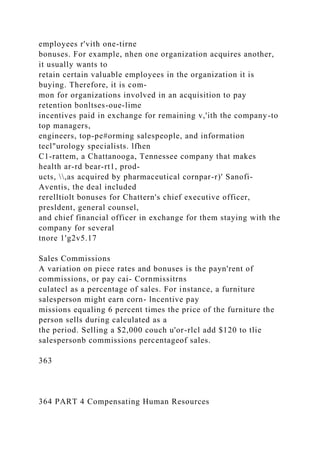
INCENTIVES FOR INNOVATION
Some companies tie bonuses to
activities that foster innovation.
Two good examples come from
entirely different i ndustries: candy
making and survey research.
Hammond's Candies pays work-
ers at its Denverfactory a $50 bonus
for any idea they provide that suc-
ceeds in driving down costs. This
idea for incentive pay occurred to
the company's new owner, Andrew
Schuman, after he learned that one
of Hammond's popular products,
ribbon snowflake candy, was the
idea of a worker on the assembly
line. Schuman concluded that the
people who actually made and
packed the candy would have the
best insight into possible improve-
ments. The production processes
involve a high degree of hand-
work, so employees are skilled at
and involved in their work. ln the
first year of the incentive program,
the company paid out more than
$500 in bonuses for ideas such as
reducing breakage of candy canes
with new packaging and imProv-
ing the efficiency of an assembly
line by adjusting a machine gear.
The changes have helped the
once-struggling company return to
profitability.
lnfosurv, a marketing research
firm based in Atlanta, asks emPloY-
ees to offer business ideas. Once
a quarler, managers pick the best
business idea and award a $150
restaurant gift card to the emploY-
ee who submitted that idea. Jared
Heyman, lnfosurv's founder, esti-
mates that in the Program's first
five years, it has delivered hun-
dreds of thousands of dollars'
worth of cost savings and addi-
tional revenue. Building on this
success, lnfosurv added a grouP
incentive, a challenge to the com-
pany's 15 employees to sug-
gest 100 innovative ideas in 100
days. lf they succeed, everyone
will receive a $'100 bonus. Given
that most of the employees are
research and information technol-
ogy experts. the one expectation
that seems certain is that great
ideas will flow. The incentives
add excitement and a sense of
urgency to the kinds of creative
thinking a companY like lnfosurv
would need as part of its dailY
business.
Sou rces: feri Evans, " Entrepreneurs
Seek Ways to Draw Out Workers' ldeas,"
Wall Street Journal, December 21 ,
2009, http:/lonline.wsj.com; Hammond!
Candies, "About Us," corporate Web
site, www.hammondscandies.com,
accessed April 26, 201 0; and lnfosurv,
"About lnfosurv," corporate Web site,
www.infosurv.com, accessed April 26,
2010.
less than 50 percent or holding steady during a period rvhen
govert'rment funds were
needed to keep tl-re companies alivel16
Adding ro this flexibilit1,, organizations also rnay motivate
employees r'vith one-tirne
bonuses. For example, nhen one organization acquires another,
it usually wants to
retain certain valuable employees in the organization it is
buying. Therefore, it is com-
mon for organizations involved in an acquisition to pay
retention bonltses-oue-lime
incentives paid in exchange for remaining v,'ith the company-to
top managers,
engineers, top-pe#orming salespeople, and information
tecl"urology specialists. lfhen
C1-rattem, a Chattanooga, Tennessee company that makes
health ar-rd bear-rt1, prod-
ucts, ,as acquired by pharmaceutical cornpar-r)' Sanofi-
Aventis, the deal included
rerelltiolt bonuses for Chattern's chief executive officer,
presldent, general counsel,
and chief financial officer in exchange for them staying with the
company for several
tnore 1'g2v5.17
Sales Commissions
A variation on piece rates and bonuses is the payn'rent of
commissions, or pay cai- Cornmissitrns
culatecl as a percentage of sales. For instance, a furniture
salesperson might earn corn- lncentive pay
missions equaling 6 percent times the price of the furniture the
person sells during calculated as a
the period. Selling a $2,000 couch u'or-rlcl add $120 to tlie
salespersonb commissions percentageof sales.
363
364 PART 4 Compensating Human Resources
Many car salespeople earn a straight contmission, meaning tlrat
10oo/o of their pay colnes lrom contnrission instead of a salary.
What
type of individual nright enjoy a job like this?
$-$3 ldentify ways
to recognize group
performance.
&ainsharing
Group incentive
pr0gram that measures
improvements in
productivity and
effectiveness and
distributes a portion of
each gain to employees.
for the periocl. Cornrnission Lates vary tremendousiy
frorn one industri, and company to another. Exatn-
ples reported include an average rate betu'een 5.0
and 5.5 percent for real estate,30 percent up to 90
percent of first year's premilllns on life insr-rrance
(then dropping to as lora'as 4 percent in subseqrrent
years of tl-re poiicy), and 20 to 30 percer-rt of profits
for auto sales.l8
Some salespeople earn a commission in addition
to a base salary; others earn only comtnissions-a
pay arrangenrer-rt called a straight commission plan.
Straight commissions are common among iusur-
ance and real estate agents and car salespeople.
Other salespeople earir no commissions at all, br"it a
straight salary Paying most or all of a salesperson's
compensation in the form of salary frees rhe sales-
person to focus on developillg clrstoner goodu'ill.
Paying lnost or zr11 of a salesperson's cornpensation ir-r the
form of cointnissitrirs encour-
ages the salesperson to focus on closing sales. in this way,
differences in salespeople's
compensation directly ir-rfluence hou, they spend their tit-tre,
hou' they treat custom-
ers, and horv much the organization sells.
Tl-re narure of salespeople's corrpensation also affects the kinds
of people nho rvill
lva11r ro take ar-rd keep sales jobswith the organization. Hard-
driving, arnbitior-rs, risk-
taking salespeople rnight enjoy the poteritial rewards of a
straight cornmission plau.
An organization that watlts salespeo1.,le to concentrate on
listening to cttstomers and
buildirrg relationships rnight ilant to attracr a differenr kind of
salesperson by affer-
ing more of the pay in the forrn of a saiary. Basing part or all of
a saiesperson's pay on
commissiorrs assumes that the organization wants to attract
people vi,ith some lr,illing-
ness ro take risks-probabll, a reasonable asslrnption about
people u'hose job includes
talking to strangers and encotrragiirg rhem to spend money.
ff*y f*r ffin*up t**rf*rm&ffie#
Empioyers may address the drawbacks of individual incentives
by including group
incentives in the organization's compensatioir p1an. To win
gror,rp incetrtives, einployees
lltllst cooperate and share knorvledge so that the entire groLrl)
call lneet its performance
targets. Comrnon group incentives include gainsharing, bot-
tttses, at-id team au'ards.
Gainsharing
Organizatior-rs that wanr ernployees to focus on efficiency may
adopt a gainsharing
program, whicl-i measures increases in productivity ancl
effectiveness and clistributes
a Lrortiou of each gain to employees. For exarnple, if a factory
enjoys a productivitv
gain worth $30,000, hallthe gail might be the cotnpany's share.
The other $i5,000
u,ouid be disrribured among the ernpioyees in the factory.
Knowing that they can
enjoy a financial benefit from helping the compar-ry be more
procluctirre, employees
supposedly will look for rvays to u'ork more efficiently and
impror,e the rvay the fac-
tory operates.
Gainsharrng addresses tl-re challenge of ider-rtifying
appropriale performance mea-
sures for cornplex jobs. For exarnple, horv would a hospital
measLtre the prodr-rction
F:
}J
;:i
'3
ril
t:
:t:
of irs
numbt
involv
surir-rg
iron, tc
focus I
later, ir
ees bel
providi
discuss
Gair
tions. I
. Man
. Nee<
. lvlan
. High
. Ernp.
r Infor
o Goal
. Com
o Perfo
and t
o Ernpl
Apo
Joseph f
field, oL
sales vah
the bonr
possible
the stant
$1.2 mil;
frr 1
)1.1 ln1l
will get :
target an
Typic:
the gain
of the gai
remainde
iosses in
rvhen cos
the organ
remaininl
the orgar-r
Group
In contras
perforrnar
plerformal
358 PART 4 Compensating Human Resources
L*f Describe how
orga nizations
recognize individual
per{ormance.
Although most, if not all, employees vah'e pay, it is important
to remember that
earning money is not the or-rly ."n on people try to do a good
job. As we discuss in
"irr",
Jt"pr"r, (r"" Chapters 4, B, u.rd 13), people also want
interesting work, appre-
ciarion for their efforts, flexibility, and a sense of belonging to
the work
group-not
to menrion the inner satisfaction of work well done. There{ore,
a cotnplete
plan for
motivating and compensating employees has many components,
from pay to work
design to ieveloping
^urrug"ri
so they can exercise positive leadership.- -ffri,tr
regard to thL f"irr-tJrs of incentive pay, the preceding chapter
described equity
,n.orv *hj.h explains how employees form judgments about the
fairness of a pay
structure. The same process uppti"t to judgments about
incentive pay. In general,
"*JoV".,
compare th"i. .ffoi* a.d rewards with other employees',
considering a
;ffi ; be {air *h.rl th" rewards are distributed according to what
the
employees
conrribute.
The rernainder of this chapter identifies elements of incentive
pay systems'
We consider each option's ,t .rrgth, and limitations with regard
to these princi"
ples. The many kinds of incenlive pay fall into lhree broad
categories: incentives
tl"f..a to inclividuai, group, or organizational performance..
Choices from these cat-
;;;;;;:h;rtd .onrid"., not o.,ly"their streng;hs and weaknesses,-
,but also their fir
*-irh ,h. organizarion's goals. The cfioice oflncentive pay '''ay
affect not oniy the
1"rr"1 of moiivation but"also the kinds of employees who are
attracted to and stay
with the organization. For example, there is some evidence that
organizatiols'"vith
team-based rewards will tend to attract employees who are more
team-oriented'
while rewards tied to individual performance make an
organization more attrac-
rive to those who thlr-rk
"r-rd
act independently, as individuals.? Gi,rett the poten-
tial impact, organizalions not only shouid u,eigh the stlengths
and li'eaknesses
in
,"i".,i"g ,yp.r"of incentive pay but also should measure the
results of these progfams
(see "Did You Know?").
Pay for lndividual Perfsrmane€
Organizations may reward individual performance with a
variety of incentives:
o Piecework rates
o Standard hour plans
r Merit pay
. lndividual bonuses
. Sales commissions
Piecework Rates
As an incentive to work efficiently, some organizations pay
production
workers a
piecework rate, a *ug. U^"a on'the. u-our'tt they produce' The
amount
paid per
lrrit o ser ar a lev.l thit rewards employees for abo'e-average
production volume'
For example, suppose that on average, assemblers can finish 10
components
in an
hour. lf rhe organization wanrs to pay its average assemblers
$8^p:t hour, it can
pay
"
p]"."*".f. ."i" of $B/hour dividea by 10 -components/hour,
o. $.80 per component'
A"-,
"rr.*bl"r
who produces the average of 10 components per hour earns an
amount
e.,rral ro $8 oer tro.r., i., assernbler *Lo prod.',.es 12
components in an hour would
;il^$.80;":.2, o, g9.60 each hour. Thii is an example of a
straight piecework
pl"i, U..""r. th" .*ployer pays the same rate per piece' no matter
how much the
r.vorker produces.
Piecework Rate
A wage based on
the amount workers
produ ce.
Straight Piecework
Plan
lncentive pay in which
the employer PaYS the
same rate Per Piece,
no matter how much
the worker Produces.
i
f
{
n
ti
itllr
!1'Ol
l]ror
ear
:no
Ir
l]tor(
iales
rmpl
if the
:ates
have
This
:har
iiecg,
;erfor
-'atisfa
:ealize
ri hile
lonus
irop a
:oais r
rrhers.
:irl orgi
.,rganiz
..rlving
that
;s in
,pre-
-not
i for
vork
luity
pay
eral,
:lga
yees
lms.
nci-
ives
cat-
r fit
the
stay
vith
ted,
rac-
ten-
sin
ams
rsa
pel
me.
ran
pay
ent.
)unt
ruld
ork
the
a;
'€
,9:
::
F,
:t:
r+:
*:
tt.
:r.t
:,ti
,9,
g
.1l
:;:'i
.t
+!
:1
,'i
i:
*
.i:
dl
i:
1;
i:;r:
:,i,
:;
.il
.i
;l
a,
:ll
:,
#:
,&
&-
:#
tr
,:'
,.:
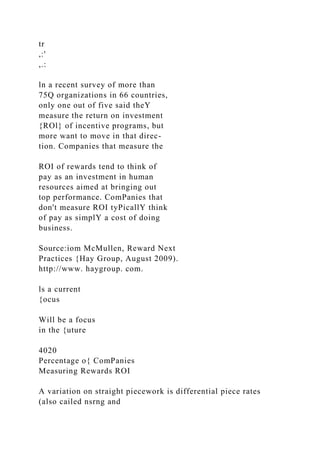
ln a recent survey of more than
75Q organizations in 66 countries,
only one out of five said theY
measure the return on investment
{ROl} of incentive programs, but
more want to move in that direc-
tion. Companies that measure the
ROI of rewards tend to think of
pay as an investment in human
resources aimed at bringing out
top performance. ComPanies that
don't measure ROI tyPicallY think
of pay as simplY a cost of doing
business.
Source:iom McMullen, Reward Next
Practices {Hay Group, August 2009).
http://www. haygroup. com.
ls a current
{ocus
Will be a focus
in the {uture
4020
Percentage o{ ComPanies
Measuring Rewards ROI
A variation on straight piecework is differential piece rates
(also cailed nsrng and
faltingdifferentials), in;hi;h the piece rate depends on the
amount produced' If the
*orki, pio.l.,.es more than the standard output, the piece rate is
higher' If the worker
prodr1.", at or below the standard, the amount paid per piece is
lower. in the preceding
"*"*p1",
the differential piece rate could be $ I per component for
components exceed-
ing 12 per hour and $.80 per component for up lo 12
components per hour'
In one study, the lse of piece rates incfeased production output
by 30 percent-
more than any'other rnotivational device evaluated.S An
obvious advantage of piece
rates is t1-re direct link between how rnuch work the employee
does and the arnount lhe
employee earns. This type of pay is easy to understand and
seems fair to many people,
lf they rhlnk the producrion standard is reasonable. In spite of
their advantages, piece
rates are relativeiy rare for several ,"uro^r.9 Most jobs,
including those of rlanagers'
have no physical output, so it is hard to develop an appropriate
performance measure.
This type of incenrive is most suited for very routine,
standardized jobs with output
that is easy to measllre. For con-iplex jobs or jobs lvith hard-to-
measure outputs'
pieceu,ork plans do not apply very well. A1so, unless a plan is
rvel1 designed to include
p"rfo.malce standards, it may not reward employees for
focusing on quality or cuslomer
iatisfaction if it interferes r.vith the day's output. In Figure
12.1, the employees quickly
realize they can earn huge bonuses by writing softu'are "bugs"
and then fixing them,
lvhile rvriting bug-free sofrware affords no chance to earn
bouuses. More seriously, a
bor-rus based on number of faucets produced gives production
rvorkers no incentire to
stop a manufacturing line to correct a quality-control problem.
Production'oriented
goul, ,ouy do nothing to encourage employees to iearn neiv
ski1ls or cooperate with
others. Therefore, individual incentives such as these may be a
pool incentive in
an organization that wants to encourage teamwofk. They rnay
nor be helpful in an
-rrganization rvith compiex jobs, ernployee empowerment, and
team-based problem
r,rlving.
r1::'r:r:.trL:j1il:r::1i{1f$*'i3i1!i{-qtii!.iil{!*!r,liiie{fir€{ry-
€@fqiSff}SFil5$ll:l'i
Differential Piece
Rates
lncentive pay in which
the piece rate is higher
when a greater amount
is produced.
359
I
-
&
i*
g
sl
g
360 PART 4 Compensating Human Resources
|: igure 1 ?. i
How lncentives Sometintes "Work"
SOURCE: DILBERT: O Scott Adams/Dist. By United Feature
Syndicate, lnc
$tandarcl llour Flan
An incentive p{an that
pays workers extra ior
work done in less than
a preset "standard
time."
Standard Hour Plans
Another quantiry-oriented incentive for production workers is
the standard hour
plan, an incentive plan that pays workers extra for work done in
less than a preset
((stan-
dard time." The organizatior-r determines a stairdard time to
complete a task, such as tun-
ing up a car-engine. If the mechanic completes the work in less
than the standard time,
rhe mechanic receives an amount of pay equal to the wage for
the fr-rll standard tirne.
Suppose the standard time for tuning up an engine is 2 hours. If
the mechanic finishes
a tlne-up in 1% hours, the rnechar-ric earns 2 hours'u'orth of
pay in i% hours. X/orking
that fast over the course of a week could add significantly ro the
mechanic's pair
In terms of their pros and cons, standard hour plans are much
like piecer.vork plans.
They encourage ernployees to work as fast as they can, but not
necessariiy to care
about quality or customer service. Also, they only succeed if
employees want the extra
money more than they u'ant to work at a pace that feels
comfortable.
Merit Pay
Alrnost all organizations have estabiished sorle program of
merit PaY-a systern of
linking pay increases to ratings on performance appraisals.
(Chapter B described the
content and ,"rse of performance appraisals.) To make the merit
increases consistent, so
they r.vill be seen as fair, many merit pay programs use a merit
ina"ease grid, such as the
sample for Merck, the giant drug company, in Table 12.1. As
the table sholvs, the deci'
sioni about merit pay are based on two factors: the individual's
performance rating and
the individual's compa-ratio (pay relative to average pay, as
defined in Chapter 11)-
This s],stern gives the biggest pay increases to the best
performers and to those whose
pay ls relatively lou, for their job. At the highest extreme, an
exceptional employee
earning B0 percent of the average pay for his lob could receive
a 15 percent merit raise.
An employee rated as having "room for improvement" wor,rld
receive a raise only if
that employee was earning relatively low pay for the job
(compa'ratio of .95 or less).
By today's standards, all of these raises are large, because they
were created at a time
wher-r inflation rvas strong and economic forces demanded big
pay increases to keep
up r.vith the cost of living. The range of percentages for a
policy used today would be
iower. Organizations establish and revise merit increase grids in
light of changing eco-
nornic conditions. When organizations revtse pay fanges,
employees have nerv compa-
ratios. A higher pay range would result in lower compa-ratios,
car-Lsing employees to
l1ttr*rit Pay
A system of linking pay
increases to ratings
on performance
a ppra isa ls.
l,:i:ri* -
Sample l
il
EX
WO
HS
RI
NA
SOURCE
President
become
it maker
Adn
recent y
age perf,
6 percer
amoLlnt
careef, tl
on a yea
shor.r's, c'
ever, ext
ernploye
raises gir.
raises for
NCIO}
ffi vj$
OUR GOAL I5 TO I,JPf,'I
BOG.FREE SOFTI.JARE,
I'LL PAY A TEN-DOLLAR
SONUS FOR EVERY SUG
YO{J FIND AND FIX.
I HOPE I,A GONNA
THIS TdFtrTL I{E A
DRIVES NEU NINIVAN
THERIGHT THIS AFTER-
BEHAVIOR. NOON1 ru,rd
Note: Experts
CHAPTER 12 Recognizing Employee Contributions with Pay
361
ii:i;ii- :,:. i
Sample Merit lncrease Grid
WD
HS
RI
NA
(Exceptional within Merck)
{Merck Standard with
Distinction)
{High Merck Standard}
{Merck Standard Boom for
lmprovement)
{Not Adequate for Merck)
EX 13-1 5%
9-i 1
7-g
5-7
1Z-140k
8-1 0
9-11%
7-9
To maximum
of range
j' ir-1:-li'c: Li" ?.
Ratings and Raises:
Underrewardin g the Best
6-8
rour
tan-
tun-
ime,
ime.
shes
<ing
lns.
tare
rtra
SOURCE: K. J. Murphy, "Merck & Co., lnc. (B)," Boston:
Harvard Business School, Case 491-0A6. Copyright @ 1990 by
the
President & Feliows of Harvard College. Reprinted with
permission.
becorne eligibie for bigger rnerit increases. An advantage of
rnerit pa)' is therefore that
rt rnakes tl-re reu'ard rnore valuable by relating it to economic
coirclitior-rs.
A dlarvback is that cclnditior-rs can shrink the available range
of increases. During
recent years, budgets fol merit Lralr irlcreascs were about 3 to 5
percent of pa1,, so aver-
age performers could receive a 4 percent raise, and top
per{ormers perhaps as tnuch as
6 percent. The 2-pelcentage-point clifference, after taxes and
other deductions, rvould
alrrolrllt to only a feri' dollars a ,eek on a salary of $40,000
per year. Over an entire
career, the biggel increases for topr perforners can grow into a
major change, but vier,r'ed
on a 1,g21-ft-year basis, they are not much of an incentive to
excei.10 As Figule 12.2
shc'rtt's, cotnpauies typically spread merit raises fairly evenly
across all elnployees. Ho$'-
ever, experts advise rnaking pay ir-rcreases twice as great for
top perforners as for ar.erage
etnployees-and not reu,arding the poor per{ormers with a raise
at a11.11 hnagure if the
raises given to the bottorn ilvo categories in Figr-rre i2.2 ir-
rstead u,ent toward 7 percent
raises for the top irerformers. Tiris t;'pe of elecision sigr-rals
that excellence is ren'arded.
rof
the
,so
,he
:ci-
nd
1).
)se
se.
if
Average Pay lncrease
Highest-Rated Workers
Next Highest Rated
Middle Rated
Low Rated
Lowest Rated
Note: Experts arlvise thaI the top category shou]d receive trsice
as nuch as the ntiddle caleltorv.
).
ne
-^p
be
o-
a-
Io
di.
444 PART 4 Compensating Human ResourcesL Explain how to.docx

444 PART 4 Compensating Human ResourcesL Explain how to.docx

  • 1.
    444 PART 4Compensating Human Resources L*? Explain how to choose the contents ol an employee benefits pa c kage. the employee's current job or {uture careet at tl'rc organization. Ernployees are reirn- bursed for rhese expenses a{ter rhey demonstrate rhey have .o,,lpl"r"j an approvecl course. - .Especially for demanding, high-stress jobs, organizarions rnay look for benefits rhat help employees put in the necessary |or-r* hours and alleyiate stress. Recreational acriv- ities such as on-sire basketball courts or con-)pany-sponsored sofrball teams provide for social interaction as u'ell as physical activity. Ernployers may reward hard-working groups or individuals with a rip for a weekend, a meai, or any acrivity empl0yees arr iikely to enjoy. Some companies, including Minneapolis design agency Sevlthsil ar-rcj Vancouver Web site designer Mezine, ailow ernployees to b.ilg their pets to work. Mezine cofounder Dean Gagnon explains the benefitr "lt's almoir impossible to have a bad day u'irl-r a dog i,valking around rhe office."Jl Seleetf mg Hmp{oys# ffisffieffts
  • 2.
    Aithor"rgh the governtnentrequires certain benefits, employers have r.vide latitude in creating the toral benefits prackage rhe1, sffgr employe"s.sz Decisions about rvhich benefits to inciude shor-rld take into account the organization's goals, its budget, and the expectarions of the organization's current emploJ,e.s and thole it wishes to recruir in the future. Employees have corne to expecr ceriain things from employers. An orga- nization that does r-rot offer the expected benefits rvill have rnore difficulty attractlng and keeping talented workers. Also, if ernployees believe their ernployer feels ,'ro .o*l mitment to their ivelfare, they are less likely to feel committed to-their employer. The Organ fzaf ion's Objectfves A logicai place to begin selecting employee benefits is to establisl-r objectiyes for rhe ber-refits package. This helps an organization select the most effective benefits ar-rd monitor whether the benefits are doing what they should. Table 13.2 is an example of one organizationt benefits objectives. tJr-rfortunately, research suggesrs that 6rost organizations do not have written benefits objectives. _ Among cotnpanies that do set goals, the rnost common objectives include coirtrol- ling the cost of health care benefits and retaining ernployeer.i' Th" firsr goal explains the growing use of wellness progralns and consumei.directed health plur-,s. Fo, the second goal, empioyers need to learn r.vhat employees care abogt. I1 soroe .nser, the
  • 3.
    approach rnay beindirect, helping the cornpany distinguish itself as an employer that certain kinds of employees wiil be attracted to and cornmitted ro. For ."uir1pl", , company that establishes itself as committed to the environment could offer benefits in line rvitir that. goal-say, bicycle storage for cornrnuters and vouchers for takilg the bus-to *otk'14 Employees with a passion for the environrnenr rvould be especialli engaged by such offerings. Employees' Expectations and Values ErnPloYees expect to receive benefits that are legally required ar-rd widely ayailable, and they value benefirs rhey are likely ro use. For example, rhe ,,HR oopri" box illus- trates the vaiue ernployees. place on product discounti. To rneet ernpioyee expecra- tions alrour benefits, it can be helpftrl to see lvhat orher organizarions off.r. E*pioy.r, can purchase survey inforrnation about benefits packagei from private .o.,r,-,1tur-rtr. In addition, the Bureau of Labor Statistics garhers bet-tefits data. The BLS Web site (u'ri'urbls.gov) is therefole a good place to check for free infonnarion aborrt employee { I ol I ol
  • 4.
    € ol r* fscus on $*tr'fff resp*nsfbifity SOURC Dearbo rights re benefir benefir ciallyc emplo1 or visit emplol thernse Ernp is likel, factors older rv insuran ing age women general olvn elr Llse sLlr be carel all the I
  • 5.
    The affect tl kinds o1 hasstro of to th CHAPTER '1 3 Providing Employee Bene{its 405 'l*i:i* 1"i^;1. An 0rganization's Benelits 0biectives I are re11n- appror,ed nefits that rnal actir'- rrovide for d-rl'orking rloyees are rthsin and s to rvork. le to have e latitr-rde rr-rt u,hich rdget, and to recnrit An orga. attracting
  • 6.
    s no colll- 1t11,s1. esfor the refits and exanrpie hat most : control- explains . For the tases, the oyer rhar ample, a benefirs rr taking :speciaily vailable, rox illus- expecta- nploysl5 sultants. Veb site rnployee . To establish and maintain an employee benefit program that is based primarily on the employees' needs f0r leisure time and 0n protection againstthe risks of old age, l0ss 0f health, and loss of life.
  • 7.
    . To establishand maintain an employee benefit program that complements the efforts of employees on their own behalf. . T0 evaluate the emplOyee benefit plan annually for its effect on employee morale and productivity, giving'consideration io turnover, unfilled positions, attendance, employees' complaints, and employees' 0pinions. . To compare the employee benefit plan annually with that of other leading companies in the same {ield and to maintain a benefit plan with an overall level of benefits based on cost per employee that falls within the second quintile of these companies. . To maintain a level of bene{its for nonunion employees that represents the same level of expenditures per employee as for union employees' . To determine annuallythe costs 0f neW changed, and existing pr0grams as.percentaqes of salaries and wages and to maintain these percentages as much as possible. . To self-fund benefits t0 the extent that a l0ng-run cost savings can be expected for the firm and catastrophic losses can be avoided' . To coordinate all benefits with social insurance programs to
  • 8.
    which the payments. company makes .To provide benefits on a noncontributory basis except for dependent coverage, for which employees should pay a portion of the cost. . To maintain cOntinual cOmmunications with all employees concerning benefit programs. soURCE: Adapted from B. T. Beam Jr. and J. J. McFadden, Employee Benefits,3rd ed. @ 1992 by Dearborn Financial Publishing, Inc. Published by Dearborn Financial Publishing, lnc, Chicago All rights reserved. benefits in the United States. !flith regard to value, medical insurance is a high'r'alue benefit because ernployees usually ,.alir. tl-rat sulgery or a majo[ ilh-Less can be finan- cialiy deyastarir-rg. Vision a1d deltal care tend to be much less expensive' bLlt many .r11plioy.., appreciate tl-Lis type of coyerage because so many people receire dental o. uirior-r .^.. ir-, the course of " y.".. As a result, rnany employers ale finding that ernploVees are e/en happy ttt pay the rnoclest prelliums for
  • 9.
    clental and visioncoverage rhemselr,es because of ii-r. u"l.,e'tl-re1, place on this benefit.li Enplol,ers shoulcl also consitler thal the valre etlployees place on various benefits is likeb, to cliffer frorn one employee ro another. At a broad let'el, basic ciernographic iactors sr-ich as age ancl sex cal-1 influence the kinds of benefits emplo1'ggs want. An olcler u,orkforce is more 1ikely to be concerned about (antl use) rnedical col'erage' life insnrance, and ;rensions. A workforce $'ith a high lrercelltage of s'omen of childbear' ilrg :rge tna)/ cafe more abolrt clisabiiity or farnilv leave. Yor- rug, untnarried men and r,,Jrr-rJr-, often place more t,alue on p:ry than on benefits' Hon'ever, these are or-rly general obseryations; organizatiols sfiould check rvhich consideratrons apply to their 3r',,,r-r "roployees ancl identifi,'rnore specific nee'i]s and .'litfer..ences' One approach is to ur. ,.,.u"1,, to usk errployees about t-he kinds of benefits lhel i'alue. The survey should be carefpl11' ,orcled so as not to raise emplo;'ss5' expectatiolls b)- seemir-ig to prornise
  • 10.
    all tl-re benefitsaskecl about at no cost to tire emplolee' The choice of benefits may infl*e'ce cllrrent emlrlsl'gtt' satisfaction and rnay also affect the organization's recruiting, in lelms of boih the ease of recrttiting and the kincls of ernpl"oy"", orr.".te.l to the organizatiot-t' For exarnple, a benefits package that has srrong medl.ul benefits and pensions n-ray be parriculally altractive to older people or to rho;e ,,r,itir many depenclents. Such benefits ma)' attract people u'ith extensil'e .- .i-: a- .-. .. ... L,. . -... .. t ... "iij.j. :,,,:-l) r.::t j i_:r::.::,:t : jti::.ii",,-.il : j l,.::. Part of knowing what employees employees flooded the site with highly valued benefit at Best value is knowing what they don't 54 pages of comments, most of Buy?Why or why not?What want to lose. Brian Dunn learned them furious. kinds of employees would this that the hard way as an executive Just five days later, Dunn benefit attract? of Best Buy. reviewed the reaction with senior 2. Suggest a way that Best Buy Dunn hoped to improve prof- management. The decision was
  • 11.
    could have reducedthe costs itability by cutting costs, and he easy: Best Buy backed down and of benefits without sparking thought employees would accept restored the employee discount employee anger. a smaller employee discount. To to its original level. 1"",":"1iil;:::, :""ii,':Iff:: ouestions source: Based on Matthew Bovre' sociar-networkins site, the water- 1. Are you surprised that ;tJ,- 'j,$:ff"t:;r:Y,t-:ili:{:r?, cooler. The results were soon in: employee discounts are a 2009, www.businessweek.com. experience and those who wish to make a lor-rg-term commitment to the organization. This strategy rnay be especially beneficial when turnover costs are very high. On the other hand, offering generous heaith care benefits may attract and retain people with high health care costs. Thus, organizations need to consider the signals sent by their benefits package as they set goals for benefits and select benefits to offer. Organizations can address differences in employees' needs and empou'er their employees by offering flexible benefits plans in place of a single benefits package for Cafeteria-Style Plan all employees. These plans, often called cafeteria-style plans, offer employees a Abenefitsplanthat set of altematives from ivhich they can choose the types and amounts of benefits offers employees a set they want. The plans vary. Some impose
  • 12.
    minimum levels forcerlain benefits, such of alternatives from as health care coverage; some allow better employees to receive money in exchange which they can choose for choosing a "light" package; and some let employees pay extra for the privilege of the types and amounts receiving Jor. uJt-t"rlm. For"example, some pla.ri l.i "*ploy."r give up vacation days of benefits they want ro, ,oor"-prv or to purchase extra ,racation d'ays in "*.hu.rg" fo. , .ed.r.tion in pay. Cafeteria-styl" pl".rr have a number of advantager.36 Th. selection process can make employees more aware of the value of the benefits, particularly when the plan assigns each employee a sum of money to allocate to benefits. Also, the individual choice in a cafeteria plan enables each empioyee to match his or her needs to the cornpanyt benefits, increasing the plan's actual value to the empioyee. And because employees would not select benefits they don't want, the company avoids the cost of providing employees u'ith benefits they don't value. Another way to control costs is to give employees incentives to choose lou,er-cost options. For example, the employ' ee's deductible on a higher-cost health plan could be larger than on a relatively lou'- cost HMO.
  • 13.
    A drawback ofcafereria-style plans is that they have a higher administrative cost. especially in the design and start'up stages. Organizations can avoid some of the higher cosr, however, by using softu,ate packages and standardized pians that have been developed for employers wishing to offer cafeteria-style benefits. Another possi- ble drawback is that employee selection of benefits wiil increase rather than decrease cosrs because employees will select the kinds of benefits they expect to need the most' 406 For exi up for empiol employ Bene. Employ informa cost dar L-rstltutt melce s terlns. Empl .rifer. Bu tfirs, the :ng for u :he most 1!'e notei rion by ir
  • 14.
    lifficuit- In rec, because t ofoption rional her ro emplo, Jmployee ior servic, :n cost be aoverage r ;osts. Eml ".i.ith risk I ir disease Legal .1s ri,e dis, :iLluirelner -,i-ays to cc :r minimiz :ng new en =mpioyees .:"lntractors :tquiremen :;i'for non -iervice stri :es cannot :rganizatior nents invol !enefirs.
  • 15.
    n n It le ie of is v' 'st, he rve isi- ase lst. CHAPTER 13 ProvidingEmployee Bene{its 407 For example, an employee expecting to-need.a 1ot of dental work is more iikely to sign up for a de.tal pt"r-,. ci.- il;;;;: l? ,n. a"r-,,"I coverage u,ould then drive up the employer,s premiums r.r-tr-r"a coverage. costs can also be clifflcult to estimate when .ropioy""t select their benefits'
  • 16.
    Benefits'Costs Er,rployers also needto consider benefits cos6. one place to start is rvith general i'rformarion about the average costs of rurio*-b"rr"fits types. fidelv used sources of cosr dara include th. Br."ui of Labor S,"rit,l.t igls),'i*pto'ee,Renefit Research l.rsrirure, and U.S. Ch;;t., of Cominerce. Annual slrrveys by the Chamber of Corn' nerce stare rhe cost of benefits as a percentage of total payroll costs and in dollar tttillolor.rs can use data about costs to help them t:l"tl :l:, klnds of benefits to oifer. But in balancing these decisions against organizational goals-and employee ben- efits, the organization -uy d..id" ,o ofl", ..rol]', high-cost b"r-re{itt while also look- ing for ways ro .orrrrol-,h. cost of those bene{its. The highest'cost items tend to offer rhe mosr room foffur*gr, uri ""rv if the items permit choice or negotiation. Also,
  • 17.
    as ri,e noted earlier,".g""i**, .ur-, .ot-r,rol certain costs such as r'r'orkers' compensa' rion by irnproving ,h";;^;;;;;;;,-,." ,"rir,,gr. corilo.rrtol is especiallv important-and Jifficuit-when economic growtil siows or declines' ln recent y.urr, f"r-t"f iJ'"tt'"a to health cate have attracted particular attenlion because these costs f-r"t'" tO." very rapidly and because employers harre a number of options. Concern over costs hu' p'o-ptJ many employ"tt- to shift from rradi- tional health inr.,r"r-ri ,o ppO' u"d COHp'' Some'employers shift more of the cost ro employees' They ;; 1;*"; the empioyer's payments by increasing the amounts .;;d"": puy fo, j.du.tibles and coinsurance ith" "mployee's share of the payrnent tor services). O, ,',"i-ttny '"q'i'" employees io puy some or all of the difference in cost between ,ruairi'or-rut i.rr,,rar-rc. ar-rd "
  • 18.
    loo,"i'cost plan. Excludingor limiting coverage for certain ;;, ;i .l;ims also can slow rhe increase in health insurance costs. Employee wellness programs, especialiy rvhen they are targeted to employees *,ith risk factors ur-,a'ir'r.t.,a"-folio*-.,p and encouragement' can reduce risk factors tbr disease.3T Legal R*quirernents fcr Empl*yee Benefits As we discussed earlier in this chapter, some benefits are required by law' This ;.;,,1.-"j;;;"aa, ," t6e cost of to*pe''suting employees' organizations iooking for ;;;;.o't*ol ,tuffi,'tg.o"' 'ouy iook fo'i"uyt'o structLlre tnt l:::|t:lt^t^t"tr3: to mininize the expense of benefits. They nay require o'e{time' Iather tt]an aoo- ;;g;;; "*ploy""r,'hi."-part-time rath.er rhan full'ti*-ie q'orkers (because parl-tirrle employees generally .;i;; ;".h smaller benefits packages), and
  • 19.
    use independent conrfactors rarher thanhire empioyees. so*. nf th.r" .hoi."s are limited by legal requirementr, hor"",r".. For e*ample, the Fair Labor Standards Act requires overtime pay for nonexempt *'oit".,, " dist""d in Chapter 11' Also' the Internal Revenue Serrrice strictly fi*ir, ii-r" d"fir'ri,ior-t of "independellt contractors," stl that employ- ees cannor auoid 1egol ;b1;;;;, by classifyr'g ,,r,orkers.as self-employed when the r.)rganizarion recei'es the fienefits of " p"r*rienr employee' Other legal require' rurents in'olve tax treat;ent of benefits, antidiscrimir"'aiion larvs' and accounting for benefits. !-*E Summarize the regulations affecting how emploYers design and administer benefits Programs.
  • 20.
    't; 1. :l ,ir ii 4 +l i :r3i :?: ::. :-r,. 362 PART 4Compensating Human Resources Another advantage of merit pay is that it provides a method for rewarding perfor- mance in all of the dimensions measured in the organization's performance manage' ment systeln. If that sysrem is appropriately designed to rleasure all the important job behaviors, then rhe merit pay is linked to the behaviors the organization desires. This link seems logical, altho.,gh so far there is little research shou'ing the effectiveness of
  • 21.
    merit pay. I2 Adrawback of merit pay, from the empioyer's standpoint, is that it can quickly become expensive. Mun"g..t at a rnajority of organizations fate most employees' p..for*ur,.. ln the top.tJo categories-(ourof four or five).I3 Therefore, the major- ity of employees are eligible for the biggest merit increases, and their pay rises rap- idiy. This cost is one reason that some organizations have established guidelines about the percentage of ernployees that may receive the top rating, as discussed in Chapter a. Anorh.. .or...iio., mlght be to use 360-degree per{ormance feedback (dlscussed in Chapter 9), but so far, organizations have not used nrultisource data for pay decisions.14' Another c{rawback of merit pay is that it makes assumptions that may be mislead- ing. Rer.varding employees for superior performance ratings assumes that those ratings dJp.nd o., "*"ploy""s' abiiity ant motivation. But performance rnay actually depend o. fo..., o.,rrid. ih" e^ploy.e's control, such as managers' rating biases, the level of cooperation from co-workers, oI the degree to which the organization gives employ-
  • 22.
    .., ah" authority,training, and resources they need. Under these conditions, employ- ees will likely conclude that the merit pa] syslsrn is unfair' Qualiry guru'$U. Edwards Deming also criticizes merit pay for discouraging team- *o.i. Ir-, b.-ing's words, "Everyone propeis himself forward, or tries to, for his own good, on hi, orin life preserver. ffr. organization is the 1oser."15 For exarnple, if E*pioy..r in the purch"ri.rg d.purt-ent afe evaluated based on the number or cost of .o.rrru.,, they negotiate, they may have little interest in the quality of the materials they buy, ..r.r, *f,.r, the manufacturing department is having quality problems' In ."u.rlor-r'to such problems, Deining advocated rhe use of group incentives' Another alternative is for merit pay to include ratings of teamwork and cooperation' Some ernployers ask co-workers to provide such ratings' Performance Bonuses Like merit pay, performance bonuses reward individual performance, but bonuses are not roiled into tase pay. The employee must fe-earn rhem during each performance period. In some .ur"i, ,h. bo.r'ls is a one-titne reward. Bonuses
  • 23.
    may also belinked to Lblective performance measures' rather than subjective ratings''Borrrrr", for individual performance can be extremely effective and give the organi' zarion grear flexibility in d'eciding wfiat kinds of behavior to reward' Examples include th" .oi-rpur'ries descrited in the "Best Practices" box and Continental Airlines, which puy, "*pioyees a quarterly bonus for ranking in the top three airlines for on- time lrriuulr,'u measure^of ,"r,ri." quality. In many cases, employees receive bonuses for meeting SuCh routine targets as sales or production nt,mbers. Such bonuses encouf- "g" hur"d rvork. But an organization that focuses on growth and innovatiop may get b"etter results from ."*uii.,g employees for ieaming new skills than from linking ;;;"r"; ro masrery of existing lobs. Similarly, bonuses make up a large part of com- pensarion pu.k"g", in rhe fin;;cial industry, and when that industry nearly collapsed in 2008, ,o*" obr"ryers questioned the basis for awarding the b,onuses.
  • 24.
    tffere invest- ment banks,for example, really rewarding the right behaviors if bonuses were falling {i 't$l "t!l ,:Jti !# $ 'r$:. i: r.,1 .ii. INCE Some c, activitier Two gor entirely r making i Hamr ers at its for any i, ceeds in idea for the comt
  • 25.
    Schumar of Hamr ribbon s ideaof a line. Sch, people I packed tl best insig ments. Ti involve t work, so and invol first year less than needed tc Addinl bonuses. . retain cer mon for c incentiver engineers. Chattem, Llcts, was retention and chief more yean Sales C A variatio culated as missions e the period
  • 26.
    rfor- age- i job fhis ss of ckly yees' ajor- falr- lines :din back a for lead- tings pend 'el of ploy- plov- eam- ovn ,1e, if rst of erials rs. In other iome
  • 27.
    es are lance :ed to :gani- clude vhictr .-time esfor ICOUr- ry get r-rking con-r- ,apsetl rvest- alling INCENTIVES FOR INNOVATION Some companies tie bonuses to activities that foster innovation. Two good examples come from entirely different i ndustries: candy making and survey research. Hammond's Candies pays work- ers at its Denverfactory a $50 bonus for any idea they provide that suc- ceeds in driving down costs. This idea for incentive pay occurred to the company's new owner, Andrew
  • 28.
    Schuman, after helearned that one of Hammond's popular products, ribbon snowflake candy, was the idea of a worker on the assembly line. Schuman concluded that the people who actually made and packed the candy would have the best insight into possible improve- ments. The production processes involve a high degree of hand- work, so employees are skilled at and involved in their work. ln the first year of the incentive program, the company paid out more than $500 in bonuses for ideas such as reducing breakage of candy canes with new packaging and imProv- ing the efficiency of an assembly line by adjusting a machine gear. The changes have helped the once-struggling company return to profitability. lnfosurv, a marketing research firm based in Atlanta, asks emPloY- ees to offer business ideas. Once a quarler, managers pick the best business idea and award a $150 restaurant gift card to the emploY- ee who submitted that idea. Jared Heyman, lnfosurv's founder, esti- mates that in the Program's first five years, it has delivered hun- dreds of thousands of dollars' worth of cost savings and addi-
  • 29.
    tional revenue. Buildingon this success, lnfosurv added a grouP incentive, a challenge to the com- pany's 15 employees to sug- gest 100 innovative ideas in 100 days. lf they succeed, everyone will receive a $'100 bonus. Given that most of the employees are research and information technol- ogy experts. the one expectation that seems certain is that great ideas will flow. The incentives add excitement and a sense of urgency to the kinds of creative thinking a companY like lnfosurv would need as part of its dailY business. Sou rces: feri Evans, " Entrepreneurs Seek Ways to Draw Out Workers' ldeas," Wall Street Journal, December 21 , 2009, http:/lonline.wsj.com; Hammond! Candies, "About Us," corporate Web site, www.hammondscandies.com, accessed April 26, 201 0; and lnfosurv, "About lnfosurv," corporate Web site, www.infosurv.com, accessed April 26, 2010. less than 50 percent or holding steady during a period rvhen govert'rment funds were needed to keep tl-re companies alivel16 Adding ro this flexibilit1,, organizations also rnay motivate
  • 30.
    employees r'vith one-tirne bonuses.For example, nhen one organization acquires another, it usually wants to retain certain valuable employees in the organization it is buying. Therefore, it is com- mon for organizations involved in an acquisition to pay retention bonltses-oue-lime incentives paid in exchange for remaining v,'ith the company-to top managers, engineers, top-pe#orming salespeople, and information tecl"urology specialists. lfhen C1-rattem, a Chattanooga, Tennessee company that makes health ar-rd bear-rt1, prod- ucts, ,as acquired by pharmaceutical cornpar-r)' Sanofi- Aventis, the deal included rerelltiolt bonuses for Chattern's chief executive officer, presldent, general counsel, and chief financial officer in exchange for them staying with the company for several tnore 1'g2v5.17 Sales Commissions A variation on piece rates and bonuses is the payn'rent of commissions, or pay cai- Cornmissitrns culatecl as a percentage of sales. For instance, a furniture salesperson might earn corn- lncentive pay missions equaling 6 percent times the price of the furniture the person sells during calculated as a the period. Selling a $2,000 couch u'or-rlcl add $120 to tlie salespersonb commissions percentageof sales. 363 364 PART 4 Compensating Human Resources
  • 31.
    Many car salespeopleearn a straight contmission, meaning tlrat 10oo/o of their pay colnes lrom contnrission instead of a salary. What type of individual nright enjoy a job like this? $-$3 ldentify ways to recognize group performance. &ainsharing Group incentive pr0gram that measures improvements in productivity and effectiveness and distributes a portion of each gain to employees. for the periocl. Cornrnission Lates vary tremendousiy frorn one industri, and company to another. Exatn- ples reported include an average rate betu'een 5.0 and 5.5 percent for real estate,30 percent up to 90 percent of first year's premilllns on life insr-rrance (then dropping to as lora'as 4 percent in subseqrrent years of tl-re poiicy), and 20 to 30 percer-rt of profits for auto sales.l8 Some salespeople earn a commission in addition to a base salary; others earn only comtnissions-a pay arrangenrer-rt called a straight commission plan. Straight commissions are common among iusur- ance and real estate agents and car salespeople. Other salespeople earir no commissions at all, br"it a straight salary Paying most or all of a salesperson's compensation in the form of salary frees rhe sales-
  • 32.
    person to focuson developillg clrstoner goodu'ill. Paying lnost or zr11 of a salesperson's cornpensation ir-r the form of cointnissitrirs encour- ages the salesperson to focus on closing sales. in this way, differences in salespeople's compensation directly ir-rfluence hou, they spend their tit-tre, hou' they treat custom- ers, and horv much the organization sells. Tl-re narure of salespeople's corrpensation also affects the kinds of people nho rvill lva11r ro take ar-rd keep sales jobswith the organization. Hard- driving, arnbitior-rs, risk- taking salespeople rnight enjoy the poteritial rewards of a straight cornmission plau. An organization that watlts salespeo1.,le to concentrate on listening to cttstomers and buildirrg relationships rnight ilant to attracr a differenr kind of salesperson by affer- ing more of the pay in the forrn of a saiary. Basing part or all of a saiesperson's pay on commissiorrs assumes that the organization wants to attract people vi,ith some lr,illing- ness ro take risks-probabll, a reasonable asslrnption about people u'hose job includes talking to strangers and encotrragiirg rhem to spend money. ff*y f*r ffin*up t**rf*rm&ffie# Empioyers may address the drawbacks of individual incentives by including group incentives in the organization's compensatioir p1an. To win gror,rp incetrtives, einployees lltllst cooperate and share knorvledge so that the entire groLrl) call lneet its performance
  • 33.
    targets. Comrnon groupincentives include gainsharing, bot- tttses, at-id team au'ards. Gainsharing Organizatior-rs that wanr ernployees to focus on efficiency may adopt a gainsharing program, whicl-i measures increases in productivity ancl effectiveness and clistributes a Lrortiou of each gain to employees. For exarnple, if a factory enjoys a productivitv gain worth $30,000, hallthe gail might be the cotnpany's share. The other $i5,000 u,ouid be disrribured among the ernpioyees in the factory. Knowing that they can enjoy a financial benefit from helping the compar-ry be more procluctirre, employees supposedly will look for rvays to u'ork more efficiently and impror,e the rvay the fac- tory operates. Gainsharrng addresses tl-re challenge of ider-rtifying appropriale performance mea- sures for cornplex jobs. For exarnple, horv would a hospital measLtre the prodr-rction F: }J ;:i '3 ril t:
  • 34.
    :t: of irs numbt involv surir-rg iron, tc focusI later, ir ees bel providi discuss Gair tions. I . Man . Nee< . lvlan . High . Ernp. r Infor o Goal . Com o Perfo and t o Ernpl Apo Joseph f field, oL sales vah the bonr possible
  • 35.
    the stant $1.2 mil; frr1 )1.1 ln1l will get : target an Typic: the gain of the gai remainde iosses in rvhen cos the organ remaininl the orgar-r Group In contras perforrnar plerformal 358 PART 4 Compensating Human Resources L*f Describe how orga nizations recognize individual per{ormance. Although most, if not all, employees vah'e pay, it is important to remember that
  • 36.
    earning money isnot the or-rly ."n on people try to do a good job. As we discuss in "irr", Jt"pr"r, (r"" Chapters 4, B, u.rd 13), people also want interesting work, appre- ciarion for their efforts, flexibility, and a sense of belonging to the work group-not to menrion the inner satisfaction of work well done. There{ore, a cotnplete plan for motivating and compensating employees has many components, from pay to work design to ieveloping ^urrug"ri so they can exercise positive leadership.- -ffri,tr regard to thL f"irr-tJrs of incentive pay, the preceding chapter described equity ,n.orv *hj.h explains how employees form judgments about the fairness of a pay structure. The same process uppti"t to judgments about incentive pay. In general, "*JoV"., compare th"i. .ffoi* a.d rewards with other employees', considering a ;ffi ; be {air *h.rl th" rewards are distributed according to what the
  • 37.
    employees conrribute. The rernainder ofthis chapter identifies elements of incentive pay systems' We consider each option's ,t .rrgth, and limitations with regard to these princi" ples. The many kinds of incenlive pay fall into lhree broad categories: incentives tl"f..a to inclividuai, group, or organizational performance.. Choices from these cat- ;;;;;;:h;rtd .onrid"., not o.,ly"their streng;hs and weaknesses,- ,but also their fir *-irh ,h. organizarion's goals. The cfioice oflncentive pay '''ay affect not oniy the 1"rr"1 of moiivation but"also the kinds of employees who are attracted to and stay with the organization. For example, there is some evidence that organizatiols'"vith team-based rewards will tend to attract employees who are more team-oriented' while rewards tied to individual performance make an organization more attrac- rive to those who thlr-rk "r-rd act independently, as individuals.? Gi,rett the poten-
  • 38.
    tial impact, organizalionsnot only shouid u,eigh the stlengths and li'eaknesses in ,"i".,i"g ,yp.r"of incentive pay but also should measure the results of these progfams (see "Did You Know?"). Pay for lndividual Perfsrmane€ Organizations may reward individual performance with a variety of incentives: o Piecework rates o Standard hour plans r Merit pay . lndividual bonuses . Sales commissions Piecework Rates As an incentive to work efficiently, some organizations pay production workers a piecework rate, a *ug. U^"a on'the. u-our'tt they produce' The amount paid per lrrit o ser ar a lev.l thit rewards employees for abo'e-average production volume' For example, suppose that on average, assemblers can finish 10 components in an hour. lf rhe organization wanrs to pay its average assemblers
  • 39.
    $8^p:t hour, itcan pay " p]"."*".f. ."i" of $B/hour dividea by 10 -components/hour, o. $.80 per component' A"-, "rr.*bl"r who produces the average of 10 components per hour earns an amount e.,rral ro $8 oer tro.r., i., assernbler *Lo prod.',.es 12 components in an hour would ;il^$.80;":.2, o, g9.60 each hour. Thii is an example of a straight piecework pl"i, U..""r. th" .*ployer pays the same rate per piece' no matter how much the r.vorker produces. Piecework Rate A wage based on the amount workers produ ce. Straight Piecework Plan lncentive pay in which the employer PaYS the same rate Per Piece,
  • 40.
    no matter howmuch the worker Produces. i f { n ti itllr !1'Ol l]ror ear :no Ir l]tor( iales rmpl if the :ates have This :har iiecg, ;erfor -'atisfa :ealize ri hile lonus
  • 41.
    irop a :oais r rrhers. :irlorgi .,rganiz ..rlving that ;s in ,pre- -not i for vork luity pay eral, :lga yees lms. nci- ives cat- r fit the stay vith ted, rac-
  • 42.
  • 43.
  • 44.
    tr ,:' ,.: ln a recentsurvey of more than 75Q organizations in 66 countries, only one out of five said theY measure the return on investment {ROl} of incentive programs, but more want to move in that direc- tion. Companies that measure the ROI of rewards tend to think of pay as an investment in human resources aimed at bringing out top performance. ComPanies that don't measure ROI tyPicallY think of pay as simplY a cost of doing business. Source:iom McMullen, Reward Next Practices {Hay Group, August 2009). http://www. haygroup. com. ls a current {ocus Will be a focus in the {uture 4020 Percentage o{ ComPanies Measuring Rewards ROI A variation on straight piecework is differential piece rates (also cailed nsrng and
  • 45.
    faltingdifferentials), in;hi;h thepiece rate depends on the amount produced' If the *orki, pio.l.,.es more than the standard output, the piece rate is higher' If the worker prodr1.", at or below the standard, the amount paid per piece is lower. in the preceding "*"*p1", the differential piece rate could be $ I per component for components exceed- ing 12 per hour and $.80 per component for up lo 12 components per hour' In one study, the lse of piece rates incfeased production output by 30 percent- more than any'other rnotivational device evaluated.S An obvious advantage of piece rates is t1-re direct link between how rnuch work the employee does and the arnount lhe employee earns. This type of pay is easy to understand and seems fair to many people, lf they rhlnk the producrion standard is reasonable. In spite of their advantages, piece rates are relativeiy rare for several ,"uro^r.9 Most jobs, including those of rlanagers' have no physical output, so it is hard to develop an appropriate performance measure. This type of incenrive is most suited for very routine, standardized jobs with output
  • 46.
    that is easyto measllre. For con-iplex jobs or jobs lvith hard-to- measure outputs' pieceu,ork plans do not apply very well. A1so, unless a plan is rvel1 designed to include p"rfo.malce standards, it may not reward employees for focusing on quality or cuslomer iatisfaction if it interferes r.vith the day's output. In Figure 12.1, the employees quickly realize they can earn huge bonuses by writing softu'are "bugs" and then fixing them, lvhile rvriting bug-free sofrware affords no chance to earn bouuses. More seriously, a bor-rus based on number of faucets produced gives production rvorkers no incentire to stop a manufacturing line to correct a quality-control problem. Production'oriented goul, ,ouy do nothing to encourage employees to iearn neiv ski1ls or cooperate with others. Therefore, individual incentives such as these may be a pool incentive in an organization that wants to encourage teamwofk. They rnay nor be helpful in an -rrganization rvith compiex jobs, ernployee empowerment, and team-based problem r,rlving. r1::'r:r:.trL:j1il:r::1i{1f$*'i3i1!i{-qtii!.iil{!*!r,liiie{fir€{ry- €@fqiSff}SFil5$ll:l'i Differential Piece Rates lncentive pay in which
  • 47.
    the piece rateis higher when a greater amount is produced. 359 I - & i* g sl g 360 PART 4 Compensating Human Resources |: igure 1 ?. i How lncentives Sometintes "Work" SOURCE: DILBERT: O Scott Adams/Dist. By United Feature Syndicate, lnc $tandarcl llour Flan An incentive p{an that pays workers extra ior work done in less than a preset "standard time." Standard Hour Plans Another quantiry-oriented incentive for production workers is
  • 48.
    the standard hour plan,an incentive plan that pays workers extra for work done in less than a preset ((stan- dard time." The organizatior-r determines a stairdard time to complete a task, such as tun- ing up a car-engine. If the mechanic completes the work in less than the standard time, rhe mechanic receives an amount of pay equal to the wage for the fr-rll standard tirne. Suppose the standard time for tuning up an engine is 2 hours. If the mechanic finishes a tlne-up in 1% hours, the rnechar-ric earns 2 hours'u'orth of pay in i% hours. X/orking that fast over the course of a week could add significantly ro the mechanic's pair In terms of their pros and cons, standard hour plans are much like piecer.vork plans. They encourage ernployees to work as fast as they can, but not necessariiy to care about quality or customer service. Also, they only succeed if employees want the extra money more than they u'ant to work at a pace that feels comfortable. Merit Pay Alrnost all organizations have estabiished sorle program of merit PaY-a systern of linking pay increases to ratings on performance appraisals. (Chapter B described the
  • 49.
    content and ,"rseof performance appraisals.) To make the merit increases consistent, so they r.vill be seen as fair, many merit pay programs use a merit ina"ease grid, such as the sample for Merck, the giant drug company, in Table 12.1. As the table sholvs, the deci' sioni about merit pay are based on two factors: the individual's performance rating and the individual's compa-ratio (pay relative to average pay, as defined in Chapter 11)- This s],stern gives the biggest pay increases to the best performers and to those whose pay ls relatively lou, for their job. At the highest extreme, an exceptional employee earning B0 percent of the average pay for his lob could receive a 15 percent merit raise. An employee rated as having "room for improvement" wor,rld receive a raise only if that employee was earning relatively low pay for the job (compa'ratio of .95 or less). By today's standards, all of these raises are large, because they were created at a time wher-r inflation rvas strong and economic forces demanded big pay increases to keep up r.vith the cost of living. The range of percentages for a policy used today would be iower. Organizations establish and revise merit increase grids in light of changing eco- nornic conditions. When organizations revtse pay fanges, employees have nerv compa-
  • 50.
    ratios. A higherpay range would result in lower compa-ratios, car-Lsing employees to l1ttr*rit Pay A system of linking pay increases to ratings on performance a ppra isa ls. l,:i:ri* - Sample l il EX WO HS RI NA SOURCE President become it maker Adn recent y
  • 51.
    age perf, 6 percer amoLlnt careef,tl on a yea shor.r's, c' ever, ext ernploye raises gir. raises for NCIO} ffi vj$ OUR GOAL I5 TO I,JPf,'I BOG.FREE SOFTI.JARE, I'LL PAY A TEN-DOLLAR SONUS FOR EVERY SUG YO{J FIND AND FIX. I HOPE I,A GONNA THIS TdFtrTL I{E A DRIVES NEU NINIVAN THERIGHT THIS AFTER- BEHAVIOR. NOON1 ru,rd Note: Experts CHAPTER 12 Recognizing Employee Contributions with Pay 361
  • 52.
    ii:i;ii- :,:. i SampleMerit lncrease Grid WD HS RI NA (Exceptional within Merck) {Merck Standard with Distinction) {High Merck Standard} {Merck Standard Boom for lmprovement) {Not Adequate for Merck) EX 13-1 5% 9-i 1 7-g 5-7 1Z-140k 8-1 0 9-11%
  • 53.
    7-9 To maximum of range j'ir-1:-li'c: Li" ?. Ratings and Raises: Underrewardin g the Best 6-8 rour tan- tun- ime, ime. shes <ing lns. tare rtra SOURCE: K. J. Murphy, "Merck & Co., lnc. (B)," Boston: Harvard Business School, Case 491-0A6. Copyright @ 1990 by the President & Feliows of Harvard College. Reprinted with permission. becorne eligibie for bigger rnerit increases. An advantage of rnerit pa)' is therefore that rt rnakes tl-re reu'ard rnore valuable by relating it to economic coirclitior-rs.
  • 54.
    A dlarvback isthat cclnditior-rs can shrink the available range of increases. During recent years, budgets fol merit Lralr irlcreascs were about 3 to 5 percent of pa1,, so aver- age performers could receive a 4 percent raise, and top per{ormers perhaps as tnuch as 6 percent. The 2-pelcentage-point clifference, after taxes and other deductions, rvould alrrolrllt to only a feri' dollars a ,eek on a salary of $40,000 per year. Over an entire career, the biggel increases for topr perforners can grow into a major change, but vier,r'ed on a 1,g21-ft-year basis, they are not much of an incentive to excei.10 As Figule 12.2 shc'rtt's, cotnpauies typically spread merit raises fairly evenly across all elnployees. Ho$'- ever, experts advise rnaking pay ir-rcreases twice as great for top perforners as for ar.erage etnployees-and not reu,arding the poor per{ormers with a raise at a11.11 hnagure if the raises given to the bottorn ilvo categories in Figr-rre i2.2 ir- rstead u,ent toward 7 percent raises for the top irerformers. Tiris t;'pe of elecision sigr-rals that excellence is ren'arded. rof the ,so ,he :ci- nd 1). )se
  • 55.
    se. if Average Pay lncrease Highest-RatedWorkers Next Highest Rated Middle Rated Low Rated Lowest Rated Note: Experts arlvise thaI the top category shou]d receive trsice as nuch as the ntiddle caleltorv. ). ne -^p be o- a- Io di.