Introduction to
Employee Benefits
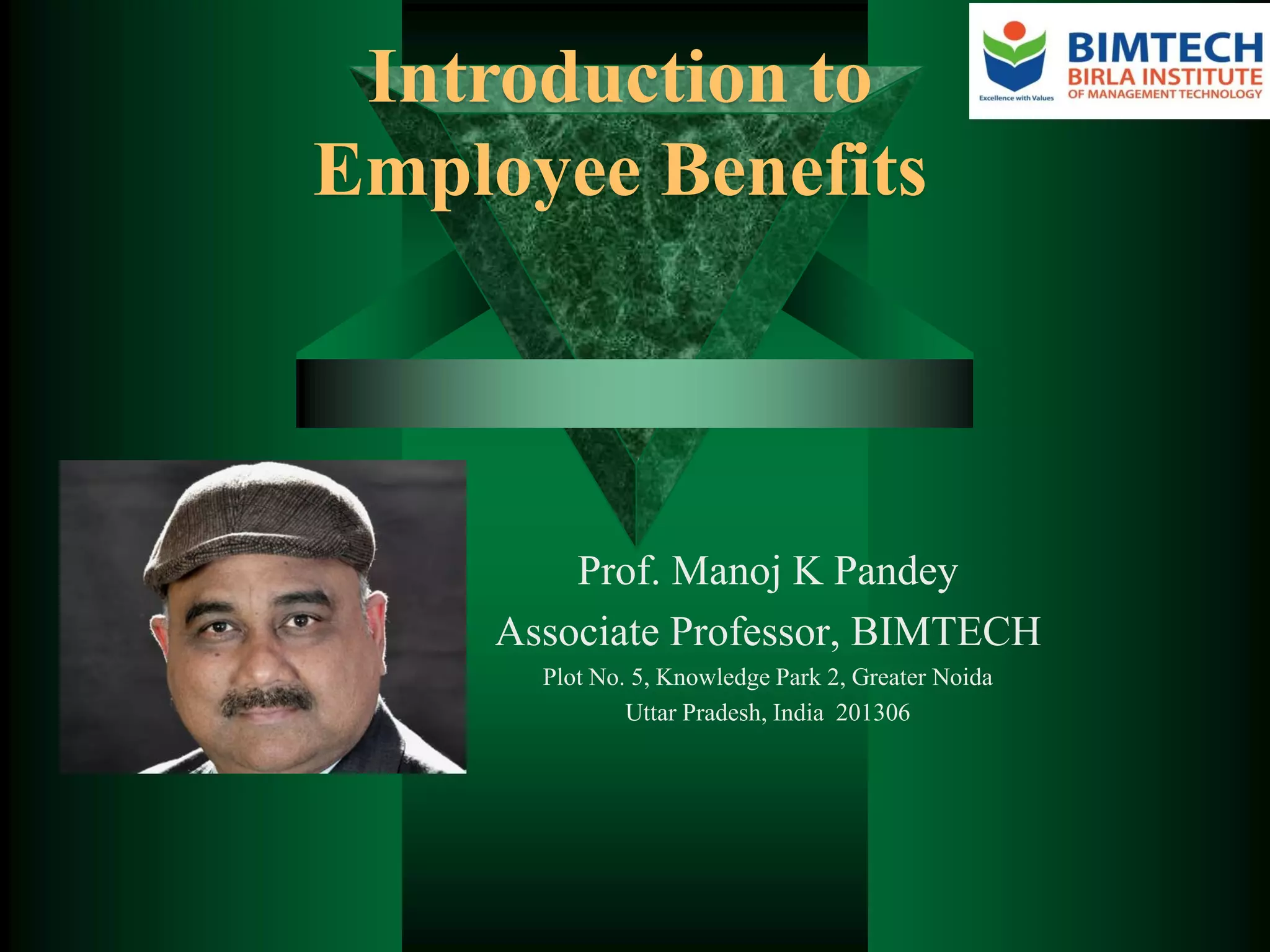
Prof. Manoj K Pandey
Associate Professor, BIMTECH
Plot No. 5, Knowledge Park 2, Greater Noida
Uttar Pradesh, India 201306
 Employee benefits (also understood by the names fringe
benefits, perquisites, or perks) are various non-wage
compensations provided to employees in addition to their
normal wages or salaries.
 Employee Benefits are growing in both cost and complexity.
Once regarded as "fringe benefits"- a minor appendages to
basic wages and salaries--they now commonly account for a
fourth or more of expenditures on employee compensation.
 Furthermore, the different taxation related benefits has added
more complexity to it & hence we see a growing
professionalization of benefits design and administration.
 Employers’ objectives in providing employee benefits:
Improving staff retention and attraction.
motivating employees to work harder.
 To foster good morale.
 Improving the health and welfare of employees.
 Being seen as an employer of choice.
 Reducing workplace stress.
 Complying with benefits regulations.
Taking benefits of the prevailing tax incentives
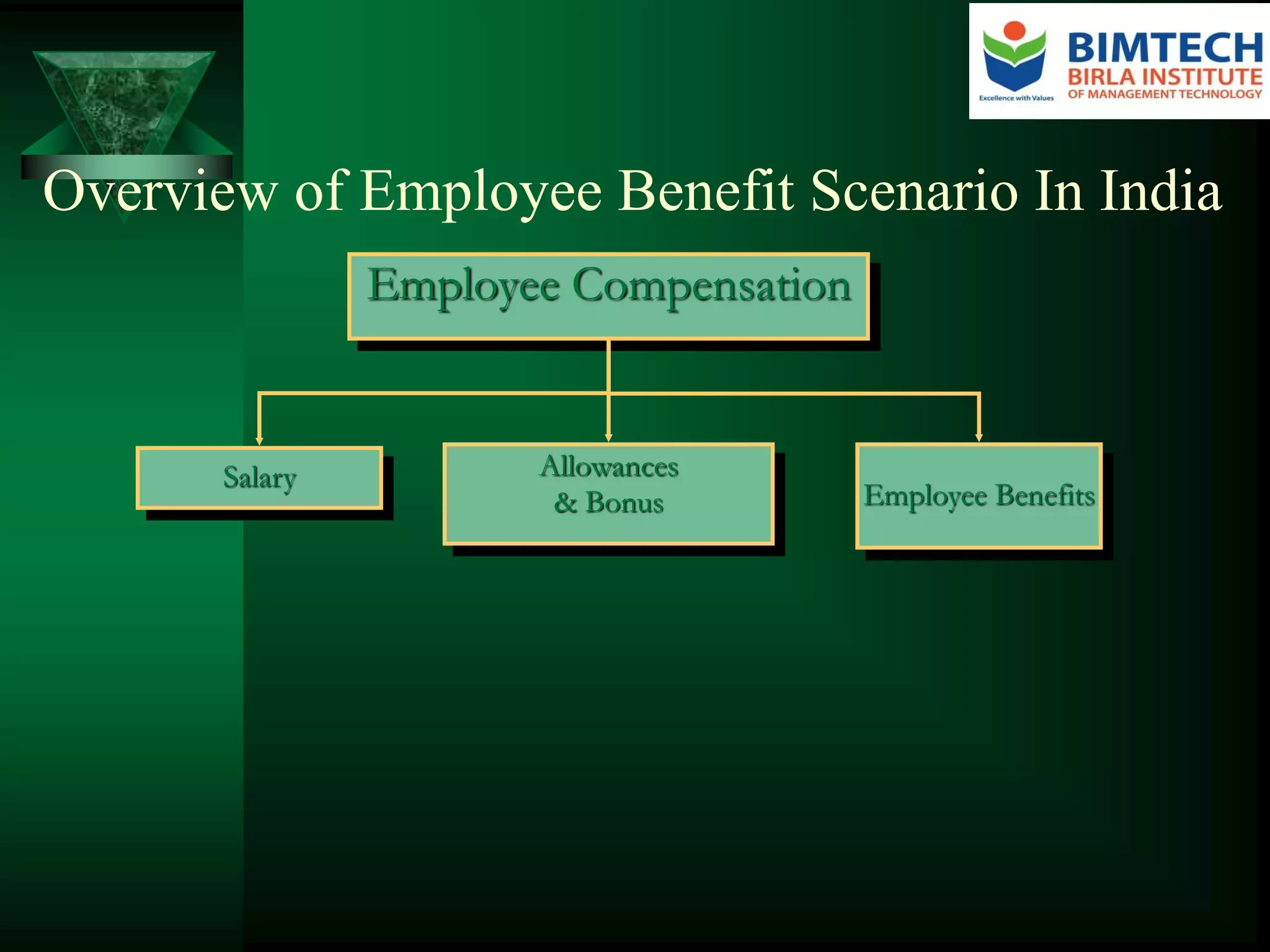
Overview of Employee Benefit Scenario In India
Employee Compensation
Salary Allowances
& Bonus Employee Benefits
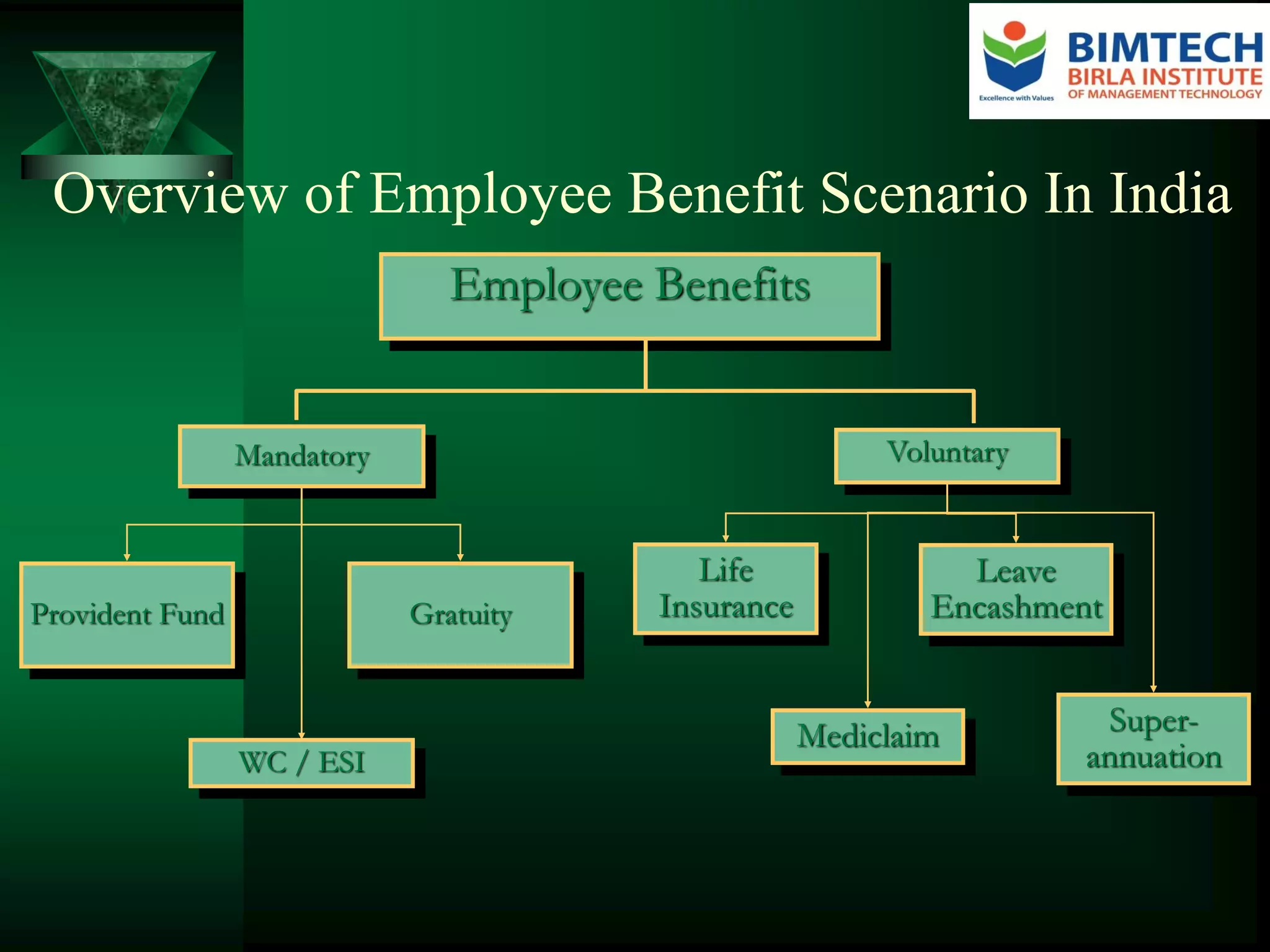
Overview of Employee Benefit Scenario In India
Employee Benefits
Mandatory Voluntary
Provident Fund Gratuity
WC / ESI
Mediclaim
Leave
Encashment
Life
Insurance
Super-
annuation
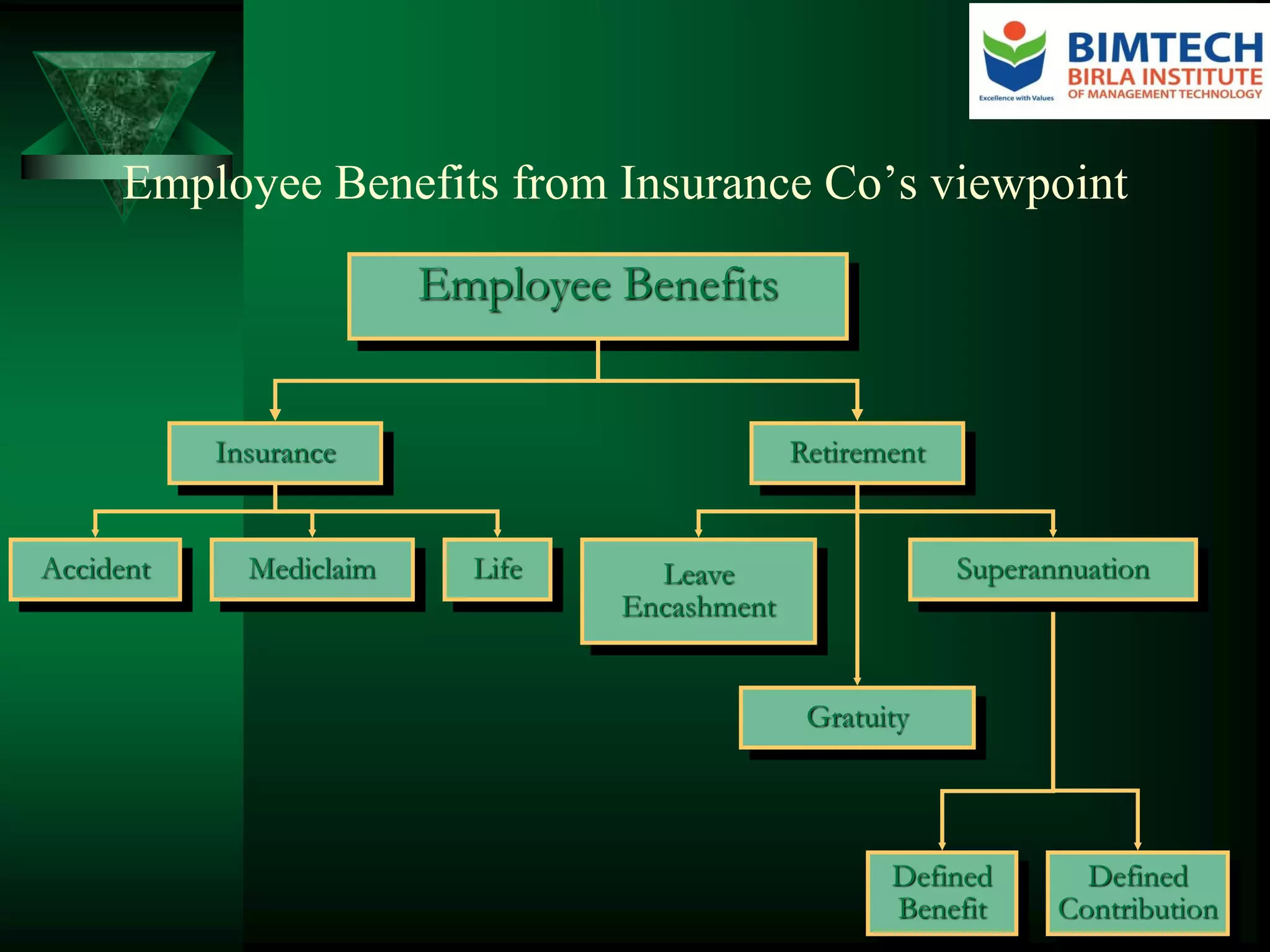
Employee Benefits from Insurance Co’s viewpoint
Employee Benefits
Insurance Retirement
Defined
Contribution
Defined
Benefit
LifeAccident Mediclaim Leave
Encashment
Gratuity
Superannuation
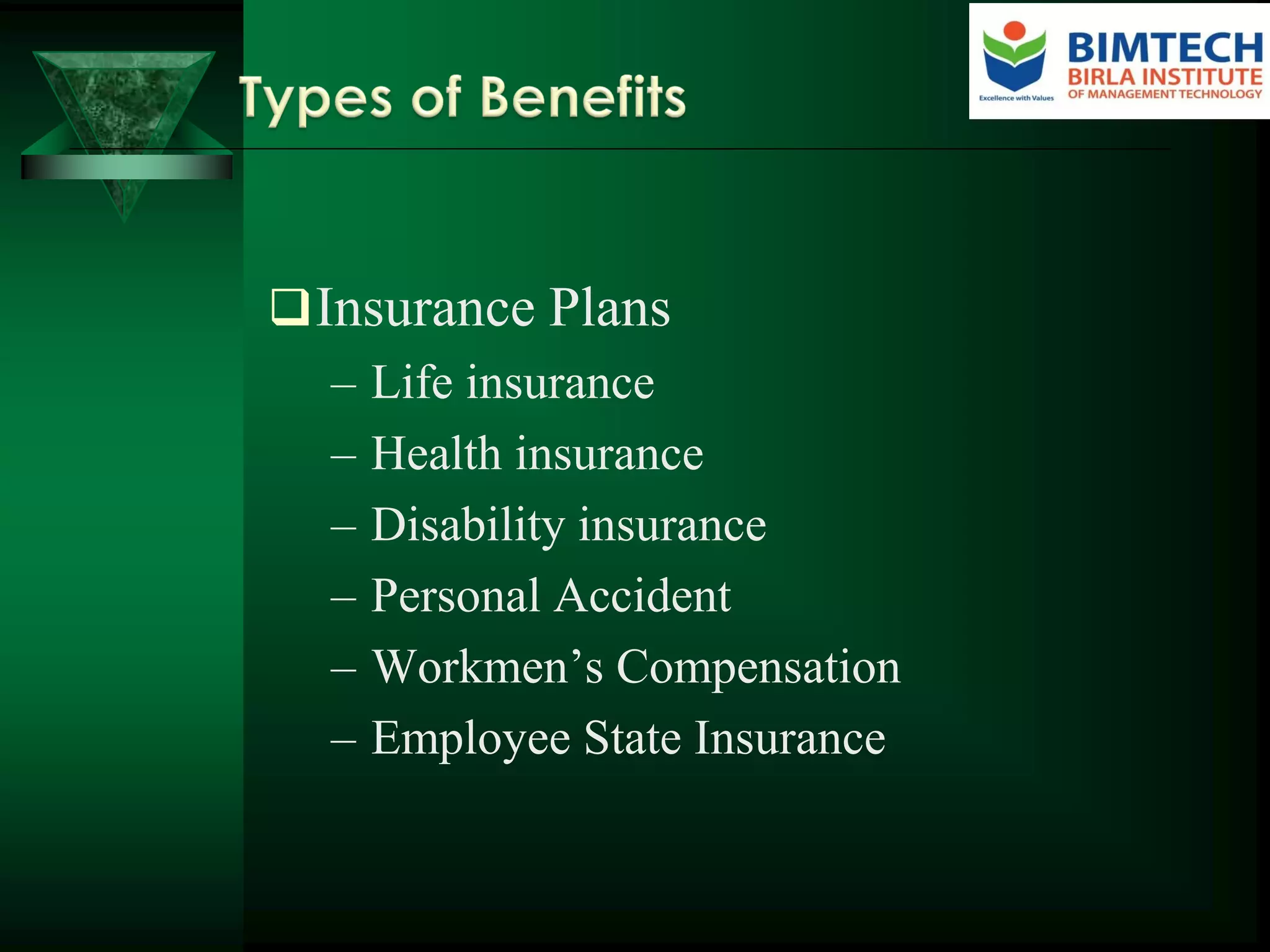
Insurance Plans
– Life insurance
– Health insurance
– Disability insurance
– Personal Accident
– Workmen’s Compensation
– Employee State Insurance
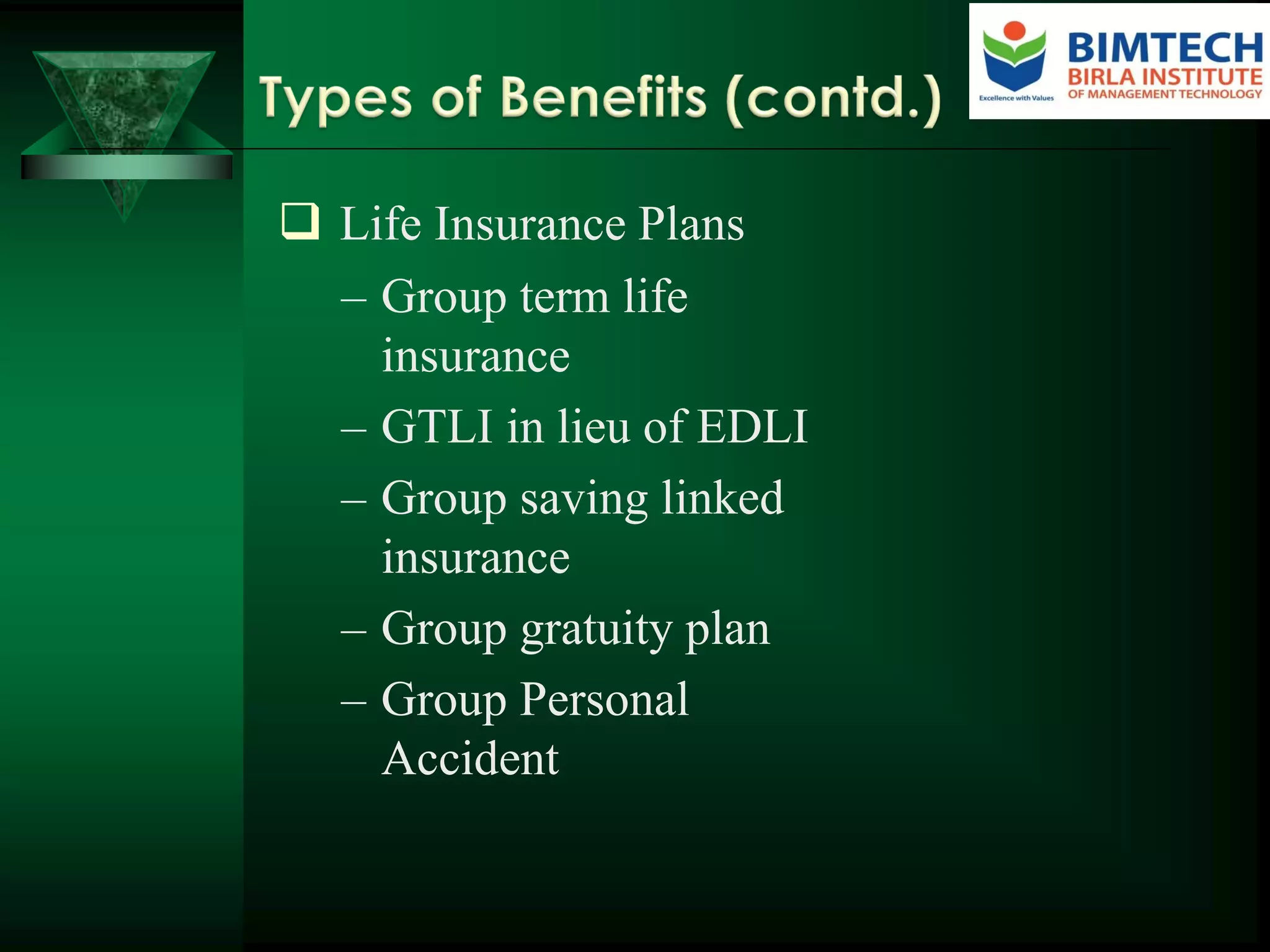
 Life Insurance Plans
– Group term life
insurance
– GTLI in lieu of EDLI
– Group saving linked
insurance
– Group gratuity plan
– Group Personal
Accident
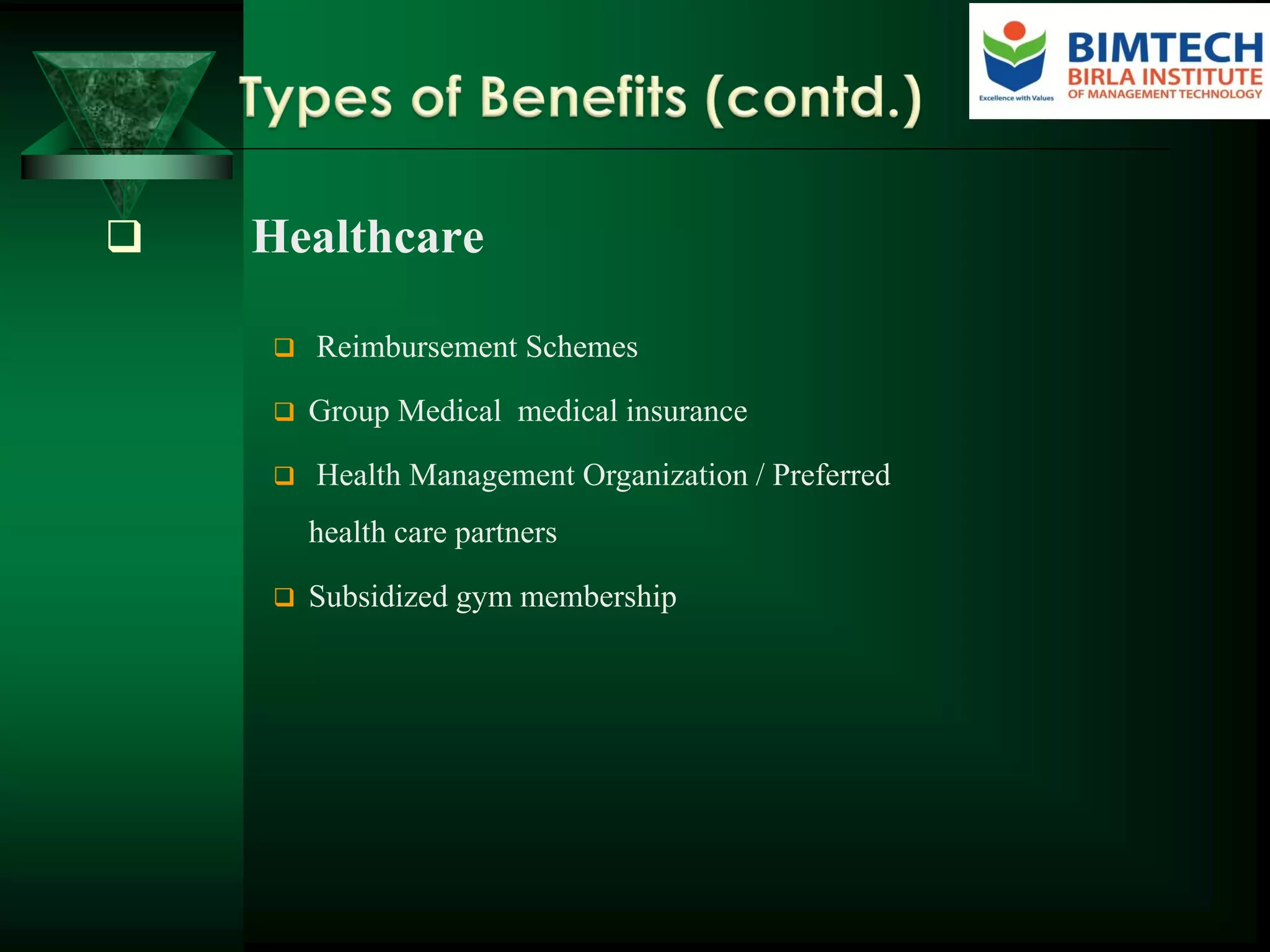
 Healthcare
 Reimbursement Schemes
 Group Medical medical insurance
 Health Management Organization / Preferred
health care partners
 Subsidized gym membership
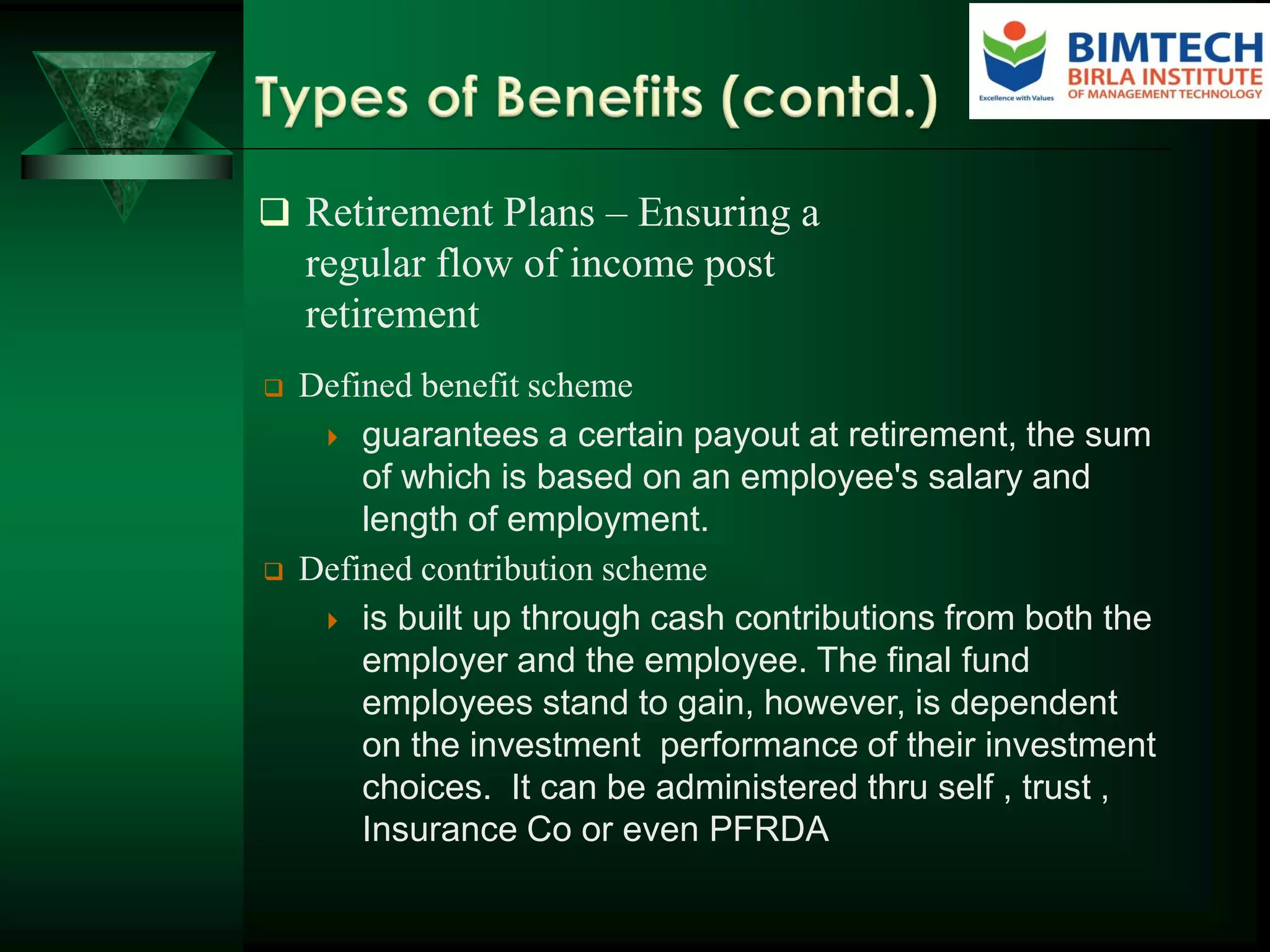
 Retirement Plans – Ensuring a
regular flow of income post
retirement
 Defined benefit scheme
 guarantees a certain payout at retirement, the sum
of which is based on an employee's salary and
length of employment.
 Defined contribution scheme
 is built up through cash contributions from both the
employer and the employee. The final fund
employees stand to gain, however, is dependent
on the investment performance of their investment
choices. It can be administered thru self , trust ,
Insurance Co or even PFRDA
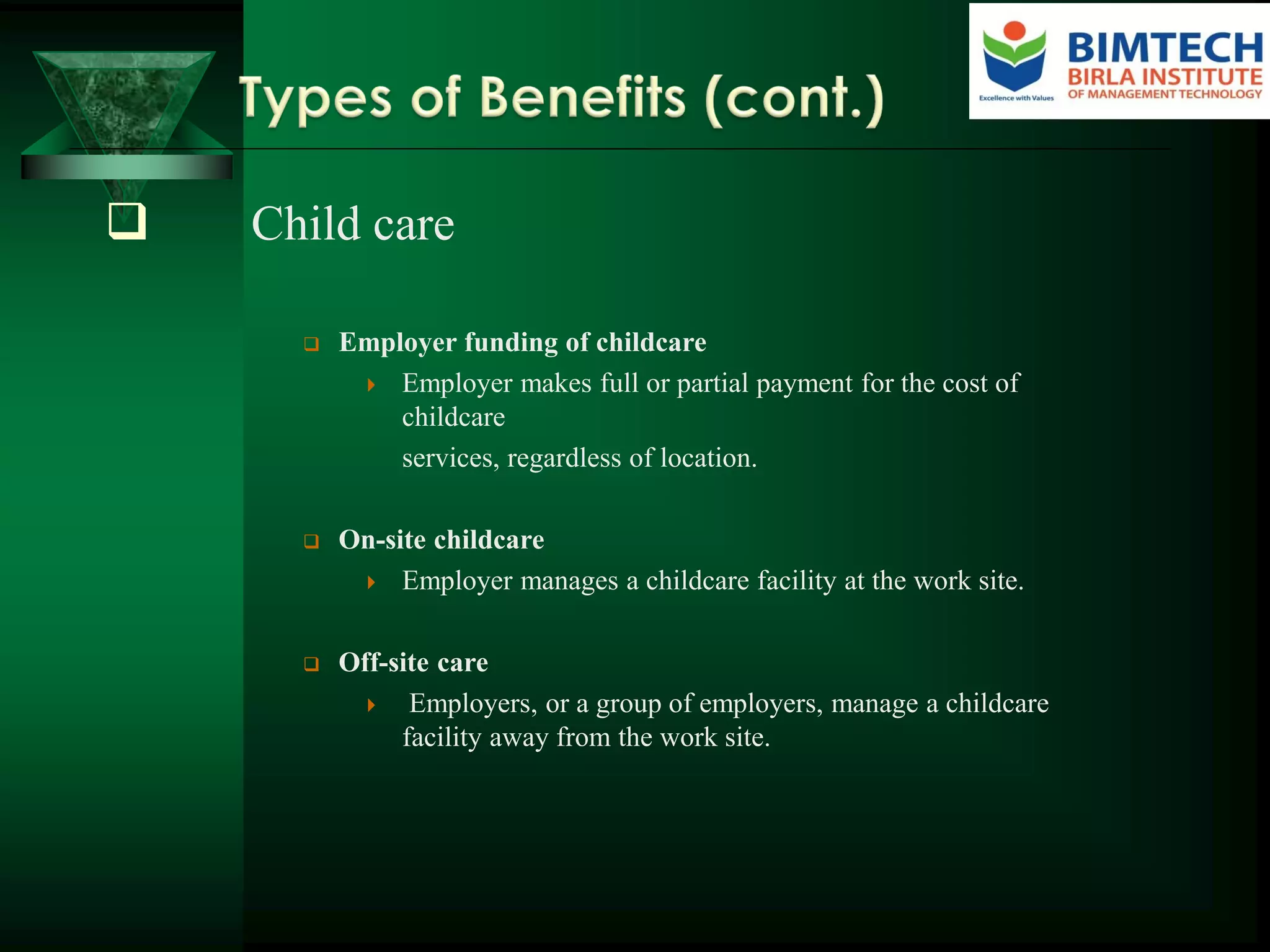
 Child care
 Employer funding of childcare
 Employer makes full or partial payment for the cost of
childcare
services, regardless of location.
 On-site childcare
 Employer manages a childcare facility at the work site.
 Off-site care
 Employers, or a group of employers, manage a childcare
facility away from the work site.
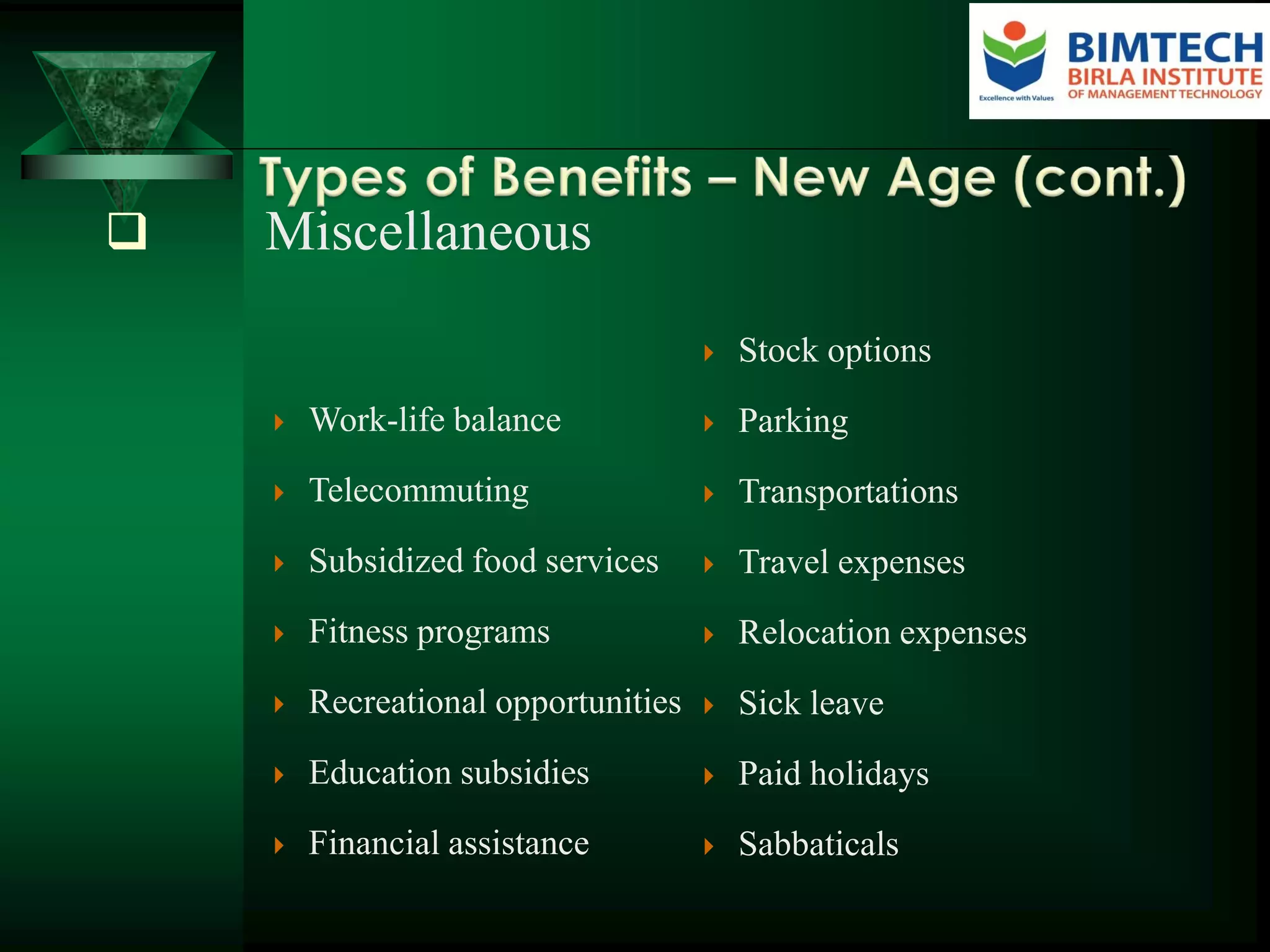
 Miscellaneous
 Work-life balance
 Telecommuting
 Subsidized food services
 Fitness programs
 Recreational opportunities
 Education subsidies
 Financial assistance
 Stock options
 Parking
 Transportations
 Travel expenses
 Relocation expenses
 Sick leave
 Paid holidays
 Sabbaticals
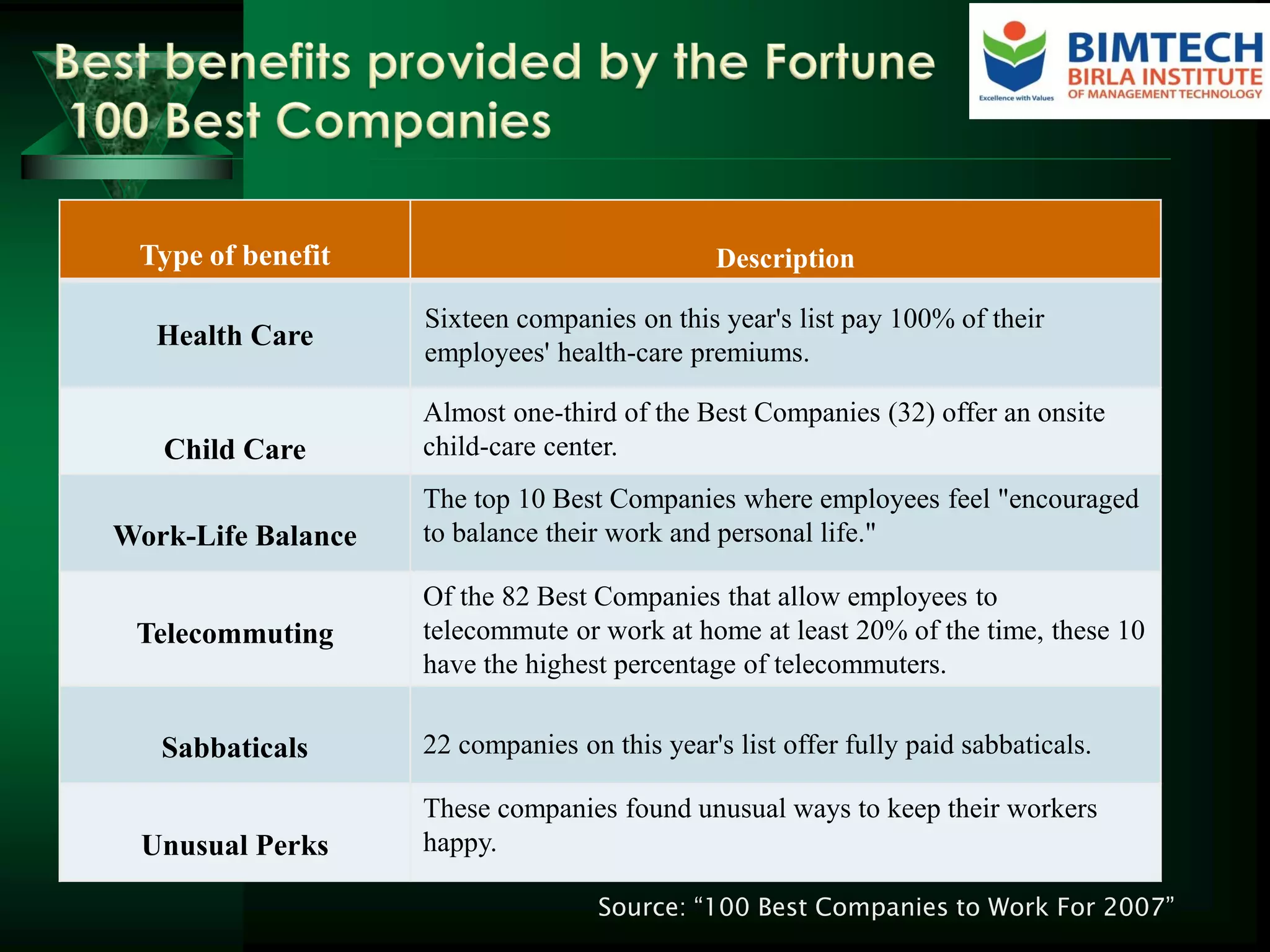
Type of benefit Description
Health Care
Sixteen companies on this year's list pay 100% of their
employees' health-care premiums.
Child Care
Almost one-third of the Best Companies (32) offer an onsite
child-care center.
Work-Life Balance
The top 10 Best Companies where employees feel "encouraged
to balance their work and personal life."
Telecommuting
Of the 82 Best Companies that allow employees to
telecommute or work at home at least 20% of the time, these 10
have the highest percentage of telecommuters.
Sabbaticals 22 companies on this year's list offer fully paid sabbaticals.
Unusual Perks
These companies found unusual ways to keep their workers
happy.
Source: “100 Best Companies to Work For 2007”
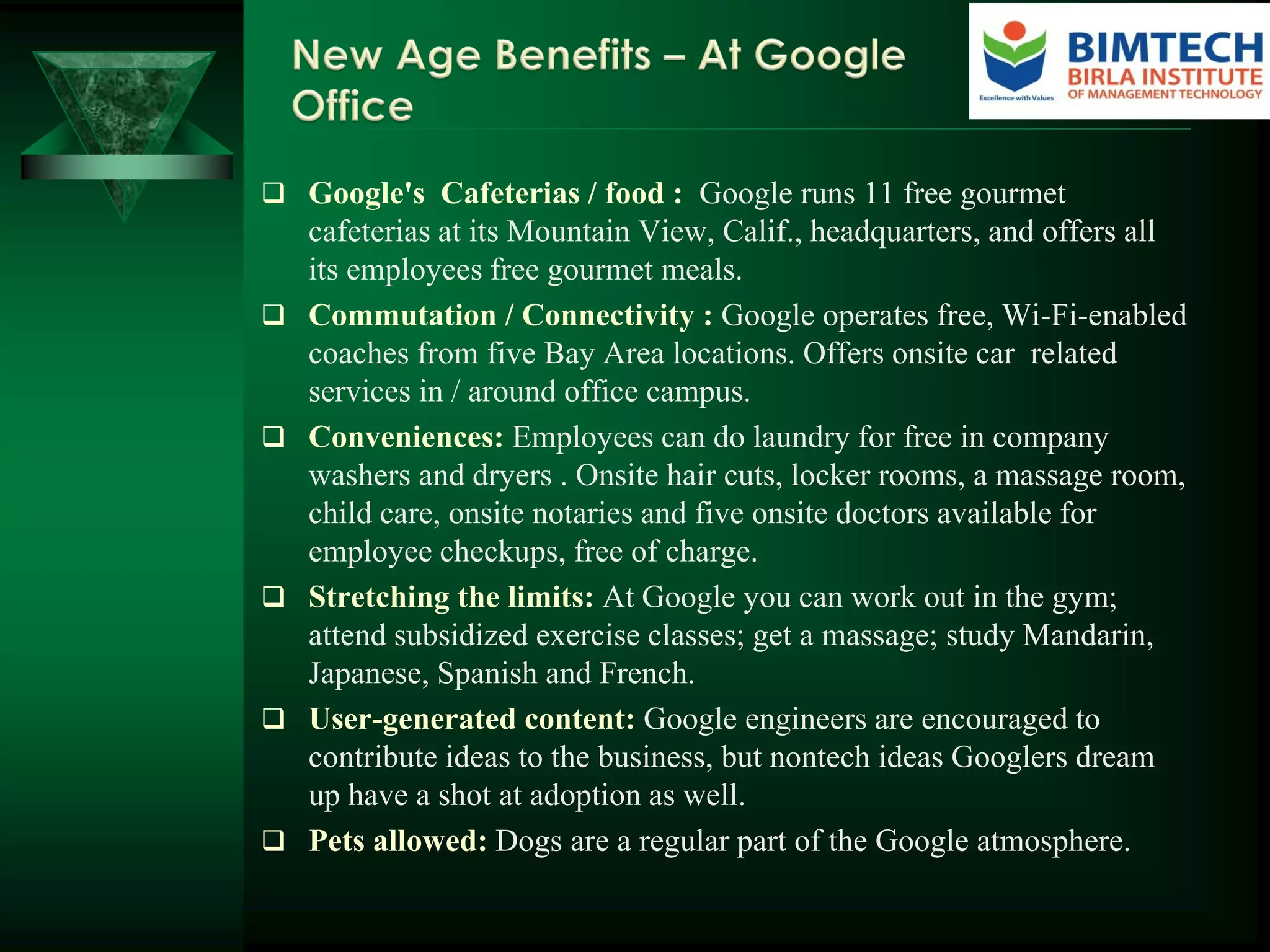
 Google's Cafeterias / food : Google runs 11 free gourmet
cafeterias at its Mountain View, Calif., headquarters, and offers all
its employees free gourmet meals.
 Commutation / Connectivity : Google operates free, Wi-Fi-enabled
coaches from five Bay Area locations. Offers onsite car related
services in / around office campus.
 Conveniences: Employees can do laundry for free in company
washers and dryers . Onsite hair cuts, locker rooms, a massage room,
child care, onsite notaries and five onsite doctors available for
employee checkups, free of charge.
 Stretching the limits: At Google you can work out in the gym;
attend subsidized exercise classes; get a massage; study Mandarin,
Japanese, Spanish and French.
 User-generated content: Google engineers are encouraged to
contribute ideas to the business, but nontech ideas Googlers dream
up have a shot at adoption as well.
 Pets allowed: Dogs are a regular part of the Google atmosphere.
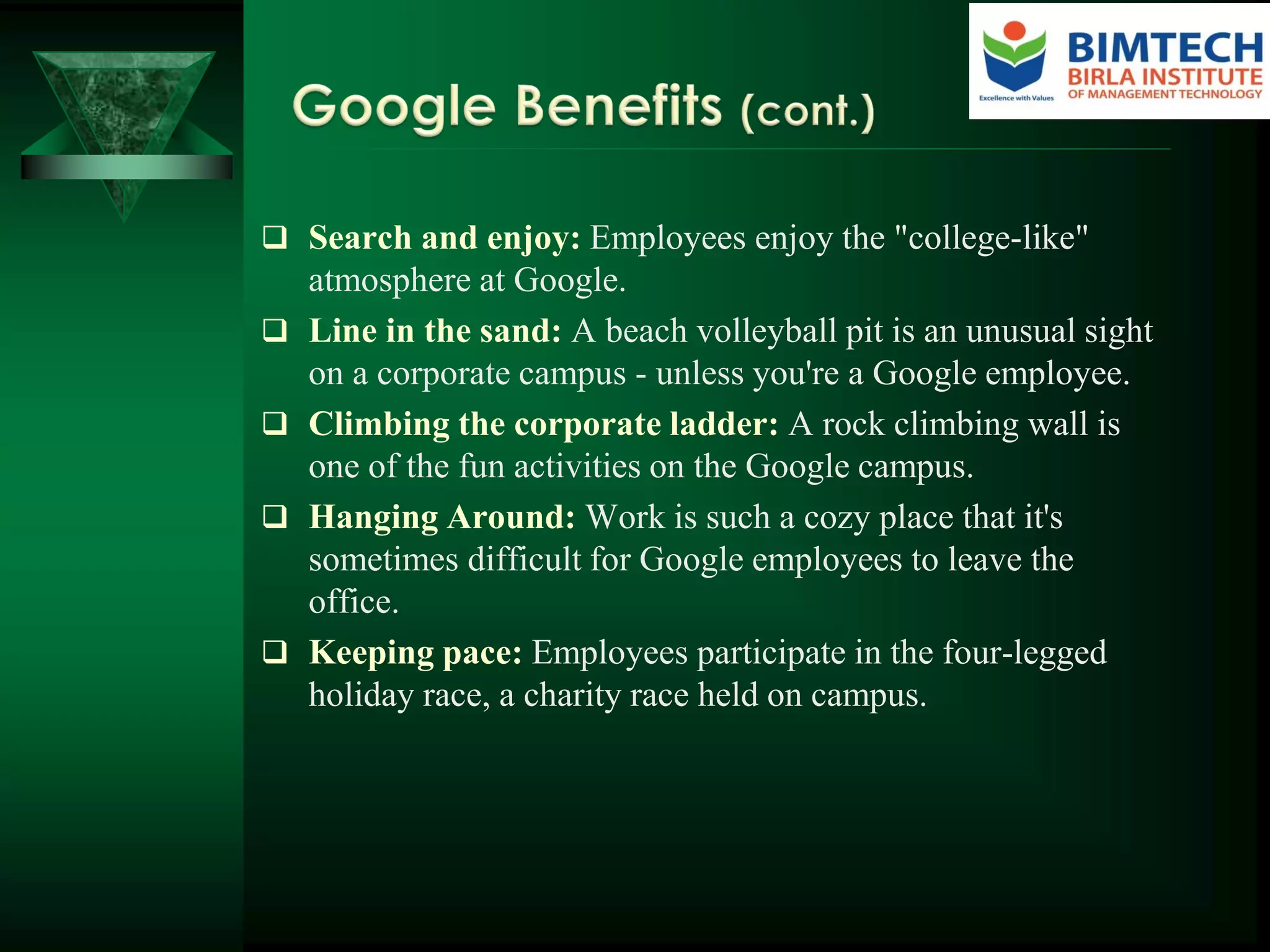
 Search and enjoy: Employees enjoy the "college-like"
atmosphere at Google.
 Line in the sand: A beach volleyball pit is an unusual sight
on a corporate campus - unless you're a Google employee.
 Climbing the corporate ladder: A rock climbing wall is
one of the fun activities on the Google campus.
 Hanging Around: Work is such a cozy place that it's
sometimes difficult for Google employees to leave the
office.
 Keeping pace: Employees participate in the four-legged
holiday race, a charity race held on campus.
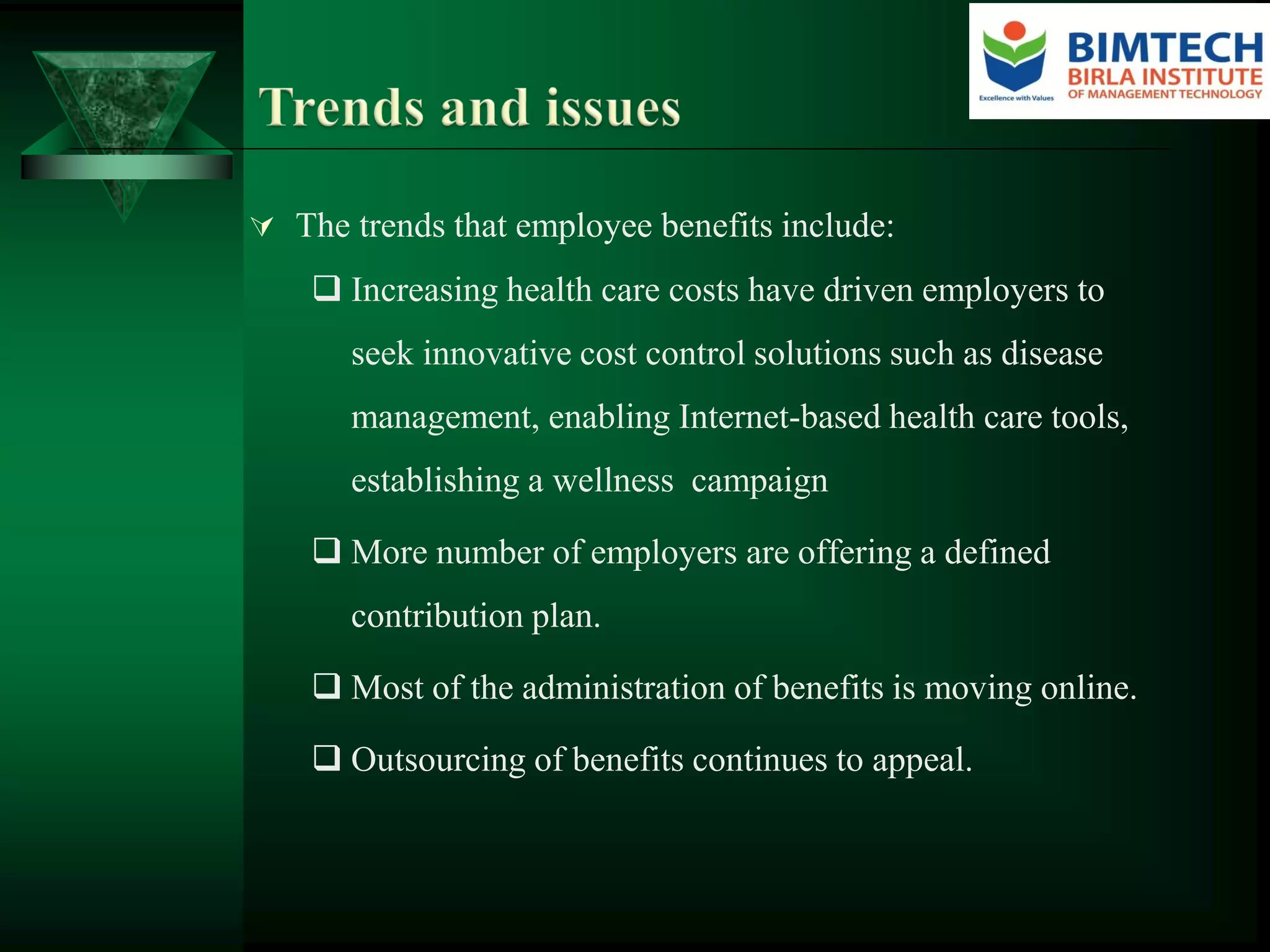
 The trends that employee benefits include:
 Increasing health care costs have driven employers to
seek innovative cost control solutions such as disease
management, enabling Internet-based health care tools,
establishing a wellness campaign
 More number of employers are offering a defined
contribution plan.
 Most of the administration of benefits is moving online.
 Outsourcing of benefits continues to appeal.
 The issues shaping the benefits design:
Improving the perceived value of the benefits
package.
Making the benefits more cost-effective.
Communicating the benefits.
Improving the staff engagement levels.
Matching benefits to employee needs.
Complying benefits to legislation.
 Importance of EB / complexities is of recent origin post
liberalization of economy.
 There were no formal EB in place in majority of the Indian
firms in pre-independence era.
 Companies with British Ownership were having retirement /
EB schemes even in those time though it was not mandatory
for their senior employees.
 Income Tax Act 1922 brought a change – allowed Income
Tax rebate for EB related funding for organizations -
though it remained voluntary
 EPF Act 1952 was a game changer – provisioning was
made compulsory for low salaried employees
 The family pension and Insurance (EDLI)schemes were
brought in in EPF in 1971 and 1976 respectively
 Payment of Bonus Act 1965 ensured sharing of the profit
with low salaried employee compulsory. Led to the
introduction of retirement plans.
 Gratuity Act came in to being in 1972 making the payment
a statutory requirement.
 Introduction of full fledged social security scheme in India
still remains a distant dream
 Implementation of even the mandatory schemes is not
adhered to in majority of the small / medium size
organizations.
Thanks

Introduction of Employee Benefits by Prof. Manoj K Pandey

  • 1.
    Introduction to Employee Benefits Prof.Manoj K Pandey Associate Professor, BIMTECH Plot No. 5, Knowledge Park 2, Greater Noida Uttar Pradesh, India 201306
  • 2.
     Employee benefits(also understood by the names fringe benefits, perquisites, or perks) are various non-wage compensations provided to employees in addition to their normal wages or salaries.  Employee Benefits are growing in both cost and complexity. Once regarded as "fringe benefits"- a minor appendages to basic wages and salaries--they now commonly account for a fourth or more of expenditures on employee compensation.  Furthermore, the different taxation related benefits has added more complexity to it & hence we see a growing professionalization of benefits design and administration.
  • 3.
     Employers’ objectivesin providing employee benefits: Improving staff retention and attraction. motivating employees to work harder.  To foster good morale.  Improving the health and welfare of employees.  Being seen as an employer of choice.  Reducing workplace stress.  Complying with benefits regulations. Taking benefits of the prevailing tax incentives
  • 4.
    Overview of EmployeeBenefit Scenario In India Employee Compensation Salary Allowances & Bonus Employee Benefits
  • 5.
    Overview of EmployeeBenefit Scenario In India Employee Benefits Mandatory Voluntary Provident Fund Gratuity WC / ESI Mediclaim Leave Encashment Life Insurance Super- annuation
  • 6.
    Employee Benefits fromInsurance Co’s viewpoint Employee Benefits Insurance Retirement Defined Contribution Defined Benefit LifeAccident Mediclaim Leave Encashment Gratuity Superannuation
  • 7.
    Insurance Plans – Lifeinsurance – Health insurance – Disability insurance – Personal Accident – Workmen’s Compensation – Employee State Insurance
  • 8.
     Life InsurancePlans – Group term life insurance – GTLI in lieu of EDLI – Group saving linked insurance – Group gratuity plan – Group Personal Accident
  • 9.
     Healthcare  ReimbursementSchemes  Group Medical medical insurance  Health Management Organization / Preferred health care partners  Subsidized gym membership
  • 10.
     Retirement Plans– Ensuring a regular flow of income post retirement  Defined benefit scheme  guarantees a certain payout at retirement, the sum of which is based on an employee's salary and length of employment.  Defined contribution scheme  is built up through cash contributions from both the employer and the employee. The final fund employees stand to gain, however, is dependent on the investment performance of their investment choices. It can be administered thru self , trust , Insurance Co or even PFRDA
  • 11.
     Child care Employer funding of childcare  Employer makes full or partial payment for the cost of childcare services, regardless of location.  On-site childcare  Employer manages a childcare facility at the work site.  Off-site care  Employers, or a group of employers, manage a childcare facility away from the work site.
  • 12.
     Miscellaneous  Work-lifebalance  Telecommuting  Subsidized food services  Fitness programs  Recreational opportunities  Education subsidies  Financial assistance  Stock options  Parking  Transportations  Travel expenses  Relocation expenses  Sick leave  Paid holidays  Sabbaticals
  • 13.
    Type of benefitDescription Health Care Sixteen companies on this year's list pay 100% of their employees' health-care premiums. Child Care Almost one-third of the Best Companies (32) offer an onsite child-care center. Work-Life Balance The top 10 Best Companies where employees feel "encouraged to balance their work and personal life." Telecommuting Of the 82 Best Companies that allow employees to telecommute or work at home at least 20% of the time, these 10 have the highest percentage of telecommuters. Sabbaticals 22 companies on this year's list offer fully paid sabbaticals. Unusual Perks These companies found unusual ways to keep their workers happy. Source: “100 Best Companies to Work For 2007”
  • 14.
     Google's Cafeterias/ food : Google runs 11 free gourmet cafeterias at its Mountain View, Calif., headquarters, and offers all its employees free gourmet meals.  Commutation / Connectivity : Google operates free, Wi-Fi-enabled coaches from five Bay Area locations. Offers onsite car related services in / around office campus.  Conveniences: Employees can do laundry for free in company washers and dryers . Onsite hair cuts, locker rooms, a massage room, child care, onsite notaries and five onsite doctors available for employee checkups, free of charge.  Stretching the limits: At Google you can work out in the gym; attend subsidized exercise classes; get a massage; study Mandarin, Japanese, Spanish and French.  User-generated content: Google engineers are encouraged to contribute ideas to the business, but nontech ideas Googlers dream up have a shot at adoption as well.  Pets allowed: Dogs are a regular part of the Google atmosphere.
  • 15.
     Search andenjoy: Employees enjoy the "college-like" atmosphere at Google.  Line in the sand: A beach volleyball pit is an unusual sight on a corporate campus - unless you're a Google employee.  Climbing the corporate ladder: A rock climbing wall is one of the fun activities on the Google campus.  Hanging Around: Work is such a cozy place that it's sometimes difficult for Google employees to leave the office.  Keeping pace: Employees participate in the four-legged holiday race, a charity race held on campus.
  • 16.
     The trendsthat employee benefits include:  Increasing health care costs have driven employers to seek innovative cost control solutions such as disease management, enabling Internet-based health care tools, establishing a wellness campaign  More number of employers are offering a defined contribution plan.  Most of the administration of benefits is moving online.  Outsourcing of benefits continues to appeal.
  • 17.
     The issuesshaping the benefits design: Improving the perceived value of the benefits package. Making the benefits more cost-effective. Communicating the benefits. Improving the staff engagement levels. Matching benefits to employee needs. Complying benefits to legislation.
  • 18.
     Importance ofEB / complexities is of recent origin post liberalization of economy.  There were no formal EB in place in majority of the Indian firms in pre-independence era.  Companies with British Ownership were having retirement / EB schemes even in those time though it was not mandatory for their senior employees.  Income Tax Act 1922 brought a change – allowed Income Tax rebate for EB related funding for organizations - though it remained voluntary  EPF Act 1952 was a game changer – provisioning was made compulsory for low salaried employees
  • 19.
     The familypension and Insurance (EDLI)schemes were brought in in EPF in 1971 and 1976 respectively  Payment of Bonus Act 1965 ensured sharing of the profit with low salaried employee compulsory. Led to the introduction of retirement plans.  Gratuity Act came in to being in 1972 making the payment a statutory requirement.  Introduction of full fledged social security scheme in India still remains a distant dream  Implementation of even the mandatory schemes is not adhered to in majority of the small / medium size organizations.
  • 20.