Geniculate Artery Embolization:
Role in Knee Hemarthrosis and
Osteoarthritis
Daniel B. Heller, BA
Allison E. Beggin, BA
Alexander H. Lam, MD
Maureen P. Kohi, MD
Michael B. Heller, MD
University of Illinois College of Medicine at Rockford, 1601
Parkview Ave, Rockford, IL 61107 (D.B.H., A.E.B.);
Department of Interventional Radiology, University of
California San Francisco, San Francisco, Calif (A.H.L.,
M.B.H.); and Department of Radiology, University of North
Carolina, Chapel Hill, NC (M.P.K.).
Outline
• Knee anatomy
• Knee hemarthrosis
• Background
• Diagnosis and Treatment
• Knee osteoarthritis
• Background
• Diagnosis and Treatment
• Geniculate Artery Embolization
• Technique
• Evidence
• Cases
• Conclusion
Hemarthrosis Osteoarthritis
Anatomy Conclusion
Geniculate Artery Embolization Cases
Hemarthrosis Osteoarthritis
Anatomy Conclusion
Geniculate Artery Embolization Cases
Knee Anatomy: Radiography & MRI
Fibula
Femur
Femur
Tibia
Tibia
Patella
Tibiofemoral
joint space Menisci
Femur
Tibia
Fibula
Patella
Suprapatellar
joint space
C
A
B
G
F
I
J
A. Femoral artery
B. Descending genicular artery
C. Popliteal artery
D. Articular branch of femoral
artery
E. Saphenous branch of femoral
artery
F. Superior lateral genicular artery
G. Superior medial genicular artery
H. Median genicular artery
I. Inferior lateral genicular artery
J. Inferior medial genicular artery
K. Anterior tibial recurrent artery
L. Anterior tibial artery
M. Tibioperoneal trunk
H
M
L
K
D
E
Hemarthrosis Osteoarthritis
Anatomy Conclusion
Geniculate Artery Embolization Cases
Knee Anatomy: Vascular
Hemarthrosis: Background
• What is it?
• Joint effusion with hemorrhage into the joint space
• Symptoms?
• Pain, swelling, stiffness, and warmth of knee
• Causes?
• Traumatic:
• Posttraumatic, postoperative vascular injury
• 0.2%-1.6% incidence after total knee arthroplasty
• Nontraumatic:
• Bleeding diatheses (hemophilia, anticoagulation)
• Osteoarthritis (OA), infectious, or neoplasm
Hemarthrosis Osteoarthritis
Anatomy Conclusion
Geniculate Artery Embolization Cases
Hemarthrosis: Diagnosis
• US: Hypoechoic fluid within joint space
• With or without internal echoes (related to hemorrhage age)
• Radiography: Joint effusion with fluid-fluid levels on lateral
view (lipohemarthrosis)
• Displacement of patella or quadriceps tendon
• CT: Acute intra-articular hemorrhage with possible associated
fracture
• MRI: Fluid-fluid levels with synovial hypertrophy/enhancement
• Traumatic: Intra-articular fracture with associated
ligamentous injury
• Chronic: Cartilage and meniscal destruction
• Aspiration (reference standard): Red, pink, or brown
synovial fluid
• Traumatic: Clotting should be present
• True bloody effusion fails to clot due to chronic fibrinolysis
Hemarthrosis Osteoarthritis
Anatomy Conclusion
Geniculate Artery Embolization Cases
Hemarthrosis: Diagnosis
Hemarthrosis Osteoarthritis
Anatomy Conclusion
Geniculate Artery Embolization Cases
A B C
A. Sagittal proton-density MRI: Narrowed joint space with subchondral degeneration (yellow) and synovial thickening.
B. Sagittal T2-weighted fat-saturated MRI: Extensive synovial proliferation, hemosiderin deposition, and associated
near-complete absence of the menisci and joint space (yellow) secondary to recurrent hemarthrosis.
C. US of the suprapatellar space: notable for moderate joint effusion with echogenic debris (red arrows), compatible
with hemarthrosis.
Hemarthrosis: Management
• Conservative management
• Noninvasive: Immobilization, ice, compression, and analgesics
• Hemophilia-related hemarthrosis:
• Arthrocentesis with lavage and steroid instillation
• Factor correction
• Recurrent episode management
• Traumatic hemarthrosis: Surgical synovectomy
• Hemophilia-related: If synovectomy not feasible or not successful, geniculate artery
embolization
Hemarthrosis Osteoarthritis
Anatomy Conclusion
Geniculate Artery Embolization Cases
Osteoarthritis (OA): Background
• What is it?
• Degenerative joint disease due to wear and tear of joint cartilage and bone
• Epidemiology?
• Leading cause of chronic pain and disability in elderly persons
• Lifetime risk of symptomatic knee OA: 40% in men, 47% in women
• 80% of OA disease burden is from knee OA, affecting 19% of Americans >40 years old
• Clinical Symptoms?
• Sharp pain with activity that may evolve into constant dull or aching pain
• Joint tenderness, bony swelling, instability, stiffness – All relieved by rest
• Risk Factors?
• Obesity, female sex
• Prior trauma, occupation, older age
Hemarthrosis Osteoarthritis
Anatomy Conclusion
Geniculate Artery Embolization Cases
Osteoarthritis: Pathophysiology
• Mechanical forces result in
degenerative changes, which result in
inflammation
• Inflammation stimulates angiogenesis,
and vice versa
• Results in pain and further
degenerative change
Hemarthrosis Osteoarthritis
Anatomy Conclusion
Geniculate Artery Embolization Cases
Hunter D, Bierma-Zeinstra S. Osteoarthritis. The Lancet. April 2019. Vol 393, Issue 10182, P 1745-1759.
Dye SF, Vaupel GL, Dye CC. Conscious neurosensory mapping of the internal structures of the human knee without intraarticular anesthesia. Am J Sports Med. 1998;26(6):773–7.
Hemarthrosis Osteoarthritis
Anatomy Conclusion
Geniculate Artery Embolization Cases
Osteoarthritis: Diagnosis
• US: Not commonly used
• Can detect joint effusion, osteophytes
• Radiography: Most commonly used modality
• Joint space narrowing, osteophytosis, subchondral sclerosis or cysts
• CT: Similar to radiography
• Reactive bony remodeling (osteophytosis, subchondral changes, sclerosis)
• MRI: Cartilage, meniscal, ligamentous, and joint space changes
• Bone remodeling (subchondral changes), effusions, synovial thickening/enhancement
• Bone marrow edema-like lesions (BMLs) – degenerative lesions
Braun H, Gold G. Diagnosis of Osteoarthritis: Imaging.. Bone 2012 August; 51(2): 278-288.
Knee MRI (proton-density, coronal): Same knee
with similar osteophytosis (red arrow), joint
space narrowing (yellow arrows), and more
noticeable is a large intraosseous ganglion (pink)
Hemarthrosis Osteoarthritis
Anatomy Conclusion
Geniculate Artery Embolization Cases
Osteoarthritis: Diagnosis
Knee radiograph (coronal): Severe
osteophytosis (red arrow) and joint space
narrowing (yellow arrows) more so on the
medial tibiofemoral compartment.
Precontrast (A) and postcontrast (B) coronal fat-saturation MRI demonstrates
synovial thickening and enhancement (red arrows)
Hemarthrosis Osteoarthritis
Anatomy Conclusion
Geniculate Artery Embolization Cases
Osteoarthritis: Diagnosis
A B
Hemarthrosis Osteoarthritis
Anatomy Conclusion
Geniculate Artery Embolization Cases
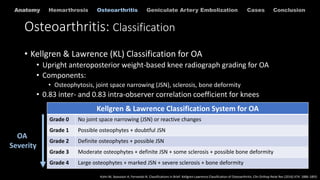
Osteoarthritis: Classification
• Kellgren & Lawrence (KL) Classification for OA
• Upright anteroposterior weight-based knee radiograph grading for OA
• Components:
• Osteophytosis, joint space narrowing (JSN), sclerosis, bone deformity
• 0.83 inter- and 0.83 intra-observer correlation coefficient for knees
Kellgren & Lawrence Classification System for OA
Grade 0 No joint space narrowing (JSN) or reactive changes
Grade 1 Possible osteophytes + doubtful JSN
Grade 2 Definite osteophytes + possible JSN
Grade 3 Moderate osteophytes + definite JSN + some sclerosis + possible bone deformity
Grade 4 Large osteophytes + marked JSN + severe sclerosis + bone deformity
OA
Severity
Kohn M, Seassoon A, Fernando N. Classifications in Brief: Kellgren-Lawrence Classification of Osteoarthritis. Clin Orthop Relat Res (2016) 474: 1886-1893.
Osteoarthritis: Management
• Conservative management (mild to moderate OA):
• Education, weight loss, exercise, knee brace
• Medications: NSAIDs, tramadol, duloxetine, capsaicin
• Minimally invasive options (mild to moderate OA):
• Intra-articular steroid or HA injections
• Geniculate artery embolization
• Surgical management (severe OA):
• Arthroplasty (unicompartmental or total knee arthroplasty)
• Avoid until severe OA to preserve natural joint for as long as possible
Hemarthrosis Osteoarthritis
Anatomy Conclusion
Geniculate Artery Embolization Cases
Geniculate Artery Embolization (GAE)
• Selective intra-arterial embolization of the geniculate arteries
• Embolize hypervascular segments related to pain location
• Reduction in synovial blood supply  decreased neovascularity 
decreased pain
Hemarthrosis Osteoarthritis
Anatomy Conclusion
Geniculate Artery Embolization Cases
Angiogenesis (Neovascularity)
Increased inflammation
Cartilage Destruction Sensory Nerve Growth
Recurrent Hemarthrosis or Mechanical Damage (OA)
Geniculate Artery Embolization
GAE: Technique
• Access: Ipsilateral or contralateral femoral artery
• Angiography: Via 5-F base catheter in popliteal artery
• Hemarthrosis: Identify synovial blush (hyperemia)
• OA: Identify synovial blush and correlate with
location of pain
• Selective catheterization via microcatheter
• Confirm location and synovial blush
• Embolization
• Particles (100-500 μm) +/- coils (hemarthrosis)
• End goal: Resolution of hyperemia and pruning of
vessels
• Postembolization
• Confirm occlusion with run via popliteal artery
Hemarthrosis Osteoarthritis
Anatomy Conclusion
Geniculate Artery Embolization Cases
GAE: Embolic Options
Temporary Embolics
• Imipenem/Cilastin (IPM/CS)
• 0.5 gram IPM/CS suspended in 5-10 mL of contrast
Permanent Embolics
• Particles (PVA or Embozene)
• Particles <300 μm have higher risk of skin ischemia
• Can cause skin color changes
• Coils (proximal embolization)
Hemarthrosis Osteoarthritis
Anatomy Conclusion
Geniculate Artery Embolization Cases
Article (GAE for OA) Embolic Agent
Okuno et al, 2015 Imipenem/Cilastin (IPM/CS)
Okuno et al, 2017 IPM/CS (n=88/95) and 75 μm Embozene (n=7/95)
Lee et al, 2019 IPM/CS (n=71)
Bagla et al, 2019 75-100 μm Embozene
Landers et al, 2020 90-180 μm PVA or IPM/CS
Recurrent Hemarthrosis
• 100-700 μm polyvinyl alcohol (PVA) particles
• Coils (prevent recanalization)
Osteoarthritis
• IPM/CS (0.5 gram IPM/CS in 5-10 mL contrast)
• 75-100 μm in 2 mL contrast (if allergic to IPM/CS)
GAE: Literature Review - Hemarthrosis
Hemarthrosis Osteoarthritis
Anatomy Conclusion
Geniculate Artery Embolization Cases
Article Embolic No. of Patients Clinical Success
Waldernberger et al, 2012 150- or 500-μm +/- Coils 35 93.4% (29 mo)
Weidner et al, 2015 100- or 700-μm 13 92.3% (24 mo)
Guevera et al, 2016 300- or 700-μm +/- NBCA 10 60% (545 d)
Van Baardewijk et al, 2019 150- or 500-μm +/- Coils 14 86% (26.8 mo)
Luyckx et al, 2020 100- or 500-μm 31 84% (82 mo)
Average of 2.6 weeks to resolution (Bagla et al, 2013)
GAE: Literature Review--OA
Hemarthrosis Osteoarthritis
Anatomy Conclusion
Geniculate Artery Embolization Cases
• Okuno et al (JVIR 2017)
• 72 patients with mild to moderate OA – 95 knees embolized (IPM/CS or 75 μm)
• 86.3% clinical success rate (50% or more reduction in WOMAC score) at 6 months
• 90% reduction in opiate use (20/22) at 12 months
• Lee et al (CVIR 2019)
• 41 patients with mild to severe OA – 71 knees embolized (IPM/CS)
• Significant reduction in VAS score at 6 months in patients with mild to moderate OA, but not severe OA
• Bagla et al (JVIR 2019)
• 20 patients with moderate to severe OA (75 or 100 μm)
• Significant decrease in WOMAC score at 6 months
P < 0.001 P < 0.001 P < 0.001
Okuno et al. JVIR 2017.
GAE: Literature Review--OA
Hemarthrosis Osteoarthritis
Anatomy Conclusion
Geniculate Artery Embolization Cases
Article Embolic Baseline 1 month 6 months
Okuno et al, 2017 IPM/CS (88/95), 75 μm (7/95) 43 ± 8.3 24 ± 14 11.2 ± 10
Bagla et al, 2019 75- or 100-μm 61 ± 12 24 ± 17 31 ± 26
Total WOMAC Score
Article Embolic Baseline 1 month 3 months
Bagla et al, 2019 75- or 100-μm 76 ± 14 22 ± 19 34 ± 26
Lee et al, 2019 IPM/CS (KL 1-3) 5.5 2.9 2.2
Lee et al, 2019 IPM/CS (KL 4) 6.3 4.4 5.4 (Not P < 0.05)
Total Visual Analogue Scale (VAS) Score
The WOMAC is a widely used, disease-specific measure for knee OA that consists of 24 items: five regarding pain, two regarding stiffness, and 17
regarding physical function; possible score ranges for each subset: (pain: 0–20; stiffness: 0–8; and physical function: 0–68)
Total WOMAC: Sum of pain, stiffness and physical function score (0-96)
Visual Analog Scale (VAS) of pain (0-100). KL 1-3 (Mild to moderate degenerative OA), KL 4 (Severe degenerative OA)
A. Preembolization angiography
demonstrates prominent
superior and inferior lateral
genicular arteries (arrows)
B. Synovial blush (yellow region)
associated with prominent
arteries
A B
Hemarthrosis Osteoarthritis
Anatomy Conclusion
Geniculate Artery Embolization Cases
Case: Hemarthrosis after total knee replacement
C. Postembolization angiogram after
particle and coil embolization (★)
demonstrates non-filling of the lateral
genicular branches and loss of
synovial blush
Hemarthrosis Osteoarthritis
Anatomy Conclusion
Geniculate Artery Embolization Cases
Case: Hemarthrosis after total knee replacement
C
A. Preembolization angiography demonstrates descending genicular artery (arrow) contributing to significant synovial blush
B. Microcatheter within the descending genicular artery with synovial enhancement (yellow region) along the medial aspect of the knee
C. Postembolization angiogram after particle embolization demonstrates reduction in synovial blush.
A B C
Hemarthrosis Osteoarthritis
Anatomy Conclusion
Geniculate Artery Embolization Cases
Case: Hemophilia-related hemarthrosis
• Hypervascularity results in inflammation and pain
• GAE is an option to reduce the vascularity with good long-term clinical success
• GAE is safe and effective for recurrent hemarthrosis and osteoarthritis
• Primary embolics
• Hemarthrosis: particles with or without coils
• OA: Particles or IPM/CS
• The appropriate patient population for OA is still unclear, but the clinical success rate is better for
those with mild to moderate OA than for those with severe OA
• Pain reduction from GAE for OA may also reduce opioid, NSAID, and other pain management use
Hemarthrosis Osteoarthritis
Anatomy Conclusion
Geniculate Artery Embolization Cases
Conclusion
References
• Bagla, S., Rholl, K., Breda, A., Sterling, K., Breda, A. Geniculate Artery Embolization in the Management of Spontaneous Recurrent Hemarthrosis of the Knee: Case Series Journal of Vascular and
Interventional Radiology. 2013; 24(3), 439-442.
• Bagla, S., Piechowiak, R., Hartman, T., Orlando, J., Gaizo, D., Isaacson, A. Genicular Artery Embolization for the Treatment of Knee Pain Secondary to Osteoarthritis Journal of Vascular and
Interventional Radiology. 2019; 31(7), 1096-1102.
• Braun H, Gold G. Diagnosis of Osteoarthritis: Imaging.. Bone. 2012 August; 51(2): 278-288.
• Dye SF, Vaupel GL, Dye CC. Conscious neurosensory mapping of the internal structures of the human knee without intraarticular anesthesia. Am J Sports Med. 1998;26(6):773–7.
• Guevara CJ, Lee KA, Barrack R, Darcy MD. Technically Successful Geniculate Artery Embolization Does Not Equate Clinical Success for Treatment of Recurrent Knee Hemarthrosis after Knee Surgery.
J Vasc Interv Radiol. 2016 Mar;27(3):383-7. doi: 10.1016/j.jvir.2015.11.056.
• Hunter D, Bierma-Zeinstra S. Osteoarthritis. The Lancet. April 2019; Vol 393, Issue 10182, P 1745-1759.
• Kohn M, Seassoon A, Fernando N. Classifications in Brief: Kellgren-Lawrence Classification of Osteoarthritis. Clin Orthop Relat Res. 2016; 474: 1886-1893.
• Landers S, Hely R, Page R, Maister N, Hely A, Harrison B, Gill S. Genicular Artery Embolization to Improve Pain and Function in Early-Stage Knee Osteoarthritis-24-Month Pilot Study Results. J Vasc
Interv Radiol. 2020 Sep;31(9):1453-1458.
• Lee, S., Hwang, J., Kim, D., So, Y., Park, J., Cho, S., Kim, J., Kim, Y., Hur, S., Jae, H. Clinical Outcomes of Transcatheter Arterial Embolisation for Chronic Knee Pain: Mild-to-Moderate Versus Severe
Knee Osteoarthritis. Cardiovascular and interventional radiology. 2019; 42(11), 1530-1536.
• Luyckx, E., Mondelaers, A., Zijden, T., Voormolen, M., Bergh, F., d’Archambeau, O. Geniculate Artery Embolization in Patients With Recurrent Hemarthrosis After Knee Arthroplasty: A Retrospective
Study. The Journal of Arthroplasty. 2020; 35(2), 550-556.
• Okuno Y, Korchi AM, Shinjo T, Kato S. Transcatheter arterial embolization as a treatment for medial knee pain in patients with mild to moderate osteoarthritis. Cardiovasc Intervent Radiol. 2015
Apr;38(2):336-43.
• Okuno, Y., Korchi, A., Shinjo, T., Kato, S., Kaneko, T. Midterm Clinical Outcomes and MR Imaging Changes after Transcatheter Arterial Embolization as a Treatment for Mild to Moderate
Radiographic Knee Osteoarthritis Resistant to Conservative Treatment Journal of Vascular and Interventional Radiology. 2017; 28(7), 995-1002.
• van Baardewijk LJ, et al. Embolization of the geniculate arteries is an effective treatment of recurrent hemarthrosis following total knee arthroplasty that can be safely repeated. J
Arthroplast. 2019;33:1177–1180.
• Waldenberger, P., Chemelli, A., Hennerbichler, A., Wick, M., Freund, M., Jaschke, W., Thaler, M., Chemelli-Steingruber, I. Transarterial embolization for the management of hemarthrosis of the knee
European Journal of Radiology. 2012; 81(10), 2737-2740.
• Weidner, Z., Hamilton, W., Smirniotopoulos, J., Bagla, S. Recurrent Hemarthrosis Following Knee Arthroplasty Treated with Arterial Embolization The Journal of Arthroplasty. 2015; 30(11), 2004-
2007.

42.1.Heller.pptx

  • 1.
    Geniculate Artery Embolization: Rolein Knee Hemarthrosis and Osteoarthritis
  • 2.
    Daniel B. Heller,BA Allison E. Beggin, BA Alexander H. Lam, MD Maureen P. Kohi, MD Michael B. Heller, MD University of Illinois College of Medicine at Rockford, 1601 Parkview Ave, Rockford, IL 61107 (D.B.H., A.E.B.); Department of Interventional Radiology, University of California San Francisco, San Francisco, Calif (A.H.L., M.B.H.); and Department of Radiology, University of North Carolina, Chapel Hill, NC (M.P.K.).
  • 3.
    Outline • Knee anatomy •Knee hemarthrosis • Background • Diagnosis and Treatment • Knee osteoarthritis • Background • Diagnosis and Treatment • Geniculate Artery Embolization • Technique • Evidence • Cases • Conclusion Hemarthrosis Osteoarthritis Anatomy Conclusion Geniculate Artery Embolization Cases
  • 4.
    Hemarthrosis Osteoarthritis Anatomy Conclusion GeniculateArtery Embolization Cases Knee Anatomy: Radiography & MRI Fibula Femur Femur Tibia Tibia Patella Tibiofemoral joint space Menisci Femur Tibia Fibula Patella Suprapatellar joint space
  • 5.
    C A B G F I J A. Femoral artery B.Descending genicular artery C. Popliteal artery D. Articular branch of femoral artery E. Saphenous branch of femoral artery F. Superior lateral genicular artery G. Superior medial genicular artery H. Median genicular artery I. Inferior lateral genicular artery J. Inferior medial genicular artery K. Anterior tibial recurrent artery L. Anterior tibial artery M. Tibioperoneal trunk H M L K D E Hemarthrosis Osteoarthritis Anatomy Conclusion Geniculate Artery Embolization Cases Knee Anatomy: Vascular
  • 6.
    Hemarthrosis: Background • Whatis it? • Joint effusion with hemorrhage into the joint space • Symptoms? • Pain, swelling, stiffness, and warmth of knee • Causes? • Traumatic: • Posttraumatic, postoperative vascular injury • 0.2%-1.6% incidence after total knee arthroplasty • Nontraumatic: • Bleeding diatheses (hemophilia, anticoagulation) • Osteoarthritis (OA), infectious, or neoplasm Hemarthrosis Osteoarthritis Anatomy Conclusion Geniculate Artery Embolization Cases
  • 7.
    Hemarthrosis: Diagnosis • US:Hypoechoic fluid within joint space • With or without internal echoes (related to hemorrhage age) • Radiography: Joint effusion with fluid-fluid levels on lateral view (lipohemarthrosis) • Displacement of patella or quadriceps tendon • CT: Acute intra-articular hemorrhage with possible associated fracture • MRI: Fluid-fluid levels with synovial hypertrophy/enhancement • Traumatic: Intra-articular fracture with associated ligamentous injury • Chronic: Cartilage and meniscal destruction • Aspiration (reference standard): Red, pink, or brown synovial fluid • Traumatic: Clotting should be present • True bloody effusion fails to clot due to chronic fibrinolysis Hemarthrosis Osteoarthritis Anatomy Conclusion Geniculate Artery Embolization Cases
  • 8.
    Hemarthrosis: Diagnosis Hemarthrosis Osteoarthritis AnatomyConclusion Geniculate Artery Embolization Cases A B C A. Sagittal proton-density MRI: Narrowed joint space with subchondral degeneration (yellow) and synovial thickening. B. Sagittal T2-weighted fat-saturated MRI: Extensive synovial proliferation, hemosiderin deposition, and associated near-complete absence of the menisci and joint space (yellow) secondary to recurrent hemarthrosis. C. US of the suprapatellar space: notable for moderate joint effusion with echogenic debris (red arrows), compatible with hemarthrosis.
  • 9.
    Hemarthrosis: Management • Conservativemanagement • Noninvasive: Immobilization, ice, compression, and analgesics • Hemophilia-related hemarthrosis: • Arthrocentesis with lavage and steroid instillation • Factor correction • Recurrent episode management • Traumatic hemarthrosis: Surgical synovectomy • Hemophilia-related: If synovectomy not feasible or not successful, geniculate artery embolization Hemarthrosis Osteoarthritis Anatomy Conclusion Geniculate Artery Embolization Cases
  • 10.
    Osteoarthritis (OA): Background •What is it? • Degenerative joint disease due to wear and tear of joint cartilage and bone • Epidemiology? • Leading cause of chronic pain and disability in elderly persons • Lifetime risk of symptomatic knee OA: 40% in men, 47% in women • 80% of OA disease burden is from knee OA, affecting 19% of Americans >40 years old • Clinical Symptoms? • Sharp pain with activity that may evolve into constant dull or aching pain • Joint tenderness, bony swelling, instability, stiffness – All relieved by rest • Risk Factors? • Obesity, female sex • Prior trauma, occupation, older age Hemarthrosis Osteoarthritis Anatomy Conclusion Geniculate Artery Embolization Cases
  • 11.
    Osteoarthritis: Pathophysiology • Mechanicalforces result in degenerative changes, which result in inflammation • Inflammation stimulates angiogenesis, and vice versa • Results in pain and further degenerative change Hemarthrosis Osteoarthritis Anatomy Conclusion Geniculate Artery Embolization Cases Hunter D, Bierma-Zeinstra S. Osteoarthritis. The Lancet. April 2019. Vol 393, Issue 10182, P 1745-1759. Dye SF, Vaupel GL, Dye CC. Conscious neurosensory mapping of the internal structures of the human knee without intraarticular anesthesia. Am J Sports Med. 1998;26(6):773–7.
  • 12.
    Hemarthrosis Osteoarthritis Anatomy Conclusion GeniculateArtery Embolization Cases Osteoarthritis: Diagnosis • US: Not commonly used • Can detect joint effusion, osteophytes • Radiography: Most commonly used modality • Joint space narrowing, osteophytosis, subchondral sclerosis or cysts • CT: Similar to radiography • Reactive bony remodeling (osteophytosis, subchondral changes, sclerosis) • MRI: Cartilage, meniscal, ligamentous, and joint space changes • Bone remodeling (subchondral changes), effusions, synovial thickening/enhancement • Bone marrow edema-like lesions (BMLs) – degenerative lesions Braun H, Gold G. Diagnosis of Osteoarthritis: Imaging.. Bone 2012 August; 51(2): 278-288.
  • 13.
    Knee MRI (proton-density,coronal): Same knee with similar osteophytosis (red arrow), joint space narrowing (yellow arrows), and more noticeable is a large intraosseous ganglion (pink) Hemarthrosis Osteoarthritis Anatomy Conclusion Geniculate Artery Embolization Cases Osteoarthritis: Diagnosis Knee radiograph (coronal): Severe osteophytosis (red arrow) and joint space narrowing (yellow arrows) more so on the medial tibiofemoral compartment.
  • 14.
    Precontrast (A) andpostcontrast (B) coronal fat-saturation MRI demonstrates synovial thickening and enhancement (red arrows) Hemarthrosis Osteoarthritis Anatomy Conclusion Geniculate Artery Embolization Cases Osteoarthritis: Diagnosis A B
  • 15.
    Hemarthrosis Osteoarthritis Anatomy Conclusion GeniculateArtery Embolization Cases Osteoarthritis: Classification • Kellgren & Lawrence (KL) Classification for OA • Upright anteroposterior weight-based knee radiograph grading for OA • Components: • Osteophytosis, joint space narrowing (JSN), sclerosis, bone deformity • 0.83 inter- and 0.83 intra-observer correlation coefficient for knees Kellgren & Lawrence Classification System for OA Grade 0 No joint space narrowing (JSN) or reactive changes Grade 1 Possible osteophytes + doubtful JSN Grade 2 Definite osteophytes + possible JSN Grade 3 Moderate osteophytes + definite JSN + some sclerosis + possible bone deformity Grade 4 Large osteophytes + marked JSN + severe sclerosis + bone deformity OA Severity Kohn M, Seassoon A, Fernando N. Classifications in Brief: Kellgren-Lawrence Classification of Osteoarthritis. Clin Orthop Relat Res (2016) 474: 1886-1893.
  • 16.
    Osteoarthritis: Management • Conservativemanagement (mild to moderate OA): • Education, weight loss, exercise, knee brace • Medications: NSAIDs, tramadol, duloxetine, capsaicin • Minimally invasive options (mild to moderate OA): • Intra-articular steroid or HA injections • Geniculate artery embolization • Surgical management (severe OA): • Arthroplasty (unicompartmental or total knee arthroplasty) • Avoid until severe OA to preserve natural joint for as long as possible Hemarthrosis Osteoarthritis Anatomy Conclusion Geniculate Artery Embolization Cases
  • 17.
    Geniculate Artery Embolization(GAE) • Selective intra-arterial embolization of the geniculate arteries • Embolize hypervascular segments related to pain location • Reduction in synovial blood supply  decreased neovascularity  decreased pain Hemarthrosis Osteoarthritis Anatomy Conclusion Geniculate Artery Embolization Cases Angiogenesis (Neovascularity) Increased inflammation Cartilage Destruction Sensory Nerve Growth Recurrent Hemarthrosis or Mechanical Damage (OA) Geniculate Artery Embolization
  • 18.
    GAE: Technique • Access:Ipsilateral or contralateral femoral artery • Angiography: Via 5-F base catheter in popliteal artery • Hemarthrosis: Identify synovial blush (hyperemia) • OA: Identify synovial blush and correlate with location of pain • Selective catheterization via microcatheter • Confirm location and synovial blush • Embolization • Particles (100-500 μm) +/- coils (hemarthrosis) • End goal: Resolution of hyperemia and pruning of vessels • Postembolization • Confirm occlusion with run via popliteal artery Hemarthrosis Osteoarthritis Anatomy Conclusion Geniculate Artery Embolization Cases
  • 19.
    GAE: Embolic Options TemporaryEmbolics • Imipenem/Cilastin (IPM/CS) • 0.5 gram IPM/CS suspended in 5-10 mL of contrast Permanent Embolics • Particles (PVA or Embozene) • Particles <300 μm have higher risk of skin ischemia • Can cause skin color changes • Coils (proximal embolization) Hemarthrosis Osteoarthritis Anatomy Conclusion Geniculate Artery Embolization Cases Article (GAE for OA) Embolic Agent Okuno et al, 2015 Imipenem/Cilastin (IPM/CS) Okuno et al, 2017 IPM/CS (n=88/95) and 75 μm Embozene (n=7/95) Lee et al, 2019 IPM/CS (n=71) Bagla et al, 2019 75-100 μm Embozene Landers et al, 2020 90-180 μm PVA or IPM/CS Recurrent Hemarthrosis • 100-700 μm polyvinyl alcohol (PVA) particles • Coils (prevent recanalization) Osteoarthritis • IPM/CS (0.5 gram IPM/CS in 5-10 mL contrast) • 75-100 μm in 2 mL contrast (if allergic to IPM/CS)
  • 20.
    GAE: Literature Review- Hemarthrosis Hemarthrosis Osteoarthritis Anatomy Conclusion Geniculate Artery Embolization Cases Article Embolic No. of Patients Clinical Success Waldernberger et al, 2012 150- or 500-μm +/- Coils 35 93.4% (29 mo) Weidner et al, 2015 100- or 700-μm 13 92.3% (24 mo) Guevera et al, 2016 300- or 700-μm +/- NBCA 10 60% (545 d) Van Baardewijk et al, 2019 150- or 500-μm +/- Coils 14 86% (26.8 mo) Luyckx et al, 2020 100- or 500-μm 31 84% (82 mo) Average of 2.6 weeks to resolution (Bagla et al, 2013)
  • 21.
    GAE: Literature Review--OA HemarthrosisOsteoarthritis Anatomy Conclusion Geniculate Artery Embolization Cases • Okuno et al (JVIR 2017) • 72 patients with mild to moderate OA – 95 knees embolized (IPM/CS or 75 μm) • 86.3% clinical success rate (50% or more reduction in WOMAC score) at 6 months • 90% reduction in opiate use (20/22) at 12 months • Lee et al (CVIR 2019) • 41 patients with mild to severe OA – 71 knees embolized (IPM/CS) • Significant reduction in VAS score at 6 months in patients with mild to moderate OA, but not severe OA • Bagla et al (JVIR 2019) • 20 patients with moderate to severe OA (75 or 100 μm) • Significant decrease in WOMAC score at 6 months P < 0.001 P < 0.001 P < 0.001 Okuno et al. JVIR 2017.
  • 22.
    GAE: Literature Review--OA HemarthrosisOsteoarthritis Anatomy Conclusion Geniculate Artery Embolization Cases Article Embolic Baseline 1 month 6 months Okuno et al, 2017 IPM/CS (88/95), 75 μm (7/95) 43 ± 8.3 24 ± 14 11.2 ± 10 Bagla et al, 2019 75- or 100-μm 61 ± 12 24 ± 17 31 ± 26 Total WOMAC Score Article Embolic Baseline 1 month 3 months Bagla et al, 2019 75- or 100-μm 76 ± 14 22 ± 19 34 ± 26 Lee et al, 2019 IPM/CS (KL 1-3) 5.5 2.9 2.2 Lee et al, 2019 IPM/CS (KL 4) 6.3 4.4 5.4 (Not P < 0.05) Total Visual Analogue Scale (VAS) Score The WOMAC is a widely used, disease-specific measure for knee OA that consists of 24 items: five regarding pain, two regarding stiffness, and 17 regarding physical function; possible score ranges for each subset: (pain: 0–20; stiffness: 0–8; and physical function: 0–68) Total WOMAC: Sum of pain, stiffness and physical function score (0-96) Visual Analog Scale (VAS) of pain (0-100). KL 1-3 (Mild to moderate degenerative OA), KL 4 (Severe degenerative OA)
  • 23.
    A. Preembolization angiography demonstratesprominent superior and inferior lateral genicular arteries (arrows) B. Synovial blush (yellow region) associated with prominent arteries A B Hemarthrosis Osteoarthritis Anatomy Conclusion Geniculate Artery Embolization Cases Case: Hemarthrosis after total knee replacement
  • 24.
    C. Postembolization angiogramafter particle and coil embolization (★) demonstrates non-filling of the lateral genicular branches and loss of synovial blush Hemarthrosis Osteoarthritis Anatomy Conclusion Geniculate Artery Embolization Cases Case: Hemarthrosis after total knee replacement C
  • 25.
    A. Preembolization angiographydemonstrates descending genicular artery (arrow) contributing to significant synovial blush B. Microcatheter within the descending genicular artery with synovial enhancement (yellow region) along the medial aspect of the knee C. Postembolization angiogram after particle embolization demonstrates reduction in synovial blush. A B C Hemarthrosis Osteoarthritis Anatomy Conclusion Geniculate Artery Embolization Cases Case: Hemophilia-related hemarthrosis
  • 26.
    • Hypervascularity resultsin inflammation and pain • GAE is an option to reduce the vascularity with good long-term clinical success • GAE is safe and effective for recurrent hemarthrosis and osteoarthritis • Primary embolics • Hemarthrosis: particles with or without coils • OA: Particles or IPM/CS • The appropriate patient population for OA is still unclear, but the clinical success rate is better for those with mild to moderate OA than for those with severe OA • Pain reduction from GAE for OA may also reduce opioid, NSAID, and other pain management use Hemarthrosis Osteoarthritis Anatomy Conclusion Geniculate Artery Embolization Cases Conclusion
  • 27.
    References • Bagla, S.,Rholl, K., Breda, A., Sterling, K., Breda, A. Geniculate Artery Embolization in the Management of Spontaneous Recurrent Hemarthrosis of the Knee: Case Series Journal of Vascular and Interventional Radiology. 2013; 24(3), 439-442. • Bagla, S., Piechowiak, R., Hartman, T., Orlando, J., Gaizo, D., Isaacson, A. Genicular Artery Embolization for the Treatment of Knee Pain Secondary to Osteoarthritis Journal of Vascular and Interventional Radiology. 2019; 31(7), 1096-1102. • Braun H, Gold G. Diagnosis of Osteoarthritis: Imaging.. Bone. 2012 August; 51(2): 278-288. • Dye SF, Vaupel GL, Dye CC. Conscious neurosensory mapping of the internal structures of the human knee without intraarticular anesthesia. Am J Sports Med. 1998;26(6):773–7. • Guevara CJ, Lee KA, Barrack R, Darcy MD. Technically Successful Geniculate Artery Embolization Does Not Equate Clinical Success for Treatment of Recurrent Knee Hemarthrosis after Knee Surgery. J Vasc Interv Radiol. 2016 Mar;27(3):383-7. doi: 10.1016/j.jvir.2015.11.056. • Hunter D, Bierma-Zeinstra S. Osteoarthritis. The Lancet. April 2019; Vol 393, Issue 10182, P 1745-1759. • Kohn M, Seassoon A, Fernando N. Classifications in Brief: Kellgren-Lawrence Classification of Osteoarthritis. Clin Orthop Relat Res. 2016; 474: 1886-1893. • Landers S, Hely R, Page R, Maister N, Hely A, Harrison B, Gill S. Genicular Artery Embolization to Improve Pain and Function in Early-Stage Knee Osteoarthritis-24-Month Pilot Study Results. J Vasc Interv Radiol. 2020 Sep;31(9):1453-1458. • Lee, S., Hwang, J., Kim, D., So, Y., Park, J., Cho, S., Kim, J., Kim, Y., Hur, S., Jae, H. Clinical Outcomes of Transcatheter Arterial Embolisation for Chronic Knee Pain: Mild-to-Moderate Versus Severe Knee Osteoarthritis. Cardiovascular and interventional radiology. 2019; 42(11), 1530-1536. • Luyckx, E., Mondelaers, A., Zijden, T., Voormolen, M., Bergh, F., d’Archambeau, O. Geniculate Artery Embolization in Patients With Recurrent Hemarthrosis After Knee Arthroplasty: A Retrospective Study. The Journal of Arthroplasty. 2020; 35(2), 550-556. • Okuno Y, Korchi AM, Shinjo T, Kato S. Transcatheter arterial embolization as a treatment for medial knee pain in patients with mild to moderate osteoarthritis. Cardiovasc Intervent Radiol. 2015 Apr;38(2):336-43. • Okuno, Y., Korchi, A., Shinjo, T., Kato, S., Kaneko, T. Midterm Clinical Outcomes and MR Imaging Changes after Transcatheter Arterial Embolization as a Treatment for Mild to Moderate Radiographic Knee Osteoarthritis Resistant to Conservative Treatment Journal of Vascular and Interventional Radiology. 2017; 28(7), 995-1002. • van Baardewijk LJ, et al. Embolization of the geniculate arteries is an effective treatment of recurrent hemarthrosis following total knee arthroplasty that can be safely repeated. J Arthroplast. 2019;33:1177–1180. • Waldenberger, P., Chemelli, A., Hennerbichler, A., Wick, M., Freund, M., Jaschke, W., Thaler, M., Chemelli-Steingruber, I. Transarterial embolization for the management of hemarthrosis of the knee European Journal of Radiology. 2012; 81(10), 2737-2740. • Weidner, Z., Hamilton, W., Smirniotopoulos, J., Bagla, S. Recurrent Hemarthrosis Following Knee Arthroplasty Treated with Arterial Embolization The Journal of Arthroplasty. 2015; 30(11), 2004- 2007.