April 2, 2015 Hot Topics: DuraSpace Community Webinar Series
Hot Topics: The DuraSpace
Community Webinar Series
Series Eleven:
“Integrating ORCID
Persistent Identifiers with
DSpace, Fedora and VIVO”
Curated by Josh Brown,
Regional Director Europe, ORCID
April 2, 2015 Hot Topics: DuraSpace Community Webinar Series
Webinar 2:
Hydra: many heads, many connections.
Enriching Fedora Repositories with
ORCID
Presented by:
Laura Paglione, Technical Director,
ORCID
Rick Johnson, Head, Digital Library Services,
University of Notre Dame
Duraspace	
  webinar,	
  April	
  2,	
  2015	
  
ORCID	
  and	
  Hydra  
  
  
Laura	
  Paglione,	
  ORCID	
  Technical	
  Director	


l.paglione@orcid-­‐org	
  
h>p://orcid.org/0000-­‐0003-­‐3188-­‐6273	
  
Name	
  ambiguity	
  is	
  a	
  problem	
  
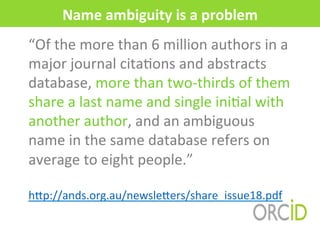
“Of	
  the	
  more	
  than	
  6	
  million	
  authors	
  in	
  a	
  
major	
  journal	
  citaMons	
  and	
  abstracts	
  
database,	
  more	
  than	
  two-­‐thirds	
  of	
  them	
  
share	
  a	
  last	
  name	
  and	
  single	
  iniMal	
  with	
  
another	
  author,	
  and	
  an	
  ambiguous	
  
name	
  in	
  the	
  same	
  database	
  refers	
  on	
  
average	
  to	
  eight	
  people.”	


h>p://ands.org.au/newsle>ers/share_issue18.pdf	


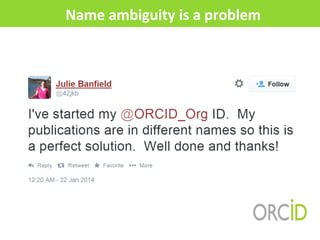
Name	
  ambiguity	
  is	
  a	
  problem	
  
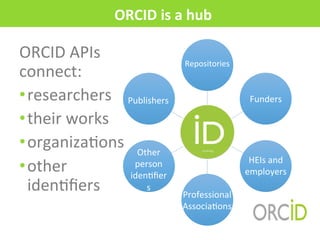
ORCID	
  APIs	
  
connect:	
  	
  
• researchers	
  	
  
• their	
  works	
  
• organizaMons	
  
• other	
  
idenMfiers	
  
Funders	
  
Repositories	
  
Publishers	
  
Other	
  
person	
  
idenMfier
s	
  
Professional	
  
AssociaMons	
  
HEIs	
  and	
  
employers	
  
ORCID	
  is	
  a	
  hub	
  
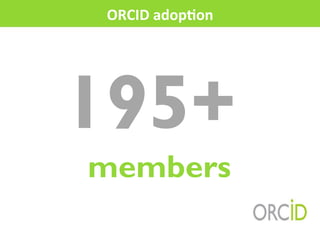
ORCID	
  adopAon	
  
195+
members
ORCID	
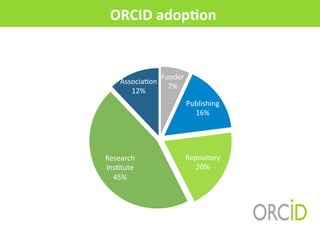
  adopAon	
  
Funder	
  
7%	
  
Publishing	
  
16%	
  
Repository	
  
20%	
  
Research	
  
InsMtute	
  
45%	
  
AssociaMon	
  
12%	
  
ORCID	
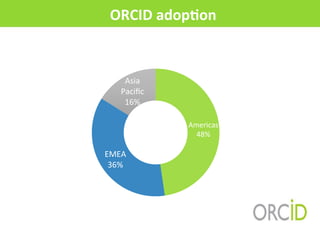
  adopAon	
  
Americas	
  
48%	
  
EMEA	
  
36%	
  
Asia	
  
Pacific	
  
16%	
  
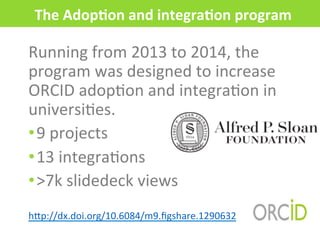
The	
  AdopAon	
  and	
  integraAon	
  program	
  
Running	
  from	
  2013	
  to	
  2014,	
  the	
  
program	
  was	
  designed	
  to	
  increase	
  
ORCID	
  adopMon	
  and	
  integraMon	
  in	
  
universiMes.	
  
• 9	
  projects	
  
• 13	
  integraMons	
  
• >7k	
  slidedeck	
  views	


h>p://dx.doi.org/10.6084/m9.figshare.1290632	
  
The	
  AdopAon	
  and	
  integraAon	
  program	
  
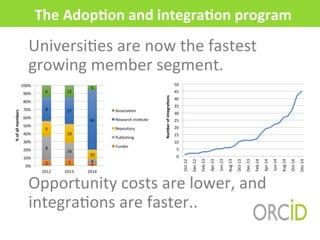
UniversiMes	
  are	
  now	
  the	
  fastest	
  
growing	
  member	
  segment.	


Opportunity	
  costs	
  are	
  lower,	
  and	
  
integraMons	
  are	
  faster..	
  
2	
   7	
   3	
  
8	
  
16	
  
4	
  
5	
  
19	
  
10	
  
8	
   27	
  
63	
  
4	
   12	
  
5	
  
0%	
  
10%	
  
20%	
  
30%	
  
40%	
  
50%	
  
60%	
  
70%	
  
80%	
  
90%	
  
100%	
  
2012	
   2013	
   2014	
  
%	
  of	
  all	
  members	
  
AssociaMon	
  
Research	
  InsMtute	
  
Repository	
  
Publishing	
  
Funder	
  
0	
  
5	
  
10	
  
15	
  
20	
  
25	
  
30	
  
35	
  
40	
  
45	
  
50	
  
Oct-­‐12	
  
Dec-­‐12	
  
Feb-­‐13	
  
Apr-­‐13	
  
Jun-­‐13	
  
Aug-­‐13	
  
Oct-­‐13	
  
Dec-­‐13	
  
Feb-­‐14	
  
Apr-­‐14	
  
Jun-­‐14	
  
Aug-­‐14	
  
Oct-­‐14	
  
Dec-­‐14	
  
Number	
  of	
  integraAons	
  
1
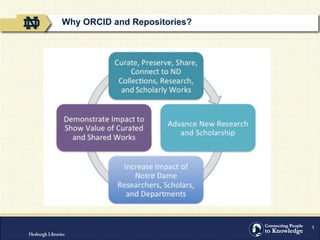
Why ORCID and Repositories?
2
– Flip the focus: from works to authors to
demonstrate and capture impact
– Better data: ORCID ids can disambiguate a
researchers activity from others (e.g.
publications, citations) and enrich metadata
– Connect to External Data: External
metadata and metrics can then be
incorporated from external sources
– Increase exposure of repository works by
pushing back to ORCID
Why ORCID and Repositories?
3
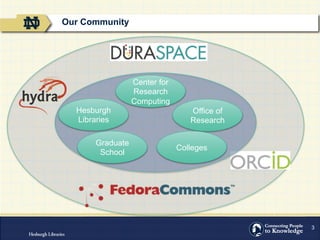
Our Community
Office of
Research
Center for
Research
Computing
Hesburgh
Libraries
Graduate
School
Colleges
4
•  Library
•  Campus: Graduate School, Undergraduate
Colleges
•  Leadership: Office of Research, Office of the
Provost
•  Community – Hydra, Fedora
–  Community First; Institution Second*
–  Lead Institution: University of Notre Dame
–  Other Contributors: Northwestern University, Yale University,
University of Cincinnati, Penn State University, University of
Virginia
–  Additional Adopters: Stanford University, Royal Library of
Denmark, University of Hull (UK), Indiana University
* Conceived from the beginning as a community solution
Stakeholders
5
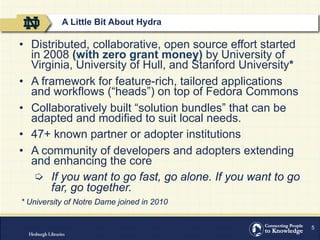
•  Distributed, collaborative, open source effort started
in 2008 (with zero grant money) by University of
Virginia, University of Hull, and Stanford University*
•  A framework for feature-rich, tailored applications
and workflows (“heads”) on top of Fedora Commons
•  Collaboratively built “solution bundles” that can be
adapted and modified to suit local needs.
•  47+ known partner or adopter institutions
•  A community of developers and adopters extending
and enhancing the core
  If you want to go fast, go alone. If you want to go
far, go together.
* University of Notre Dame joined in 2010
A Little Bit About Hydra
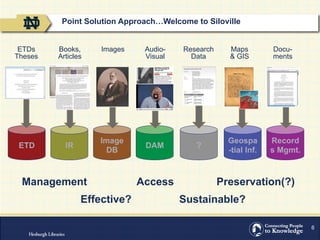
6
ETDs
(Theses)
Books,
Articles
Images Audio-
Visual
Research
Data
Maps
& GIS
Docu-
ments
ETD IR
Image
DB
DAM ?
Geospa
-tial Inf.
Record
s Mgmt.
Management Access Preservation(?)
Effective? Sustainable?
Point Solution Approach Welcome to Siloville
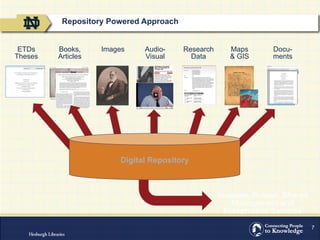
7
Digital Repository
Scalable, Robust, Shared
Management and
Preservation Services
ETDs
(Theses)
Books,
Articles
Images Audio-
Visual
Research
Data
Maps
& GIS
Docu-
ments
Repository Powered Approach
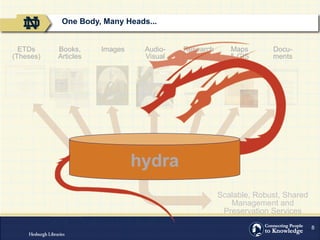
8
hydra
Scalable, Robust, Shared
Management and
Preservation Services
ETDs
(Theses)
Books,
Articles
Images Audio-
Visual
Research
Data
Maps
& GIS
Docu-
ments
Audio-
Visual
RRRRRRRRRRRRRRRRRRRRRRRRRRRRRRRRRRRRRRRRRRRReeeeeeeeeeeeeeeeeeeeeeeeeeeeeeeeeeeeeeessssssssssssssssssssssssssssssssssssseeeeeeeeeeeeeeeeeeeeeeeeeeeeeeeeeeeeaarrrrrrrrrccccccccccccccccccccccccccccccccccccccccccccccccccchhhhhhhhhhhhhhhhhhhhhhhhhhhhhhhhhhhhhhhhhhhhhhhhhhhhhhhhhhhhh
DDDDDDDDDDDDDDDDDDaaaaaaaaaaaaaaaaaaaaatttttttttttttttttttaaaaaaaaaaaaa
Maps
&&&&&&&&&&&&&&&&&&&&&&&&&&&&&&&&&&&&&&&&& GGGGGGGGGGGGGGGGGGGGGGGGGGGGGGGGGGGGGGGGGGGGGGGGGGGGGGGGGGGGGGGGGGGGGGGGGGGGGGIIIIIIIIIIIIIIIIIIIIIIIIIIIIIIIIIIIIIIIIIIIIIIIIISSSSSSSSSSSSSSSSSSSSSSSSSSSSSSSSSSSSSSSSSSSSSSSSSSSSSSS
Doc
men
One Body, Many Heads...
9
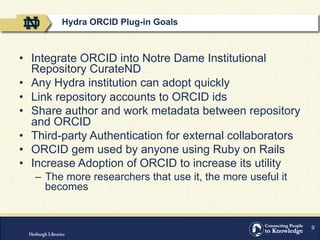
•  Integrate ORCID into Notre Dame Institutional
Repository CurateND
•  Any Hydra institution can adopt quickly
•  Link repository accounts to ORCID ids
•  Share author and work metadata between repository
and ORCID
•  Third-party Authentication for external collaborators
•  ORCID gem used by anyone using Ruby on Rails
•  Increase Adoption of ORCID to increase its utility
–  The more researchers that use it, the more useful it
becomes
Hydra ORCID Plug-in Goals
10
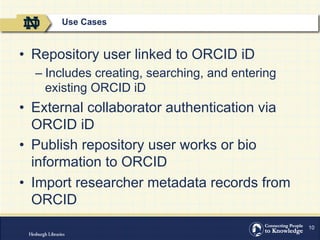
•  Repository user linked to ORCID iD
– Includes creating, searching, and entering
existing ORCID iD
•  External collaborator authentication via
ORCID iD
•  Publish repository user works or bio
information to ORCID
•  Import researcher metadata records from
ORCID
Use Cases
11
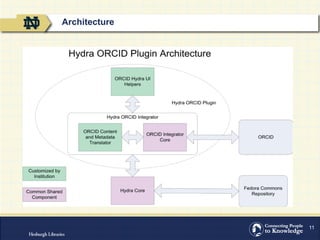
Architecture
12
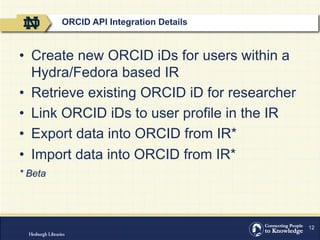
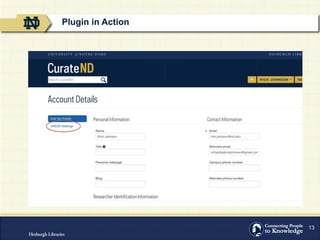
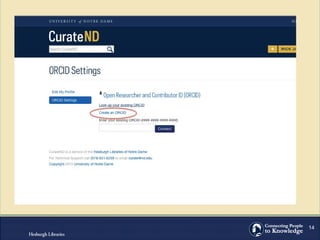
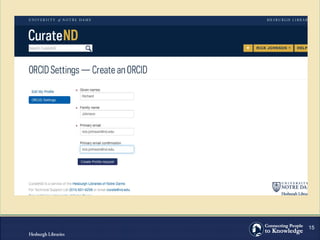
•  Create new ORCID iDs for users within a
Hydra/Fedora based IR
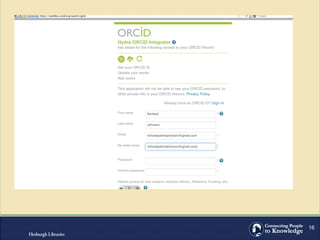
•  Retrieve existing ORCID iD for researcher
•  Link ORCID iDs to user profile in the IR
•  Export data into ORCID from IR*
•  Import data into ORCID from IR*
* Beta
ORCID API Integration Details
13
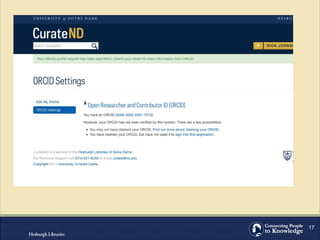
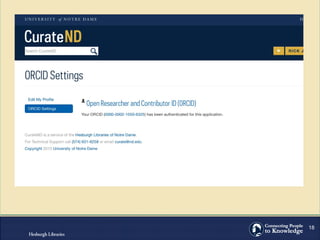
Plugin in Action
14
15
16
17
18
19
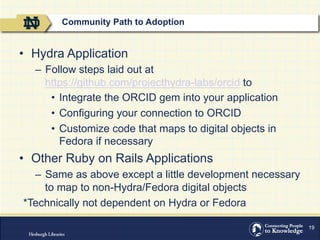
•  Hydra Application
–  Follow steps laid out at
https://github.com/projecthydra-labs/orcid to
•  Integrate the ORCID gem into your application
•  Configuring your connection to ORCID
•  Customize code that maps to digital objects in
Fedora if necessary
•  Other Ruby on Rails Applications
–  Same as above except a little development necessary
to map to non-Hydra/Fedora digital objects
*Technically not dependent on Hydra or Fedora
Community Path to Adoption
20
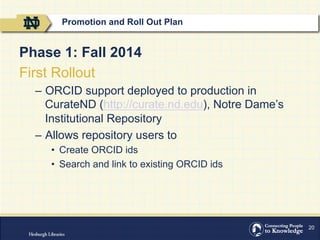
Phase 1: Fall 2014
First Rollout
–  ORCID support deployed to production in
CurateND (http://curate.nd.edu), Notre Dame’s
Institutional Repository
–  Allows repository users to
•  Create ORCID ids
•  Search and link to existing ORCID ids
Promotion and Roll Out Plan
21
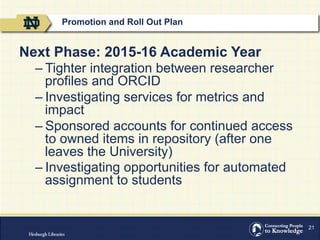
Next Phase: 2015-16 Academic Year
– Tighter integration between researcher
profiles and ORCID
– Investigating services for metrics and
impact
– Sponsored accounts for continued access
to owned items in repository (after one
leaves the University)
– Investigating opportunities for automated
assignment to students
Promotion and Roll Out Plan
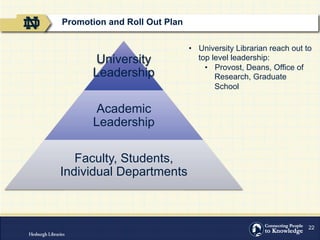
22
University
Leadership
Academic
Leadership
Faculty, Students,
Individual Departments
Promotion and Roll Out Plan
•  University Librarian reach out to
top level leadership:
•  Provost, Deans, Office of
Research, Graduate
School
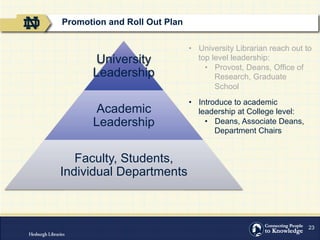
23
University
Leadership
Academic
Leadership
Faculty, Students,
Individual Departments
Promotion and Roll Out Plan
•  University Librarian reach out to
top level leadership:
•  Provost, Deans, Office of
Research, Graduate
School
•  Introduce to academic
leadership at College level:
•  Deans, Associate Deans,
Department Chairs
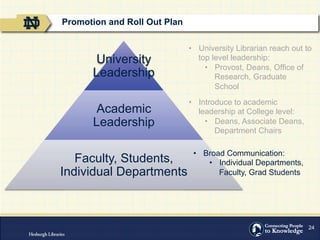
24
University
Leadership
Academic
Leadership
Faculty, Students,
Individual Departments
Promotion and Roll Out Plan
•  University Librarian reach out to
top level leadership:
•  Provost, Deans, Office of
Research, Graduate
School
•  Introduce to academic
leadership at College level:
•  Deans, Associate Deans,
Department Chairs
•  Broad Communication:
•  Individual Departments,
Faculty, Grad Students
25
Next Steps: 2015-16 Academic Year
Develop Campus Partnerships
–  Identify campus advocates and partners
–  Begin outreach to partners including the Office of
Research
Promotion and Roll Out Plan
26
Next Steps: 2015-16 Academic Year
Develop Campus Partnerships
–  Beginning with University Librarian, top level
discussions with University Leadership and key
stakeholder groups:
Provost, Office of Research, Graduate School, Deans
•  Highlight program benefits and partner institutions and their
contribution
•  Raise awareness of how it ties into university mission and the
institutional repository
•  Give context of how ORCID helps with research goals and
university goals
Promotion and Roll Out Plan
27
Next Steps: 2015-16 Academic Year
Roll Out Awareness: Next Level Stakeholders
–  University Librarian introduce ORCID to Leadership at
College, and Academic Department levels
•  Highlight program benefits, partner institutions and their
contribution
•  Raise awareness of how it ties into university mission and the
institutional repository
•  Give context of how ORCID helps with research goals for
departments and individual faculty members and graduate
students
–  Follow up with Department Chairs, department-level
presentations, lunch and learns, etc.
Promotion and Roll Out Plan
28
Next Steps: 2015-16 Academic Year
Roll Out Awareness: Faculty & Grad Students
–  Broad communication i.e., details of our grant
related efforts in a press release and related
news
–  Targeted marketing tailored to each group of
departments, faculty, students
–  Library subject matter experts to cross-promote
within ongoing support of academic departments
–  Sponsored accounts
Promotion and Roll Out Plan
29
•  ORCID and the Sloan Foundation
•  Jeremy Friesen (Lead Developer)
•  Hydra Partner Contributors and
Supporters
•  Campus partners:
– Office of Research
– Provost’s Office
– College of Arts and Letters
Acknowledgements
30
•  ORCID gem
– https://github.com/projecthydra-labs/orcid
•  Project wiki
– https://wiki.duraspace.org/display/hydra/Hydra
+ORCID+Plug-in
•  CurateND
– http://curate.nd.edu
•  Rick Johnson, rick.johnson@nd.edu
•  Jeremy Friesen, jfriesen@nd.edu
More Information
31
?
Questions

4.2.15 Slides, “Hydra: many heads, many connections. Enriching Fedora Repositories with ORCID.”

  • 1.
    April 2, 2015Hot Topics: DuraSpace Community Webinar Series Hot Topics: The DuraSpace Community Webinar Series Series Eleven: “Integrating ORCID Persistent Identifiers with DSpace, Fedora and VIVO” Curated by Josh Brown, Regional Director Europe, ORCID
  • 2.
    April 2, 2015Hot Topics: DuraSpace Community Webinar Series Webinar 2: Hydra: many heads, many connections. Enriching Fedora Repositories with ORCID Presented by: Laura Paglione, Technical Director, ORCID Rick Johnson, Head, Digital Library Services, University of Notre Dame
  • 3.
    Duraspace  webinar,  April  2,  2015   ORCID  and  Hydra       Laura  Paglione,  ORCID  Technical  Director     l.paglione@orcid-­‐org   h>p://orcid.org/0000-­‐0003-­‐3188-­‐6273  
  • 4.
    Name  ambiguity  is  a  problem   “Of  the  more  than  6  million  authors  in  a   major  journal  citaMons  and  abstracts   database,  more  than  two-­‐thirds  of  them   share  a  last  name  and  single  iniMal  with   another  author,  and  an  ambiguous   name  in  the  same  database  refers  on   average  to  eight  people.”     h>p://ands.org.au/newsle>ers/share_issue18.pdf      
  • 5.
    Name  ambiguity  is  a  problem  
  • 6.
    ORCID  APIs   connect:     • researchers     • their  works   • organizaMons   • other   idenMfiers   Funders   Repositories   Publishers   Other   person   idenMfier s   Professional   AssociaMons   HEIs  and   employers   ORCID  is  a  hub  
  • 7.
  • 8.
    ORCID  adopAon   Funder   7%   Publishing   16%   Repository   20%   Research   InsMtute   45%   AssociaMon   12%  
  • 9.
    ORCID  adopAon   Americas   48%   EMEA   36%   Asia   Pacific   16%  
  • 10.
    The  AdopAon  and  integraAon  program   Running  from  2013  to  2014,  the   program  was  designed  to  increase   ORCID  adopMon  and  integraMon  in   universiMes.   • 9  projects   • 13  integraMons   • >7k  slidedeck  views     h>p://dx.doi.org/10.6084/m9.figshare.1290632  
  • 11.
    The  AdopAon  and  integraAon  program   UniversiMes  are  now  the  fastest   growing  member  segment.             Opportunity  costs  are  lower,  and   integraMons  are  faster..   2   7   3   8   16   4   5   19   10   8   27   63   4   12   5   0%   10%   20%   30%   40%   50%   60%   70%   80%   90%   100%   2012   2013   2014   %  of  all  members   AssociaMon   Research  InsMtute   Repository   Publishing   Funder   0   5   10   15   20   25   30   35   40   45   50   Oct-­‐12   Dec-­‐12   Feb-­‐13   Apr-­‐13   Jun-­‐13   Aug-­‐13   Oct-­‐13   Dec-­‐13   Feb-­‐14   Apr-­‐14   Jun-­‐14   Aug-­‐14   Oct-­‐14   Dec-­‐14   Number  of  integraAons  
  • 12.
    1 Why ORCID andRepositories?
  • 13.
    2 – Flip the focus:from works to authors to demonstrate and capture impact – Better data: ORCID ids can disambiguate a researchers activity from others (e.g. publications, citations) and enrich metadata – Connect to External Data: External metadata and metrics can then be incorporated from external sources – Increase exposure of repository works by pushing back to ORCID Why ORCID and Repositories?
  • 14.
    3 Our Community Office of Research Centerfor Research Computing Hesburgh Libraries Graduate School Colleges
  • 15.
    4 •  Library •  Campus:Graduate School, Undergraduate Colleges •  Leadership: Office of Research, Office of the Provost •  Community – Hydra, Fedora –  Community First; Institution Second* –  Lead Institution: University of Notre Dame –  Other Contributors: Northwestern University, Yale University, University of Cincinnati, Penn State University, University of Virginia –  Additional Adopters: Stanford University, Royal Library of Denmark, University of Hull (UK), Indiana University * Conceived from the beginning as a community solution Stakeholders
  • 16.
    5 •  Distributed, collaborative,open source effort started in 2008 (with zero grant money) by University of Virginia, University of Hull, and Stanford University* •  A framework for feature-rich, tailored applications and workflows (“heads”) on top of Fedora Commons •  Collaboratively built “solution bundles” that can be adapted and modified to suit local needs. •  47+ known partner or adopter institutions •  A community of developers and adopters extending and enhancing the core   If you want to go fast, go alone. If you want to go far, go together. * University of Notre Dame joined in 2010 A Little Bit About Hydra
  • 17.
    6 ETDs (Theses) Books, Articles Images Audio- Visual Research Data Maps & GIS Docu- ments ETDIR Image DB DAM ? Geospa -tial Inf. Record s Mgmt. Management Access Preservation(?) Effective? Sustainable? Point Solution Approach Welcome to Siloville
  • 18.
    7 Digital Repository Scalable, Robust,Shared Management and Preservation Services ETDs (Theses) Books, Articles Images Audio- Visual Research Data Maps & GIS Docu- ments Repository Powered Approach
  • 19.
    8 hydra Scalable, Robust, Shared Managementand Preservation Services ETDs (Theses) Books, Articles Images Audio- Visual Research Data Maps & GIS Docu- ments Audio- Visual RRRRRRRRRRRRRRRRRRRRRRRRRRRRRRRRRRRRRRRRRRRReeeeeeeeeeeeeeeeeeeeeeeeeeeeeeeeeeeeeeessssssssssssssssssssssssssssssssssssseeeeeeeeeeeeeeeeeeeeeeeeeeeeeeeeeeeeaarrrrrrrrrccccccccccccccccccccccccccccccccccccccccccccccccccchhhhhhhhhhhhhhhhhhhhhhhhhhhhhhhhhhhhhhhhhhhhhhhhhhhhhhhhhhhhh DDDDDDDDDDDDDDDDDDaaaaaaaaaaaaaaaaaaaaatttttttttttttttttttaaaaaaaaaaaaa Maps &&&&&&&&&&&&&&&&&&&&&&&&&&&&&&&&&&&&&&&&& GGGGGGGGGGGGGGGGGGGGGGGGGGGGGGGGGGGGGGGGGGGGGGGGGGGGGGGGGGGGGGGGGGGGGGGGGGGGGGIIIIIIIIIIIIIIIIIIIIIIIIIIIIIIIIIIIIIIIIIIIIIIIIISSSSSSSSSSSSSSSSSSSSSSSSSSSSSSSSSSSSSSSSSSSSSSSSSSSSSSS Doc men One Body, Many Heads...
  • 20.
    9 •  Integrate ORCIDinto Notre Dame Institutional Repository CurateND •  Any Hydra institution can adopt quickly •  Link repository accounts to ORCID ids •  Share author and work metadata between repository and ORCID •  Third-party Authentication for external collaborators •  ORCID gem used by anyone using Ruby on Rails •  Increase Adoption of ORCID to increase its utility –  The more researchers that use it, the more useful it becomes Hydra ORCID Plug-in Goals
  • 21.
    10 •  Repository userlinked to ORCID iD – Includes creating, searching, and entering existing ORCID iD •  External collaborator authentication via ORCID iD •  Publish repository user works or bio information to ORCID •  Import researcher metadata records from ORCID Use Cases
  • 22.
  • 23.
    12 •  Create newORCID iDs for users within a Hydra/Fedora based IR •  Retrieve existing ORCID iD for researcher •  Link ORCID iDs to user profile in the IR •  Export data into ORCID from IR* •  Import data into ORCID from IR* * Beta ORCID API Integration Details
  • 24.
  • 25.
  • 26.
  • 27.
  • 28.
  • 29.
  • 30.
    19 •  Hydra Application – Follow steps laid out at https://github.com/projecthydra-labs/orcid to •  Integrate the ORCID gem into your application •  Configuring your connection to ORCID •  Customize code that maps to digital objects in Fedora if necessary •  Other Ruby on Rails Applications –  Same as above except a little development necessary to map to non-Hydra/Fedora digital objects *Technically not dependent on Hydra or Fedora Community Path to Adoption
  • 31.
    20 Phase 1: Fall2014 First Rollout –  ORCID support deployed to production in CurateND (http://curate.nd.edu), Notre Dame’s Institutional Repository –  Allows repository users to •  Create ORCID ids •  Search and link to existing ORCID ids Promotion and Roll Out Plan
  • 32.
    21 Next Phase: 2015-16Academic Year – Tighter integration between researcher profiles and ORCID – Investigating services for metrics and impact – Sponsored accounts for continued access to owned items in repository (after one leaves the University) – Investigating opportunities for automated assignment to students Promotion and Roll Out Plan
  • 33.
    22 University Leadership Academic Leadership Faculty, Students, Individual Departments Promotionand Roll Out Plan •  University Librarian reach out to top level leadership: •  Provost, Deans, Office of Research, Graduate School
  • 34.
    23 University Leadership Academic Leadership Faculty, Students, Individual Departments Promotionand Roll Out Plan •  University Librarian reach out to top level leadership: •  Provost, Deans, Office of Research, Graduate School •  Introduce to academic leadership at College level: •  Deans, Associate Deans, Department Chairs
  • 35.
    24 University Leadership Academic Leadership Faculty, Students, Individual Departments Promotionand Roll Out Plan •  University Librarian reach out to top level leadership: •  Provost, Deans, Office of Research, Graduate School •  Introduce to academic leadership at College level: •  Deans, Associate Deans, Department Chairs •  Broad Communication: •  Individual Departments, Faculty, Grad Students
  • 36.
    25 Next Steps: 2015-16Academic Year Develop Campus Partnerships –  Identify campus advocates and partners –  Begin outreach to partners including the Office of Research Promotion and Roll Out Plan
  • 37.
    26 Next Steps: 2015-16Academic Year Develop Campus Partnerships –  Beginning with University Librarian, top level discussions with University Leadership and key stakeholder groups: Provost, Office of Research, Graduate School, Deans •  Highlight program benefits and partner institutions and their contribution •  Raise awareness of how it ties into university mission and the institutional repository •  Give context of how ORCID helps with research goals and university goals Promotion and Roll Out Plan
  • 38.
    27 Next Steps: 2015-16Academic Year Roll Out Awareness: Next Level Stakeholders –  University Librarian introduce ORCID to Leadership at College, and Academic Department levels •  Highlight program benefits, partner institutions and their contribution •  Raise awareness of how it ties into university mission and the institutional repository •  Give context of how ORCID helps with research goals for departments and individual faculty members and graduate students –  Follow up with Department Chairs, department-level presentations, lunch and learns, etc. Promotion and Roll Out Plan
  • 39.
    28 Next Steps: 2015-16Academic Year Roll Out Awareness: Faculty & Grad Students –  Broad communication i.e., details of our grant related efforts in a press release and related news –  Targeted marketing tailored to each group of departments, faculty, students –  Library subject matter experts to cross-promote within ongoing support of academic departments –  Sponsored accounts Promotion and Roll Out Plan
  • 40.
    29 •  ORCID andthe Sloan Foundation •  Jeremy Friesen (Lead Developer) •  Hydra Partner Contributors and Supporters •  Campus partners: – Office of Research – Provost’s Office – College of Arts and Letters Acknowledgements
  • 41.
    30 •  ORCID gem – https://github.com/projecthydra-labs/orcid • Project wiki – https://wiki.duraspace.org/display/hydra/Hydra +ORCID+Plug-in •  CurateND – http://curate.nd.edu •  Rick Johnson, rick.johnson@nd.edu •  Jeremy Friesen, jfriesen@nd.edu More Information
  • 42.