Building Open Research Infrastructure
with PIDs
13 September, 2019
Gabriela Mejias
https://orcid.org/0000-0002-1598-7181
Engagement Lead, Europe
@gabioshka
@ORCID_Org
persistent
an organization
made a promise
to keep it alive
identifier
globally unique string
(known as PIDs to their friends)
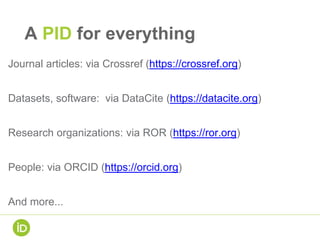
A PID for everything
Journal articles: via Crossref (https://crossref.org)
Datasets, software: via DataCite (https://datacite.org)
Research organizations: via ROR (https://ror.org)
People: via ORCID (https://orcid.org)
And more...
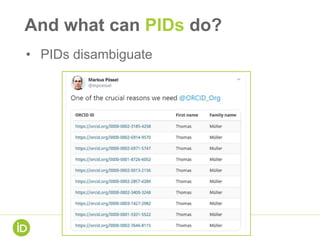
And what can PIDs do?
• PIDs disambiguate
And what can PIDs do?
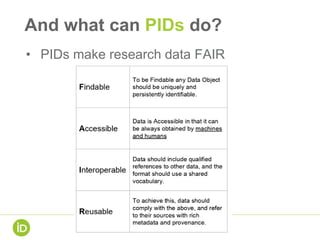
• PIDs make research data FAIR
What is ORCID?
• ORCID is an open, not-for-profit organization run
by and for the research community
• We provide researchers with a unique identifier,
an ORCID iD, that reliably and clearly connects
them with their research contributions, affiliations,
funding & facilities
• We provide open tools (ORCID Registry & API)
that enable transparent connections between
researchers, and identifiers for their activities &
contributions.
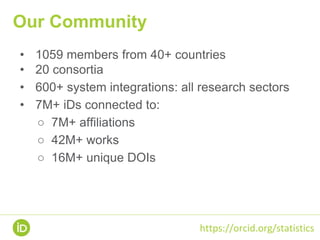
Our Community
https://orcid.org/statistics
• 1059 members from 40+ countries
• 20 consortia
• 600+ system integrations: all research sectors
• 7M+ iDs connected to:
○ 7M+ affiliations
○ 42M+ works
○ 16M+ unique DOIs
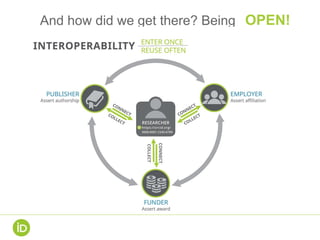
And how did we get there? Being OPEN!
PID Power
By connecting everything, you can see the true
power of PIDs
Researchers, institutions, publications, datasets,
grants, peer review and more are already
interconnected in real life, and this can be reflected
and tracked through PIDs
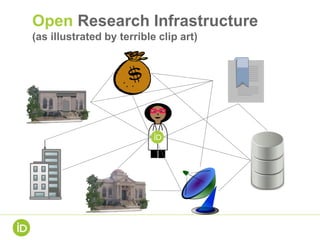
Open Research Infrastructure
(as illustrated by terrible clip art)
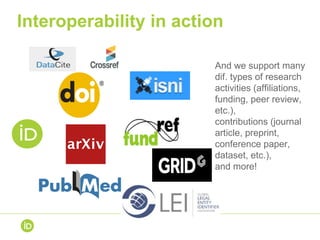
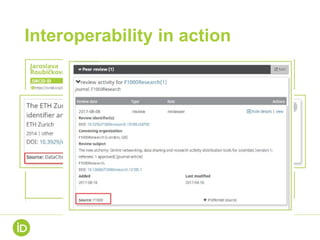
Interoperability in action
And we support many
dif. types of research
activities (affiliations,
funding, peer review,
etc.),
contributions (journal
article, preprint,
conference paper,
dataset, etc.),
and more!
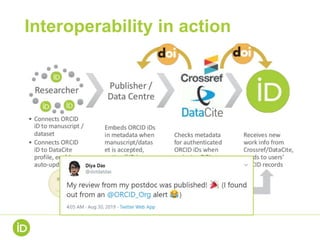
Interoperability in action
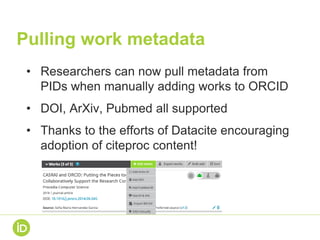
Pulling work metadata
• Researchers can now pull metadata from
PIDs when manually adding works to ORCID
• DOI, ArXiv, Pubmed all supported
• Thanks to the efforts of Datacite encouraging
adoption of citeproc content!
Annotations and physical objects
• There are emerging use cases for connecting
annotations and physical objects to ORCID
iDs
• Working with RDA Biodiversity Standards,
Bloodhound, SciCrunch and more
• We’ve added support for both work types this
week!
https://members.orcid.org/api/resources/work-types
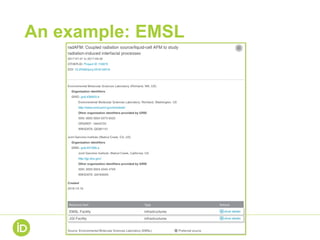
Demonstrating facility impact
• Making accurate assessment of the scientific
impact of public investments in research
infrastructure is very difficult
• PIDs can help
• ORCID has workflows for adding resource
proposals and awards to ORCID records and
work metadata
An example: EMSL
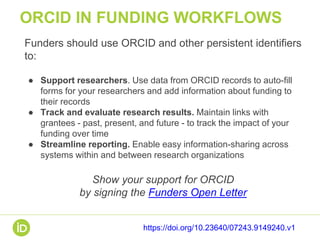
Funders should use ORCID and other persistent identifiers
to:
● Support researchers. Use data from ORCID records to auto-fill
forms for your researchers and add information about funding to
their records
● Track and evaluate research results. Maintain links with
grantees - past, present, and future - to track the impact of your
funding over time
● Streamline reporting. Enable easy information-sharing across
systems within and between research organizations
Show your support for ORCID
by signing the Funders Open Letter
ORCID IN FUNDING WORKFLOWS
https://doi.org/10.23640/07243.9149240.v1
So what can you do?
Step 1: Register PIDs
It’s hard to connect things when we don’t know they exist
• Get an ORCID iD for yourself → https://orcid.org
• Give DOIs to your research publications, data and
software → https://datacite.org,
• Use repositories that generate PIDs →
https://repositoryfinder.datacite.org https://zenodo.org/ or
your institutional repository
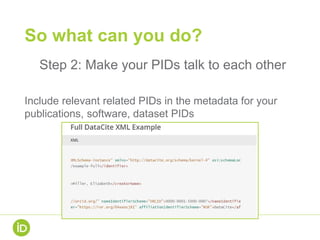
So what can you do?
Step 2: Make your PIDs talk to each other
Include relevant related PIDs in the metadata for your
publications, software, dataset PIDs
So what can you do?
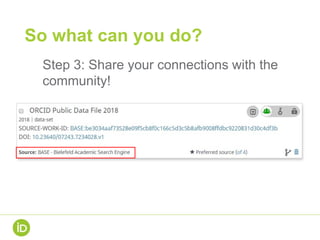
Step 3: Share your connections with the
community!
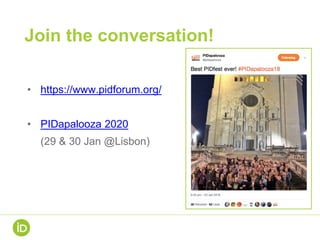
Join the conversation!
• https://www.pidforum.org/
• PIDapalooza 2020
(29 & 30 Jan @Lisbon)
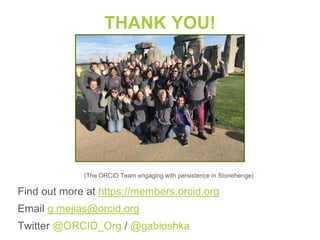
(The ORCID Team engaging with persistence in Stonehenge)
Find out more at https://members.orcid.org
Email g.mejias@orcid.org
Twitter @ORCID_Org / @gabioshka
THANK YOU!

Building Open Research Infrastructure with PIDs

  • 1.
    Building Open ResearchInfrastructure with PIDs 13 September, 2019 Gabriela Mejias https://orcid.org/0000-0002-1598-7181 Engagement Lead, Europe @gabioshka @ORCID_Org
  • 2.
    persistent an organization made apromise to keep it alive identifier globally unique string (known as PIDs to their friends)
  • 3.
    A PID foreverything Journal articles: via Crossref (https://crossref.org) Datasets, software: via DataCite (https://datacite.org) Research organizations: via ROR (https://ror.org) People: via ORCID (https://orcid.org) And more...
  • 4.
    And what canPIDs do? • PIDs disambiguate
  • 5.
    And what canPIDs do? • PIDs make research data FAIR
  • 6.
    What is ORCID? •ORCID is an open, not-for-profit organization run by and for the research community • We provide researchers with a unique identifier, an ORCID iD, that reliably and clearly connects them with their research contributions, affiliations, funding & facilities • We provide open tools (ORCID Registry & API) that enable transparent connections between researchers, and identifiers for their activities & contributions.
  • 7.
    Our Community https://orcid.org/statistics • 1059members from 40+ countries • 20 consortia • 600+ system integrations: all research sectors • 7M+ iDs connected to: ○ 7M+ affiliations ○ 42M+ works ○ 16M+ unique DOIs
  • 8.
    And how didwe get there? Being OPEN!
  • 9.
    PID Power By connectingeverything, you can see the true power of PIDs Researchers, institutions, publications, datasets, grants, peer review and more are already interconnected in real life, and this can be reflected and tracked through PIDs
  • 10.
    Open Research Infrastructure (asillustrated by terrible clip art)
  • 11.
    Interoperability in action Andwe support many dif. types of research activities (affiliations, funding, peer review, etc.), contributions (journal article, preprint, conference paper, dataset, etc.), and more!
  • 12.
  • 13.
  • 14.
    Pulling work metadata •Researchers can now pull metadata from PIDs when manually adding works to ORCID • DOI, ArXiv, Pubmed all supported • Thanks to the efforts of Datacite encouraging adoption of citeproc content!
  • 15.
    Annotations and physicalobjects • There are emerging use cases for connecting annotations and physical objects to ORCID iDs • Working with RDA Biodiversity Standards, Bloodhound, SciCrunch and more • We’ve added support for both work types this week! https://members.orcid.org/api/resources/work-types
  • 16.
    Demonstrating facility impact •Making accurate assessment of the scientific impact of public investments in research infrastructure is very difficult • PIDs can help • ORCID has workflows for adding resource proposals and awards to ORCID records and work metadata
  • 17.
  • 18.
    Funders should useORCID and other persistent identifiers to: ● Support researchers. Use data from ORCID records to auto-fill forms for your researchers and add information about funding to their records ● Track and evaluate research results. Maintain links with grantees - past, present, and future - to track the impact of your funding over time ● Streamline reporting. Enable easy information-sharing across systems within and between research organizations Show your support for ORCID by signing the Funders Open Letter ORCID IN FUNDING WORKFLOWS https://doi.org/10.23640/07243.9149240.v1
  • 19.
    So what canyou do? Step 1: Register PIDs It’s hard to connect things when we don’t know they exist • Get an ORCID iD for yourself → https://orcid.org • Give DOIs to your research publications, data and software → https://datacite.org, • Use repositories that generate PIDs → https://repositoryfinder.datacite.org https://zenodo.org/ or your institutional repository
  • 20.
    So what canyou do? Step 2: Make your PIDs talk to each other Include relevant related PIDs in the metadata for your publications, software, dataset PIDs
  • 21.
    So what canyou do? Step 3: Share your connections with the community!
  • 22.
    Join the conversation! •https://www.pidforum.org/ • PIDapalooza 2020 (29 & 30 Jan @Lisbon)
  • 23.
    (The ORCID Teamengaging with persistence in Stonehenge) Find out more at https://members.orcid.org Email g.mejias@orcid.org Twitter @ORCID_Org / @gabioshka THANK YOU!