International Indexed & Referred Research Journal, April, 2012. ISSN- 0974-2832, RNI-RAJBIL 2009/29954; VoL. IV * ISSUE-39
                                         Research Paper Zoology
           "Beel Fisheries of Assam and its Imapct on the
               Socio-Economic Life of the people of
                        Lakhimpur District"
                * Sarat Baruah                                                                                  April , 2012
               * Assistant Professor, Madhabdev College
A B S T R A C T
 Beels are the derelict or semi derelict wetlands, which are very much important fishery resource of Assam. Beels are the only
 source of fish for the rural people, neighboring to the wetland. They depend on beels for their daily consumption of fish as
 well as a source of livelihood. Ecological energy studies shows that beels have a high productive potentiality. There are about
 1392 beels in Assam, in which maximum number being in Nagaon District (289), followed by Cahar (263); Lakhimpur (153)
 and Jorhat (131). However, the present regulation and system of management are not sufficient to sustainable production
 of these water bodies.

Introduction:                                                    2.To know about the morphometey and hydrodynamics
           Assam is gifted by God with many extensive            of wetlands.3.To analyse the physio-chemical proper-
water bodies, commonly known as beels (Jhingarn and              ties of the beels.4.To analyse the diversity of the fish
Pathak 1987), that are the only source of fish for the poor      fauna of the beels of Assam.5.To analyse the socio-
people in the surrounding villages. In Assam two major           economic aspects of the community surrounding by
river systems namely Brahamputra and the Barak and               the beels.
the beels are situated along the tributaries of these two        Methodology:
river systems. In Brahamputra Valley there exists a total                  The methodology used in this paper in de-
number of 1030 beels covering an area of 92,693 ha; out          scriptive and analytical. The different data used for the
of which 300 beels (31,214 ha.) are in the central Assam;        study were collected from field study as well as com-
409 beels (29,383 ha.) in the lower Assam and 315 beels          ments received from the local people nearby the beels.
(32,015 ha.) are in the upper Assam. On the other hand,          The secondary data also available from different news
there are about 167 beels with an area of 8122 ha. in Barak      papers. Fisheries bulletins of Assam, Journals and
Valley. Presently these beels are adversely affected by          Published books. Moreover, personal knowledge is
various factors like pollution, reclamation, habitat deg-        used to make meaningful interpretation of the data.
radation etc.                                                    Morphometry and Hydrodynamics of the beels:
Objective of the Study:                                                    The principal, morphometric characteristics
           The objective of the study is to analyse the          that influence the productivity of beel ecosystem are
various parameters in relation to the socio-economic             shore line area, depth and slope. These characteristics
aspects of this region. The specific objective of the            are directly related to the hydrodynamics of the wet-
study are:1.To study the bio-geographical status of the          lands. There are three major sources of water input in to
beels of Assam.                                                  beel ecosystem, viz, over flow from the river channel,
                                                                 surface flow and rainfall. In Assam, during the period of

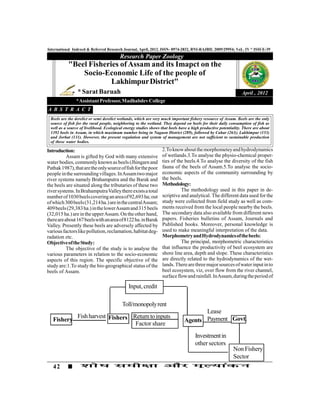
                                              Input, credit

                                          Toll/monopoly rent
                                                                                     Lease
           Fish harvest Fishers Return to inputs
   Fishery                                                                    Agents Payment Govt.
                                 Factor share
                                                                                    Investment in
                                                                                    other sectors
                                                                                                           Non Fishery
                                                                                                           Sector
   42
International Indexed & Referred Research Journal, April, 2012. ISSN- 0974-2832, RNI-RAJBIL 2009/29954; VoL. IV * ISSUE-39
April-June, heavy rainfall takes place, due to which all          147 fishermen families. It was observed that none of the
law laying areas and beels are flooded with rain water.           fishers abide by the Indian Fisheries Act 1897.In Assam,
Thus, flood is the main source of water for the beels of          the beels are under the control of the Revenue Depart-
Assam. The water loss by various means causes shrink-             ment. In 1977 a substantial number of beels have been
age and lowering of the depth in the beels. Conse-                handed over to the Assam Fisheries Devepment corpo-
quently, the fluviatile nature of the system is trans-            ration (AFDC), for maintenance. Under the present
formed in to a lentic and stagnant water body till nest           system of manage ment (Fig.-1), both the Revenue De-
flooding the seasonal change.                                     partment and AFDC lease out the beels for a period of
Physio-chemical properties of the beels:                          5-7 years at a time.The prime objectives is to earn rev-
           Water flow plays a vital role in the nutrient          enue for the state's exchequer. The protection of the
dynamics and aquatic productivity of the beels. There             interest of the Koiborta (traditional fishers flok) commu-
are three principal mechanisms, which control the water           nity is not given much attention under the existing
chemistry of the beels. Beels are generally considered            policy. It was observed during our field study that, the
as highly entrophicated system with high rate of pri-             system allows rich middle persons to obtain the leases.
mary productivity.                                                However, the lessee hires fishers to do the fishing. In
           Soil is one of the major parameter that main-          most of the cases fishers of adjacent villages are em-
taining the productivity of any water body. The soil and          ployed at very low wages. The fishers are not allowed
water quality of the beels of Assam are mentioned be-             to marketing their fishes (share) in the market. There-
low: See Fig 1                                                    fore, they were compelled to shell it back to the lessee
Analysis: Beels is a highly productive natural ecosys-            at a low rate fixed by them.At the lease period the lease-
tem which can convert the solar energy into organic               holders, catch maximum stock of the fishes to maximizes
Carbon in the presence of rich nutrients available from           their income. The provisions of the Indian Fisheries Act
                          Table-1                                 1897, enacted for the protection and conservation of
  Parameters                                  Range               aquatic biota, are meaningless under this management
  1.Soil Quality                                                  system.
  PH                                         5.10-5.80                       In most cases poor fishers are also under pres-
  Organic Carbon(%)                          2.80-5.90            sure to increase their income and also under pressure
  2. Water Quality                                                to increase their income and easily fall prey to the lessee's
  Temperatur (0C)                            18.50-31.50          interests. A number of fisher co-operatives exist but
  Transparency ()                            48.00-121.00         have no meaningful functions. The members are often
  Dissolved Oxygen (PPm)                     4.27-11.20           ignorant about their rights and roles. It is necessary to
  PH                                         6.40-7.60            develop a community based co-management model for
  Free Carbon-di-Oxide (ppm)                 2.00-12.00           the beels ofAssam, like those applied Brazil (Christensen
  Total hardness (Rpm)                       13.90-35.66          et. al. 1995). The govt. must take the initative and get
Source: Social, economic and policy respects of Fish-             scientists and development personal to develop and
eries.                                                            establish community-based fisheries co-management
natural sources. Historically, there have been three              for beel fisheries in Assam.
dominant group of people involved in organized fishing            Conclusion:
is the beels: 1.Those who catch fish for their own daily                      Beels, of Assam are rich in fish diversity and
consumption. 2.Those who belonging to the fisher com-             it harbours almost all freshwater species available in the
munity and depend in fishing for their livelihood. 3.Ru-          North Estern region. Due to improper fishing, lack of
ral Entrepreneurs (Leasholders) The leases further auc-           proper planning and proper conservation measures fish
tion the leases to the fishers and provide capital at high        species are depleting very rapidly in the state. If it
rate of interest to them (Ahmed et. al. 1992) Within my           continues for another few years, most of the indigenous
present study, conducted at Neriapather Koibotra Gaon,            fishes will extinct. So, immediate attention from govt.
a typical fisher men village at Narayanpur revenue circle         agencies, NGOs, researchers, planners and policy mak-
of Lakhimpur district of Assam. The village comprises             ers, local people etc. is required in this regard.
R E F E R E N C E                                                 Jhingarn, V.G. (1991) Fish and Fisheries of North-East India. Vol.
                                                                  on Arunachal Pradesh Published by A.K. Chaudhary, Barrackpora,
1. Biswas, K.P. 1995 Ecological and Fisheries Dev. In wetlands.
                                                                  West Bengal, India.
CICFRI, 2000, Ecology and Fisheries of beel of Assam. Bulletin    3. Pithaiah et. al.: Socio-Economic conditions of Fisherman. A
No. 97, central Island capture Fisheries Research Institute,      Case Study, Kurkshetra, May, 1907.
Barreckpore, 743101 West Bengal.
                                                                  4. Dey, S.C. 1981, Studies on the hydro-biological conditions of
2. Dyal, S. Fisheries Co-Operatives and their role in marketing   some commercially important lakes (beel) of Kamrup district
of Fish in India with Special reference to Gujarat.               of Assam and their bearing on fish production.
    SHODH, SAMIKSHA                                         AUR            MULYANKAN                                        43

42 43

  • 1.
    International Indexed &Referred Research Journal, April, 2012. ISSN- 0974-2832, RNI-RAJBIL 2009/29954; VoL. IV * ISSUE-39 Research Paper Zoology "Beel Fisheries of Assam and its Imapct on the Socio-Economic Life of the people of Lakhimpur District" * Sarat Baruah April , 2012 * Assistant Professor, Madhabdev College A B S T R A C T Beels are the derelict or semi derelict wetlands, which are very much important fishery resource of Assam. Beels are the only source of fish for the rural people, neighboring to the wetland. They depend on beels for their daily consumption of fish as well as a source of livelihood. Ecological energy studies shows that beels have a high productive potentiality. There are about 1392 beels in Assam, in which maximum number being in Nagaon District (289), followed by Cahar (263); Lakhimpur (153) and Jorhat (131). However, the present regulation and system of management are not sufficient to sustainable production of these water bodies. Introduction: 2.To know about the morphometey and hydrodynamics Assam is gifted by God with many extensive of wetlands.3.To analyse the physio-chemical proper- water bodies, commonly known as beels (Jhingarn and ties of the beels.4.To analyse the diversity of the fish Pathak 1987), that are the only source of fish for the poor fauna of the beels of Assam.5.To analyse the socio- people in the surrounding villages. In Assam two major economic aspects of the community surrounding by river systems namely Brahamputra and the Barak and the beels. the beels are situated along the tributaries of these two Methodology: river systems. In Brahamputra Valley there exists a total The methodology used in this paper in de- number of 1030 beels covering an area of 92,693 ha; out scriptive and analytical. The different data used for the of which 300 beels (31,214 ha.) are in the central Assam; study were collected from field study as well as com- 409 beels (29,383 ha.) in the lower Assam and 315 beels ments received from the local people nearby the beels. (32,015 ha.) are in the upper Assam. On the other hand, The secondary data also available from different news there are about 167 beels with an area of 8122 ha. in Barak papers. Fisheries bulletins of Assam, Journals and Valley. Presently these beels are adversely affected by Published books. Moreover, personal knowledge is various factors like pollution, reclamation, habitat deg- used to make meaningful interpretation of the data. radation etc. Morphometry and Hydrodynamics of the beels: Objective of the Study: The principal, morphometric characteristics The objective of the study is to analyse the that influence the productivity of beel ecosystem are various parameters in relation to the socio-economic shore line area, depth and slope. These characteristics aspects of this region. The specific objective of the are directly related to the hydrodynamics of the wet- study are:1.To study the bio-geographical status of the lands. There are three major sources of water input in to beels of Assam. beel ecosystem, viz, over flow from the river channel, surface flow and rainfall. In Assam, during the period of Input, credit Toll/monopoly rent Lease Fish harvest Fishers Return to inputs Fishery Agents Payment Govt. Factor share Investment in other sectors Non Fishery Sector 42
  • 2.
    International Indexed &Referred Research Journal, April, 2012. ISSN- 0974-2832, RNI-RAJBIL 2009/29954; VoL. IV * ISSUE-39 April-June, heavy rainfall takes place, due to which all 147 fishermen families. It was observed that none of the law laying areas and beels are flooded with rain water. fishers abide by the Indian Fisheries Act 1897.In Assam, Thus, flood is the main source of water for the beels of the beels are under the control of the Revenue Depart- Assam. The water loss by various means causes shrink- ment. In 1977 a substantial number of beels have been age and lowering of the depth in the beels. Conse- handed over to the Assam Fisheries Devepment corpo- quently, the fluviatile nature of the system is trans- ration (AFDC), for maintenance. Under the present formed in to a lentic and stagnant water body till nest system of manage ment (Fig.-1), both the Revenue De- flooding the seasonal change. partment and AFDC lease out the beels for a period of Physio-chemical properties of the beels: 5-7 years at a time.The prime objectives is to earn rev- Water flow plays a vital role in the nutrient enue for the state's exchequer. The protection of the dynamics and aquatic productivity of the beels. There interest of the Koiborta (traditional fishers flok) commu- are three principal mechanisms, which control the water nity is not given much attention under the existing chemistry of the beels. Beels are generally considered policy. It was observed during our field study that, the as highly entrophicated system with high rate of pri- system allows rich middle persons to obtain the leases. mary productivity. However, the lessee hires fishers to do the fishing. In Soil is one of the major parameter that main- most of the cases fishers of adjacent villages are em- taining the productivity of any water body. The soil and ployed at very low wages. The fishers are not allowed water quality of the beels of Assam are mentioned be- to marketing their fishes (share) in the market. There- low: See Fig 1 fore, they were compelled to shell it back to the lessee Analysis: Beels is a highly productive natural ecosys- at a low rate fixed by them.At the lease period the lease- tem which can convert the solar energy into organic holders, catch maximum stock of the fishes to maximizes Carbon in the presence of rich nutrients available from their income. The provisions of the Indian Fisheries Act Table-1 1897, enacted for the protection and conservation of Parameters Range aquatic biota, are meaningless under this management 1.Soil Quality system. PH 5.10-5.80 In most cases poor fishers are also under pres- Organic Carbon(%) 2.80-5.90 sure to increase their income and also under pressure 2. Water Quality to increase their income and easily fall prey to the lessee's Temperatur (0C) 18.50-31.50 interests. A number of fisher co-operatives exist but Transparency () 48.00-121.00 have no meaningful functions. The members are often Dissolved Oxygen (PPm) 4.27-11.20 ignorant about their rights and roles. It is necessary to PH 6.40-7.60 develop a community based co-management model for Free Carbon-di-Oxide (ppm) 2.00-12.00 the beels ofAssam, like those applied Brazil (Christensen Total hardness (Rpm) 13.90-35.66 et. al. 1995). The govt. must take the initative and get Source: Social, economic and policy respects of Fish- scientists and development personal to develop and eries. establish community-based fisheries co-management natural sources. Historically, there have been three for beel fisheries in Assam. dominant group of people involved in organized fishing Conclusion: is the beels: 1.Those who catch fish for their own daily Beels, of Assam are rich in fish diversity and consumption. 2.Those who belonging to the fisher com- it harbours almost all freshwater species available in the munity and depend in fishing for their livelihood. 3.Ru- North Estern region. Due to improper fishing, lack of ral Entrepreneurs (Leasholders) The leases further auc- proper planning and proper conservation measures fish tion the leases to the fishers and provide capital at high species are depleting very rapidly in the state. If it rate of interest to them (Ahmed et. al. 1992) Within my continues for another few years, most of the indigenous present study, conducted at Neriapather Koibotra Gaon, fishes will extinct. So, immediate attention from govt. a typical fisher men village at Narayanpur revenue circle agencies, NGOs, researchers, planners and policy mak- of Lakhimpur district of Assam. The village comprises ers, local people etc. is required in this regard. R E F E R E N C E Jhingarn, V.G. (1991) Fish and Fisheries of North-East India. Vol. on Arunachal Pradesh Published by A.K. Chaudhary, Barrackpora, 1. Biswas, K.P. 1995 Ecological and Fisheries Dev. In wetlands. West Bengal, India. CICFRI, 2000, Ecology and Fisheries of beel of Assam. Bulletin 3. Pithaiah et. al.: Socio-Economic conditions of Fisherman. A No. 97, central Island capture Fisheries Research Institute, Case Study, Kurkshetra, May, 1907. Barreckpore, 743101 West Bengal. 4. Dey, S.C. 1981, Studies on the hydro-biological conditions of 2. Dyal, S. Fisheries Co-Operatives and their role in marketing some commercially important lakes (beel) of Kamrup district of Fish in India with Special reference to Gujarat. of Assam and their bearing on fish production. SHODH, SAMIKSHA AUR MULYANKAN 43