The SIP Brief
SIP402 Workshop
The core document for the SIP
Template based
Started in SIP311.
Goals:
– Refine what you have.
– Complete the
remaining sections.
– Revise/Edit
Template
Make sure you are using the most recent
template!
https://tinyurl.com/SIP-Brief
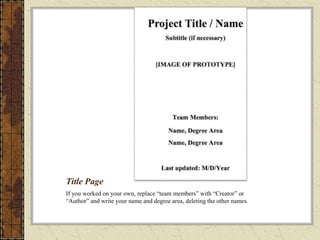
Title Page
If you worked on your own, replace “team members” with “Creator” or
“Author” and write your name and degree area, deleting the other names.
TECHNICAL FIELD
Derived from patent-style documentation, this restates the field (or
fields) your project encompasses.
Background information
One paragraph (5 sentences, minimum).
– What inspired this project?
– Where did your idea come from?
In the US, approximately a third of all households have a dog.
However, most people do not know much about their furry
friend and how they view the world. This leads to
misunderstanding and fear from our beloved animals. This
inspired me to come up with a way for an animal owner to
experience what it’s like to socialize with other dogs and
learn their body language. This way people would be able to
better understand their pet’s behaviors and improve the
overall connection between themselves and their pets.
Prior Art
A legal term that refers to any similar
designs or ideas.
RESEARCH! All ideas have prior art!
– https://www.google.com/patents/USD376826
– Ex: if you have a sports game, discuss similar
games on the market.
• Strong sample: https://tinyurl.com/Prior-art-ex
Project description
Now that you have discussed what has
come before, you can describe your work.
– Discuss in 1 paragraph (at least 5 sentences):
• The general area of application
• Intended tasks your creation will support
• Intended user population
– Be precise and succinct.
The full deliverable of this project is a working prototype of a game with
the eventual inclusion of a VR component to enhance the experience for
the user. The gamer would be playing as a dog that just arrived at the dog
park that has several other dogs already at that location. In the dog park,
the user will learn dog body language from other dogs, knowing when to
approach or back away depending on the actions of the dogs, who will use
certain activities such as pawing at the ground or wagging their tail. This
can help the user better understand dog body language with their own pets
in a fun switch of perspective. The goal of this game is for users to have a
unique and fun experience, with a subtle educational element that can
strengthen relationships with their own pets.
Innovation Claim
Consider this the “thesis” for this paper.
1-2 sentences
– “This project’s innovation comes from…”
– “This project is innovative because…”
Zombie Treasure Island will be innovative in the
options it will give the player to decide how
difficult the game will be. While many games
have presets for difficulty options (easy, normal,
hard, etc.), Zombie Treasure Island's goal is to
allow players customized control over how
difficult the game is for them at any point, fine-
tuning the options to a level that has not been seen
before.
Usage scenario
Think beyond your project.
Sell the reader on the idea behind your
creation.
– How could this product be used beyond the
concept you’re demonstrating?
1-2 paragraphs
– Avoid the first person or “storytelling” tone.
Example
Student created a game focused on a
wheelchair bound protagonist.
– Primary goal: to widen representation in games.
– Extended use: integrate into therapy to promote
positive self esteem among the recently
disabled.
Stuck on the usage?
An alternative here is to focus on your
demographics.
– Think user stories:
• What would the typical user be like? How would
they use this product based on their demographics?
– Expectations are the same– 1-2 paragraphs,
avoiding 1st person/storytelling style.
The demographic for this project would be for any person who is
interested in virtual reality. The game is primarily directed at individuals
who own pets, but anyone interested in virtual reality would still benefit
from the project. Due to teaching nature of the game the system would
also benefit those who are researching dog behavior which could in
turn benefit later development of the game. The game will also have
simple mechanics and should be easily usable by a person of any age. As
the number of pet owners in the US is roughly 30% of the population this
will provide a very wide demographic by which the product could be
marketed (ASPCA, 2011).
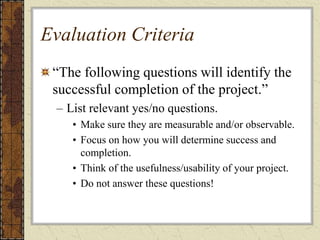
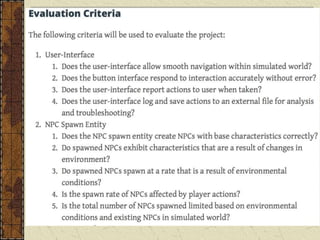
Evaluation Criteria
“The following questions will identify the
successful completion of the project.”
– List relevant yes/no questions.
• Make sure they are measurable and/or observable.
• Focus on how you will determine success and
completion.
• Think of the usefulness/usability of your project.
• Do not answer these questions!
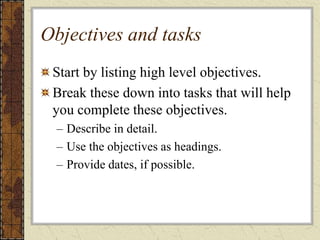
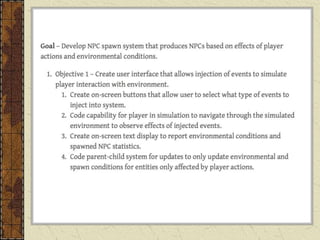
Objectives and tasks
Start by listing high level objectives.
Break these down into tasks that will help
you complete these objectives.
– Describe in detail.
– Use the objectives as headings.
– Provide dates, if possible.
Description of design prototype
At least 1 paragraph on how will you
implement your prototype:
– Platform used to build it
– Directions on how to run it
– Elaborate on how the parts function.
Goal: give the reader an understanding of
what the prototype will be and how it
relates to your project’s goals.
Example:
The design prototype was created in the Unity Game Engine
for PC environments. Ideally, the prototype would utilize VR
technologies. Currently, the prototype holds four dogs
surrounded by shrubs, a fountain, and fencing. There are two
main scripts that are utilized define the dogs interaction with
the character and one for scoring.
…continues to discuss the two main scripts in detail (3
paragraphs total).
Evaluation Plan
Use paragraphs.
How will you evaluate the success of your
project?
How will you go about answering the
“evaluation criteria” questions.
– Do not just repeat those questions!
A group of at least 10 students tested the game to test its usability based on the
criteria listed in the evaluation criteria section. Their play testing involved them
playing each level and modifying the difficulty settings as they felt was needed.
They also tested the shop feature to see if it truly helps the player to set a difficulty
level that is right for them. At the end of the test, they filled out a Google survey
answering the questions listed in the evaluation criteria section. Each play testing
session was limited to two weeks, and what was said has been taken into account,
both for modifications already in the project prototype, and in future
modifications.
Overall, the players felt the game was fun and liked being able to modify the
settings. They saw promise in the game and felt it would be even more fun as
more content is added. All players saw good enough reason to replay levels to give
themselves a challenge and to collect doubloons to unlock further difficulty
modifications. What was said in the survey helped me to fix bugs, such as pathing
and collision issues. It also helped me to make the attacks feel better, as many felt
that the sword animation was too slow. <<This can also become part of the next
section!
Project completion Assessment
AKA: Post-mortem or “lessons learned”
Keywords: in depth description!
– How well does this function?
– Highlight the innovative features.
Sample outline
Sample outline (2-4 paragraphs):
– What went right?
– What went wrong?
– What was learned throughout the process?
– What would be done differently if you had to
do it again?
Appendices
Supporting materials
– Charts, graphs, data
– Images associated with the project
– Game design documents, read-me files
• Give file name for reference
• Link to relevant files
– Patents or other sources
• Cite in APA style
Required format
Appendix letter: Description- file name
– Appendix A: Game design document –
myGameDoc.docx
– Appendix B: 3D render of primary character –
mainCharacter.jpg
– Appendix C: References
Smith, J. (2007). Title. State: Publisher.
Food for thought…
Is each section still accurate depending on
the results of your SIP?
– Check also for future tense. You wrote in this
tense for SIP311, but your work is at an end.
Revise to the present or past tense as needed.
And finally…
As you read your drafted document, is your
progress clear?
– Make sure you explain what has been
completed and what is left to be done!
– Do not just assume the SME will know. Clarity
here will help your assessment.
ANY QUESTIONS?
Thanks for your time!

402 w2

  • 1.
  • 2.
    The core documentfor the SIP Template based Started in SIP311. Goals: – Refine what you have. – Complete the remaining sections. – Revise/Edit
  • 3.
    Template Make sure youare using the most recent template! https://tinyurl.com/SIP-Brief
  • 4.
    Title Page If youworked on your own, replace “team members” with “Creator” or “Author” and write your name and degree area, deleting the other names.
  • 5.
    TECHNICAL FIELD Derived frompatent-style documentation, this restates the field (or fields) your project encompasses.
  • 6.
    Background information One paragraph(5 sentences, minimum). – What inspired this project? – Where did your idea come from?
  • 7.
    In the US,approximately a third of all households have a dog. However, most people do not know much about their furry friend and how they view the world. This leads to misunderstanding and fear from our beloved animals. This inspired me to come up with a way for an animal owner to experience what it’s like to socialize with other dogs and learn their body language. This way people would be able to better understand their pet’s behaviors and improve the overall connection between themselves and their pets.
  • 8.
    Prior Art A legalterm that refers to any similar designs or ideas. RESEARCH! All ideas have prior art! – https://www.google.com/patents/USD376826 – Ex: if you have a sports game, discuss similar games on the market. • Strong sample: https://tinyurl.com/Prior-art-ex
  • 9.
    Project description Now thatyou have discussed what has come before, you can describe your work. – Discuss in 1 paragraph (at least 5 sentences): • The general area of application • Intended tasks your creation will support • Intended user population – Be precise and succinct.
  • 10.
    The full deliverableof this project is a working prototype of a game with the eventual inclusion of a VR component to enhance the experience for the user. The gamer would be playing as a dog that just arrived at the dog park that has several other dogs already at that location. In the dog park, the user will learn dog body language from other dogs, knowing when to approach or back away depending on the actions of the dogs, who will use certain activities such as pawing at the ground or wagging their tail. This can help the user better understand dog body language with their own pets in a fun switch of perspective. The goal of this game is for users to have a unique and fun experience, with a subtle educational element that can strengthen relationships with their own pets.
  • 11.
    Innovation Claim Consider thisthe “thesis” for this paper. 1-2 sentences – “This project’s innovation comes from…” – “This project is innovative because…”
  • 12.
    Zombie Treasure Islandwill be innovative in the options it will give the player to decide how difficult the game will be. While many games have presets for difficulty options (easy, normal, hard, etc.), Zombie Treasure Island's goal is to allow players customized control over how difficult the game is for them at any point, fine- tuning the options to a level that has not been seen before.
  • 13.
    Usage scenario Think beyondyour project. Sell the reader on the idea behind your creation. – How could this product be used beyond the concept you’re demonstrating? 1-2 paragraphs – Avoid the first person or “storytelling” tone.
  • 14.
    Example Student created agame focused on a wheelchair bound protagonist. – Primary goal: to widen representation in games. – Extended use: integrate into therapy to promote positive self esteem among the recently disabled.
  • 15.
    Stuck on theusage? An alternative here is to focus on your demographics. – Think user stories: • What would the typical user be like? How would they use this product based on their demographics? – Expectations are the same– 1-2 paragraphs, avoiding 1st person/storytelling style.
  • 16.
    The demographic forthis project would be for any person who is interested in virtual reality. The game is primarily directed at individuals who own pets, but anyone interested in virtual reality would still benefit from the project. Due to teaching nature of the game the system would also benefit those who are researching dog behavior which could in turn benefit later development of the game. The game will also have simple mechanics and should be easily usable by a person of any age. As the number of pet owners in the US is roughly 30% of the population this will provide a very wide demographic by which the product could be marketed (ASPCA, 2011).
  • 17.
    Evaluation Criteria “The followingquestions will identify the successful completion of the project.” – List relevant yes/no questions. • Make sure they are measurable and/or observable. • Focus on how you will determine success and completion. • Think of the usefulness/usability of your project. • Do not answer these questions!
  • 19.
    Objectives and tasks Startby listing high level objectives. Break these down into tasks that will help you complete these objectives. – Describe in detail. – Use the objectives as headings. – Provide dates, if possible.
  • 21.
    Description of designprototype At least 1 paragraph on how will you implement your prototype: – Platform used to build it – Directions on how to run it – Elaborate on how the parts function. Goal: give the reader an understanding of what the prototype will be and how it relates to your project’s goals.
  • 22.
    Example: The design prototypewas created in the Unity Game Engine for PC environments. Ideally, the prototype would utilize VR technologies. Currently, the prototype holds four dogs surrounded by shrubs, a fountain, and fencing. There are two main scripts that are utilized define the dogs interaction with the character and one for scoring. …continues to discuss the two main scripts in detail (3 paragraphs total).
  • 23.
    Evaluation Plan Use paragraphs. Howwill you evaluate the success of your project? How will you go about answering the “evaluation criteria” questions. – Do not just repeat those questions!
  • 24.
    A group ofat least 10 students tested the game to test its usability based on the criteria listed in the evaluation criteria section. Their play testing involved them playing each level and modifying the difficulty settings as they felt was needed. They also tested the shop feature to see if it truly helps the player to set a difficulty level that is right for them. At the end of the test, they filled out a Google survey answering the questions listed in the evaluation criteria section. Each play testing session was limited to two weeks, and what was said has been taken into account, both for modifications already in the project prototype, and in future modifications. Overall, the players felt the game was fun and liked being able to modify the settings. They saw promise in the game and felt it would be even more fun as more content is added. All players saw good enough reason to replay levels to give themselves a challenge and to collect doubloons to unlock further difficulty modifications. What was said in the survey helped me to fix bugs, such as pathing and collision issues. It also helped me to make the attacks feel better, as many felt that the sword animation was too slow. <<This can also become part of the next section!
  • 25.
    Project completion Assessment AKA:Post-mortem or “lessons learned” Keywords: in depth description! – How well does this function? – Highlight the innovative features.
  • 26.
    Sample outline Sample outline(2-4 paragraphs): – What went right? – What went wrong? – What was learned throughout the process? – What would be done differently if you had to do it again?
  • 27.
    Appendices Supporting materials – Charts,graphs, data – Images associated with the project – Game design documents, read-me files • Give file name for reference • Link to relevant files – Patents or other sources • Cite in APA style
  • 28.
    Required format Appendix letter:Description- file name – Appendix A: Game design document – myGameDoc.docx – Appendix B: 3D render of primary character – mainCharacter.jpg – Appendix C: References Smith, J. (2007). Title. State: Publisher.
  • 29.
    Food for thought… Iseach section still accurate depending on the results of your SIP? – Check also for future tense. You wrote in this tense for SIP311, but your work is at an end. Revise to the present or past tense as needed.
  • 30.
    And finally… As youread your drafted document, is your progress clear? – Make sure you explain what has been completed and what is left to be done! – Do not just assume the SME will know. Clarity here will help your assessment.
  • 31.