All I Ever Needed to Know About Programming I Learned From Re-writing Classic Arcade Games Katrin Becker J. R. Parker
Overview The Challenge of reaching students. What we usually do in 1 st  year. Games and Students Effective Learning Games and Pedagogy Why Arcade Games What can we teach with games? Dialing Down & Ramping Up
The Challenge Enrollments in CS are down. Demand for CS professionals is changing. Need More breadth (applications, media). Outsourcing. How to fill demand for programmers? How to attract CS Majors?
The Usual Typical progression:  Uniform, incremental steps Mathematical sequencing of content Teach programming step-wise,  From little to  big ;  From simple (sorting lists)...to complex (sorting big lists) From boring to…. Still boring
Games and Students CS students are gamers Games got many students interested in CS Students  get  games Usually better than “widgets”
Effective learning happens when… Students care about the problems they need to solve Students understand the problems they need to solve We take prior learning into account (start from where the students are)
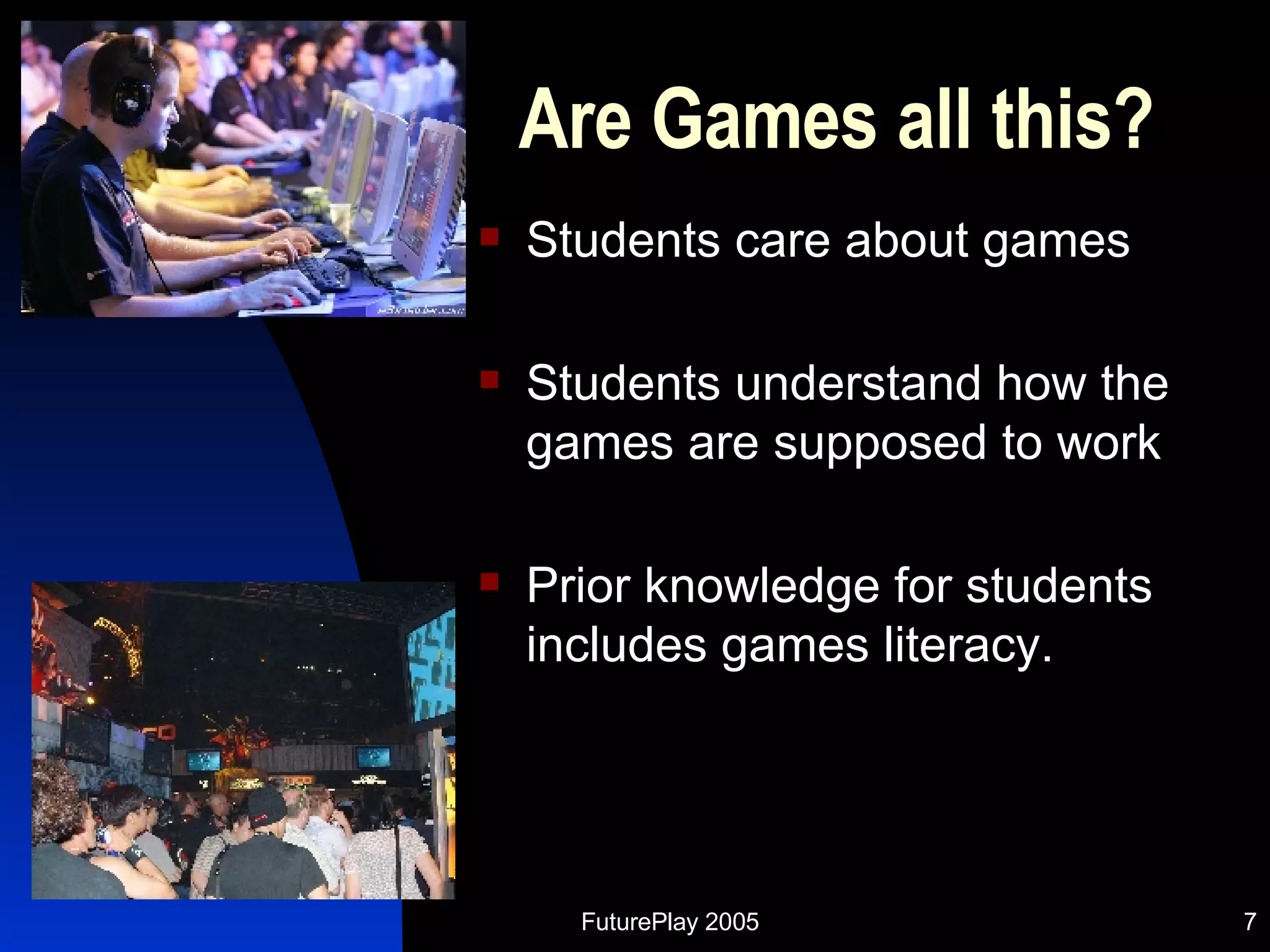
Are Games all this? Students care about games Students understand how the games are supposed to work Prior knowledge for students includes games literacy.
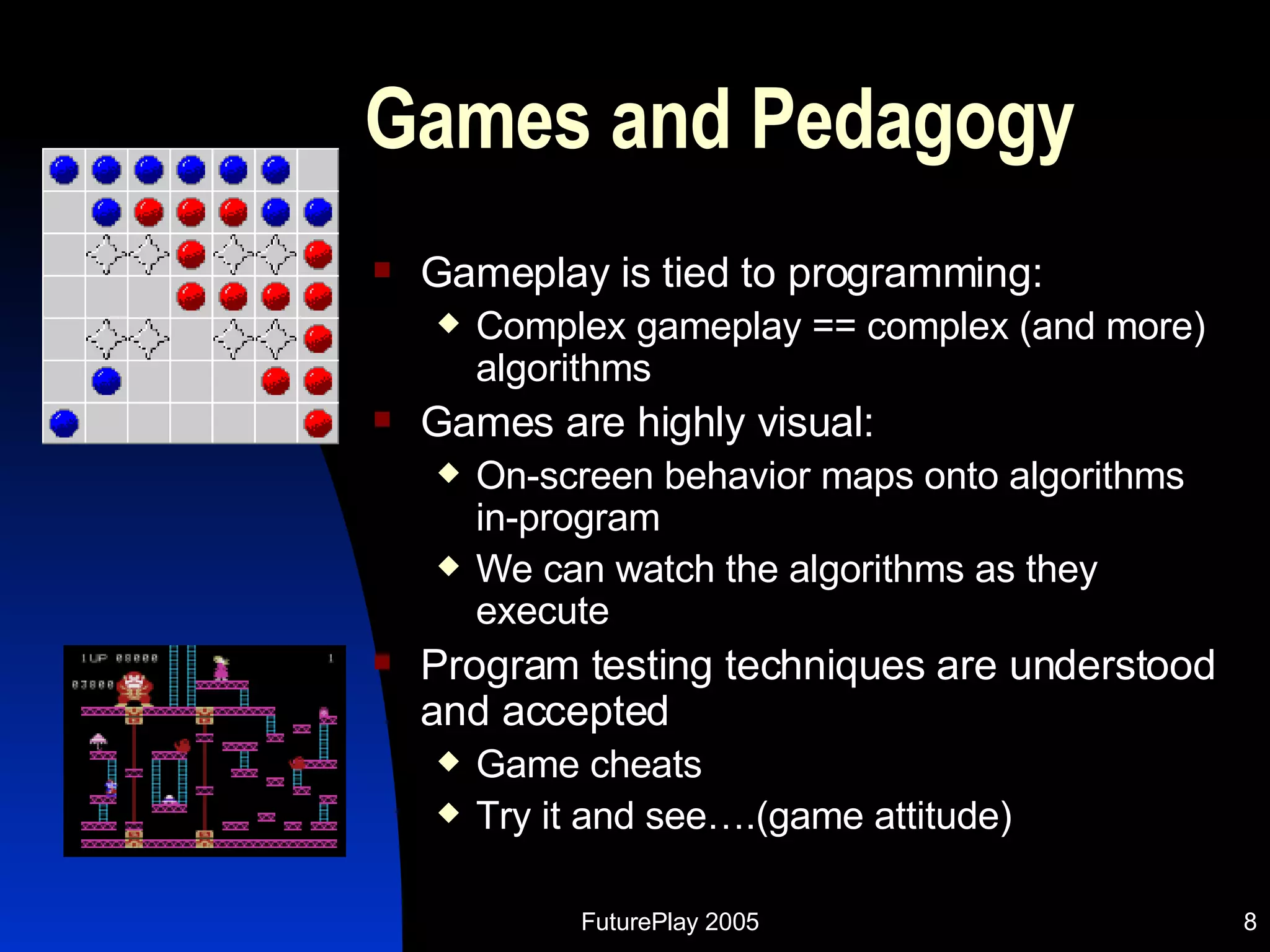
Games and Pedagogy Gameplay is tied to programming: Complex gameplay == complex (and more) algorithms Games are highly visual: On-screen behavior maps onto algorithms in-program We can watch the algorithms as they execute Program testing techniques are understood and accepted  Game cheats Try it and see….(game attitude)
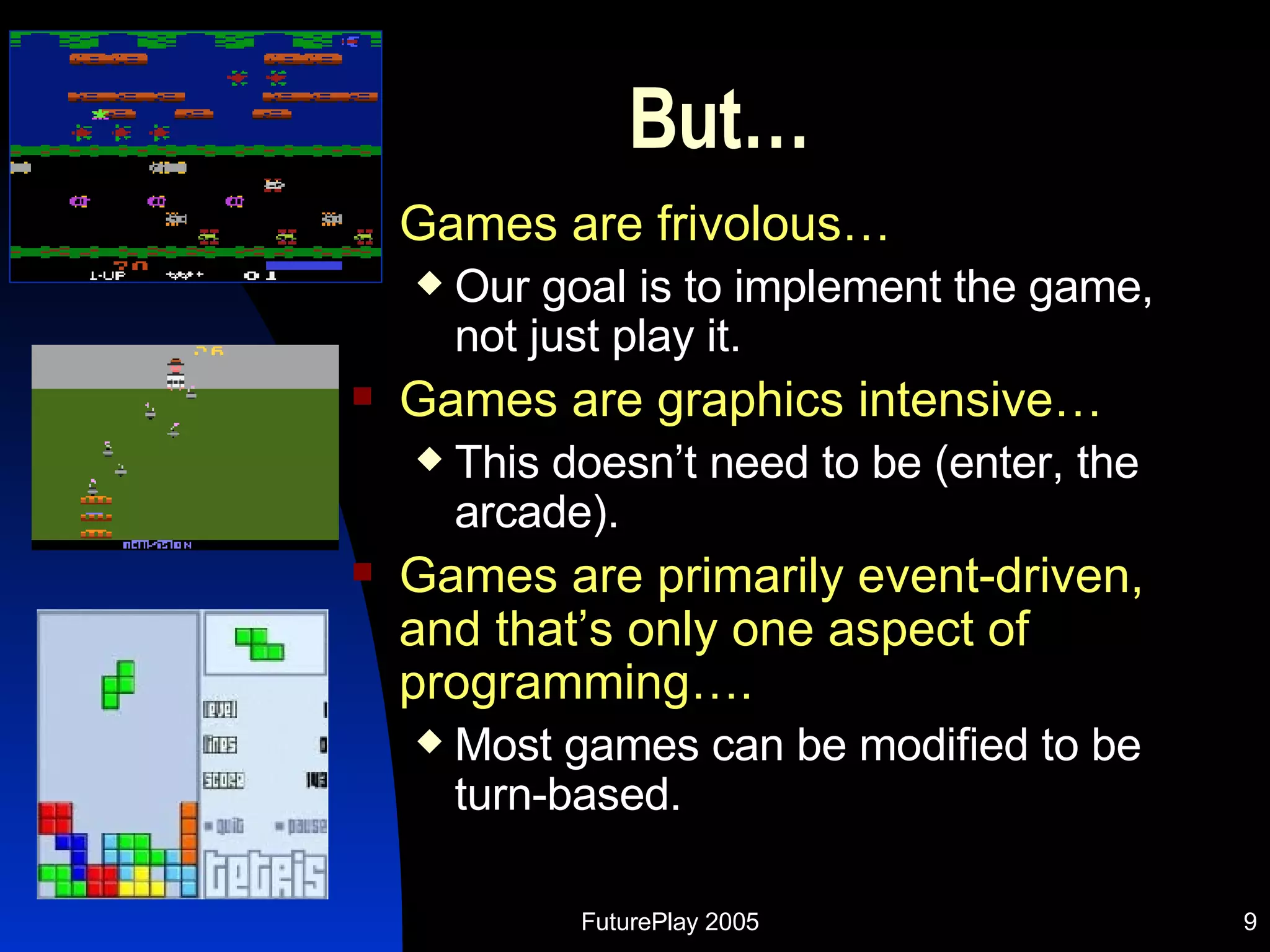
But… Games are frivolous… Our goal is to implement the game, not just play it. Games are graphics intensive… This doesn’t need to be (enter, the arcade). Games are primarily event-driven, and that’s only one aspect of programming…. Most games can be modified to be turn-based.
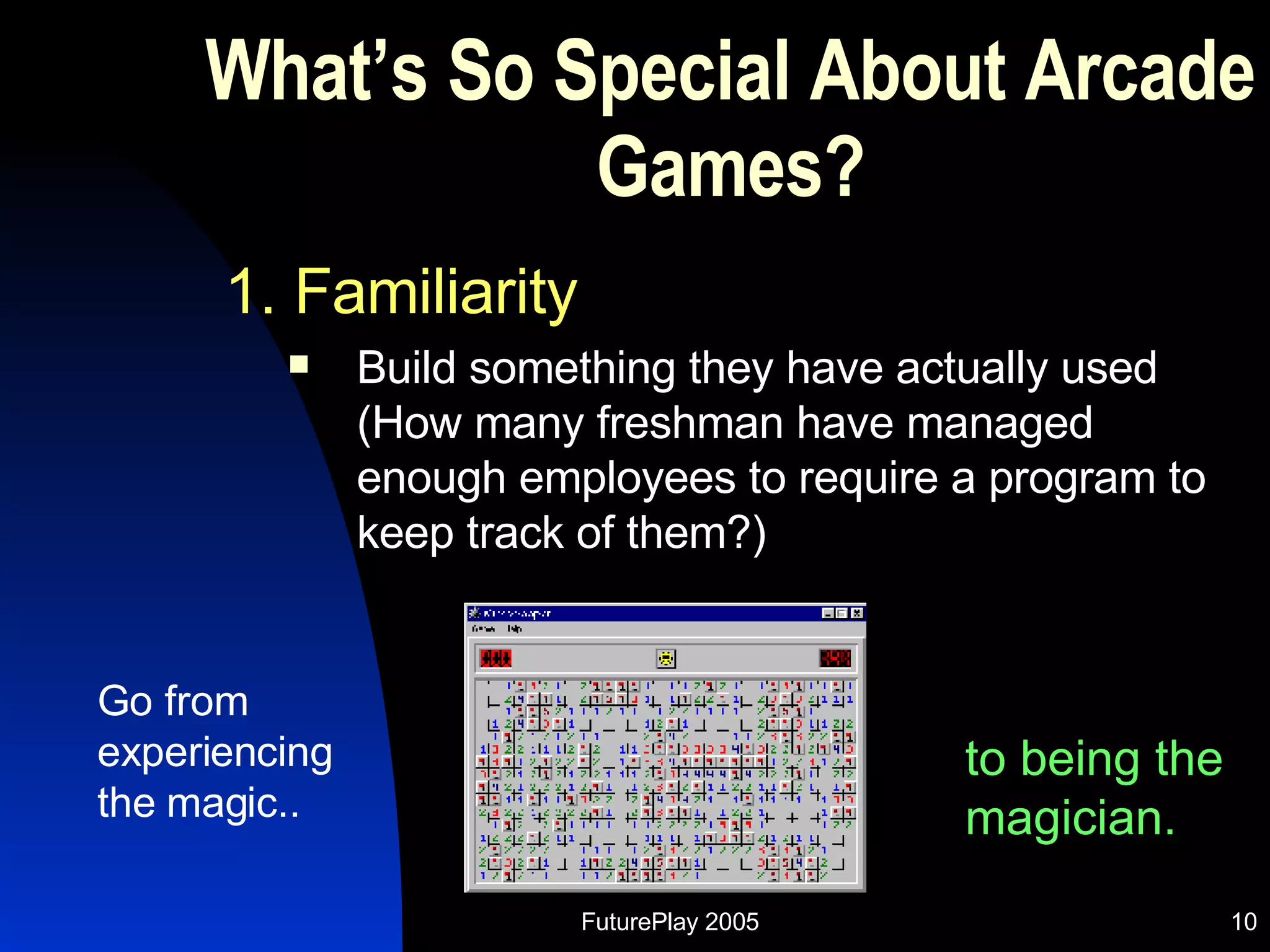
What’s So Special About Arcade Games? 1. Familiarity Build something they have actually used (How many freshman have managed enough employees to require a program to keep track of them?) Go from experiencing the magic.. to being the magician.
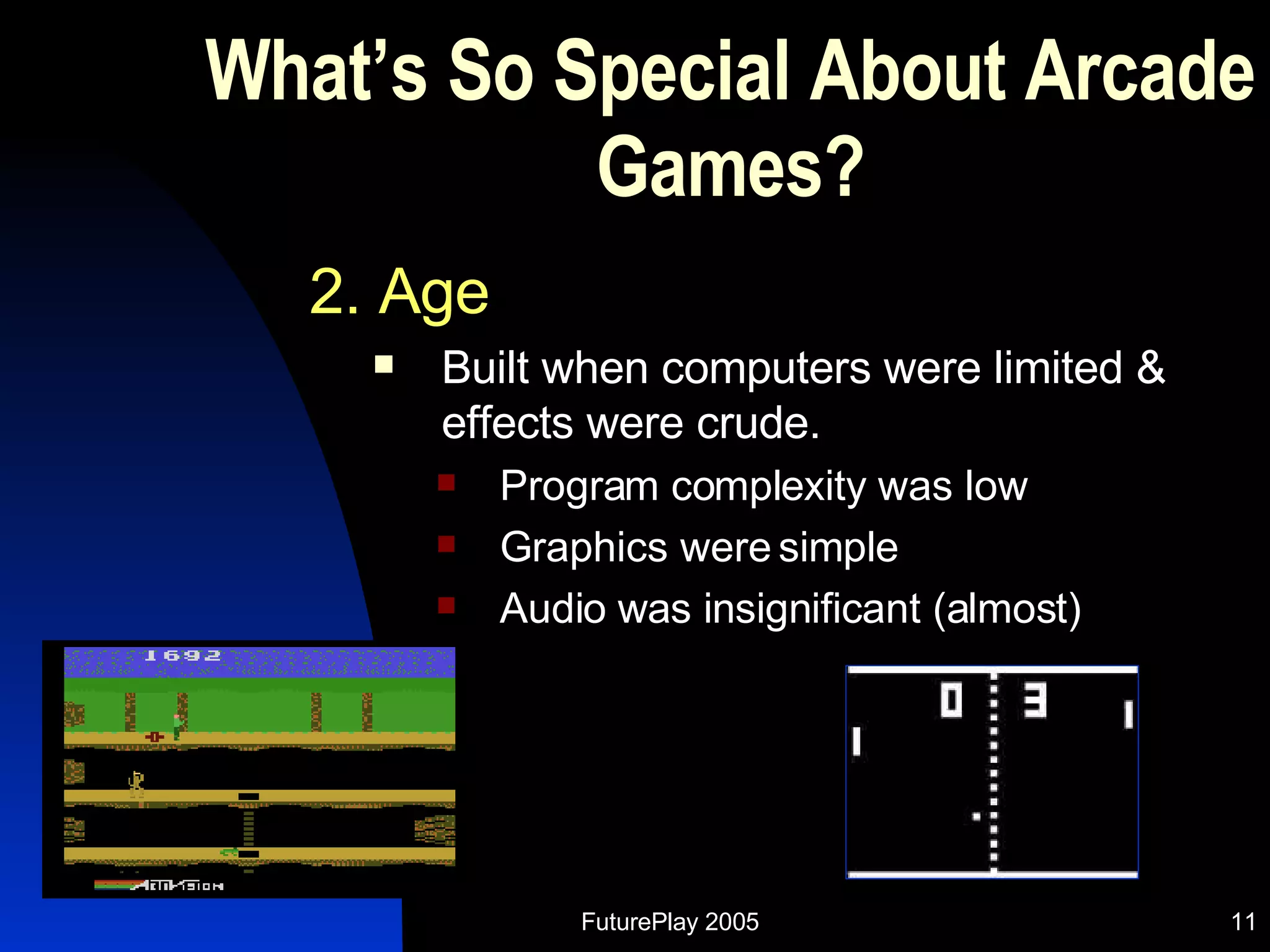
What’s So Special About Arcade Games? 2. Age Built when computers were limited & effects were crude. Program complexity was low Graphics were simple Audio was insignificant (almost)
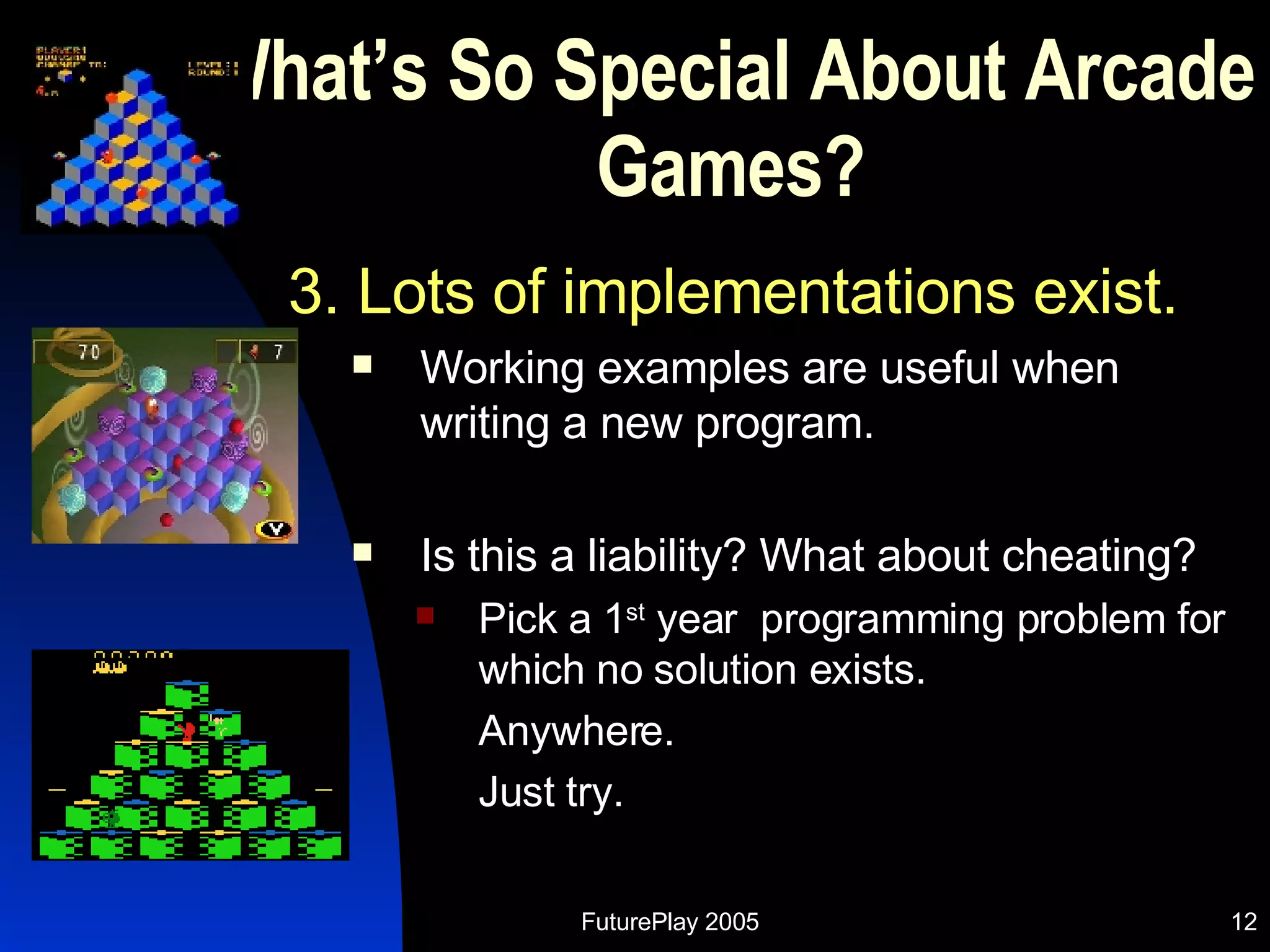
What’s So Special About Arcade Games? 3. Lots of implementations exist. Working examples are useful when writing a new program. Is this a liability? What about cheating? Pick a 1 st  year  programming problem for which no solution exists.  Anywhere.  Just try.
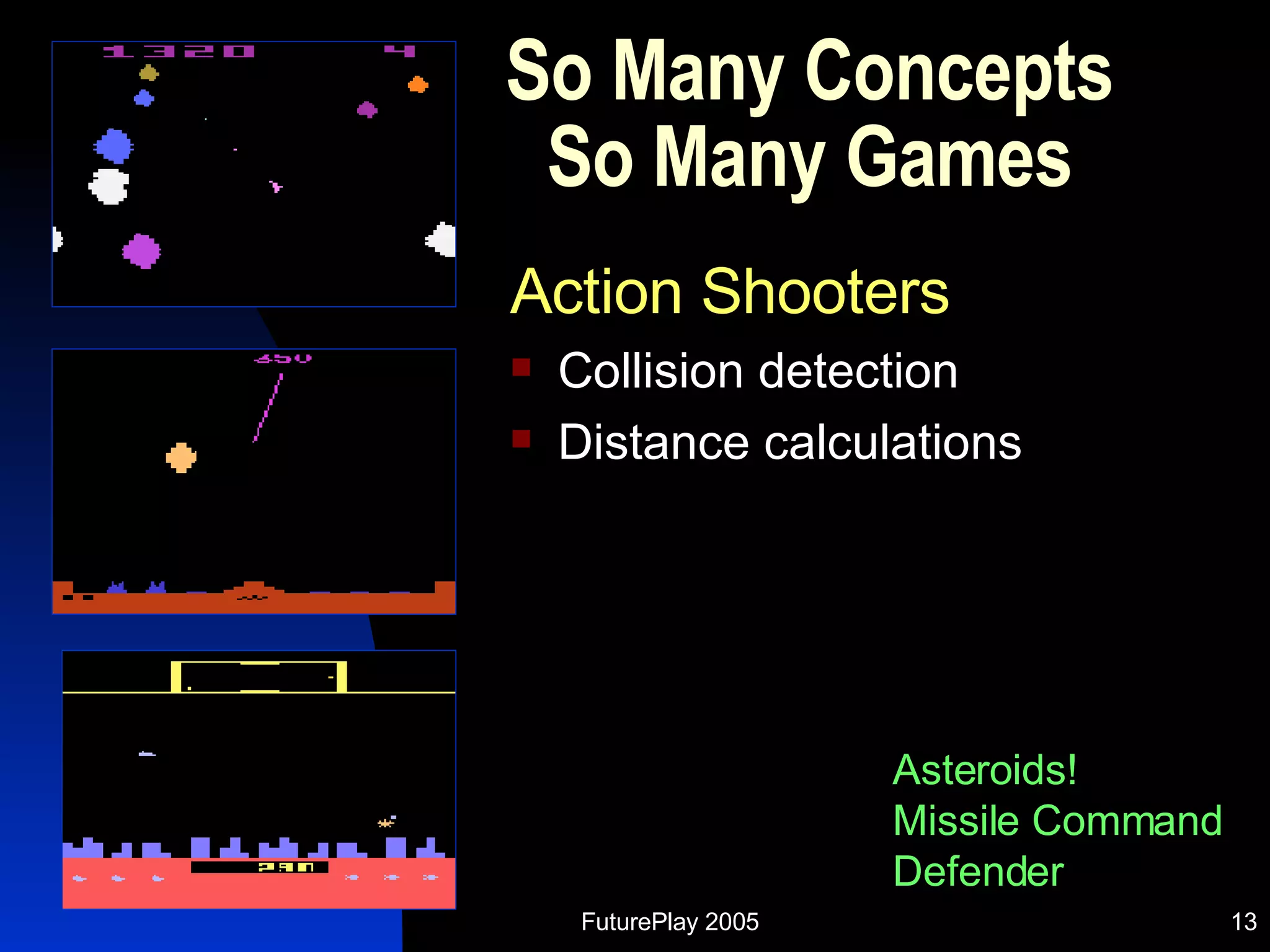
So Many Concepts So Many Games Action Shooters Collision detection Distance calculations Asteroids! Missile Command Defender
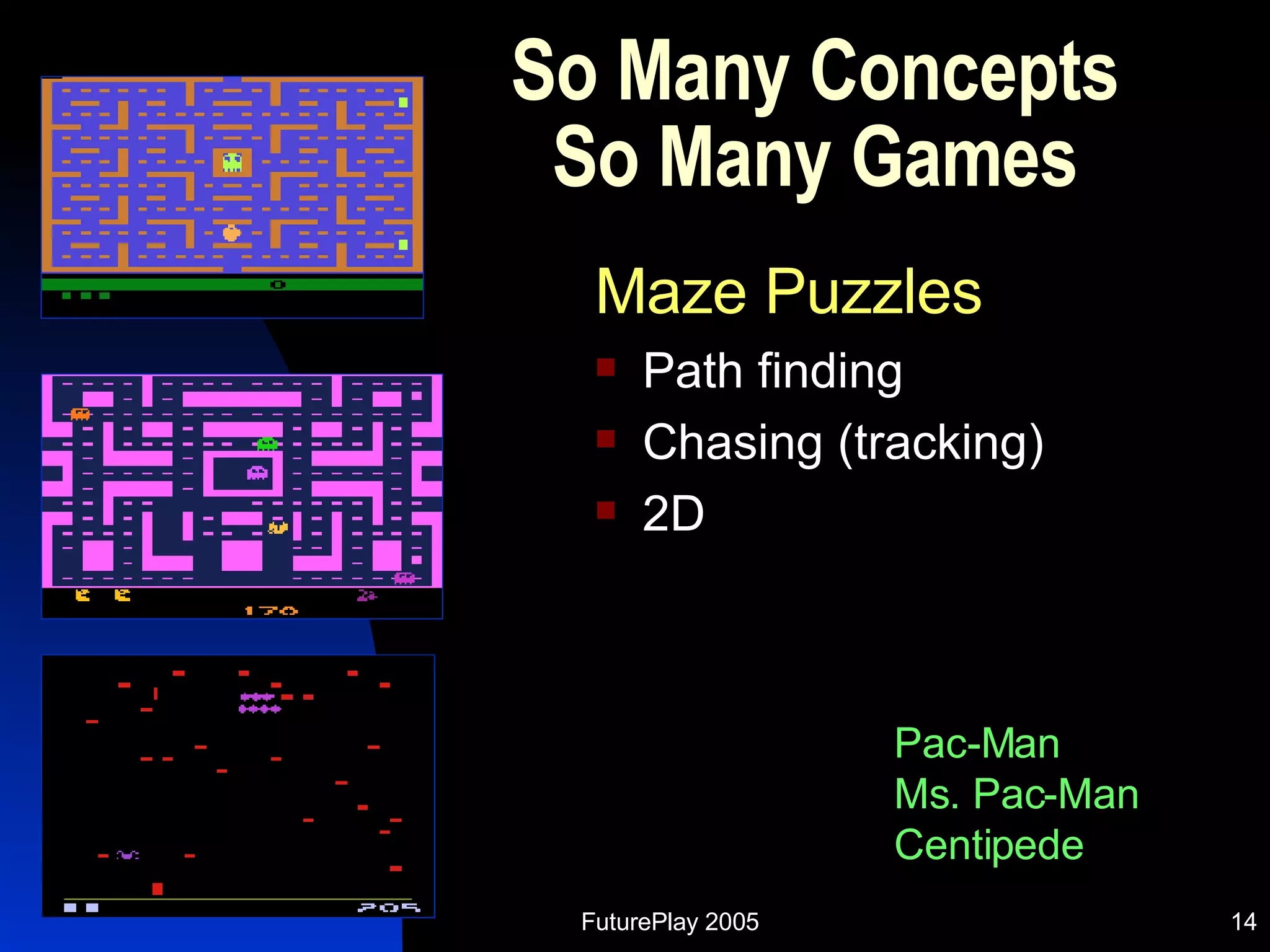
So Many Concepts So Many Games Maze Puzzles Path finding Chasing (tracking) 2D  Pac-Man Ms. Pac-Man Centipede
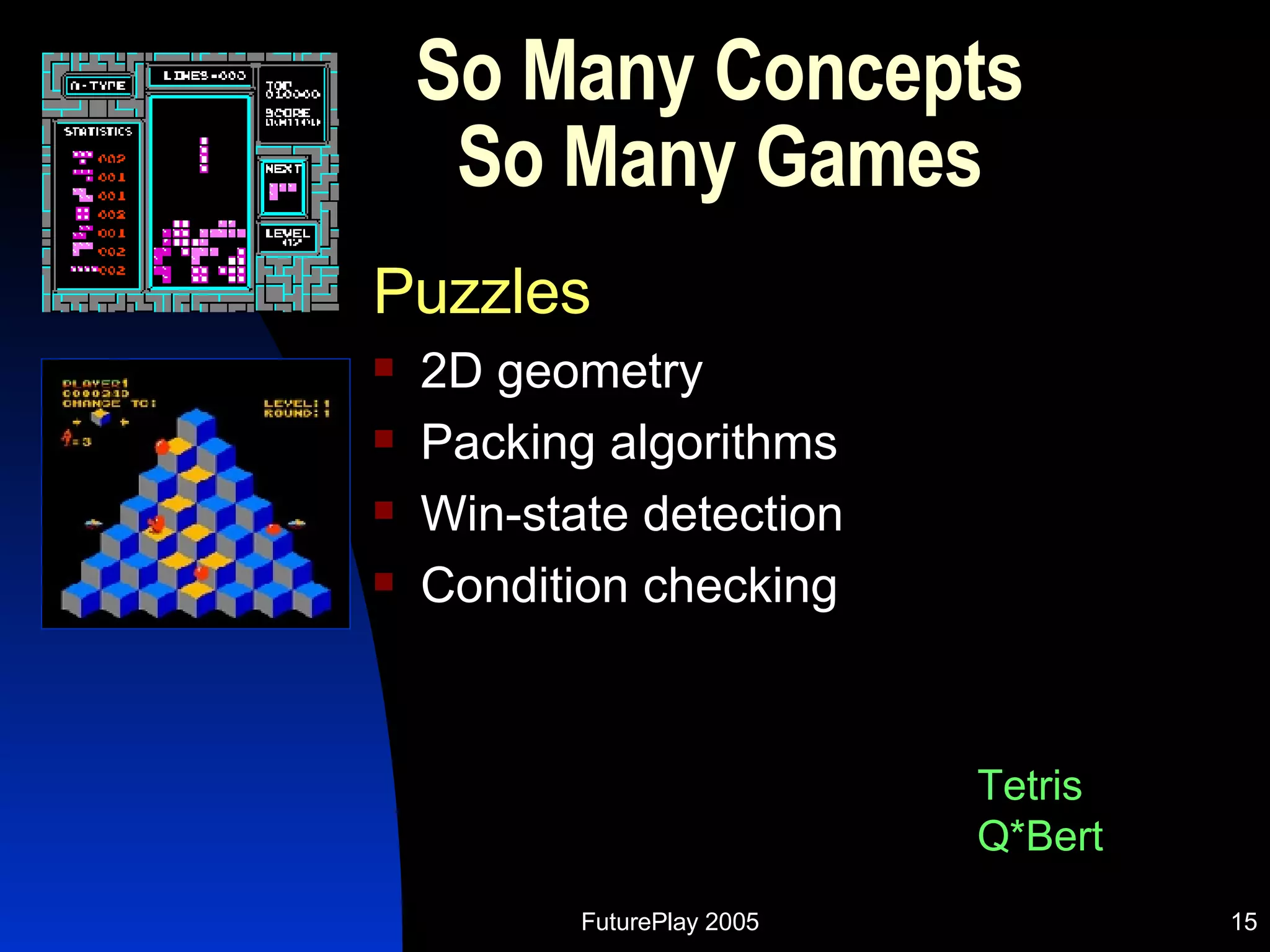
So Many Concepts So Many Games Puzzles 2D geometry Packing algorithms Win-state detection Condition checking Tetris Q*Bert
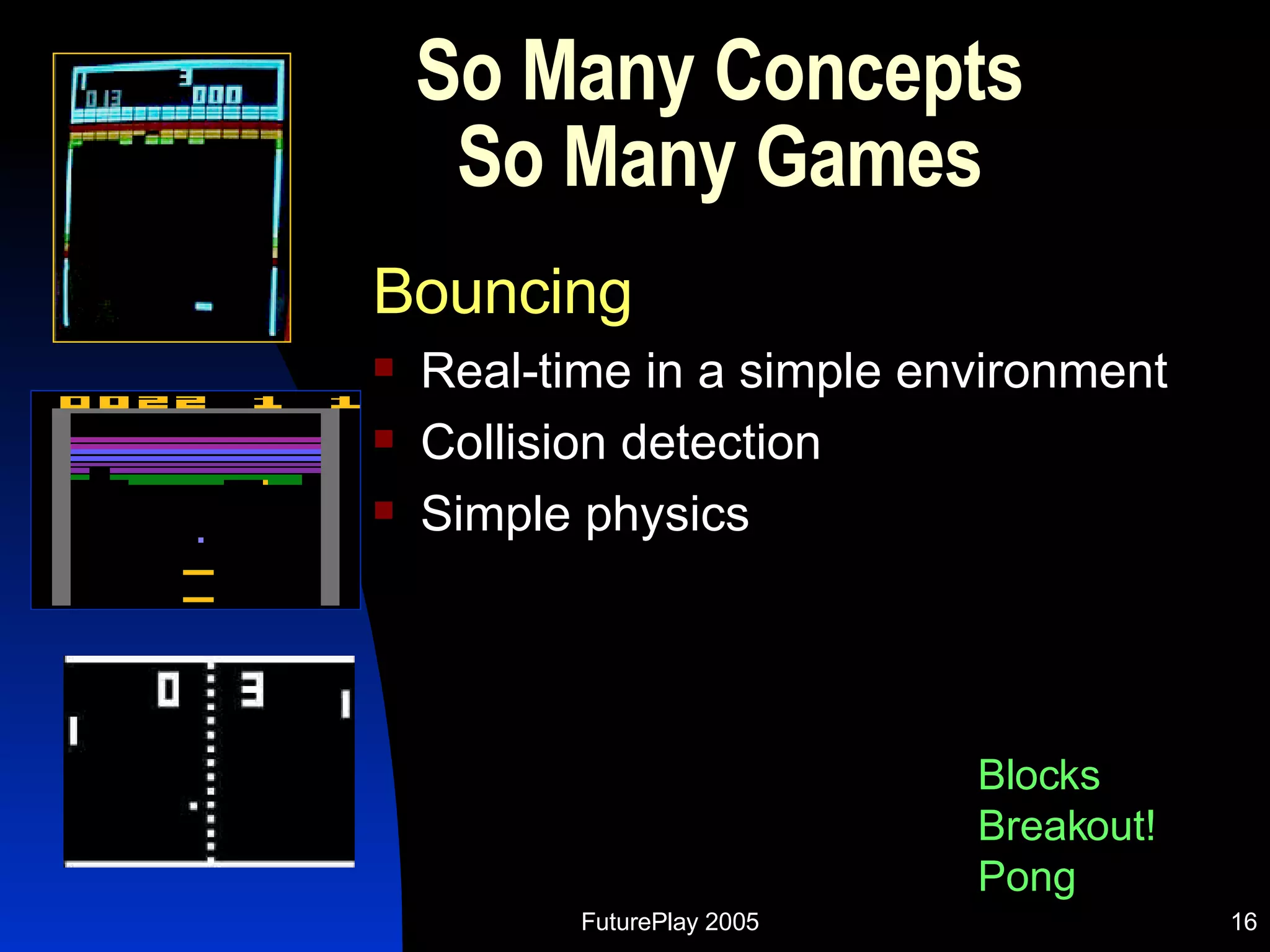
So Many Concepts So Many Games Bouncing Real-time in a simple environment Collision detection Simple physics Blocks Breakout! Pong
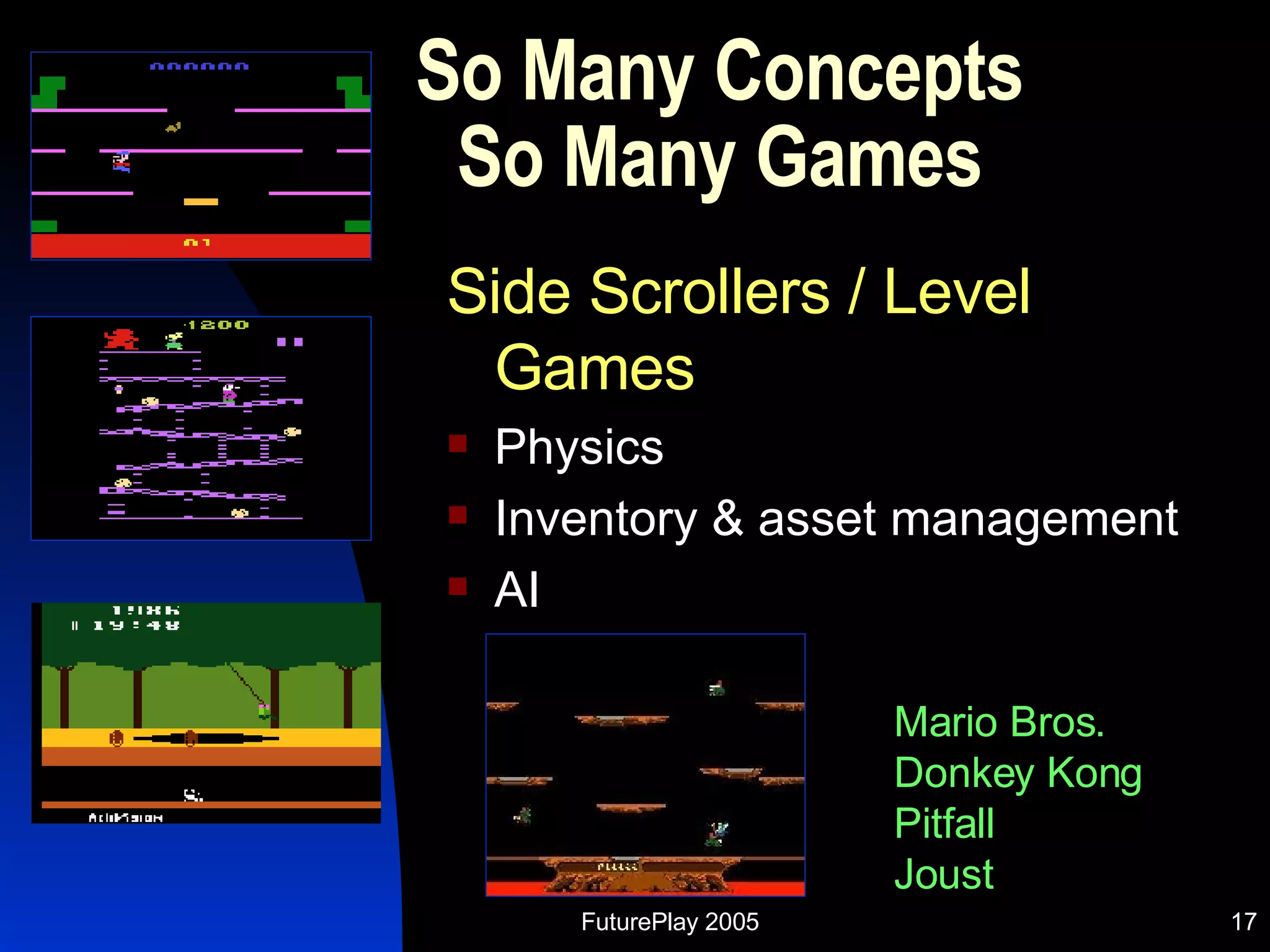
So Many Concepts So Many Games Side Scrollers / Level Games Physics Inventory & asset management AI  Mario Bros. Donkey Kong Pitfall Joust
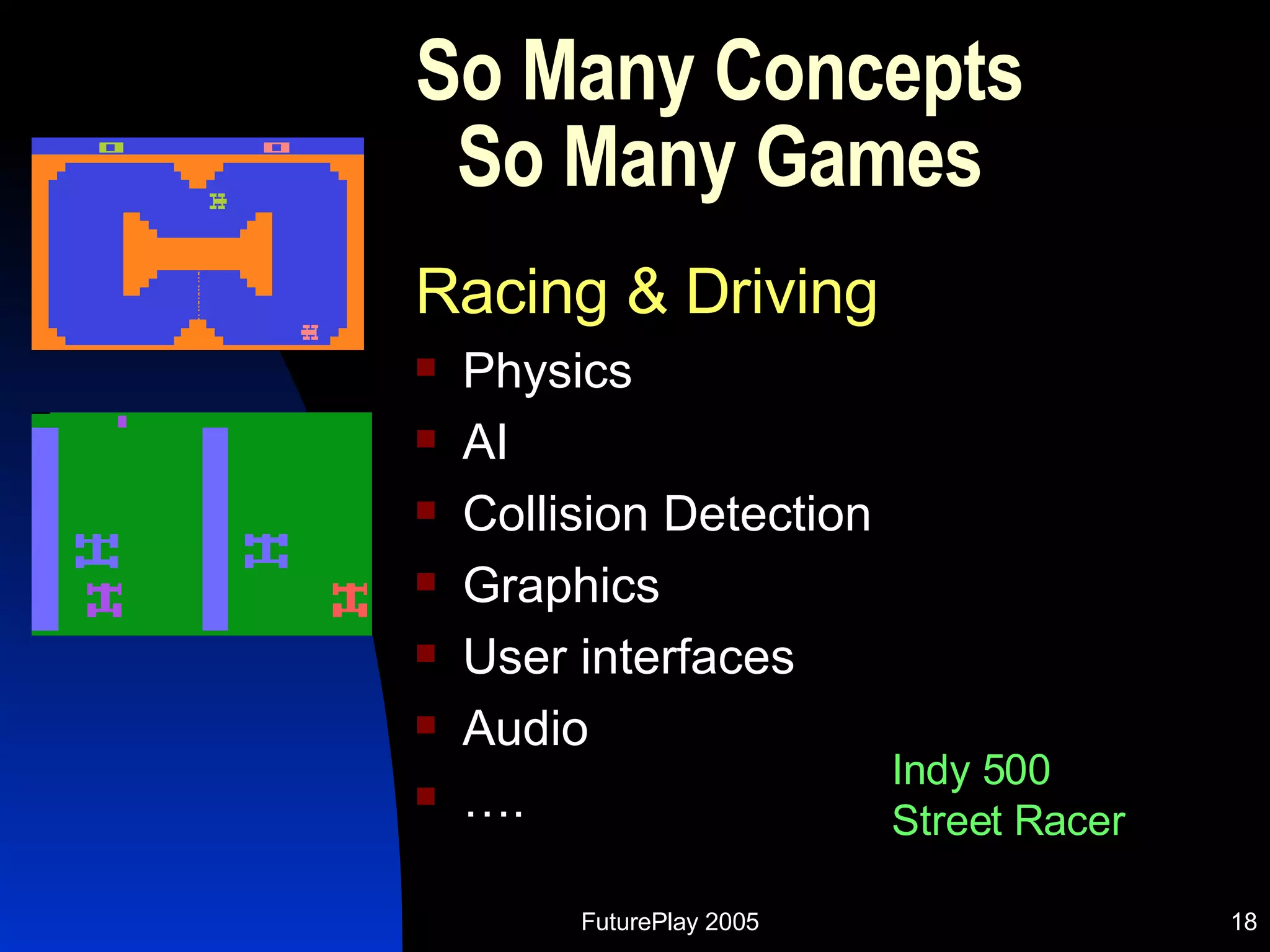
So Many Concepts So Many Games Racing & Driving Physics AI Collision Detection Graphics User interfaces Audio …. Indy 500 Street Racer
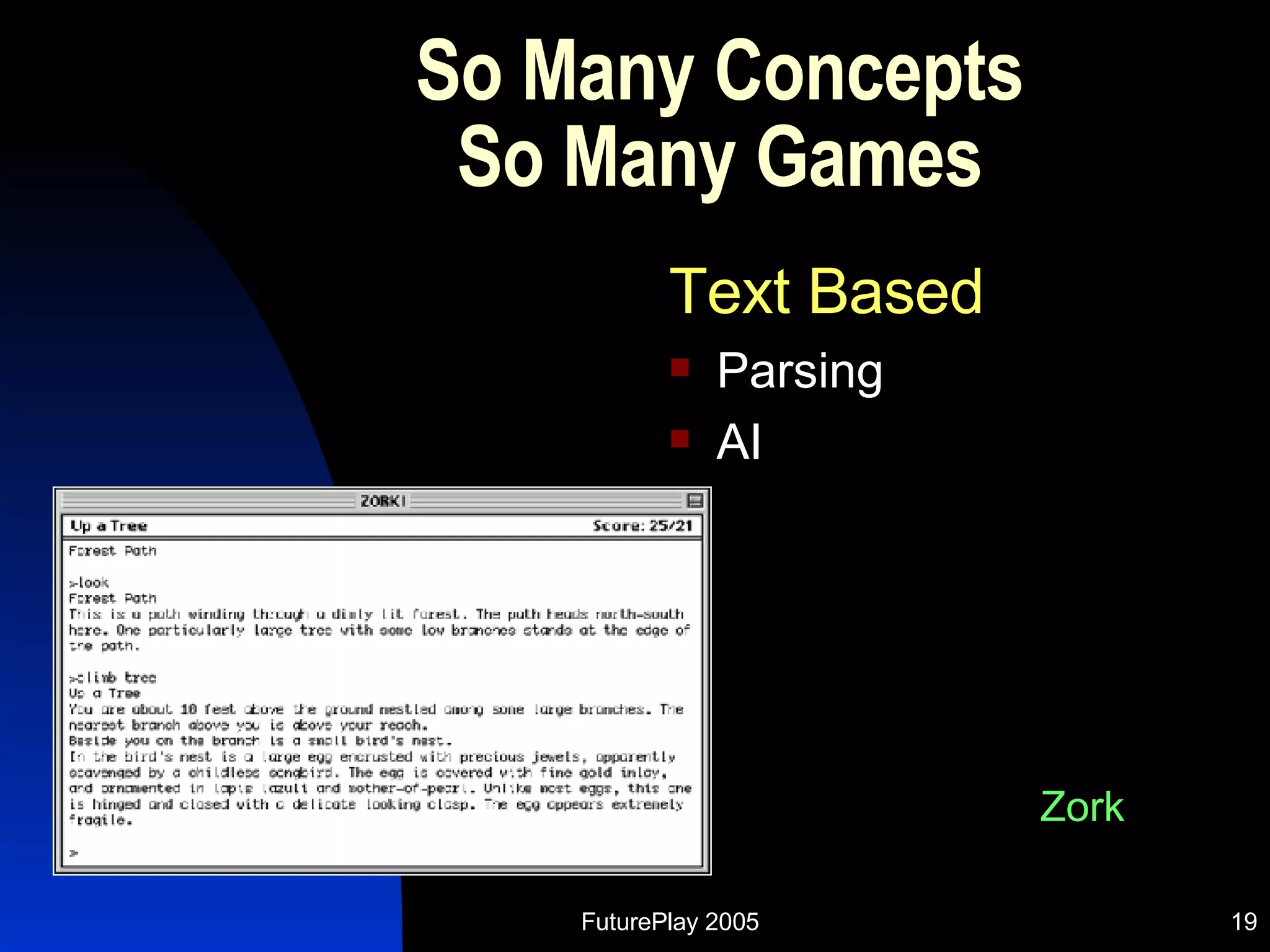
So Many Concepts So Many Games Text Based Parsing AI Zork
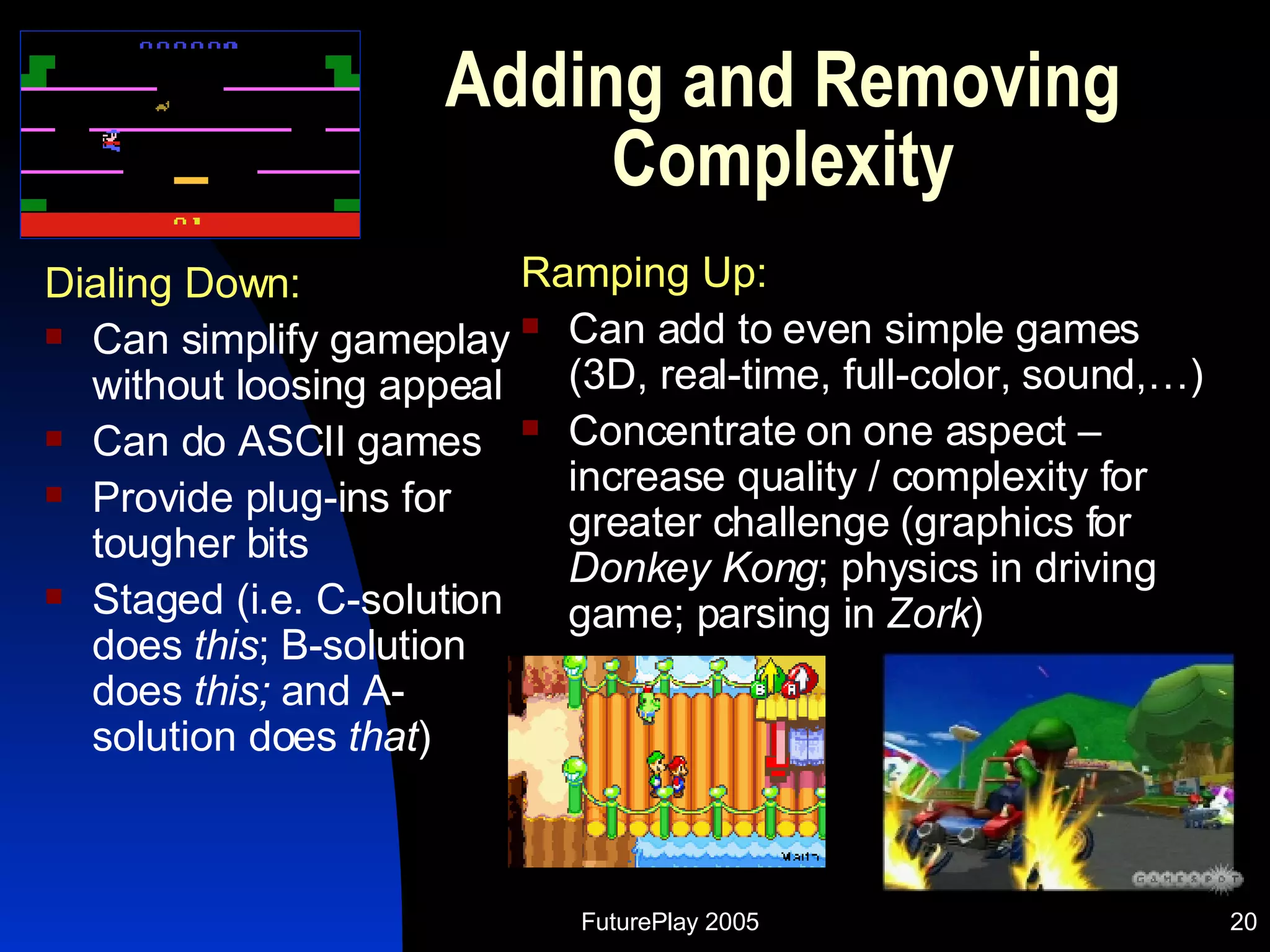
Adding and Removing Complexity Dialing Down: Can simplify gameplay without loosing appeal  Can do ASCII games Provide plug-ins for tougher bits Staged (i.e. C-solution does  this ; B-solution does  this;  and A-solution does  that ) Ramping Up: Can add to even simple games (3D, real-time, full-color, sound,…) Concentrate on one aspect – increase quality / complexity for greater challenge (graphics for  Donkey Kong ; physics in driving game; parsing in  Zork )
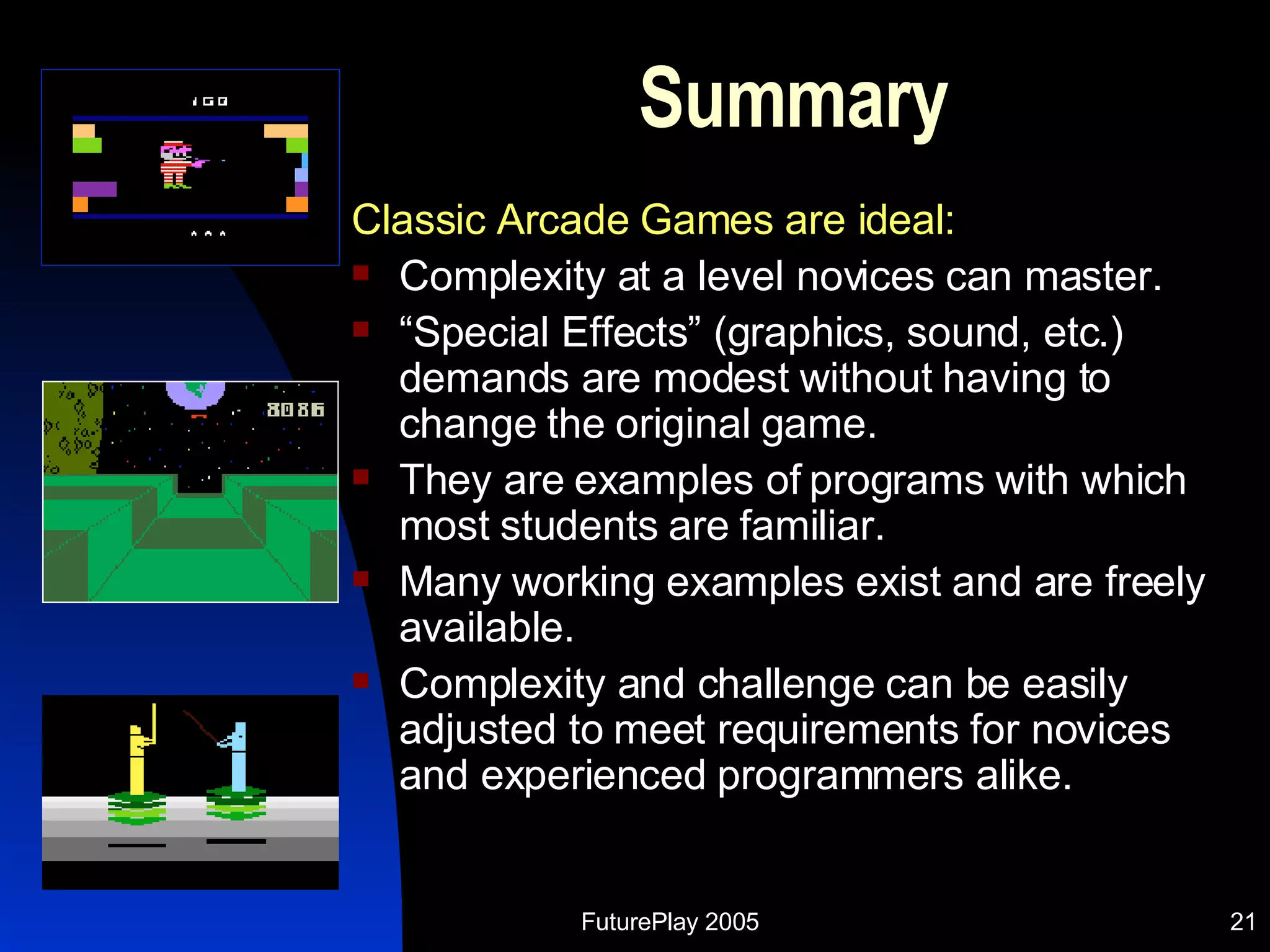
Summary Classic Arcade Games are ideal: Complexity at a level novices can master. “ Special Effects” (graphics, sound, etc.) demands are modest without having to change the original game. They are examples of programs with which most students are familiar. Many working examples exist and are freely available. Complexity and challenge can be easily adjusted to meet requirements for novices and experienced programmers alike.
Thanks.
Image credits Attaxx:  http://www.pressibus.org/ataxx/gen/gbintro.html Breakout:  http://freespace.virgin.net/james.handlon/earlygamingmemoriespart2.htm Q*Bert:  http://www.gamespot.com Lunar Lander:  http://gnm5.tripod.com/Lunar_lander.htm Joust:  http://www.glitchnyc.com/cgi-bin/blosxom.cgi/technology/games/index.phblox Zork: Infocom, Inc.  Zork I: The Great Underground Empire.  Cambridge, MA: 1981. Street Racer:  http://www.vgmuseum.com/pics5/streetracer.html Pitfall:  http://www.geocities.com/xinet2004/segagenesis.htm VideoGameCritic.net (multiple images, especially  Atari 2600 Games, and Intellivision) GameSpot MobyGames

All I Ever Needed To Know About Programming

  • 1.
    All I EverNeeded to Know About Programming I Learned From Re-writing Classic Arcade Games Katrin Becker J. R. Parker
  • 2.
    Overview The Challengeof reaching students. What we usually do in 1 st year. Games and Students Effective Learning Games and Pedagogy Why Arcade Games What can we teach with games? Dialing Down & Ramping Up
  • 3.
    The Challenge Enrollmentsin CS are down. Demand for CS professionals is changing. Need More breadth (applications, media). Outsourcing. How to fill demand for programmers? How to attract CS Majors?
  • 4.
    The Usual Typicalprogression: Uniform, incremental steps Mathematical sequencing of content Teach programming step-wise, From little to big ; From simple (sorting lists)...to complex (sorting big lists) From boring to…. Still boring
  • 5.
    Games and StudentsCS students are gamers Games got many students interested in CS Students get games Usually better than “widgets”
  • 6.
    Effective learning happenswhen… Students care about the problems they need to solve Students understand the problems they need to solve We take prior learning into account (start from where the students are)
  • 7.
    Are Games allthis? Students care about games Students understand how the games are supposed to work Prior knowledge for students includes games literacy.
  • 8.
    Games and PedagogyGameplay is tied to programming: Complex gameplay == complex (and more) algorithms Games are highly visual: On-screen behavior maps onto algorithms in-program We can watch the algorithms as they execute Program testing techniques are understood and accepted Game cheats Try it and see….(game attitude)
  • 9.
    But… Games arefrivolous… Our goal is to implement the game, not just play it. Games are graphics intensive… This doesn’t need to be (enter, the arcade). Games are primarily event-driven, and that’s only one aspect of programming…. Most games can be modified to be turn-based.
  • 10.
    What’s So SpecialAbout Arcade Games? 1. Familiarity Build something they have actually used (How many freshman have managed enough employees to require a program to keep track of them?) Go from experiencing the magic.. to being the magician.
  • 11.
    What’s So SpecialAbout Arcade Games? 2. Age Built when computers were limited & effects were crude. Program complexity was low Graphics were simple Audio was insignificant (almost)
  • 12.
    What’s So SpecialAbout Arcade Games? 3. Lots of implementations exist. Working examples are useful when writing a new program. Is this a liability? What about cheating? Pick a 1 st year programming problem for which no solution exists. Anywhere. Just try.
  • 13.
    So Many ConceptsSo Many Games Action Shooters Collision detection Distance calculations Asteroids! Missile Command Defender
  • 14.
    So Many ConceptsSo Many Games Maze Puzzles Path finding Chasing (tracking) 2D Pac-Man Ms. Pac-Man Centipede
  • 15.
    So Many ConceptsSo Many Games Puzzles 2D geometry Packing algorithms Win-state detection Condition checking Tetris Q*Bert
  • 16.
    So Many ConceptsSo Many Games Bouncing Real-time in a simple environment Collision detection Simple physics Blocks Breakout! Pong
  • 17.
    So Many ConceptsSo Many Games Side Scrollers / Level Games Physics Inventory & asset management AI Mario Bros. Donkey Kong Pitfall Joust
  • 18.
    So Many ConceptsSo Many Games Racing & Driving Physics AI Collision Detection Graphics User interfaces Audio …. Indy 500 Street Racer
  • 19.
    So Many ConceptsSo Many Games Text Based Parsing AI Zork
  • 20.
    Adding and RemovingComplexity Dialing Down: Can simplify gameplay without loosing appeal Can do ASCII games Provide plug-ins for tougher bits Staged (i.e. C-solution does this ; B-solution does this; and A-solution does that ) Ramping Up: Can add to even simple games (3D, real-time, full-color, sound,…) Concentrate on one aspect – increase quality / complexity for greater challenge (graphics for Donkey Kong ; physics in driving game; parsing in Zork )
  • 21.
    Summary Classic ArcadeGames are ideal: Complexity at a level novices can master. “ Special Effects” (graphics, sound, etc.) demands are modest without having to change the original game. They are examples of programs with which most students are familiar. Many working examples exist and are freely available. Complexity and challenge can be easily adjusted to meet requirements for novices and experienced programmers alike.
  • 22.
  • 23.
    Image credits Attaxx: http://www.pressibus.org/ataxx/gen/gbintro.html Breakout: http://freespace.virgin.net/james.handlon/earlygamingmemoriespart2.htm Q*Bert: http://www.gamespot.com Lunar Lander: http://gnm5.tripod.com/Lunar_lander.htm Joust: http://www.glitchnyc.com/cgi-bin/blosxom.cgi/technology/games/index.phblox Zork: Infocom, Inc. Zork I: The Great Underground Empire. Cambridge, MA: 1981. Street Racer: http://www.vgmuseum.com/pics5/streetracer.html Pitfall: http://www.geocities.com/xinet2004/segagenesis.htm VideoGameCritic.net (multiple images, especially Atari 2600 Games, and Intellivision) GameSpot MobyGames