INTERNATIONAL JOURNAL OF ELECTRONICS AND 
International Journal of Electronics and Communication Engineering & Technology (IJECET), ISSN 0976 – 
6464(Print), ISSN 0976 – 6472(Online), Volume 5, Issue 7, July (2014), pp. 39-45 © IAEME 
COMMUNICATION  
ENGINEERING  TECHNOLOGY (IJECET) 
ISSN 0976 – 6464(Print) 
ISSN 0976 – 6472(Online) 
Volume 5, Issue 7, July (2014), pp. 39-45 
© IAEME: http://www.iaeme.com/IJECET.asp 
Journal Impact Factor (2014): 7.2836 (Calculated by GISI) 
www.jifactor.com 
39 
 
IJECET 
© I A E M E 
MECHANICAL SPARE PART INSPECTION USING ARTIFICIAL NEURAL 
NETWORK 
Sweety H Meshram*†, Vinay Keswani*, Nilesh Bodne* 
*Department of Electronic and Communication, Vidharbha Institute of Technology, 
RTMNU Nagpur 
†Corresponding author 
ABSTRACT 
Artificial Neural Network (ANN) is a fast-growing method which has been used in different 
industries during recent years. The main idea for creating ANN which is a subset of artificial 
intelligence is to provide a simple model of human brain in order to solve complex scientific and 
industrial problems. ANNs are high-value and low-cost tools in modelling, simulation, control, 
condition monitoring, sensor validation and fault diagnosis of different systems. It have high 
flexibility and robustness in modeling, simulating and diagnosing the behavior of rotating machines 
even in the presence of inaccurate input data. They can provide high computational speed for 
complicated tasks that require rapid response such as real-time processing of several simultaneous 
signals. ANNs can also be used to improve efficiency and productivity of energy in rotating 
equipment. 
In the present study develop an efficient system for sorting out various machine components 
in order to attain very high efficiency. Feature extraction tools are used for feature extraction of the 
input object. Artificial neural network the popular artificial intelligence technique is used for 
recognising the wavelet component object. There is also a special error function for increasing the 
efficiency of the system. Matlab 7.10 is used for the simulation of the object. 
Keywords: Digital Signature, MATLAB 7.10, Recognition, Wavelet Transform, Artificial Neural 
Network. 
1. INTRODUCTION 
There are things at which humans are still way ahead of the machines in terms of efficiency 
one of such thing is the recognition especially pattern recognition. There are several methods which 
are tested for giving the machines the intelligence in a efficient way for pattern recognition purpose.
International Journal of Electronics and Communication Engineering  Technology (IJECET), ISSN 0976 – 
6464(Print), ISSN 0976 – 6472(Online), Volume 5, Issue 7, July (2014), pp. 39-45 © IAEME 
 
The artificial neural network is one of the most optimization techniques used for training the 
networks for efficient recognition. 
40 
 
The machine is made by integration of many parts to extract information from an image in 
order to solve some task. As a scientific discipline, computer vision is concerned with the theory 
behind artificial systems that extract information from images. Recognition is the classical problem 
in computer vision, image processing, and machine vision. It is related to the determination of 
whether or not the image data contains some specific object, feature, or activity. This task can 
normally be solved robustly and without effort by a human, but is still not satisfactorily solved in 
computer vision for the general case, involving arbitrary objects in arbitrary situations. The existing 
methods for dealing with this problem can at best solve it only for specific objects, such as simple 
geometric objects, human faces, printed or handwritten characters, or vehicles, and in specific 
situations, typically described in terms of well-defined illumination, background, and pose of the 
object relative to the camera. Protective relaying is applied to components of a mechanical sorting 
for the following reasons: 
a) Separate the faulted equipment from the remainder of the system so that they can continue to 
function. 
b) Limit damage to the faulted equipment. 
c) Minimize the possibility of fire. 
d) Minimize hazards to personnel. 
e) Minimize the risk of damage to adjacent high-voltage apparatus. 
Sort recognitions are the most important components in a system. Avoiding damage to 
component is vital; otherwise continuity in power delivery may be seriously disrupted. However, 
since the cost of repairing faulty machine may be great and since high-speed, highly sensitive 
protective devices can reduce damage and thereby repair cost, relays should be considered for 
protecting machines also, particularly in the larger sizes. Faults internal to machines quite often 
involve a magnitude of fault current that is low relative to the transformer base rating. This indicates 
a need for high sensitivity and high speed to ensure good protection. The plan selected should 
balance the best combination of these factors against the overall economics of the situation while 
holding to a minimum. 
a) Cost of repairing damage 
b) Cost of lost production 
c) Adverse effects on the balance of the system 
d) The spread of damage to adjacent equipment 
e) The period of unavailability of the damaged equipment 
Differential protective relay has been used as the primary protection of most machines for 
many years. Inrush can be generated when a transformer is switched on the transmission line or an 
external line fault is cleared. Similarly Over-excitation and CT saturation conditions may produce 
differential currents. This may result in mal-operation of differential protection if blocking scheme is 
unavailable. Therefore, to distinguish between fault current and other operating conditions is the key 
to improve the security of the differential protection. 
2. LITERATURE REVIEW 
The present study based on implementation of artificial neural network for sorting out 
automobile parts using MATLAB 7.10 software. Internal fraud detection is concerned with
International Journal of Electronics and Communication Engineering  Technology (IJECET), ISSN 0976 – 
6464(Print), ISSN 0976 – 6472(Online), Volume 5, Issue 7, July (2014), pp. 39-45 © IAEME 
 
determining fraudulent financial reporting by management [17, 18, 19, 20, 14, 9]. The optimization 
algorithm has less iteration than implementation with Artificial Neural Network process for the same 
task and other improved algorithms while the convergence rate is faster and the precision is higher 
[7]. Curve figures in terms of perimeter radius are used as feature extraction [6, 10, 12] for 
recognizing objects. This method is more suitable for real time recognition systems compared with 
previous research [5], because we can get better iteration time, speed of belt conveyor and accuracy, 
the idea of combining different modules has been studied in the ANN field and statistics [2, 3], few 
attempts have been made in evolutionary learning to use population information in forming the final 
system. Recognition is the classical problem in computer vision, image processing, and machine 
vision. It is related to the B. Green, J. Choi, Assessing the Risk of Management Fraud through 
Neural Network Technology. Auditing: A Journal of Practice and Theory 1997, vol. 16(1) pp14- 28. 
41 
 
Determination of whether or not the image data contains some specific object, feature, or 
activity. This task can normally be solved robustly and without effort by a human, but is still not 
satisfactorily solved in computer vision for the general case, involving arbitrary objects in arbitrary 
situations. The existing methods for dealing with this problem can at best solve it only for specific 
objects, such as simple geometric objects, human faces, printed or handwritten characters, or 
vehicles, and in specific situations, typically described in terms of well-defined illumination, 
background, and pose of the object relative to the camera [1–6, 8, 11]. 
In this paper, we use the MATLAB and implement the wavelet transform analysis and 
artificial neural network for image processing and detection [13]. The optimization algorithm has 
less iteration than implementation with Artificial Neural Network process for the same task and other 
improved algorithms while the convergence rate is faster and the precision is higher [7]. Curve 
figures in terms of perimeter radius are used as feature extraction [6, 10, 12] for recognizing objects. 
This method is efficient and more suitable for real time recognition systems compared with previous 
research [5, 7] because we can get better iteration time, speed of belt conveyor and accuracy. 
3. METHODOLOGY 
A software framework is designed using the MATLAB which is more suited for the image 
processing application due to its basic matrices. The process start with image acquisition where 
image will be capture using the high resolution camera, follow by pre-processing of the images 
captured to reduce the image for its unified size [15]. Images are then converted to gray scale and 
double precision image for the analyzing process. After the images have been pre-processed, the 
WAVELET TRANSFORM is determined. Lastly according to the parameter of WT, the status of a 
TRAINING process can be determined by using neural network and action can be taken to follow up 
this result. 
3.1 Configuration database 
This configuration is used for configuring the information such as image size and image 
resolution. In this case, image size is fixed i.e. 100 x 100 pixels, and the image input format is in 
gray scale. 
3.2. Image processing feature extraction 
Image processing feature extraction consists of wavelet transform methodology for getting 
the unique feature vector. 
3.3. Artificial neural network 
Artificial neural network is the soft computing optimisation technique which is used to give 
the train result in a efficient way depending on the training set of data. So, it is essential to give
International Journal of Electronics and Communication Engineering  Technology (IJECET), ISSN 0976 – 
6464(Print), ISSN 0976 – 6472(Online), Volume 5, Issue 7, July (2014), pp. 39-45 © IAEME 
 
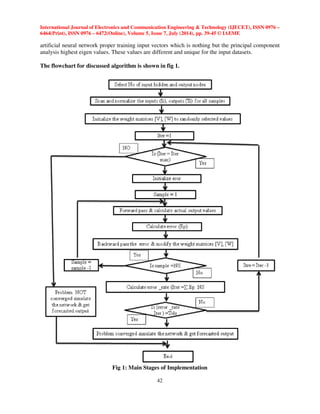
artificial neural network proper training input vectors which is nothing but the principal component 
analysis highest eigen values. These values are different and unique for the input datasets. 
The flowchart for discussed algorithm is shown in fig 1. 
42 
 
Fig 1: Main Stages of Implementation
International Journal of Electronics and Communication Engineering  Technology (IJECET), ISSN 0976 – 
6464(Print), ISSN 0976 – 6472(Online), Volume 5, Issue 7, July (2014), pp. 39-45 © IAEME 
 
The algorithm for implementation of the work is as follows: 
 − × 
43 
 
1. Image acquisition from digital camera or web camera of high resolution. 
2. Pre-processing of the acquired image by image enhancement algorithms. 
3. Image resize into 100x100 common resolutions for uniformity. 
4. Wavelet decomposition using haar wavelet function. 
5. Wavelet energy detection and get parameters like approximate coefficient, horizontal 
coefficient, vertical coefficient and diagonal coefficients. 
4. SIMULATION RESULT 
Finally, we compare the wavelet-based image compression with the DCT-based image 
compression while the compression ratio is similar. In the figures followed, the left column is DCT-based 
images, and the right column is Wavelet-based images. Both of them use larger and larger 
quantization step-size to generate higher and higher compression ratio, and we observe the difference 
of the two compression method. 
I1: Original image with width W and height H 
C: Encoded jpeg stream from I1 
I2: Decoded image from C 
CR (Compression Ratio) = sizeof(I1) / sizeof(C) 
RMS (Root mean square error) = [ ]2 
1 2 
1 1 
( , ) ( , ) /( ) 
H W 
y x 
I x y I x y H W 
= = 
In this study we have touched the topic of performance evaluation of three feature extraction 
techniques which is given to the artificial neural network for recognition of nut and bolt. We noticed 
that it becomes more and more urgent to correctly and appropriately evaluate computer vision 
algorithm performance. Therefore a generic evaluation system must be constructed for bench 
marking.
International Journal of Electronics and Communication Engineering  Technology (IJECET), ISSN 0976 – 
6464(Print), ISSN 0976 – 6472(Online), Volume 5, Issue 7, July (2014), pp. 39-45 © IAEME 
 
44 
 
Fig. 2: Simulation result on MATLAB 7.10. A. Running window of MATLAB 7.10, B. Selected 
spare part input, C. Graphical simulation output of selected input, D. Name of selected input 
5. CONCLUSIONS 
The wavelet transform decomposition analysis is the simple yet powerful descriptors of 
object detection. We tested on the basis of theoretical concepts that this descriptor can be used to 
approximate the spatial location of a sparse foreground hidden in a spectrally sparse background, 
which is also continuous in nature. Provided experimental data to show that the approximate 
foreground location highlighted by wavelet energy was perfectly notable, predicting them better than 
other algorithm at a very high speed and accuracy. The result is then when given to the artificial 
neural network the result accuracy is very high compared to some traditional methods. 
REFERENCES 
[1] Akbar H. and Prabuwono A. S., The design and development of automated visual inspection 
system for press part sorting, in Proc. International Conference on Computer Science and 
Information Technology (ICCSIT'08), 2008, pp. 683-686. 
[2] Akbar H. and Prabuwono A. S., Webcam based system for press part industrial inspection, 
International Journal of Computer Science and Network Security, Oct. 2008, vol. 8, 
pp. 170-177.
International Journal of Electronics and Communication Engineering  Technology (IJECET), ISSN 0976 – 
6464(Print), ISSN 0976 – 6472(Online), Volume 5, Issue 7, July (2014), pp. 39-45 © IAEME 
 
45 
 
[3] Akbar H., Prabuwono A. S., Izzah Z., and Tahir Z., Image processing algorithm in machine 
vision approach for industrial inspection, in Proc. the 1st Makassar International 
Conference on Electrical Engineering and Informatics (MICEEI'08), 2008, pp. 58-62. 
[4] Akbar H. and Prabuwono A. S., Automated visual inspection (AVI) research for quality 
control in metal stamping manufacturing, in Proc. the 4th International Conference on 
Information Technology and Multimedia (ICIMU'08), 2008, pp. 626-630. 
[5] Dewanto S., Suwandi, T. and Yanto, E., Sistem sortir mur dan baut menggunakan jaringan 
syaraf tiruan, Jurnal Teknik Komputer, 2005, vol. 13, no. 1, pp. 1-13. 
[6] Kyaw M.M., Ahmed S. K., and Md Sharrif Z. A., Shape-based sorting of agricultural 
product using support vector machines in a MATLAB/SIMULINK environment, in Proc. 
5th International Colloquium on Signal Processing  Its Applictions (CSPA'09), 2009, pp. 
135-139. 
[7] Zhao Z., Xin H., Ren Y., and Guo X., Application and comparison of BP neural network 
algorithm in MATLAB, in Proc. International Conference on Measuring Technology and 
Mechantronic Automation, 2010, pp. 590-593. 
[8] Lahajnar F., Bernard R., Pernus F., and Kovacic S., Machine vision system for inspecting 
electric plates, Computers in Industry, vol. 47, no. 1, pp. 113-122, Jan. 2001. 
[9] B. Green, J. Choi, Assessing the Risk of Management Fraud through Neural Network 
Technology. Auditing: A Journal of Practice and Theory 1997, vol. 16(1) pp 14- 28. 
[10] Nooritawati M. T., Aini H., Salina A. S., and Hafizah H., Pengecaman insan berasaskan 
kaedah profil sentroid dan pengelas rangkaian neural buatan, Jurnal Teknologi Universiti 
Teknologi Malaysia, pp. 69-79, Sep. 2010. 
[11] Prabuwono A. S. and Akbar H., PC based weight scale system with load cell for product 
inspection, in Proc. International Conference on Computer Engineering and Technology 
(ICCET'09), 2009, pp. 343-346. 
[12] Prabuwono A. S., Sulaiman R., Hamdan A. R., and Hasniaty A., Development of intelligent 
visual inspection system (IVIS) for bottling machine, in Proc. IEEE Region 10 Conference 
of TENCON, 2006, pp. 1-4. 
[13] Ambarish Salodkar, M.M.Khanapurkar. “Recognition of Bolt and Nut using Stationary 
Wavelet Transform”, International Conference on Emerging Frontiers in Technology for 
Rural Area (EFITRA) 2012 Proceedings published in International Journal of Computer 
Applications (IJCA). 
[14] M. Beneish, Detecting GAAP Violation: Implications for Assessing Earnings Management 
Among Firms with Extreme Financial Performance. Journal of Accounting and Public Policy, 
1997, 16 pp 271-309. 
[15] A.S. Prabuwono, Y. Away, and A.R. Hamdan, Design and Development of Intelligent Vision 
System for Quality Control in Bottling Production Line, Proceeding of FTSM UKM 
Postgraduate Seminar, 2004, pp. 138-141. 
[16] L.N. Wayne, The Automated Inspection of Moving Webs using Machine Vision, IEE 
Colloquium in Application of Machine Vision, 1995, pp. 3/1-3/8. 
[17] J. Lin, M. Hwang, J. Becker, A Fuzzy Neural Network for Assessing the Risk of Fraudulent 
Financial Reporting. Managerial Auditing Journal 2003 vol. 18(8) pp 657-665. 
[18] T.Bell, J. Carcello, A Decision Aid for Assessing the Likelihood of Fraudulent Financial 
Reporting. Auditing: A Journal of Practice and Theory 2000, vol. 10(1) pp 271-309. 
[19] K. Fanning, K. Cogger, R. Srivastava, Detection of Management Fraud: A Neural Network 
Approach. Journal of Intelligent Systems in Accounting, Finance and Management 1995, 4, 
pp 113-126. 
[20] S. Summers, J. Sweeney, Fraudulently Misstated Financial Statements and Insider Trading: 
An Empirical Analysis, The Accounting Review, 1998, pp 131-146.

40120140507006

  • 1.
    INTERNATIONAL JOURNAL OFELECTRONICS AND International Journal of Electronics and Communication Engineering & Technology (IJECET), ISSN 0976 – 6464(Print), ISSN 0976 – 6472(Online), Volume 5, Issue 7, July (2014), pp. 39-45 © IAEME COMMUNICATION ENGINEERING TECHNOLOGY (IJECET) ISSN 0976 – 6464(Print) ISSN 0976 – 6472(Online) Volume 5, Issue 7, July (2014), pp. 39-45 © IAEME: http://www.iaeme.com/IJECET.asp Journal Impact Factor (2014): 7.2836 (Calculated by GISI) www.jifactor.com 39 IJECET © I A E M E MECHANICAL SPARE PART INSPECTION USING ARTIFICIAL NEURAL NETWORK Sweety H Meshram*†, Vinay Keswani*, Nilesh Bodne* *Department of Electronic and Communication, Vidharbha Institute of Technology, RTMNU Nagpur †Corresponding author ABSTRACT Artificial Neural Network (ANN) is a fast-growing method which has been used in different industries during recent years. The main idea for creating ANN which is a subset of artificial intelligence is to provide a simple model of human brain in order to solve complex scientific and industrial problems. ANNs are high-value and low-cost tools in modelling, simulation, control, condition monitoring, sensor validation and fault diagnosis of different systems. It have high flexibility and robustness in modeling, simulating and diagnosing the behavior of rotating machines even in the presence of inaccurate input data. They can provide high computational speed for complicated tasks that require rapid response such as real-time processing of several simultaneous signals. ANNs can also be used to improve efficiency and productivity of energy in rotating equipment. In the present study develop an efficient system for sorting out various machine components in order to attain very high efficiency. Feature extraction tools are used for feature extraction of the input object. Artificial neural network the popular artificial intelligence technique is used for recognising the wavelet component object. There is also a special error function for increasing the efficiency of the system. Matlab 7.10 is used for the simulation of the object. Keywords: Digital Signature, MATLAB 7.10, Recognition, Wavelet Transform, Artificial Neural Network. 1. INTRODUCTION There are things at which humans are still way ahead of the machines in terms of efficiency one of such thing is the recognition especially pattern recognition. There are several methods which are tested for giving the machines the intelligence in a efficient way for pattern recognition purpose.
  • 2.
    International Journal ofElectronics and Communication Engineering Technology (IJECET), ISSN 0976 – 6464(Print), ISSN 0976 – 6472(Online), Volume 5, Issue 7, July (2014), pp. 39-45 © IAEME The artificial neural network is one of the most optimization techniques used for training the networks for efficient recognition. 40 The machine is made by integration of many parts to extract information from an image in order to solve some task. As a scientific discipline, computer vision is concerned with the theory behind artificial systems that extract information from images. Recognition is the classical problem in computer vision, image processing, and machine vision. It is related to the determination of whether or not the image data contains some specific object, feature, or activity. This task can normally be solved robustly and without effort by a human, but is still not satisfactorily solved in computer vision for the general case, involving arbitrary objects in arbitrary situations. The existing methods for dealing with this problem can at best solve it only for specific objects, such as simple geometric objects, human faces, printed or handwritten characters, or vehicles, and in specific situations, typically described in terms of well-defined illumination, background, and pose of the object relative to the camera. Protective relaying is applied to components of a mechanical sorting for the following reasons: a) Separate the faulted equipment from the remainder of the system so that they can continue to function. b) Limit damage to the faulted equipment. c) Minimize the possibility of fire. d) Minimize hazards to personnel. e) Minimize the risk of damage to adjacent high-voltage apparatus. Sort recognitions are the most important components in a system. Avoiding damage to component is vital; otherwise continuity in power delivery may be seriously disrupted. However, since the cost of repairing faulty machine may be great and since high-speed, highly sensitive protective devices can reduce damage and thereby repair cost, relays should be considered for protecting machines also, particularly in the larger sizes. Faults internal to machines quite often involve a magnitude of fault current that is low relative to the transformer base rating. This indicates a need for high sensitivity and high speed to ensure good protection. The plan selected should balance the best combination of these factors against the overall economics of the situation while holding to a minimum. a) Cost of repairing damage b) Cost of lost production c) Adverse effects on the balance of the system d) The spread of damage to adjacent equipment e) The period of unavailability of the damaged equipment Differential protective relay has been used as the primary protection of most machines for many years. Inrush can be generated when a transformer is switched on the transmission line or an external line fault is cleared. Similarly Over-excitation and CT saturation conditions may produce differential currents. This may result in mal-operation of differential protection if blocking scheme is unavailable. Therefore, to distinguish between fault current and other operating conditions is the key to improve the security of the differential protection. 2. LITERATURE REVIEW The present study based on implementation of artificial neural network for sorting out automobile parts using MATLAB 7.10 software. Internal fraud detection is concerned with
  • 3.
    International Journal ofElectronics and Communication Engineering Technology (IJECET), ISSN 0976 – 6464(Print), ISSN 0976 – 6472(Online), Volume 5, Issue 7, July (2014), pp. 39-45 © IAEME determining fraudulent financial reporting by management [17, 18, 19, 20, 14, 9]. The optimization algorithm has less iteration than implementation with Artificial Neural Network process for the same task and other improved algorithms while the convergence rate is faster and the precision is higher [7]. Curve figures in terms of perimeter radius are used as feature extraction [6, 10, 12] for recognizing objects. This method is more suitable for real time recognition systems compared with previous research [5], because we can get better iteration time, speed of belt conveyor and accuracy, the idea of combining different modules has been studied in the ANN field and statistics [2, 3], few attempts have been made in evolutionary learning to use population information in forming the final system. Recognition is the classical problem in computer vision, image processing, and machine vision. It is related to the B. Green, J. Choi, Assessing the Risk of Management Fraud through Neural Network Technology. Auditing: A Journal of Practice and Theory 1997, vol. 16(1) pp14- 28. 41 Determination of whether or not the image data contains some specific object, feature, or activity. This task can normally be solved robustly and without effort by a human, but is still not satisfactorily solved in computer vision for the general case, involving arbitrary objects in arbitrary situations. The existing methods for dealing with this problem can at best solve it only for specific objects, such as simple geometric objects, human faces, printed or handwritten characters, or vehicles, and in specific situations, typically described in terms of well-defined illumination, background, and pose of the object relative to the camera [1–6, 8, 11]. In this paper, we use the MATLAB and implement the wavelet transform analysis and artificial neural network for image processing and detection [13]. The optimization algorithm has less iteration than implementation with Artificial Neural Network process for the same task and other improved algorithms while the convergence rate is faster and the precision is higher [7]. Curve figures in terms of perimeter radius are used as feature extraction [6, 10, 12] for recognizing objects. This method is efficient and more suitable for real time recognition systems compared with previous research [5, 7] because we can get better iteration time, speed of belt conveyor and accuracy. 3. METHODOLOGY A software framework is designed using the MATLAB which is more suited for the image processing application due to its basic matrices. The process start with image acquisition where image will be capture using the high resolution camera, follow by pre-processing of the images captured to reduce the image for its unified size [15]. Images are then converted to gray scale and double precision image for the analyzing process. After the images have been pre-processed, the WAVELET TRANSFORM is determined. Lastly according to the parameter of WT, the status of a TRAINING process can be determined by using neural network and action can be taken to follow up this result. 3.1 Configuration database This configuration is used for configuring the information such as image size and image resolution. In this case, image size is fixed i.e. 100 x 100 pixels, and the image input format is in gray scale. 3.2. Image processing feature extraction Image processing feature extraction consists of wavelet transform methodology for getting the unique feature vector. 3.3. Artificial neural network Artificial neural network is the soft computing optimisation technique which is used to give the train result in a efficient way depending on the training set of data. So, it is essential to give
  • 4.
    International Journal ofElectronics and Communication Engineering Technology (IJECET), ISSN 0976 – 6464(Print), ISSN 0976 – 6472(Online), Volume 5, Issue 7, July (2014), pp. 39-45 © IAEME artificial neural network proper training input vectors which is nothing but the principal component analysis highest eigen values. These values are different and unique for the input datasets. The flowchart for discussed algorithm is shown in fig 1. 42 Fig 1: Main Stages of Implementation
  • 5.
    International Journal ofElectronics and Communication Engineering Technology (IJECET), ISSN 0976 – 6464(Print), ISSN 0976 – 6472(Online), Volume 5, Issue 7, July (2014), pp. 39-45 © IAEME The algorithm for implementation of the work is as follows: − × 43 1. Image acquisition from digital camera or web camera of high resolution. 2. Pre-processing of the acquired image by image enhancement algorithms. 3. Image resize into 100x100 common resolutions for uniformity. 4. Wavelet decomposition using haar wavelet function. 5. Wavelet energy detection and get parameters like approximate coefficient, horizontal coefficient, vertical coefficient and diagonal coefficients. 4. SIMULATION RESULT Finally, we compare the wavelet-based image compression with the DCT-based image compression while the compression ratio is similar. In the figures followed, the left column is DCT-based images, and the right column is Wavelet-based images. Both of them use larger and larger quantization step-size to generate higher and higher compression ratio, and we observe the difference of the two compression method. I1: Original image with width W and height H C: Encoded jpeg stream from I1 I2: Decoded image from C CR (Compression Ratio) = sizeof(I1) / sizeof(C) RMS (Root mean square error) = [ ]2 1 2 1 1 ( , ) ( , ) /( ) H W y x I x y I x y H W = = In this study we have touched the topic of performance evaluation of three feature extraction techniques which is given to the artificial neural network for recognition of nut and bolt. We noticed that it becomes more and more urgent to correctly and appropriately evaluate computer vision algorithm performance. Therefore a generic evaluation system must be constructed for bench marking.
  • 6.
    International Journal ofElectronics and Communication Engineering Technology (IJECET), ISSN 0976 – 6464(Print), ISSN 0976 – 6472(Online), Volume 5, Issue 7, July (2014), pp. 39-45 © IAEME 44 Fig. 2: Simulation result on MATLAB 7.10. A. Running window of MATLAB 7.10, B. Selected spare part input, C. Graphical simulation output of selected input, D. Name of selected input 5. CONCLUSIONS The wavelet transform decomposition analysis is the simple yet powerful descriptors of object detection. We tested on the basis of theoretical concepts that this descriptor can be used to approximate the spatial location of a sparse foreground hidden in a spectrally sparse background, which is also continuous in nature. Provided experimental data to show that the approximate foreground location highlighted by wavelet energy was perfectly notable, predicting them better than other algorithm at a very high speed and accuracy. The result is then when given to the artificial neural network the result accuracy is very high compared to some traditional methods. REFERENCES [1] Akbar H. and Prabuwono A. S., The design and development of automated visual inspection system for press part sorting, in Proc. International Conference on Computer Science and Information Technology (ICCSIT'08), 2008, pp. 683-686. [2] Akbar H. and Prabuwono A. S., Webcam based system for press part industrial inspection, International Journal of Computer Science and Network Security, Oct. 2008, vol. 8, pp. 170-177.
  • 7.
    International Journal ofElectronics and Communication Engineering Technology (IJECET), ISSN 0976 – 6464(Print), ISSN 0976 – 6472(Online), Volume 5, Issue 7, July (2014), pp. 39-45 © IAEME 45 [3] Akbar H., Prabuwono A. S., Izzah Z., and Tahir Z., Image processing algorithm in machine vision approach for industrial inspection, in Proc. the 1st Makassar International Conference on Electrical Engineering and Informatics (MICEEI'08), 2008, pp. 58-62. [4] Akbar H. and Prabuwono A. S., Automated visual inspection (AVI) research for quality control in metal stamping manufacturing, in Proc. the 4th International Conference on Information Technology and Multimedia (ICIMU'08), 2008, pp. 626-630. [5] Dewanto S., Suwandi, T. and Yanto, E., Sistem sortir mur dan baut menggunakan jaringan syaraf tiruan, Jurnal Teknik Komputer, 2005, vol. 13, no. 1, pp. 1-13. [6] Kyaw M.M., Ahmed S. K., and Md Sharrif Z. A., Shape-based sorting of agricultural product using support vector machines in a MATLAB/SIMULINK environment, in Proc. 5th International Colloquium on Signal Processing Its Applictions (CSPA'09), 2009, pp. 135-139. [7] Zhao Z., Xin H., Ren Y., and Guo X., Application and comparison of BP neural network algorithm in MATLAB, in Proc. International Conference on Measuring Technology and Mechantronic Automation, 2010, pp. 590-593. [8] Lahajnar F., Bernard R., Pernus F., and Kovacic S., Machine vision system for inspecting electric plates, Computers in Industry, vol. 47, no. 1, pp. 113-122, Jan. 2001. [9] B. Green, J. Choi, Assessing the Risk of Management Fraud through Neural Network Technology. Auditing: A Journal of Practice and Theory 1997, vol. 16(1) pp 14- 28. [10] Nooritawati M. T., Aini H., Salina A. S., and Hafizah H., Pengecaman insan berasaskan kaedah profil sentroid dan pengelas rangkaian neural buatan, Jurnal Teknologi Universiti Teknologi Malaysia, pp. 69-79, Sep. 2010. [11] Prabuwono A. S. and Akbar H., PC based weight scale system with load cell for product inspection, in Proc. International Conference on Computer Engineering and Technology (ICCET'09), 2009, pp. 343-346. [12] Prabuwono A. S., Sulaiman R., Hamdan A. R., and Hasniaty A., Development of intelligent visual inspection system (IVIS) for bottling machine, in Proc. IEEE Region 10 Conference of TENCON, 2006, pp. 1-4. [13] Ambarish Salodkar, M.M.Khanapurkar. “Recognition of Bolt and Nut using Stationary Wavelet Transform”, International Conference on Emerging Frontiers in Technology for Rural Area (EFITRA) 2012 Proceedings published in International Journal of Computer Applications (IJCA). [14] M. Beneish, Detecting GAAP Violation: Implications for Assessing Earnings Management Among Firms with Extreme Financial Performance. Journal of Accounting and Public Policy, 1997, 16 pp 271-309. [15] A.S. Prabuwono, Y. Away, and A.R. Hamdan, Design and Development of Intelligent Vision System for Quality Control in Bottling Production Line, Proceeding of FTSM UKM Postgraduate Seminar, 2004, pp. 138-141. [16] L.N. Wayne, The Automated Inspection of Moving Webs using Machine Vision, IEE Colloquium in Application of Machine Vision, 1995, pp. 3/1-3/8. [17] J. Lin, M. Hwang, J. Becker, A Fuzzy Neural Network for Assessing the Risk of Fraudulent Financial Reporting. Managerial Auditing Journal 2003 vol. 18(8) pp 657-665. [18] T.Bell, J. Carcello, A Decision Aid for Assessing the Likelihood of Fraudulent Financial Reporting. Auditing: A Journal of Practice and Theory 2000, vol. 10(1) pp 271-309. [19] K. Fanning, K. Cogger, R. Srivastava, Detection of Management Fraud: A Neural Network Approach. Journal of Intelligent Systems in Accounting, Finance and Management 1995, 4, pp 113-126. [20] S. Summers, J. Sweeney, Fraudulently Misstated Financial Statements and Insider Trading: An Empirical Analysis, The Accounting Review, 1998, pp 131-146.